
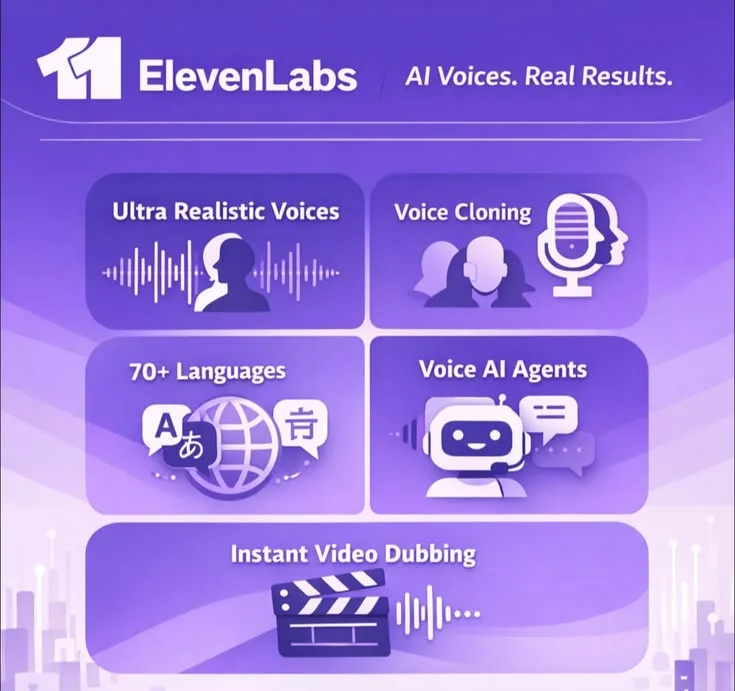
Daniel runs a small media production company that creates educational content for corporate clients. In 2023, his company began using ElevenLabs after a demo convinced his team that AI narration had reached the quality threshold required for professional training videos.
The demo was accurate: the voices were remarkable. A client who watched a finished video and did not know it was AI-narrated described the narrator as "very clear and professional." The quality threshold had been cleared.
The problems arrived later. A client's legal team reviewed the production agreement and asked for documentation of the voice licensing. Daniel discovered that his Starter plan at $5/month included commercial use rights but did not include access to the highest-quality voice models, which were on the Creator plan at $22/month.
Fine. He upgraded. Then a second client asked whether the voice used in their training video could be used again in a future series - they wanted brand consistency.
Voice cloning required a Professional plan at $99/month, which was meaningful overhead for a small production company running five to eight projects per month of varying size. Then one of the generated audio files had a subtle artifact in the middle of a paragraph that sounded like the voice had momentarily shifted registers.
The client noticed it. Re-generating that paragraph cost additional characters and, more importantly, time explaining what had happened.
None of these experiences made ElevenLabs a bad product. They were the ordinary friction points of integrating any new production technology. But they prompted a systematic evaluation of the alternatives, which had also improved significantly in the two years since the original adoption.
"ElevenLabs set the quality standard for AI voice. The market has spent two years chasing it, and the gap is now smaller than most creators realize."
Why People Look for ElevenLabs Alternatives
ElevenLabs is the quality leader in AI voice synthesis, and that position is well-earned. The expressiveness, naturalness, and emotional range of its top-tier voices are the reference point the industry uses to evaluate competitors. But being the quality leader does not make a tool the right tool for every use case.
Pricing scales with quality and usage. The $5/month Starter plan provides 30,000 characters per month (roughly 20-25 minutes of audio) with commercial rights and access to the pre-built voice library. The $22/month Creator plan provides 100,000 characters with access to the higher-quality models.
The $99/month Professional plan provides 500,000 characters with professional voice cloning and priority rendering. For high-volume production, the per-character cost at the Professional tier is not competitive with API-based tools like Amazon Polly or Google Cloud TTS.
Voice cloning raises ethical and legal questions. The ability to clone any voice from a short audio sample is technically powerful and ethically complex.
ElevenLabs requires consent confirmation, but the technology's availability at consumer price points creates risk for producers who need clear documentation of voice sourcing for commercial content.
Organizations with legal review requirements over their content production find that the provenance of AI-generated voices requires more careful documentation than the tool's onboarding implies.
API rate limits affect production workflows. High-volume generation - long-form audiobooks, large-scale content localization, real-time voice synthesis for interactive applications - can run into rate limits at standard plan tiers.
Enterprise customers with consistent high-volume needs often find that purpose-built API solutions like Amazon Polly provide more predictable throughput guarantees.
Quality is sufficient at lower tiers for many use cases. ElevenLabs is the best when quality is the primary criterion. When quality is sufficient rather than maximum, the alternatives offer comparable output at lower cost, which changes the value equation.
Murf.ai
Murf.ai is a studio-quality AI voice platform with 120+ voices across 20+ languages, purpose-built for professional content creation with a browser-based studio interface.
Features: 120+ AI voices in 20+ languages, voice parameter controls (speed, pitch, pronunciation), emphasis marking within text for natural delivery, background music and sound effects library, video syncing for creating voiceovers timed to video timelines.
Also included: collaboration workspace for team projects, custom pronunciation dictionary, voice cloning on higher plans, API for developer integration, commercial use on all paid plans.
Pricing: Free: 10 minutes, no commercial use. Basic $19/month: 60 minutes, commercial use, 60 voices. Pro $26/month: 180 minutes, all voices, collaboration. Enterprise $99/month: unlimited minutes, custom voice cloning.
Pros vs ElevenLabs: The studio interface is more polished for non-technical content creators - video sync, background music, emphasis markers, and team collaboration are all built in. The 120+ voice library is extensive. Per-minute pricing at lower tiers is straightforward to predict.
Cons vs ElevenLabs: Voice expressiveness and naturalness are slightly below ElevenLabs' top models on careful listening. The free plan does not allow commercial use. Monthly minute limits constrain high-volume production.
Best for: Content creators, marketing teams, and instructional designers who want a complete voiceover production environment with studio tools, not just audio synthesis.
Play.ht
Play.ht is an ultra-realistic AI voice platform with a focus on podcast-style narration and voice cloning, used by content creators for long-form audio production.
Features: Ultra-realistic voices trained on diverse speaker characteristics, voice cloning from a short audio sample, multi-voice conversations (dialogues between two voices in one audio file), emotional control with anger, happiness, sadness, and other emotion parameters.
Also included: podcast publishing integration for creating AI-narrated episodes, API access, 100+ languages, real-time voice generation, custom pronunciation dictionary, commercial licensing on paid plans.
Pricing: Creator $31.20/month: 500,000 words/month, voice cloning, commercial use. Unlimited $99/month: unlimited words, priority generation. Enterprise: custom.
Pros vs ElevenLabs: The ultra-realistic voices on paid plans are competitive with ElevenLabs on quality benchmarks. Multi-voice dialogues in a single generation are not available in ElevenLabs at lower tiers. The podcast integration workflow is practical for audio content creators.
Cons vs ElevenLabs: The pricing starts higher than ElevenLabs' Starter plan for equivalent capability. The interface is less intuitive than Murf.ai's studio environment for non-technical users.
Best for: Podcast producers and audio content creators who want ultra-realistic narration for long-form content and are comfortable with a technical interface.
Speechify
Speechify is a text-to-speech tool with an accessibility focus, designed primarily for consuming written content as audio rather than producing content for an audience.
Features: High-speed text-to-speech for reading documents, articles, PDFs, and ebooks faster than normal reading speed, Chrome extension for reading web pages aloud, iOS and Android apps.
Also included: AI voices including celebrity voice packs, offline listening, OCR for photographed text, dyslexia-friendly features, focus mode, word tracking synchronized with audio playback.
Pricing: Free: limited speed, basic voices. Premium $139/year (approximately $11.58/month): high-speed reading, AI voices, unlimited use.
Pros vs ElevenLabs: The best-in-class tool for consuming written content as audio - if the goal is reading rather than production, Speechify's interface and speed controls are purpose-built for the use case. The Chrome extension and mobile app cover the consumption contexts ElevenLabs does not address.
Cons vs ElevenLabs: Not a content production tool - Speechify is for personal listening, not for creating audio files for distribution to an audience. The output is not designed for broadcast quality.
Best for: Individuals who want to consume written content as audio for productivity or accessibility reasons, not for creators producing audio content for others.
Amazon Polly
Amazon Polly is Amazon Web Services' managed text-to-speech service, providing access to 60+ voices in 30+ languages through a reliable, enterprise-grade API.
Features: 60+ voices including Neural Text-to-Speech (NTTS) voices that are more natural than standard voices, SSML support for fine-grained control over pronunciation, emphasis, pauses, and speaking rate, 30+ languages.
Also included: speech marks for word-level timestamp data useful for lip sync and subtitle alignment, real-time streaming synthesis for interactive applications, Lexicon support for custom pronunciation of domain-specific terms, AWS CloudFront integration for low-latency global delivery of synthesized speech.
Pricing: Free tier: 5 million characters per month for first 12 months. Standard voices: $4/million characters. Neural voices: $16/million characters. No subscription required.
Pros vs ElevenLabs: Enterprise-grade reliability with AWS SLA guarantees. Per-character pricing is dramatically cheaper at scale than ElevenLabs' subscription tiers. SSML support provides programmatic control that ElevenLabs does not offer at equivalent price points. Deep AWS ecosystem integration for production applications.
Cons vs ElevenLabs: Neural voices are notably less expressive and natural than ElevenLabs' premium voices. No voice cloning or custom voice creation. API-first with no studio interface for non-technical users. Not suitable for content where voice quality is a primary differentiator.
Best for: Developers building applications that need reliable, scalable, affordable text-to-speech - notifications, e-learning platforms, accessibility features, IVR systems, and any high-volume use case where cost per character matters.
Google Cloud TTS
Google Cloud Text-to-Speech provides access to Google's WaveNet and Neural2 voice models with a broad language library and deep integration with Google Cloud services.
Features: WaveNet voices built on DeepMind's speech synthesis technology, Neural2 voices with improved naturalness, Studio voices for the highest quality narration, 40+ languages and 220+ voices.
Also included: SSML support for detailed pronunciation control, audio profiles for target playback devices (phone telephony, media audio, etc.), real-time streaming synthesis, integration with Google Cloud AI services.
Pricing: Free tier: 1 million characters/month for standard voices, 1 million characters/month for WaveNet voices. Standard voices: $4/million characters. WaveNet voices: $16/million characters. Studio voices: $160/million characters.
Pros vs ElevenLabs: WaveNet and Neural2 voices are among the most natural AI voices from a major cloud provider. Free tier is generous for testing and low-volume production. Google Cloud ecosystem integration for applications on GCP.
The Studio voice tier at $160/million characters is higher quality than standard API voices, though still below ElevenLabs' top tier.
Cons vs ElevenLabs: WaveNet voices are notably less expressive than ElevenLabs for emotional or narrative content. Studio voices at $160/million characters close the quality gap but at significant cost premium. No voice cloning. API-first with no studio interface.
Best for: Developers on Google Cloud building TTS into applications, and organizations that need multilingual voice synthesis across a broad language library with reliable infrastructure.
OpenAI TTS
OpenAI's text-to-speech API provides six high-quality voices at low cost, making it the simplest integration for developers already using the OpenAI platform.
Features: Six voices (alloy, echo, fable, onyx, nova, shimmer) each with distinct character and tone, standard and HD quality options, MP3, Opus, AAC, and FLAC output formats, streaming synthesis for real-time applications, character input with standard API authentication, integration with the OpenAI API ecosystem.
Pricing: Standard quality: $15/million characters. HD quality: $30/million characters.
Pros vs ElevenLabs: The simplest API integration for developers already using OpenAI. No subscription or monthly commitment. Voice quality on the six voices is high relative to price. The HD option provides noticeably better quality for production audio.
Cons vs ElevenLabs: Only six voices with no library browsing or audition. No voice cloning or custom voices. No SSML support for fine-grained control. No studio interface for non-technical users. Limited language support compared to Polly or Google Cloud TTS.
Best for: Developers building applications that use OpenAI's API for other features (completions, embeddings, moderation) and want to add TTS without managing a separate service relationship.
Resemble AI
Resemble AI is a professional voice cloning and synthesis platform with real-time capabilities, designed for interactive applications, gaming, and enterprise content production.
Features: High-quality voice cloning from a minimum audio sample, real-time voice synthesis (under 500ms latency) for interactive applications, localization synthesis for dubbing content into other languages in a cloned voice, emotion and style transfer.
Also included: noise cancellation for cleaning source audio before cloning, API with webhooks and streaming, managed voice library for enterprise clients protecting voice assets, voice moderation for detecting synthesized speech, integration with game engines and interactive media platforms.
Pricing: Pay-per-use at $0.006/character. Professional $29/month: 50,000 characters, voice cloning, API. Enterprise: custom volume pricing and managed voices.
Pros vs ElevenLabs: Real-time synthesis under 500ms is essential for interactive voice applications that ElevenLabs does not support at equivalent price points. The enterprise managed voice library with access controls is appropriate for corporate content production.
Localization for dubbing content in multiple languages using the same cloned voice is a distinct capability.
Cons vs ElevenLabs: Lower brand recognition and smaller pre-built voice library than ElevenLabs. The interface is more developer-oriented than studio-oriented. Best used through the API rather than a consumer-facing editor.
Best for: Game developers, interactive application developers, and enterprise content teams that need real-time voice synthesis, programmatic voice management, or multilingual content localization.
Coqui TTS
Coqui TTS is an open-source text-to-speech library with multiple model types including XTTS for voice cloning, available for free local deployment.
Features: Multiple TTS model architectures including XTTS (cross-language voice cloning), YourTTS, and VITS, voice cloning from a short audio sample, multi-language synthesis in 16+ languages with XTTS.
Also included: local deployment on CPU or GPU hardware, Python API for integration into applications, fine-tuning capability for custom voice models, no usage limits on local deployment, no data sent to external servers.
Pricing: Free (open-source, MIT license).
Pros vs ElevenLabs: Zero cost with no usage limits. Voice cloning quality with the XTTS model is competitive with commercial tools on good source audio. Complete privacy - no audio data leaves local hardware. Self-hosted deployment is appropriate for sensitive content or regulated environments.
Cons vs ElevenLabs: Requires Python knowledge and GPU hardware for practical use at reasonable speed. No studio interface. Setup and maintenance effort is significant compared to hosted services. Support is community-based rather than commercial.
Best for: Developers, researchers, and technically proficient creators who want voice cloning and synthesis at zero cost with full control over the process, and organizations that cannot send audio data to external services.
LOVO AI
LOVO AI is an AI voiceover and dubbing platform with 500+ voices targeting video content creators and media localization workflows.
Features: 500+ voices in 100+ languages, AI dubbing for translating and re-voicing existing video content in other languages, script editor with voice preview, timeline editor for syncing voiceover to video.
Also included: AI art generation within the same platform, voice cloning on higher plans, API access, integration with video editing tools, commercial use on paid plans.
Pricing: Basic $32/month: 20 minutes/month, 500 voices. Pro $64/month: unlimited minutes, voice cloning, API. Enterprise $149/month: custom voices, SLA. Team pricing available.
Pros vs ElevenLabs: The 500+ voice library is one of the largest in the category. AI dubbing for translating videos into other languages while maintaining the speaker's voice character is a distinct capability. The integrated script and timeline editor is well-suited for video voiceover production.
Cons vs ElevenLabs: Voice naturalness per-voice is less consistent than ElevenLabs - with 500+ voices, quality varies more than in a smaller, more curated library. More expensive at comparable tiers than ElevenLabs for pure voice quality.
Best for: Video content creators, e-learning producers, and media localization teams who need voiceover production with video timeline integration and multilingual dubbing capabilities.
Replica Studios
Replica Studios is an AI voice platform for gaming and entertainment media, with professional voice actors who have specifically licensed their voices for AI cloning and commercial use.
Features: Voice library of professionally trained AI voice actors who have provided consent for commercial AI use, emotional range controls including fear, happiness, sadness, anger, and surprise parameters, voice performance direction within the platform.
Also included: game engine integrations for dynamic in-game dialogue generation, cinematic voice matching for maintaining character voice consistency across projects, API for interactive media applications.
Pricing: Indie $24/month: 30 minutes, 40 voices. Pro $100/month: 300 minutes, all voices, API. Studio $300/month: unlimited, custom voices, priority support.
Pros vs ElevenLabs: The consent and commercial licensing model is clearer than general voice cloning tools - every voice in the library has been specifically licensed for AI use by the voice actor. This provides better legal standing for commercial entertainment productions.
The emotional performance controls are designed for dramatic content in ways that general TTS tools are not.
Cons vs ElevenLabs: The voice library is smaller and less diverse than ElevenLabs. The entertainment and gaming focus means the voices and interface are not optimized for corporate narration, e-learning, or other content production use cases. More expensive than ElevenLabs at comparable tiers.
Best for: Game developers, animation studios, and interactive media producers who need emotionally expressive AI voices with clear commercial licensing and game engine integration.
Comparison Table
| Tool | Free Plan | Paid Plans | Best Feature | Biggest Limitation |
|---|---|---|---|---|
| ElevenLabs | 10,000 chars/month | $5-99/month | Voice quality, expressiveness | Cost at scale, cloning ethics |
| Murf.ai | 10 min, no commercial | $19-99/month | Studio interface, video sync | Below ElevenLabs on expressiveness |
| Play.ht | No | $31.20-99/month | Ultra-realistic, multi-voice | Higher starting price |
| Speechify | Limited | $139/year | Accessibility reading tool | Not a production tool |
| Amazon Polly | 5M chars first year | $4-16/million chars | Scale, reliability, SSML, AWS | Less expressive than ElevenLabs |
| Google Cloud TTS | 1M chars/month | $4-160/million chars | WaveNet quality, languages | Studio tier expensive |
| OpenAI TTS | No | $15-30/million chars | Simplest API integration | 6 voices only, no cloning |
| Resemble AI | No | $0.006/char or $29/month | Real-time synthesis, localization | Developer-oriented |
| Coqui TTS | Free (open-source) | Free | Zero cost, full privacy | Requires technical setup |
| LOVO AI | No | $32-149/month | 500+ voices, AI dubbing | Quality inconsistency |
| Replica Studios | No | $24-300/month | Gaming/entertainment, consent model | Niche audience, expensive |
Who Should Switch Away from ElevenLabs
Switch to Amazon Polly or Google Cloud TTS if you are generating large volumes of audio for applications where cost per character matters and the voices need to be professional but not emotionally expressive.
Notification systems, e-learning narration at scale, accessibility features, and IVR are all appropriate use cases for the lower-cost API providers.
Switch to Murf.ai if you need a studio environment with video sync, background music, and collaboration tools built in, and you produce content for presentation in a video format rather than as standalone audio.
Switch to Resemble AI if you are building an interactive application, game, or voice assistant where real-time synthesis latency is a requirement or where multilingual content dubbing in a cloned voice is the core use case.
Switch to Coqui TTS if you are a developer or researcher who wants voice cloning at zero cost and is comfortable with local model deployment, or if your use case involves sensitive content that cannot be sent to external servers.
Switch to Replica Studios if you are producing games or entertainment content and need emotionally expressive AI voices with unambiguous commercial licensing backed by actor consent.
Switch to OpenAI TTS if you are already using the OpenAI API and want to add TTS with minimal integration overhead, and the six available voices suit your needs.
Who Should Stay with ElevenLabs
ElevenLabs is the right choice when voice quality is the primary differentiator for your content.
For audiobook narration, premium podcast sponsorship reads, brand voice content that represents your company's identity, and any context where a listener's impression of the narrator directly affects their engagement with the content, ElevenLabs' expressiveness and naturalness justify the premium.
If you have tested a specific piece of content on ElevenLabs and a leading alternative side by side and could hear the difference, that perceptual quality gap is worth paying for. If you have not done that comparison, it is worth doing before committing to the higher-cost platform.
Related reading: Best Alternatives to Descript for Video Transcription and Editing in 2026 | Best AI Tools for Creators in 2026 | Best Podcast Tools in 2026