
Why Governance Matters, Even If You're Not a Shareholder
Corporate: Enron collapses (2001). Cause: Board failed to challenge executive fraud. Thousands lose jobs, retirement savings vanish.
Wells Fargo scandal (2016). Cause: Incentive structure encouraged fraud; board oversight absent. Millions of fake accounts opened.
Boeing 737 MAX crisis (2018-2019). Cause: Cost-cutting prioritized over safety; board failed to ensure engineering rigor. 346 people die.
Governance failures don't just harm shareholders: they destroy jobs, endanger customers, damage economies, and erode trust.
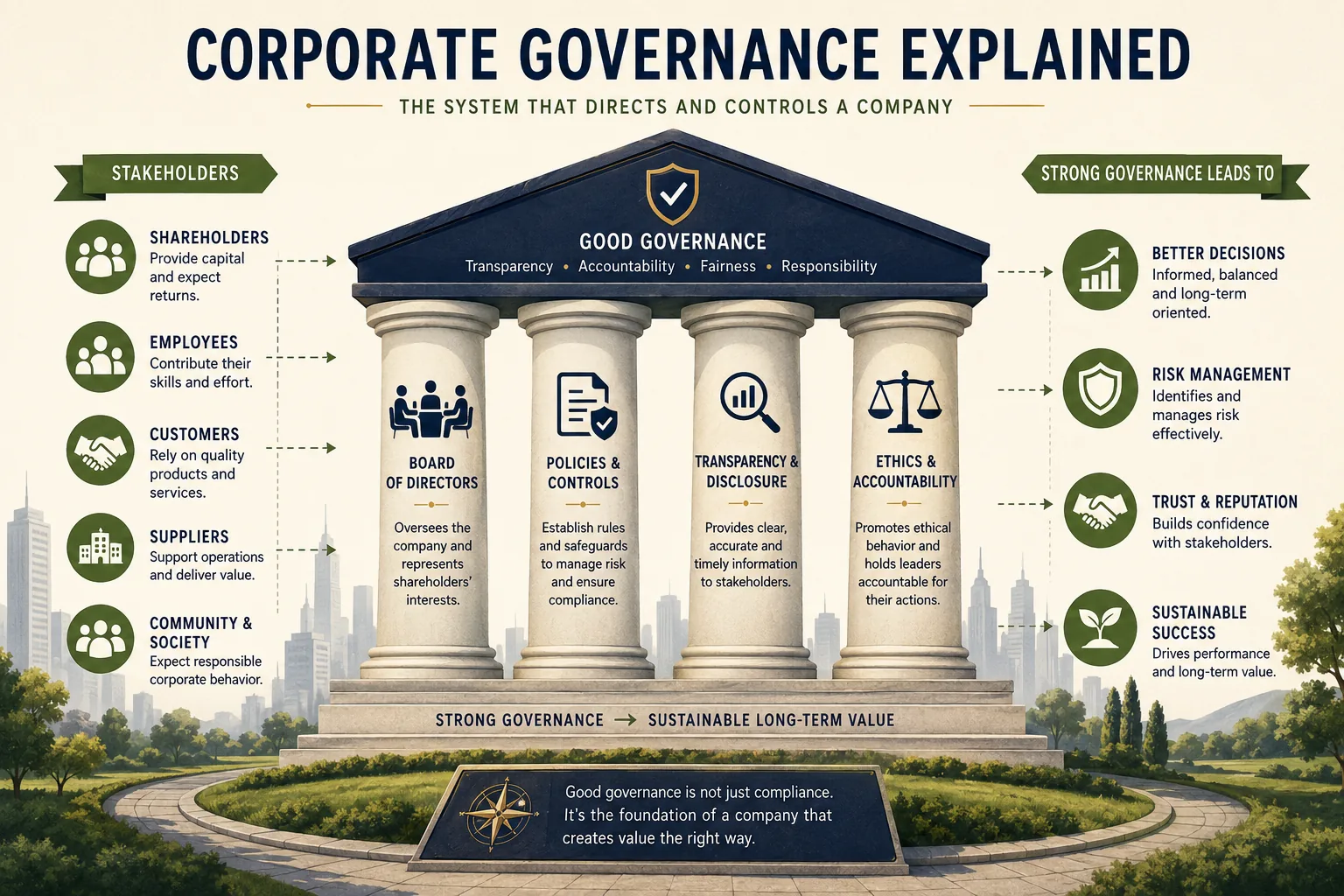
Corporate governance is the system that's supposed to prevent this. It's the architecture of accountability: who makes decisions, who oversees them, how power is checked, and how stakeholders' interests are protected.
As Adolf Berle and Gardiner Means observed in their landmark 1932 study, "The separation of ownership from control produces a condition where the interests of owner and of ultimate manager may, and often do, diverge." That divergence is precisely what governance is designed to manage.
Most people think corporate governance is:
- Boring procedural stuff for lawyers
- Only matters to shareholders
- Just "following the rules"
What corporate governance actually is:
- Power structure that determines who controls organizations
- Accountability system that prevents abuse
- Decision architecture that shapes organizational behavior
- Protection mechanism for employees, customers, communities, investors
Understanding governance helps you:
- Recognize warning signs of organizational dysfunction
- Evaluate whether institutions can be trusted
- Understand why scandals happen (usually governance failure)
- Design better accountability systems
This is the vocabulary of organizational power, oversight, and responsibility, essential for anyone working in, investing in, or affected by large organizations.
Core Governance Concepts
What Is Corporate Governance?
Definition: System of rules, practices, processes, and structures that direct and control a company, defining relationships and distributing rights and responsibilities among stakeholders.
Components:
- Structure: Who has authority and oversight (board, executives, shareholders)
- Processes: How decisions are made and reviewed
- Accountability: How performance is measured and failures addressed
- Transparency: What information is disclosed and to whom
- Stakeholder relations: How interests of shareholders, employees, customers, communities are balanced
Metaphor: Constitutional system for a company
- Constitution defines powers, limits, checks
- Governance defines who decides, who oversees, who's accountable
Not just compliance: Following laws is minimum. Good governance goes beyond: it's about sound decision-making, ethical culture, long-term thinking.
Why it matters: Governance determines whether organizations:
- Serve stakeholders or exploit them
- Make sound decisions or reckless ones
- Operate transparently or hide problems
- Self-correct or spiral into crisis
Example - Two companies, different governance:
Company A (strong governance):
- Independent board challenges management
- Whistleblower protections functional
- Risk management robust
- Transparent reporting
- Result: Problems caught early, corrected
Company B (weak governance):
- Board dominated by insiders
- Dissent discouraged
- Risk ignored or hidden
- Opaque reporting
- Result: Problems fester, explode into crisis
Application: When evaluating organization (as employee, investor, customer, citizen), ask: "How is power checked? Who ensures accountability?"
Key Governance Actors
Board of Directors
Definition: Group elected by shareholders to oversee management, set strategy, and protect stakeholder interests.
Primary responsibilities:
1. Oversight:
- Monitor management performance
- Ensure compliance with laws, regulations, policies
- Review financial reporting accuracy
- Assess and manage risk
2. Strategic direction:
- Set long-term strategy (with management input)
- Approve major decisions (acquisitions, capital allocation)
- Define mission, values, culture
3. Executive management:
- Hire, evaluate, compensate, and (if necessary) fire CEO
- Succession planning
- Set incentive structures
4. Accountability:
- Report to shareholders
- Ensure transparency
- Address conflicts of interest
5. Risk management:
- Identify major risks
- Ensure adequate controls
- Oversee crisis response
Board structure:
| Role | Function |
|---|---|
| Chair | Leads board, sets agenda, facilitates discussion |
| Independent directors | No material relationship with company (not employees, not tied to management) |
| Inside directors | Company executives (e.g., CEO) |
| Committees | Specialized groups (audit, compensation, nomination, risk) |
Board independence: Critical for oversight. Independent directors free to challenge management without personal conflicts.
"I've observed many boards over the years, and I can say with confidence that the most important quality in a director isn't expertise or connections, it's the willingness to ask the uncomfortable question." - Warren Buffett, Chairman and CEO of Berkshire Hathaway
Red flags for board dysfunction:
- CEO also serves as board chair (concentrates power)
- Few or no independent directors
- Directors with conflicts of interest (business relationships with company)
- Rubber-stamp approval (never questions management)
- Insufficient time commitment (directors overextended)
- Lack of relevant expertise
Example - Theranos board failure:
- High-profile directors (Kissinger, Mattis, Shultz), but no medical/scientific expertise
- Controlled by founder Elizabeth Holmes (dual-class voting)
- No audit committee with financial expertise
- Minimal oversight of scientific claims
- Result: Massive fraud went unchallenged; board added credibility without scrutiny
Application: Evaluate board quality by: independence, expertise, time commitment, track record, willingness to challenge management.
Management (Executive Team)
Definition: Executives responsible for day-to-day operations, implementing strategy, running the business.
Key distinction:
- Board governs (oversight, direction, accountability)
- Management operates (execution, operations, tactics)
CEO's dual role:
- Reports to board (accountable for performance)
- Runs company (leads management team)
- Tension: CEO has information advantage over board (asymmetry creates governance challenge)
Management responsibilities:
- Execute strategy set by board
- Manage operations
- Report accurately to board
- Implement risk controls
- Build and maintain organizational culture
- Deliver financial performance
Governance challenge: Management has power and information. Board must oversee without micromanaging: requires trust but verification.
Incentive alignment:
- Good: Executive compensation tied to long-term company performance
- Bad: Incentives encourage short-term manipulation or excessive risk
Example - 2008 financial crisis:
- Bank executives compensated for short-term profits
- Encouraged excessive risk-taking (subprime mortgages)
- Boards failed to align incentives with long-term stability
- Result: Banks collapsed; executives had already collected bonuses
Application: Ask: "What are executives incentivized to do? Does it align with stakeholder interests?"
Shareholders
Definition: Owners of company (hold stock); elect board; vote on major decisions.
Rights:
- Vote for board members
- Vote on major corporate actions (mergers, amendments to charter)
- Receive financial disclosures
- Sue for breaches of fiduciary duty
Types:
1. Institutional investors (pension funds, mutual funds, sovereign wealth funds):
- Large shareholdings
- Professional managers
- Increasing focus on long-term value, ESG (environmental, social, governance)
2. Retail investors (individual investors):
- Smaller holdings
- Often less engaged in governance
- Collective power through shareholder activism
3. Activist investors:
- Buy shares to influence company strategy
- Push for changes (sell divisions, return cash, replace management)
- Can improve governance or prioritize short-term gains
Shareholder power varies:
| Share Class | Voting Rights | Control |
|---|---|---|
| Common stock | 1 share = 1 vote | Proportional to ownership |
| Dual-class stock | Founder shares typically have 10x or more votes | Founders retain control despite minority ownership |
| Preferred stock | Often no voting rights | Financial rights, not governance |
Dual-class structures (Google, Facebook, Snap):
- Rationale: Protect founders from short-term pressure, enable long-term vision
- Risk: Entrench founders, reduce accountability, minority shareholders powerless
Shareholder activism: Investors using ownership rights to influence company behavior (governance reforms, strategic changes, social/environmental issues).
Application: Who controls the company? Is power distributed or concentrated? Can shareholders hold management accountable?
Other Stakeholders
Stakeholders: Groups affected by company decisions but not necessarily shareholders.
Key stakeholders:
- Employees: Livelihoods depend on company
- Customers: Product safety, quality, service
- Suppliers: Business relationships, payment terms
- Communities: Local employment, environmental impact
- Creditors: Loan repayment, financial stability
Governance debate: Shareholder primacy vs. Stakeholder capitalism
Shareholder primacy (Friedman, 1970):
- Company exists to maximize shareholder value
- Other stakeholder interests secondary (unless legally required)
- Rationale: Shareholders are residual claimants (paid last); incentivizes efficient management
Milton Friedman put it bluntly: "The social responsibility of business is to increase its profits." This became the dominant doctrine of Anglo-American governance for decades, and remains deeply contested.
Stakeholder capitalism:
- Company should balance interests of all stakeholders
- Long-term value requires treating employees, customers, communities well
- Rationale: Narrow focus on shareholders harms other groups and ultimately company
R. Edward Freeman, whose 1984 book established stakeholder theory as a serious framework, argued the opposite: "The stakeholder theory says that there are other groups to whom management have a responsibility: employees, customers, suppliers, communities, as well as shareholders." For Freeman, treating these groups well was not charity; it was how sustainable businesses actually worked.
Trend: Shift toward stakeholder governance (Business Roundtable 2019 statement, ESG investing growth).
Governance implication: Who sits on boards? Who's consulted in decisions? Whose interests are prioritized?
Example - Stakeholder conflict:
- Layoffs increase short-term profits (benefit shareholders)
- Destroy employee livelihoods (harm employees, communities)
- Governance question: Should boards consider employee welfare or only shareholder returns?
Application: Evaluate governance by asking: "Whose interests does this company prioritize? What happens when stakeholder interests conflict?"
Governance Mechanisms
Fiduciary Duty
Definition: Legal obligation of directors and officers to act in the best interests of the company and its shareholders, prioritizing their welfare over personal gain.
Two components:
1. Duty of Care:
- Make informed decisions
- Exercise reasonable diligence
- Stay informed about company affairs
- Not grossly negligent
Standard: "Prudent person" standard (act as reasonably prudent person would in similar circumstances)
Example violation: Board approves major acquisition without reviewing financials or getting expert advice.
2. Duty of Loyalty:
- Act in company's best interests, not personal interests
- Avoid conflicts of interest
- No self-dealing (profiting at company's expense)
- Corporate opportunity doctrine (don't take opportunities belonging to company)
Example violation: Director awards contract to own business without disclosure or competitive bidding.
Business Judgment Rule: Courts generally defer to board decisions if:
- Directors informed themselves
- No conflicts of interest
- Rational basis for decision
Protection: Directors not liable for bad outcomes if process was sound (encourages reasonable risk-taking).
Breach consequences:
- Personal liability (directors can be sued)
- Removal from board
- Reputational damage
- Criminal charges (if fraud)
Application: Fiduciary duty is enforcement mechanism. Without it, directors could exploit position for personal gain.
Transparency and Disclosure
Definition: Requirement to share material information with shareholders and public.
What must be disclosed (varies by jurisdiction, public vs. private):
- Financial statements (audited)
- Executive compensation
- Related-party transactions
- Risk factors
- Material events (acquisitions, lawsuits, executive changes)
Why transparency matters:
- Accountability: Can't oversee what you can't see
- Market efficiency: Investors make informed decisions
- Fraud prevention: Disclosure requirements deter misconduct
- Trust: Transparency builds confidence
John Bogle, founder of Vanguard and a lifelong advocate for investor rights, captured the stakes plainly: "Sunlight is the best disinfectant. The more information shareholders have, the more they can hold management accountable for decisions made in their name."
Transparency failures:
| Company | What Was Hidden | Consequence |
|---|---|---|
| Enron | Off-balance-sheet debt, inflated profits | Bankruptcy, criminal charges |
| WorldCom | $11 billion accounting fraud | Bankruptcy, CEO imprisoned |
| Wirecard | €1.9 billion missing cash | Collapse, executive arrested |
Limits of transparency:
- Disclosure doesn't guarantee understanding (complexity obscures)
- Competitive information dilemma (transparency vs. trade secrets)
- Can overwhelm with irrelevant data (compliance theater)
Best practice: Clear, accessible disclosure of material information, not just legal compliance but meaningful transparency.
Application: Evaluate: "What information is disclosed? What's hidden? Is disclosure meaningful or obfuscated?"
Audit and Controls
Audit: Independent examination of financial statements to verify accuracy.
Types:
1. External audit (required for public companies):
- Independent accounting firm reviews financials
- Issues opinion: financial statements fairly represent company's condition
- Provides assurance to investors
2. Internal audit:
- Company's own audit function
- Reviews internal controls, compliance, risk management
- Reports to board (ideally, not just management)
Audit committee (board subcommittee):
- Oversees external auditor selection, independence, performance
- Reviews financial reporting
- Monitors internal controls
- Investigates concerns
Red flags:
- Auditor frequently changed (potential opinion shopping)
- Non-audit fees exceed audit fees (compromises independence)
- Audit committee lacks financial expertise
- Management interferes with auditor access
Internal controls: Systems and processes ensuring:
- Accurate financial reporting
- Compliance with laws/policies
- Safeguarding assets
- Operational efficiency
Control failures enable fraud:
- Weak controls → Easy to manipulate numbers
- No segregation of duties → One person can commit and hide fraud
- Lack of oversight → Fraud goes undetected
Example - Societe Generale (2008):
- Trader Jérôme Kerviel lost €4.9 billion through unauthorized trades
- Weak internal controls allowed circumvention
- Oversight failures let positions grow undetected
Application: Strong audit and controls are infrastructure of accountability. Without them, fraud and mismanagement flourish. See also: how ethical failures happen.
Executive Compensation
Definition: How executives are paid; critical governance tool (aligns incentives or encourages bad behavior).
Components:
- Base salary: Fixed annual pay
- Bonus: Short-term performance incentive (usually annual)
- Equity (stock, options): Long-term incentive (value tied to stock price)
- Benefits: Perks, retirement, insurance
Governance principles:
1. Alignment: Pay should align with long-term company and shareholder interests
- Good: Equity vesting over 3-5 years (rewards sustained performance)
- Bad: Huge bonuses for short-term metrics (encourages gaming)
2. Transparency: Compensation disclosed (shareholders can evaluate)
3. Independence: Compensation committee (independent directors) sets pay
- Prevents CEO setting own pay or influencing process
4. Reasonableness: Pay proportional to performance, competitive but not excessive
Common problems:
Pay-performance disconnect:
- Executives paid handsomely despite poor performance
- "Pay for failure" (golden parachutes after being fired)
Example: Yahoo CEO Marissa Mayer received $23 million severance package after company sold at fraction of peak value.
Short-termism:
- Incentives focused on quarterly results
- Encourages cutting R&D, manipulating earnings, excessive risk
Example: Wells Fargo: sales targets so aggressive employees opened fake accounts (met targets, damaged company long-term).
Excessive risk-taking:
- Asymmetric payoffs (huge upside if bets pay off, limited downside if they fail)
- "Heads I win big, tails company loses"
Example: Pre-2008 financial crisis: bank executives took massive risks (paid if successful, bailed out if failed).
Best practices:
- Long vesting periods (3-5 years minimum)
- Clawback provisions (recover pay if based on fraudulent/restated results)
- Balance metrics (not just financial, customer satisfaction, employee retention, risk metrics)
- Limit severance for poor performance
Application: Compensation structure reveals what company actually values. Misaligned incentives predict future problems.
Governance Models
Shareholder-Centric Governance (Anglo-American Model)
Characteristics:
- Shareholder primacy (maximize shareholder value)
- Active equity markets (shares traded frequently)
- Board accountable primarily to shareholders
- Disclosure-focused regulation
- Market discipline (poor performance → stock drops → pressure on management)
Countries: US, UK, Canada, Australia
Strengths:
- Clear accountability (shareholders are principals)
- Market efficiency (information quickly reflected in prices)
- Capital allocation (poor performers lose funding)
Weaknesses:
- Short-term pressure (quarterly earnings focus)
- Neglects other stakeholders (employees, communities)
- Shareholder activists can push for value extraction over long-term investment
Example: Activist investor buys stake, pushes for cost cuts and share buybacks. Stock rises short-term; R&D investment falls; long-term competitiveness declines.
Stakeholder-Centric Governance (European/Asian Model)
Characteristics:
- Stakeholder orientation (balance multiple interests)
- Long-term relationships (stable ownership, banks as major shareholders)
- Employee representation on boards (e.g., German co-determination)
- Less focus on quarterly performance
- Relationship-based governance
Countries: Germany, Japan, Scandinavia
Strengths:
- Long-term thinking (less quarterly pressure)
- Stakeholder consideration (employees, communities have voice)
- Stability (less vulnerable to hostile takeovers)
Weaknesses:
- Slower decision-making (more stakeholders to consult)
- Potential for entrenchment (management less accountable)
- Capital allocation may be less efficient
Example - German co-determination:
- Large companies must have employee representatives on supervisory board (up to 50%)
- Ensures worker interests considered in strategic decisions
- Criticized by some as reducing flexibility; praised by others as promoting stability
Convergence: Models increasingly blend (US companies adopting stakeholder language; European companies becoming more shareholder-focused).
Application: Governance model shapes priorities. Shareholder-centric risks short-termism; stakeholder-centric risks diffuse accountability.
Governance Failures: Why They Happen
Structural Weaknesses
Board capture:
- Board dominated by insiders or management allies
- Directors beholden to CEO (friendship, compensation, reappointment)
- Result: Board won't challenge management
Conflicts of interest:
- Directors with business relationships to company
- Cross-directorships (board members sit on each other's boards)
- Result: Loyalty divided
Insufficient expertise:
- Board lacks knowledge to oversee company (e.g., tech board with no technologists)
- Result: Can't evaluate decisions or risks
Overextension:
- Directors serve on too many boards
- Insufficient time for meaningful oversight
- Result: Superficial engagement
Example - Carillion collapse (UK, 2018):
- Construction company collapsed owing £7 billion
- Board failed to challenge aggressive accounting
- Directors served on multiple boards (insufficient time)
- Audit committee lacked construction expertise
Cultural Dysfunction
Groupthink:
- Board/management consensus-seeking without critical evaluation
- Dissent discouraged
- Result: Bad decisions go unchallenged
Overconfidence:
- Leaders believe they can't fail
- Dismiss warnings and risks
- Result: Reckless decisions
Toxic incentives:
- "Make the numbers at any cost" culture
- Punishment for bad news, reward for hiding problems
- Result: Fraud, risk-taking, covering up failures
Siloed information:
- Board doesn't get full picture
- Management filters information (shows good news, hides bad)
- Result: Board can't fulfill oversight role
Example - Boeing 737 MAX:
- Culture prioritized cost and schedule over safety
- Engineers' concerns dismissed
- Board inadequately briefed on MCAS system risks
- Result: 346 deaths, billions in losses, reputational devastation
Incentive Misalignment
Short-term focus:
- Compensation tied to quarterly earnings
- Market pressure for immediate results
- Result: Sacrifice long-term health for short-term numbers
Asymmetric risk:
- Executives profit from upside, don't bear full downside
- "Bet the company" strategies (huge gain if works; bankruptcy if fails but executives already cashed out)
Earnings management:
- Meet or beat analyst expectations at all costs
- Accounting gimmicks, aggressive revenue recognition
- Result: Eventually crashes when reality catches up
Example - Valeant Pharmaceuticals:
- Strategy: Acquire drug companies, slash R&D, jack up prices
- Stock soared (executives made millions)
- Unsustainable; company nearly collapsed
- Board failed to question strategy
Regulatory Gaps and Enforcement Weakness
Weak regulations:
- Disclosure requirements inadequate
- Penalties for violations too small (cost of doing business)
Regulatory capture:
- Regulators influenced by industry
- Enforcement weak or selective
Complexity:
- Rules so complex, easy to find loopholes
- Compliance theater (check boxes without substance)
Application: Governance failures rarely single-cause. Usually combination: weak structure, toxic culture, misaligned incentives, regulatory gaps. Understanding how these systems interact is key to diagnosing, and preventing, institutional collapse.
Evaluating Governance Quality
Questions to ask:
Board Quality
- Are directors independent (no conflicts)?
- Do they have relevant expertise?
- How much time do they commit?
- Do they challenge management or rubber-stamp?
- Track record of decisions (good/bad)?
Transparency
- Is disclosure clear and comprehensive?
- Or obfuscated and minimal?
- Are risks honestly communicated?
Accountability
- Are executives held responsible for failures?
- Or rewarded despite poor performance?
- Are there consequences for misconduct?
Incentive Alignment
- Is compensation tied to long-term performance?
- Or short-term metrics that can be gamed?
- Do incentives encourage excessive risk?
Stakeholder Consideration
- Does governance include stakeholder voices?
- Or only shareholder interests?
- How are conflicts resolved?
Risk Management
- Does board actively oversee risks?
- Are there robust controls and audits?
- Is bad news surfaced and addressed?
Culture and Values
- Is there ethical culture?
- Is dissent encouraged or punished?
- Are values lived or just PR?
Red flags checklist:
- ❌ CEO also board chair
- ❌ Few independent directors
- ❌ Lack of relevant expertise
- ❌ Frequent auditor changes
- ❌ Opacity in disclosures
- ❌ Pay disconnected from performance
- ❌ History of scandals/violations
- ❌ High employee turnover
- ❌ Retaliation against whistleblowers
- ❌ Dual-class shares concentrating control
Green flags:
- ✅ Independent board chair
- ✅ Majority independent directors
- ✅ Relevant, diverse expertise
- ✅ Clear, comprehensive disclosure
- ✅ Long-term incentive alignment
- ✅ Strong risk management
- ✅ Ethical culture, whistleblower protection
- ✅ Stakeholder engagement
- ✅ Track record of sound decisions
Application: Governance quality predicts organizational health. Strong governance doesn't guarantee success, but weak governance predicts eventual failure.
Why Governance Matters Beyond Shareholders
Common misconception: Governance only matters if you own stock.
Reality: Everyone is affected by governance, or lack thereof.
Employees: Governance failures lead to layoffs, pension losses, career damage
- Example: Enron employees lost jobs and retirement savings (heavily invested in company stock)
Customers: Poor governance → unsafe products, data breaches, service failures
- Example: Boeing 737 MAX passengers died due to governance failure
Communities: Governance failures → environmental damage, economic disruption
- Example: BP Deepwater Horizon (weak governance → oil spill → ecosystem destruction)
Economy: Systemic governance failures → financial crises, economic pain
- Example: 2008 financial crisis (governance failures at banks → global recession)
Trust: Repeated governance failures → erosion of trust in institutions
- Consequences: Cynicism, political instability, less investment, less cooperation
Governance is infrastructure of trust. When it fails, everyone pays.
Good governance:
- Prevents abuse of power
- Improves decision quality
- Protects stakeholders
- Builds trust
- Enables long-term value creation
Bad governance:
- Enables fraud, exploitation, recklessness
- Destroys value
- Harms stakeholders
- Erodes trust
- Creates systemic risk
Understanding governance helps you:
- Recognize warning signs (as employee, customer, citizen, investor)
- Demand accountability (use voice, exit, vote)
- Design better systems (if you have governance role)
- Evaluate organizational trustworthiness
Governance isn't sexy. But it's the difference between organizations that serve society and those that harm it.
Pay attention to governance. It shapes everything else.
Research Evidence: What Governance Quality Actually Predicts
Decades of empirical research have moved corporate governance beyond normative theory into testable propositions about what works and what fails. The findings are consistent enough to inform both organizational design and investment decisions.
Lucian Bebchuk, Alma Cohen, and Allen Ferrell published a landmark 2009 study in the Review of Financial Studies introducing the "Entrenchment Index" (E-Index), which measured six governance provisions: staggered boards, limits on shareholder bylaw amendments, supermajority requirements, golden parachutes, poison pills, and restrictions on special meetings.
Examining over 1,800 companies from 1990 to 2002, they found that firms scoring high on the E-Index (most entrenched management) showed significantly lower firm value, lower stock returns, and lower operating performance than firms with low entrenchment.
An increase of one point in the E-Index was associated with roughly a 6-7% lower Tobin's Q (a standard measure of market value relative to asset value). The mechanism was straightforward: entrenched management had less pressure to perform, and boards that couldn't discipline underperformance allowed it to continue.
Rafael La Porta, Florencio Lopez-de-Silanes, Andrei Shleifer, and Robert Vishny produced a series of highly cited studies from 1997 to 2002 demonstrating that the legal protection of investor rights has measurable effects on financial market development and firm value.
Their "Law and Finance" (1998) paper, published in the Journal of Political Economy, showed that countries with common law systems (UK, US, Australia, Canada) provided stronger investor protections and consequently had larger capital markets, more dispersed share ownership, and more liquid equity markets than civil law countries with weaker minority shareholder rights.
This cross-national research established that governance is not merely organizational aesthetics: it shapes entire financial systems and determines who has access to capital.
Paul Gompers, Joy Ishii, and Andrew Metrick's 2003 study in the Quarterly Journal of Economics created the widely used "G-Index," a composite of 24 governance provisions.
They tracked 1,500 firms from 1990 to 1998 and found that an investment strategy of buying firms with strong shareholder rights and selling firms with weak rights would have earned abnormal returns of 8.5% per year.
Firms with stronger governance also showed higher firm value, higher profits, higher sales growth, and lower capital expenditures, suggesting better capital allocation.
The effect was particularly pronounced during the 1990s bull market, when governance premium compressed, suggesting that boom markets mask poor governance that becomes visible only when conditions deteriorate.
Executive compensation research has added another dimension. Marianne Bertrand and Sendhil Mullainathan's 2001 study in the Quarterly Journal of Economics documented "pay for luck": CEOs receiving higher compensation for performance driven by industry-wide factors (oil price rises benefiting all oil companies equally) rather than their individual decisions.
Using variation in oil prices as an instrument, they found that CEOs in less-monitored firms (those without large outside blockholders) captured more luck-based pay, suggesting that weak governance allows rent extraction that strong governance prevents.
Board diversity research has expanded the frame. A 2015 meta-analysis by Corinne Post and Kris Byron, covering 140 studies, found that female board representation was positively associated with accounting returns (particularly in countries with stronger shareholder protections) and negatively associated with risk-taking, suggesting that diverse boards make more conservative and better-considered decisions.
McKinsey's "Diversity Wins" report (2020), examining 1,000 companies across 15 countries, found that companies in the top quartile for gender diversity on executive teams were 25% more likely to achieve above-average profitability than peers.
Case Study: How Governance Reform Transformed Institutional Performance
The contrast between governance reform successes and failures provides some of the clearest evidence that governance structure changes real outcomes rather than merely satisfying procedural requirements.
CalPERS and the "Focus List" experiment: The California Public Employees' Retirement System, managing over $400 billion in assets today, began in 1992 publishing an annual list of poorly governed portfolio companies and engaging actively with their boards.
Researchers Robert Wahal (1996) and then Jonathan Carleton and colleagues examined returns to CalPERS's activism and found measurable effects: targeted companies showed negative announcement returns when placed on the list (reflecting previously unrecognized governance discounts) and positive returns following engagement, particularly when companies adopted CalPERS's recommended governance changes.
The five-year post-engagement returns for academic studies of the CalPERS Focus List found that companies that adopted the recommended reforms tended to outperform unresponsive companies in the years following, though the size of this effect (early estimates were around 20-plus percentage points cumulatively) has been debated and appears to have diminished or disappeared in later research once other factors were controlled for. This demonstrated that governance engagement by major institutional investors, not just internal governance structure, could shift corporate performance.
Sarbanes-Oxley's measurable effects: Following the Enron, WorldCom, and Tyco collapses, Congress passed the Sarbanes-Oxley Act in 2002, requiring CEO and CFO certification of financial statements, stronger audit committee independence, and internal control assessments.
Ivy Zhang (2007) studied the stock market response to SOX legislation and found that firms with weaker pre-SOX governance (those more likely to restate earnings, more likely to face SEC enforcement) suffered larger negative announcement returns, suggesting markets priced in the expected compliance costs for those who had been gaming the system.
More substantively, accounting restatements declined sharply after SOX. PricewaterhouseCoopers reported that major restatements fell by approximately 30% in the five years following SOX implementation.
The legislation also contributed to a significant increase in audit committee independence and financial expertise, as firms rushed to comply with the new requirements.
The Danish pension fund governance experiment: Denmark introduced mandatory governance codes for pension funds in 2012 requiring "comply or explain" adherence to specific governance principles.
Researchers Morten Bennedsen and colleagues found that Danish pension funds subject to the code significantly improved their governance disclosures and shifted toward more professional board compositions, with measurable effects on investment performance.
Danish funds that adopted stronger governance provisions showed risk-adjusted returns approximately 1.2% higher than those that did not, a substantial improvement for portfolios managing retirement savings.
This natural experiment, leveraging the variation in adoption timing across funds, provides relatively clean evidence that governance reform causes performance improvement rather than merely correlating with it.
The Volkswagen emissions scandal and governance gaps: The Volkswagen emissions scandal (discovered in 2015) offers a detailed case study of how governance structure created the conditions for a major ethical failure. VW had, on paper, many governance mechanisms: a supervisory board, worker representation, and audit processes.
What it lacked was functional independence. The controlling Porsche-Piech family held approximately 52% of voting rights through a complex share structure, and the board's supervisory function was compromised by close ties between family interests and management.
When whistleblower concerns about emissions test performance reached management, the response was to install defeat device software rather than engineer genuine compliance. The board, which should have been the ultimate check on management conduct, was not positioned to challenge the decision.
The consequences were measurable and severe: VW paid over $30 billion in fines, settlements, and legal costs globally; the stock lost approximately 35% of its value in the week following the scandal's exposure; and several executives faced criminal prosecution.
Post-scandal, VW undertook substantial governance reform: reducing family influence on the supervisory board, strengthening compliance functions, and separating the audit committee from management influence.
The contrast between pre- and post-scandal governance structures illustrates concretely what functional versus dysfunctional governance looks like and what the difference costs.
Essential Readings
Governance Foundations:
- Monks, R. A. G., & Minow, N. (2011). Corporate Governance (5th ed.). Chichester: Wiley. [Comprehensive textbook]
- Tricker, R. I. (2015). Corporate Governance: Principles, Policies, and Practices (3rd ed.). Oxford: Oxford University Press.
- Blair, M. M. (1995). Ownership and Control: Rethinking Corporate Governance for the Twenty-First Century. Washington, DC: Brookings Institution.
Boards and Fiduciary Duty:
- Lorsch, J. W., & MacIver, E. (1989). Pawns or Potentates: The Reality of America's Corporate Boards. Boston: Harvard Business School Press.
- Bebchuk, L. A., & Fried, J. M. (2004). Pay Without Performance. Cambridge, MA: Harvard University Press. [Executive compensation]
- Stout, L. A. (2012). The Shareholder Value Myth. San Francisco: Berrett-Koehler. [Critique of shareholder primacy]
Governance Failures:
- McLean, B., & Elkind, P. (2003). The Smartest Guys in the Room. New York: Portfolio. [Enron]
- Cohan, W. D. (2009). House of Cards. New York: Doubleday. [Bear Stearns collapse]
- Carreyrou, J. (2018). Bad Blood. New York: Knopf. [Theranos fraud]
- Robison, P. (2021). Flying Blind. New York: Doubleday. [Boeing 737 MAX]
Shareholder vs. Stakeholder Debate:
- Friedman, M. (1970). "The Social Responsibility of Business Is to Increase Its Profits." The New York Times Magazine, September 13.
- Freeman, R. E. (1984). Strategic Management: A Stakeholder Approach. Boston: Pitman.
- Stout, L. A. (2012). "The Problem of Corporate Purpose." Issues in Governance Studies, 48 (Brookings Institution).
- Henderson, R. (2020). Reimagining Capitalism in a World on Fire. New York: PublicAffairs. [Stakeholder capitalism]
International Governance Models:
- Hall, P. A., & Soskice, D. (2001). Varieties of Capitalism. Oxford: Oxford University Press. [Comparative governance]
- Vitols, S. (2001). "Varieties of Corporate Governance." In P. A. Hall & D. Soskice (Eds.), Varieties of Capitalism (pp. 337-360). Oxford: Oxford University Press.
Agency Theory and Corporate Control:
- Jensen, M. C., & Meckling, W. H. (1976). "Theory of the Firm: Managerial Behavior, Agency Costs and Ownership Structure." Journal of Financial Economics, 3(4), 305-360.
- Berle, A. A., & Means, G. C. (1932). The Modern Corporation and Private Property. New York: Macmillan. [Classic on separation of ownership and control]
Governance Reform:
- Coffee, J. C. (2006). Gatekeepers: The Professions and Corporate Governance. Oxford: Oxford University Press. [Role of auditors, lawyers, analysts]
- Cheffins, B. R. (2013). The History of Modern U.S. Corporate Governance. Cheltenham: Edward Elgar.
Audit and Controls:
- Rittenberg, L. E., & Martens, F. (2012). Enterprise Risk Management: Understanding and Communicating Risk Appetite. COSO.
- Arens, A. A., Elder, R. J., & Beasley, M. S. (2016). Auditing and Assurance Services (16th ed.). Boston: Pearson.