
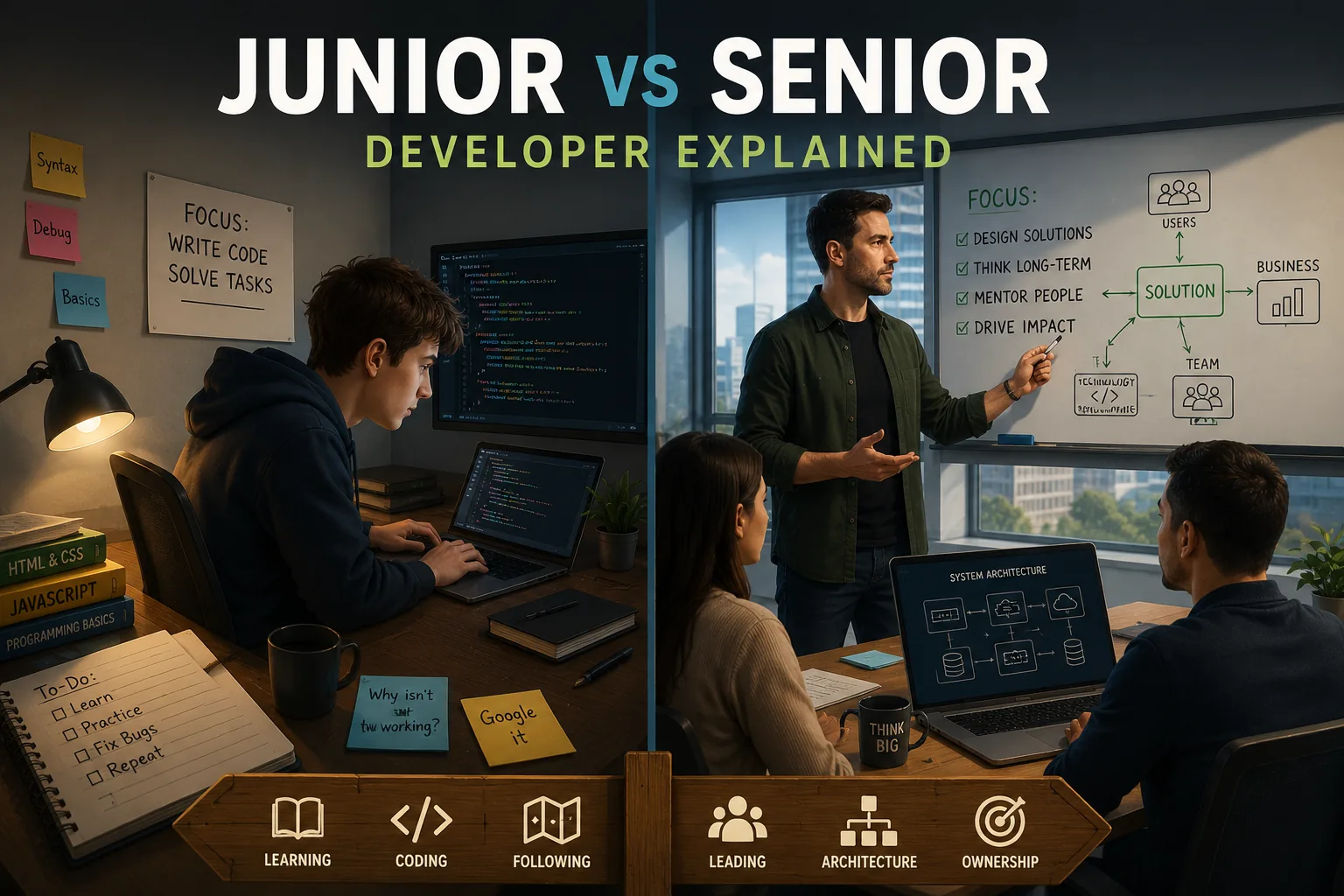
What Distinguishes a Junior from a Senior Developer?
The difference between a junior and a senior developer is not primarily a matter of years spent coding or volume of code written. A junior developer focuses on completing assigned tasks - making the code work within the specifications given.
A senior developer focuses on impact: questioning whether the task is the right one, anticipating how requirements will evolve, designing solutions that remain maintainable as the system grows, and multiplying the effectiveness of the whole team through mentorship and technical leadership.[3]
Seniority is a shift in scope and mindset, from "can I implement this?" to "should we build this, and what are the long-term consequences of how we do it?"
Introduction: The Day Everything Changed
Maya, a junior developer with 18 months of experience, received a task: "Add user filtering to the dashboard."
Her approach:
- Found similar code elsewhere in the codebase
- Copied the pattern
- Modified variable names
- Tested basic functionality
- Created pull request
- Time: 6 hours
Alex, a senior developer on her team, reviewed the PR. His feedback wasn't about bugs-the code worked perfectly. Instead:
- "This filtering logic duplicates what exists in three other places. Can we extract a shared utility?"
- "What happens when we have 10,000 users? Should we add pagination?"
- "The business wants to add role-based filtering next quarter. Could we structure this to make that easier?"
- "Should filtering state persist in the URL so users can bookmark/share filtered views?"
Maya was confused. The code worked. She'd completed the task. Why was Alex bringing up scenarios that didn't exist yet?
Six months later, requirements changed: "Add role-based filtering." Maya now understood. Her implementation would have required rewriting the filtering logic a fourth time. Alex's approach would have taken an extra 2 hours initially but saved 20+ hours of rework.
This is the difference between junior and senior developers.
It's not primarily about years of experience, lines of code written, or technical knowledge-though those matter. It's about:
- Thinking beyond the immediate task to the broader system
- Anticipating future needs without over-engineering
- Evaluating tradeoffs between multiple valid solutions
- Reducing complexity for the team
- Delivering business value, not just working code
This article explores the concrete differences between junior and senior developers: technical skills, problem-solving approaches, responsibilities, mindset shifts, and the path from one to the other.
Part 1: The Fundamental Differences
Technical Skill Levels
Junior Developer (0-2 years):
Learning fundamentals:
- Still mastering syntax, patterns, standard libraries
- Googling frequently ("how to sort array in JavaScript")
- Following tutorials and documentation closely
- Building mental models of how things work
Narrow focus:
- One language, one framework
- Specific area of codebase
- Individual features or bug fixes
- Immediate problem, not broader context
Execution focus:
- "How do I implement this?"
- Getting code to work
- Following specifications
- Delivered features
Mid-Level Developer (2-5 years):
Mastered fundamentals:
- Language and tools second nature
- Rarely needs to Google basic syntax
- Understands frameworks deeply
- Fast, confident implementation
Broader scope:
- Multiple related technologies
- Larger sections of codebase
- End-to-end features
- Adjacent concerns (frontend dev understanding backend)
Reliability focus:
- Consistently delivers on time
- Minimal guidance needed
- Good technical decisions
- Fewer bugs, better quality
Senior Developer (5+ years):
Fundamentals automatic:
- Implementation details trivial
- Focus on design, not syntax
- Quickly picks up new technologies
- Deep expertise in core areas
System-wide scope:
- Architecture across services
- Impact on entire team
- Long-term implications
- Strategic technical direction
Impact focus:
- "What should we build?"
- "Why are we solving this problem?"
- Business value delivery
- Team effectiveness
Responsibility Spectrum
| Dimension | Junior | Mid-Level | Senior |
|---|---|---|---|
| Task definition | Assigned clear tasks | Some ambiguity tolerated | Identifies own work |
| Scope | Single feature | Multiple features | System/team level |
| Timeframe | Days | Weeks | Months to quarters |
| Autonomy | Needs guidance | Mostly independent | Fully self-directed |
| Mentoring | Receives mentoring | Occasional mentoring | Provides mentoring |
| Decisions | Follows patterns | Chooses approaches | Sets technical direction |
| Communication | Within team | Cross-team | Cross-functional |
| Impact | Individual contribution | Team productivity | Organizational capability |
The Mindset Shift
Junior mindset:
- "Can I build this?"
- "Is my code correct?"
- "How does this work?"
- "What should I do?"
Senior mindset:
- "Should we build this?"
- "What are the tradeoffs?"
- "Why does this problem exist?"
- "What should the team do?"
This shift from implementation focus to impact focus is the core difference.
"A senior engineer's job is not to write code. It's to solve problems-and often the best solution involves writing less code, not more." - Tanya Reilly
Part 2: Problem-Solving Approaches
How Juniors Approach Problems
Problem identification:
- Reactive: Assigned problems by manager or senior
- Accept requirements: Take specifications as given
- Narrow scope: Focus on specific task
Example: "Add pagination to user list"
- Junior implements pagination as specified
- Doesn't question whether pagination is right solution
- Doesn't consider alternatives (infinite scroll, virtual scrolling)
Solution exploration:
- First working solution: Find something that works, implement it
- Pattern matching: Look for similar code, copy and adapt
- Stack Overflow reliance: Search for solutions to specific problems
- Single path: Rarely explores multiple approaches
Implementation:
- Make it work: Primary goal is functioning code
- Linear progression: Start at beginning, work to end
- Follow examples: Stick close to tutorials or existing patterns
- Iterate until working: Trial and error
Example implementation approach:
// Junior approach: Get it working
function filterUsers(users, filterText) {
  let result = [];
  for (let i = 0; i < users.length; i++) {
    if (users[i].name.includes(filterText) ||
        users[i].email.includes(filterText)) {
      result.push(users[i]);
    }
  }
  return result;
}
Works perfectly.
Solves immediate problem. But...
How Seniors Approach Problems
Problem identification:
- Proactive: Identify problems before being told
- Question requirements: Understand why, validate assumptions
- Broad context: Consider how problem fits larger system
Example: "Add pagination to user list"
- Senior asks: "Why pagination? What problem are we solving?"
- Discovers: Slow loading, too much data
- Considers: Pagination vs. infinite scroll vs. better backend filtering vs. virtual scrolling
- Proposes tradeoffs of each approach
Solution exploration:
- Multiple solutions: Generate several approaches, evaluate tradeoffs[5]
- Simplicity first: Bias toward simple solutions
- Pattern creation: Design reusable approaches, not just copy existing[14]
- Long-term thinking: Consider maintenance, extensibility
Implementation:
- Make it right: Correct, maintainable, appropriate complexity
- Strategic approach: Architecture first, then implementation
- Anticipate change: Design for likely future needs (not all possible needs)
- Systematic refinement: Test hypotheses, iterate deliberately
Example implementation approach:
// Senior approach: Reusable, efficient, maintainable

// Extract generic filtering utility
function filterByFields(items, query, fields) {
  const lowerQuery = query.toLowerCase();
  return items.filter(item =>
    fields.some(field =>
      String(item[field]).toLowerCase().includes(lowerQuery)
    )
  );
}

// Usage
const filteredUsers = filterByFields(users, searchText, ['name', 'email']);

// Easy to extend: add fields, customize matching logic
// Reusable: works for products, posts, any entity
// Testable: pure function, simple to test
// Performant: single pass, early termination with 'some'
Same functionality, but:
- Reusable across codebase
- Easier to test
- Easier to extend (add fields, change matching)
- Simpler to understand (declarative, clear intent)
Debugging Approaches
Junior debugging:
- Trial and error: Change things, see if it fixes
- Print statements:
console.logeverywhere - Random changes: "Maybe if I move this line..."
- Ask immediately: Get stuck, ask for help without deep investigation
Senior debugging:
- Systematic hypothesis: Form theory, test it
- Minimal reproduction: Isolate problem to smallest failing case
- Use proper tools: Debugger, profiler, network inspector
- Read documentation: Understand intended behavior
- Extensive attempt: Exhaust options before asking for help
Example scenario: API call failing
Junior approach:
console.log('before API call');
const result = await fetchUser(id);
console.log('result:', result);
console.log('after API call');
// Doesn't work... ask for help
Senior approach:
// 1. Check network tab: Is request being made? What's response?
// 2. Check browser console: Any errors?
// 3. Check API documentation: Correct endpoint, parameters?
// 4. Minimal test: Does simplest possible call work?
// 5. Compare working vs failing: What's different?
// 6.
Form hypothesis: "Maybe auth token expired"
// 7. Test hypothesis: Check token, try refreshing
// 8. Only ask for help if systematic investigation doesn't resolve
Part 3: Code Quality and Design
Junior Code Characteristics
Gets it working:
// Junior code: Works but...
function processOrder(order) {
  if (order.items.length > 0) {
    let total = 0;
    for (let i = 0; i < order.items.length; i++) {
      total = total + order.items[i].price * order.items[i].quantity;
    }
    if (order.coupon) {
      if (order.coupon.type === 'percent') {
        total = total - (total * order.coupon.value / 100);
      } else if (order.coupon.type === 'fixed') {
        total = total - order.coupon.value;
      }
    }
    if (order.customer.isPremium) {
      total = total - (total * 0.1);
    }
    return total;
  } else {
    return 0;
  }
}
Problems:
- All logic in one function (hard to test, reuse, modify)
- No validation (what if prices are negative?)
- Mixed concerns (calculation + business rules)
- Imperative (how to do it) vs. declarative (what to do)
- No error handling
Senior Code Characteristics
Makes it right:
// Senior code: Clear, testable, extensible

class Order {
  constructor(items, coupon, customer) {
    this.items = items;
    this.coupon = coupon;
    this.customer = customer;
  }

  getSubtotal() {
    return this.items.reduce((sum, item) =>
      sum + item.price * item.quantity, 0
    );
  }

  getCouponDiscount() {
    if (!this.coupon) return 0;

    const subtotal = this.getSubtotal();
    const { type, value } = this.coupon;

    if (type === 'percent') {
      return subtotal * (value / 100);
    }
    if (type === 'fixed') {
      return Math.min(value, subtotal); // Can't discount more than subtotal
    }

    throw new Error(`Unknown coupon type: ${type}`);
  }

  getPremiumDiscount() {
    if (!this.customer.isPremium) return 0;
    return this.getSubtotal() * 0.1;
  }

  getTotal() {
    const subtotal = this.getSubtotal();
    const couponDiscount = this.getCouponDiscount();
    const premiumDiscount = this.getPremiumDiscount();

    return Math.max(0, subtotal - couponDiscount - premiumDiscount);
  }
}

// Usage
const total = new Order(items, coupon, customer).getTotal();
Improvements:
- Separated concerns (each method does one thing)
- Easy to test (test each discount type independently)
- Clear intent (method names explain what, not how)
- Easy to extend (add new discount types)
- Defensive (handles edge cases, validates)
- DRY (each calculation defined once)
Design Principles Seniors Apply
1. Single Responsibility Principle
- Each function/class does one thing
- Easy to name (if hard to name, probably doing too much)
- Easy to test
- Easy to change
2. Don't Repeat Yourself (DRY)
- Duplicate logic extracted into functions
- Reusable across codebase
- Change in one place affects everywhere
3. YAGNI (You Aren't Gonna Need It)
- Don't build for hypothetical future needs
- Build for actual current needs
- Add complexity only when necessary
4. Appropriate Abstraction
- Juniors: No abstraction (copy-paste) or over-abstraction (premature)[4]
- Seniors: Right level (refactor after seeing pattern repeated 2-3 times)[12]
5. Readability
- Code quality read 10 more than written
- Clear names, clear structure
- Comments explain "why", not "what"
Part 4: Communication and Collaboration
Junior Communication Patterns
Technical focus:
- Talks about implementation details
- "I used a hash map to..."
- Audience: Other developers
Reactive communication:
- Updates when asked
- Announces when done
- Doesn't proactively share status or blockers
Synchronous preference:
- Taps colleague on shoulder
- Instant messages frequently
- Meetings for clarity
Limited context:
- Shares technical details
- Doesn't explain business rationale
- Assumes others have same context
Senior Communication Patterns
Business focus:
- Talks about outcomes and value
- "This reduces checkout time by 30%, which should improve conversion"
- Audience: Engineers, product managers, executives
Proactive communication:
- Regular status updates
- Flags blockers before they become critical
- Shares risks and dependencies
Asynchronous preference:
- Written documentation
- Clear, self-contained messages
- Reduces meeting need
Rich context:
- Explains why, not just what
- Connects work to business goals
- Assumes others lack context; fills gaps
Example comparison:
Junior update: "Finished the user filtering feature. PR is ready for review."
Senior update:"Completed user filtering feature (#1234). This unblocks the Q1 admin dashboard launch.
Implemented using our standard FilterBuilder utility (consistent with products page). Added pagination for 10K+ users, which resolves the performance issue Product flagged.[7]
Testing: Unit tests, → Integration tests, → QA approval Monitoring: Added metrics for filter usage (helps inform future filter priorities) Deployment: Low risk; feature-flagged, gradual rollout[8]
PR ready for review: [link] Deployment plan: [link]
Next: Starting role-based filtering (#1235), estimated 3 days."
Senior communication provides:
- Business context (Q1 launch)
- Technical decisions and rationale
- Risk assessment
- Dependencies and connections
- Next steps
- Links to relevant resources
"The most important skill for a senior engineer is communication, not code." - Will Larson
Cross-Functional Collaboration
Junior:
- Works primarily with engineering team
- Receives requirements from product
- Minimal interaction with design, QA, ops
Senior:
- Regular interaction with product, design, QA, ops, business stakeholders
- Contributes to requirements (technical feasibility, suggestions)
- Represents engineering perspective in planning
Example: New feature request
Junior response: "Sure, I can build that. Give me the specs."
Senior response:
- "Let's make sure I understand the problem. Users want X because Y, right?"
- "Have we considered approach A vs. B? Here are tradeoffs..."
- "This will take approximately 2 weeks. It touches the payment system, so we'll need extra QA."
- "It conflicts with Z initiative. Should we prioritize this over Z?"
- "I'll need design mockups for the confirmation flow by Friday to stay on schedule."
Senior provides:
- Clarification of requirements
- Technical options and tradeoffs
- Realistic estimates
- Dependencies and risks
- Clear needs to unblock work
Part 5: Handling Ambiguity
Junior and Ambiguity
Needs clarity:
- "What exactly should I build?"
- "How should this work?"
- Uncomfortable without clear specifications
- Waits for direction
Executes precisely:
- Implements exactly what's specified
- Doesn't question requirements
- Doesn't fill in gaps
Example scenario: "Improve the onboarding experience"
Junior reaction:
- Confused (too vague)
- Waits for clearer requirements
- "What do you mean by 'improve'?"
- Needs specific tasks
Senior and Ambiguity
Comfortable with uncertainty:
- Ambiguity is normal
- Part of the job is clarifying
- Opportunity to add value
Clarifies strategically:
- Asks "why?" to understand goals
- Identifies gaps in requirements
- Proposes specific solutions
- Validates assumptions
Example scenario: "Improve the onboarding experience"
Senior response:
1. Understand the problem:
- "What specific problems are users having?"
- "Do we have data? (analytics, support tickets, user feedback)"
- "What's the business goal? (retention, activation, time-to-value)"
2. Investigate:
- Analyzes onboarding funnel: Where do users drop off?
- Reviews user feedback: What are complaints?
- Benchmarks competitors: What do others do well?
3. Propose solutions:
- "I found that 40% of users abandon during step 3 (connecting data source)"
- "Proposal: Simplify by supporting OAuth instead of requiring API keys"
- "Alternative: Add clearer instructions and examples"
- "Quick win: Fix confusing error messages (2 day effort)"
4. Create plan:
- Breaks ambiguous goal into concrete, prioritized tasks
- Estimates effort
- Defines success metrics
- Gets buy-in
Senior turns ambiguity into clarity for the team.
Breaking Down Ambiguous Work
Senior approach:
1. Identify known vs. unknown:
- What's clear? What's unclear?
- What decisions must be made?
2. Time-boxed investigation:
- "Spike": 1-2 days of research
- Prototype to learn
- Don't disappear for weeks
3. Incremental delivery:
- Build smallest useful piece
- Get feedback
- Iterate
4. Document assumptions:
- "Assuming X, we'll build Y"
- "Need decision on Z to proceed"
- Makes dependencies explicit
5. Communicate options:
- "Here are three approaches with pros/cons"
- "I recommend A because..."
- Facilitates decision-making
Part 6: Leadership and Mentoring
Senior Developer Leadership Responsibilities
Note: Seniors are individual contributors, not managers. Leadership is informal, through expertise and influence.
1. Mentoring
Answering questions:
- Junior: "How do I center this div?"
- Senior: Answers, but also explains why (box model, flexbox vs. grid)
- Teaches patterns, not just solutions
Code review as teaching:
// Junior code
function getUserName(user) {
  return user.firstName + ' ' + user.lastName;
}

// Senior review (teaching approach)
"This works!  A few thoughts:

1.
Edge case: What if firstName or lastName is null/undefined?
   Consider: `${user.firstName || ''} ${user.lastName || ''}`.trim()

2.
Internationalization: Name order varies by culture (some cultures:
   lastName first). If we'll internationalize, might want:
   `user.displayName` or a proper formatting utility.

3.
Reuse: We format names in several places. Extract this into
   utils/formatUserName.js?

Not blockers for this PR, but good to think about as we build this out."
Teaching:
- Pairing sessions (working together)
- Lunch & learns (presentations)
- Documentation (write guides)
2. Technical Leadership
Architecture decisions:
- "Should we use REST or GraphQL?"
- "How should we structure this service?"
- "What database is appropriate?"
Setting standards:
- Code style guides
- Testing expectations
- Documentation requirements
Technical debt management:
- Identifies accumulating debt
- Prioritizes what to fix
- Advocates for refactoring time
3. Project Leadership
Scope clarification:
- Turns ambiguous goals into concrete tasks
- Identifies risks and dependencies
- Creates technical plans
Unblocking:
- Team members stuck? Senior helps
- Needs decision? Senior facilitates
- Blocked by external team? Senior coordinates
Driving progress:
- Keeps project moving forward
- Identifies issues early
- Adjusts plan as needed
4. Setting Example
Code quality:
- Seniors model good practices
- Thorough testing
- Clear documentation
- Thoughtful design
Work habits:
- Sustainable pace (not heroics)
- Collaboration
- Continuous learning
- Helping others
Part 7: Progressing from Junior to Senior
Timeline and Expectations
Typical progression:
Junior (0-2 years):
- Learning fundamentals
- Needs guidance
- Narrow scope
Mid-Level (2-5 years):
- Mastered fundamentals
- Independent execution
- Expanding scope
Senior (5-7+ years):
- Deep expertise
- Leadership emerging
- Broad impact
Important: Years are approximate. Progression depends on:
- Learning rate
- Quality of experience (complex projects vs. repetitive work)
- Mentorship (learning from seniors)
- Initiative (seeking growth vs. staying comfortable)
- Company standards (senior at startup → senior at Google)
Skills to Develop
Technical depth:
1. Master fundamentals:
- Data structures and algorithms (not just for interviews)
- System design
- One technology stack deeply (full expertise)
2. Debugging:
- Systematic problem-solving
- Use proper tools
- Read source code when necessary
3. Code quality:
- Readable, maintainable code
- Appropriate abstractions
- Testing
Broadening scope:
1. Learn adjacent areas:
- Frontend dev learns backend
- Backend dev learns infrastructure
- Full understanding of system
2. Own features end-to-end:
- Design → implementation → deployment → monitoring
- Experience full lifecycle
3. Production operations:
- On-call rotations
- Debugging live issues
- Understanding operational concerns
Communication skills:
1. Writing:
- Technical documentation
- Design proposals
- Pull request descriptions
- Status updates
2. Explaining:
- Technical concepts to non-technical stakeholders
- Teaching juniors
- Presentations
3. Listening:
- Understanding before responding
- Extracting requirements
- Empathy for users and colleagues
Leadership abilities:
1. Mentoring:
- Help junior developers
- Teach through code review
- Share knowledge
2. Initiative:
- Identify problems (don't wait to be told)
- Propose solutions
- Drive projects
3. Influence:
- Convince through compelling arguments
- Build consensus
- No formal authority; influence through expertise
Business understanding:
1. Product thinking:
- What should we build?
- Why does this matter to users?
- How do we measure success?
2. Priorities:
- Understanding business constraints
- Tradeoffs between projects
- Communicating technical in business terms
3. User empathy:
- Building for users, not for engineers
- Usability and design awareness
- Customer feedback integration
Accelerating Growth
Strategies:
1. Seek stretch projects:
- Just beyond current comfort zone
- Opportunity to learn new skills
- Visible impact
2. Learn from seniors:
- Observe how they work
- Ask questions (why decisions made)
- Request mentorship
3. Teach others:
- Best way to solidify understanding
- Forces clear thinking
- Develops communication skills
4. Read code:
- Open source projects
- Colleagues' code
- See different approaches and patterns
5. Reflect:
- What went well?
- What would I do differently?
- What did I learn?
- Document learnings
6. Take initiative:
- Volunteer for complex work
- Identify problems and fix them
- Don't wait for permission
7. Get feedback:
- Ask manager, seniors, peers
- "What should I improve?"
- "How can I have more impact?"
- Act on feedback
"The only way to learn a new programming language is by writing programs in it." - Dennis Ritchie
Red Flags You're Stuck
Warning signs:
1. Same skills as a year ago:
- Not growing
- Staying in comfort zone
- Need to seek new challenges
2. Always need guidance:
- Not becoming independent
- Should gradually need less help
3. Avoid challenging work:
- Only take easy tasks
- Fear of failure blocking growth
4. Don't help others:
- Not developing leadership
- Opportunity to mentor
5. Blame environment:
- "No opportunities here"
- Often, opportunities exist if you look
- Consider: Are you creating opportunities?
Demonstrating Senior-Level Impact
For promotions, you must demonstrate you're already operating at the next level.
Evidence of senior impact:
1. Technical excellence:
- Led complex projects
- Designed significant systems
- Measurably improved code quality, performance, reliability
2. Leadership:
- Mentored others (who, how did they grow?)
- Led projects (scope, team size, outcome)
- Unblocked team repeatedly
- Knowledge sharing (documentation, talks)
3. Scope:
- Larger projects over time
- Longer timeframes (months, not days)
- Cross-team coordination
- Handled ambiguity and clarified requirements
4. Business impact:
- User outcomes improved
- Revenue impact
- Efficiency gains
- Reliability improvements
5. Consistent pattern:
- Not one big project
- Ongoing demonstration of senior behaviors
- Sustained impact
Document everything:
- Keep "brag document" of accomplishments
- Quantify impact ("reduced load time 40%", "saved team 10 hours/week")
- Testimonials from colleagues
- Use for promotion packet and performance reviews
Part 8: Senior Doesn't Mean "Knows Everything"
Common Misconceptions
Myth: Seniors know everything
- Reality: Seniors know how to figure things out
- Comfortable saying "I don't know, but I'll find out"
- Know when to research, ask experts, prototype
Myth: Seniors write perfect code
- Reality: Seniors write code appropriate for context
- Sometimes quick and dirty (throwaway prototype)
- Sometimes carefully crafted (core library)
- Judgment about when perfection matters
Myth: Seniors work alone
- Reality: Seniors collaborate extensively
- Recognize when to ask for help
- Leverage team expertise
- More collaboration, not less
Myth: Seniors are always confident
- Reality: Seniors experience imposter syndrome too
- Technology always evolving (constant learning)
- Humility and curiosity essential
"No matter how far down the wrong road you've gone, turn back." - Turkish Proverb
What Senior Really Means
Pattern recognition:
- Seen similar problems before
- "This looks like X, which we solved with Y"
- Not knowledge of everything, but knowledge of patterns
Judgment:
- When to optimize, when "good enough"
- When to refactor, when to leave it
- When to seek help, when to push through
- What tradeoffs to make
Risk assessment:
- What could go wrong?
- Edge cases and failure modes
- Security implications
- Scale considerations
Long-term thinking:
- Sustainable pace
- Technical debt awareness
- Team capability building
- System evolution
Business alignment:
- Connecting technical work to business value
- Understanding priorities
- Communicating effectively with non-technical stakeholders
Conclusion: The Journey from Junior to Senior
Being a senior developer is less about how much you know and more about how you think.
The progression:
Junior: "Can I implement this feature?"
- Focus: Making code work
- Scope: Individual tasks
- Autonomy: Needs guidance
- Impact: Individual contributions
Mid-Level: "Can I deliver this project reliably?"
- Focus: Consistent execution
- Scope: Features and small projects
- Autonomy: Mostly independent
- Impact: Reliable team member
Senior: "Should we build this, and how does it fit our system?"
- Focus: Business value and system health
- Scope: System-level, team-level
- Autonomy: Fully self-directed
- Impact: Multiplies team effectiveness
The shift happens gradually through:
- Experience: Seeing patterns, learning from mistakes
- Expanding scope: Taking on larger, more ambiguous work
- Developing judgment: Evaluating tradeoffs, knowing when "good enough"
- Building influence: Leading through expertise, not authority
- Business understanding: Connecting technical work to outcomes
It's not just time. Some developers with 10 years still think like juniors (narrow focus, needs direction, doesn't mentor). Others reach senior mindset in 3-4 years (curiosity, initiative, breadth).
You accelerate growth by:
- Seeking challenges just beyond your comfort zone
- Learning from seniors (observe, ask, request feedback)
- Teaching others (solidifies understanding, develops leadership)
- Taking initiative (identify and solve problems, don't wait)
- Reflecting (what worked, what didn't, what did I learn)
The goal isn't reaching "senior" and stopping. The best seniors continue learning, growing, expanding impact. Some become staff engineers (deeper technical expertise), some become architects (system design), some become engineering managers (people leadership).[10]
What matters: Continuous growth, increasing impact, helping others succeed.
Start where you are. Focus on the next step, not the destination. The journey from junior to senior is one of expanding perspective, deepening judgment, and multiplying impact through both your code and your influence on others.
What Research Shows About Developer Seniority and Skill Development
The most rigorous research on skill development in software engineering comes from studies of deliberate practice and expertise formation. K. Anders Ericsson, whose work on expertise was popularized by Malcolm Gladwell's "10,000 hours" concept, studied chess grandmasters, musicians, and athletes to identify what separates the elite from the merely experienced.
Ericsson's key finding, published with Ralf Krampe and Clemens Tesch-Romer in "The Role of Deliberate Practice in the Acquisition of Expert Performance" (Psychological Review, 1993), was that mere experience does not produce expertise, only deliberate practice at the edge of current competence, with immediate feedback, produces meaningful skill gains.
This applies directly to software development: a developer who writes similar code in a comfortable domain for ten years does not develop the same capabilities as one who consistently seeks challenges at the boundary of their current skills.
Microsoft Research's work on developer expertise, including a 2008 study by Andrew Begel and Beth Simon, "Struggles of New College Graduates in Their First Software Development Job," documented the gap between what new developers expected their job to require (primarily coding) and what it actually required, including a great deal of communication, requirement clarification, and understanding of existing systems.
Senior developers, consistent with this finding, tend to spend proportionally more time on these non-coding activities, not less. The finding is counterintuitive but consistent with how expertise develops: the most technically skilled developers often spend a smaller fraction of their time writing new code than junior developers do.
Amy Edmondson's research on psychological safety, published in "Psychological Safety and Learning Behavior in Work Teams" (Administrative Science Quarterly, 1999), found that teams where members felt safe to take risks, ask questions, and admit mistakes learned faster and performed better on complex tasks.[6]
Edmondson's subsequent book The Fearless Organization (2018) drew on research across healthcare, financial services, and technology companies.
For software development specifically, the underlying psychological safety literature suggests that senior developers in psychologically safe teams are more likely to share knowledge, mentor junior members, and raise concerns about technical risks, behaviors that multiply team productivity, while in psychologically unsafe teams senior developers tend toward knowledge hoarding and avoid raising concerns, reducing the knowledge transfer that accelerates junior developer growth.
Will Larson's book Staff Engineer: Leadership Beyond the Management Track (2021) draws on a set of interviews with staff-level engineers at major technology companies to describe the actual work patterns and skill profiles of engineers above the senior level.[11]
Larson describes several recurring threads across the engineers he profiled: setting technical direction, sponsoring and mentoring less experienced engineers, contributing an engineering perspective to organizational decisions, and doing the unglamorous coordination and communication work sometimes called "glue work."[1]
The book challenges the assumption that technical progression beyond senior level means increasingly specialized deep technical work, instead describing it as involving increasingly broad organizational impact.
Real-World Case Studies: Junior to Senior Progression
Google's engineering ladder is one of the more publicly discussed examples of how a major technology company formally distinguishes developer levels, described in various forms across public talks, blog posts, and leaked internal documents over the years.
Google's promotion criteria are commonly described in terms of scope and impact of work and technical leadership, criteria that scale up as engineers move from executing well-defined projects to identifying and driving work that affects a team, then multiple teams, then the company as a whole. "Googleyness," a real term in Google's vocabulary, is more specifically associated with hiring and cultural fit assessment than with the promotion ladder itself.
Google's ladder makes explicit what practitioners observe elsewhere: each level is not simply more technical competence at the same scope, but comparable competence applied at a progressively larger scope.
Large technology companies' engineering career frameworks in general, including publicly available materials from companies like Meta, consistently emphasize that the bottleneck for most developers progressing from mid-level to senior is not technical skill but ownership and tolerance for ambiguity.
Companies with this kind of culture expect engineers to identify important problems and solve them with minimal guidance; engineers who wait to be assigned work, regardless of their technical skill, tend to struggle to progress under such frameworks.
This reflects a finding consistent across the industry: senior level is as much about initiative and judgment as it is about technical competence.
Pivotal Labs' apprenticeship model was one of the most deliberate junior-developer development programs in the industry, built around pair programming as the primary mode of work rather than an occasional practice.
Pivotal paired junior engineers extensively with senior engineers during their early months, on the premise that senior engineers catching problems in real time, during pairing, produces faster and more durable skill development than unstructured onboarding followed only by after-the-fact code review.[9]
The specific degree of acceleration this produced relative to less structured onboarding approaches is not something that could be confirmed with precise figures, though the underlying pairing-heavy model itself is well documented as a real and influential part of Pivotal's engineering culture.
Netflix's "keeper test," described by former Chief Talent Officer Patty McCord in Powerful: Building a Culture of Freedom and Responsibility (2017), reflects Netflix's approach to talent management.
Netflix managers are asked to evaluate each employee against a hypothetical: if this person told me they were leaving, would I fight to keep them? Engineers who would not be fought for were encouraged to leave.
The result, according to McCord's account, was a workforce where senior engineers had unusually high impact because they were surrounded by other high-impact engineers, the absence of low performers raising the performance floor for everyone.
The model is not universally applicable but reflects a genuine finding: team composition affects individual performance.
Key Metrics and Evidence in Developer Career Development
Research on the productivity gap between junior and senior developers consistently finds larger differences than most practitioners expect, though the most famous single study in this area is also one of the most frequently misquoted.
A widely cited 1968 study by Harold Sackman, W.J. Erikson, and E.E. Grant, "Exploratory Experimental Studies Comparing Online and Offline Programming Performance," found large productivity differences, on the order of 10 to 1 or more depending on which specific measure is examined, between the best and worst programmers given identical tasks.[13]
The study is also a well-known example of a result that gets oversimplified in industry discourse: it involved a small sample of programmers, conflated several different variables, and has been the subject of methodological critique for decades, even as later analyses have generally concluded that a real, substantial productivity gap of roughly this order of magnitude does exist.
The Stack Overflow Developer Survey tracks the developer community's demographics and experience levels annually, including years of professional experience broken down by role, though it is more useful as a general picture of the field than as a source for a precise, universal timeline from first job to a specific title such as "senior," since title conventions vary widely across companies.
What career-development research more broadly and consistently supports is that developers who actively seek mentorship, contribute to open source projects, and take on stretch assignments outside their comfort zone tend to reach senior-level responsibility faster than those who do not.
Research on the value of code review as a learning mechanism was published by Alberto Bacchelli and Christian Bird in their study of Microsoft's code review practices, "Expectations, Outcomes, and Challenges of Modern Code Review" (ICSE 2013), based on interviews and surveys of Microsoft developers and managers.
Among the motivations for code review that the study documented was its use as an explicit knowledge-transfer and educational tool for junior developers learning an unfamiliar codebase, a finding consistent with the broader industry view that explanatory, reasoning-based feedback in code review is a more valuable teaching tool than simple approval or rejection, even though the study itself did not attempt to measure a specific skill-improvement timeline.
Tanya Reilly's influential 2019 talk "Being Glue" documented the pattern of undervalued "glue work," the non-technical work such as documentation, coordination, onboarding, and process improvement that keeps teams functioning, which Reilly observed is disproportionately performed by junior developers and underrepresented groups.[2]
Reilly's talk argued that developers who take on significant glue work are often not promoted to senior despite having high organizational impact, because the work is less visible than technical output.
The talk sparked a broader industry conversation about how engineering organizations define and recognize impact, with several technology companies subsequently revising how their career ladders credit organizational contribution.
Sources & Further Reading
Larson, W. (2021). Staff Engineer: Leadership Beyond the Management Track. Will Larson.
Reilly, T. (2022). The Staff Engineer's Path: A Guide for Individual Contributors Navigating Growth and Change. Sebastopol, CA: O'Reilly Media.
Fournier, C. (2017). The Manager's Path: A Guide for Tech Leaders Navigating Growth and Change. Sebastopol, CA: O'Reilly Media.
Martin, R. C. (2008). Clean Code: A Handbook of Agile Software Craftsmanship. Upper Saddle River, NJ: Prentice Hall.
Thomas, D., & Hunt, A. (2019). The Pragmatic Programmer: Your Journey to Mastery (20th Anniversary Edition). Boston: Addison-Wesley Professional.
Edmondson, A. C. (2018). The Fearless Organization: Creating Psychological Safety in the Workplace for Learning, Innovation, and Growth. Hoboken, NJ: John Wiley & Sons.
Kleppmann, M. (2017). Designing Data-Intensive Applications: The Big Ideas Behind Reliable, Scalable, and Maintainable Systems. Sebastopol, CA: O'Reilly Media.
Kim, G., Humble, J., Debois, P., & Willis, J. (2016). The DevOps Handbook: How to Create World-Class Agility, Reliability, and Security in Technology Organizations. Portland, OR: IT Revolution Press.
Julia Evans. (2021). How to do a code review. Julia Evans Blog (jvns.ca).
Charity Majors. (2019). The Engineer/Manager Pendulum. Charity Majors Blog. Retrieved from View source
Will Larson. (2020). Staff archetypes. Irrational Exuberance (lethain.com).
Fowler, M. (2018). Refactoring: Improving the Design of Existing Code (2nd ed.). Boston: Addison-Wesley Professional.
McConnell, S. (2004). Code Complete: A Practical Handbook of Software Construction (2nd ed.). Microsoft Press.
Gamma, E., Helm, R., Johnson, R., & Vlissides, J. (1994). Design Patterns: Elements of Reusable Object-Oriented Software. Addison-Wesley Professional.
Further Reading
Pat Kua. (2022). The Effective Tech Lead. Retrieved from View source
Horstmann, C. S. (2018). Core Java Volume I: Fundamentals (11th ed.). Addison-Wesley Professional.