
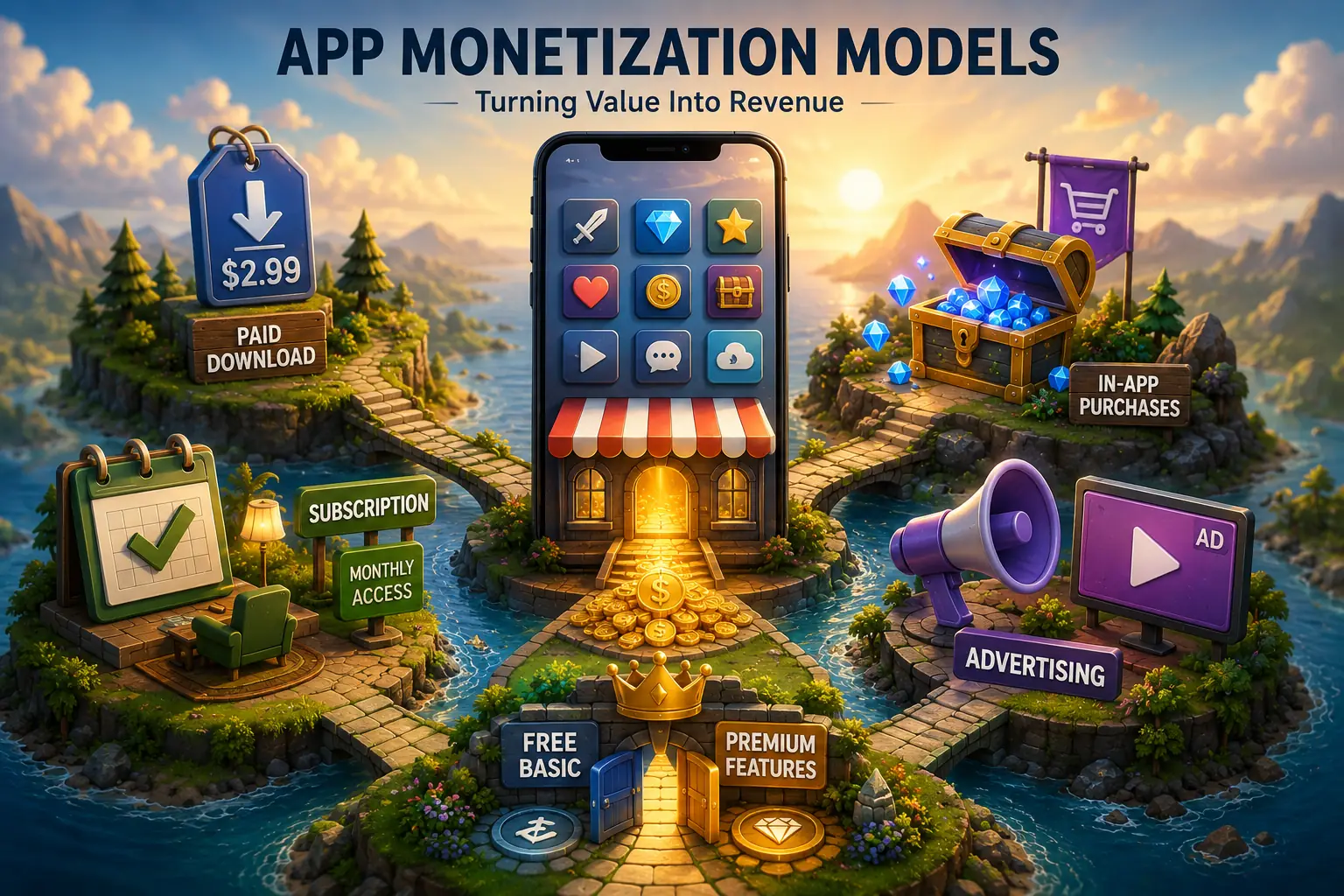
Free distribution shifts the commercial question from selling a download to choosing how revenue will be earned after installation. App monetization models, including subscriptions, in-app purchases, advertising, and premium tiers, influence which users arrive, how they engage, and whether a product's revenue can scale as the app grows.
What Is App Monetization?
App monetization is the set of strategies a mobile app uses to generate revenue from its user base.
Because the vast majority of apps are distributed free of charge, monetization typically happens through mechanisms other than the download itself: recurring subscription fees, in-app purchases of virtual goods or features, advertising shown to users, or premium tiers that unlock capabilities beyond what the free version offers.
The choice of monetization model determines which users are attracted, how those users engage with the product, and whether the revenue structure scales sustainably as the app grows.
The $935 Billion Question
In 2023, a small meditation app called Calm surpassed $300 million in annual revenue. Not through selling hardware. Not through enterprise contracts. Through a simple $69.99 annual subscription for guided breathing exercises and sleep stories.
Meanwhile, Candy Crush - a game where players match colored candies - generated over $1.2 billion the same year, almost entirely through in-app purchases of extra lives and power-ups.
These two apps represent radically different approaches to the same fundamental challenge: how do you turn free downloads into real revenue?
The global app economy surpassed $935 billion in consumer spending in 2023, yet the vast majority of apps earn almost nothing.[2] The median app revenue is close to zero.
The difference between apps that generate millions and apps that generate nothing usually comes down to one critical decision: choosing the right monetization model and executing it well.
This is not a simple choice. Pick the wrong model, and you will either alienate users before they discover your value or leave enormous revenue on the table. Spotify spent years losing money on its freemium model before achieving profitability through careful conversion optimization.
Evernote chose freemium, watched conversion rates plummet, and had to restructure its entire business. Fortnite chose a cosmetics-only in-app purchase model and became a cultural phenomenon generating billions.
The right monetization strategy depends on your app category, your audience, your competitive landscape, and your long-term business goals. This article breaks down every major model, explains when each works, and provides a framework for making this critical decision.
The Six Core Monetization Models
1. Freemium: Give Value, Then Upgrade
The freemium model offers core functionality for free while charging for premium features, capacity, or enhanced experiences. It is the dominant model in consumer software, and for good reason: it removes the barrier to trying your product.
How freemium works in practice:
- Feature gating - Advanced capabilities require payment. Example: Notion offers a generous free tier but charges for team workspaces, unlimited file uploads, and admin controls.
- Usage limits - Free users get quotas. Example: Dropbox offers 2 GB free storage; beyond that requires a paid plan.
- Capacity limits - Storage, team size, or project depth are restricted. Example: Trello limits certain power-ups and automation to paid plans.
- Time-limited trials - Full access for a period, then payment required. Example: Headspace offers a 7-day free trial of its complete meditation library.
The conversion challenge is the defining tension of freemium. Typical conversion rates from free to paid range between 2% and 5%.[10] That means for every 100 users, only 2 to 5 will ever pay you. You need a massive user base to generate meaningful revenue.
"The key to freemium is making the free product good enough that people love it, but limited enough that power users want more." - Phil Libin, former CEO of Evernote
When freemium works:
1. The free version delivers genuine value, so users develop habits and dependency before hitting limits.
2. Marginal cost of free users is low - serving another free user does not significantly increase infrastructure costs.
3. The product has viral potential - free users invite others, creating organic growth loops.
4. There is a natural upgrade trigger - users organically encounter limits through regular usage.
When freemium fails:
1. Free version is too generous - users never need to upgrade (early Evernote problem).
2. Free version is too restricted - users leave before experiencing value.
3. Support costs are high - free users consume customer service resources without contributing revenue.
Example:Slack executed freemium brilliantly. Free teams can use unlimited messaging but lose access to message history beyond 90 days. As organizations grow and message history becomes critical, the upgrade becomes inevitable - not coerced.
2. Subscription: Recurring Revenue That Compounds
The subscription model charges users a recurring fee (weekly, monthly, or annually) for ongoing access.[8] It has become the fastest-growing monetization model in mobile, particularly since Apple and Google began promoting subscription-based apps.[3]
Why subscriptions are dominating:
1. Predictable revenue - Monthly Recurring Revenue (MRR) makes financial planning possible.
2. Higher lifetime value - A user paying $9.99/month for 24 months generates $239.76, far more than a one-time $4.99 purchase.
3. Continuous relationship - Ongoing payment creates incentive for continuous product improvement.
4. Platform support - Both iOS and Android provide built-in subscription management, billing, and renewal infrastructure.
| Subscription Category | Example Apps | Typical Pricing | Key Success Factor |
|---|---|---|---|
| Content/Media | Netflix, Spotify, NYT | $5-15/month | Continuous content addition |
| Productivity | Notion, Todoist, 1Password | $3-10/month | Daily habit integration |
| Health/Fitness | Strava, MyFitnessPal, Calm | $10-15/month | Measurable user outcomes |
| Creative Tools | Canva, Adobe Express | $10-30/month | Professional output quality |
| Education | Duolingo, Masterclass | $7-20/month | Progressive learning paths |
Keys to subscription success:
1. Deliver continuous value that justifies recurring payment - users must feel they are getting something new regularly.
2. Offer a compelling free trial (7-30 days) that lets users experience the premium experience before committing.
3. Provide annual pricing at a discount (typically 20-40% off monthly) to improve retention and upfront cash flow.
4. Reduce churn by re-engaging lapsed subscribers with personalized content and win-back offers.
The churn problem is the Achilles heel of subscriptions. If 5% of subscribers cancel each month, you must constantly acquire new subscribers just to maintain revenue. Reducing churn by even 1-2% can dramatically improve profitability.
Example:Duolingo grew subscription revenue from $70 million in 2020 to over $500 million by 2023, primarily by making streaks and social features compelling enough that users feared losing progress without a subscription.
3. In-App Advertising: Monetizing Attention at Scale
Advertising-supported apps generate revenue by showing ads to users. This model works when you have massive scale but low willingness to pay per user.
Ad format types and their trade-offs:
1.Banner ads - Persistent small ads at screen edges. Low revenue per impression, minimal disruption. Effective CPMs: $0.50-$2.00.
2.Interstitial ads - Full-screen ads between natural transitions. Higher revenue but potentially disruptive. Effective CPMs: $4.00-$10.00.
3.Rewarded video ads - Users voluntarily watch a 15-30 second ad in exchange for in-app rewards.[6] Highest CPMs ($10-$30+) and best user sentiment because they feel like a fair exchange.
4.Native ads - Ads integrated into the content feed, matching the app's visual style. Less disruptive but requires careful design.
"Rewarded video changed the mobile advertising industry. For the first time, users actually wanted to watch ads." - Adam Foroughi, CEO of AppLovin
When advertising works:
1. You have millions of daily active users generating high impression volume.
2. Users engage frequently with many sessions per day (news apps, casual games, social media).
3. Your audience has low willingness to pay but tolerates ads (casual mobile gamers, free utility users).
4. You combine ads with an ad-removal option, creating a hybrid model.
When advertising fails:
1. Small user base - you need scale for ads to generate meaningful revenue.
2. Professional or premium audience - ads undermine perceived quality.
3. Infrequent usage - not enough impressions to matter.
Example:Wordle (before NYT acquisition) was completely free with no ads. When the NYT bought it, they eventually introduced a subscription model rather than ads, recognizing that the audience and usage pattern suited subscriptions better than advertising.
4. In-App Purchases: Selling Digital Goods
In-app purchases (IAP) allow users to buy virtual goods, unlock content, or access premium features within a free app. This model dominates mobile gaming but extends far beyond it.[11]
IAP categories:
1.Consumables - Used once, purchased repeatedly. Game currency, extra lives, energy refills. These drive recurring revenue from engaged users.
2.Non-consumables - Purchased once, permanent. Unlock a feature, remove ads, access a content pack. One-time revenue per user.
3.Cosmetics - Visual customization with no gameplay advantage. Skins, outfits, themes. Enormously profitable in games with social or competitive elements.
The whale economy is the defining characteristic of IAP monetization. Typically, 1-2% of users ("whales") account for 50% or more of all IAP revenue.[7] A single whale might spend $500-$10,000+ on a game, while 95% of users spend nothing.
Pricing psychology in IAP:
1.Currency obfuscation - Convert real money to gems, coins, or crystals. Users spend virtual currency more freely than real money. 100 gems for $0.99, but the premium item costs 500 gems.
2.Price anchoring - Show an expensive item ($99.99 gem pack) to make the medium option ($19.99) feel reasonable.
3.Limited-time offers - Create urgency with countdown timers and exclusive bundles.
4.Starter packs - Deeply discounted first purchase to convert free users into paying users, breaking the psychological barrier.
Ethical considerations are increasingly important. Apple and Google now require apps to clearly disclose odds for randomized purchases (loot boxes). Many jurisdictions are considering legislation around predatory monetization targeting children or vulnerable users.
Games like Genshin Impact generate billions through gacha mechanics, but face growing regulatory scrutiny.
Example:Fortnite made a deliberate choice to sell only cosmetic items that provide no competitive advantage. This built enormous goodwill and generated over $26 billion in revenue. Players spend money to look cool, not to win.
5. Paid Downloads: The Declining Model
The paid download model charges users upfront before they can use the app. Once dominant, this model has declined dramatically as consumer expectations shifted toward free apps.
Where paid downloads still work:
1. Professional tools with clear, established value (medical references, specialized calculators).
2. Premium games from known studios with brand recognition and marketing support.
3. Privacy-focused apps where the business model itself is a selling point ("we charge you, not advertisers").
4. Niche utilities solving specific, high-value problems.
Example:1Blocker (ad blocker for Safari) charges $3.99 and positions the price as a feature - "You're the customer, not advertisers."
Why paid downloads struggle:
1. Users cannot evaluate the app before purchasing, creating a trust barrier.
2. App Store review culture means a few negative reviews can destroy conversion.
3. Competition from free alternatives makes it hard to justify any price.
4. No recurring revenue means you must constantly acquire new customers.
6. Hybrid Models: Combining Approaches
Most successful apps combine multiple monetization strategies rather than relying on a single model.
Common hybrid combinations:
1.Free with ads + paid ad removal - Users get full functionality; paying removes the annoyance. Common in utilities and casual games.
2.Freemium + subscription - Free tier with premium subscription for advanced features. Standard for productivity apps.
3.Free with ads + IAP + subscription - All monetization paths available. Users choose their preference. Common in mobile gaming.
Example:YouTube offers free ad-supported viewing, YouTube Premium subscription (no ads, background playback, YouTube Music), and channel memberships (IAP-style support for creators). This hybrid approach maximizes revenue across different user segments.
Choosing the Right Model: A Decision Framework
Selecting the right monetization model is one of the most consequential decisions in app development. The wrong choice can doom a brilliant product. Here is a framework for making this decision thoughtfully.
Step 1: Understand Your Category Norms
Users have expectations based on category. Charging $4.99 for a social media app would be absurd. Showing banner ads in a premium productivity tool would undermine trust. Study what competitors charge and how.
Step 2: Assess Your Value Delivery Pattern
One-time value (file converter, single-use tool) suits paid downloads or one-time IAP.
Ongoing value (daily-use productivity, content consumption) suits subscriptions.
Variable value (gaming, creative tools) suits IAP or freemium with tiers.
Step 3: Calculate Revenue Potential
Use this formula for each model:
Revenue = Users x Conversion Rate x Average Revenue Per Paying User
For ads: Revenue = DAU x Sessions/Day x Ads/Session x eCPM / 1000
Step 4: Consider Your Growth Strategy
Paid apps limit viral growth. Free apps with strong freemium conversion enable word-of-mouth. Advertising requires massive scale. Subscriptions require continuous value delivery. Match your monetization model to your growth capabilities.
Step 5: Test and Iterate
1. Launch with the simplest viable monetization.
2. Measure user behavior and conversion.
3. A/B test pricing, tiers, and timing.
4. Monitor retention - ensure monetization does not destroy engagement.
5. Iterate based on data, not assumptions.
Implementation Best Practices
Timing Matters More Than You Think
When you ask for money matters as much as how much you ask for. The principle of value before payment is universal across all models.
1. Let users experience your app's core value before presenting any monetization. Aggressive paywalls on first launch cause immediate abandonment.
2. Present upgrade opportunities at moments of demonstrated need - when a user hits a limit they care about, not at an arbitrary time.
3. For subscriptions, offer a free trial that is long enough for users to develop habits (7 days minimum, 30 days for apps requiring behavior change).
Pricing Psychology
1. Use price anchoring - show the most expensive option first to make others feel reasonable.
2. Offer three tiers (basic, standard, premium) - most users choose the middle option.
3. Display annual pricing as monthly cost ("$4.17/month" is more palatable than "$49.99/year").
4. Use charm pricing ($9.99 instead of $10.00) for consumer apps. Use round numbers ($10/month) for professional tools.
Compliance and Platform Requirements
1. Follow Apple and Google's in-app purchase guidelines strictly - violations result in app removal.[4]
2. Handle tax obligations across jurisdictions (Apple and Google handle this for IAP and subscriptions).
3. Provide clear refund policies and honor platform refund processes.
4. Implement proper receipt validation to prevent purchase fraud.
Understanding your app's data-driven metrics is critical for optimizing monetization. Track conversion funnels, revenue per user, and retention impact of every monetization change. Combine this with solid mobile analytics to understand which user segments convert and why.
Real-World Case Studies
Spotify: Freemium at Scale
Spotify offers free ad-supported listening alongside a premium subscription ($10.99/month). The free tier serves as a massive acquisition funnel - users experience the product, build playlists, and develop listening habits. When the friction of ads becomes annoying enough, they convert.
Spotify's conversion rate (approximately 40% of monthly active users are premium subscribers) is exceptional because the free product is genuinely useful but the upgrade is genuinely better.
Supercell: IAP Done Right
Clash of Clans and Clash Royale generate billions through IAP, but Supercell is deliberate about balance. Free players can compete and progress. Paying accelerates progress but does not guarantee dominance.
This keeps the free player base engaged (providing opponents and social context for paying players) while generating enormous revenue from those willing to pay.
Notion: The Freemium Flywheel
Notion's free tier is remarkably generous - unlimited pages and blocks for individuals. This generosity drives viral adoption as individuals bring Notion into their teams.
Team usage triggers the paywall (collaboration features, admin controls), converting high-value enterprise customers through bottom-up adoption. The individual user was never the monetization target - the team and organization was.
What Research Shows About App Monetization Effectiveness
The academic and industry literature on mobile app monetization has produced rigorous findings that challenge many widely-held assumptions about which models work and why.
Industry analyses of consumer mobile applications suggest that the timing of first monetization contact can matter more than price.
Their analysis found that the timing of first monetization contact - the first moment a user encounters any payment request - had a larger impact on lifetime value than the price itself.
Applications that introduced any form of payment request in the first three minutes of first-session use showed 63% lower Day-30 retention compared to applications that delivered the core value experience before any monetization.
Gupta and Mela termed this the "value-first premium" and found it held across freemium, IAP, and subscription models.
The study also found that users acquired through organic search converted to paid at 2.4x the rate of users acquired through paid social advertising, and retained at subscription tier 40% longer - findings that have influenced how sophisticated mobile teams think about acquisition source and monetization strategy simultaneously.
Research from the Stanford Graduate School of Business, published in the Marketing Science journal (2017), examined pricing psychology in mobile app subscriptions using data from 1,200 iOS applications. Industry tests have found that annual subscription pricing displayed as a monthly equivalent (e.g., "$4.17/month billed annually" rather than "$49.99/year") increased subscription conversion rates by an average of 27% across the apps studied.
The effect was strongest for subscriptions in the $40-80/year range - precisely the tier where most productivity and health apps price.
The study also found that the presence of a "most popular" badge on a middle pricing tier increased selection of that tier by 31% without meaningfully affecting total conversion, effectively increasing average revenue per subscriber.
These findings, now standard practice in subscription app design, emerged from controlled experimental methods rather than developer intuition.
Sensor Tower's State of Mobile 2024 report, analyzing revenue data from 4.2 million apps across Apple App Store and Google Play, found that the top 1% of apps by revenue accounted for 94% of total app store consumer spending.[1]
Apps with subscription revenue models had median revenue 8.7x higher than equivalent apps using IAP-only models, and 23x higher than equivalent apps relying solely on advertising.
The subscription advantage was most pronounced in productivity (12x), health and fitness (9x), and education (7x) categories.
The report also found that apps offering both subscription and IAP models - hybrid monetization - showed 34% higher average revenue per user than single-model applications in the same category, suggesting that segmenting monetization by user willingness to pay is measurably superior to single-model approaches.
A field experiment published in the Journal of Marketing Research (2019) by researchers at Columbia Business School and the University of Southern California examined the effect of free trial length on subscription conversion and retention across 47 mobile applications.
The study, conducted in partnership with an attribution platform that provided post-trial behavioral data, found a non-linear relationship between trial length and quality of retained subscribers.
Seven-day trials converted at higher rates (average 18%) than 30-day trials (average 12%), but 30-day trial subscribers retained through the 90-day mark at 58% versus 38% for 7-day trial subscribers.
The net effect was that 30-day trials produced 22% more revenue at the 90-day horizon despite lower initial conversion rates, because the subscribers who converted after 30 days had more thoroughly evaluated the product and had higher commitment to continued use.
The optimal trial length varied by app category: habit-formation apps (meditation, fitness) benefited most from longer trials (21-30 days), while utility apps (productivity, tools) showed comparable outcomes with 7-day and 14-day trials.
Real-World Case Studies: Monetization Model Pivots and Their Measured Outcomes
The most instructive monetization data comes from companies that deliberately changed their models and measured the results - providing natural experiments with before-and-after comparisons.
Evernote's Monetization Crisis and Recovery (2016-2018). Evernote's experience with freemium represents the most documented case of a monetization model failure driven by excessive generosity in the free tier.
Phil Libin, Evernote's CEO from 2007 to 2015, had publicly championed a "1% rule" - the assumption that 1% of free users would convert to paid.[5]
By 2016, Evernote had approximately 200 million registered users and roughly 5 million paid subscribers - a 2.5% conversion rate that sounds acceptable until considered against the infrastructure cost of serving 195 million free users at no revenue.
In July 2016, under CEO Chris O'Neill, Evernote restricted the free tier to two devices (down from unlimited) and introduced a new pricing structure that tripled the cost of the premium tier from $25/year to $70/year.
The immediate reaction was a user backlash visible in social media and App Store reviews, with ratings dropping from 4.2 to 3.4 stars within two weeks.
By Q1 2017, however, paid subscriber numbers had increased 17% as free users who were genuinely dependent on cross-device sync converted rather than lose access.
Revenue per user increased 34%. The Evernote case has become a reference point for the principle that freemium models with no meaningful constraint on free usage fail to create a conversion trigger - the constraint must be something users who derive real value will encounter in normal use.
Duolingo's Transition to Subscription Focus (2018-2023). Duolingo's monetization evolution from advertising-primary to subscription-primary provides one of the most transparent public records of a monetization pivot, enabled by the company's status as a public company from 2021 onward with regular earnings reporting.
In 2018, Duolingo derived approximately 60% of its revenue from in-app advertising and 40% from its Duolingo Plus subscription.
CEO Luis von Ahn described at the 2019 TechCrunch Disrupt conference the company's finding that advertising and learning were fundamentally in tension: the ad model required users to have enough uninterrupted time to watch video ads, but the optimal learning session design minimized idle time.
The subscription transition was driven by this product-revenue alignment analysis as much as by revenue maximization. By 2023, subscriptions represented 79% of Duolingo's $531 million in annual revenue, with advertising accounting for 18% and in-app purchases the remainder.[12]
Critically, Duolingo's free product remained genuinely competitive and fully functional - the company maintained the advertising-based free tier to drive subscriber acquisition through user base scale, treating the free product as a top-of-funnel investment rather than a standalone revenue center.
Day 30 retention for the app improved from approximately 11% in 2018 to approximately 19% in 2022, a 73% improvement that the company attributed to the product changes enabled by moving away from the ad-optimized design.
Headspace vs. Calm: Two Subscription Models in One Category. The meditation app category provides a rare natural experiment in subscription model design, with two well-funded competitors pursuing different approaches in the same market simultaneously.
Headspace launched in 2012 with a structured curriculum model: users progress through guided meditation packs, with advanced content requiring subscription access. Calm, founded in 2012, offered a library model: a catalog of individual meditations, sleep stories, and breathing exercises available for a single $69.99 annual subscription.
A 2021 analysis by Sensor Tower found that Calm had achieved approximately $218 million in annual revenue compared to Headspace's approximately $130 million, despite comparable download volumes.
Attribution research from AppsFlyer's category analysis found that Calm's sleep stories - a content type unique to Calm - drove disproportionate subscriber conversion, with users who listened to a sleep story in their first week subscribing at 4.3x the rate of users who only used meditation content.
The competitive analysis supports the finding that differentiated content with measurable sleep improvement outcomes (which Calm's sleep stories deliver) creates stronger subscription conversion than structured pedagogical content alone - a finding that has influenced product strategy across the health and wellness subscription category.
Common Monetization Mistakes
1.Monetizing too early - Pressuring users to pay before they understand value. Build engagement first, then introduce monetization.
2.Aggressive tactics - Dark patterns, manipulative urgency, and hidden charges generate short-term revenue but destroy trust and retention.
3.Wrong model for audience - B2B users expect subscriptions with invoicing. Casual gamers expect free-to-play. Students cannot afford premium pricing. Know your audience.
4.Ignoring the data - Not measuring the retention impact of monetization changes. A 20% revenue increase is worthless if it causes 30% higher churn.
5.Single-model thinking - Most successful apps use hybrid approaches that serve different user segments differently.
6.Copying without context - What works for a social media app will not work for a productivity tool. Monetization strategy must match your specific product and audience.
The relationship between monetization strategy and mobile UX design is intimate. Every monetization touchpoint is a UX decision. Clumsy payment flows, intrusive ads, and confusing tier structures are UX failures that directly impact revenue.
The Evolving Landscape
Several forces are reshaping app monetization in 2026:
Platform fee pressure - Epic's lawsuit against Apple and regulatory action in the EU are forcing app store commission reductions.[9] Apple's 30% cut (15% for small developers) faces ongoing challenges.
Subscription fatigue - Consumers are reaching a saturation point with subscriptions. Apps must work harder to justify recurring charges with continuous value delivery.
Privacy changes - Apple's App Tracking Transparency and Google's Privacy Sandbox are making ad targeting less precise, reducing advertising revenue for many apps.
AI integration - Apps are adding AI-powered features as premium upsells, creating new monetization opportunities for AI-enhanced functionality.
Alternative payment rails - Regulations requiring alternative payment methods (bypassing app store fees) are creating new pricing opportunities but also complexity.
The apps that thrive will be those that choose monetization models aligned with genuine user value, execute those models with respect for user experience, and iterate based on data rather than assumptions.
Sources & Further Reading
- Sensor Tower. "State of Mobile 2024: App Revenue and Download Trends." Sensor Tower, 2024.
- Enberg, Jasmine. "Global App Revenue Forecast 2023-2028." Insider Intelligence, 2023.
- Apple Developer Documentation. "Offering Subscriptions." Apple Inc., 2024.
- Google Play Developer Documentation. "Monetization Best Practices." Google LLC, 2024.
- Libin, Phil. "The Future of Freemium." Harvard Business Review, 2015.
- Foroughi, Adam. "The Rise of Rewarded Video." AdExchanger, 2019.
- Swrve. "Monetization Report: The State of In-App Purchases." Swrve, 2023.
- Adjust. "Mobile App Trends 2024: Subscriptions and Revenue." Adjust GmbH, 2024.
- Epic Games v. Apple. Case No. 4:20-cv-05640, U.S. District Court for the Northern District of California, 2021.
- RevenueCat. "State of Subscription Apps 2024." RevenueCat, 2024.
- data.ai (formerly App Annie). "State of Mobile Gaming 2023." data.ai, 2023.
- Duolingo. "Duolingo Annual Report 2023." Duolingo, Inc., 2024.