
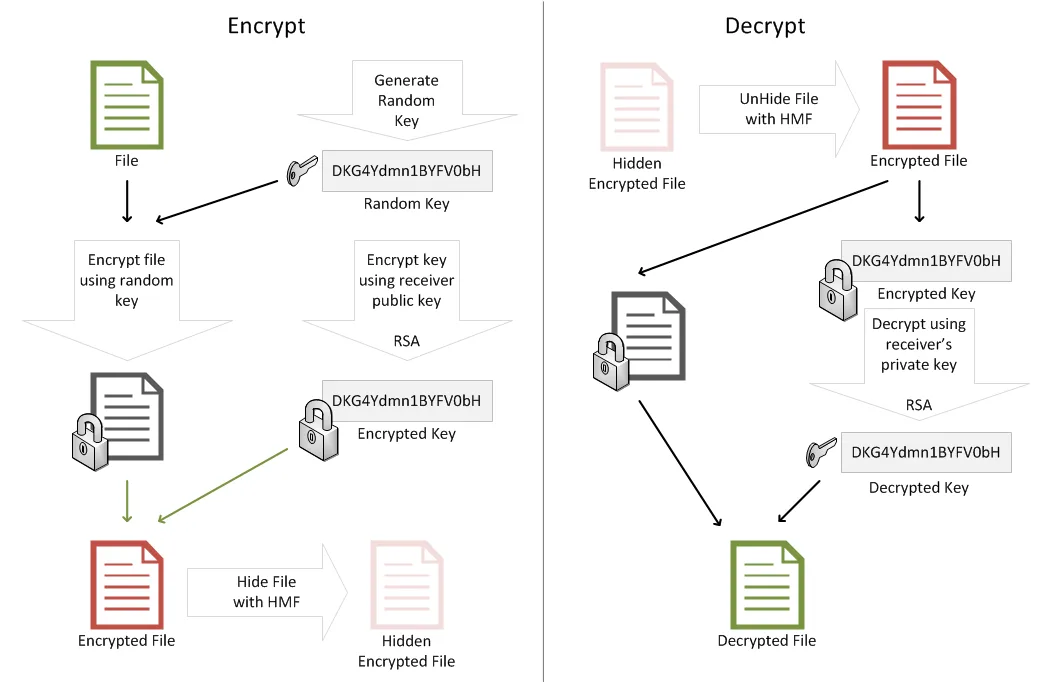
Encryption transforms readable data into ciphertext that can be restored only with the proper key, allowing information to remain protected even if files are stolen. Understanding encryption means recognizing that strong public algorithms rely on secret key management, not hidden designs. Modern symmetric and public-key techniques address different needs, while implementation and endpoint failures can still undermine sound cryptography.
In November 2014, hackers released nearly 100 terabytes of Sony Pictures internal data - emails, salary records, unreleased films, and personal information for thousands of employees.
What made the breach particularly damaging was not just that the attackers got in; it was that the sensitive data was stored in a way that made it immediately readable.
Security researchers found that Sony had stored passwords in a folder literally named "Password." The data the attackers stole was not protected by any meaningful encryption. Once they had the files, they had everything.
Contrast this with a scenario where the same files had been properly encrypted at rest.
The attackers would still have stolen something, but they would have been left with an enormous collection of meaningless ciphertext - computationally indistinguishable from random noise without the decryption keys.
The breach would still have happened, but its consequences would have been drastically reduced.
This gap - between what encryption promises and whether organizations actually use it correctly - is where most of the real story of encryption lives. The mathematics of modern cryptography is well-understood and, when properly implemented, effectively unbreakable by any known method.
The failures happen at the edges: in key management, in implementation choices, in what gets encrypted and what gets left exposed.
"Encryption works. Properly implemented strong crypto systems are one of the few things that you can rely on. Unfortunately, endpoint security is so terrifically weak that NSA can frequently find ways around it." - Bruce Schneier
"If privacy is outlawed, only outlaws will have privacy." - Phil Zimmermann
"Encryption is the most important privacy-protecting technology we have, and it works best when it's on by default." - Edward Snowden
"The biggest breakthrough in cryptography of the century was not a new algorithm. It was the realization that you could share a secret without ever sharing it." - Whitfield Diffie
What Encryption Actually Does
Encryption is the process of transforming readable data - called plaintext - into an unreadable format called ciphertext, using a mathematical algorithm and a key. The transformation is deterministic and reversible: the same algorithm run in reverse with the correct key will reproduce the original plaintext exactly.
The key insight is that the security of modern encryption does not depend on keeping the algorithm secret.[2] Algorithms like AES and RSA are fully public, extensively analyzed, and implemented in open-source libraries. What matters is the key.
The algorithm is the lock design; the key is the specific key that opens a particular lock. Publishing the lock design does not let anyone open a lock without the right key, provided the lock design is strong enough.
A simple historical example illustrates the concept. Julius Caesar reportedly encrypted messages by shifting each letter a fixed number of positions in the alphabet - shifting by 3 turns "attack" into "dwwdfn." This is a substitution cipher.
Anyone who knows the shift value of 3 can decrypt any message. The weakness is that there are only 25 possible shifts, making it trivially breakable by trying each one.
Modern encryption operates on the same conceptual principle - transform plaintext using a mathematical rule based on a key - but with algorithms and key spaces of extraordinary complexity.
From Caesar to Modern Cryptography
The history of cryptography runs parallel to the history of warfare and statecraft, because secrets have always mattered to people with power. The Vigenere cipher, developed in the 16th century, used a repeating keyword to vary the substitution, defeating simple frequency analysis.
The Enigma machine used by Germany in World War II implemented a sophisticated electromechanical cipher that the Allies at Bletchley Park, including Alan Turing, spent years breaking - a breakthrough that historians estimate shortened the war by two years.
The fundamental limitation of all pre-digital cryptography was what cryptographers call the key distribution problem. If you want to send an encrypted message to someone, you first have to agree on a shared key. But how do you share the key securely?
If you could share information securely, you would not need encryption in the first place. This circular problem limited encryption to organizations that could establish shared secrets through secure channels - embassies, military couriers, direct meetings.
The 1976 paper by Whitfield Diffie and Martin Hellman, "New Directions in Cryptography," solved this problem and launched the modern era of cryptography.[1] Their insight was a mathematical process that allows two parties to establish a shared secret key over a completely public channel without ever transmitting the key itself.
The mathematics involves modular exponentiation and discrete logarithms - operations that are easy to compute in one direction and computationally infeasible to reverse. Their work made public-key cryptography possible, enabling the encrypted internet we rely on today.
Symmetric Encryption: Speed and the Key Problem
Symmetric encryption uses the same key to encrypt and decrypt data. The sender scrambles the plaintext with the key; the receiver uses the identical key to unscramble the ciphertext.
This approach is computationally efficient - modern hardware can encrypt gigabytes of data per second using symmetric algorithms - which makes it suitable for encrypting large volumes of data.
The dominant symmetric encryption standard today is AES, the Advanced Encryption Standard. The United States National Institute of Standards and Technology (NIST) selected AES in 2000 and published it as FIPS 197 in 2001 after a roughly three-year public competition that evaluated fifteen candidate algorithms.
AES operates on 128-bit blocks of data and supports key sizes of 128, 192, or 256 bits. AES-256 - the version with 256-bit keys - is used for encrypting classified US government communications and is the gold standard for data-at-rest encryption.
To understand what AES-256 security means in practice: there are 2^256 possible keys, a number so large that even a computer performing a trillion operations per second would need longer than the current age of the universe to check them all by brute force.
The security of AES is not in doubt. What is in doubt, in practice, is always the implementation - how the key is generated, stored, and managed.[4]
AES-256 is what your iPhone uses to encrypt its storage. It is what encrypts files on a BitLocker-protected Windows drive and a FileVault-protected Mac. It is what Amazon Web Services and Google Cloud use to encrypt data at rest in their storage systems.
When you see an organization claim it encrypts your data, AES-256 is almost certainly the algorithm they mean.
The limitation of symmetric encryption is precisely what motivated Diffie and Hellman: to use it, both parties need the same key, and distributing that key securely is a problem.
If you use symmetric encryption to protect data you are sending to someone, you have to get the key to them through some other secure channel, which is not always practical.
Asymmetric Encryption: The Public-Private Key Pair
Asymmetric encryption solves the key distribution problem by using two mathematically linked keys: a public key and a private key. Anything encrypted with the public key can only be decrypted with the corresponding private key, and vice versa.
The public key can be freely shared - posted on a website, included in an email signature, embedded in a certificate. The private key is kept secret by its owner.
The mathematics underlying most asymmetric systems - most notably RSA, developed by Ron Rivest, Adi Shamir, and Leonard Adleman at MIT in 1977 - relies on the difficulty of factoring large numbers.
Multiplying two large prime numbers together is fast; factoring the result back into its prime components is computationally infeasible for numbers of sufficient size.
A 2048-bit RSA key, for example, has never been factored and is considered secure for most current applications, though 3072-bit or 4096-bit keys are increasingly recommended for new implementations.
The RSA paper is remarkable partly because Rivest, Shamir, and Adleman initially doubted they had actually solved the problem. As Rivest later described, Shamir had the idea late one night and called him in excitement. They spent weeks trying to find the flaw before accepting that the scheme actually worked.
Asymmetric encryption is slower than symmetric - often 1000 times slower for equivalent data volumes - which is why it is not used to encrypt bulk data directly. Instead, it solves the key exchange problem so that symmetric encryption can be used for the actual data.
Symmetric vs. Asymmetric Encryption: A Comparison
| Dimension | Symmetric Encryption | Asymmetric Encryption |
|---|---|---|
| Key type | Single shared key (same to encrypt and decrypt) | Key pair: public key to encrypt, private key to decrypt |
| Speed | Very fast; suitable for large data volumes | Slow; typically 1000x slower than symmetric |
| Use case | Bulk data encryption (files, databases, disk) | Key exchange, digital signatures, TLS handshakes |
| Example algorithm | AES-128, AES-256, ChaCha20 | RSA-2048, RSA-4096, ECC (ECDH, ECDSA) |
How HTTPS Works: The TLS Handshake
Every time you visit a website over HTTPS, your browser and the website's server execute a procedure called the TLS handshake. TLS (Transport Layer Security) is the protocol that provides encrypted communications over the web. Understanding the handshake makes the relationship between symmetric and asymmetric encryption concrete.
The handshake begins with your browser sending a "hello" message that includes the TLS version it supports and a list of cipher suites - combinations of algorithms it knows how to use. The server responds with its own hello, selects a cipher suite from the list, and sends its digital certificate.
The certificate contains the server's public key and is signed by a Certificate Authority (CA) - a trusted third party like DigiCert or Let's Encrypt whose signatures browsers are configured to trust.
Your browser verifies the certificate's authenticity by checking the CA's signature. This step prevents man-in-the-middle attacks, where an attacker intercepts traffic and presents their own fake certificate.
If the certificate is valid, the browser uses the server's public key to help establish a shared symmetric session key through a process that ensures neither side directly transmits the key.
Once both sides have derived this session key, they use AES or another symmetric cipher to encrypt the rest of the conversation.
The result is that the bulk of data - the web page content, your form submissions, your session cookies - travels encrypted with fast symmetric encryption, while the slow asymmetric operations handled only the initial key exchange. The padlock in your browser address bar indicates this process completed successfully.
End-to-End Encryption: What It Actually Means
End-to-end encryption (E2EE) is a specific architecture that extends the protection of encryption to the service provider itself. In a standard HTTPS connection, your data is encrypted in transit, but the server decrypts it when it arrives.
Google can read your Gmail messages on its servers. A bank can read your account messages. The server is an endpoint, and data is plaintext there.
End-to-end encryption means the data is encrypted on your device, transmitted and stored as ciphertext, and can only be decrypted on the recipient's device.
The service provider whose servers carry the message never has access to the decryption keys and therefore cannot read the content, even if compelled by a court order or compromised by an attacker.
Signal, the messaging application developed by Moxie Marlinspike and Open Whisper Systems, pioneered practical E2EE for consumer messaging.
The Signal Protocol that underlies it uses a combination of the Diffie-Hellman key exchange and what cryptographers call a "ratchet" mechanism - a system that generates new encryption keys for each message, so that compromising one message's key does not expose any other messages.
WhatsApp adopted the Signal Protocol in 2016, making E2EE the default for its 2 billion users.
E2EE is strong protection, but it is worth being precise about what it protects and what it does not. Signal cannot read your messages; your message content is genuinely private from the provider. But Signal can see metadata: who you messaged, when, and how frequently.
Metadata analysis can reveal significant information even without message content. If a government sees that you are in regular encrypted communication with a known activist, journalist, or suspected criminal, that metadata has investigative value regardless of what the messages say.
E2EE also does not protect against endpoint compromise. If malware is installed on your phone, it can read your messages on your screen before they are encrypted. Signal cannot protect you from a compromised device.
In the 2019 WhatsApp vulnerability discovered by security researchers at Citizen Lab, attackers could install spyware with a single missed video call - the encryption was intact, but the endpoint was not.
What Encryption Protects Against - and What It Does Not
Encryption provides strong protection against specific threats. It protects data in transit against eavesdropping: anyone who intercepts encrypted packets between you and a web server sees only ciphertext they cannot read.
It protects data at rest against theft: a stolen laptop with full-disk encryption is useless to an attacker who does not have the key. It protects stored data against server breaches where the attacker copies the database but does not obtain the keys.
What encryption does not protect: it does nothing against malware operating on a device before encryption happens or after decryption happens. It does not protect against bad passwords, which are one of the most common ways encryption keys are compromised in practice.
It does not protect against social engineering that tricks users into revealing credentials.
It does not protect against vulnerabilities in the software that implements the encryption - OpenSSL's Heartbleed vulnerability in 2014 allowed attackers to read arbitrary memory from servers running the vulnerable version, effectively bypassing TLS encryption.[6]
The LinkedIn breach of 2012 illustrates what happens when encryption is present but poorly implemented. LinkedIn stored user passwords hashed with SHA-1 without "salting" - a technique of adding random data to each password before hashing to ensure identical passwords produce different hashes.
When the database of 6.5 million hashed passwords leaked, attackers used precomputed lookup tables called rainbow tables to reverse millions of hashes quickly.
A stronger algorithm (bcrypt, Argon2) and proper salting would have made the hashes computationally infeasible to reverse. The lesson is not that encryption was absent but that the wrong type was used the wrong way.
Key Management: The Hard Part
The security of any encryption system depends on the security of its keys. This is where most real-world encryption failures occur, and it is consistently underestimated by organizations that believe encryption is a checkbox rather than a practice.
Key management encompasses the full lifecycle of cryptographic keys: generation, distribution, storage, rotation, and revocation. Each stage introduces risk if handled carelessly. Keys should be generated with cryptographically secure random number generators - not predictable pseudo-random sources.
They should be stored separately from the data they protect - a key stored in the same database as the encrypted data provides little additional protection if the database is compromised.
They should be rotated periodically, so that a key compromised without immediate detection limits the window of exposure. They should be revoked and replaced when personnel with access leave an organization or when compromise is suspected.
Cloud providers offer dedicated key management services - AWS Key Management Service, Google Cloud KMS, Azure Key Vault - that handle many of these concerns.
Some organizations use hardware security modules (HSMs), tamper-resistant physical devices designed specifically to store and use cryptographic keys without ever exposing the raw key material to software.
The payment card industry's HSM requirements exist precisely because of how often software-based key storage leads to compromise.
The gold standard for key protection combines multiple controls: HSM storage, strict access policies, audit logging of every key operation, geographic distribution, and regular key rotation. Most organizations achieve something considerably less than this, and the gap is where attackers find their opportunities.
Encryption at Rest vs. Encryption in Transit
The distinction between encryption in transit and encryption at rest reflects two different threat scenarios and requires two different implementations.
Encryption in transit protects data moving across a network. TLS over HTTPS is the most visible example. Secure Shell (SSH) encrypts administrative connections to servers. Virtual Private Networks (VPNs) encrypt traffic from a device to a network gateway.
Any time data travels across infrastructure that is not under your full physical control - which is almost always - encryption in transit is essential.
Encryption at rest protects data that is stored. Full-disk encryption tools like BitLocker on Windows and FileVault on macOS encrypt everything written to the drive, so the drive is meaningless without authentication. Database encryption protects stored records.
Object storage services like Amazon S3 and Google Cloud Storage can encrypt every object automatically. Backup encryption ensures that stolen or improperly disposed backup media does not expose data.
Both are necessary. Organizations that encrypt data in transit but not at rest are protected against network interception but exposed to server-side breaches, theft of hardware, and insider threats.
Organizations that encrypt at rest but not in transit are protected against storage theft but vulnerable to eavesdropping and interception. A complete security posture requires both, applied consistently across all systems that handle sensitive data.
The Quantum Computing Threat and Post-Quantum Cryptography
The asymmetric encryption algorithms that secure the internet - RSA, elliptic curve cryptography (ECC), and the Diffie-Hellman key exchange - all rely on mathematical problems that are computationally hard for classical computers.
RSA's security depends on the difficulty of factoring large numbers. ECC's security depends on the difficulty of the elliptic curve discrete logarithm problem.
In 1994, mathematician Peter Shor presented a quantum algorithm that could solve both factoring and discrete logarithm problems in polynomial time on a sufficiently powerful quantum computer - exponentially faster than the best known classical algorithms.
If a large-scale, error-corrected quantum computer were built, it would render RSA and ECC insecure with no warning period except the years of research that preceded it.
This threat is real but not immediate. Current quantum computers are small, noisy, and error-prone. Breaking RSA-2048 would require millions of logical qubits with error correction; the largest current systems have hundreds of physical qubits.
However, adversaries with the resources to build such computers are already collecting encrypted traffic today, with the intention of decrypting it when quantum computers mature - a strategy called "harvest now, decrypt later." Data that needs to remain secret for decades faces a genuine quantum threat.
NIST completed its post-quantum cryptography standardization process in 2024, selecting four algorithms: CRYSTALS-Kyber for key encapsulation (replacing RSA and ECDH for key exchange) and CRYSTALS-Dilithium, FALCON, and SPHINCS+ for digital signatures.[3]
These algorithms are based on mathematical problems that are believed to be hard for both classical and quantum computers, primarily the difficulty of solving certain lattice problems.[5]
Major technology companies are beginning to migrate. Google has incorporated post-quantum cryptography into Chrome and its internal infrastructure. Apple announced post-quantum support in iMessage.
The migration will take years and requires updating both clients and servers simultaneously - a transition comparable in complexity to the shift from HTTP to HTTPS, which took nearly a decade to become the web's default.
Practical Takeaways
Understanding encryption conceptually is useful only if it informs actual decisions. Several practical principles follow from everything covered above.
The encryption algorithm itself is rarely the problem. AES-256 is secure. TLS 1.3 is well-designed. The Signal Protocol is excellent. What goes wrong is implementation and key management - how these algorithms are deployed, who has access to keys, and how those keys are protected.
Encryption in transit and encryption at rest are both necessary and serve different threat models. An organization that has only one without the other has a gap that attackers will find.
End-to-end encryption provides strong content protection but does not eliminate metadata exposure and does not protect compromised endpoints. Threat modeling should reflect these limits.
The quantum transition is not urgent for most organizations today but is relevant for any data that must remain confidential for decades and for organizations that need to plan multi-year infrastructure migrations.
Good key management is harder than good algorithm selection and matters far more for practical security.
The investment in proper key lifecycle management - including hardware security modules for the most sensitive keys, strict access controls, audit logging, and regular rotation - pays higher security dividends than debating algorithm choices among already-strong options.
The Sony Pictures breach and the LinkedIn password failure are instructive not because the organizations were uniquely incompetent but because they reflect a pattern: encryption is technically understood but organizationally deprioritized until after a breach makes the gap visible.
The goal of understanding encryption is to make those tradeoffs consciously, before the cost of getting them wrong arrives.
The Research Behind Modern Cryptography
The encryption systems protecting contemporary digital infrastructure were built on decades of mathematical research. Understanding key contributions clarifies not only how encryption works but why specific design decisions were made and what their limitations are.
Diffie and Hellman (1976), "New Directions in Cryptography": The paper published by Whitfield Diffie and Martin Hellman in the IEEE Transactions on Information Theory established public-key cryptography as a practical field.
Before this work, all encryption required pre-shared secret keys, limiting encrypted communication to parties who had already established secure channels.
The Diffie-Hellman key exchange protocol allowed two parties to derive a shared secret over a public channel without transmitting the secret itself---using the mathematical asymmetry of modular exponentiation.
The insight was so fundamental that the NSA reportedly attempted to restrict publication of the paper. Diffie and Hellman received the Turing Award for 2015 (announced in 2016), the highest honor in computer science, for this contribution.
The paper's opening sentence---"We stand today on the brink of a revolution in cryptography"---proved accurate: the TLS protocol securing the web depends directly on Diffie-Hellman key exchange.
Rivest, Shamir, and Adleman (1977), "A Method for Obtaining Digital Signatures and Public-Key Cryptosystems": The RSA algorithm, developed at MIT by Ron Rivest, Adi Shamir, and Leonard Adleman, provided the first practical public-key encryption system.
RSA's security rests on the computational difficulty of factoring the product of two large prime numbers---multiplication is fast in one direction, factoring is computationally infeasible for large enough numbers.
RSA enabled digital signatures (proving a message came from a specific sender without revealing the signing key) and asymmetric encryption (encrypting to a public key that only the corresponding private key can decrypt).
The algorithm remains in production use in TLS, SSH, and digital certificate systems worldwide, though recommended key sizes have grown from 512 bits (broken by 1999) to 2048 bits (current minimum) to 4096 bits (recommended for long-term security).
Joan Daemen and Vincent Rijmen (2001), AES Standardization: The Advanced Encryption Standard competition, run by NIST from 1997 to 2001, evaluated fifteen candidate symmetric algorithms submitted by cryptographers worldwide. Belgian cryptographers Joan Daemen and Vincent Rijmen submitted the Rijndael algorithm, which NIST selected as AES.
The competition process itself was significant: unlike classified government cipher selection, it was fully public, with the scientific community invited to attempt to break each candidate over three years.
Algorithms that survived public cryptanalysis were more trustworthy than those developed in secret. AES has no known cryptanalytic weaknesses after more than two decades of intensive analysis.
The open competition model has become the standard approach for cryptographic standardization, used in NIST's subsequent competition for post-quantum algorithms (2016-2024).
Bernstein et al. (2012), "High-speed high-security signatures" (Journal of Cryptographic Engineering): Daniel J. Bernstein, Niels Duif, Tanja Lange, Peter Schwabe, and Bo-Yin Yang published the Ed25519 digital signature algorithm, which became widely adopted in modern cryptographic protocols including Signal, WireGuard VPN, and SSH.
Ed25519 provided performance advantages over RSA and earlier elliptic curve implementations while maintaining resistance to timing attacks---a class of attack that exploits variations in computation time to extract key information.
Bernstein's broader contribution to applied cryptography includes the ChaCha20 stream cipher and the Poly1305 authentication code, widely deployed as an alternative to AES in environments where hardware AES acceleration is unavailable.
Bernstein's work illustrates how academic cryptographic research directly produces production algorithms used by billions of people.
Shor (1994), "Algorithms for Quantum Computation": Peter Shor's paper at Bell Labs demonstrated that a quantum computer could solve the integer factoring problem (breaking RSA) and the discrete logarithm problem (breaking Diffie-Hellman and elliptic curve cryptography) in polynomial time.
Presented at the IEEE Symposium on Foundations of Computer Science (FOCS 1994) and subsequently published in the SIAM Journal on Computing (1997), the paper created the field of post-quantum cryptography.
NIST's post-quantum standardization process, completed in 2024 with the selection of CRYSTALS-Kyber, CRYSTALS-Dilithium, FALCON, and SPHINCS+, is the direct consequence of Shor's 1994 result.
The selected algorithms use lattice-based mathematics that is believed to resist both classical and quantum attacks---though "believed to resist" carries less certainty than the decades of analysis accumulated for RSA and AES.
Encryption Failures in Practice: Case Studies of Implementation Errors
The mathematical foundations of modern encryption are strong. Documented failures in production systems almost uniformly result from implementation errors, key management failures, and incorrect deployment---not weaknesses in the underlying algorithms.
Heartbleed (OpenSSL, 2014): The Heartbleed vulnerability (CVE-2014-0160), discovered by Neel Mehta of Google Security and independently by researchers at Codenomicon, was a buffer over-read bug in OpenSSL's implementation of the TLS heartbeat extension.
The vulnerability allowed an attacker to request that a server send back a chunk of memory far larger than the legitimate heartbeat payload, leaking arbitrary memory contents including private keys, session tokens, and plaintext data from other users' sessions.
OpenSSL was used in approximately two-thirds of all active web servers at the time of disclosure. The bug had existed undetected in the codebase for two years before discovery. The encryption algorithm (AES) was not compromised; the implementation of the protocol surrounding it was.
Patching required updating OpenSSL on millions of servers and then regenerating and revoking affected certificates---a process that took weeks because certificate revocation infrastructure was not designed for this scale.
Heartbleed demonstrated that open-source cryptographic libraries, despite public code review, can contain critical implementation vulnerabilities for extended periods.
LinkedIn Password Breach (2012 and 2016): In 2012, LinkedIn acknowledged that approximately 6.5 million password hashes had been stolen and posted online. In 2016, the full scope was revealed: about 117 million accounts.
LinkedIn had used SHA-1 without salting to hash passwords---a decision that allowed attackers with the stolen hash database to use precomputed rainbow tables to reverse millions of hashes quickly.
SHA-1 is a cryptographic hash function, not a password hashing algorithm; it was designed for speed, which made it suitable for content integrity verification but catastrophically unsuited for password storage.
The correct algorithms for password storage---bcrypt (1999), scrypt (2009), Argon2 (2015, NIST-recommended)---are intentionally slow and memory-intensive, making rainbow table attacks computationally prohibitive. LinkedIn's failure was not using weak encryption but using the wrong type of cryptographic primitive for the use case.
The 2016 disclosure, four years after the original breach, illustrated the long-term value of harvested credential databases to attackers.
Juniper Networks Backdoor (2015): Juniper Networks disclosed in December 2015 that unauthorized code had been found in ScreenOS, the operating system for its NetScreen firewall products.
The unauthorized code included two components: one that allowed unauthorized remote administrative access through a hardcoded password, and a second that weakened the Dual EC DRBG pseudorandom number generator used to generate cryptographic keys for VPN connections.
Dual EC DRBG had been the subject of controversy since 2007, when researchers including Dan Shumow and Niels Ferguson had pointed out that it appeared to contain a backdoor exploitable by whoever generated its constants---constants that were later linked to the NSA.
Juniper had adopted Dual EC DRBG, and an unknown party (later attributed to a nation-state actor) had changed the constants to ones they controlled, allowing passive decryption of VPN traffic.
The incident demonstrated that a weak random number generator undermines all encryption built on top of it---the AES encryption protecting VPN traffic was mathematically sound, but the keys were generated using a predictable process that an attacker with the backdoor constants could exploit.
Cellebrite and GrayKey: Encryption at the Endpoint (2018-present): Companies including Cellebrite and Grayshift have sold tools to law enforcement that extract data from encrypted iOS and Android devices. These tools do not break AES-256 encryption mathematically.
Instead, they exploit implementation vulnerabilities in device bootloaders and iOS recovery modes to bypass the lockscreen without triggering the data erasure that normally occurs after failed password attempts.
Apple's response has been a continuous arms race: Restricted Mode (limiting data transfer over Lightning to paired devices), Secure Enclave isolation of the decryption keys, and Lockdown Mode (introduced in iOS 16 for high-risk users).
The pattern illustrates a fundamental principle: strong encryption of data at rest does not protect against an attacker with physical access to a powered-on device running vulnerable software. The encryption protects the data; the device security protects the encryption keys.
Both must be maintained.
Sources & Further Reading
- Diffie, W. & Hellman, M. (1976). "New directions in cryptography." IEEE Transactions on Information Theory, 22(6), 644-654.
- Schneier, B. (1996). Applied Cryptography: Protocols, Algorithms, and Source Code in C (2nd ed.). Wiley.
- NIST. (2024). Post-Quantum Cryptography Standards: FIPS 203, 204, and 205. National Institute of Standards and Technology.
- Ferguson, N., Schneier, B., & Kohno, T. (2010). Cryptography Engineering: Design Principles and Practical Applications. Wiley.
- Bernstein, D. J. & Lange, T. (2017). "Post-quantum cryptography." Nature, 549(7671), 188-194.
- Codenomicon. (2014). "The Heartbleed bug." heartbleed.com. Retrieved from heartbleed.com.