
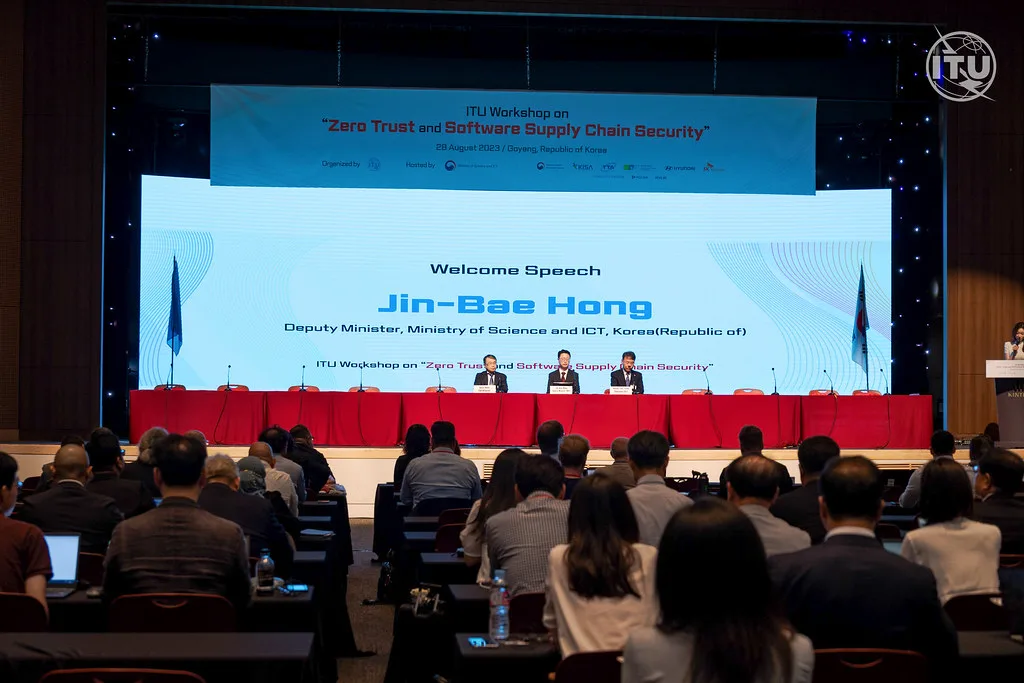
Zero trust security rejects the assumption that a user, device, or system becomes safe simply by being inside a network perimeter. Each access request is continuously verified using identity, device, and context, while least privilege and microsegmentation limit what an intruder can reach after compromise. This model better fits cloud, remote, and partner-connected organizations where the old boundary between inside and outside has dissolved.
For decades, corporate network security operated on a simple assumption: everything inside the firewall is friendly. Build a strong wall around the perimeter, and trust what is inside.
This model made sense when employees worked at desks connected to a fixed office network, when software lived on servers in a company's own data center, and when the boundary between inside and outside was reasonably clear.
None of those conditions reliably apply anymore, and they have not for some time.
The modern enterprise is distributed by nature. Employees work from home, coffee shops, and hotel lobbies. Applications run in cloud environments maintained by third parties. Data is accessed through mobile devices, personal laptops, and shared workstations.
Contractors and partners connect from their own networks. The perimeter - that clean line between trusted inside and untrusted outside - has effectively dissolved. Yet for much of the 2000s and 2010s, organizations continued building security architectures as though it still existed, with predictable results.
High-profile breaches at Target (2013), Anthem (2015), Equifax (2017), and SolarWinds (2020) all involved attackers gaining a foothold inside the supposed perimeter and then moving freely through internal systems that trusted them by default.
Zero trust emerged as a framework that takes this reality seriously. Its premise is simple: trust nothing and no one by default, regardless of where they are in relation to your network. Verify everything, continuously, before granting access.
Limit what any verified entity can access to exactly what they need. This article examines where zero trust came from, how it works, what its core components are, and how organizations can move toward implementing it.
"The perimeter is dead. The network is no longer a safe place to be - and it never really was." - John Kindervag, creator of the zero trust model, Forrester Research, 2010
Key Definitions
Zero trust: A security model based on the principle of "never trust, always verify." It assumes no user, device, or network segment is inherently trustworthy and requires continuous authentication and authorization for every access request.
Perimeter security: The traditional model of network defense that relies on a strong boundary (firewall, VPN) between trusted internal networks and untrusted external networks. Also called the "castle and moat" model.
Microsegmentation: The division of a network into small, isolated segments with tightly controlled access between them, limiting the lateral movement an attacker can achieve after breaching one segment.
Least-privilege access: The principle that any user, system, or process should have access to only the minimum resources and permissions required to perform its function - and nothing more.
Identity-first security: An approach to zero trust that treats verified identity - who you are, what device you are on, and under what conditions - as the primary basis for access decisions, rather than network location.
Lateral movement: The technique attackers use to progressively move through a network after initial compromise, escalating privileges and accessing additional systems. Zero trust architectures are specifically designed to limit lateral movement.
Just-in-time access: A zero trust practice in which elevated or privileged access is granted only for the specific duration needed for a task, then automatically revoked - rather than remaining permanently assigned.
Zero Trust vs. Perimeter Security Compared
| Dimension | Perimeter Security | Zero Trust |
|---|---|---|
| Core assumption | Inside is trusted; outside is untrusted | Nothing is trusted by default - inside or outside |
| Access model | Location-based (inside = access) | Identity + device + context-based |
| Lateral movement | Unrestricted once inside | Blocked by microsegmentation at each step |
| Remote access method | VPN grants broad network access | Application-level access, each request verified |
| Breach impact | High - attacker moves freely inside | Limited - each segment requires fresh verification |
| Monitoring | Perimeter traffic primarily | All traffic, all users, all sessions |
| Suitable for | Fixed office, on-prem, pre-cloud | Hybrid, cloud, remote-first environments |
The Origins of Zero Trust
John Kindervag and the Forrester Framework
John Kindervag published his foundational zero trust framework while working as a principal analyst at Forrester Research in 2010.[1] His core insight was that the traditional trust model was not merely imperfect - it was structurally wrong.
By assuming that internal network traffic was safe, organizations were effectively giving attackers free rein once they breached the perimeter.
And breaching the perimeter was often not especially difficult: a phishing email, a compromised third-party vendor, or a single misconfigured server was frequently sufficient.
Kindervag proposed replacing the binary trusted/untrusted distinction with a model built on three core concepts: verify all traffic regardless of source; limit access through least-privilege principles; and inspect and log all traffic.
The model initially faced resistance from practitioners who viewed it as impractically complex, but it gained rapid traction as high-profile breaches demonstrated the fragility of perimeter-based defenses.
The 2013 Target breach was particularly instructive. Attackers gained initial access not by attacking Target directly, but by compromising an HVAC contractor that had network credentials. From there, they moved laterally through Target's internal network - which trusted the contractor's systems - and reached point-of-sale systems.
A zero trust architecture, with proper segmentation and least-privilege access for the vendor connection, would have contained the initial breach.
Google's BeyondCorp
One of the most significant real-world implementations of zero trust principles came from Google's BeyondCorp initiative, which Google began developing internally around 2011 following the Aurora attacks - a series of sophisticated intrusions into Google and dozens of other major corporations attributed to Chinese state-sponsored actors.
Google's response was to eliminate the concept of a trusted internal network entirely.[10] Under BeyondCorp, there is no VPN and no privileged internal network. Employees access services over the public internet, and every access request is evaluated based on device state, user identity, and context.
A Google engineer working from the office receives no more inherent trust than one working from home. Access decisions are made dynamically, based on continuous verification.
Google published their BeyondCorp approach in a series of papers in the USENIX magazine beginning in 2014, making the implementation details publicly available.[2] This transparency significantly accelerated broader adoption of zero trust principles across the industry and influenced the commercial zero trust platforms that followed.
The Core Pillars of Zero Trust
Identity Verification
In a zero trust architecture, identity is the new perimeter. Who is making a request - and what is their verified identity - becomes the primary basis for access decisions.
This means robust multi-factor authentication (MFA) for all users and systems, strong privileged access management for administrative accounts, and increasingly, continuous authentication that re-evaluates trust during a session rather than only at login.
Modern zero trust identity systems go beyond usernames and passwords. They incorporate device health (is the device managed? is its software up to date?
has it been compromised?), behavioral context (is this access request consistent with this user's normal patterns?), and location context (is this request coming from an expected location?).
Risk-based authentication uses these signals to decide whether additional verification is needed before granting access.
Identity providers like Okta, Microsoft Entra ID (formerly Azure AD), and Ping Identity form the core of most enterprise zero trust identity architectures, integrating with applications to provide policy-enforced, context-aware access decisions at scale.
Device Health and Endpoint Security
Zero trust requires knowing the security state of devices requesting access. A user may be who they claim to be, but if their device is unmanaged, out of date, or showing signs of compromise, that changes the risk calculation significantly.
Zero trust architectures typically require device management enrollment, enforce minimum security configurations (patch levels, encryption, endpoint detection tools), and assess device health at the time of each access request.
This pillar is particularly important for remote work environments, where personal devices and corporate devices connect to the same systems. Under traditional perimeter security, the distinction between managed and unmanaged devices was often enforced at the network boundary.
Without that boundary, device health verification must be built into the access decision itself.
Mobile Device Management (MDM) platforms - Jamf for Apple devices, Microsoft Intune for mixed environments - provide the device health signals that zero trust policies consume.
A device that has not applied recent security patches, or that does not have endpoint detection tools running, can be denied access to sensitive systems regardless of whether the user's credentials are valid.
Microsegmentation and Least-Privilege Access
Even after verification, zero trust limits what any authenticated entity can access. Microsegmentation implements this at the network level by creating small, isolated zones with strict access controls between them.
An attacker who compromises one system cannot automatically reach another - each lateral movement requires fresh authentication and authorization against explicit policy.
Least-privilege access implements the same principle at the authorization level: users and systems get access to only what they demonstrably need.
In practice, this means regular access reviews to prune unnecessary permissions, role-based access control with tightly scoped roles, and just-in-time access provisioning for sensitive resources - granting elevated access for a specific, time-limited purpose rather than permanently.
The 2020 SolarWinds attack illustrated the cost of failing to implement least-privilege. Attackers who compromised SolarWinds's build pipeline inserted malicious code into software updates delivered to thousands of customers.[11]
Once inside those customers' networks, the attackers moved laterally through systems that trusted the SolarWinds software implicitly and had broad access.[7] Better segmentation and access controls would have significantly limited the blast radius of the breach.
Continuous Monitoring and Analytics
Zero trust does not treat verification as a one-time event. Continuous monitoring of all traffic, access events, and user behavior allows anomalies to be detected in real time.
If a user who normally accesses HR data in the morning suddenly begins downloading large quantities of financial records at 2am from an unusual location, zero trust systems flag or block that behavior rather than trusting the authenticated session.
This pillar relies on comprehensive logging and security information and event management (SIEM) systems that correlate signals across the environment.
The Cybersecurity and Infrastructure Security Agency (CISA) has incorporated continuous monitoring and diagnostics as a core requirement in its Zero Trust Maturity Model, published in 2023.[4]
User and Entity Behavior Analytics (UEBA) tools add machine learning to this layer, establishing behavioral baselines for users and systems and automatically flagging deviations.
When an account that normally accesses a handful of internal tools suddenly begins probing dozens of systems, UEBA signals the anomaly - whether the account is externally compromised or represents a malicious insider.
How Zero Trust Differs From VPN-Based Security
Many organizations rely on virtual private networks (VPNs) to extend corporate network access to remote workers. VPNs create an encrypted tunnel between the user's device and the corporate network - but once connected, the user is typically inside the perimeter and trusted broadly.
Zero trust architects describe this as equivalent to giving someone who passed a front door security check unrestricted access to the entire building.
VPNs also create a single point of failure and a high-value target: compromise VPN credentials and you have broad network access. Several major breaches have exploited exactly this - the Pulse Secure VPN vulnerabilities exploited in 2021 allowed attackers direct access to internal networks of government agencies and defense contractors.[6]
Zero trust replaces VPN broad-network access with application-level access: users access specific applications and services directly, with each access request evaluated independently. This eliminates the broad implicit trust that VPN architectures extend to connected users.
Zero Trust Network Access (ZTNA) platforms - Zscaler Private Access, Cloudflare Access, Palo Alto Prisma Access - implement this model commercially, providing application-level access without exposing the underlying network.
The practical difference is significant: with VPN, a compromised device inside the tunnel can scan and attack any internal system. With ZTNA, a compromised device can access only the specific applications the user's policy permits - and each access is logged and evaluated.
Implementing Zero Trust: A Practical Progression
The CISA Zero Trust Maturity Model and the National Institute of Standards and Technology (NIST) SP 800-207 standard provide frameworks for phased implementation.[3]
Realistically, most organizations cannot achieve full zero trust overnight - they move through stages from traditional perimeter-based security toward fully verified, continuously monitored, least-privilege access.[12]
Starting With Identity
The highest-impact first step is almost always identity: deploying MFA universally, implementing a modern identity provider with single sign-on and risk-based authentication, and beginning to build an inventory of what access each user and system actually needs.
Organizations that have not yet deployed MFA universally should treat this as the immediate priority, as credential-based attacks - phishing, credential stuffing, password spray - account for the majority of initial access in enterprise breaches.
Passwordless authentication - using FIDO2 hardware security keys or platform authenticators like Windows Hello and Touch ID - represents the most phishing-resistant form of identity verification available.
Microsoft has reported that MFA blocks over 99.9 percent of account compromise attempts; hardware security keys eliminate the residual credential phishing risk that remains with software-based MFA.
Mapping Data and Access Flows
Before you can control access, you need to understand what exists. A zero trust project requires mapping critical data assets, understanding which systems and users access them, and identifying the communication flows between systems.
This discovery phase often surfaces surprising legacy access patterns - service accounts with administrator privileges, shared credentials, applications with excessive permissions - that represent high-priority remediation targets regardless of broader zero trust progress.
This mapping process is also where organizations identify their "crown jewels" - the data assets, systems, and services most critical to protect - and can prioritize segmentation and monitoring around those first.
Incrementally Applying Segmentation
Microsegmentation can be applied incrementally, starting with the highest-value or highest-risk segments. Isolating customer data stores, financial systems, or industrial control networks from the general corporate network delivers significant risk reduction without requiring the entire network to be resegmented simultaneously.
Network segmentation has historically been difficult because flat networks are easy to build and hard to restructure.
Software-defined networking and cloud-native architectures have made micro-segmentation substantially more achievable - cloud environments like AWS, Azure, and Google Cloud provide security groups and network policies that implement microsegmentation natively.
Real-World Zero Trust Adoption
Following the SolarWinds attack and a series of ransomware incidents targeting critical infrastructure, the Biden administration issued Executive Order 14028 in May 2021, which explicitly directed U.S.[5] federal agencies to move toward zero trust architectures.
The subsequent CISA and Office of Management and Budget (OMB) guidance in January 2022 (Memorandum M-22-09) set a fiscal year 2024 target for federal agencies to reach defined zero trust milestones covering identity, devices, networks, applications, and data.[9]
Major technology vendors - Microsoft, Google, Palo Alto Networks, Zscaler, Okta - have built substantial product portfolios around zero trust principles, which has both accelerated adoption and complicated purchasing decisions as vendors apply the "zero trust" label broadly.
Gartner estimated that by 2025, more than 60 percent of organizations would have adopted zero trust as a starting point for security, up from less than 10 percent in 2021.[8]
Cloud-native organizations have an inherent advantage in zero trust adoption: modern cloud platforms were built without the assumption of a trusted internal network, so identity-based access controls and per-request verification are native to their architectures rather than retrofitted.
Organizations migrating from legacy on-premises environments face more complexity, but the migration itself creates opportunities to restructure access models.
Common Zero Trust Implementation Mistakes
Treating Zero Trust as a Product
Zero trust is a philosophy and an architecture - not a product you can purchase.
Many vendors market their offerings as "zero trust solutions," but purchasing a ZTNA platform without addressing identity management, device health verification, and access policy does not deliver zero trust outcomes.
The technology is in service of the principles; the principles must guide the technology choices.
Neglecting Service-to-Service Authentication
Most zero trust programs start with human users and identity - which is right. But applications and services also communicate with each other, and service-to-service authentication is equally important.
Hardcoded credentials, overly permissive service accounts, and unverified machine identities are a significant attack vector that user-focused zero trust programs often overlook. SPIFFE/SPIRE and similar frameworks address machine identity within zero trust architectures.
Underestimating Change Management
Zero trust fundamentally changes how people work - additional authentication steps, application access replacing network access, device compliance requirements.
Without adequate change management and communication, security teams often encounter resistance that leads to policy exceptions and workarounds that undermine the architecture. User experience considerations belong in zero trust design, not just security engineering.
Practical Takeaways
Zero trust is a security philosophy as much as a specific technology stack. Its power is in the shift in assumption: instead of asking "is this person inside our perimeter?" it asks "does this specific request, from this specific identity, on this specific device, in this specific context, warrant the access being requested right now?" That shift in framing changes what you build, what you log, and what you respond to.
For organizations beginning the journey, the priority sequence is generally: implement universal MFA, establish strong identity and access management, begin inventorying access permissions and removing excess, and build toward microsegmentation of critical assets.
Perfection is not required to gain benefit - incremental progress toward zero trust delivers real risk reduction at every stage.
Zero trust does not mean zero friction. Well-designed zero trust architectures are often less disruptive than legacy VPN and perimeter systems - applications are accessible from anywhere without VPN, and risk-based authentication applies additional checks only when signals warrant them, not by default.
The goal is appropriate trust, dynamically evaluated - not maximum inconvenience.
Sources & Further Reading
- Kindervag, J. (2010). Build Security Into Your Network's DNA: The Zero Trust Network Architecture. Forrester Research.
- Ward, R., & Beyer, B. (2014). "BeyondCorp: A New Approach to Enterprise Security." USENIX ;login:, 39(6).
- NIST. (2020). SP 800-207: Zero Trust Architecture. National Institute of Standards and Technology.
- CISA. (2023). Zero Trust Maturity Model, Version 2.0. Cybersecurity and Infrastructure Security Agency.
- Executive Order 14028 on Improving the Nation's Cybersecurity. (2021). White House.
- Osborne, C. (2021). "Pulse Secure VPN zero-day used to hack defense firms, govt agencies." ZDNet, April 20.
- Perlroth, N., & Sanger, D. E. (2020). "SolarWinds hack was far more widespread than first revealed." The New York Times, December 17.
- Gartner. (2023). Gartner Predicts 2023: Zero Trust Comes of Age. Gartner Inc.
- OMB. (2022). Memorandum M-22-09: Moving the U.S. Government Toward Zero Trust Cybersecurity Principles. Office of Management and Budget.
- Patel, S. (2021). "Google BeyondCorp: The story behind the zero trust model." Google Cloud Blog.
- Greenberg, A. (2021). "The untold story of the SolarWinds, the boldest supply chain hack ever." Wired, May 7.
- Rose, S., et al. (2020). Implementing a Zero Trust Architecture. National Cybersecurity Center of Excellence, NIST.