
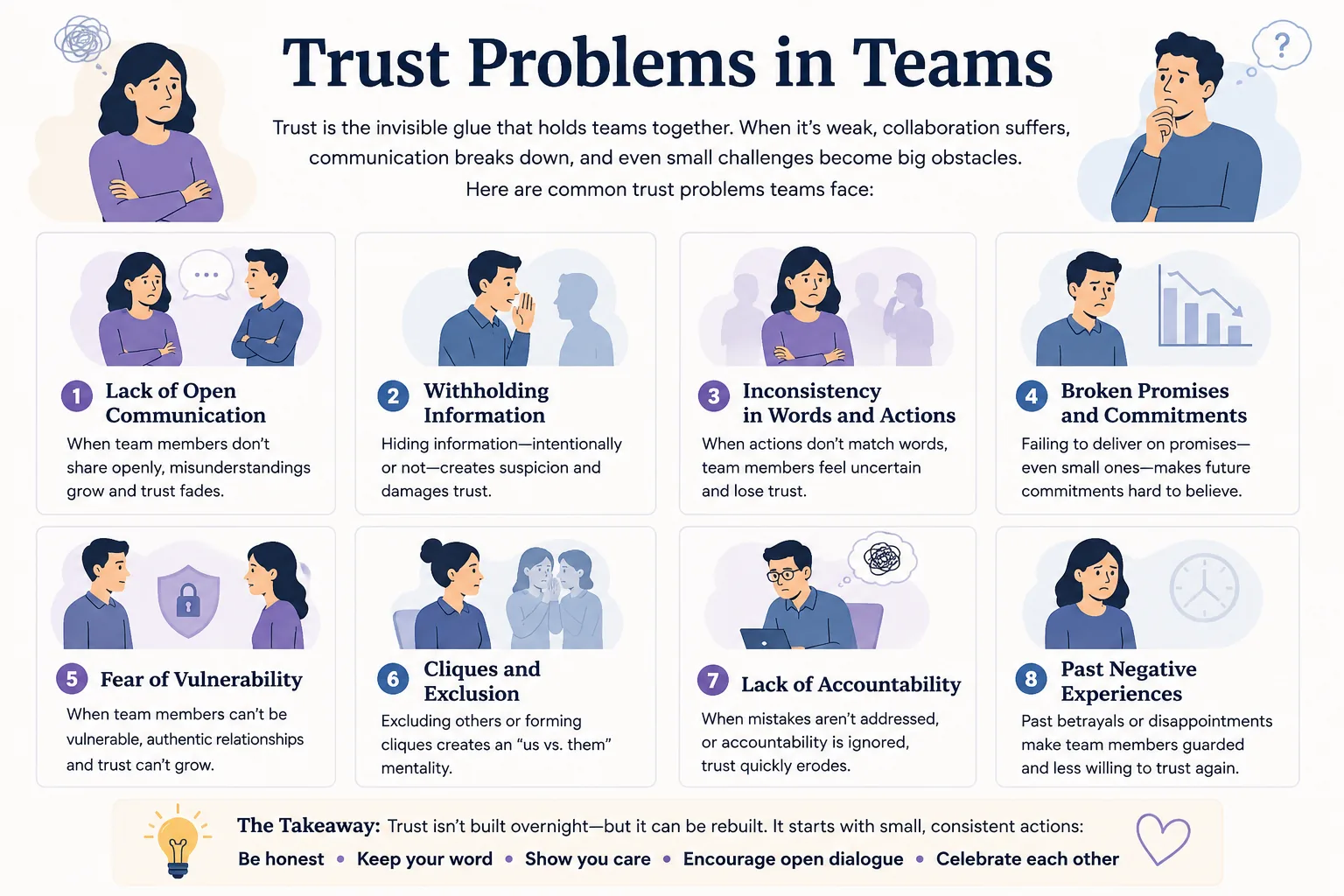
Low trust makes routine work expensive, adding defensive documentation, slow decisions, duplicated effort, and fear of failure. Trust problems in teams involve confidence in colleagues' competence, reliability, integrity, and intentions, while psychological safety concerns whether people can speak up. Both must be built through consistent conduct, clear commitments, shared goals, and conditions for direct disagreement.
A software team ships a critical feature with known bugs because no one felt safe telling the VP of Engineering that the deadline was unrealistic. A product manager hoards strategic context instead of sharing it, fearing others will challenge their decisions.
Engineers write defensive code comments documenting every decision to protect themselves from future blame. Marketing and sales teams duplicate efforts because neither trusts the other's judgment enough to coordinate.
These aren't primarily process problems or communication failures, they're trust problems.
And trust problems create a tax on everything: decisions take longer because people need consensus to feel safe; coordination requires excessive documentation because no one trusts verbal agreements; innovation stalls because failure might be punished rather than learned from; talented people leave because working in a low-trust environment is exhausting.
"Trust is the lubrication that makes it possible for organizations to work. Without it, everything slows down, every transaction must be verified, and the energy that could go into creating value goes into protection." - Warren Bennis, leadership scholar
Yet organizations persistently try to solve trust deficits with structural interventions: new collaboration tools, more meetings, clearer processes, reorganizations.
These approaches assume the problem is information flow or organizational design when the actual problem is social infrastructure: whether people believe their colleagues are competent, reliable, and acting with good intent.
Trust isn't a soft, touchy-feely concern separate from hard business outcomes. It's the substrate on which everything else runs.
In high-trust teams, people communicate efficiently because they don't hedge every statement; they make decisions quickly because they trust others' judgment; they innovate because failure is learning rather than punishment; they coordinate with minimal overhead because verbal agreements stick.
Low trust creates the opposite: every interaction requires defensive effort, every decision needs excessive validation, every failure triggers blame rather than improvement.
This analysis examines trust problems in teams: what trust actually is (and isn't), how it breaks down, why common interventions fail, what systematically builds trust, and how to diagnose and address trust deficits that undermine team performance.
| Trust Problem | How It Manifests | Common (Failed) Intervention | What Actually Helps |
|---|---|---|---|
| Broken commitments | Verbal agreements not followed through | More meetings to follow up | Fewer, clearer commitments with written records |
| Competence uncertainty | Double-checking others' work; excessive review cycles | Team-building activities | Demonstrated track record on smaller tasks first |
| Information hoarding | Siloed knowledge; people protect context | Mandate sharing in all-hands meetings | Incentive structures that reward sharing over territory |
| Interpersonal conflict | Passive communication; issues raised behind backs | Conflict resolution workshops | Psychological safety to raise concerns directly |
| Leadership trust deficit | Cynicism about stated strategy; disengagement | Leadership communication campaigns | Consistent behavior matching stated values over time |
| Cross-team mistrust | Duplication of effort; territorial defensiveness | Reorganization | Shared goals with joint accountability |
What Trust Actually Means
Trust is confidence that others will:
- Be competent: Have the skills and judgment to do good work
- Be reliable: Follow through on commitments and obligations
- Act with integrity: Be honest and consistent between words and actions
- Have good intent: Consider others' interests, not just their own
These dimensions are distinct: you can trust someone's competence but not their reliability (brilliant but flaky), or their reliability but not their intent (they do what they say but only for self-serving reasons).
Trust vs. Psychological Safety
Often confused but importantly different:
Trust = Confidence in others: Will they deliver? Are they competent? Do they mean well?
Psychological safety = Confidence about yourself: Can I speak up, admit mistakes, ask questions, disagree without being punished or humiliated?
A team can have:
- High trust, low safety: Everyone is competent and reliable, but you can't admit uncertainty or question decisions (common in high-performing but rigid cultures)
- High safety, low trust: You can speak freely, but people don't deliver on commitments (common in overly permissive cultures)
- Both high: Optimal state, confident in others' competence and your own ability to take interpersonal risks
- Both low: Dysfunctional, don't trust others' abilities and can't voice concerns
Both are necessary; neither alone suffices. This analysis focuses primarily on trust, though psychological safety connects closely.
Layers of Trust
Trust develops at different levels with different characteristics:
Calculative trust (transactional):
- Based on self-interest: "They'll deliver because it benefits them"
- Common in new relationships or arms-length transactions
- Fragile, breaks when incentives misalign
- Example: Vendor delivers because they want repeat business, not loyalty
Competence-based trust (professional):
- Based on demonstrated ability: "They consistently do good work"
- Develops through observing performance over time
- Medium durability, persists unless competence questioned
- Example: Trusting colleague's technical judgment from years of solid work
Relational trust (personal):
- Based on relationship and shared values: "They care about me/us, not just themselves"
- Develops through vulnerability, consistency, and mutual investment
- Most durable, survives occasional failures
- Example: Trusting team member will tell hard truths because they're invested in your success
High-performing teams need all three layers. Calculative trust handles transactions, competence trust enables delegation, relational trust allows vulnerability and candor essential for difficult work.
How Trust Breaks Down
Trust erodes through specific, diagnosable patterns:
1. Inconsistency Between Words and Actions
The pattern: Saying one thing, doing another. Stated values conflicting with actual decisions.
Example: Leadership says "failure is learning" but then punishes the first team that ships a failed experiment. Everyone learns the real value: don't take risks.
Example: Manager says "transparency is important" but excludes team from strategic discussions, sharing only filtered information. Team learns: stated values are aspirational, not real.
Why it destroys trust: Inconsistency creates unpredictability. If people can't rely on what you say, they must constantly guess what you really mean, exhausting cognitive effort and creating defensive behavior.
2. Lack of Vulnerability from Leadership
The pattern: Leaders project infallibility, never admitting mistakes or uncertainty.
Example: Executive makes poor strategic decision, blames market conditions rather than acknowledging judgment error. Team learns: admitting mistakes is weakness, not learning.
Example: Manager pretends to have all answers rather than admitting uncertainty. Team stops surfacing difficult questions because asking is positioned as doubt rather than collaboration.
Why it destroys trust: Vulnerability is the currency of relational trust. If leaders won't show it, others won't either, preventing the reciprocal vulnerability that builds deep trust. Without vulnerability, relationship stays transactional and fragile.
3. Information Hoarding and Opacity
The pattern: Withholding context, making decisions behind closed doors, selectively sharing information.
Example: Product manager makes prioritization decisions without explaining rationale. Team doesn't understand why their work matters or how decisions get made, creating distrust of decision-making process.
Example: Leadership discusses org changes in private, letting rumors fill the information void. Lack of transparency creates anxiety and speculation, eroding trust that leaders will communicate honestly.
Why it destroys trust: Information asymmetry creates suspicion. When people lack context, they fill gaps with negative assumptions about intent. Transparency demonstrates trust ("I trust you with this information") and builds reciprocal trust.
4. Blame Culture and Punishment for Failure
The pattern: When things go wrong, the response is finding fault and assigning blame rather than understanding system factors and learning.
Example: Production incident occurs. Post-mortem focuses on who made the mistake rather than what process improvements would prevent recurrence. Engineer who made error becomes defensive; others learn to hide mistakes.
"In a blame culture, people spend their energy covering their mistakes rather than correcting them. You get the worst of both worlds: the error persists, and so does the fear." - Amy Edmondson, Novartis Professor of Leadership, Harvard Business School
Example: Project misses deadline. Leadership focuses on "holding people accountable" (punishment) rather than understanding unrealistic initial estimates or changing requirements. Team learns: don't surface problems early because bringing bad news gets you blamed.
Why it destroys trust: Blame creates fear. When failure leads to punishment, people hide problems until they're too large to hide, preventing early correction. Trust requires belief that admitting mistakes is safe, not career-limiting.
5. Unclear Expectations Leading to Disappointment
The pattern: Ambiguous goals, shifting priorities, or unspoken assumptions create situations where people think they delivered but others are disappointed.
Example: Manager gives vague feedback like "be more strategic." Employee thinks they're improving, but manager remains dissatisfied. Relationship deteriorates because neither feels the other is trying.
Example: Team launches feature they believe meets requirements, but stakeholders are unhappy because unstated expectations weren't met. Stakeholders lose trust in team's judgment; team loses trust in stakeholder's clarity.
Why it destroys trust: Repeated disappointment, even from misunderstanding rather than malice, erodes trust. Clear expectations are infrastructure for reliability: you can't be reliable if you don't know what others need.
6. Insufficient Relationship Investment
The pattern: Interactions are purely transactional, only discussing work, never investing in relationship beyond immediate task needs.
Example: Manager only talks to reports in weekly 1:1s about project status, never asking about career goals, challenges, or interests beyond current work. Relationship stays instrumental and fragile.
Example: Remote team communicates only through Slack about immediate tasks. No video calls, no informal chat, no personal connection. When conflict arises, there's no relationship cushion to absorb it.
Why it destroys trust: Relational trust requires knowing people as humans, not just role-fillers. Without personal connection, relationships stay calculative and fragile. The investment in knowing each other creates resilience when work gets hard.
The Performance Cost of Low Trust
Trust deficits create measurable drag on team performance:
Slower Decision-Making
High-trust teams: Individuals make decisions in their domains, trusting others' judgment. Decisions are quick and local.
Low-trust teams: Decisions require consensus because no one trusts others to decide without group validation. Every decision becomes a committee decision, slowing everything.
Example: In high-trust engineering team, individual developers make technical decisions within established architecture. In low-trust team, every technical decision requires architecture review board approval, creating bottlenecks and delays.
Cost: Decision latency increases by 3-10x. Multiply this across hundreds of daily decisions.
Increased Coordination Overhead
High-trust teams: Verbal agreements stick. Documentation is minimal, just enough for future reference.
Low-trust teams: Everything must be written down defensively. People create paper trails to protect themselves. CYA (cover your ass) behavior dominates.
Example: High-trust product team has quick conversation about feature requirements, documents key points in ticket, builds it. Low-trust team requires detailed specifications, sign-off emails, status updates every step to demonstrate they followed approved plan if something goes wrong.
Cost: Communication overhead increases by 2-5x. Time spent on defensive documentation and status reporting could be spent on value creation.
Reduced Innovation and Risk-Taking
High-trust teams: People experiment, fail, learn, iterate. Failure is data collection, not career risk.
Low-trust teams: People avoid anything risky. Only pursue sure things. Propose ideas they're confident leadership will approve rather than ideas that might work best.
Example: High-trust team runs 10 experiments, 7 fail, 3 succeed, they learn what works. Low-trust team proposes only safe, proven approaches, innovates slowly, gets disrupted by faster-moving competitors.
Cost: Innovation throughput drops by 5-10x. In competitive markets, this determines winners and losers.
Information Silos and Duplication
High-trust teams: People share information freely because they're not hoarding competitive advantage.
Low-trust teams: Information is power. People hoard knowledge to remain indispensable or prevent others from challenging their position.
Example: High-trust sales and marketing teams share customer insights constantly, improving both functions. Low-trust teams duplicate effort, with sales claiming marketing doesn't understand customers and marketing claiming sales doesn't share feedback.
Cost: Duplication of effort (1.5-2x cost), missed opportunities from lack of shared knowledge.
Talent Attrition
High-trust teams: People stay because the environment is energizing. Psychological safety allows learning and growth.
Low-trust teams: Working in low-trust environment is exhausting: constant vigilance, defensive behavior, political navigation. Best performers leave for better environments.
Example: High-trust team retains top performers for 5-10 years, building institutional knowledge. Low-trust team has 40% annual turnover, constantly training replacements, losing momentum.
Cost: Recruiting costs (20-50% of annual salary per replacement), productivity loss during ramp-up, knowledge loss when people leave.
Increased Stress and Burnout
High-trust teams: Energy goes toward productive work. Psychological safety reduces anxiety.
Low-trust teams: Energy goes toward political navigation, defending oneself, managing anxiety. Chronic stress accumulates.
Example: High-trust team ends day tired from hard work but satisfied. Low-trust team ends day exhausted from interpersonal stress and defensive effort, even if actual work was minimal.
Cost: Reduced cognitive performance, health issues, burnout, lower quality of work and life.
The cumulative effect: low-trust teams might achieve 50-70% of the productivity of high-trust teams with identical technical talent and resources. Trust is multiplicative infrastructure, not additive nice-to-have.
"The speed of trust is the single most significant variable in organizational performance. Low trust is a hidden tax; high trust is a multiplier that makes everything move faster and cost less." - Stephen M. R. Covey, author of The Speed of Trust
Why Common Interventions Fail
Organizations recognize trust problems but often apply solutions that don't address root causes:
Failed Intervention 1: More Meetings
The logic: "We need better communication. Let's have more meetings for alignment."
Why it fails: Meetings don't build trust if the underlying problem is that people don't believe what they hear in meetings. More meetings in low-trust environment just means more time spent in unproductive, guarded conversations.
What's actually needed: Consistency between what's said in meetings and what happens afterward. One meeting where decisions stick builds more trust than 10 meetings where decisions get reversed or ignored.
Failed Intervention 2: Team-Building Activities
The logic: "Trust comes from knowing each other. Let's do an off-site with games and activities."
Why it fails: Superficial bonding activities don't create trust if day-to-day work environment undermines it. Playing trust falls during an off-site doesn't help if Monday morning brings blame, information hoarding, and broken commitments.
What's actually needed: Daily behavioral consistency: following through on commitments, sharing information, admitting mistakes, giving credit. Trust builds through repeated small interactions, not isolated events.
Failed Intervention 3: New Collaboration Tools
The logic: "Poor collaboration is a communication problem. Better tools will fix it."
Why it fails: Tools don't create trust. Low-trust teams will use sophisticated collaboration platforms the same way they use email: carefully, defensively, creating paper trails for protection.
What's actually needed: Addressing behavioral and cultural issues that make people communicate defensively. The problem isn't the medium; it's what people feel safe saying.
Failed Intervention 4: Reorganization
The logic: "Trust problem stems from organizational structure. New org will fix relationships."
Why it fails: Trust problems follow people into new structures unless behavioral patterns change. Reorganizing shuffles the same trust deficits into new configurations.
What's actually needed: Address behavioral patterns creating distrust: how decisions get made, how leaders model vulnerability, how mistakes are handled, regardless of org structure.
Failed Intervention 5: Values Statements and Culture Initiatives
The logic: "Let's articulate our values and create culture programs around them."
Why it fails: Stated values don't create trust if leadership behavior contradicts them. In fact, prominent values statements highlighting the gap between aspiration and reality can make trust worse by highlighting hypocrisy.
What's actually needed: Alignment between stated values and actual behavior, especially leadership behavior. Values are demonstrated through daily decisions, not posters.
Failed Intervention 6: Individual Relationship Coaching
The logic: "These two people don't trust each other. Let's coach them on interpersonal skills."
Why it fails: If the trust problem is systemic (blame culture, information hoarding, unclear expectations), coaching individuals treats symptoms not causes. They return to an environment that recreates the problem.
What's actually needed: System-level changes in how the organization handles failure, shares information, and makes decisions. Individual relationships exist within organizational context.
What Actually Builds Trust
Trust-building is boring, slow, and behavioral, not structural or rhetorical:
1. Consistent Follow-Through on Commitments
The practice: Do what you say you'll do, when you say you'll do it. If you can't, communicate early and renegotiate.
Why it works: Reliability is the foundation of trust. Each kept commitment is a small deposit in the trust account. Each broken commitment is a large withdrawal. Consistency over time builds confidence that you can be relied upon.
How to implement:
- Make fewer, clearer commitments (better to under-promise and over-deliver)
- Track commitments explicitly (don't rely on memory)
- Communicate proactively when commitments are at risk
- Renegotiate early rather than missing deadlines silently
- Acknowledge when you dropped something (builds trust through honesty)
Example: Manager commits to providing feedback on proposal by Friday. Thursday realizes they won't have time. Messages team member: "I committed to Friday feedback but won't make it, can we move to Monday?" This maintains trust. Silently missing Friday deadline erodes trust.
2. Vulnerability from Leadership
The practice: Leaders admit mistakes, uncertainty, and limitations. Model the behavior you want from others.
Why it works: Vulnerability is invitation to reciprocal vulnerability. If leaders show they won't be punished for admitting mistakes, others feel safer doing the same. Vulnerability also demonstrates humanity, leaders are people, not perfect machines.
"Vulnerability is not weakness. And that myth is profoundly dangerous. Vulnerability is the birthplace of innovation, creativity, and change. You cannot have one without the other." - Brene Brown, research professor and author of Dare to Lead
How to implement:
- Explicitly acknowledge your mistakes in public forums
- Admit when you don't know something rather than bluffing
- Share your reasoning including uncertainties, not just conclusions
- Ask for help and feedback rather than projecting omniscience
- Thank people who surface problems or challenge your thinking
Example: CEO in all-hands: "We made a strategic bet on X that didn't work. I pushed for this despite concerns some of you raised. You were right; I was wrong. Here's what we learned and how we're adjusting." This builds massive trust.
3. Transparent Decision-Making
The practice: Share how decisions get made, what factors matter, who has input. Make reasoning visible.
Why it works: Opacity breeds suspicion. Transparency demonstrates respect ("you deserve to understand") and confidence ("we're not hiding anything"). Even when people disagree with decisions, understanding the process maintains trust in the system.
How to implement:
- Document decision-making process (who decides, what criteria, how input is considered)
- Share reasoning behind decisions, not just outcomes
- Invite input before decisions, be clear about how it will be used
- Explain why certain input didn't change the decision (not just ignoring it)
- Make decision-making patterns predictable and consistent
Example: Product manager shares prioritization framework: "We score features on impact/effort. Here's how we scored these options. Some ideas you championed scored lower on impact. Here's why we assessed them that way." This maintains trust even when people's suggestions aren't chosen.
4. Blameless Problem-Solving
The practice: When things go wrong, focus on understanding system factors and improving processes rather than finding fault and punishing individuals.
Why it works: Blame creates fear; fear destroys trust and information flow. Blameless culture encourages surfacing problems early (when they're fixable) and learning from failures. This requires genuine belief that most mistakes come from system factors, not individual character flaws.
How to implement:
- Frame incidents as learning opportunities, not fault-finding exercises
- Ask "what conditions made this likely?" not "who screwed up?"
- Focus on process improvements that prevent recurrence
- Distinguish honest mistakes (no blame) from integrity violations (appropriate accountability)
- Celebrate people who surface problems and admit mistakes
Example: After missed deadline, instead of "Why didn't you tell us earlier?" ask "What prevented early visibility into the problem? How can we create better signals of timeline risk?" This invites learning rather than defensiveness.
5. Regular, Balanced Feedback
The practice: Give feedback frequently (not just annual reviews), both positive and constructive, specific and actionable.
Why it works: Regular feedback builds trust by demonstrating investment in others' growth and creating transparency about how you perceive their work. Balanced feedback (not just criticism) shows you notice good work, not only problems.
How to implement:
- Make feedback immediate (within 24-48 hours of observing behavior)
- Use specific examples, not generalizations
- Maintain 3-5:1 ratio of positive to constructive feedback
- Make positive feedback public, constructive feedback private
- Focus on behavior and impact, not personality judgments
Example: After successful presentation: "Your explanation of the technical architecture was exceptionally clear, you anticipated questions and addressed them proactively. That built confidence with stakeholders." This specific positive feedback builds trust that you notice and value good work.
6. Generous Credit Attribution
The practice: Publicly acknowledge others' contributions. Share credit liberally. Take responsibility for failures.
Why it works: Generosity with credit demonstrates secure leadership, you're not threatened by others' success. It also builds reciprocal generosity and creates culture where people support each other rather than competing for credit.
How to implement:
- Name specific people who contributed when sharing successes
- Avoid "we" when describing work you didn't do personally
- Redirect credit when others thank you for others' work
- Take ownership of failures without deflecting to team
- Celebrate others' achievements in public forums
Example: When board praises product launch, CEO responds: "That success belongs to the product team. Sarah led the design work that users are loving, and engineering team led by James delivered it six weeks ahead of schedule." This builds enormous trust and loyalty.
7. Personal Connection Beyond Work
The practice: Invest time in knowing people as humans: interests, values, challenges, not just as role-fillers.
Why it works: Relational trust requires seeing people as whole humans, not instrumentally. Personal connection creates resilience: relationships can absorb conflict and disappointment when there's genuine care for the person, not just their output.
How to implement:
- Start meetings with personal check-ins (genuine curiosity, not pro forma)
- Have occasional conversations entirely about non-work topics
- Remember and follow up on important personal matters (family events, hobbies)
- Share appropriate personal information about yourself (modeling vulnerability)
- Create informal spaces for connection (virtual coffee, team lunches)
Example: Manager starts 1:1: "How was your daughter's soccer tournament?" Shows they remembered what's important to the person. Relationship deepens beyond transactional work discussion.
Rebuilding Broken Trust
When trust has been damaged, rebuilding requires specific steps:
1. Acknowledge the Breach Explicitly
Don't: Pretend nothing happened or expect trust to rebuild without addressing what broke it.
Do: Name specifically what happened and that it damaged trust. Demonstrate you understand the impact.
Example: "I committed to including you in the hiring decision, then made the hire without your input. That broke my commitment and likely made you doubt whether your opinion matters on this team. I understand why that damages trust."
2. Understand Impact Without Defensiveness
Don't: Explain why you did it, justify the decision, or minimize the harm.
Do: Listen to how it affected the other person. Accept their experience without debating whether they should feel that way.
Example: When they say "I felt blindsided and disrespected," don't respond with "I was under time pressure" or "That wasn't my intent." Respond with: "I hear that you felt blindsided and disrespected. That makes sense given what happened."
3. Commit to Specific Changed Behavior
Don't: Make vague promises like "I'll do better" or "I'll try harder."
Do: Describe specifically what you'll do differently. Make it observable and verifiable.
Example: "Going forward, I'll share draft hiring decisions with you before finalizing them, even if timelines are tight. You'll have at least 24 hours to provide input before I make the final call."
4. Follow Through Consistently Over Time
Don't: Expect trust to rebuild immediately after apology.
Do: Demonstrate changed behavior repeatedly. Each instance of doing what you committed to is a small trust deposit. This takes months, not days.
Example: Next three hiring decisions, manager proactively shares drafts with team member and incorporates feedback. Consistent follow-through over time rebuilds confidence in reliability.
5. Accept That Rebuilding Takes Longer Than Breaking
Don't: Get frustrated if trust doesn't return quickly. Don't interpret continued wariness as unwillingness to move forward.
Do: Accept that rebuilding trust takes much longer than breaking it (often 5-10x longer). Continued consistency eventually overcomes skepticism.
Example: Trust was broken in a single incident but might take six months of consistent different behavior to rebuild. That's normal, not unreasonable.
6. Create Transparency About Progress
Don't: Assume the other person notices your changed behavior.
Do: Periodically check in about whether they're seeing the changes and whether trust is rebuilding. Make the process explicit.
Example: After two months: "I've been trying to include you earlier in decisions. Are you noticing that change? Is it helping rebuild trust? What else would help?"
Some trust damage is permanent
Reality: Not all broken trust can be fully repaired. Severe breaches (lying, integrity violations, deep betrayal) may leave permanent scars. The question becomes: can we rebuild enough trust to work together effectively, even if the relationship never returns to its previous state?
Sometimes the answer is no, and the healthy outcome is ending the relationship rather than trying to force trust that can't be rebuilt.
Diagnosing Trust Problems
How do you know if trust is the underlying problem?
Symptoms of Trust Deficits
Communication patterns:
- Heavy CYA behavior (documenting everything to protect oneself)
- Reluctance to share information ("need to know" mentality)
- Careful, guarded language in meetings (no one speaks freely)
- Extensive email trails for simple decisions
- Important discussions happen in private, not public forums
Decision-making patterns:
- Decisions require excessive consensus (no one trusts others to decide)
- Decisions get revisited repeatedly (lack of confidence in process)
- Analysis paralysis (fear of making wrong decision)
- Leaders override delegated decisions (don't trust others' judgment)
- People ask permission for routine decisions (don't trust they have authority)
Collaboration patterns:
- Territorial behavior (protecting turf)
- Duplication of effort (not coordinating)
- Withholding help (hoarding competitive advantage)
- Blaming other teams when things go wrong
- Credit disputes (competing for recognition)
Cultural indicators:
- People leave meetings and immediately debrief privately ("what did they really mean?")
- Rumors and speculation fill information voids
- Talented people leave despite good compensation
- High stress and burnout despite reasonable workload
- New ideas get shut down quickly (fear of risk)
Diagnostic Questions
For individuals:
- Do you trust your teammates' competence? Reliability? Intent?
- Do you feel safe admitting mistakes? Asking for help? Disagreeing?
- Can you take people at their word or do you second-guess their motives?
- Do you spend energy protecting yourself or on productive work?
For teams:
- How long does it take to make routine decisions?
- How much documentation is defensive vs. genuinely useful?
- What percentage of communication is information sharing vs. political navigation?
- Do people volunteer help or wait to be asked?
- How do people respond when things go wrong?
For organizations:
- What's the turnover rate for high performers?
- How much information flows freely vs. being hoarded?
- Do people speak candidly in large meetings or only privately?
- How consistent is behavior with stated values?
- What happens when leaders make mistakes?
If answers reveal patterns of defensiveness, information hoarding, excessive caution, and energy spent on protection rather than production, trust deficit is likely the root cause.
Key Takeaways
What trust is:
- Confidence in others' competence, reliability, integrity, and intent
- Distinct from psychological safety (confidence about yourself vs. others)
- Develops in layers: calculative (transactional), competence-based (professional), relational (personal)
- All three layers needed for high-performing teams
How trust breaks down:
- Inconsistency between words and actions
- Lack of vulnerability from leadership
- Information hoarding and opacity in decision-making
- Blame culture and punishment for failure
- Unclear expectations leading to repeated disappointment
- Insufficient personal relationship investment beyond transactions
Performance costs of low trust:
- Slower decisions (3-10x longer requiring consensus)
- Higher coordination overhead (2-5x more defensive documentation)
- Reduced innovation (5-10x fewer experiments)
- Information silos and duplication (1.5-2x wasted effort)
- Talent attrition (recruiting and ramp-up costs)
- Increased stress and burnout (reduced cognitive performance)
Why common interventions fail:
- More meetings don't help if people don't trust what they hear
- Team-building activities don't stick if daily environment undermines trust
- New tools don't solve behavioral and cultural problems
- Reorganization shuffles same trust deficits into new structure
- Values statements without behavioral alignment highlight hypocrisy
- Individual coaching doesn't fix systemic problems
What actually builds trust:
- Consistent follow-through on commitments (reliability foundation)
- Vulnerability from leadership (modeling safe behavior)
- Transparent decision-making (reducing suspicion)
- Blameless problem-solving (encouraging early problem surfacing)
- Regular balanced feedback (demonstrating investment)
- Generous credit attribution (showing secure leadership)
- Personal connection beyond work (building relational trust)
Rebuilding broken trust requires:
- Explicit acknowledgment of breach and impact
- Understanding consequences without defensiveness
- Specific behavioral commitments (not vague promises)
- Consistent follow-through over months
- Acceptance that rebuilding takes 5-10x longer than breaking
- Transparency about progress and changes
- Recognition that some breaches cause permanent damage
Trust is infrastructure, not nice-to-have. It's the substrate enabling efficient communication, rapid decisions, innovation, coordination, and talent retention. Low-trust teams might achieve 50-70% of high-trust team productivity with identical resources.
Building trust requires boring, consistent behavioral work over time: following through on commitments, admitting mistakes, sharing information, giving credit, investing in relationships. There are no shortcuts, quick fixes, or structural substitutes for this daily behavioral consistency.
What Research Shows About Trust Problems in Teams
Amy Edmondson at Harvard Business School published her foundational research on psychological safety in the Administrative Science Quarterly in 1999, titled "Psychological Safety and Learning Behavior in Work Teams." Studying 51 work teams in a manufacturing company, Edmondson found that psychological safety predicted learning behavior and team performance; her earlier medication-error study of hospital teams found that better-performing units reported more errors.
The resolution was that high-performing teams operated in environments with higher psychological safety - they felt safe reporting errors and surfacing problems - while lower-performing teams concealed errors out of fear.
Edmondson measured psychological safety using a seven-item scale and found it was the strongest predictor of team learning behavior, significantly outpacing team composition, leader coaching behavior, and context support.
Her 2018 book "The Fearless Organization," synthesizing twenty years of follow-on research across 25 organizations in healthcare, aviation, financial services, and technology, concluded that psychological safety is not a personality trait or team chemistry variable but an organizational climate that leaders actively create or destroy through specific behavioral choices.
The Google's Project Aristotle research, which analyzed 180 teams, was publicized in 2016 and reached a similar conclusion to Edmondson's: psychological safety was the single strongest predictor of team effectiveness, more predictive than individual talent, team composition, or team structure.
Roger Mayer at Texas Christian University, James Davis at the University of Notre Dame, and F. David Schoorman at Purdue University published "An Integrative Model of Organizational Trust" in the Academy of Management Review in 1995, which became the most widely cited theoretical framework for understanding organizational trust.
The model distinguishes three antecedents of trustor trust in a trustee: ability (competence-based trust), benevolence (relational trust based on perceived goodwill), and integrity (consistency between stated values and behavior).
The model proposes that these dimensions are weighted differently depending on the relationship stage and context, but that integrity has the highest leverage for initial trust formation because it is most directly observable through behavioral consistency.
Subsequent research on trust repair (e.g., Kim, Ferrin, Cooper & Dirks, 2004, Journal of Applied Psychology) found that trust violations based on integrity are harder to repair than violations based on competence, and that trust recovery after integrity violations required significantly longer periods of consistent behavior than trust recovery after competence failures - a finding that has direct implications for how organizations approach leader accountability.
Paul Zak at Claremont Graduate University published "The Neuroscience of Trust" in Harvard Business Review in January 2017, reporting findings from a decade of field and laboratory research on oxytocin's role in organizational trust.
Zak measured oxytocin through blood samples (and in some studies administered synthetic oxytocin) while having participants play economic trust games with real monetary stakes, finding that oxytocin release was directly correlated with reciprocal trust behavior and that people who received more trust (in the form of larger monetary transfers) showed higher oxytocin levels and reciprocated more generously.
The research established a neurological basis for the social reciprocity dynamic underlying trust: being trusted increases oxytocin, which increases trustworthy behavior, creating a positive feedback loop.
Zak's organizational research, involving surveys and physiological measurements at dozens of companies, found that employees in high-trust organizations (as measured by validated trust scales) compared to low-trust organizations showed 74% less stress, 106% more energy at work, 50% higher productivity, 13% fewer sick days, and 40% less burnout (per Zak's HBR 2017 article).
The magnitude of these differences, while likely subject to selection effects, established trust as a consequential organizational variable with measurable physiological and performance correlates.
Stephen M.R. Covey at FranklinCovey formalized the concept of "trust dividends" and "trust taxes" in "The Speed of Trust" (2006), synthesizing research on how trust affects organizational transaction costs.
Drawing on economic research by Kenneth Arrow (who observed in 1972 that "virtually every commercial transaction has within itself an element of trust") and building on political economist Francis Fukuyama's analysis of trust as social capital, Covey documented that low-trust environments impose measurable costs in verification overhead, contractual complexity, communication time, and error correction.
His analysis of organizational case studies found that low-trust companies spent an average of 14% of their communication time in "political navigation" - hedging statements, seeking confirmation, managing information for protective purposes - versus less than 5% in high-trust organizations.
Covey estimated that the aggregate transaction cost difference between high-trust and low-trust organizations could represent 10-30% of organizational operating costs, representing what he called a "hidden trust tax" that does not appear on any financial statement but depresses performance across every function.
The framework has been criticized for relying heavily on case studies rather than controlled research, but its conceptual model of trust costs has been validated by subsequent empirical research in transaction cost economics.
Real-World Case Studies in Trust Problems in Teams
Google's Project Aristotle, conducted between 2012 and 2016 by Google's People Analytics team under the leadership of Julia Rozovsky, analyzed 180 teams using internal performance ratings, sales goals achievement, and manager evaluations to identify what distinguished high-performing teams from low-performing ones.
The project examined over 250 variables including team composition, personality traits, communication patterns, management styles, and work structure.
The most predictive variable by a significant margin was psychological safety as measured by Edmondson's scale. Google reported that psychological safety was the most important of five dynamics distinguishing effective teams.
Google's subsequent implementation of Project Aristotle findings included manager training on psychological safety-building behaviors, focusing specifically on three skills: "positive reinforcement" (acknowledging contributions before critique), "frame for learning" (explicitly positioning failure as data rather than judgment), and "model curiosity" (asking questions rather than asserting answers in team settings).
Google reported in 2018 that the training produced measurable improvements in psychological safety scores at the team level over 12 months, though it did not publish controlled comparison data.
Wells Fargo's 2016 fraudulent accounts scandal provides a case study of what happens when organizational trust breaks down in the opposite direction: employees who do not trust that legitimate concerns will be heard or that ethical behavior will be protected.
Investigations found that Wells Fargo's ethics hotline, which was supposed to allow employees to report unethical sales practices confidentially, was ineffective, and that some employees who reported concerns were retaliated against.
Interviews with former employees documented a pervasive fear that reporting would result in retaliation - and that fear was validated by documented cases of employees who were terminated after reporting to the hotline.
The investigation found that approximately 5,300 employees were fired over a period of years for improper sales practices, most of them frontline bank employees who had created fraudulent accounts under quota pressure.
The trust failure operated at every level simultaneously: employees did not trust that the reporting system would protect them, management did not trust that employees would achieve targets without coercion, and leadership concealed information from regulators it did not trust to respond proportionately.
Pixar Animation Studios has been extensively documented as a case study in trust-based creative culture, primarily through Ed Catmull's memoir "Creativity, Inc." (2014) and subsequent academic analysis.
Pixar's "Braintrust" mechanism - a regular peer review where all films in production are reviewed by a group of senior creative staff and directors, who give candid feedback without authority to mandate changes - operates explicitly on psychological safety principles.
Catmull documented that the Braintrust was ineffective in its early years when it included executives with authority over the films, because directors filtered feedback through defensive strategies rather than genuine engagement.
Removing formal authority from the Braintrust and replacing it with peer trust transformed the quality of engagement: directors began seeking Braintrust feedback actively rather than defensively, and the hit rate of Pixar films improved measurably after the mechanism matured.
Pixar's win rate at the Academy Awards for Best Animated Feature - 11 wins in 15 nominations through 2023 - is frequently cited as evidence of the Braintrust's effectiveness, though the causal attribution is complicated by many other organizational factors.
Nokia's internal trust collapse in the years leading to its mobile phone market loss, documented in a 2016 academic paper by Quy Huy at INSEAD and Timo Vuori at Aalto University School of Business published in Administrative Science Quarterly, provides a rare internally documented case of strategic failure caused by trust breakdown at the leadership level.
Huy and Vuori conducted 76 interviews with Nokia managers and analyzed internal documents, finding a consistent pattern: middle managers believed Nokia's Symbian mobile operating system was fundamentally unable to compete with the iPhone and Android, but were afraid to communicate this directly to senior leadership.
The fear was not irrational: senior executives were described as reacting defensively to bad news, and several managers who had delivered negative assessments directly had experienced career consequences.
The result was that senior Nokia leadership received systematically filtered information that reinforced their belief that Symbian improvements could maintain market competitiveness, while middle management privately began planning for alternatives.
By the time the information asymmetry became undeniable (Nokia's global smartphone market share fell from approximately 50% in 2007 to under 5% by 2012), the window for strategic response had closed.
Huy and Vuori described the mechanism as "top management's fear-induced silence" - leadership behavior that created an environment where the critical information needed for strategic adaptation was systematically suppressed.
Sources & Further Reading
Mayer, R. C., Davis, J. H., & Schoorman, F. D. (1995). "An Integrative Model of Organizational Trust." Academy of Management Review 20(3): 709-734. DOI: 10.5465/amr.1995.9508080335
Edmondson, A. C. (1999). "Psychological Safety and Learning Behavior in Work Teams." Administrative Science Quarterly 44(2): 350-383. DOI: 10.2307/2666999
Huy, Q., & Vuori, T. (2016). "Distributed Attention and Shared Emotions in the Innovation Process: How Nokia Lost the Smartphone Battle." Administrative Science Quarterly 61(1): 9-51. DOI: 10.1177/0001839216653473
Lencioni, P. (2002). The Five Dysfunctions of a Team: A Leadership Fable. Jossey-Bass. DOI: 10.1002/ltl.40051
Bryk, A. S., & Schneider, B. (2002). Trust in Schools: A Core Resource for Improvement. Russell Sage Foundation. DOI: 10.7758/9781610447362
Zak, P. J. (2017). "The Neuroscience of Trust." Harvard Business Review 95(1): 84-90.
Covey, S. M. R., & Merrill, R. R. (2006). The Speed of Trust: The One Thing That Changes Everything. Free Press.
Brown, B. (2018). Dare to Lead: Brave Work, Tough Conversations, Whole Hearts. Random House. DOI: 10.1177/0021886319876198
Ferrazzi, K., & Raz, T. (2014). Never Eat Alone: And Other Secrets to Success, One Relationship at a Time. Crown Business.
Dirks, K. T., & Ferrin, D. L. (2001). "The Role of Trust in Organizational Settings." Organization Science 12(4): 450-467. DOI: 10.1287/orsc.12.4.450.10640
McAllister, D. J. (1995). "Affect- and Cognition-Based Trust as Foundations for Interpersonal Cooperation in Organizations." Academy of Management Journal 38(1): 24-59. DOI: 10.5465/256727
Rousseau, D. M., Sitkin, S. B., Burt, R. S., & Camerer, C. (1998). "Not So Different After All: A Cross-Discipline View of Trust." Academy of Management Review 23(3): 393-404. DOI: 10.5465/amr.1998.926617
Edmondson, A. C. (2018). The Fearless Organization: Creating Psychological Safety in the Workplace for Learning, Innovation, and Growth. Wiley. DOI: 10.1002/9781119477247
Bennis, W., and Nanus, B. (1985). Leaders: The Strategies for Taking Charge. Harper & Row.
Brown, B. (2018). Dare to Lead: Brave Work, Tough Conversations, Whole Hearts. Random House.
Duhigg, C. (2016). "What Google Learned from Its Quest to Build the Perfect Team." The New York Times Magazine. View source
Sinek, S. (2014). Leaders Eat Last: Why Some Teams Pull Together and Others Don't. Portfolio/Penguin.
Catmull, E. (2014). Creativity, Inc.: Overcoming the Unseen Forces That Stand in the Way of True Inspiration. Random House.
Hogan, L. (2019). Resilient Management. A Book Apart.
Kim, G., Humble, J., Debois, P., and Willis, J. (2016). The DevOps Handbook: How to Create World-Class Agility, Reliability, and Security in Technology Organizations. IT Revolution Press.
Westrum, R. (2004). "A Typology of Organisational Cultures." Quality and Safety in Health Care, 13(Suppl 2), ii22–ii27.