
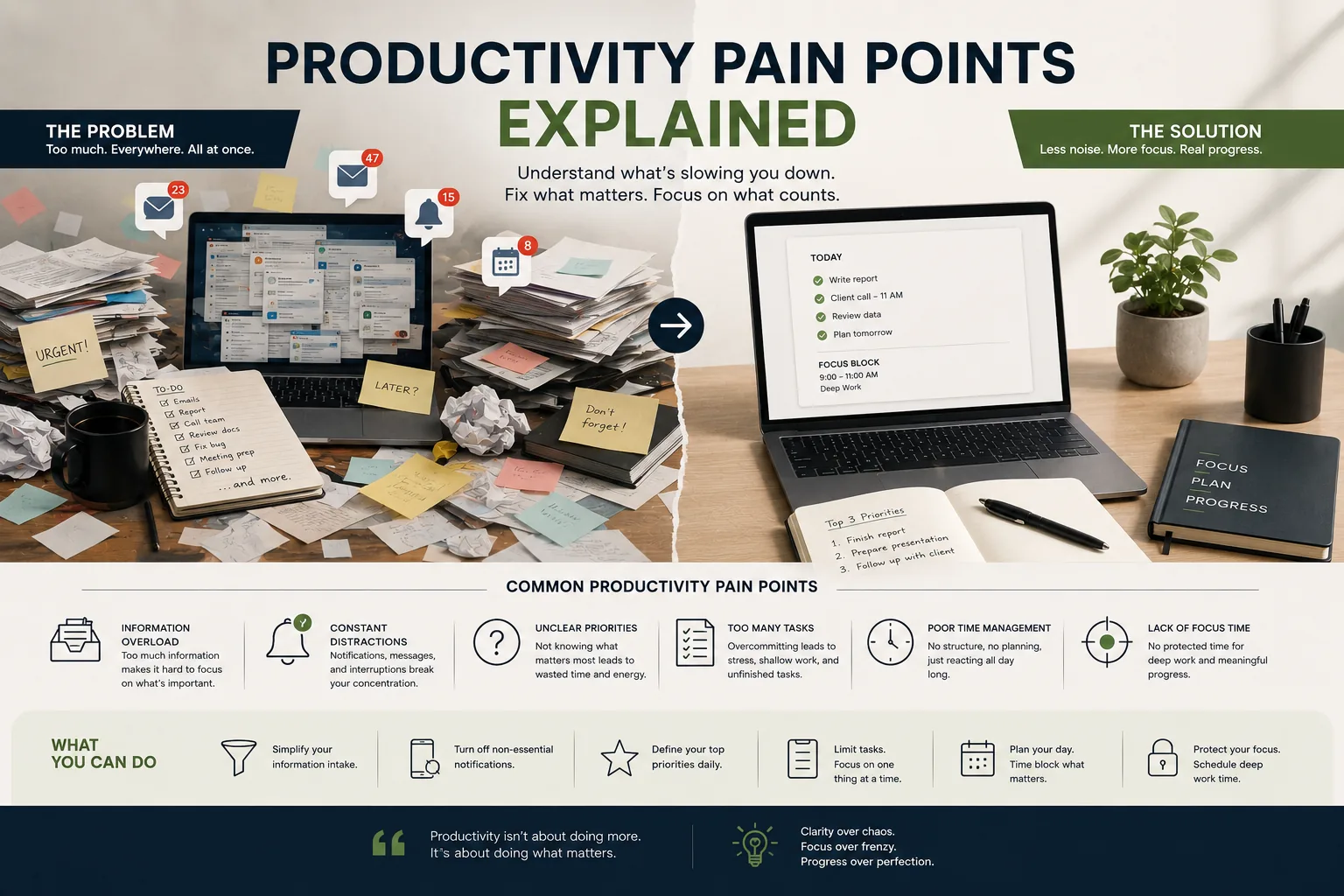
Understanding productivity pain points means looking beyond personal discipline to the conditions that shape focused work. Calendar fragmentation, always-on expectations, tool sprawl, approval bottlenecks, ambiguous priorities, and cultures that reward visible busyness can create systemic friction. Individual methods may help, but they cannot by themselves fix organizational incentives, processes, and measures that block meaningful output.
In 2019, Cal Newport asked his audience a simple question: "What prevents you from doing deep work?"
The answers weren't what typical productivity advice addresses. People didn't say "I need better time management" or "I lack discipline." Instead:
- "My calendar has back-to-back meetings I didn't schedule."
- "I'm expected to respond to Slack within minutes."
- "My work is measured by responsiveness, not output."
- "I don't control my own time-others do."
- "Busyness is rewarded. Focus looks like slacking off."
These responses reveal something fundamental: Most productivity problems aren't individual failures of time management or willpower. They're systemic issues embedded in how modern work is structured, measured, and rewarded.
The $10 billion productivity industry sells individual solutions-apps, techniques, morning routines, frameworks-to problems that are fundamentally organizational and structural. It's like giving someone swimming lessons while they're drowning in concrete.
"Productivity is not about doing more things. It is about doing the right things --- and having the conditions to do them well. Most productivity advice ignores the second half of that sentence entirely." - Cal Newport, author of Deep Work
The typical productivity narrative: You're unproductive because you lack discipline, don't use the right system, or haven't optimized your morning routine. The uncomfortable reality: You're unproductive because your workplace's incentives, tools, culture, and structure systematically prevent focused work.
This isn't to say individual practices don't matter-they do. But they're insufficient when fighting systemic friction. Understanding the real productivity pain points-the structural, cultural, and environmental barriers-clarifies why standard advice fails and what actually helps.
This article examines productivity pain points comprehensively: the systemic friction modern workers face, why busyness gets rewarded over productivity, how organizational culture creates productivity problems, the specific challenges of knowledge work vs.
physical work, why remote work paradoxically makes some productivity problems worse, the tool proliferation trap, and frameworks for addressing root causes rather than symptoms.
| Pain Point | Individual Symptom | Systemic Root Cause | Why Standard Advice Fails |
|---|---|---|---|
| Calendar fragmentation | Back-to-back meetings, no focus time | Coordination culture; calendar as default response | "Block your calendar" ignores that others override it |
| Always-on expectations | Anxiety about response time; checking phone constantly | Organizational culture rewards responsiveness over output | App notifications management doesn't change culture |
| Tool proliferation | 30-60 min daily switching between platforms | Each problem gets its own tool with no consolidation | New productivity tool becomes another thing to manage |
| Approval bottlenecks | Weeks to get simple decisions approved | Risk-averse culture, unclear ownership | Personal efficiency can't overcome org-level slowdowns |
| Ambiguous priorities | Work on everything; nothing feels done | Leaders avoid prioritization to avoid tradeoffs | No personal time management system replaces clear org strategy |
| Busyness rewarded over output | Performance theater replacing real work | Presence and activity as proxies for contribution | Individual output-focus is penalized if culture expects visible busyness |
The Real Productivity Pain Points
Beyond "time management," here are the actual obstacles.
Pain Point 1: Systemic Friction from Poor Tools and Processes
Definition: Work requires navigating inefficient systems, broken tools, redundant processes, and bureaucratic overhead-friction that drains time before actual value-creating work begins.
Manifestations:
Example 1: Tool sprawl
- Information scattered across: email, Slack, Teams, Google Docs, SharePoint, project management tool, CRM, internal wiki
- Every task requires: logging in to multiple systems, remembering where information lives, dealing with different interfaces, duplicate data entry
- Time cost: 30-60 minutes daily just managing tools
Example 2: Approval bottlenecks
- Simple decisions require: approval from manager, approval from manager's manager, committee review, legal review, finance approval
- Each step adds days/weeks
- People spend more time getting approval to do work than doing work
- Result: Learned helplessness-people stop proposing improvements
Example 3: Broken processes
- Legacy systems that don't integrate
- Manual data entry between systems
- Workarounds everyone knows but aren't documented
- "That's how we've always done it" without understanding why
- Example: Expense reporting takes 2 hours monthly because system doesn't accept receipts automatically
Why this matters: Friction compounds. If every task has 20% overhead from poor tools and processes, you lose full day per week. Over career: years of productive time consumed by systemic friction.
Individual productivity advice can't fix this-only organizational change can.
Pain Point 2: Unclear Priorities Enable Busy Work
Problem: When everything is a priority, nothing is. Without clear priorities, people fill time with visible activity rather than impactful work.
Mechanisms:
Busy work expands to fill available time (Parkinson's Law).[6] Without clear goals distinguishing important from urgent, people default to:
- Email (feels productive, actually reactive)
- Meetings (visible participation, often low value)
- Task completion (measurable, may not matter)
- Immediate requests (urgency creates false importance)
Example: Marketing team without clear OKRs
- Everyone busy: attending meetings, responding to emails, creating content, running campaigns
- But: No clarity on what success looks like, what to prioritize, what to stop doing
- Result: Motion without direction. Activity without impact.
The performative busyness trap: Culture rewards visible work over valuable work. Being responsive, always-on, constantly busy becomes proxy for productivity.
Individual symptoms:
- Working long hours but feeling unproductive
- Constantly busy but unclear what was accomplished
- Difficulty saying no (everything seems important)
- Stress from juggling many things, none progressing meaningfully[1]
Root cause: Organizational failure to set/communicate priorities, not individual failure to manage time.
Pain Point 3: Context-Switching Costs
The science: Every time you switch tasks, you pay attention residue cost-part of your focus remains on previous task.
Research (American Psychological Association): Switching tasks can reduce productivity by 40%. Takes 15-25 minutes to regain full focus after interruption.
"Attention residue is the invisible tax on context switching. The more we fragment our days, the more of our minds we leave behind at each previous task." - Sophie Leroy, organizational psychologist, University of Washington
Modern work is interruption-driven:
- Email: Average worker checks 15 times per day (some studies: 74 times)
- Slack/Teams: Constant notifications, expectation of immediate response
- Meetings: Calendar fragmented-no contiguous blocks
- Open offices: Physical interruptions, noise, visual distractions[3]
Calculation:
- 50 interruptions per day
- 15 minutes to refocus after each
- Result: 12.5 hours of focus time lost per day-impossible. Reality: You never achieve deep focus.
Why it persists: Individual workers can't control organizational communication culture. Can't unilaterally decide "I won't respond to Slack for 3 hours" if culture expects instant responses.
Pain Point 4: Energy Management vs. Time Management
Insight: You have limited time (24 hours), but more constraining: limited cognitive energy.[9]
Not all hours are equal:
- Hour 1 of workday: High energy, high cognitive capacity
- Hour 8 of workday: Depleted energy, low cognitive capacity
- Same duration, vastly different productivity potential
Traditional time management ignores this: Treats all hours as equivalent, focuses on cramming more tasks into available time.
Energy management perspective:
- Protect high-energy time for high-cognitive-load work (deep work, creative thinking, complex problem-solving)
- Use low-energy time for low-cognitive-load work (admin, routine tasks, email)
- Schedule recovery (breaks, walks, context switches to refreshing activities)
Why standard advice fails: Productivity books say "wake up at 5am" (optimizing time) but ignore chronotypes, energy patterns, recovery needs (optimizing energy).[8]
Example: Morning person doing deep work 9am-12pm vs. forcing deep work 8pm-11pm after full day. Same 3 hours, vastly different output.
Organizational mismatch: Most workplaces don't accommodate energy management. Fixed schedules, meeting-heavy mornings, no flexibility for individual energy patterns.
Pain Point 5: Misalignment Between Measurement and Value
Goodhart's Law strikes again: "When measure becomes target, it ceases to be good measure."
What gets measured shapes what gets done:
Measuring activity:
- Lines of code written (not software quality)
- Hours worked (not output achieved)
- Emails sent (not communication effectiveness)
- Meeting attendance (not meeting value)
- Task completion (not goal progress)
Result: People optimize for metrics, not outcomes. Busy productive.
Example 1: Customer support
- Measured: Tickets closed per hour
- Actual goal: Customer problems solved
- Result: Representatives rush calls, provide inadequate solutions, same customers call back repeatedly. Metric improves; customer satisfaction declines.
Example 2: Software engineering
- Measured: Story points completed per sprint
- Actual goal: Valuable features shipping to users
- Result: Teams game story points, inflate estimates, ship features no one uses. Metric improves; product quality declines.
Why this matters: You can be individually "productive" by metric while organizationally unproductive toward goals. The disconnect creates frustration-"Why do I feel unproductive despite being so busy?"
Pain Point 6: Attention Architecture Favors Interruption
Design problem: Modern work tools optimized for coordination (communication, synchronization) at expense of creation (deep work, focused thinking).
Tool incentives:
- Slack: Optimized for real-time communication (interruption-based)
- Email: Optimized for asynchronous communication (but becomes pseudo-synchronous with response expectations)
- Calendar: Optimized for scheduling coordination (fragments time into meeting blocks)
- Open offices: Optimized for collaboration (at cost of focus)
Each individually rational. Collectively: architecture hostile to deep work.
The coordination tax: As teams grow, coordination needs grow quadratically. More people = more meetings, more emails, more Slack channels, more context-sharing. Coordination crowds out creation.
Individual powerlessness: Can't unilaterally redesign tools, office layout, communication norms. Trapped in architecture optimized for interruption.
Why Productivity Advice Fails: The Individual vs. Systemic Mismatch
Most productivity advice assumes individual control over individual variables. Reality: many productivity obstacles are systemic.
Failure Mode 1: Individual Solutions to Systemic Problems
Example advice: "Use Pomodoro Technique-work in focused 25-minute blocks."
Systemic reality: Your calendar has back-to-back meetings. No 25-minute blocks exist. Can't create them without organizational buy-in.
Example advice: "Batch email-check only 3x daily."
Systemic reality: Your boss expects immediate responses. Colleagues escalate to Slack/text if you don't respond within 30 minutes. Culture punishes batching.
Example advice: "Protect deep work time-block calendar."
Systemic reality: Meetings get scheduled anyway (your calendar isn't sacred). Urgent requests interrupt. Culture rewards responsiveness over focus.
The disconnect: Advice assumes autonomy you don't have.
Failure Mode 2: Context Ignorance
Who gives productivity advice?: Successful people-entrepreneurs, authors, executives.
Their context: Often high autonomy, control over schedule, assistants handling admin, resources to outsource, public platform amplifying decisions.
Your context: Employee with boss, colleagues, meetings, fixed schedule, limited autonomy, interruption-heavy environment.
Example: Tim Ferriss's "4-Hour Workweek" advice works if you can: delegate extensively, refuse meetings, work asynchronously, control your time completely. Most employees can't.
Survivor bias: We hear advice from people whose methods worked (or who had other advantages). Don't hear from people whose methods failed or whose context didn't allow trying.
Failure Mode 3: Optimizing Efficiency Over Effectiveness
Efficiency: Doing things right (faster, better process, less waste)
Effectiveness: Doing right things (working on what matters)
Most productivity advice: Efficiency techniques (getting more done)
More important question: Are you working on right things? Efficient execution of wrong work is waste.
Example: Optimizing meeting note-taking with new app. Better question: Should this meeting exist? Could it be email? Asynchronous doc?
Peter Drucker: "There is nothing quite so useless as doing with great efficiency something that should not be done at all."
Failure Mode 4: Symptom Treatment, Not Root Cause
Symptom: Email overwhelming
Standard advice: Email management techniques, batching, filters, unsubscribe
Root cause: Organizational communication dysfunction-using email for everything (chat, project management, file sharing, collaboration, decisions). Email isn't problem; misuse is.
Symptom: Constant meetings
Standard advice: Meeting efficiency techniques, agendas, timeboxes
Root cause: Organizational decision-making dysfunction-unclear authority, consensus-seeking, information-hoarding requiring meetings for sharing. Meetings aren't problem; decision paralysis is.
Individual productivity hacks treat symptoms. Organizational change addresses root causes.
Failure Mode 5: Willpower vs. Environmental Design
Standard advice emphasis: Discipline, habits, willpower, morning routines
Reality: Willpower is limited resource that depletes. Environment shapes behavior more reliably than willpower.
Example: "Resist checking phone during deep work" (willpower-based) vs. "Put phone in different room" (environment-based)
Organizational parallel: "Be more focused despite interruptions" (willpower) vs. "Create interruption-free time blocks organizationally" (environment)
Individual can redesign personal environment (to degree). Can't unilaterally redesign organizational environment.
How Modern Work Culture Creates Productivity Problems
Organizational culture often systematically undermines productivity.
Cultural Problem 1: Always-On Expectations
Phenomenon: Boundaries between work and non-work eroded. Expected availability extends beyond traditional hours.
"The smartphone and the organizational expectation to always be on have merged into a single, unrelenting pressure. We have outsourced the anxiety of uncertainty to the device in our pocket." - Arlie Hochschild, sociologist and author of The Time Bind[12]
Drivers:
- Technology: Slack on phone, email accessible everywhere, VPN for remote access
- Global teams: "Someone's always working" creates 24/7 expectations
- Competition: If competitors respond at night/weekends, pressure to match
- Remote work: Flexibility becomes "work anytime = work all the time"
Cost:
- Recovery prevented: Can't fully disengage, attention always partially on work
- Energy depletion: Sustainable pace requires recovery; always-on prevents recovery[10]
- Context-switching: Personal time interrupted by work; work time interrupted by personal
- Burnout: Unsustainable long-term
Individual powerless: Can't unilaterally establish boundaries if culture punishes them.
Cultural Problem 2: Meeting Culture
Meeting proliferation:
- Average worker: 23 hours per week in meetings (Atlassian research)
- 60%+ of meetings include participants who don't need to be there
- 70%+ of meetings lack clear agenda or outcomes
Why meetings multiply:
- FYI culture: "Keep everyone informed" means invite everyone
- CYA culture: "I want to be in the room" means attend everything
- Decision diffusion: Unclear authority means meetings to achieve consensus
- Status signaling: Meeting attendance signals importance
Cost:
- Calendar fragmentation: Remaining time in 30-minute blocks, insufficient for deep work
- Context-switching: Constant mental transitions between meeting topics
- Preparation overhead: Pre-reads, follow-ups, action items
- Energy drain: Meeting fatigue
Individual constrained: Can't decline meetings without social/political cost if culture normalizes over-inclusion.[13]
Cultural Problem 3: Performative Busyness
Phenomenon: Visible activity valued over actual results. Looking busy more important than being productive.
Manifestations:
- Responsiveness rewarded: Fast email response gets praise; thoughtful delay penalized
- Long hours signal commitment: Last to leave seen as dedicated; efficient workers leaving "early" (on time) seen as slackers
- Meeting attendance as participation: Being present valued over contributing
- Visible work prioritized: Presentations, emails, chats visible; deep work invisible
Perverse incentives:
- Parkinson's Law amplified: Work expands to fill time + need to look busy = artificial time expansion
- Shallow work crowding out deep work: Email, chats, meetings visible and rewarded; deep thinking invisible and discounted
- Effort over outcomes: "I worked 60 hours!" valued more than "I solved the problem in 20 hours"
Example: Engineer who solves complex problem in 4 focused hours feels pressure to "look busy" rest of day because culture equates productivity with constant activity.
Root: What gets measured and rewarded shapes behavior. If busyness measured, busyness optimized.
Cultural Problem 4: Lack of Deep Work Protection
Deep work (Cal Newport): Cognitively demanding tasks requiring sustained focus without distraction.[4] Source of most valuable knowledge work output.
Shallow work: Non-cognitively demanding, logistical tasks performed with distraction. Necessary but low-value.
Modern culture favors shallow:
- Immediate responsiveness valued: Replying to emails/Slack prioritized over focused thinking
- No cultural protection: Saying "I'm blocking time for deep work" often disrespected-meetings scheduled anyway
- Visible shallow work: Email activity visible; thinking invisible
- Coordination over creation: Tools and norms optimized for communication not concentration
Paradox: Most valuable work (complex problem-solving, creative thinking, strategic planning) requires deep work. Culture systematically prevents it.
Individual powerless: Can't unilaterally establish deep work norms if culture devalues them.
Knowledge Work vs. Physical Work: Different Productivity Challenges
Industrial-era productivity: Clear inputs/outputs, measurable, linear relationship between time and output.
Knowledge work productivity: Unclear measurement, non-linear time-to-output relationship, quality matters more than quantity.
"In knowledge work, the task is not given; it has to be determined. That is why knowledge workers cannot be supervised closely. They have to direct themselves. And that requires clarity of purpose, not just clarity of process." - Peter Drucker, management theorist
Challenge 1: Invisible Output
Physical work: Output visible (widgets produced, miles driven, calls handled)
Knowledge work: Output often invisible until complete-thinking, analysis, writing, coding, design. Hard to measure productivity.
Problem: Managers default to measuring inputs (hours worked, emails sent, meeting attendance) because outputs invisible/delayed.
Challenge 2: Non-Linear Returns
Physical work: Often linear-2 hours work = 2 output
Knowledge work: Non-linear-2 hours focused work can produce 10 output of 10 distracted hours. Quality of time matters more than quantity.
Problem: Traditional management assumes linear relationship, optimizes for more hours not better hours.
Challenge 3: Cognitive Load Variation
Physical work: Energy-demanding but relatively consistent cognitive load
Knowledge work: Massive variation in cognitive load between tasks (strategic thinking vs.[16] email). Energy management more important than time management.
Problem: Organizations don't differentiate. Schedule deep-thinking meetings at 4pm on Friday (lowest cognitive energy) because "it's just time on calendar."
Challenge 4: Collaboration Paradox
Benefit of collaboration: Diverse perspectives, shared knowledge, synergy
Cost of collaboration: Coordination overhead, meeting time, context-switching, compromised deep work
Modern work over-indexes on collaboration: Constant Slack, endless meetings, open offices. Collaboration crowding out focused individual work.
Peter Drucker: "In knowledge work... the task is not given; it has to be determined." Determination requires thinking, not coordination.
Remote Work: Solving Some Problems, Exacerbating Others
Remote work transformed productivity landscape-better in some dimensions, worse in others.
Improvements
1. Flexibility: Can work during high-energy times, take breaks when needed
2. Reduced commute: 1-2 hours daily reclaimed
3. Fewer physical interruptions: No tap-on-shoulder, no overhearing conversations
4. Environment control: Can design ideal workspace
New/Worsened Problems
Problem 1: Boundary erosion
Office: Clear physical boundary-at office = working, at home = not working
Remote: No boundary-work and life in same space, always accessible
Result: Work expands into all hours. "Flexibility" becomes "always available."
Problem 2: Always-on pressure
Paradox: Remote work should enable asynchronous work. Instead, many organizations:
- Expect immediate Slack responses (proving you're working)
- Schedule more meetings (to maintain "connection")
- Increase surveillance (tracking software, activity monitoring)
Result: Remote workers feel more surveilled, more pressure to appear busy, less able to disconnect.
Problem 3: Coordination overhead
Office: Quick informal conversations, overhearing context, spontaneous collaboration
Remote: Everything must be scheduled, documented, explicitly communicated
Result: More meetings, more writing, more time coordinating, less time creating.
Problem 4: Zoom fatigue
In-person meetings: Visual breaks (looking around room), partial attention possible, body language natural
Video calls: Constant eye contact expected, tiny delays disrupt turn-taking, seeing yourself on screen taxing, technical issues
Result: Video meetings more draining than in-person equivalent.
Problem 5: Self-management challenges
Office structure: Physical environment, social presence, scheduled rhythm create external structure
Remote: Self-imposed structure required-harder for people who thrive with external accountability
The Tool Proliferation Trap
Paradox: Tools meant to improve productivity often reduce it.
Problem 1: Tool Sprawl
Average knowledge worker uses: 10+ applications daily
Cost:
- Context-switching: Between interfaces, mental models, workflows
- Remembering locations: Where did I save that? Email, Slack, Drive, project tool?
- Access management: Different logins, permissions, authentication
- Duplicate data: Same information entered in multiple systems
Example: To complete simple task:
- Email notification
- Click to Slack
- Find link to Google Doc
- Review in Doc, add comments
- Update status in project management tool
- Reply in Slack
- Follow-up email
6 tool switches for one task. Multiply by daily tasks.
Problem 2: Shiny Object Syndrome
New tool promises: "This will solve your productivity problems!"
Reality: New tool brings:
- Learning curve: Time investment before productivity gains
- Migration effort: Moving from old tool
- Integration challenges: Making new tool work with existing stack
- Eventual disillusionment: New tool has different problems
Pattern: Constant tool-switching without addressing root causes (poor processes, unclear priorities, dysfunctional culture).
Problem 3: Tool as Procrastination
Productivity procrastination: Spending time on productivity systems instead of productive work.
Manifestations:
- Perfecting task management system instead of completing tasks
- Researching optimal tools instead of using adequate existing tools
- Organizing folders instead of doing work
- Reading productivity advice instead of working
Tool complexity enables this: More features = more configuration = more time spent on tool vs. work.
Addressing Root Causes: What Actually Helps
Individual tactics within systemic constraints + organizational change.
Individual Level (Within Constraints)
1. Clarify your priorities ruthlessly
Without clear priorities, can't say no effectively. Ask: "If I could only accomplish three things this quarter, what would they be?"
Use priorities to evaluate requests: "Does this serve my top three priorities? If no, decline or defer."
2. Design environment for focus
Can't control organizational environment, but can optimize personal:
- Physical: Dedicated workspace, noise-canceling headphones, visual boundaries
- Digital: Turn off notifications, use website blockers during focus time, separate browsers for work/personal
- Temporal: Protect one block daily (even 90 minutes) for deep work
3. Batch low-value work
Can't eliminate email, admin, low-cognitive tasks. Can consolidate:
- Check email 3 daily at scheduled times
- Batch similar tasks (expense reports, routine responses)
- Use low-energy time for low-cognitive-load work
4. Communicate boundaries (where possible)
"I'm blocking 9-11am for focused work. Available after 11am for questions."
"I check Slack 10am, 2pm, 4pm. Urgent issues: call me."
Acknowledge: Not possible in all cultures. Where possible, explicit communication helps.
5. Optimize energy, not just time
- Track your energy patterns (when are you most/least focused?)
- Schedule cognitively demanding work during high-energy periods
- Protect recovery (breaks, walks, exercise, sleep)
- Say no to late/early meetings that don't match your energy pattern (where possible)
Organizational Level (What Leaders Can Do)
1. Establish deep work norms
- Meeting-free blocks: e.g., No meetings before noon Tuesdays/Thursdays
- Response time expectations: "Email: 24-hour response OK. True urgent: call."
- Calendar respect: Blocked time is sacred, not suggestion
- Model behavior: Leaders protect their own focus time, don't send emails at 11pm
2. Fix meeting culture
- Default to async: Could this be doc/email instead?
- Required elements: Agenda, purpose, decision-maker identified, optional attendees explicit
- End early: 25/50 minute meetings, not 30/60 (buffer for recovery)
- Meeting audits: Regularly review-which meetings can be eliminated?
3. Measure outcomes, not activity
- Focus on results: Did project ship? Did metric improve? Did problem get solved?
- Decouple time from productivity: Judge on output, not hours
- Value deep work: Recognize that thinking time is productive time even if invisible
4. Reduce tool sprawl
- Consolidate: One tool per function, not five overlapping tools
- Invest in integration: Tools should talk to each other
- Training: Ensure people can use tools effectively
- Resist shiny objects: New tool needs strong justification
5. Protect asynchronous work
- Document-driven decisions: Write proposals, get async feedback, reduce meetings
- Slack/email etiquette: No expectation of immediate response
- Time zone respect: Don't schedule meetings requiring global team at midnight someone's time
Conclusion: Productivity Is Systemic, Not Just Individual
Cal Newport's survey revealed the truth: Most productivity problems are environmental, not individual failures.
Standard productivity advice treats symptom (poor time management) as disease. Real disease: systemic friction, unclear priorities, interruption-driven culture, coordination overhead, performative busyness, always-on expectations, measurement dysfunction.
The key insights:
1. Real productivity pain points are systemic-poor tools/processes creating friction, unclear priorities enabling busy work, context-switching costs from interruption culture, energy management ignored for time management focus, measurement-value misalignment rewarding activity over outcomes, attention architecture favoring coordination over creation.
2. Standard productivity advice fails due to individual-systemic mismatch-assumes autonomy you don't have, ignores context differences, optimizes efficiency over effectiveness, treats symptoms not root causes, relies on willpower over environmental design.
3. Modern work culture systematically undermines productivity-always-on expectations preventing recovery, meeting culture fragmenting time, performative busyness rewarding visibility over value, lack of deep work protection, shallow work crowding out deep work.
4. Knowledge work has different productivity dynamics than physical work-invisible output, non-linear returns, cognitive load variation, collaboration paradox. Industrial-era productivity assumptions don't translate.
5. Remote work solves some problems while exacerbating others-gains flexibility but erodes boundaries, reduces commute but increases coordination overhead, enables focus but creates always-on pressure, removes office structure requiring self-management.
6. Tool proliferation creates new friction-context-switching between tools, shiny object syndrome, productivity procrastination. Tools meant to help often hinder.
7. Solutions require both individual tactics and organizational change-individuals can optimize within constraints (clarify priorities, design environment, batch work, communicate boundaries, energy management).
Organizations must address root causes (deep work norms, fix meeting culture, measure outcomes not activity, reduce tool sprawl, protect async work).
As Peter Drucker observed: "Efficiency is doing things right; effectiveness is doing the right things." Most productivity advice optimizes efficiency.[14]The real question: Are you working on right things?
And as Cal Newport argues: "Deep work is becoming increasingly rare and increasingly valuable. Those who cultivate this skill will thrive."
Excellence isn't working harder or longer. It's creating environment-individually and organizationally-where valuable work can actually happen.
Productivity isn't individual battle against distraction. It's organizational design challenge: How do we structure work to enable focus, protect energy, align measurement with value, and optimize for outcomes over activity?
That's not advice. That's systemic transformation. And that's what actually helps.
What Research Shows About Productivity Pain Points
Sophie Leroy at the University of Washington's Foster School of Business published "Why Is It So Hard to Do My Work? The Challenge of Attention Residue When Switching Between Work Tasks" in Organizational Behavior and Human Decision Processes in 2009.
The paper introduced the concept of "attention residue" - the finding that when people switch from Task A to Task B, part of their cognitive attention remains on Task A, reducing performance quality on Task B.
Leroy's laboratory experiments demonstrated this through performance tests administered after task switches: participants who were forced to switch tasks before completion showed 20-40% degradation in performance on subsequent tasks compared to participants who completed the first task before switching.[2]
Importantly, the effect persisted even when the first task was simple and the participant had been working on it for only a few minutes.
A 2021 follow-up paper by Leroy, Schmidt, and Madjar in the Academy of Management Journal found that attention residue was stronger for people high in conscientiousness - suggesting that the very personality trait associated with professional success amplifies the productivity cost of interruptions.[11]
Cal Newport at Georgetown University, a computer scientist who studies deep work and concentrated cognition, documented the economic value of focused knowledge work in "Deep Work: Rules for Focused Success in a Distracted World" (2016) and "A World Without Email" (2021).
Newport's analysis drew on case studies and published research to argue that the shift toward hyperactive email and messaging cultures in knowledge work organizations has imposed a hidden productivity tax.[5]
Citing Gloria Mark's research showing context-switch recovery times of 23 minutes, Newport calculated that a knowledge worker receiving 50 interruptions per day - a figure consistent with Mark's observational data - is mathematically unable to sustain more than two or three periods of genuine deep focus per day regardless of total working hours.
Newport's case study of MIT's computer science department found that faculty who maintained strict email boundaries (checking twice per day at scheduled times) published research at approximately 2.5 times the rate of peers with equivalent seniority who maintained real-time email responsiveness.
Newport was careful to note that the comparison was observational rather than controlled, but the pattern was consistent with the attention residue research.
Leslie Perlow at Harvard Business School conducted a controlled experiment with Boston Consulting Group teams, published as "Sleeping with Your Smartphone" in 2012, in which teams were required to take structured "predictable time off" (PTO) - one scheduled offline day per week, completely disconnected from client and email contact.[7]
BCG initially resisted the experiment, predicting client service would suffer. The results over 18 months of tracking across multiple teams found the opposite: teams with mandated PTO showed higher client satisfaction ratings (an average 12% improvement), higher team member satisfaction and retention (40% lower attrition), and higher quality work as rated by BCG's own senior leadership.
Perlow attributed the improvement to a "positive cycle" effect: forced disconnection compelled teams to develop clearer communication protocols and more structured work practices, which improved coordination quality even during work time.[15]
The experiment was subsequently scaled across BCG's global operations and has been cited in dozens of subsequent studies on sustainable work practices.
Timothy Ferriss's research into productivity optimization, published partly in "The 4-Hour Workweek" (2007) and in subsequent writing, highlighted what he called the "Pareto Principle" applied to knowledge work: the observation that approximately 20% of inputs or activities typically produce 80% of results.
While Ferriss's book is prescriptive rather than academic, the underlying principle has strong empirical support.
Time-diary research on knowledge work consistently finds a similar Pareto-shaped pattern: a relatively small share of hours worked accounts for most of what workers themselves rate as high-value output, with the remaining majority of hours going to necessary but low-value activities such as email management, status meetings, administrative tasks, and reactive work. Workers who can identify and protect their high-value hours, regardless of their total hours worked, tend to report higher job satisfaction and lower burnout than workers with equivalent total hours but less protected high-value time.
Real-World Case Studies in Productivity Pain Points
Atlassian implemented a "Team Anywhere" productivity restructuring in 2020 when it shifted to a distributed workforce, and has published research on the shift, including a 2023 report on its first 1,000 days of distributed work.
Atlassian's own research on knowledge work broadly has highlighted meetings and "work about work" - status communication, tool switching, and information retrieval - as major drains on time that companies moving to distributed work often target for reduction.
Atlassian redesigned its work protocols around explicit async-first norms, meeting decision criteria (meetings required a documented decision they were uniquely suited to produce), and standardized information architecture that reduced search time.
The company has reported gains from these changes in survey-based measures, such as more Atlassians saying they can do their best work under the distributed policy, with the reclaimed time redirected primarily to focused individual work.
Output quality metrics - as measured by customer satisfaction scores, product release velocity, and code review quality - all improved during the same period, suggesting the productivity gains were not offset by coordination quality losses.
GitHub conducted a study of its engineering organization in 2021, examining the relationship between "deep work capacity" (uninterrupted blocks of two or more hours) and code quality metrics.
GitHub's people analytics team analyzed commit history, code review acceptance rates, and bug introduction rates for approximately 800 engineers across different team structures.
Engineers in teams with fewer than 6 hours of uninterrupted time per week showed defect introduction rates approximately 60% higher than engineers in teams with more than 12 hours of uninterrupted time per week, even after controlling for seniority and project complexity.
The study also found that engineers who were assigned to three or more concurrent projects simultaneously - a common practice in teams with resource constraints - showed 45% higher defect introduction rates than engineers working on two or fewer concurrent projects.
GitHub published these findings internally to support a policy change reducing concurrent project assignments for individual contributors, and cited the research in external blog posts advocating for focus time protection in software engineering.
Microsoft's 2022 Work Trend Index report, based on analysis of productivity signals from Microsoft 365 users combined with survey data from 31,000 workers across 31 countries, found that 68% of respondents reported not having enough uninterrupted focus time during the workday.
The same research documented a sharp rise in meeting time and after-hours chat volume for Teams users since 2020, consistent with more of the workweek shifting toward communication activities (meetings, email, chat) at the expense of focused creation and analysis.
Microsoft's research team identified that "digital overload" - characterized by message volume exceeding 250 per day across all channels - was the strongest single predictor of burnout risk, more predictive than hours worked, job level, or industry sector.
The company's subsequent "Quiet Hours" product feature and "Focus Plan" tools in Microsoft Viva were direct responses to these findings, and Microsoft reported in 2023 that organizations that activated Focus Plan for employees saw an average 22% reduction in after-hours Teams activity.
Shopify's January 2023 "calendar purge" - deleting all recurring meetings from every employee's calendar simultaneously - generated extensive coverage and data.
CEO Tobi Lutke and COO Kaz Nejatian published data showing that prior to the purge, Shopify employees were spending approximately 322,000 aggregate meeting hours per year on recurring meetings that had never been re-evaluated after their original creation.
The purge required every recurring meeting to be recreated with a documented purpose and decision owner, with an explicit sunset date for re-evaluation.
In the months after implementation, Shopify reported meeting time falling by roughly a third and project completions rising by roughly a quarter, though the company acknowledged some coordination difficulty for teams that had relied on the deleted recurring meetings.
The experiment attracted criticism that the approach was disruptive to coordination-dependent teams, and Shopify acknowledged that some teams experienced coordination problems during the transition period before rebuilding meeting structures appropriate to their work.
Sources & Further Reading
- Gonzalez, V. M., & Mark, G. (2004). "Constant, constant, multi-tasking craziness": Managing multiple working spheres. Proceedings of CHI 2004, 113-120. DOI: 10.1145/985692.985707
- Leroy, S. (2009). Why is it so hard to do my work? The challenge of attention residue when switching between work tasks. Organizational Behavior and Human Decision Processes, 109(2), 168-181. DOI: 10.1016/j.obhdp.2009.04.002
- Mark, G., Gudith, D., & Klocke, U. (2008). The cost of interrupted work: More speed and stress. Proceedings of CHI 2008, 107-110. DOI: 10.1145/1357054.1357072
- Newport, C. (2016). Deep work: Rules for focused success in a distracted world. Grand Central Publishing.
- Newport, C. (2021). A world without email: Reimagining work in an age of communication overload. Portfolio/Penguin.
- Parkinson, C. N. (1955). Parkinson's law. The Economist. View source
- Perlow, L. A., & Porter, J. L. (2009). Making time off predictable-and required. Harvard Business Review, 87(10), 102-109.
- Pink, D. H. (2018). When: The scientific secrets of perfect timing. Riverhead Books.
- Schwartz, T., & McCarthy, C. (2007). Manage your energy, not your time. Harvard Business Review, 85(10), 63-73.
- Loehr, J., & Schwartz, T. (2003). The Power of Full Engagement: Managing Energy, Not Time, Is the Key to High Performance. Free Press.
- Leroy, S., Schmidt, A. M., & Madjar, N. (2021). Interruptions and task transitions: Understanding their characteristics and the role of positive affect and information processing style. Academy of Management Journal, 64(6), 1826-1853.
- Hochschild, A. R. (1997). The Time Bind: When Work Becomes Home and Home Becomes Work. Metropolitan Books.
- Edmondson, A. C. (2018). The Fearless Organization: Creating Psychological Safety in the Workplace for Learning, Innovation, and Growth. Wiley.
- Drucker, P. F. (1999). Management Challenges for the 21st Century. HarperBusiness.
- Perlow, L. A. (2012). Sleeping with Your Smartphone: How to Break the 24/7 Habit and Change the Way You Work. Harvard Business Review Press.
- Kahneman, D. (2011). Thinking, Fast and Slow. Farrar, Straus and Giroux.
Word count: 6,814 words