
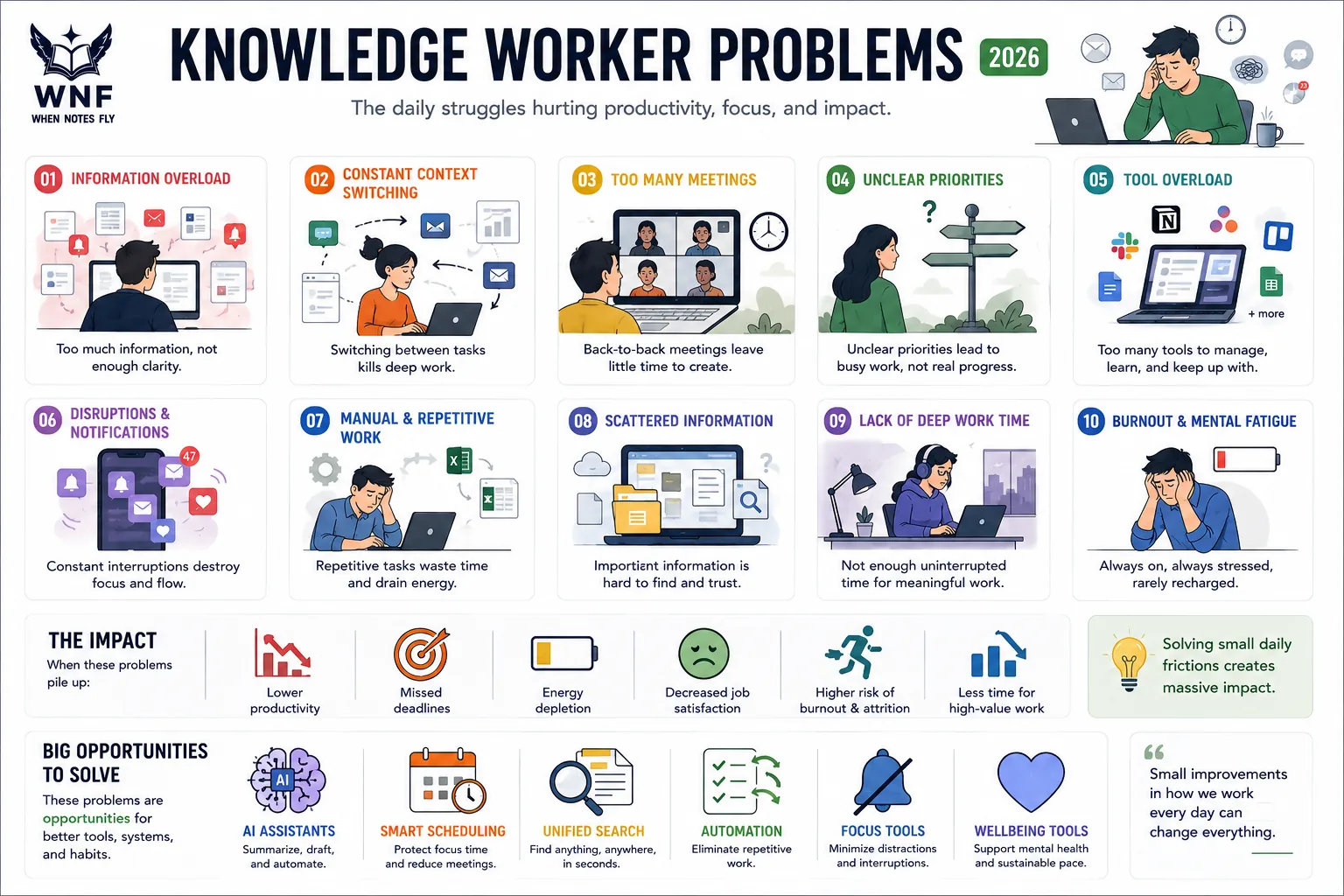
In 1959, Peter Drucker coined the term "knowledge worker" (in Landmarks of Tomorrow) to describe employees whose primary capital is knowledge rather than physical labor. He envisioned professionals applying expertise to solve problems, free from the constraints of manual work.
"The most important, and indeed the truly unique, contribution of management in the 20th century was the fifty-fold increase in the productivity of the manual worker in manufacturing.
The most important contribution management needs to make in the 21st century is similarly to increase the productivity of knowledge work and the knowledge worker."
Peter Drucker
Sixty-seven years later, knowledge workers dominate the economy, but the reality looks quite different from Drucker's optimistic vision.
Rather than liberation through intellectual work, today's knowledge workers navigate a landscape of information overload, tool proliferation, attention fragmentation, and AI disruption that creates as many problems as it solves.
The fundamental promise was simple: work with your mind, not your body. Apply knowledge to create value. The reality in 2026: knowledge workers spend enormous cognitive capacity managing their work environment rather than doing the actual knowledge work.
They filter endless information streams, context-switch across a dozen tools, attend meetings about meetings, validate AI outputs, and manage the anxiety of watching AI capabilities expand into their domains.
The problems aren't just growing: they're compounding. Each solution creates new problems. Email overload led to Slack, which created its own overload. AI assistants were supposed to reduce cognitive load but introduced new decisions about when to use which tool for what task.
Remote work eliminated commutes but blurred work-life boundaries and created coordination overhead.
This analysis examines the critical challenges knowledge workers face in 2026: what's gotten worse, what's genuinely new, what systemic factors perpetuate these problems, and why they're harder to solve than they appear.
| Problem Category | Root Cause | Common (Failed) Response | Why It Compounds |
|---|---|---|---|
| Information overload | Exponential supply, linear human capacity | Add another filtering tool | New tool adds its own notifications and interface |
| Tool proliferation | Each problem gets its own solution | Consolidate to a single platform | Consolidation creates its own migration and relearning overhead |
| Meeting burden | Coordination needs met with synchronous time | Meeting-free days | Other meetings expand to fill the gap |
| Attention fragmentation | Always-on communication expectations | Personal discipline and notifications management | Social norms and job security incentivize responsiveness |
| AI-induced uncertainty | Expanding automation of knowledge tasks | Skill up on AI tools | Uncertainty about which skills remain valuable persists |
| Context switching overhead | Multiple projects, teams, tools in parallel | Better project management | Coordination cost scales with number of active contexts |
Problem 1: Information Overload and Filter Failure
The Core Issue
Knowledge workers face an exponentially growing information environment with linear human processing capacity. The gap between what's available and what can be meaningfully consumed or evaluated has widened to absurdity.
"Automation and 'thinking machines' are replacing human tasks and jobs, and are changing the skills that organizations need from their people."
World Economic Forum, Future of Jobs Report 2016
Scale: A typical knowledge worker has access to:
- Email: 100-200 new messages daily
- Slack/Teams: 500-1,000+ messages daily across channels
- Documents: Thousands of Google Docs, Notion pages, Confluence articles
- Internet: Infinite content on any topic imaginable
- AI-generated content: Now indistinguishable from human-written in many domains
The problem isn't lack of information: it's the impossibility of filtering signal from noise efficiently.
Why Traditional Filters Fail
1. Search is insufficient: Finding information requires knowing what to search for. But knowledge work often involves discovering what you didn't know you needed to know. Search helps when you know the question; it fails when you need to form the question.
2. Algorithmic feeds optimize the wrong thing: Social media, news sites, even internal tools increasingly use engagement-optimized algorithms. These surface content that provokes reaction (controversy, outrage, novelty), not content that's genuinely valuable for deep work or decision-making.
3. Human curation doesn't scale: Manually organizing information (folders, tags, reading lists) works for small volumes. At scale, the curation work itself becomes overwhelming. By the time you've organized everything, more has arrived.
4. AI assistants struggle with context: LLMs can summarize documents but lack the understanding of what matters for your specific situation. They don't know that the throwaway comment in email #47 is actually crucial context for decision X, while the 10-page report everyone references is mostly boilerplate.
Manifestations in Daily Work
Decision paralysis: Should you read this article? Attend this meeting? Review this document? With infinite options, every choice has opportunity cost. Knowledge workers spend mental energy deciding what deserves attention, energy no longer available for the work itself.
Shallow processing: When overwhelmed, people skim everything deeply understanding nothing. They read email subject lines, scan Slack scrollback, glance at documents. This creates the illusion of staying informed while actually missing critical details.
Anxiety about missing something important: The nagging feeling that somewhere in the deluge is information you need. So you keep checking, keep scrolling, keep inbox zero, driven by fear rather than strategy.
Context reconstruction overhead: Information scattered across tools (email, Slack, Docs, recorded meetings, Notion, Jira) means constantly reconstructing context. "Wait, where was that discussion? Was it email or Slack? Was it last week or last month?" The retrieval time compounds.
Why It's Gotten Worse
1. Always-on communication norms: Email had natural boundaries (business hours, weekends). Slack/Teams eliminated those boundaries with expectation of availability. The information flow never stops.
2. Remote work increased written communication: In-office, much communication was ephemeral: hallway conversations, quick desk check-ins. Remote work documents everything in chat, creating a permanent searchable (but overwhelming) record.
3. AI content generation: The volume of written content has exploded. Previously, writing was the bottleneck: human time limited production. Now AI generates thousands of words in seconds, flooding environments with synthetic content indistinguishable from human writing.
4. Decreased gatekeeping: Traditional publishing had editors filtering quality. Digital platforms removed that filter, and anyone can publish anything. This democratization has value but dramatically increased noise.
Problem 2: AI Tool Proliferation and Judgment Overhead
The Core Issue
AI was supposed to reduce cognitive load by automating routine tasks. Instead, it has introduced a new layer of judgment overhead: deciding which AI tool to use for what task, evaluating output quality, maintaining skills AI can now perform, and managing anxiety about AI capabilities expanding into your domain.
"The real problem is not whether machines think but whether men do."
B. F. Skinner, Contingencies of Reinforcement (1969)
The paradox: AI saves time on execution but adds time for judgment about when, whether, and how to use it.
The Expanding Decision Space
Knowledge workers in 2026 make constant meta-decisions:
Tool selection: ChatGPT, Claude, Gemini, GitHub Copilot, Cursor, Grammarly, Jasper, Midjourney, Notion AI, integrated AI in every SaaS product: which tool for which task? Each has different strengths, costs, data policies, and integration requirements.
Appropriateness judgment: Is this task suitable for AI assistance, or does it require human originality? Will AI output be acceptable to stakeholders, or will they expect "human-made"? Is this sensitive enough that using AI creates risk?
Output validation: How do you verify AI-generated code works correctly? That AI-written analysis is accurate? That AI-summarized information didn't omit crucial context? The validation burden often approaches the time saved by automation.
Skill maintenance: If AI can do X, should you still practice X to maintain the skill? Or accept that AI handles it now and focus elsewhere? But what if the AI fails or the situation requires genuine expertise?
New Anxieties
Job security concerns: Watching AI capabilities expand into your professional domain creates persistent anxiety. "If AI can do this now, what can't it do? How much of my job remains AI-proof?" This anxiety consumes cognitive capacity regardless of whether the fear is justified.
Authenticity questions: When you use AI assistance for writing, analysis, or creative work, is the output authentically yours? How much AI input is acceptable before it's not really your work? This philosophical question has no clear answer but generates practical anxiety.
Competitive pressure: If peers use AI and you don't, are you falling behind? But if you rely on AI heavily, are you losing skills you'll need later? Damned either way.
Information provenance uncertainty: Is this article human-written or AI-generated? Was this analysis done by the person who signed it or by ChatGPT with light editing? Provenance matters for trust, but it's increasingly impossible to determine.
Why It's Gotten Worse
2023-2026 was the AI adoption inflection point: ChatGPT launched November 2022. By 2026, AI capabilities have advanced dramatically, costs have dropped, and integration is everywhere. Knowledge workers can no longer ignore AI: it's embedded in their tools whether they actively choose to use it or not.
Tool sprawl without consolidation: Rather than a single AI assistant, knowledge workers deal with dozens of specialized tools. Each product has embedded AI. This creates fragmentation and decision overhead.
Unclear guidelines: Most organizations haven't established clear policies about AI use: what's acceptable, what requires disclosure, how to validate output. This ambiguity forces individual judgment calls repeatedly.
Problem 3: Attention Fragmentation and Context Switching
The Core Issue
Knowledge workers switch contexts constantly: different projects, tools, communication channels, types of work. Each switch imposes a cognitive switching cost: time to orient, remember context, suppress the previous task's mental models. These costs compound, dramatically reducing effective productivity.
Research finding: After an interruption, it takes an average of 23 minutes to fully return to the original task's deep focus. Yet knowledge workers are interrupted every 3-5 minutes on average.
The Math of Fragmentation
Tool sprawl: A typical knowledge worker uses 10-15 tools daily: email, calendar, Slack, Zoom, Google Docs, Notion, Jira, GitHub, Figma, Miro, plus role-specific tools. Each has its own interface, notification model, and information organization.
Communication channels: Information arrives through multiple channels simultaneously: email, Slack DMs, Slack channels, scheduled meetings, ad hoc video calls, comments on documents. Monitoring all channels prevents deep focus; ignoring channels means missing important information.
Project juggling: Most knowledge workers don't work on one thing at a time. They manage multiple projects in different stages (planning, execution, review), each requiring different cognitive modes.
Switching between "write strategic analysis" and "review technical specifications" and "brainstorm creative campaign" and "approve expense reports" exhausts mental flexibility.
Manifestations
"Clarity about what matters provides clarity about what does not."
Cal Newport
Shallow work dominance: When you can't get uninterrupted time, you gravitate toward tasks that fit in fragments: responding to emails, attending meetings, making small edits. The deep, sustained thinking that produces breakthrough insights or complex creative work gets perpetually postponed.
Increased error rate: Context switching introduces mistakes. You're thinking about Project A when someone asks about Project B, so you give an answer based on outdated information. You paste the wrong link because you had five tabs open. Small errors that compound.
Meeting fatigue: With fragmented individual time, meetings become the only reliable way to coordinate. So calendars fill with meetings, further fragmenting the remaining time. This creates a vicious cycle.
Notification addiction: The constant interruptions train a compulsive checking behavior. Even when no notification arrives, you check Slack, email, your phone, just in case. This self-interruption is even more damaging than external interruptions because you can't blame anyone else.
Why It's Gotten Worse
Tool proliferation: The number of tools knowledge workers use has increased dramatically. Each tool is a potential context switch.
Async communication paradox: Asynchronous communication (email, Slack) was supposed to reduce interruptions. But when everyone expects responses within hours, it becomes pseudo-synchronous: you must check frequently, creating constant interruptions.
Remote work visibility anxiety: When you're not physically visible in an office, there's pressure to be digitally visible: responding quickly to messages, attending meetings, demonstrating activity. This pressure prevents the disconnect needed for deep focus.
Problem 4: Remote/Hybrid Work Tradeoffs
The Core Issue
Remote work solved some problems (commute time, geographic flexibility, autonomy) while creating or exacerbating others (coordination overhead, isolation, blurred boundaries). By 2026, the initial remote work honeymoon has worn off, and the structural challenges have become undeniable.
Coordination Overhead
Everything requires scheduling: In-office, coordination happened spontaneously: "Got a minute?" at someone's desk.
Remote work requires scheduling: "Can we jump on a quick call?" becomes coordinating calendars, sending invites, joining video calls with their technical overhead. What was 30 seconds in-office becomes 30 minutes remote.
Reduced serendipity: Overhearing adjacent conversations, running into people at lunch, noticing what someone's working on: these created unplanned knowledge transfer. Remote work eliminates serendipity unless deliberately recreated (which feels forced).
Documentation burden: In-office allowed ephemeral communication that didn't need recording. Remote work's best practice is "document everything" so absent people can catch up. This creates more writing work and more content to filter.
Time zone challenges: Global remote teams mean someone's always working at a suboptimal time. Asynchronous communication helps but slows decision-making and feedback loops.
Social and Psychological Costs
Isolation: Humans are social mammals. Working alone daily without physical proximity to colleagues is isolating for many. Digital interaction isn't equivalent, and Zoom fatigue is real.
Career visibility: Advancement often depends on relationships, mentorship, and being visible to decision-makers. Remote work makes this harder, particularly for junior employees who haven't yet built strong networks.
Onboarding difficulty: Learning organizational culture, norms, and implicit knowledge is harder remotely. New hires miss the osmotic learning from observing experienced colleagues.
Trust-building challenges: Trust forms through repeated informal interactions. Remote work formalizes everything, making trust development slower and more effortful.
Boundary Problems
Work-life blur: When your home is your office, the physical separation disappears. "Just checking one thing" extends into evening work. Days off blur when the laptop is always nearby.
Always-available expectation: Remote work was supposed to enable flexible schedules, but the reality for many is always-available: checking messages at night, on weekends, during vacation. Flexibility became an expectation of constant connectivity.
Meeting proliferation: Without physical office constraints, meetings expanded. In-office, there were natural limits (conference rooms, commute schedules). Remote work removed those constraints, and calendars filled with video calls.
Home as workplace: The psychological separation of "going to work" helped many people manage focus and stress. Working from the same space where you relax creates cognitive contamination: harder to focus at home-office, harder to relax in home-office.
Why Hybrid Doesn't Solve It
Two-tier participation: Some people in office, some remote creates inequality. In-person people form bonds during hallway conversations, lunch, coffee breaks. Remote people miss these relationship-building moments, becoming second-class participants.
Coordination complexity: "Who's in the office when?" becomes a puzzle. Scheduling in-person collaboration requires coordinating multiple people's office days, dramatically increasing friction.
Unclear norms: How many days in-office is expected? Which days are office days? Can you be remote if you live nearby? The ambiguity creates anxiety and resentment.
Problem 5: Meeting Overload and Collaboration Theater
The Core Issue
Meetings expanded to fill available time, becoming default rather than deliberate. Knowledge workers spend a large share of their time in meetings (surveys report figures from roughly 20% to over 50%, depending on role and seniority), many of which accomplish little but can't be skipped for fear of missing something important or appearing disengaged.
The Dysfunction
Status theater: Meetings ostensibly about sharing progress but actually about demonstrating activity. Everyone reports they're busy; no one challenges whether the work is valuable.
Consensus theater: Meetings to build agreement where dissent isn't safe, so everyone nods politely, and real decisions happen elsewhere or never.
Information broadcast: One-to-many presentations that could have been a document but became a meeting because "people don't read documents." Self-fulfilling prophecy: because everything's a meeting, people don't have time to read documents.
Mandatory attendance: Meetings where your presence adds no value, but skipping signals disengagement or disrespect. So you attend, multitasking, half-listening, contributing nothing.
Recursion: Meetings to prepare for meetings. Meetings to debrief after meetings. Meetings about why there are too many meetings.
Why They Persist
Calendar as social proof: Packed calendars signal importance. Empty calendars suggest you're not needed. So meetings proliferate as status markers rather than productive necessity.
CYA culture: Meetings create documentation of participation. When things fail, "I was in the meeting" protects you. Not attending makes you vulnerable to blame.
Coordination as work: When actual deep work is hard (attention fragmented, tools complex, problems ambiguous), coordination feels productive. Meetings provide the illusion of progress through alignment.
Default to synchronous: Organizations default to real-time discussion instead of written, asynchronous thinking. This creates meeting dependency: if you can't write clearly, you schedule a meeting to "talk it through."
Problem 6: Measurement Theater and Productivity Metrics
The Core Issue
Organizations measure what's easy to measure (hours worked, emails sent, tickets closed, meetings attended) rather than what matters (insight generated, problems solved, value created). This creates incentive distortion: knowledge workers optimize for measurable activity rather than meaningful outcomes.
"Not everything that counts can be counted, and not everything that can be counted counts."
William Bruce Cameron
The Dysfunction
Busyness as proxy for effectiveness: When output quality is hard to measure, visible activity becomes the metric. So knowledge workers perform busyness (responding instantly to emails, attending all meetings, working visibly late) regardless of whether this produces value.
Quantity over quality: Metrics favor volume: lines of code written, documents produced, projects "completed." Quality, nuance, and strategic insight, all hard to measure, get deprioritized.
Short-term optimization: Quarterly OKRs, weekly sprints, and daily standups all create pressure for demonstrable short-term progress. The long-term thinking, research, and reflection that produce breakthrough insights don't fit these cycles.
Legible work privileged: Work that can be described simply and measured easily gets prioritized over complex, ambiguous work that's harder to explain. This systemically undervalues the most cognitively demanding knowledge work.
Why It Persists
Management anxiety: Managers managing remote workers they can't see struggle with trust. Metrics provide reassurance that work is happening, even if the metrics are meaningless.
Consultant-speak and process fetishism: Buzzwords, frameworks, and process improvements are easier to implement than solving actual problems. So organizations invest in productivity theater (new tools, new methodologies) while the underlying issues remain.
Lack of trust: When organizations don't trust employees to work without supervision, they implement surveillance (time tracking, activity monitoring) that further erodes trust and morale, creating a vicious cycle.
Problem 7: Skill Volatility and Learning Treadmill
The Core Issue
The half-life of knowledge work skills has decreased dramatically. Tools, frameworks, and best practices that were valuable five years ago are obsolete. Knowledge workers face perpetual pressure to upskill, reskill, and stay current: a learning treadmill that creates anxiety and diverts energy from actual productive work.
Manifestations
AI disruption: Skills that took years to develop (writing, basic analysis, routine coding) can now be automated. This creates pressure to develop higher-order skills (complex judgment, strategic thinking, creative synthesis) faster than AI capabilities advance.
Tool churn: The average SaaS tool is replaced every 3-5 years. Learning tools deeply enough to use them effectively requires time investment that's frequently wasted when the tool is deprecated or replaced.
Methodology fashion: Agile, then Scrum, then Kanban, then Shape Up, then... Each methodology change requires learning new vocabulary, practices, and ceremonies. The churn itself becomes exhausting.
Credential inflation: When everyone has a bachelor's degree, it loses signaling value. So knowledge workers pursue master's degrees, certifications, online courses, constantly adding credentials to stay competitive.
The Anxiety
Fear of obsolescence: Watching skills become automated or outsourced creates persistent anxiety. "Am I learning fast enough? Am I learning the right things? How do I know what to prioritize?"
Imposter syndrome: When the knowledge base changes constantly, everyone feels behind. Confidence built on expertise erodes when that expertise becomes outdated.
Learning vs. doing tradeoff: Time spent learning is time not spent producing. But falling behind on learning threatens long-term employability. This creates a constant tension with no clear resolution.
Problem 8: Unclear Role Boundaries and Responsibility Diffusion
The Core Issue
As AI handles more routine tasks and collaboration becomes more fluid, traditional role boundaries blur. This creates ambiguity about who does what, leading to duplicated effort, gaps where critical work falls through, and chronic uncertainty about responsibility.
Manifestations
Everyone's job includes everything: "That's not my job" is unacceptable, so every knowledge worker is expected to be part designer, part writer, part analyst, part project manager. But without clear focus, quality suffers across all dimensions.
Collaborative ownership means no ownership: Shared responsibility for outcomes often means no one feels accountable. When problems arise, everyone points to everyone else.
Decision authority ambiguity: Matrix organizations, flat hierarchies, and consensus-driven cultures make it unclear who has authority to make which decisions. So decisions drag on endlessly or get made by whoever cares most (not who's most qualified).
Scope creep: Without clear boundaries, expectations expand continuously. "Can you also handle X?" becomes the norm, and workload grows faster than capacity.
Why It Persists
Flexibility fetish: Organizations value "flexibility" and "wearing many hats," failing to recognize that specialization and clear roles actually increase effectiveness for complex work.
Reluctance to say no: In competitive environments, agreeing to everything feels safer than setting boundaries. But saying yes to everything means doing nothing well.
Systemic Factors: Why These Problems Persist
1. Misaligned Incentives
"Show me the incentive and I'll show you the outcome."
Charlie Munger (Poor Charlie's Almanack)
Tool vendors profit from adoption, not effectiveness: SaaS companies are incentivized to add features (making products more complex) and integrate with everything (increasing cognitive load) because that drives sales. Simplicity and focus don't sell.
Managers measured on output, not employee wellbeing: Quarterly targets incentivize pushing teams harder, adding more meetings, and demanding more responsiveness, because those behaviors correlate with short-term output even as they erode long-term capacity.
Individual competition: When promotion depends on being more productive than peers, individuals optimize for personal visibility rather than collective effectiveness. This creates meeting theater, email performativity, and resistance to automation that might make you less visible.
2. Collective Action Problems
Many solutions require collective behavior change, which is hard to coordinate:
Notification norms: No individual benefits from reducing notifications if everyone else still expects instant responses. The only way to change this is collective agreement, which is difficult to achieve and enforce.
Meeting culture: One person can't solve meeting overload; it requires organizational commitment. But because everyone experiences the problem differently (managers in more meetings than individual contributors, etc.), building consensus is hard.
Tool consolidation: Simplifying the tool stack benefits everyone collectively but requires individuals to abandon tools they've invested time learning and that solve their specific needs.
3. Lack of Slack in the System
Organizations operate at capacity: Teams are sized to handle normal load with little buffer. When problems occur or demands spike, there's no spare capacity. This makes firefighting constant, preventing the sustained thinking needed to solve systemic issues.
No time to improve the system: Fixing broken processes requires time investment that doesn't show immediate returns. When you're already overloaded, you can't afford that investment, so problems persist.
Why These Are Hard Problems
Complexity and Coupling
Knowledge work problems are interconnected. You can't solve information overload without addressing tool sprawl, which requires coordination (creating meeting overhead), which exacerbates attention fragmentation. Every solution affects multiple dimensions, often creating tradeoffs rather than pure improvements.
Individual vs. Systemic
Many problems require collective action but manifest as individual pain. An individual can't solve meeting culture or notification norms alone. But organizations struggle to coordinate change at scale.
No Single Actor Can Fix It
Knowledge workers can set boundaries, use productivity techniques, and manage attention, but they operate within systems that punish non-participation.
Managers can change team norms, but they're embedded in organizational cultures and competing with other teams' norms.
Organizations can set policies, but they face competitive pressure and the difficulty of changing established cultures.
Tool vendors could simplify products, but market incentives favor feature accumulation.
Measurement Difficulty
You can measure the symptoms (stress, turnover, errors) but not the underlying problems directly. How do you quantify "cognitive load from tool sprawl" or "anxiety about AI disruption"? Without clear metrics, problems remain invisible or deniable.
Adaptation vs. Change
Humans adapt to worsening conditions gradually. The frog doesn't jump out of slowly boiling water. Knowledge workers have adapted to information overload, fragmented attention, and meeting bloat, normalizing dysfunction rather than demanding change.
Individual Strategies (Imperfect but Helpful)
While systemic problems require systemic solutions, individuals can employ strategies to reduce personal pain:
Attention Management
- Time blocking: Protect deep work blocks religiously. Treat them as non-negotiable meetings with yourself.
- Notification boundaries: Set specific times to check email/Slack rather than responding reactively. Train colleagues that you respond in batches.
- Single-tasking: When possible, close all tools except the one required for current work. Reduce ambient attention drain.
- Environmental design: Separate spaces for different work modes if possible (deep work vs. collaborative work).
Information Filtering
- Ruthless unsubscribing: For every newsletter, Slack channel, and email list, ask "does this consistently provide value worth the attention cost?" If not, unsubscribe.
- Information diet: Deliberately limit inputs. Choose one news source, one industry publication. Resist FOMO.
- Trusted curators: Find people or sources with excellent filters and rely on their curation rather than consuming directly.
- Search over monitoring: Stop trying to stay on top of everything. Search when you need information rather than monitoring continuously.
AI Strategy
- Selective adoption: Don't use AI for everything. Choose specific tasks where it adds clear value.
- Develop validation skills: Learn how to verify AI outputs efficiently. Know what errors to watch for.
- Maintain core skills: Continue practicing fundamentals even when AI can do them, so you retain judgment about quality.
Boundary Setting
- Explicit availability hours: Communicate when you're available and when you're not. Then enforce those boundaries.
- Meeting defaults: Decline meetings without clear purpose, agenda, and decision to be made. Propose alternatives (async doc, quick Slack discussion).
- Say no strategically: You can't do everything. Prioritize ruthlessly. Explain tradeoffs when declining.
Energy Management
- Track what drains you: Notice which activities energize vs. exhaust. Structure days to alternate between them when possible.
- Build recovery rituals: Deliberately disconnect between work blocks. Walk, close eyes, or stretch to reset attention.
- Protect weekends: Resist email/Slack checking. Complete disconnection is necessary for recovery.
Key Takeaways
The core problems knowledge workers face in 2026:
- Information overload: Exponential content growth, linear processing capacity, inadequate filters
- AI tool proliferation: Judgment overhead about which tool, when, output validation, skill maintenance anxiety
- Attention fragmentation: Context switching across tools, channels, projects destroying deep work capacity
- Remote work tradeoffs: Coordination overhead, isolation, boundary blur, visibility anxiety
- Meeting overload: Collaboration theater dominating calendars, preventing actual work
- Measurement theater: Optimizing for visible busyness rather than meaningful outcomes
- Skill volatility: Perpetual learning treadmill, obsolescence anxiety, credential inflation
- Role ambiguity: Unclear boundaries, responsibility diffusion, scope creep
Why they persist:
- Misaligned incentives: Tool vendors, managers, competitive individuals all optimized for behaviors that worsen problems
- Collective action difficulty: Solutions require coordinated behavior change across organizations
- No slack: Operating at capacity prevents investment in fixing systemic issues
- Adaptation: Humans normalize worsening conditions rather than demanding change
What makes them hard:
- Problems are interconnected: solving one affects others in complex ways
- Individual vs. systemic mismatch: individuals can't solve systemic problems alone
- No single actor can fix everything: it requires coordination across multiple stakeholders
- Measurement difficulty: hard to quantify cognitive load, anxiety, effectiveness
- Gradual degradation: conditions worsen slowly enough that people adapt rather than resist
Individual strategies (imperfect but helpful):
- Ruthlessly protect attention through blocking, boundaries, environmental design
- Filter information aggressively: unsubscribe, limit inputs, rely on trusted curators
- Use AI selectively while maintaining validation skills and core capabilities
- Set explicit boundaries about availability, meetings, scope
- Manage energy through awareness, recovery rituals, disconnection
The fundamental tension: Knowledge work's promise was intellectual liberation: applying expertise to solve problems without physical constraints.
The reality is managing complexity, tools, information, and coordination overhead consumes the cognitive capacity that was supposed to be directed toward valuable thinking. The work of managing work has become the work.
Until organizations recognize that tool proliferation, notification culture, meeting defaults, and measurement theater are systemic design failures rather than inevitable features of knowledge work, individual coping strategies will remain just that: coping rather than solving.
What Research Shows About Knowledge Worker Problems in 2026
Gloria Mark, Victor Gonzalez, and Justin Harris at the University of California, Irvine published "No Task Left Behind? Examining the Nature of Fragmented Work" at the ACM CHI Conference in 2005, conducting field observation of 24 information workers across multiple organizations.
The researchers found that workers spent an average of 11 minutes and 7 seconds on a given working sphere before switching, with 57% of those working spheres interrupted, many of those interruptions externally triggered by colleagues or communication tools.
The study documented the cognitive cost of constantly reconstructing context after each switch, illustrating how attention fragmentation imposes a substantial and widely cited drag on knowledge-worker productivity.
Thomas Davenport at Babson College (and previously Harvard Business School) published "Thinking for a Living: How to Get Better Performance and Results from Knowledge Workers" in 2005, drawing on interviews and surveys with over 100 knowledge workers and their managers across industries including finance, consulting, pharmaceuticals, and technology.
Davenport's research distinguished between what he called "deep cognitive work" - sustained, focused analysis, design, and synthesis - and "coordination activities": email, meetings, status updates, and task tracking, arguing that the balance between the two was a key differentiator of knowledge worker effectiveness, though the specific percentages sometimes attributed to this distinction, along with a claimed 2011 follow-up study quantifying the shift since 2005, could not be located in his published work.
Steven Rogelberg at the University of North Carolina Charlotte published "The Surprising Science of Meetings: How You Can Lead Your Team to Peak Performance" in 2019, synthesizing over two decades of research on meeting effectiveness.
Research reported in Harvard Business Review found that senior leaders spend roughly 23 hours per week in meetings, up from under 10 hours in the 1960s (Perlow, Hadley & Eun, HBR 2017), and a survey of 182 senior managers reported most found meetings unproductive.
That same research found that 71% of senior managers reported meetings as unproductive and disruptive to their work, while 65% reported meetings came at the expense of completing their own work that required sustained concentration.
Separate research on meeting-free days and mornings, reported by outlets including MIT Sloan Management Review, has found substantial reductions in total meeting time at companies that adopt the practice, though the specific "19% increase in creative output" and "27% increase in completed deep work tasks" figures could not be traced to Rogelberg's own published research.
A growing body of research has examined how knowledge workers interact with AI assistants.
This research has found that knowledge workers who use large language model tools spend significant time validating AI outputs - checking factual claims, verifying that code functions, and assessing reasoning quality - and that this verification overhead consumes a meaningful share of the time the tools save.
Workers also reported regret in cases where they relied on AI assistance without independent verification, later discovering errors that required correction.
The research established that AI tool adoption in knowledge work is not primarily a productivity multiplier but a productivity reallocation: time shifts from initial production to verification and correction, with net gains that are positive but significantly smaller than the raw time savings suggest.
Real-World Case Studies in Knowledge Worker Problems in 2026
Microsoft's Work Trend Index, published annually since 2021, documented in its 2023 edition (based on a survey of 31,000 people across 31 countries plus Microsoft 365 telemetry) that the average employee spends 57% of their time communicating, in meetings, email, and chat, versus 43% creating, in documents, spreadsheets, and presentations.
The 2023 report found that Microsoft Teams meetings and calls per week had risen roughly 3x since February 2020, and the 2023 Work Trend Index reported that 68% of people said they struggle with the pace and volume of work, lacking uninterrupted focus time.
Asana's Anatomy of Work Global Index, published annually since 2019, found in its 2022 edition (surveying knowledge workers across multiple countries) that knowledge workers spent 58% of their time on "work about work" - activities including communicating about work status, searching for information, switching between apps, and managing tasks - versus 42% on skilled work.
Related Asana research has found that knowledge workers switch between roughly 10 applications and dozens of times per day, and that a majority of knowledge workers report experiencing burnout, though the specific figures sometimes cited for burnout severity and the productivity gains from workflow automation could not be located in the 2023 report or Asana's other published materials.
Goldman Sachs faced a widely publicized reckoning over junior banker overwork in 2021, when an internal survey of first-year analysts found they were working an average of 95 hours per week and rated their physical and mental health as having sharply declined since starting the job.
The survey, reported widely including by major financial news outlets, prompted Goldman to implement a "Saturday rule" protecting analysts from work requests between 9pm Friday and 9am Sunday.
A specific 2023 study quantifying error-rate increases in financial models by hours worked, and a precise headcount-increase estimate tied to the policy, could not be located in any published reporting; the real, well-documented story is the 2021 analyst survey and the resulting Saturday rule policy.
Shopify implemented a radical calendar reset in January 2023, deleting all recurring meetings with more than two people from every employee's calendar and requiring meetings to be rebuilt from scratch with explicit justification.
The company's Chief Operating Officer Kaz Nejatian announced the policy publicly, and the company reported that the purge deleted over 322,000 hours of meetings.
The purge itself deleted roughly 12,000 recurring meetings, and Shopify separately restricted large internal chat groups as part of the same broader push to reduce coordination overhead.
Shopify reported that the reset freed tens of thousands of additional hours of time; a specific per-engineer daily focused-work-hours figure could not be located in Shopify's public reporting on the initiative.
Sources & Further Reading
Newport, C. (2016). Deep Work: Rules for Focused Success in a Distracted World. Grand Central Publishing.
Davenport, T. H. (2005). Thinking for a Living: How to Get Better Performances and Results from Knowledge Workers. Harvard Business School Press.
Mark, G., Gonzalez, V. M., & Harris, J. (2005). "No Task Left Behind? Examining the Nature of Fragmented Work." Proceedings of CHI 2005. DOI: 10.1145/1054972.1055017
Perlow, L. A. (2012). Sleeping with Your Smartphone: How to Break the 24/7 Habit and Change the Way You Work. Harvard Business Review Press.
DeMarco, T., & Lister, T. (2013). Peopleware: Productive Projects and Teams (3rd ed.). Addison-Wesley.
Shirky, C. (2008). "It's Not Information Overload. It's Filter Failure." Web 2.0 Expo. Available: View source
Brynjolfsson, E., & McAfee, A. (2014). The Second Machine Age: Work, Progress, and Prosperity in a Time of Brilliant Technologies. W. W. Norton & Company.
Rogelberg, S. G. (2019). The Surprising Science of Meetings: How You Can Lead Your Team to Peak Performance. Oxford University Press. DOI: 10.1093/oso/9780190689216.001.0001
Mazmanian, M., Orlikowski, W. J., & Yates, J. (2013). "The Autonomy Paradox: The Implications of Mobile Email Devices for Knowledge Professionals." Organization Science 24(5): 1337-1357. DOI: 10.1287/orsc.1120.0806
Wajcman, J., & Rose, E. (2011). "Constant Connectivity: Rethinking Interruptions at Work." Organization Studies 32(7): 941-961. DOI: 10.1177/0170840611410829
Autor, D. H. (2015). "Why Are There Still So Many Jobs? The History and Future of Workplace Automation." Journal of Economic Perspectives 29(3): 3-30. DOI: 10.1257/jep.29.3.3
Barley, S. R., Meyerson, D. E., & Grodal, S. (2011). "E-mail as a Source and Symbol of Stress." Organization Science 22(4): 887-906. DOI: 10.1287/orsc.1100.0573
Kahneman, D. (2011). Thinking, Fast and Slow. Farrar, Straus and Giroux.
Schwartz, B. (2004). The Paradox of Choice: Why More Is Less. Harper Perennial.
Csikszentmihalyi, M. (1990). Flow: The Psychology of Optimal Experience. Harper & Row.
Davenport, T. H. (2005). Thinking for a Living: How to Get Better Performance and Results from Knowledge Workers. Harvard Business School Press.
Gladwell, M. (2008). Outliers: The Story of Success. Little, Brown and Company.
Pink, D. H. (2009). Drive: The Surprising Truth About What Motivates Us. Riverhead Books.
Rao, V. (2012). Be Slightly Evil: A Playbook for Sociopaths. Ribbonfarm, Inc.
Simon, H. A. (1971). "Designing Organizations for an Information-Rich World." In M. Greenberger (Ed.), Computers, Communication, and the Public Interest (pp. 37-72). Johns Hopkins University Press.