
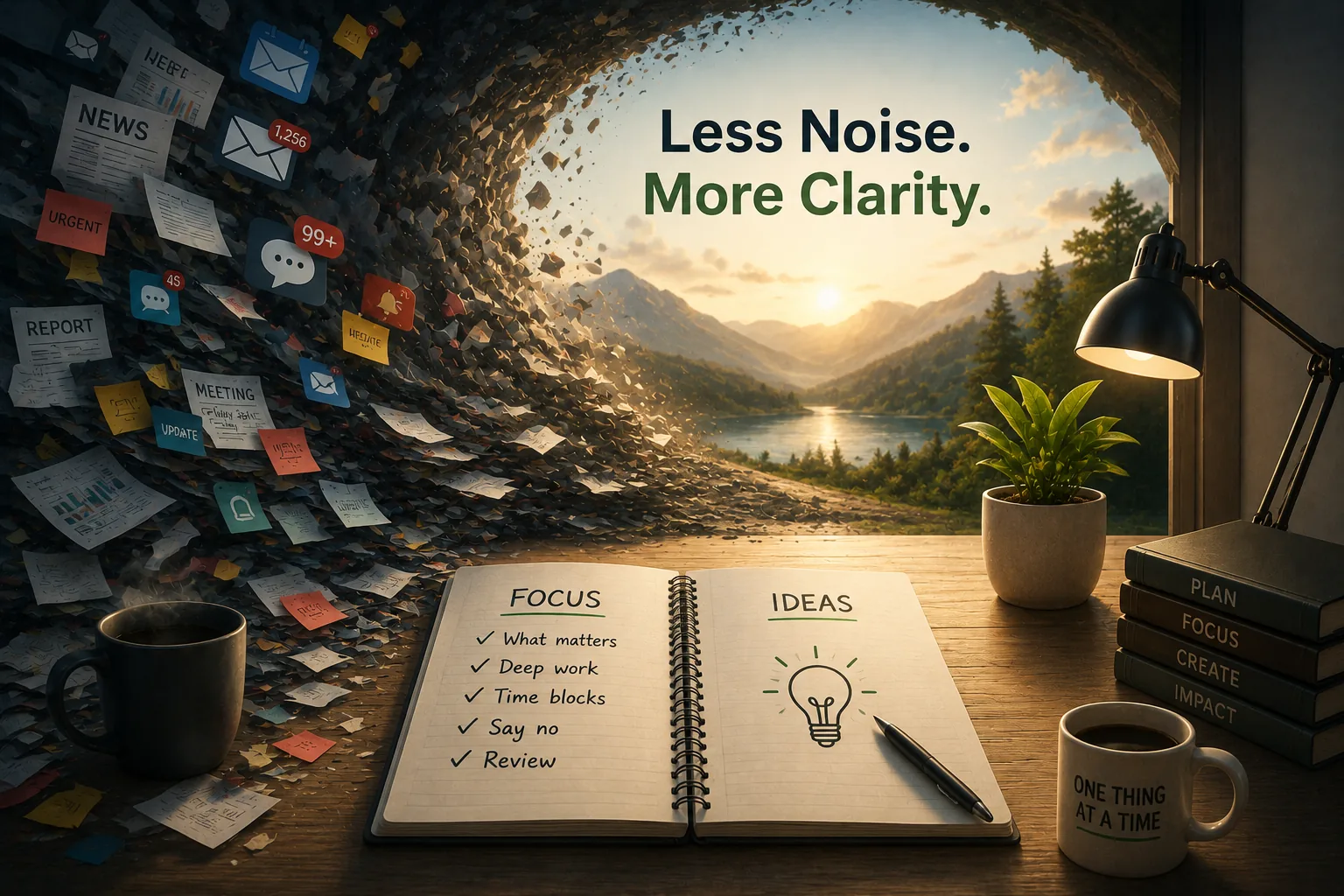
In 1971, economist Herbert Simon warned that "a wealth of information creates a poverty of attention." Fifty years later, that warning has become a defining crisis of knowledge work.
The average knowledge worker encounters more information in a single day-emails, Slack messages, articles, tweets, videos, reports, newsletters-than a medieval scholar encountered in a lifetime. We're drowning in content, starving for understanding.
Information overload isn't just about volume. It's about the fundamental mismatch between the exponential growth of available information and the fixed capacity of human attention and working memory. Every year, more content is created than in all previous human history combined.
Meanwhile, your brain's processing capacity remains constant. The gap widens relentlessly.
The consequences are severe: decision paralysis, shallow thinking, chronic distraction, anxiety from FOMO (fear of missing out), declining deep work capacity, and the persistent feeling of being overwhelmed despite consuming enormous amounts of content.
Most critically, there's the confusion of consumption with learning-saving articles feels productive, scrolling feels like staying informed, but little of this translates into actual knowledge, insight, or capability.
This article explores the problem of information overload systematically: why it's gotten dramatically worse, why traditional solutions fail, and evidence-based strategies for filtering signal from noise, building knowledge systems that scale, and reclaiming cognitive capacity for thinking rather than processing.
The Modern Information Landscape: Understanding the Crisis
To design effective solutions, we must first understand what's changed about information consumption and why traditional approaches no longer work.
The Exponential Content Explosion
The volume of created content has grown exponentially:
| Era | Information Doubling Time | Implication |
|---|---|---|
| Pre-printing press | ~1,000 years | Scarcity; information was precious |
| 1900 | ~100 years | Still manageable; experts could know their field |
| 1950 | ~25 years | Specialization required; breadth becoming impossible |
| 2000 | ~2 years | Constant stream; "keeping up" becomes difficult |
| 2020+ | Hours to days | Infinite content; processing is the bottleneck |
According to various estimates:
- Roughly 500 million posts per day on X (Twitter), by earlier estimates
- Over 500 hours of video uploaded to YouTube per minute
- Roughly 350 billion emails sent daily (Radicati Group, 2023)
- Roughly 2.5 quintillion bytes of data created daily (a widely cited industry estimate)
For any topic, interest, or question, there's essentially infinite content available. The constraint is never supply-it's always attention and processing capacity.
The Algorithmic Amplification Problem
"We are drowning in information but starved for knowledge." - John Naisbitt[13]
It's not just volume-it's that algorithms optimize for engagement, not insight. Social media feeds, recommendation engines, and news aggregators are designed to maximize time-on-platform through:
- Novelty bias: Constantly surfacing new content, creating FOMO
- Outrage and emotion: Controversial, emotionally charged content gets priority
- Confirmation bias exploitation: Feeding you content similar to what you've engaged with
- Variable reward schedules: Unpredictable valuable content mixed with filler, creating addictive checking behavior
The result: you're fed an endless stream of emotionally engaging but cognitively empty content, optimized for consumption, not comprehension.
The Disappearance of Natural Filters
Traditional information environments had built-in scarcity that acted as filters:
- Physical limits: Shelf space, attention of publishers/editors
- Cost barriers: Books, journals, subscriptions cost money
- Social gatekeepers: Librarians, editors, teachers curated and recommended
- Time delays: Publishing, distribution took time; urgency was rare
Digital information removes all these filters:
- Publishing is free and instant for anyone
- Distribution is unlimited (infinite shelf space)
- No gatekeepers required (anyone can broadcast)
- Everything feels urgent (real-time notifications)
The absence of natural scarcity means you must become your own filter-but most people lack effective filtering strategies.[12]
The Cognitive Cost of Context-Switching
Information overload isn't just about quantity-it's about fragmentation. A 2004-2005 study by Mark, Gonzalez and Harris found knowledge workers spent about three minutes on a task before switching on average. Each switch carries cognitive costs:
- Attention residue: Part of your mind stays on the previous task
- Re-orientation time: Time to remember context and resume work
- Working memory depletion: Each switch consumes mental resources
Psychologist Gloria Mark found it takes an average of 23 minutes to fully return to a task after an interruption.[4] With interruptions every three minutes, you never reach full cognitive capacity.
"Attention is the rarest and purest form of generosity." - Simone Weil
The Illusion of Learning Through Consumption
Perhaps the most insidious aspect: consumption feels like learning. Saving an article to "read later," scrolling through Twitter threads, watching educational YouTube videos creates a sense of productivity and knowledge acquisition-but most of this content passes through your mind without being processed, connected, or retained.
Cognitive scientist Daniel Willingham emphasizes: "Memory is the residue of thought." If you're not actively thinking about content-questioning it, connecting it to existing knowledge, applying it-you're not learning. You're just experiencing a fleeting sensation of information exposure.
Why Traditional Solutions Fail
Most people's approach to information overload involves strategies that superficially seem reasonable but actually exacerbate the problem.
The "Read Later" Trap
"Read later" apps (Instapaper, Pocket, browser bookmarks) promise to solve overload by allowing you to save content for when you have time. In practice:
- Saved → Read: Most saved content is never consumed
- Infinite growth: Saves accumulate faster than reading, creating anxiety
- Deferred decisions: Saving avoids deciding "is this worth my time now?"-but you'll face the same decision later
- Collection illusion: Saving feels productive but produces no knowledge
The result: a graveyard of thousands of unread articles, constant guilt, and no actual learning.
The "Stay Informed" Treadmill
Many knowledge workers feel obligated to "stay informed" across broad domains: industry news, general news, social media trends, research in their field, cultural conversations. This produces:
- Reactive consumption: Responding to what's trending rather than pursuing depth
- Shallow coverage: Skimming dozens of sources without mastering any
- Recency bias: Latest content crowds out timeless, foundational knowledge
- FOMO anxiety: Constant fear of missing important information
Paradoxically, those who try to stay informed about everything often understand less than those who focus deeply on a few areas-breadth without depth produces superficial familiarity, not expertise.
The "Better Tools" Mirage
Many seek technological solutions: better apps, more sophisticated organization systems, AI-powered summarization. While tools can help at the margins, they don't solve the fundamental problem:
- Productivity theater: Reorganizing notes feels productive but doesn't create understanding
- Tool obsession: Time spent optimizing systems exceeds time spent learning
- Capacity remains fixed: No tool expands your brain's processing capacity
As the saying goes: "A fool with a tool is still a fool." Better information management without strategic filtering just lets you organize overwhelm more efficiently.
The "More Effort" Illusion
Some respond to overload by working longer hours, reading faster, multitasking more. This leads to:
- Burnout: Unsustainable cognitive load
- Diminishing returns: Tired brains learn poorly
- Quality collapse: Speed reduces comprehension and retention
- Health costs: Sleep deprivation, stress, anxiety
You can't outwork a problem of infinite supply versus finite capacity.
Core Principle: Filtering Over Processing
"It's not information overload. It's filter failure." - Clay Shirky
The fundamental shift required: move from processing more to filtering better. The bottleneck isn't your ability to consume content-it's your ability to identify what's worth consuming and ruthlessly ignore the rest.
This requires inverting traditional assumptions:
| Old Mindset | New Mindset |
|---|---|
| Read as much as possible | Read as little as necessary |
| Stay broadly informed | Go deep in core areas |
| Save everything interesting | Save only what you'll act on |
| Keep up with latest content | Prioritize timeless, foundational knowledge |
| FOMO-might miss something | JOMO (joy of missing out)-confident in choices |
| Information as end goal | Information as means to action/insight |
The strategic question isn't "How can I process more?" but "What can I safely ignore?"
Strategic Filtering: A Multi-Layer Approach
Effective information management requires filtering at multiple levels, from high-level strategy to moment-to-moment decisions.
Layer 1: Define Information Goals and Criteria
Before filtering, clarify why you consume information. Common goals:
- Skill development: Learning specific capabilities
- Problem-solving: Finding solutions to current challenges
- Awareness maintenance: Staying aware of field developments
- Inspiration: Generating new ideas and perspectives
- Entertainment: Enjoyment and relaxation
Most information fails to serve any clear goal-it's consumption for consumption's sake. Establishing explicit goals enables asking: "Does this serve my goals?" If not, ignore it.
Criteria for valuable information (adapted from Shane Parrish and David Allen):[1]
"Half of the troubles of this life can be traced to saying yes too quickly and not saying no soon enough." - Josh Billings
- Actionable: Enables a specific decision or action
- Timeless: Remains relevant beyond this week
- Foundational: Builds understanding of core concepts
- Surprising: Challenges existing beliefs or reveals unknown unknowns
- Connected: Links to existing knowledge, creating new insights
Information that doesn't meet at least one criterion is likely noise.
Layer 2: Ruthlessly Curate Sources
The highest-leverage filtering happens at the source level-choosing which streams to expose yourself to. Most people are far too permissive here.
Audit current sources:
- List all information sources: newsletters, social media, news sites, podcasts, YouTube channels
- For each, estimate: hours per week consuming, concrete value gained (skills learned, decisions improved, insights generated)
- Calculate ROI: value gained / time spent
- Unsubscribe/unfollow anything with negative or low ROI
Use trusted curators: Rather than consuming raw content, rely on people or organizations that filter and synthesize:
- Domain experts: Follow a few respected voices who read widely and share highlights
- Aggregators: Newsletters or publications that curate the best content (e.g., The Browser, Farnam Street, domain-specific aggregators)
- Friends/colleagues with good judgment: People whose recommendations consistently deliver value
The key: leverage others' filtering work. Let high-quality curators do the first pass; you do the second pass on pre-filtered content.[15]
Layer 3: Just-in-Time Over Just-in-Case
Knowledge workers often consume content "just in case" it's useful someday. This leads to vast consumption with minimal application.
Just-in-time learning inverts this:
- Start with problems: When you encounter a challenge, then seek information
- Read with questions: Have specific questions you're trying to answer
- Apply immediately: Use information in real contexts soon after learning
This approach:
- Dramatically reduces consumption (only read what's immediately relevant)
- Improves retention (application solidifies memory)
- Provides natural filtering (only valuable information survives application test)
Caveat: Some foundational knowledge is worth acquiring "just in case"-but far less than most people assume.
Layer 4: Batch Processing and Time Limits
Rather than responding to information as it arrives (reactive, fragmented), batch similar activities:
- Email: Check 2-3 times per day, not constantly
- News/social media: Once per day, time-boxed (e.g., 30 minutes)
- Articles/reading: Designated reading time, not scattered throughout day
- Newsletters: Weekly review session, unsubscribe from anything not opened
Time limits prevent infinite consumption: "I'll spend 20 minutes on news, then stop regardless of what I've covered." This forces prioritization and breaks compulsive checking.
Layer 5: The Two-Minute Rule for Decisions
For each piece of content encountered, decide immediately:
- Act on it now (if takes <2 minutes): Read, respond, apply
- Schedule it (if important but time-consuming): Block time to handle properly
- Delegate or refer (if relevant to someone else): Forward and forget
- Delete/ignore (if not meeting criteria): No guilt, no saving
The key: make a decision, don't defer. "Read later" is usually "read never." If it's not worth reading now, it's probably not worth reading ever.
Building Knowledge Systems That Scale
Filtering reduces input, but you still need systems to convert valuable information into actual knowledge.
Progressive Summarization: Capture, Organize, Distill, Express
Productivity expert Tiago Forte's progressive summarization provides a scalable approach:[3]
- Capture: Save content with minimal processing (highlights, key quotes)
- Organize: File by project/area, not elaborate taxonomies
- Distill: Summarize key points, extract core insights
- Express: Create outputs (writing, presentations, applications) that force synthesis
The critical insight: most content doesn't deserve full processing. Process content to the level required for current use, no further. Only the most valuable content reaches "express" stage.
Evergreen Notes Over Endless Filing
Traditional note systems accumulate linearly: folders upon folders of notes, organized by source or topic. Over time, they become unsearchable graveyards.
Evergreen notes (popularized by Andy Matuschak) invert this:[5]
- Concept-oriented, not source-oriented: One note per concept, not per article/book[2]
- Densely linked: Notes connect to related concepts
- Continuously updated: Add to notes over time as you encounter new information on the same concept
- Expressed in your own words: Rewording forces comprehension
This creates a growing web of knowledge rather than an ever-expanding pile of unprocessed content.
Tools: Roam Research, Obsidian, Notion (with heavy linking), Zettelkasten-style systems.
Connection-Building Over Collection
The value of knowledge comes from connections, not volume. Richard Feynman distinguished between knowing the name of something and understanding it-most information consumption learns names without understanding.
Practices that build connections:
- Ask questions while reading: "How does this relate to [concept I already know]?" "What would this predict about [situation]?"
- Create analogies: "This is like [familiar concept] because..."
- Test yourself: Close the article; can you explain the core idea?
- Teach or write: Explaining to others (or to your future self) reveals gaps
If you can't generate connections to existing knowledge, you haven't learned-you've just experienced exposure.
Spaced Repetition for Core Knowledge
Not all information is equal. For foundational knowledge you need to retain long-term (key concepts in your field, mental models, critical facts), use spaced repetition:
- Tools like Anki or RemNote use algorithms to show you information at increasing intervals
- This fights the forgetting curve, solidifying knowledge into long-term memory
- Requires upfront investment (creating cards) but ensures retention
Reserve this for truly important knowledge-don't try to memorize everything.
Regular Review and Pruning
Knowledge systems decay without maintenance:
- Weekly review: Scan captured content; promote valuable items, delete noise
- Monthly review: Revisit key notes; update, connect, remove outdated content
- Quarterly review: Audit sources; unsubscribe from low-value inputs
- Annual review: Big-picture assessment of information diet; major adjustments
The principle: entropy is natural; systems require active maintenance to remain useful.
Mindset Shifts for Sustainable Information Management
Beyond tactics, overcoming information overload requires psychological shifts.
From FOMO to JOMO: Embracing Intentional Ignorance
The fear of missing out drives much dysfunctional consumption. The antidote: JOMO (joy of missing out)-actively embracing that you will miss things, and that's fine.
Cognitive shifts:
- Missing out is inevitable: With infinite content, you'll miss 99.9999% regardless of effort
- Depth beats breadth: Deep understanding of a few areas provides more insight and capability than superficial familiarity with many
- Others' highlights will reach you: Truly important information spreads; you'll encounter it eventually
- You can't know everything: Accepting this is liberating, not limiting
Practical: Periodically take "information fasts"-days or weeks without news, social media, or non-essential reading. The world continues; you survive; often you realize how little you actually missed.
From Consumption to Creation: Learning Through Output
The most effective knowledge workers invert the consumption/creation ratio: they consume selectively and create prolifically.
Creation (writing, teaching, building, speaking) forces:
- Synthesis: Combining ideas from multiple sources
- Gap identification: Revealing what you don't actually understand
- Consolidation: Turning vague impressions into concrete models
- Accountability: Public creation creates pressure for quality
Learn in public (as developer Shawn Wang advocates): Share notes, summaries, and insights publicly (blog, Twitter, newsletters).[10] This:
"Tell me and I forget, teach me and I may remember, involve me and I learn." - Benjamin Franklin
- Forces clarity (writing for others demands comprehension)
- Creates accountability (public commitment to learning)
- Attracts feedback (others correct, extend, connect your ideas)
- Builds reputation (positions you as knowledgeable)
Shift from "consume then maybe create" to "consume only what supports active creation."
From Completionism to Satisficing
Many knowledge workers have completionist tendencies: feeling obligated to finish every article started, read every email, clear every notification. This is unsustainable with infinite content.
Adopt satisficing (a term from Herbert Simon): seeking "good enough" rather than optimal. In practice:
- Skim ruthlessly: Read introduction and conclusion; dive deeper only if valuable
- Abandon freely: If content isn't delivering value, stop reading-no guilt
- Accept incompleteness: You don't need to read the whole book; key ideas often emerge in first chapters or last chapters
- Use summaries: For many books/articles, a good summary provides 80% of value in 5% of time
Remember: the goal isn't consuming content-it's building knowledge and capability. Consuming more doesn't guarantee more learning.
Domain-Specific Strategies
Optimal strategies vary by field and role.
For Researchers and Academics
- Rely on literature reviews and syntheses: Let others survey the field; read reviews rather than all primary sources
- Follow key labs/authors: Track work of top contributors directly rather than surveying entire field
- Use citation networks: When you find a valuable paper, explore what it cites and what cites it
- Attend conferences selectively: In-person exposure to current work, but prohibitively time-consuming to attend all
For Knowledge Workers and Professionals
- Focus on fundamentals: Deep understanding of core concepts in your domain beats superficial awareness of latest trends
- Use aggregators and curators: Industry-specific newsletters, curators who synthesize developments
- Just-in-time learning: Learn new tools/techniques when you have an immediate project to apply them to
- Build a personal advisory board: Cultivate relationships with people in different niches who can alert you to relevant developments
For Entrepreneurs and Business Leaders
- Customer conversations over content: Direct customer feedback provides higher signal than articles about market trends
- Financial metrics: Revenue, costs, conversions-actual data beats opinions
- Selective thought leaders: Follow a few respected voices; ignore hype cycles
- Delegation: Have team members specialize and brief you on their domains
Measuring Success: What Good Information Management Looks Like
How do you know if your strategies are working? Key indicators:
Positive Signals
- Calm, not frantic: Information consumption feels sustainable, not overwhelming
- Deep work capacity: Able to sustain focused work for extended periods
- Idea generation: Regularly generating insights and connections (not just consuming others')
- Application: Frequently using learned information in real contexts
- Retention: Able to recall and explain key concepts without re-looking up
Warning Signs
- Growing backlogs: Unread articles/books piling up faster than cleared
- Constant checking: Compulsively refreshing feeds, checking email
- Shallow engagement: Skimming without comprehension
- Guilt and anxiety: Feeling behind, overwhelmed, stressed about information
- Lack of output: Consuming without creating, learning without applying
If warning signs outnumber positive signals, your system isn't working-time to audit and adjust.
Conclusion: From Overload to Intentionality
Information overload is not a problem of insufficient capacity or tools-it's a problem of misaligned incentives and absent strategy. The platforms and systems that deliver information are optimized for engagement and consumption, not comprehension and wisdom.
The default path-consume as much as possible, save everything, try to keep up-leads inevitably to overwhelm, shallow thinking, and anxiety.
The solution isn't working harder or adopting better apps. It's a fundamental shift in approach: from maximizing consumption to maximizing signal, from reactive processing to strategic filtering, from accumulation to application, from breadth to depth.
This requires accepting uncomfortable truths:
- You will miss things-and that's fine
- Most content isn't worth consuming-even if it's interesting
- Collecting information isn't learning-application and synthesis are
- Depth in a few areas beats superficial coverage of many
- Saying no to most information is essential to engaging meaningfully with any
The goal isn't perfect information management-it's intentional information engagement: consuming strategically, processing deeply, applying consistently, and creating prolifically. In an infinite-content world, the scarce resource isn't information-it's attention, comprehension, and wisdom.
As Herbert Simon warned: a wealth of information creates a poverty of attention.[9] But attention deliberately deployed-on carefully filtered, deeply processed, actively applied information-creates a wealth of understanding. That's the shift required to thrive in the age of overload.
What Research Shows About Information Overload Solutions
Gloria Mark at the University of California, Irvine, along with Daniela Gudith and Ulrich Klocke, published "The Cost of Interrupted Work: More Speed and Stress" in the Proceedings of the CHI Conference on Human Factors in Computing Systems in 2008.
The study tracked 36 information workers over multiple days using a combination of observation and computer logging, finding that the average worker was interrupted or self-interrupted every 3 minutes and 5 seconds.
The study's most consequential finding for information overload was that recovering full cognitive engagement after interruption required an average of 23 minutes - a figure that makes effective deep work statistically impossible in notification-heavy environments.[6]
Mark's subsequent research, published in her 2023 book Attention Span and based on over two decades of experience sampling studies at UC Irvine, documented that the average period of continuous focus on a single screen dropped from about 2.5 minutes in 2004 to approximately 47 seconds by 2020 - a decline of roughly 69% coinciding with the rise of always-on communication tools and social media feeds.
Eyal Ophir, Clifford Nass, and Anthony Wagner at Stanford University published "Cognitive Control in Media Multitaskers" in the Proceedings of the National Academy of Sciences in 2009, examining whether heavy media multitaskers - people who regularly consume multiple information streams simultaneously - developed enhanced cognitive abilities compared to light multitaskers.[14]
The hypothesis was that chronic multitaskers might develop superior attention-filtering abilities.
The results were the opposite: heavy media multitaskers performed significantly worse than light multitaskers on tests of sustained attention, working memory, and task switching.
Heavy multitaskers were more susceptible to distraction from irrelevant information and had greater difficulty filtering out perceptual and cognitive interference.
The researchers concluded that heavy multitasking did not produce cognitive adaptation but instead created persistent vulnerabilities to distraction that degraded performance even in single-task environments. The study established empirically that information multitasking does not build cognitive capacity - it degrades it.
Peter Pirolli and Stuart Card at Xerox PARC published "Information Foraging" in Psychological Review in 1999, applying evolutionary foraging theory to human information-seeking behavior.
The framework proposes that humans approach information environments the same way animals approach food patches: evaluating the expected return rate of an information source against the cost of searching it, and abandoning sources when expected returns fall below a threshold - a concept they called "giving up time." The research showed that people unconsciously apply cost-benefit calculations to information consumption, tending to abandon difficult or unrewarding sources in favor of easily digestible ones.
The theory predicts the specific failure mode of information overload: when information supply is infinite and presentation is optimized for engagement rather than value, foraging behavior directs attention toward the most stimulating rather than most useful content.
Pirolli and Card's framework was later cited extensively in research on algorithmic feed design, explaining why recommendation systems optimized for engagement produce the informational equivalent of junk food.[8]
Daniel Willingham at the University of Virginia, a cognitive scientist specializing in educational psychology, published "Why Don't Students Like School?" in 2009 and has written extensively on how memory formation works in relation to information processing.
Willingham's central research finding - summarized in his aphorism "memory is the residue of thought" - is that information is retained in long-term memory only to the extent that it is actively processed at the time of encoding.[11]
Passive exposure to information, even repeated passive exposure, produces minimal durable memory.
The research implications for information overload are direct: the vast majority of content consumed through reading, video, and social media produces no lasting knowledge because it is processed at a level insufficient to create memory traces.
Willingham argues that how deeply information is processed at encoding is more predictive of retention than the volume consumed.
Real-World Case Studies in Information Overload Solutions
Basecamp (now 37signals) has been one of the most documented organizational experiments in deliberate information reduction.
The company, which develops project management software and employs approximately 70 people, published its internal operating philosophy in Jason Fried and David Heinemeier Hansson's 2018 book "It Doesn't Have to Be Crazy at Work." Basecamp eliminated internal email entirely, restricted real-time messaging to designated "chat" hours, and implemented a policy of asynchronous work as the default.
The company published internal data showing that the median response time to work-related messages was measured in hours rather than minutes, with employees reporting significantly higher sustained focus blocks.
In 2020, Basecamp published a "Shape Up" methodology that documented their 6-week work cycles, which structurally prevent information overload by creating hard boundaries on scope and eliminating the continuous backlog monitoring that generates perpetual information noise.
McKinsey Global Institute published a major analysis in 2012 titled "The Social Economy: Unlocking Value and Productivity Through Social Technologies," examining the value of social technologies across four industries (and a survey of about 4,200 companies).
The research found that knowledge workers spent an average of 28% of their workweek managing email and another 20% searching for information or tracking down colleagues who held needed information.
The study estimated that improving information accessibility could raise knowledge worker productivity by 20-25%, representing a potential economic value of $900 billion to $1.3 trillion annually across the US economy.
Slack's Workforce Lab (Future Forum) has published surveys of desk workers on notification and communication loads.
Surveys have reported that many workers feel unable to disconnect from communication channels.
The study identified a "notification tax": each incoming notification produced a measurable productivity cost even when the notification was not acted upon, because the evaluation process - "is this worth my attention now?" - consumed cognitive resources.
Workers who used notification batching (designated check-in times rather than continuous monitoring) reported 21% higher sustained focus scores and 18% lower self-reported stress levels than continuous-monitoring workers.
Slack's data also showed that organizations with explicit asynchronous communication norms - documented and enforced by leadership - showed 40% lower "evening work hours" (activity between 6pm and 10pm) than organizations without such norms, with no measurable reduction in output quality.
Farnam Street, the knowledge management and mental models publication founded by Shane Parrish, has discussed information consumption patterns among its readers.
The survey compared readers who described themselves as "broad consumers" (consuming from 15+ information sources weekly) versus "focused readers" (consuming from fewer than 5 sources with deliberate criteria).
Focused readers reported 40% higher rates of "applying something learned in the past month to a real decision," 35% higher confidence in explaining concepts they had recently studied, and 28% lower information anxiety scores.
Parrish documented these findings in his 2023 book "Clear Thinking," using them to argue that the curation decision - which sources to trust and follow - is more consequential for knowledge development than any downstream consumption behavior.[7]
Sources & Further Reading
- Allen, D. (2001). Getting things done: The art of stress-free productivity. Penguin Books.
- Ahrens, S. (2017). How to take smart notes: One simple technique to boost writing, learning and thinking. CreateSpace.
- Forte, T. (2022). Building a second brain: A proven method to organize your digital life and unlock your creative potential. Atria Books.
- Mark, G., Gudith, D., & Klocke, U. (2008). The cost of interrupted work: More speed and stress. Proceedings of the SIGCHI Conference on Human Factors in Computing Systems, 107-110. DOI: 10.1145/1357054.1357072
- Matuschak, A. (2019). Evergreen notes. Retrieved from View source
- Newport, C. (2016). Deep work: Rules for focused success in a distracted world. Grand Central Publishing.
- Parrish, S. (2023). Clear Thinking: Turning Ordinary Moments into Extraordinary Results. Portfolio.
- Pirolli, P., & Card, S. (1999). Information foraging. Psychological Review, 106(4), 643-675. DOI: 10.1037/0033-295X.106.4.643
- Simon, H. A. (1971). Designing organizations for an information-rich world. In M. Greenberger (Ed.), Computers, communication, and the public interest (pp. 37-72). Johns Hopkins University Press.
- Wang, S. (2021). Learn in public. Retrieved from View source
- Willingham, D. T. (2009). Why don't students like school? A cognitive scientist answers questions about how the mind works and what it means for the classroom. Jossey-Bass.
- Shirky, C. (2008). "It's Not Information Overload. It's Filter Failure." Web 2.0 Expo NY. View source
- Naisbitt, J. (1982). Megatrends: Ten New Directions Transforming Our Lives. Warner Books.
- Ophir, E., Nass, C., and Wagner, A. D. (2009). "Cognitive Control in Media Multitaskers." Proceedings of the National Academy of Sciences, 106(37), 15583-15587.
- Rosenbaum, S. (2011). Curation Nation: How to Win in a World Where Consumers are Creators. McGraw-Hill.
Further Reading
- Carr, N. (2010). The shallows: What the internet is doing to our brains. W. W. Norton & Company. DOI: 10.17323/1726-3247-2011-4-140-147
- Gladwell, M. (2019). Talking to strangers: What we should know about the people we don't know. Little, Brown and Company.
- Schwartz, B. (2004). The paradox of choice: Why more is less. Harper Perennial. DOI: 10.1037/e413792005-001
- Csikszentmihalyi, M. (1990). Flow: The Psychology of Optimal Experience. Harper & Row.
- Toffler, A. (1970). Future Shock. Random House.