
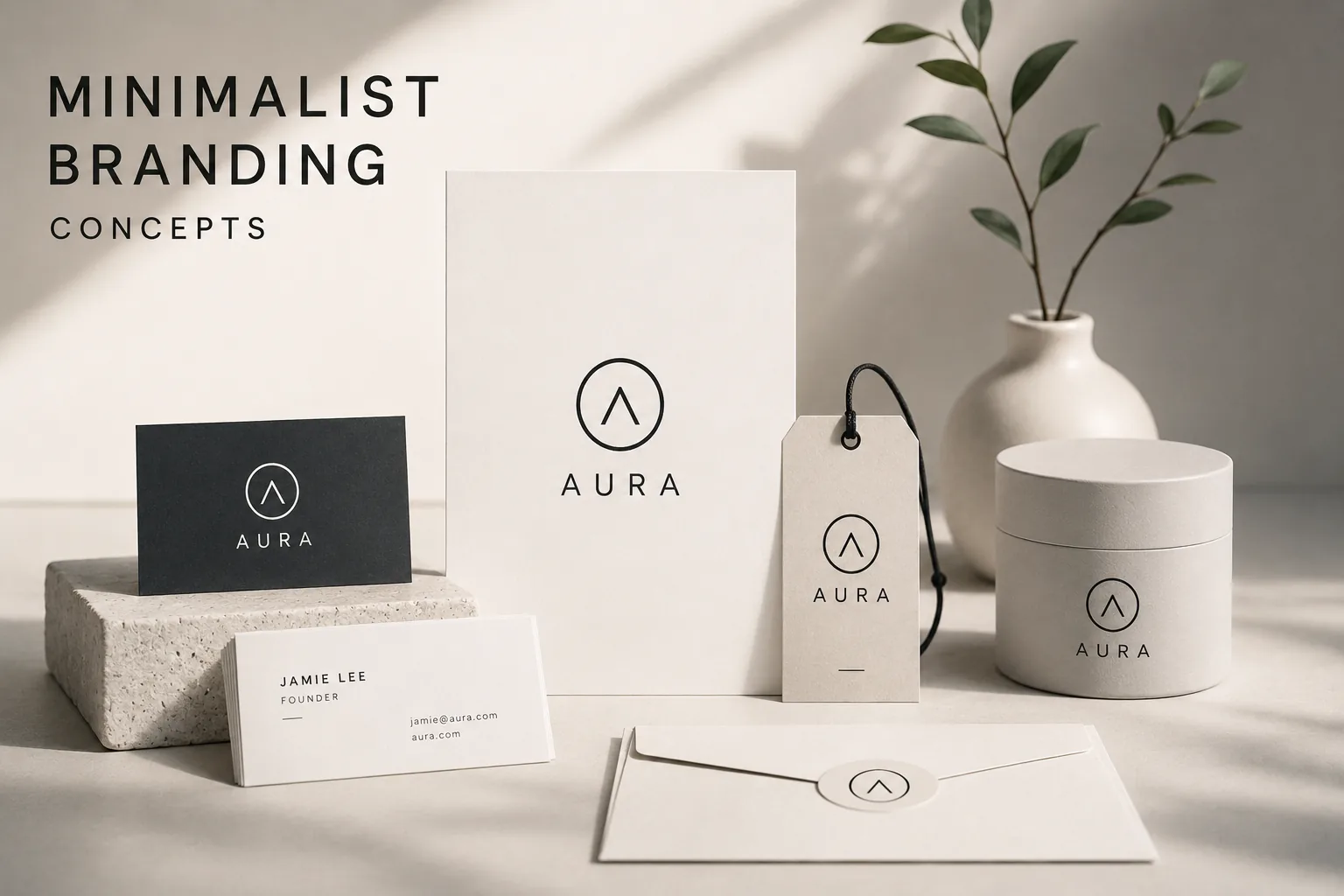
Minimalist branding concepts center on rigorous choices about what to remove as well as what to include. Limited colors, restrained typography, whitespace, and direct language can concentrate attention and signal precision, quality, or confidence. This approach works best when those associations support a brand's positioning; for categories needing warmth, playfulness, energy, or richness, minimalism can weaken the intended message.
In 2016, Mastercard introduced a new logo design, and in 2019 it dropped its name from the logo. The decision was made by the design firm Pentagram under the direction of Mastercard's chief marketing officer Raja Rajamannar, and it was controversial internally before it was controversial externally - how could a global financial brand abandon its own name from its most recognizable visual asset?
But the decision reflected a strategic confidence rooted in data: research showed that 80% of consumers recognized the brand from the two overlapping circles alone, without the wordmark.
The name was not adding information. It was adding visual noise to a symbol that had already achieved the ultimate goal of minimalist branding: instant recognition through radical simplicity.
By 2019, Mastercard had removed the name from all of its primary brand applications. The circles - red and yellow, overlapping to create an orange intersection that suggests connection and completion - stood alone on credit cards, merchant signs, and global advertising.
The decision was vindicated: brand recognition remained strong, the visual identity became cleaner and more versatile, and Mastercard had demonstrated something that most organizations find counterintuitive: that removing elements from a brand identity can make it more powerful, not less.
What Minimalism Actually Means in Branding
Minimalist branding is not the absence of design. It is the presence of rigorous editorial judgment about what to include and what to exclude. Every element in a minimalist brand - every color, typeface, spatial relationship, and word - must earn its place by serving a clear communication purpose.[6]
Elements that do not serve a purpose are removed not because they are unattractive but because they dilute the elements that do matter.
"Perfection is achieved not when there is nothing more to add, but when there is nothing left to take away." - Antoine de Saint-Exupery
This principle operates at every level of brand expression. In visual identity, it means limited color palettes, restrained typography, generous whitespace, and the elimination of decorative elements that do not serve communication.
In verbal identity, it means clear, direct language that avoids jargon, qualifiers, and marketing superlatives.[8] In brand experience, it means streamlined interactions that respect the customer's time and attention.
The strategic foundation of minimalist branding is focus. A minimalist brand communicates one clear message rather than attempting to convey multiple messages simultaneously.
This focus is what creates the clarity that audiences experience as confidence and professionalism - the brand knows exactly what it is and communicates that identity without equivocation.
This is distinct from being understated or subdued. Apple's minimalist identity is not quiet; it is precise and confident.
The Helvetica typeface that dominated Swiss design in the 1960s and continues to appear on signage systems worldwide is not invisible; it commands attention precisely because it does not compete with itself. Minimalism creates visual authority by concentrating attention rather than dispersing it.
The psychological mechanism is attention allocation. Human visual processing is limited: people cannot attend to everything simultaneously. A visual environment with many competing elements requires the viewer to decide where to direct attention.
A visual environment with few, purposeful elements guides attention to those elements automatically. Minimalist branding exploits this mechanism by removing the competition.
When Minimalism Works and When It Does Not
Minimalist branding is not universally appropriate. Its effectiveness depends on the brand's positioning, category, audience, and strategic objectives.
| Context | Minimalism Effectiveness | Reason |
|---|---|---|
| Premium positioning | High | Restraint signals quality; abundance signals discount |
| Technology and SaaS products | High | Clean interfaces, competence signals align with minimalism |
| Professional services | High | Confidence, precision, and competence communicate effectively through restraint |
| Healthcare and financial services | Medium-high | Trust and clarity are aligned, but warmth may be needed |
| Consumer packaged goods | Variable | Minimalism can signal premium but may lack appetite appeal |
| Luxury fashion | Variable | Can signal exclusivity or feel austere depending on execution |
| Entertainment brands | Low | Need energy, emotion, and richness that minimalism suppresses |
| Children's products | Low | Need warmth, playfulness, and visual richness |
| Community and nonprofit organizations | Low-medium | May feel cold; approachability and warmth often required |
The key insight is that minimalism communicates specific associations: precision, quality, confidence, sophistication. These associations benefit some positioning strategies and undermine others. A premium tech product brand benefits from the precision signal; a warm community platform may be damaged by it.
The decision to pursue minimalist branding should be made strategically, based on what it communicates, not aesthetically.[5]
Example: Basecamp's brand identity is deliberately informal and human - using a warm color palette, conversational typography, and illustration styles that feel personal rather than corporate. This choice serves Basecamp's positioning as the anti-corporate alternative to enterprise software.
A minimalist brand identity would undermine that positioning by signaling the corporate precision that Basecamp is explicitly rejecting.
The Elements of Minimalist Brand Design
Color Restraint and the Weight of Few Choices
Minimalist brands typically work with limited color palettes - often a primary color, a secondary color, and neutrals. This restraint has several strategic effects. It makes the brand more recognizable because fewer colors are easier to remember and identify.
It creates visual consistency across applications because there are fewer variables to manage. And it signals editorial confidence - the willingness to make decisions and commit to them.
The choice of colors within a minimalist palette carries disproportionate weight. When a brand has twelve colors, no single color defines the brand; each contributes marginally to the visual identity. When a brand has two colors, each color is essential to the identity.
This concentration of identity into fewer elements is both the source of minimalism's power and the source of its risk.
Minimalist color selection requires understanding color psychology (the associations different colors activate), cultural associations (colors that work in one market may carry different meanings in another), competitive differentiation (choosing colors that are not dominated by competitors), and functional requirements (contrast ratios for accessibility, reproduction quality across print and digital).
Example: Stripe's brand identity uses a distinctive purple (specifically, Stripe's signature gradient moving from a warm purple to a cooler blue) that no other major payment infrastructure company used when Stripe established it.
In a category dominated by blue and green (PayPal, Visa, Mastercard, American Express), the purple created immediate differentiation. The choice was strategic, not arbitrary.
Typography as Primary Visual Vehicle
In minimalist branding, typography does the heavy lifting that decorative elements do in maximal approaches. With minimal decorative elements, type becomes the primary vehicle for both information and personality.
The choice of typeface, the hierarchy of sizes and weights, the spacing between letters and lines - these decisions define the brand's visual character more completely than they would in a richer visual environment.
The attention to typographic detail in effective minimalist branding is considerable. Kerning - the spacing between individual letter pairs - affects the texture of text in ways that readers perceive subliminally even when they cannot articulate the difference.
Leading - the spacing between lines - affects both readability and the visual density of text blocks. The relationship between the weight of headings and body text creates hierarchy that guides reading order. These details are invisible when done well and distracting when done poorly.
Minimalist brands tend toward typefaces with genuine character within their restraint: geometric sans-serifs like Futura, Gotham, or Avenir for contemporary precision; humanist sans-serifs like Gill Sans or Frutiger for warmth within clarity; well-chosen serifs like Garamond or Caslon for heritage and authority.
The common failure mode is defaulting to system fonts (Helvetica, Arial) that are ubiquitous and therefore distinctionless.
Whitespace as Active Design Element
In minimalist branding, whitespace - the empty space between and around elements - is not wasted space.[4] It is an active design element that serves multiple communication purposes simultaneously.[2]
It creates visual breathing room that reduces cognitive load. Crowded layouts require visual parsing before communication can occur; open layouts allow the eye to move directly to content. It directs attention to the elements that remain by eliminating competition for the viewer's focus.
A single sentence in the center of a wide-margin page commands attention in a way that the same sentence embedded in dense text does not. And it communicates luxury and confidence - the brand has so much visual space that it does not need to fill every inch with messaging.
"Whitespace is to be regarded as an active element, not a passive background." - Jan Tschichold
The effective use of whitespace requires organizational confidence. Marketing instincts push toward filling available space with additional messages, calls to action, and supporting evidence. "We have empty space on this page" feels like a missed opportunity.
Minimalist branding resists this impulse, trusting that fewer elements presented with more space will communicate more effectively than many elements crowded together - which the evidence consistently supports.
Example: Apple's retail store design, developed by architect Peter Bohlin and influenced by Steve Jobs, uses space in ways that were initially controversial in retail: enormous stores with very few products on display, wide aisles, and large areas of empty floor.
The effect is the opposite of the cluttered retail environment that most consumer electronics stores used. The space communicates that each product is significant and worth careful consideration rather than lost in an overwhelming selection.
Research on Minimalism's Effect on Perception and Purchase Behavior
The strategic case for minimalist branding is supported by a well-developed body of cognitive psychology and consumer behavior research examining how visual complexity affects brand perception, purchase decisions, and price tolerance.
John Maeda, then a professor at the MIT Media Lab and later President of Rhode Island School of Design (RISD), established the theoretical foundation for design minimalism in The Laws of Simplicity (MIT Press, 2006).[3] Maeda's research synthesis identified ten laws governing simplicity's impact on human experience.
The book is a design-philosophy work built on ten laws, not a controlled user-testing study.
Maeda's "Law of Reduce" - eliminate features until you reach the minimum irreducible set - maps directly onto minimalist brand design: each removed element increases the perceived value of those that remain.
Research on organizational complexity signals and stakeholder trust has been applied to brand communication.
While focused on corporate governance, their finding - that organizations presenting simpler, more coherent public identities received higher trust ratings from both consumers and institutional investors - has been widely applied to brand communication.
The research established an empirical link between the clutter of brand communication and trust deficits.
Dr. Nilli Lavie of University College London's Institute of Cognitive Neuroscience published influential research on "perceptual load theory" with implications for minimalist design.
Her 2005 paper in Trends in Cognitive Sciences, "Distracted and confused?: Selective attention under load," established that high perceptual load (visual environments with many competing elements) consumes cognitive resources needed for higher-order processing.
Applied to brand contexts, Lavie's research predicts that brands using high-density visual communication consume cognitive resources that audiences could otherwise allocate to processing brand messages and forming brand attitudes.
Minimalist brand environments, by reducing perceptual load, free cognitive resources for message processing - explaining why minimalist brands are often described as "clearer" even when the information content is identical to more complex alternatives.
Case study - Apple Store's Minimalism ROI: Apple's retail store concept, pioneered with the first stores opening in May 2001 in Tysons Corner, Virginia and Glendale, California, deployed radical spatial minimalism that was initially controversial among retail analysts.
A 2012 analysis by Deloitte, examining Apple Store revenue per square foot against industry benchmarks, found that Apple Store generated approximately $5,546 in annual revenue per square foot - the highest of any retailer in the US, surpassing second-ranked Tiffany & Co at $3,043 per square foot and the department store average of approximately $165 per square foot.
Deloitte attributed the extraordinary revenue density in part to the minimalist environment's effect on dwell time and conversion: Apple Store visitors spent an average of 27 minutes in-store versus a consumer electronics category average of 11 minutes, and converted at a rate of 26% versus the category average of 12%.
The research linked the conversion premium to minimalism's role in reducing decision complexity and increasing product focus.
Case study - Evian's Packaging Minimalism Test: Evian water, owned by Danone, conducted a controlled packaging experiment across six European markets in 2014, documented in a Danone investor presentation and analyzed by brand consultancy Interbrand.
The original packaging featured a mountain image, a brand history text block, and multiple regulatory disclosures in a dense visual layout. A minimalist redesign retained only the brand name, the Alps silhouette, and a single quality statement.
Blind tests in controlled retail environments found that the minimalist packaging generated 19% higher premium price tolerance (consumers' maximum acceptable price before switching to alternatives), 12% higher brand quality ratings, and 8% higher purchase intent scores.
The research also found that the minimalist packaging reduced the time-to-decision in simulated shopping scenarios from 4.2 seconds to 2.7 seconds, consistent with Lavie's perceptual load theory - reducing visual complexity accelerated the recognition and purchase decision process.
The Cognitive Science Behind Visual Restraint
The psychological mechanisms through which minimalism creates commercial advantage have been investigated across multiple research disciplines, providing a coherent theoretical account of an empirical phenomenon.
Professor Rolf Reber of the University of Bergen and colleagues, publishing in Personality and Social Psychology Review (2004), introduced the concept of "processing fluency" - the subjective experience of ease in processing information - as a mediator between visual simplicity and aesthetic judgment.
Their experiments found that stimuli processed more fluently (more easily) were rated as more beautiful, more truthful, and more high-quality than identical stimuli processed less fluently.
Processing fluency was directly manipulated by reducing visual complexity: removing background elements, increasing contrast, and simplifying compositions all increased fluency scores.
The research established that minimalist design, by enhancing processing fluency, generates positive affect that transfers to the brand itself - people feel better about brands they can process easily.
Research by Winkielman, Schwarz, Fazendeiro, and Reber (2003) in a chapter of The Psychology of Evaluation extended the fluency research by examining its effects on commercial behavior.
Their experiments found that high-fluency stimuli (simple, clear, easily processed) generated significantly higher willingness-to-pay than low-fluency stimuli, even when participants were unaware that fluency was influencing their judgment.
Specifically, they found price premiums of 15-30% for high-fluency product presentations versus low-fluency presentations of identical products.
This finding has direct implications for minimalist branding: the premium that consumers attribute to minimalist brands may be partly attributable to fluency effects rather than (or in addition to) quality signals.
Professor Siegfried Vögele of the German Institute for Direct Marketing conducted research across 500,000 mail-order transactions examining the relationship between visual complexity and response rates.
His 1984 research, published in Dialogue Method: Book of Direct Mail and Telephone Marketing, found that promotional materials with fewer visual elements generated 34% higher response rates than materials with equivalent information presented in complex visual layouts.
Vögele attributed this to "visual dialogue" - the eye's natural tendency to follow a guided path through information - which is disrupted by visual complexity and enabled by minimalist organization.
While pre-digital, Vögele's findings have been replicated in modern eye-tracking studies of digital advertising by researchers at the Advertising Research Foundation.
Case study - Mastercard's Wordmark Removal: Measurable Impact: Mastercard's 2019 decision to remove its wordmark from its primary brand mark, leaving only the overlapping red and yellow circles, was preceded by comprehensive brand recognition research.
Pentagram's design director Michael Bierut documented that Mastercard's brand testing found 80% unaided recognition of the symbol without the wordmark among consumers in the US and Europe - the threshold the company had established as prerequisite for the removal.[9]
A post-implementation study conducted by Mastercard's brand team and presented at the Brand Strategy Summit (2020) found that the simplified mark achieved 80% unaided recognition in 21 of the 23 markets tested within six months of implementation, with recognition actually improving by 4 percentage points overall (from 80% to 84% aided recognition) as the more distinctive, isolated mark became easier to process and remember.
The study also found that brand "premium" perception - the proportion of consumers who associated Mastercard with superior quality - increased by 7 percentage points following the mark simplification.
Case study - IKEA's Catalog Minimalism Research: IKEA's internal consumer research team, results shared at the European Association for Consumer Research annual conference (2016), examined how visual presentation style affected perceptions of its product catalog.
The research compared traditional complex catalog layouts (multiple products per spread, dense copy, multiple typefaces, promotional messaging) against minimalist layouts (single product focus, generous whitespace, consistent typography, minimal copy).
Consumer panels evaluating the two approaches found that the minimalist catalog generated 22% higher ratings for "product desirability," 31% higher ratings for "brand premium perception," and 18% higher purchase intent - despite presenting identical products at identical prices.
Critically, the minimalist catalog also generated 27% higher recall of specific products in memory tests conducted 48 hours after exposure, consistent with Lavie's perceptual load theory that reduced visual complexity improves information encoding.
Avoiding the Generic Minimalism Trap
The most significant risk of minimalist branding is arriving at a design that is clean, modern, and completely indistinguishable from every other minimalist brand.
The explosion of technology company branding in the 2010s produced a near-identical visual language: a sans-serif wordmark (often a geometric sans-serif with optically corrected letter spacing), a limited color palette anchored by a single vivid color against white, and generous whitespace.
By 2018, the visual identities of dozens of high-profile software companies were nearly interchangeable.
This convergence created a paradox: the minimalist approach that was adopted to create differentiation became the dominant category visual language, eliminating the differentiation it was intended to create.
The brand that looked most like the category standard was the least differentiated, despite using a design approach intended to signal distinctive quality.
Differentiation within minimalism requires finding ways to be specific and distinctive within the constraints of the approach:
Distinctive typography choices. Selecting a typeface with genuine character - one that is not default geometric sans-serif - creates visual distinctiveness within a minimalist framework. Choosing a serif typeface, an unusual geometric, or a custom typeface creates differentiation at the most fundamental level of minimalist design.
Unexpected color combinations. Rather than the standard tech blue or the omnipresent "gradient startup" palette, choosing a color that is ownable because few competitors use it creates recognition even within a minimal visual vocabulary.
Monzo's distinctive coral, Mailchimp's signature yellow, and Spotify's evolving palette of vibrant colors all created differentiation within minimal systems.
A single distinctive element. One element that has genuine character within an otherwise restrained system creates a recognizable hook.
A distinctive logo mark, an unusual graphic device (Stripe's gradient, Notion's illustrations), or a signature visual treatment creates the specific association that a purely generic minimalism cannot.
Voice and personality. Minimalist visual design paired with a distinctive, personality-rich verbal identity creates contrast that is both memorable and effective. Differentiation in a minimalist visual context often shifts from the visual to the verbal, with copywriting carrying the personality that the design deliberately restrains.
Mailchimp's brand voice - playful, informal, occasionally self-deprecating - creates the warmth and personality that its relatively minimal visual system cannot convey alone.
Minimalism in Messaging
Visual minimalism paired with verbose, cluttered messaging creates dissonance. Minimalist branding requires corresponding discipline in language: clear, direct, economical writing that respects the audience's intelligence and time.
Minimalist messaging principles:
- Lead with the most important information - the key point first, supporting detail second
- Eliminate qualifiers ("quite," "very," "rather"), hedges ("we believe," "in many cases"), and filler ("in order to" instead of "to")
- Use concrete language rather than abstract claims ("cut invoicing time from 3 hours to 20 minutes" rather than "improve your financial workflows")
- Write in short sentences that communicate one idea each - complexity in ideas, simplicity in expression
- Resist the temptation to say everything - choose the one message that matters most and commit to it
The discipline of verbal minimalism is as demanding as visual minimalism, and it is frequently harder to achieve because organizations have more stakeholders with competing claims on messaging space. The product team wants features mentioned.
The sales team wants pricing mentioned. The executive team wants mission mentioned. The result of all these legitimate claims, without editorial discipline, is a brand message that says everything and communicates nothing.
The connection to content that builds authority is direct: authoritative content, like authoritative brands, achieves its impact through focus rather than comprehensiveness. The piece that says one thing well is more memorable and persuasive than the piece that says ten things adequately.
The Distinction Between Minimalist and Underdeveloped
The most common criticism of minimalist branding is that it is lazy - using simplicity as an excuse for insufficient effort. This criticism is sometimes justified. The distinction between genuinely minimalist and merely underdeveloped branding is clear when examined closely.
Minimalist branding is the result of extensive strategic thinking, design exploration, and editorial judgment. The creator has considered many options and deliberately selected the essential elements while consciously excluding others.[1]
The work to arrive at apparent simplicity is typically greater than the work to arrive at complexity, because simplicity requires decisions while complexity can accumulate without decisions.
Dieter Rams's work at Braun throughout the 1960s and 1970s - the design philosophy that influenced Apple's Jonathan Ive - was arrived at through rigorous analysis of every product decision, not through avoiding the decision.[10]
Underdeveloped branding is the result of insufficient effort, expertise, or strategic thinking. The brand looks simple not because complexity was considered and rejected, but because the work to develop it thoroughly was never done.
A brand with a generic sans-serif logo, a default color palette, and no documented rationale is not minimalist; it is incomplete.
The practical test: can the creator explain why every element is present and what was deliberately excluded? Can they articulate the strategic rationale for each decision? If yes, it is minimalism. If no, it is underdevelopment. The external appearance may be similar; the internal discipline that produced it is not.
This parallels the distinction in writing between concision - achieved through careful editing of a complete, substantive draft - and thinness, which results from not having enough to say. Both produce short texts, but one is arrived at through rigorous reduction and the other through insufficient generation.
Minimalism and Digital Environments
The digital context creates specific considerations for minimalist branding that physical contexts do not present.
Performance requirements. Clean, minimal digital design typically performs better technically - fewer elements mean faster loading times, which matters for user experience and search ranking. The SEO and distribution benefits of fast-loading pages are substantial; minimalist design aligns technical performance with brand aesthetic.
Accessibility requirements. Minimalism creates natural alignment with accessibility - high contrast ratios, clear typographic hierarchy, and reduced visual complexity generally improve accessibility for users with visual processing differences.
The discipline of asking "does this element serve communication?" is also the discipline of ensuring the experience works for users with different needs.
Dark mode and responsive adaptation. Minimal systems with well-documented color principles adapt more gracefully to dark mode and different device sizes than complex systems with many variables.
When a minimal color system is fully specified (including dark mode values and accessibility-verified contrast ratios), the adaptation is manageable. When a complex system must be adapted, the work multiplies.
Animation and interaction. Minimalist design in static contexts can become surprisingly rich in digital contexts through animation - motion that reveals the precision and care behind the apparent simplicity.
Apple's interface animations, carefully timed and physically accurate in their easing curves, create a sense of craft that the static screenshots do not convey. Motion can add personality without adding visual complexity.
Implementing a Transition to Minimalism
Organizations transitioning from visually complex branding to minimalist branding often face internal resistance. Stakeholders accustomed to visually rich brand expressions may perceive minimalism as insufficient or as a reduction in effort rather than a change in approach.
Managing the transition:
The most effective approach to internal alignment is demonstrating the effectiveness of minimalist principles through comparison rather than assertion. Show the existing complex brand execution alongside a minimalist interpretation.
Ask which communicates the brand's intended positioning more effectively. When the answer is "the simpler version," the strategic case for minimalism becomes self-evident.
The implementation process proceeds through stages:
Audit: Evaluate current brand elements and identify which serve clear communication purposes and which are decorative or redundant. Document the current state, including all existing templates, assets, and applications.
Reduce: Eliminate elements that do not serve communication goals, simplify those that remain, and test the reduced identity for recognizability and effectiveness with target audience members.
Refine: Polish the remaining elements to ensure each one performs optimally. In minimalism, every element is under scrutiny because there are no surrounding elements to compensate for weaknesses. A slightly wrong kerning value in a minimalist wordmark is visible in a way it would not be in a busy composition.
Document: Create brand guidelines that define the minimalist system with enough specificity to maintain consistency while providing the strategic rationale that prevents creeping complexity.
The common failure mode is "Christmas tree syndrome" - stakeholders adding back elements one by one, each individually justifiable, until the minimalist system has been gradually destroyed.
Train: The operational discipline of maintaining minimalism requires organization-wide understanding of why the discipline matters. Without that understanding, the temptation to add is constant and well-intentioned. With it, the entire team becomes guardians of the system.
This connects directly to how brand consistency systems function as organizational infrastructure rather than design artifacts.[7]
Sources & Further Reading
- Rams, Dieter. Less but Better. Jo Klatt Design+Design, 1995. View source
- Tschichold, Jan. The New Typography. University of California Press, 1995 (original 1928). View source
- Maeda, John. The Laws of Simplicity. MIT Press, 2006. View source
- Hara, Kenya. Designing Design. Lars Muller Publishers, 2007. View source
- Neumeier, Marty. The Brand Gap. New Riders, 2006. View source
- Muller-Brockmann, Josef. Grid Systems in Graphic Design. Verlag Niggli, 1981. View source
- Wheeler, Alina. Designing Brand Identity: An Essential Guide for the Whole Branding Team. Wiley, 2017. View source
- Siegel, Alan and Etzkorn, Irene. Simple: Conquering the Crisis of Complexity. Twelve, 2013. View source
- Pentagram. "Mastercard Symbol Identity." Pentagram Case Studies, 2019. View source
- Ive, Jonathan. "Remembering Steve Jobs." Apple, 2011. View source