
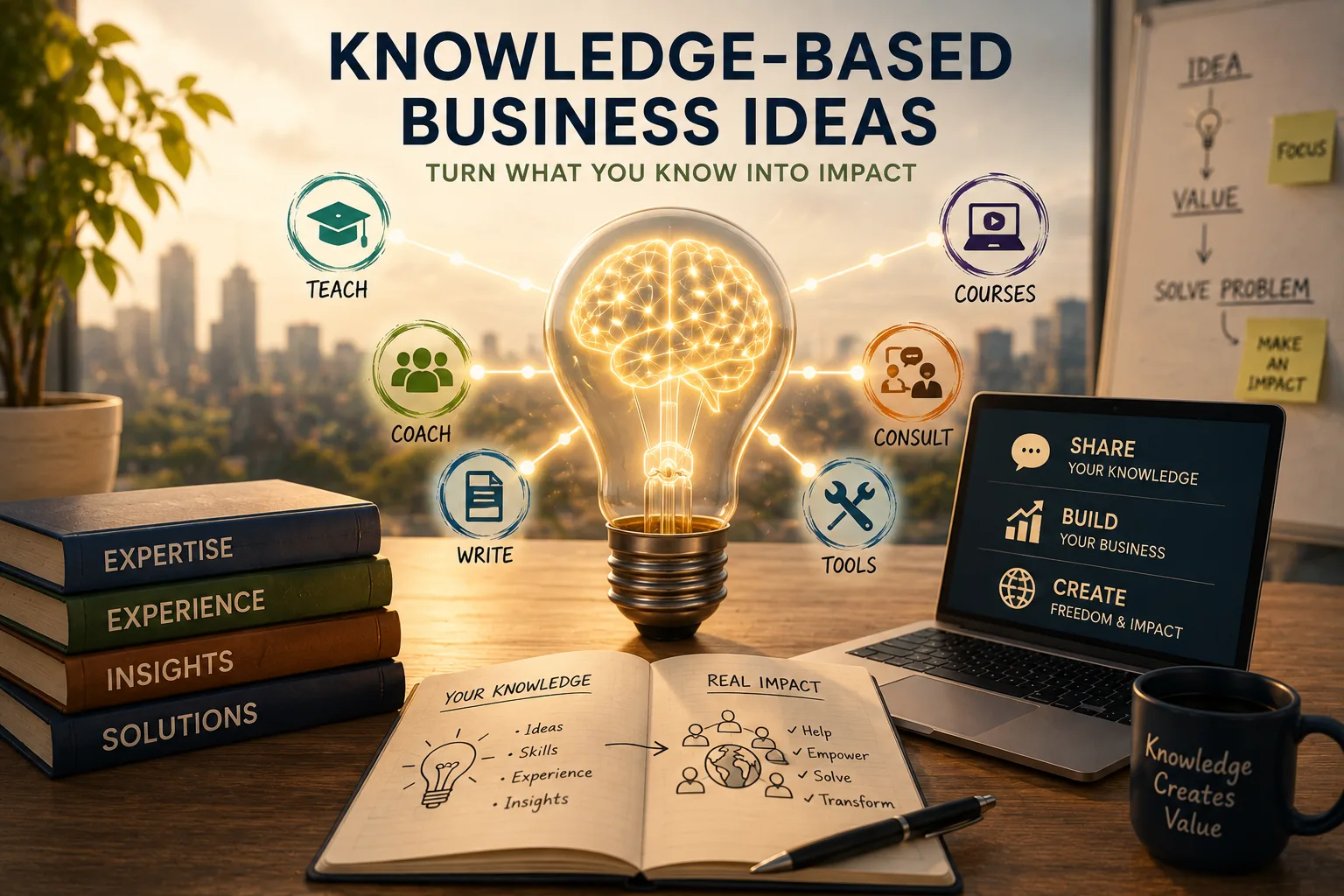
In 1997, McKinsey & Company generated roughly $2.4 billion in annual revenue. Their product was not software, not physical goods, not even proprietary data. It was knowledge - specifically, the accumulated expertise of their consultants applied to client problems.
McKinsey owned no factories, held no patents on their core offering, and sold nothing you could hold in your hand. What they sold was the ability to think clearly about complex business problems and communicate conclusions in forms that executives could act on.
Today, the same fundamental model - monetizing specialized knowledge - is available to individuals.[5] The infrastructure that once required a global firm with thousands of employees and a prestigious brand built over decades can now be replicated by a single expert with a laptop, a clear niche, and a growing body of public work.
This democratization is not hypothetical. David C. Baker, an independent advisor to creative firms, built a multi-million dollar business by becoming the most recognized expert in a single narrow domain. Alex Hormozi, starting with gym consulting, built media and investment businesses generating hundreds of millions in revenue.
Christine Comaford, a former Cisco executive, charges $45,000 per day for executive coaching. Their common thread: deep expertise in a specific domain, packaged and delivered in forms that buyers value highly enough to pay extraordinary sums for.
The Economics of Knowledge Businesses
Knowledge businesses have a cost structure that most physical businesses would envy. The primary input - expertise - has already been acquired through years of education and professional experience.
The marginal cost of delivering that expertise approaches zero for digital formats: a course created once can be sold to ten thousand students with no additional creation cost. A framework developed for one client can be refined and applied to the next with minimal additional investment.
This creates an unusual economic profile: high fixed costs (years of learning, career experience, professional credentialing), near-zero variable costs in digital formats, and pricing based on value delivered rather than cost of production.
"Your most valuable asset is not your time. It is your accumulated expertise - the ability to see patterns others miss and solve problems others cannot." - Alan Weiss
The knowledge economy rewards depth over breadth with particular force. A generalist "business consultant" competes with millions of practitioners. An expert in "pricing strategy for B2B SaaS companies with $5-20 million ARR" competes with perhaps a dozen people worldwide.
The narrower the expertise, the higher the premium, because the buyer's alternative is not another consultant - it is attempting to solve a complex, high-stakes problem without expert help.
This premium is not merely theoretical. Research by Blair Enns, author of The Win Without Pitching Manifesto, found that specialist consultants command rates two to four times higher than generalists serving the same client types.[3]
The narrowing of focus that feels risky - "am I excluding too many potential clients?" - is in practice the decision that enables premium pricing.
Knowledge Business Models: A Spectrum of Leverage
The range of knowledge business models spans from pure time-for-money to fully leveraged products. Understanding the spectrum helps you choose the right starting point and plan the evolution over time.
| Model | Leverage Level | Revenue Per Unit | Scalability | Upfront Investment |
|---|---|---|---|---|
| 1:1 consulting | Minimal | $200-1,000/hour | Limited by hours | Low |
| Group consulting/workshops | Moderate | $500-5,000/session | 5-20x individual | Moderate |
| Cohort-based courses | High | $1,000-5,000/student | 20-100 students per cohort | High (design), Moderate (delivery) |
| Self-paced online courses | Very high | $200-2,000/sale | Unlimited | High (creation), Zero (delivery) |
| Templates and frameworks | Very high | $50-500/sale | Unlimited | Moderate (creation) |
| Research subscriptions | High | $20-500/month | Unlimited subscribers | Ongoing creation |
| Books | Extremely high | $15-30/sale + authority | Unlimited | High (writing) |
| Certifications and licensing | High | $500-5,000/certification | High but requires infrastructure | Very high |
Most successful knowledge entrepreneurs move up this spectrum over time. They start with consulting to validate their expertise and build market understanding. They create courses and training programs to productize their most common advice.
They eventually produce templates, frameworks, and subscriptions that generate revenue without direct time involvement.
The critical insight is not to start at the top of the leverage stack. Founders who create courses before consulting have never validated what the market actually values. They productize their assumptions about what customers need rather than the validated understanding that consulting reveals.
Finding Your Knowledge Niche
The most common mistake in knowledge businesses is choosing a niche that is either too broad or too narrow. The sweet spot requires three conditions to be simultaneously true.
You have genuine, demonstrable expertise. Not casual interest - deep knowledge gained through years of direct practice. The kind of expertise where you can answer unexpected questions, solve novel problems, and recognize when a client is asking the wrong question.
This is what makes deliberate practice over years so critical: it is the process by which casual practitioners become genuine experts whose knowledge is worth paying for at professional rates.
The audience has purchasing power. Knowledge businesses serving hobbyists struggle because hobbyists have discretionary budgets and expect much to be free.
Knowledge businesses serving professionals thrive because professionals have employer training budgets, professional development funds, or the direct economic justification to invest in expertise that improves their work.
"Photography" is a poor niche; "commercial real estate photography for luxury listings" serves professionals with business budgets.
The market is large enough but not so large that incumbents dominate. A niche serving 300 potential clients is too small unless each client pays $20,000+. A niche serving 50,000 potential clients is viable with moderate pricing.
A niche serving millions is probably already dominated by established players with brand recognition, SEO authority, and content depth you cannot match without years of effort.
The practical test: search for your proposed niche topic on Google, Amazon, and LinkedIn. If you find dozens of books, hundreds of courses, and thousands of consultants, the niche is probably too broad. If you find almost nothing, either the niche is too narrow or it does not exist as a commercial category.
The sweet spot has some competition - which proves the market exists - but limited depth, which creates room for a genuine specialist.
Knowledge Business Ideas for Technical Experts
Implementation Consulting
Companies adopt new technologies constantly but struggle with implementation. Every major enterprise software category - Salesforce, Workday, Snowflake, Kubernetes, Terraform - has created a consulting ecosystem of specialists who help organizations implement and optimize these technologies correctly.
The value proposition is specific and quantifiable: a company can hire a general developer for $150/hour who will take four months and make costly mistakes, or they can hire an implementation specialist for $400/hour for six weeks with a proven playbook that minimizes risk and accelerates timelines.
The math reliably favors the specialist.
The opportunity in 2026 is in the AI implementation layer. Organizations across every industry are attempting to deploy AI tools, automation, and machine learning - most without adequate technical expertise.
An implementation consultant who specializes in helping mid-size companies in a specific industry (healthcare, legal, finance, manufacturing) deploy AI tools for specific use cases (claims processing, contract review, financial forecasting, quality control) combines technical capability with domain expertise in a way that neither pure technologists nor pure domain experts can replicate.
Technical Decision Advisory
Senior engineers and CTOs face consequential technical decisions - which database architecture to use, whether to rebuild or refactor an aging codebase, which cloud provider to standardize on, whether to build or buy a specific capability - with incomplete information and high stakes.
A technical advisor who has seen dozens of these decisions across multiple companies and observed their outcomes can charge $5,000-25,000 for a structured decision engagement.
The format: assess the situation, evaluate options against actual experience from comparable cases, identify second and third-order consequences that internal teams are likely to miss, and recommend with documented reasoning.
This is an application of decision-making under uncertainty principles that organizations consistently struggle with because they lack the comparative context that experience across multiple companies provides.
The credibility requirement for this model is high - you cannot advise on decisions of this magnitude without genuine experience at the level where those decisions are made.
But for engineers with 15+ years of experience across multiple companies and technology generations, this advisory model generates income equivalent to senior engineering roles with significantly more flexibility.
Security and Compliance Assessment
Cybersecurity assessments, compliance gap analyses (SOC 2, HIPAA, PCI-DSS, ISO 27001), and architecture security reviews are productized knowledge services with significant demand and limited supply of genuine experts.
A single penetration test can command $20,000-100,000 depending on scope and complexity; a compliance assessment for a mid-size healthcare company might run $50,000-200,000.
The productization model works especially well here: fixed scope (what systems will be assessed), fixed deliverable (prioritized findings report with remediation plan), fixed price (based on organizational size and scope), and repeatable delivery process.
This is a knowledge business that scales through standardization of the engagement structure, not through the knowledge itself.
Knowledge Business Ideas for Non-Technical Experts
Regulatory Interpretation Services
Regulations change constantly, and businesses need help understanding what changes mean for their specific operations. This need is especially acute in industries where regulatory non-compliance carries significant penalties: healthcare, financial services, food production, environmental management, construction, and legal practice.
The model: provide a subscription service that interprets regulatory changes for a specific industry in practical terms.
Not "here is the new rule text" (available free from the regulatory agency) but "here is what this new rule means for your operations specifically, which of your current practices need to change, and what the timeline for compliance looks like."
The pricing reflects the professional value: $100-500/month for individual practitioners, $500-2,000/month for organizational subscriptions.
At 200 organizational subscribers paying $1,000/month, that is $200,000 monthly revenue from a service that primarily requires staying current with one regulatory domain you already follow professionally.
Operational Playbooks and Documented Methodology
Document your expertise as step-by-step playbooks that companies can follow without hiring you. The format: a structured guide that takes someone from problem to solution with enough specificity that they can implement it without expert guidance.
Example products: A playbook for transitioning a creative agency from project-based to retainer-based billing, including client conversation scripts, contract templates, and transition timeline.
A guide for setting up a customer success function from scratch in a B2B SaaS company, including hiring profiles, metrics framework, and 90-day implementation plan. A handbook for independent financial advisors navigating the SEC custody rule changes of 2025.
Pricing range: $200-1,500 per product. The buyer gets expert guidance at a fraction of consulting cost; you get leverage from work done once. A well-positioned playbook can sell for years with periodic updates as conditions change.
"The goal of a knowledge business is to make your expertise available to people who need it, in the format that best serves them, at the price point that reflects the value you create." - David C. Baker
Industry Benchmarking and Research
If your career has given you access to operational data from multiple companies in the same industry - through roles in management consulting, investment banking, industry association leadership, or senior operational positions - you have the raw material for a benchmarking research business.
Annual compensation surveys, operational efficiency benchmarks, technology adoption studies, and customer experience benchmarks are purchased by thousands of companies who cannot gather this data independently. The incumbents (Mercer, Radford, Willis Towers Watson) serve large enterprises.
The gap is in benchmarks for mid-market companies in specific industry niches that large research firms do not prioritize.
Scaling Beyond Personal Time: The Transition Architecture
The fundamental challenge of knowledge businesses is that they start as time-for-money and must evolve deliberately to achieve scale. The transition requires patience, strategic clarity, and a willingness to turn down work that does not fit your scaling model.
Phase 1: Consulting for market intelligence. Work directly with clients. Charge appropriately (not below market, ever). Pay close attention to what problems recur across multiple clients, what advice you give repeatedly, and where your expertise creates the most disproportionate value.
This phase builds both market knowledge and credibility.
Phase 2: Productize repeating patterns. When you notice yourself giving the same guidance to multiple clients, create a course, template, or guide that delivers that guidance at scale.
The first productized offering typically addresses the most common engagement type and converts 40-60% of what would have been consulting time into leveraged revenue.
Phase 3: Build inbound demand through content. Create content - writing, speaking, podcasting - that demonstrates your expertise to potential buyers at scale. The goal is to make buyers come to you rather than requiring you to pursue them.
An approach to building authority through content compounds over time: content created years ago continues generating inquiries if it addresses durable professional questions.
Phase 4: Hire to deliver your methodology. Train others to deliver your method while you focus on creating new intellectual property, building the brand, and serving only the highest-value clients personally. This is where a knowledge business becomes a knowledge company.
The transition requires documenting your methodology well enough that someone else can learn it.
Phase 5: Platform or certification program. Build a community of practitioners around your methodology. Certification programs that verify competence in your framework, peer learning communities, and practitioner networks create recurring revenue and network effects that transcend any individual's time constraints.
This is how coaching methodologies, consulting frameworks, and professional development programs generate ongoing revenue decades after their creators have moved on.
The Credibility Problem and How to Solve It
The biggest obstacle for new knowledge businesses is credibility. Why should anyone pay for your expertise? This question is especially acute when you are transitioning from employment to independent practice, when you are entering a new niche, or when you are offering a new type of product to an existing audience.
Demonstrate outcomes, not credentials. Case studies and specific documented results carry far more persuasive weight than credentials or years of experience.
"I helped Company X reduce customer churn from 8% to 3% over six months, generating $400,000 in additional annual recurring revenue" is more persuasive than "I have 15 years of experience in customer success." The outcome is specific, quantified, and time-bound.
The credential is not.
Give away your best thinking publicly. Counterintuitively, sharing your most valuable insights publicly builds credibility faster than hoarding them.
People who read your free analysis and find it genuinely insightful become buyers of your premium offerings because they have already experienced the quality of your thinking. The knowledge business requires demonstrating expertise before asking people to pay for it.
Charge premium rates from the beginning. Underpricing signals uncertainty about your own value. A pricing model based on value created - rather than cost of inputs or hours invested - communicates confidence that most buyers interpret as a signal of genuine expertise.
Consultants who double their rates frequently discover that they lose the clients who were most difficult and demanding while retaining or attracting clients who respect expertise more. This applies to pricing models across formats: price your courses, templates, and subscriptions at levels that reflect the value delivered.
Be specific about who you serve and who you do not. "I work with mid-size manufacturing companies navigating digital transformation" is more credible than "I help businesses improve." Specificity signals genuine expertise; generality signals that you will take any work.
Common Mistakes That Prevent Knowledge Businesses from Working
Going too broad too soon. The most common mistake is choosing a niche broad enough to capture every possible client. This destroys the premium positioning that makes knowledge businesses profitable. You cannot be the expert in everything; you can be the definitive expert in something narrow.
Skipping the consulting phase. Jumping directly to courses or productized services means you are productizing your assumptions about what the market needs, not validated understanding. The consulting phase is not just revenue - it is research that tells you what products are worth building.
Treating knowledge as static. Expertise must be actively maintained. Markets change, technologies evolve, regulations shift, and best practices advance. A knowledge business that stops learning becomes obsolete within years. The deep work required to maintain genuine expertise is not a cost of the business - it is the business.
Failing to document methodology. Your expertise lives in your head until you create frameworks, processes, and systems that can be communicated, taught, and eventually delivered by others.[7] Documentation is not administrative overhead - it is the core asset that enables scaling, delegation, and exit.[9]
Confusing thought leadership with expertise. Publishing LinkedIn posts, speaking at conferences, and appearing on podcasts builds visibility but not necessarily expertise. Buyers eventually discover the difference.
Real expertise is built through direct, sustained engagement with the problems you claim to solve - not through commentary about those problems.
What Research Shows About Knowledge Business Economics
Blair Enns, founder of Win Without Pitching and author of "The Win Without Pitching Manifesto" (RockBench Publishing, 2018), conducted survey research covering 1,200 creative and knowledge-work consulting firms across North America and Europe, publishing findings in the "Win Without Pitching Census" in 2022.
His research found that specialist consultants - defined as practitioners who served a single defined industry or functional niche - commanded average hourly effective rates of $287, compared to $104 for generalists serving equivalent client types.
More significantly, specialists reported winning 68% of opportunities they pursued without competing on price, while generalists reported winning 31% of opportunities in competitive price-sensitive selection processes.
Enns's data showed that the decision to narrow focus - which most consultants feared would reduce the pool of potential clients - consistently increased both win rates and effective billing rates, because specialization created a "category of one" position that eliminated direct comparison to competitors.
Robert Grant, Professor of Strategic Management at Georgetown University's McDonough School of Business, published "Toward a Knowledge-Based Theory of the Firm" in the Strategic Management Journal in 1996 (vol. 17, pp.
109-122), a paper that has been cited more than 16,000 times and remains foundational to understanding how knowledge creates competitive advantage.
Grant's research established that knowledge which is tacit (experiential rather than codifiable), specialized (concentrated in specific domains rather than general), and complementary (requiring combination with other specific knowledge to produce value) generates the most durable competitive advantages.[8]
His framework predicted that individual knowledge practitioners with 10+ years of specialized experience in a single domain would consistently outperform generalists in market positioning and pricing power - a prediction validated by subsequent empirical research by David Maister, Alan Weiss, and multiple other management scholars.[1]
Grant's work provided the theoretical foundation for understanding why deep niche expertise consistently commands premium pricing in professional markets.
David Maister, former Professor at Harvard Business School and author of "Managing the Professional Service Firm" (Free Press, 1993), conducted field research with 350 professional service firms over a 15-year period published in his final report "Strategy and the Fat Smoker" (Spangle Press, 2008).
His longitudinal analysis found that professional service firms that maintained strict practice focus - limiting engagements to defined client types and problem categories - grew revenue at 2.3 times the rate of firms that accepted any client with budget.
Maister's research also documented that focused firms experienced 60% lower proposal costs (because they could reuse methodology documentation and pitch materials), 40% shorter sales cycles (because buyers recognized their specific expertise faster), and 25% lower project delivery costs (because they had refined processes for their defined scope).[6]
The cumulative economic advantage of specialization over a five-year period was large enough that generalist firms that refused to specialize were consistently displaced from their markets by specialist competitors who attracted the highest-value clients.
Cal Newport, Associate Professor of Computer Science at Georgetown University and author of "So Good They Can't Ignore You" (Grand Central Publishing, 2012), synthesized research from deliberate practice studies by Anders Ericsson at Florida State University to establish the relationship between accumulated expertise and market value.
Newport's analysis of career outcomes for knowledge workers found that practitioners who had accumulated at least 10,000 hours of deliberate practice in a specific domain commanded consulting and advisory rates 4-7 times higher than practitioners with comparable years of general experience.
The research specifically found that the premium for depth accelerated after approximately 7 years of concentrated practice in a single domain, as practitioners crossed the threshold from "competent practitioner" to "recognized expert" in peer communities.
Newport's work established that the knowledge business opportunity is not merely in what you know but in how long you have practiced knowing it - duration and focus of expertise accumulation being more predictive of market value than formal credentials or years of undifferentiated experience.[4]
Real-World Case Studies in Knowledge Business Building
David C. Baker, principal at ReCourses and author of "The Business of Expertise" (RockBench Publishing, 2017), built a multi-million dollar advisory practice by positioning himself as the world's leading expert on the business side of creative agencies specifically - not marketing consultants, not branding agencies, not all professional service firms, but the management and positioning of firms that sell creative services.[2]
Baker began his practice in 1994 and spent five years building a reputation through writing, speaking, and consulting that was consistently scoped to his single niche.
By 2010, his positioning was sufficiently specific that creative agency owners seeking business advice had essentially one credible specialist option at the advisory level: Baker or a much more general consultant.
Baker's fee structure reflected this positioning advantage - his day rate reached $12,000 by 2015, a level he described as sustainable specifically because no qualified competitor had built the same niche depth.
His business generates revenue through a combination of consulting engagements, online training programs, books, and a podcast - all scoped to the same defined audience.
Christine Comaford, executive coach and neuroscience researcher who worked as a software engineer at Apple and Microsoft before founding her first company, built a coaching and consulting practice that charges $45,000 per day for executive coaching engagements.
Comaford's premium positioning rests on a specific combination: 20 years of executive operational experience combined with formal training in applied neuroscience and a published research base on leadership decision-making.
Her book "Smart Tribes: How Teams Become Brilliant Together" (Portfolio, 2013) provided the framework that made her intellectual property tangible and licensable.
By combining a corporate memoir with operational neuroscience research, Comaford created a knowledge asset that made her coaching methodology auditable and defensible in ways that credential-only coaches could not match.
Her business model demonstrates how published intellectual property - in book, research, or framework form - creates premium pricing power by making expertise observable before the client commits to an engagement.
Alex Hormozi, founder of Gym Launch in 2016 and later of Acquisition.com, began his knowledge business by consulting directly with gym owners using a revenue-share model: he implemented his specific operating system in struggling gyms and took 35% of revenue increases he generated.
After working with 32 gyms in 18 months and consistently generating 2-4x revenue improvements within 90 days, Hormozi had sufficient documented case studies to transition to a $18,000 licensing fee for his operating system.
By 2018, Gym Launch had generated over $40 million in revenue with minimal team overhead because the knowledge product - his specific gym operating system - delivered predictable outcomes that eliminated the sales objection of unproven methodology.
Hormozi subsequently documented his entire methodology in "$100M Offers" (Acquisition.com, 2021), a book that sold over 500,000 copies and became the primary marketing vehicle for his investment and consulting firm.[10]
His trajectory from direct consulting to licensing to published methodology to investment platform illustrates the scaling architecture available to knowledge practitioners who document their expertise systematically.
McKinsey Global Institute published "The Economic Potential of Generative AI: The Next Productivity Frontier" in June 2023, analyzing the effects of AI tools on knowledge work.
The report estimated that generative AI could add $2.6 trillion to $4.4 trillion annually to the global economy across the use cases analyzed, and that current technology could automate activities absorbing 60-70% of employees' time.
The most defensible knowledge businesses are those that interpret information through domain expertise that AI cannot replicate from training data alone.
Sources & Further Reading
- Weiss, Alan. Million Dollar Consulting: The Professional's Guide to Growing a Practice. McGraw-Hill, 2016. View source
- Baker, David C. The Business of Expertise: How Entrepreneurial Experts Convert Their Knowledge into Revenue. RockBench Publishing, 2017.
- Enns, Blair. The Win Without Pitching Manifesto. RockBench Publishing, 2018. View source
- Newport, Cal. So Good They Can't Ignore You: Why Skills Trump Passion in the Quest for Work You Love. Grand Central Publishing, 2012. View source
- Drucker, Peter. Managing in a Time of Great Change. Harvard Business Review Press, 1995. View source
- Maister, David, Green, Charles, and Galford, Robert. The Trusted Advisor. Free Press, 2000. View source
- Nonaka, Ikujiro and Takeuchi, Hirotaka. The Knowledge-Creating Company: How Japanese Companies Create the Dynamics of Innovation. Oxford University Press, 1995.
- Grant, Robert M. "Toward a Knowledge-Based Theory of the Firm." Strategic Management Journal, vol. 17, 1996. DOI: 10.1002/smj.4250171110
- Davenport, Thomas and Prusak, Laurence. Working Knowledge: How Organizations Manage What They Know. Harvard Business Review Press, 1998.
- Hormozi, Alex. $100M Offers: How To Make Offers So Good People Feel Stupid Saying No. Acquisition.com, 2021. View source