
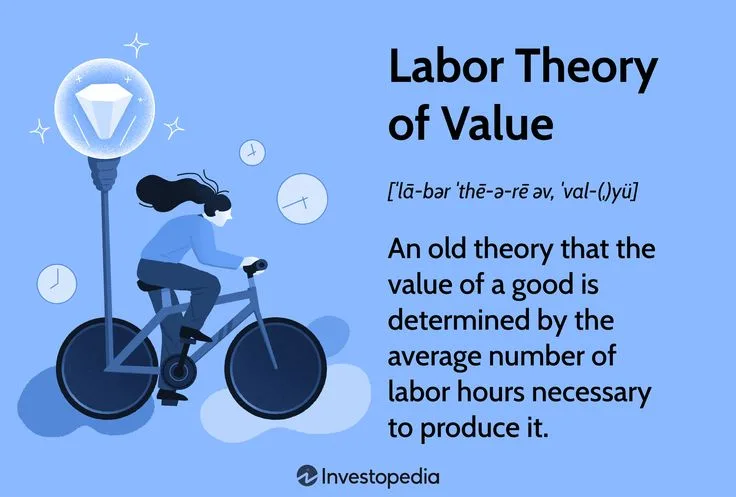
The labor theory of value holds that labor time helps explain the exchange value of commodities and underpins Marx's critique of capitalist profit and distribution. Classical economists developed earlier versions, while Marx focused on socially necessary labor time rather than each worker's actual hours. The theory struggled with the water-diamond paradox, helping spur the marginalist account of value.
Why does a diamond cost more than water, even though water is essential to life and diamonds are not? Why does a shirt made by a factory worker in Bangladesh cost less than one sewn by an artisan in Milan? What determines the prices of things, and where does profit actually come from?
These are not new questions. For centuries, philosophers and economists have tried to develop coherent theories of value - accounts of what makes things worth what they are worth. The labor theory of value is the most famous and controversial answer to these questions.
It forms the intellectual foundation of Karl Marx's critique of capitalism, and understanding it is essential for understanding modern debates about economics, work, and distribution.
The debate over this theory is not merely historical. It sits beneath contemporary arguments about automation, the minimum wage, inequality, and who should benefit when machines replace human workers.
Understanding the labor theory of value - what it claims, what it gets right, and where it fails - is part of the intellectual toolkit required for these discussions.
Origins: Before Marx
The labor theory of value did not originate with Marx. Its roots run through the history of classical economics.
John Locke (1632-1704) provided an early proto-labor theory in his Two Treatises of Government, arguing that labor was the source of property rights: by mixing your labor with natural resources, you made them yours.[5] This was not a price theory but it established the intellectual connection between labor and value.
Adam Smith (1723-1790), in The Wealth of Nations (1776), offered an ambiguous account of value.[4] He distinguished between "value in use" (utility) and "value in exchange" (price), noting the water-diamond paradox - things with high use value can have low exchange value and vice versa.
Smith suggested that in a "rude and early state" of society, exchange ratios would be proportional to labor time, but he recognized that in developed capitalist economies with capital and land, the analysis was more complicated.
David Ricardo (1772-1823) produced the most rigorous pre-Marxian version of the labor theory. In Principles of Political Economy and Taxation (1817), Ricardo argued that exchange values were proportional to the relative labor times required to produce commodities.[3]
Ricardo struggled with important exceptions - the role of capital goods in production, the effect of wages on prices - and acknowledged these complications candidly, but he maintained the core proposition as a strong approximation.
Ricardo was primarily interested in the distribution of income between wages, profits, and rent - the three categories corresponding to workers, capitalists, and landlords. The labor theory gave him a framework for analyzing how changes in wages affected the distribution of income among these classes.
The Water-Diamond Paradox and Its Historical Significance
The water-diamond paradox (sometimes called the paradox of value) was the central unsolved problem in value theory for nearly a century. Water is essential; diamonds are not. Yet diamonds command vastly higher prices. Why?
Classical economists, including Smith and Ricardo, struggled to reconcile use value and exchange value. Their difficulty was that they lacked the concept of marginal utility - the value of one additional unit, as opposed to the total utility of all units combined.
Water has enormous total utility but very low marginal utility in a world where it is abundant. Diamonds have low total utility but high marginal utility because they are scarce.
It was precisely the inability of the labor theory to resolve this paradox cleanly that ultimately led to its overthrow in mainstream economics. But the puzzle drove a century of remarkable economic theorizing before the marginalist revolution solved it.
Marx's Development of the Theory
Karl Marx encountered Ricardo's economics in his systematic engagement with classical political economy during the 1840s and 1850s. Marx took the labor theory and developed it into a comprehensive critique of capitalism's inner workings.
The Key Innovation: Socially Necessary Labor Time
Marx's first major refinement was the concept of socially necessary labor time (SNLT).[1] Value, for Marx, is not determined by the actual hours any particular worker spends producing something.
It is determined by the labor time required to produce the commodity at the average level of skill, technology, and intensity prevailing in society at a given time.
This matters because it explains why inefficiency does not create value. If the average shoemaker in 1850 took three hours to produce a pair of shoes, a particular incompetent shoemaker who took six hours did not create twice the value - they created the same value, and their extra three hours was simply lost.
The market would not pay double for their shoes.
Crucially, SNLT changes over time as technology improves. When machinery increases the productivity of labor, the socially necessary labor time to produce goods falls, and their value falls with it.
This helps explain falling prices for manufactured goods over industrialization - the same output requires progressively less labor as technology advances.
Between 1800 and 1900, the price of cotton cloth fell by approximately 80% in Britain, largely because machinery dramatically reduced the labor required to produce it (Mokyr, 1990).[12]
Use Value and Exchange Value
Marx distinguished sharply between use value (the concrete, specific utility of a commodity - the fact that a coat keeps you warm) and exchange value (the quantity at which a commodity exchanges for other commodities in the market).
He argued that what makes commodities commensurable in exchange - what allows you to equate a coat with five yards of linen - cannot be a physical property. It must be something they share in the abstract.
For Marx, that common property is that they are all products of abstract human labor - labor stripped of its specific form (weaving, tailoring, mining) and considered as an undifferentiated expenditure of human energy and time. Value, in Marx's framework, is congealed abstract labor.
This philosophical framing was part of what distinguished Marx's treatment from Ricardo's and what made it so controversial. For Ricardo, the labor theory was a useful approximation for understanding prices and distribution. For Marx, it was a theory about the social form that labor takes under capitalism.
Commodity Fetishism
A concept unique to Marx's treatment is commodity fetishism: the way that market exchange conceals the social relationships between producers behind a relationship between things.
When you buy a shirt, you see a price - but the price obscures the human labor and the labor relations that produced the shirt. The social character of production is made invisible; only the market relations between commodities are visible.
"A commodity appears at first sight an extremely obvious, trivial thing. But its analysis brings out that it is a very strange thing, abounding in metaphysical subtleties and theological niceties." - Karl Marx, Capital Volume I (1867)
This is not mere philosophical complaint. For Marx, commodity fetishism is built into the structure of capitalist production. It is what makes exploitation systematic rather than personal - not a matter of individual bad actors but of how markets organize production and obscure those relationships.
The concept has influenced fields far beyond economics: it has shaped sociology (through Lukacs's concept of reification), cultural theory (Debord's "spectacle"), and contemporary critiques of consumer culture.
Surplus Value: The Source of Profit
Marx's most important application of the labor theory was his account of surplus value - his explanation of where profit actually comes from.
The argument runs as follows:
- Workers sell their labor power (their capacity to work for a period of time) to capitalists in exchange for wages
- The wage corresponds to the value required to reproduce the worker - food, shelter, clothing, the raising of children to replace the worker in the next generation
- But workers can produce more value in a day than the value of their own reproduction. If it takes four hours of labor to produce the value equivalent to a day's wage, the worker still has four more hours of labor time the capitalist can extract
- This surplus labor time produces surplus value - the source of profit, interest, and rent
The capitalist relationship, in this analysis, is not one of equal exchange but of exploitation by structure. The worker appears to be paid for their work - and in a sense they are, but only for the labor power they sold, not for the full product of their labor.
The difference - surplus value - is appropriated by the capitalist as a condition of the wage relationship.
"The secret of the self-valorization of capital resolves itself into having disposal of a definite quantity of other people's unpaid labour." - Karl Marx, Capital Volume I (1867)
Marx distinguished between absolute surplus value (extending the working day, forcing workers to work longer hours) and relative surplus value (increasing productivity so that the socially necessary labor time for reproducing the worker's subsistence falls, freeing more hours for surplus production).
The history of industrial capitalism can, in Marx's framework, be read partly as a story of the shift from extracting absolute surplus value (the long working days of early industrialization) to relative surplus value (machinery, scientific management, automation).
The Rate of Exploitation and Rate of Profit
Marx defined the rate of exploitation (or rate of surplus value) as the ratio of surplus labor to necessary labor:
Rate of exploitation = Surplus labor time / Necessary labor time
If workers spend 4 hours producing their own wage equivalent and 4 hours producing surplus value, the rate of exploitation is 100% - not meaning workers are paid nothing, but that the capitalist extracts as much surplus labor as the worker spends on their own reproduction.
Separately, Marx defined the organic composition of capital as the ratio of capital invested in machinery and raw materials (constant capital, which does not create new value) to capital invested in labor (variable capital, which does create new value).
As capitalism develops and becomes more mechanized, Marx predicted the organic composition would rise - and that this would create a tendency for the rate of profit to fall over time.
This prediction - one of Marx's most controversial - argued that capitalism contained an internal contradiction: the mechanism that increased productivity (replacing workers with machines) simultaneously undermined profitability (since only labor creates surplus value). Marx saw this as a source of periodic economic crises.
The Two-Department Model
Marx developed an elaborate macro-level model of how capitalist economies reproduce themselves over time, dividing production into two departments:
| Department | What It Produces | Example |
|---|---|---|
| Department I | Means of production | Machinery, raw materials, tools |
| Department II | Means of consumption | Food, clothing, housing |
For the economy to reproduce itself at the same scale or grow, the output of each department must be appropriately distributed between them. This model anticipated later work in growth theory and input-output economics, and it provides a framework for analyzing structural contradictions in capitalist accumulation.
Wassily Leontief, who won the Nobel Prize in Economics in 1973 for his input-output analysis of the U.S. economy, acknowledged the intellectual debt his framework owed to Marx's two-department reproduction scheme.
The Transformation Problem
The most technically challenging issue in Marxist economics is the transformation problem: the difficulty of reconciling the theory that labor creates value (Volume I of Capital) with the analysis of how actual prices and profit rates form in competitive markets (Volume III).[2]
The problem arises from the following structure:
- In Volume I, Marx analyzes commodities exchanging at their values (proportional to SNLT)
- In Volume III, Marx recognizes that competition equalizes profit rates across industries by attracting capital to high-profit sectors and driving it away from low-profit ones
- But if profit rates equalize, commodities cannot all exchange at their values - because industries with different ratios of "living labor" to capital would have different value compositions but the same profit rate, which means their prices would systematically diverge from their values
Marx acknowledged this problem and attempted a solution: producers sell at "prices of production" (cost of production plus average profit), not at values, but the divergence of prices from values is systematic and the aggregate identity of total value = total prices holds.
Critics, including Ladislaus von Bortkiewicz in 1907, showed that Marx's transformation procedure was mathematically incomplete - he transformed outputs from values to prices but left inputs valued at labor values rather than prices of production, creating an inconsistency.[8]
Defenders of Marx have offered numerous responses over the subsequent century:
The New Interpretation (Duménil, 1980; Foley, 1982): Redefines the value of money such that the money wage bill equals the value of labor power, preserving aggregate equalities while dissolving the inconsistency.[10][9]
Temporal Single System Interpretation (TSSI) (Kliman & McGlone, 1999): Argues that the inconsistency arises from interpreting Marx simultaneously when the actual economy is sequential - inputs are valued at past prices, outputs at current prices, and no inconsistency arises when time is taken seriously.[11]
Value as social form: A more philosophical approach that reframes value not as a technical economic quantity but as a social form - a way that human labor is related in capitalism - which makes the mathematical transformation less central.
The transformation problem remains disputed and is primarily of interest to scholars engaging closely with Marx's technical economic arguments.
The Marginalist Revolution: The Mainstream Alternative
In the 1870s, three economists working independently - William Stanley Jevons in England, Carl Menger in Austria, and Leon Walras in Switzerland - proposed a fundamentally different theory of value: subjective value theory or marginalist theory.[7][6]
Their key insight: value is not an objective property of commodities determined by their production history. Value is a relationship between a commodity and a valuing subject. Specifically, value is determined by marginal utility - the additional satisfaction a consumer derives from one more unit of a good.
The diamond-water paradox dissolves in this framework: water has enormous total utility but very low marginal utility (because it is abundantly available; one more glass of water adds little to your wellbeing).
Diamonds have low total utility but high marginal utility (because they are scarce; getting one more diamond is genuinely valuable because they are so rare).
This framework became the foundation of neoclassical economics and remains the theoretical core of mainstream economics today. Prices in competitive markets reflect the intersection of marginal utility (demand) and marginal cost (supply) - not the labor embedded in products.
The marginalist revolution effectively pushed the labor theory of value out of mainstream academic economics, where it has remained largely marginalized (with notable exceptions) for over a century.
| Framework | Source of Value | Price Determination | Key Theorists |
|---|---|---|---|
| Labor Theory of Value | Socially necessary labor time | Labor content (with distributional complications) | Smith, Ricardo, Marx |
| Marginalist/Subjective | Marginal utility | Intersection of marginal utility and marginal cost | Jevons, Menger, Walras, Marshall |
| Modern synthesis | Multiple factors | General equilibrium | Samuelson, Arrow, Debreu |
What the Labor Theory Gets Right
Despite being rejected by mainstream economics, the labor theory of value captures several important truths:
Labor is the ultimate source of economic production. All economic activity ultimately rests on human work applied to natural resources. Capital goods (machines, buildings) are themselves products of past labor. This is not a contested empirical claim - it is the starting point of any serious economic theory of production.
Exploitation is possible even in free markets. When workers have limited alternatives - limited by capital ownership, bargaining power asymmetries, geographic constraints - employers can extract more value from their labor than the wage covers.
The labor theory provides a systematic framework for analyzing this. That systematic framework has influenced labor law, union organizing, and the development of labor economics as a distinct field.
Value creation is social, not individual. No producer creates value in isolation. The productivity of any individual worker depends on the accumulated technology, infrastructure, knowledge, and social organization of the economy they operate within.
The labor theory's emphasis on socially necessary labor time (rather than individual labor time) captures this social dimension.
Mariana Mazzucato (2013), in The Entrepreneurial State, makes a related argument: that private sector value creation depends on publicly funded infrastructure, research, and education that the market alone would not provide.[14]
Markets obscure real relationships. The commodity fetishism insight - that market exchange hides the social relations of production - remains analytically powerful.
Price relationships tell you something about exchange conditions but nothing about the human relationships that generated the goods exchanged. This insight has been foundational in economic sociology, the sociology of work, and critical supply chain studies.
What the Labor Theory Gets Wrong
The labor theory also has genuine weaknesses:
It cannot adequately explain price formation. Why does a software company's product, which required relatively little labor to produce additional copies, command a high price? Why do artisanal goods sometimes cost more than factory-produced goods requiring more labor? The subjective theory of value handles these cases better.
Natural scarcity is not captured. The labor theory struggles with goods like land and natural resources, whose prices reflect scarcity rather than labor content. Ricardo tried to handle this through rent theory but acknowledged the difficulty.
Capital goods are treated problematically. Capital goods contribute to production but are themselves products of past labor. The accounting of how past labor embodied in capital contributes to current value creation is technically complex and has never been fully resolved.
Demand is undertheorized. The labor theory is essentially a supply-side theory of value. It has relatively little to say about how consumer preferences and demand interact with production to determine prices.
It cannot explain differential returns to skill. Why does a neurosurgeon earn more than a cleaner? Both perform labor. The labor theory needs some account of skilled versus unskilled labor - Marx reduced skilled labor to multiples of simple unskilled labor, but this "reduction" is asserted rather than derived.
Modern Relevance
The labor theory of value is not the foundation of policy debates or standard economic analysis today. But it is not historically irrelevant either.
The conceptual distinction between work and profit - between value created by labor and value appropriated by capital ownership - structures important contemporary debates about inequality, taxation, the minimum wage, and the power of labor versus capital.
When economists like Thomas Piketty (2014) document the tendency of capital's share of income to rise relative to labor's share (his famous r > g relationship), they are operating in intellectual territory that Marx mapped, even when they do not use Marxist language.
Piketty's central dataset showed that in most developed economies, the ratio of capital to national income roughly doubled between 1970 and 2010, from around 2-3 times annual income to 4-6 times.[13]
This coincided with the labor share of income falling in most OECD countries - a pattern consistent with Marx's predictions about the rising organic composition of capital, even if the mechanisms Piketty emphasizes are different.
The theory also provides a critical lens on discussions about automation, artificial intelligence, and the future of work. As machines take over more production, questions about how the productivity gains are distributed - between owners of capital and workers - become central economic and political questions.
A 2019 McKinsey Global Institute report estimated that up to 375 million workers globally might need to switch occupational categories due to automation by 2030.[16]
The question of who benefits from that productivity increase - and whether the gains flow to capital owners or are broadly shared - is precisely the question Marx's framework was designed to analyze.
Labor economist Lawrence Katz and economist Alan Krueger (2016) documented the rise of "alternative work arrangements" - contractors, gig workers, freelancers - in the United States.[15] By 2015, these arrangements accounted for all net employment growth since 2005.
This fragmentation of traditional employment relationships is directly relevant to surplus value theory: when employers can contract for specific outputs rather than purchasing labor power for extended periods, the extraction of surplus value takes on new institutional forms.
Understanding the labor theory of value, its strengths, its limitations, and the debates it has generated, is part of the intellectual equipment needed to engage seriously with those questions.
It is a flawed theory, but a productively flawed one - it identified real dynamics of capitalist production that more technically successful frameworks sometimes obscure.
Sources & Further Reading
- Marx, K. (1867). Capital: A Critique of Political Economy, Volume I. Trans. Ben Fowkes. Penguin Classics (1990 edition).
- Marx, K. (1894). Capital: A Critique of Political Economy, Volume III. Ed. Friedrich Engels. International Publishers (1967 edition).
- Ricardo, D. (1817). On the Principles of Political Economy and Taxation. John Murray.
- Smith, A. (1776). An Inquiry into the Nature and Causes of the Wealth of Nations. W. Strahan and T. Cadell.
- Locke, J. (1689). Two Treatises of Government. Awnsham Churchill.
- Jevons, W. S. (1871). The Theory of Political Economy. Macmillan.
- Menger, C. (1871). Grundsatze der Volkswirtschaftslehre [Principles of Economics]. Wilhelm Braumuller.
- von Bortkiewicz, L. (1907). On the Correction of Marx's Fundamental Theoretical Construction in the Third Volume of Capital. Jahrbucher fur Nationalokonomie und Statistik, 34.
- Duménil, G. (1980). De la valeur aux prix de production. Economica.
- Foley, D. K. (1982). The Value of Money, the Value of Labor Power and the Marxian Transformation Problem. Review of Radical Political Economics, 14(2), 37-47.
- Kliman, A., & McGlone, T. (1999). A Temporal Single-System Interpretation of Marx's Value Theory. Review of Political Economy, 11(1), 33-59.
- Mokyr, J. (1990). The Lever of Riches: Technological Creativity and Economic Progress. Oxford University Press.
- Piketty, T. (2014). Capital in the Twenty-First Century. Trans. Arthur Goldhammer. Harvard University Press.
- Mazzucato, M. (2013). The Entrepreneurial State: Debunking Public vs. Private Sector Myths. Anthem Press.
- Katz, L. F., & Krueger, A. B. (2016). The Rise and Nature of Alternative Work Arrangements in the United States, 1995-2015. NBER Working Paper No. 22667.
- McKinsey Global Institute. (2019). The Future of Work in America: People and Places, Today and Tomorrow. McKinsey & Company.