
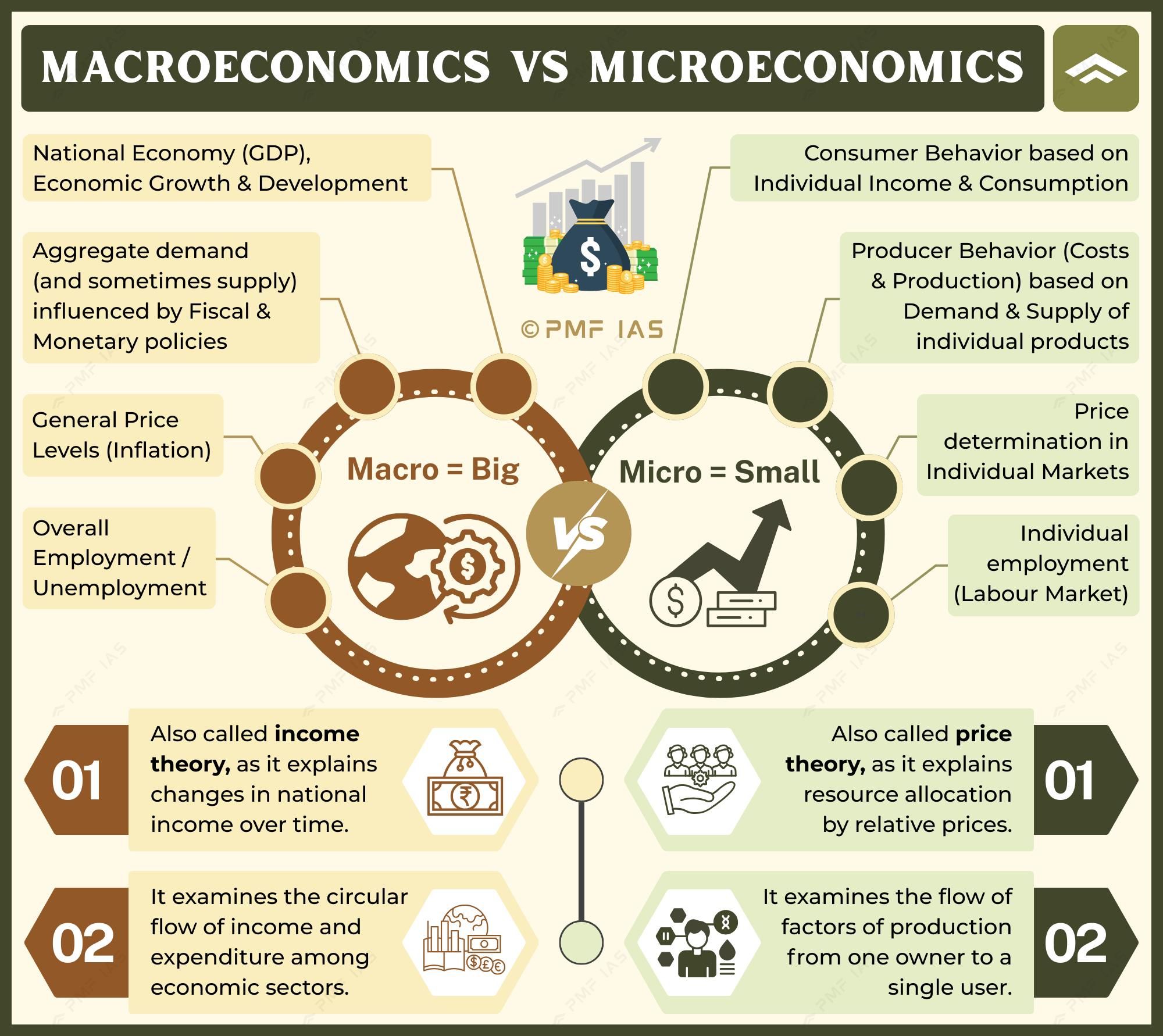
Macroeconomics explained examines national output, employment, inflation, business cycles, and the effects of fiscal and monetary policy. It emerged from efforts to explain persistent mass unemployment and treats aggregate demand as a central driver of short-run activity. Competing schools disagree over market adjustment, expectations, money, financial fragility, and government intervention, making its technical debates inseparable from practical choices about recessions and inflation.
In the autumn of 1929, the New York Stock Exchange collapsed, initiating a cascade of bank failures, credit contraction, and mass unemployment that left a quarter of the American labor force without work by 1933. The Great Depression did not merely produce suffering; it produced a crisis of economic theory.
The prevailing view held that market economies were fundamentally self-correcting - that recessions were temporary dislocations that would resolve themselves as prices and wages adjusted.
The Depression refused to cooperate. It persisted for years, and the elegant theoretical models that said it should not could not explain why.
John Maynard Keynes wrote 'The General Theory of Employment, Interest and Money' (1936) in direct response to this failure.[1]
The book argued that economies could become trapped at high unemployment equilibria, that aggregate demand - the total spending in an economy - was the essential variable, and that government intervention was not only permissible but sometimes necessary to restore economic health.
In doing so, Keynes effectively founded macroeconomics as a distinct analytical discipline, separating the study of aggregate economic behavior from the microeconomic analysis of individual markets.
Macroeconomics has grown enormously since Keynes. It encompasses the measurement of national output, the analysis of business cycles, theories of inflation, the operation of monetary and fiscal policy, and the architecture of the international monetary system.
It is also one of the most contested fields in social science, riven by disagreements that are not merely technical but reflect deep differences about how markets function, how people form expectations, and what governments can and cannot accomplish.
Understanding these debates is inseparable from understanding the economies in which we live.
"The ideas of economists and political philosophers, both when they are right and when they are wrong, are more powerful than is commonly understood. Indeed, the world is ruled by little else." - John Maynard Keynes, The General Theory, 1936
Key Definitions
Gross Domestic Product (GDP): The total monetary value of all final goods and services produced within a country's borders in a given period. The standard measurement identity is Y = C + I + G + (X-M), where C is consumption, I is investment, G is government spending, and X-M is net exports.
Recession: A significant, widespread, and prolonged decline in economic activity.
The US National Bureau of Economic Research (NBER) Business Cycle Dating Committee defines recessions holistically across multiple indicators; the popular shorthand of "two consecutive quarters of negative GDP growth" is an approximation, not the official definition.
Fiscal policy: Government decisions about taxation and public spending, used to influence aggregate demand and economic activity.
Monetary policy: Central bank decisions about interest rates and money supply, used to influence borrowing costs, investment, and the price level.
Phillips curve: The proposed empirical relationship between unemployment and inflation - originally described by A.W. Phillips in 1958 - positing that lower unemployment is associated with higher inflation.[8] The relationship was complicated by the stagflation of the 1970s and subsequent theoretical revisions.
Major Schools of Macroeconomic Thought
| School | Key figures | Core claim | Policy prescription | Vulnerability |
|---|---|---|---|---|
| Keynesian economics | Keynes (1936); Hicks; Samuelson | Economies can get stuck at high unemployment equilibria; aggregate demand is the key variable | Fiscal stimulus in recessions; government as spender of last resort | May crowd out private investment; political difficulty of deficit reduction in good times |
| Monetarism | Milton Friedman; Phelps | Money supply growth determines inflation in the long run; government fiscal intervention has limited real effects | Steady, predictable money supply growth; rule-based rather than discretionary policy | Controlling money supply technically difficult; financial innovation destabilizes money demand |
| New Classical / RBC | Lucas; Kydland; Prescott | Agents form rational expectations; markets clear continuously; business cycles reflect real supply shocks | Minimal intervention; stabilization policy is counterproductive or ineffective | Cannot explain deep recessions, unemployment persistence, or financial crisis dynamics |
| New Keynesian | Mankiw; Romer; Woodford | Sticky prices and wages justify stabilization policy; rational expectations incorporated | Inflation targeting; countercyclical monetary policy; fiscal multipliers in deep recessions | Model of household and firm behavior may miss financial frictions |
| Post-Keynesian / Minsky | Minsky; Godley; Lavoie | Financial fragility is endogenous; stability breeds instability; effective demand drives output | Financial regulation; functional finance; automatic stabilizers | Less formal modeling; policy prescriptions sometimes unclear |
| MMT | Mosler; Wray; Kelton | Currency-issuing governments cannot run out of money; fiscal constraint is inflation, not solvency | Deficit spending to full employment; taxes to control inflation, not fund spending | Contested empirically; critics argue it underestimates inflation risk; 2021-22 inflation used as challenge |
The Birth of Macroeconomics
Keynes and Aggregate Demand
Before Keynes, the dominant framework in economics was what he termed "classical economics" - broadly, the view that flexible prices and wages would ensure that supply creates its own demand (Say's Law) and that full employment would prevail in the long run.
Keynes's critical insight was that this long-run story was inadequate: in his memorable phrase, "in the long run we are all dead." In the short run, nominal wages are often sticky downward - workers resist wage cuts, and coordinating across an entire economy to achieve simultaneous wage reductions is practically impossible.
When demand collapses, the result is unemployment, not the rapid wage adjustment that classical theory predicted.
Keynes introduced the concept of aggregate demand - the total spending in an economy on final goods and services - as the proximate determinant of output and employment.
The fundamental components of aggregate demand, which he analyzed in detail, were consumption (driven by the "propensity to consume"), investment (driven by the "marginal efficiency of capital" and, crucially, by "animal spirits" - the irreducible uncertainty and sentiment that governs investment decisions), and government spending.
If private demand collapsed, government could substitute for it directly.
The IS-LM model, developed by John Hicks in 1937 to formalize Keynes's framework, became the workhorse of Keynesian macroeconomics.[3]
The IS curve represents combinations of interest rates and income at which the goods market is in equilibrium (investment equals saving); the LM curve represents combinations at which the money market is in equilibrium.
Together they determine the equilibrium interest rate and income level. The model provided a rigorous framework for analyzing fiscal and monetary policy and remained central to macroeconomic teaching for decades.
Measuring the Economy: The Development of GDP
Aggregate demand analysis required aggregate measurement. Simon Kuznets, a Ukrainian-American economist working at the National Bureau of Economic Research, developed the system of national income accounts in the 1930s at the request of the US Congress, which needed to understand the scale of the Depression.
Kuznets estimated national income from 1929 to 1932, providing the first systematic picture of the US economy's collapse. He received the Nobel Prize in Economic Sciences in 1971 for this work.
GDP, as refined subsequently, measures the total value of final production - goods and services sold to end users - within a country's borders during a period. Intermediate goods are excluded to avoid double-counting.
The three approaches - expenditure, income, and production - yield the same result in principle because every dollar of spending is someone's income and represents value added.
Nominal GDP reflects both real output and price changes; real GDP removes price changes through a deflator, enabling genuine comparisons of output over time. GDP per capita - dividing by population - provides a rough measure of average living standards.[9]
The Business Cycle: Expansion, Contraction, and Crisis
Anatomy of the Cycle
Economic activity oscillates. Periods of expansion - rising employment, output, and incomes - are followed by downturns, and recovery eventually follows contraction. This recurring pattern, the business cycle, has been studied systematically since the nineteenth century.
The NBER identifies four phases: expansion (rising from trough), peak (the turning point before contraction), contraction or recession (declining activity), and trough (the turning point before recovery).
The Great Moderation - a period running roughly from 1984 to 2007 during which output volatility declined markedly in the United States and other advanced economies - appeared to some observers to signal that policymakers had learned to manage the business cycle effectively.
Federal Reserve Chairman Ben Bernanke gave a celebrated lecture in 2004 attributing the moderation to improved monetary policy, better inventory management, and favorable supply shocks. The 2008 crisis abruptly terminated this narrative.
Minsky and Financial Fragility
Hyman Minsky, an economist at Washington University in St. Louis who spent his career working outside the mainstream, offered a theory of why financial crises were endogenous to capitalism rather than external accidents.
In 'Stabilizing an Unstable Economy' (1986) and earlier papers, Minsky argued that extended periods of economic stability encourage increasing financial risk-taking.[4] Firms and households begin with "hedge" financing - where cash flows cover all obligations.
As confidence grows, they shift toward "speculative" financing, where cash flows cover interest but not principal, requiring continuous refinancing. Finally, in a boom, "Ponzi" financing prevails, where cash flows cannot cover even interest payments and rising asset prices alone sustain debt service.
At this point, any disruption to asset prices triggers cascading defaults, forced asset sales, and financial collapse. The economy's very stability breeds the conditions for its eventual instability - what Paul McCulley, a PIMCO fund manager, labeled a "Minsky moment" in 1998, a phrase widely applied to the 2008 crisis.
Keynesian Economics: Fiscal Policy and Its Critics
The Multiplier and the Paradox of Thrift
A central Keynesian concept is the fiscal multiplier: the proposition that a dollar of government spending produces more than a dollar increase in total output, because the initial recipients of government spending use part of their additional income to spend again, generating further rounds of economic activity.
The size of the multiplier depends on the marginal propensity to consume and on whether the economy has spare capacity. At full employment, additional spending crowds out private investment; in a demand-constrained recession with a zero lower bound on interest rates, the multiplier may be considerably above one.
The paradox of thrift illustrates the fallacy of composition that lies at the heart of macroeconomics: while any individual household is prudent to save more during hard times, if all households simultaneously attempt to save more, aggregate spending falls, income falls, and actual saving may not increase because income has declined.
What is rational individually is destructive collectively. This paradox, which Keynes formalized, explains why market economies can remain stuck in recessions without active demand management.
New Keynesian Economics
From the 1980s, a new synthesis emerged that incorporated Keynesian insights - particularly the non-neutrality of money in the short run and the importance of aggregate demand - into models with explicit microeconomic foundations.
New Keynesian economics, associated with economists including Gregory Mankiw, Olivier Blanchard, Lawrence Ball, and Michael Woodford, emphasizes price and wage stickiness as the fundamental friction that gives monetary policy real effects.
Prices are not continuously re-optimized; firms update their prices infrequently (Calvo pricing, named after Guillermo Calvo, is a common formalization). This stickiness means that monetary policy can affect real variables, not just nominal ones, in the short run.
Michael Woodford's 'Interest and Prices: Foundations of a Theory of Monetary Policy' (2003) provided the theoretical foundations for the New Keynesian approach that underlies inflation targeting at most major central banks.[7]
The book's core message was that the central bank's primary instrument is the short-term nominal interest rate, and that its credibility in maintaining a given inflation target was itself a powerful tool - expectations management, not just the current interest rate, determines macroeconomic outcomes.
Monetarism, the Phillips Curve, and Supply-Side Economics
Friedman, Schwartz, and the Money Supply
Milton Friedman spent his career arguing that monetary policy was more powerful and discretionary fiscal policy less reliable than the Keynesian consensus held.
His most influential empirical contribution, co-authored with Anna Schwartz, was 'A Monetary History of the United States, 1867-1960' (1963), which traced the relationship between the money supply and economic activity over nearly a century.[2]
The book's central argument was that the Great Depression was primarily a monetary phenomenon: the Federal Reserve's failure to prevent a one-third contraction of the money supply between 1929 and 1933 - through bank failures and a failure to act as lender of last resort - turned a severe recession into an economic catastrophe.
The appropriate policy response was to maintain stable money growth, not to engage in activist discretionary policy, which Friedman argued was likely to be destabilizing due to policy lags.
Friedman's 1968 presidential address to the American Economic Association introduced the concept of the natural rate of unemployment - the rate consistent with stable inflation once inflationary expectations have fully adjusted - and argued that policymakers could not exploit the Phillips curve trade-off permanently.
Any attempt to hold unemployment below the natural rate would result in accelerating inflation as workers' inflationary expectations rose.
Edmund Phelps, working independently, published the same argument simultaneously in 1968. The stagflation of the 1970s - simultaneous high inflation and high unemployment - appeared to vindicate this analysis and severely damaged the credibility of the simple Keynesian Phillips curve.
Supply-Side Economics
The 1970s economic crisis generated both the monetarist revival and supply-side economics, which emphasized reducing marginal tax rates to stimulate work, saving, and investment.
The Laffer curve - associated with economist Arthur Laffer, who reportedly drew it on a napkin in 1974 - depicted the relationship between tax rates and tax revenues, arguing that at sufficiently high rates, tax cuts could increase revenue by expanding the tax base.
This proposition underpinned the Reagan administration's 1981 tax cuts.
The subsequent record was mixed: while the economy recovered from the 1981-82 recession, budget deficits expanded substantially, calling into question the revenue-enhancing claims.
Supply-side economics remains a contested field, with advocates emphasizing growth effects and critics emphasizing distributional consequences and the problematic empirical record.
Modern Macroeconomics and Its Critics
DSGE Models and the Lucas Critique
From the 1980s, macroeconomic modeling was transformed by the rational expectations revolution. Robert Lucas Jr.
argued in his celebrated 1976 critique that historical econometric relationships between policy instruments and outcomes could not be relied upon to predict the effects of policy changes, because rational economic agents would adjust their behavior in response to anticipated policy shifts.
Models needed explicit microfoundations - to derive aggregate behavior from the optimizing choices of households and firms.
This led to Dynamic Stochastic General Equilibrium (DSGE) models, which became the standard tool at central banks and academic macroeconomics departments.
Finn Kydland and Edward Prescott developed real business cycle theory in their 1982 paper 'Time to Build and Aggregate Fluctuations,' arguing that business cycles were optimal responses to technological shocks rather than market failures requiring policy correction.[6]
This approach, combined with Lucas's framework, pushed the mainstream away from Keynesian activism and toward an emphasis on credible rules-based policy.[5] Kydland and Prescott received the Nobel Prize in 2004.
The 2008 Crisis and Heterodox Challenges
The 2008 financial crisis exposed major limitations of the mainstream framework. DSGE models, which largely abstracted from financial sectors and the possibility of systemic collapse, failed to anticipate or adequately analyze the crisis.
Paul Krugman's 2009 essay 'How Did Economists Get It So Wrong?' argued that the profession had been seduced by mathematical elegance into building models that assumed away the most important problems.[12]
The Great Moderation had encouraged complacency; finance had been treated as a veil rather than a potentially catastrophic source of instability.
In the post-crisis environment, several heterodox perspectives gained renewed attention. Modern Monetary Theory, associated with L.
Randall Wray, Stephanie Kelton, and Warren Mosler, argued that sovereign currency issuers face no financial constraint analogous to household budget constraints, and that deficits are appropriate whenever private saving exceeds private investment.
The binding constraint on government spending is inflation, not the availability of financing.
Kelton's 'The Deficit Myth' (2020) brought these arguments to a broad audience.
Larry Summers, in a widely noted 2013 speech, revived Alvin Hansen's 1938 concept of secular stagnation - the argument that advanced economies might face a chronic deficiency of demand driven by demographic change, declining investment opportunities, and rising inequality, keeping equilibrium real interest rates persistently low or negative.[11]
International Macroeconomics
Balance of Payments and Exchange Rates
Open economies are connected to the rest of the world through trade and capital flows, captured in the balance of payments accounts. The current account records trade in goods and services, primary income (investment income), and secondary income (transfers).
The capital and financial accounts record cross-border investment and lending. By accounting identity, a current account deficit must be matched by a capital account surplus: countries that import more than they export must borrow from abroad or sell assets to foreigners.
Exchange rates - the prices at which currencies trade against each other - play a central role in international macroeconomic adjustment.
Flexible exchange rates allow relative prices to adjust without requiring changes in domestic wage and price levels; fixed exchange rates, by contrast, force adjustment through internal price deflation or inflation, which is typically slower and more painful.
The Mundell-Fleming model, extending the IS-LM framework to an open economy, showed that under free capital mobility, fiscal policy has large effects under fixed exchange rates (because the exchange rate is held constant) but limited effects under flexible exchange rates (because currency appreciation crowds out net exports).[10]
Monetary policy has the reverse pattern.
The Impossible Trinity and Global Imbalances
The impossible trinity - that a country cannot simultaneously maintain a fixed exchange rate, free capital mobility, and independent monetary policy - has been a central organizing principle of international monetary economics since Robert Mundell's work in the 1960s.
Countries in the Eurozone accepted loss of monetary autonomy to achieve a common currency. Countries like China long maintained capital controls to preserve both exchange rate management and domestic monetary policy.
The United States floats its exchange rate and maintains open capital markets, allowing independent monetary policy at the cost of exchange rate volatility.
The United States has run persistent current account deficits since the 1980s, financed by capital inflows from countries, particularly China and East Asian economies, that run corresponding surpluses.
This pattern of global imbalances - analyzed extensively by economists including Ben Bernanke, who coined the term "global saving glut" in a 2005 speech - has been both a source of cheap financing for American borrowers and a potential source of vulnerability.
The Triffin dilemma, articulated by Belgian-American economist Robert Triffin in 1960, identified the structural contradiction in the dollar's reserve currency role: the United States must supply dollars to the world economy by running deficits, but persistent deficits eventually undermine confidence in the dollar's stability, creating long-run pressure for reform of the international monetary system.
Sources & Further Reading
- Keynes, J.M. (1936). The General Theory of Employment, Interest and Money. Macmillan.
- Friedman, M., & Schwartz, A.J. (1963). A Monetary History of the United States, 1867-1960. Princeton University Press.
- Hicks, J.R. (1937). Mr. Keynes and the 'Classics': A suggested interpretation. Econometrica, 5(2), 147-159.
- Minsky, H.P. (1986). Stabilizing an Unstable Economy. Yale University Press.
- Lucas, R.E. (1976). Econometric policy evaluation: A critique. Carnegie-Rochester Conference Series on Public Policy, 1, 19-46.
- Kydland, F.E., & Prescott, E.C. (1982). Time to build and aggregate fluctuations. Econometrica, 50(6), 1345-1370.
- Woodford, M. (2003). Interest and Prices: Foundations of a Theory of Monetary Policy. Princeton University Press.
- Phillips, A.W. (1958). The relation between unemployment and the rate of change of money wage rates in the United Kingdom, 1861-1957. Economica, 25(100), 283-299.
- Stiglitz, J.E., Sen, A., & Fitoussi, J.P. (2009). Report by the Commission on the Measurement of Economic Performance and Social Progress. Commission on the Measurement of Economic Performance and Social Progress.
- Mundell, R.A. (1963). Capital mobility and stabilization policy under fixed and flexible exchange rates. Canadian Journal of Economics and Political Science, 29(4), 475-485.
- Summers, L.H. (2014). U.S. economic prospects: Secular stagnation, hysteresis, and the zero lower bound. Business Economics, 49(2), 65-73.
- Krugman, P. (2009, September 6). How did economists get it so wrong? The New York Times Magazine.