
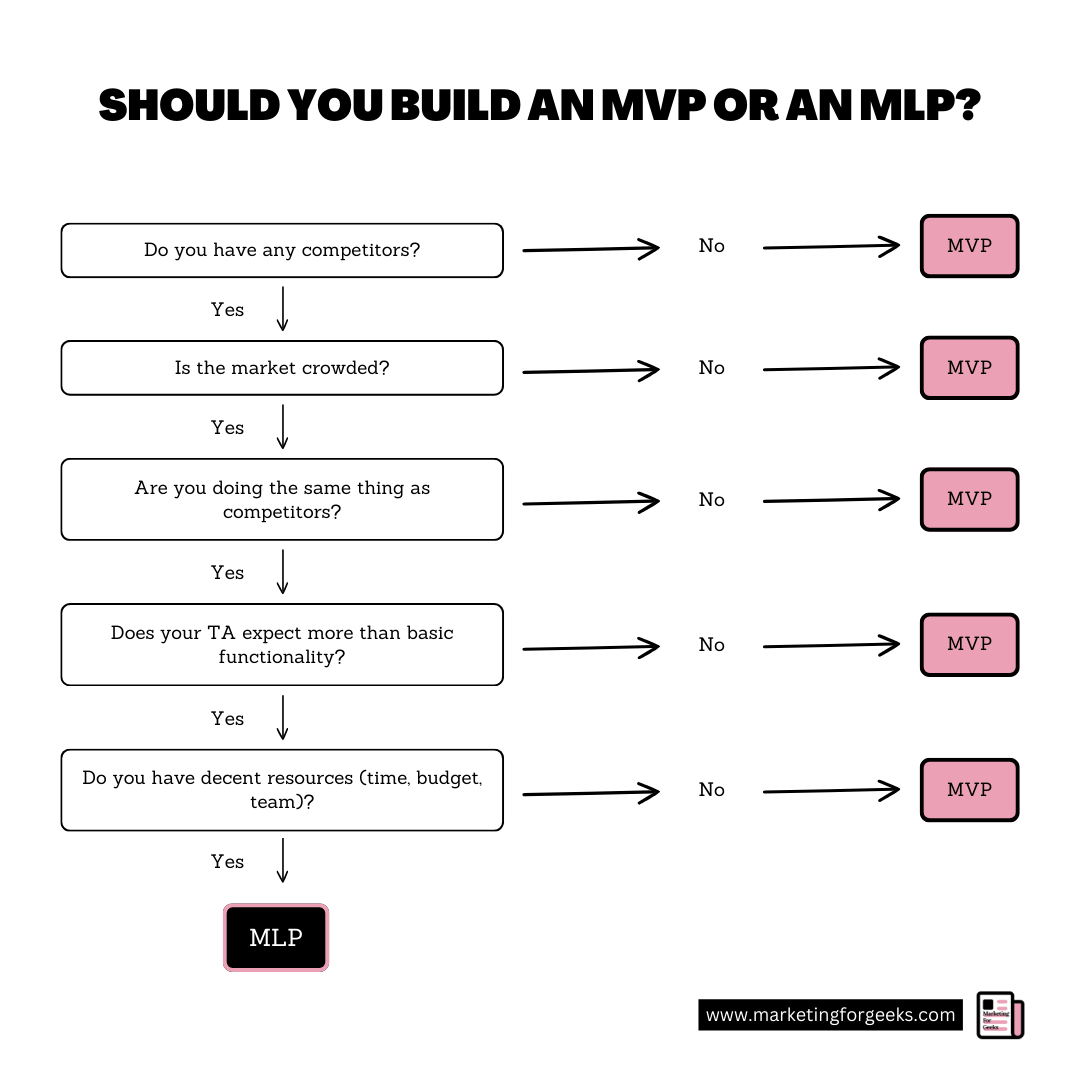
A minimum lovable product retains the discipline of limited scope while asking whether the core experience is enjoyable, trustworthy, and worth recommending. It arose as a response to teams treating an MVP label as permission to ship rough interfaces and broken flows. In markets with many alternatives, functional adequacy may test a hypothesis but fail to create the emotional pull needed for retention.
A Minimum Lovable Product (MLP) is a version of a product that includes only the features essential to solving a core user problem but executes those features with enough quality, care, and emotional resonance that users genuinely enjoy using it and want to come back.
Unlike the Minimum Viable Product, which tests whether a product can function, the MLP tests whether a product can inspire loyalty. It is the smallest thing you can ship that someone would recommend to a friend.
The concept emerged as a corrective to a decade of misapplied MVP thinking, and it reflects a fundamental shift in product strategy: in competitive markets with abundant alternatives and zero switching costs, technical functionality is table stakes.
What separates products that grow from products that flatline is whether users feel something when they use them. The MLP framework provides a disciplined approach to building that emotional connection without abandoning the lean principles of scope restraint and rapid iteration.
"People will forget what you said, people will forget what you did, but people will never forget how you made them feel." - Maya Angelou
This observation, though not originally about product design, captures the core insight behind the MLP. Products are experiences. And experiences are remembered emotionally.
The Rise and Misapplication of the MVP
Eric Ries introduced the Minimum Viable Product concept in The Lean Startup (2011), and it quickly became the dominant framework for early-stage product development. The core idea was sound and urgently needed: stop building enormous systems before talking to users.
Ship the smallest thing that tests your hypothesis. Get feedback. Iterate. The software industry had a serious problem with over-engineering - teams spending years building products nobody wanted, burning resources on features driven by executive assumptions rather than user evidence.
The MVP was a corrective, and it worked. Thousands of startups adopted the principle, shipped faster, learned faster, and wasted less capital on untested assumptions. The methodology produced genuine successes and remains a valuable framework for hypothesis testing.
But over the following decade, something went wrong. "MVP" became a license to ship bad products. "It's an MVP" became an excuse for ugly interfaces, broken flows, missing error handling, and generally joyless experiences.
Laurence McCahill, co-founder of The Happy Startup School, coined the term "Minimum Lovable Product" around 2013 precisely to address this drift. He observed that teams were hiding behind the MVP label to avoid the harder work of crafting experiences people actually wanted.
The problem was not the MVP concept. The problem was what "viable" had come to mean in practice. Viable does not mean enjoyable, trustworthy, or worth recommending. It means it works well enough to technically function. And in competitive markets, technically functional is not enough to survive.
The Data on First Impressions
The case against shipping rough products is not just philosophical - it is empirical.
A landmark 2006 study by Gitte Lindgaard and colleagues at Carleton University, published in Behaviour & Information Technology, found that users form reliable aesthetic judgments about websites in as little as 50 milliseconds - faster than conscious processing can occur.
A follow-up study by Google researchers in collaboration with the University of Basel (Tuch et al., 2012) confirmed that these ultra-fast first impressions predict overall satisfaction and trustworthiness judgments, and are difficult to revise upward after a negative initial reaction.
What this means practically: users who encounter a visually rough or poorly designed product make a snap negative judgment that colors everything that follows. They approach subsequent interactions with skepticism. They interpret ambiguous moments negatively.
Their threshold for abandonment drops dramatically. An MVP that wins the logic contest but loses the aesthetic contest may never get users engaged enough to discover its value.
Why "Viable" Is No Longer Enough
The Abundance Problem
When the MVP concept was articulated in 2011, the internet was less saturated. Category-defining products could acquire and retain users despite roughness because alternatives were scarce. If you wanted a social network, Facebook was the social network.
If you wanted to share photos, Instagram was it. Rough edges were tolerated because there was nothing better.
The landscape in 2026 is radically different. Statista reports over 8.93 million mobile apps available across the Apple App Store and Google Play combined as of 2024. Any product in any category faces dozens of credible alternatives at or near launch.
A notes app competes with Notion, Obsidian, Roam, Apple Notes, Bear, and a dozen others. A meeting scheduler competes with Calendly, Cal.com, SavvyCal, and more. An email client competes with every email client ever made.
In this environment, a product that technically works but fails to delight will lose to a competitor that does the same thing more pleasantly. Users will not learn an awkward interface or forgive a frustrating interaction pattern when they can switch to an alternative in thirty seconds at zero cost.
The Retention Crisis
Even MVPs that attract initial users face a predictable retention pattern that product analytics firms have documented extensively.
Amplitude's 2023 Product Report, analyzing data from over 1.5 billion users across thousands of digital products, found that the median mobile app loses 77% of daily active users within the first three days of installation. By Day 30, median retention drops to approximately 5-6%.
The diagnosis is often not missing features. It is missing emotional connection. Users can accomplish the task. They just do not want to. The product is not bad enough to create a visceral negative reaction, but it is not good enough to create any positive pull.
It is forgettable. Products you love, you return to without prompting. Products you merely use, you abandon the moment friction appears.
The Word-of-Mouth Threshold
Fred Reichheld, creator of the Net Promoter Score (NPS) framework, demonstrated through research at Bain & Company that the single strongest predictor of organic growth is whether users would recommend the product to others (Reichheld, 2003).
The critical finding: there is a nonlinear threshold. Users who rate their experience 7 or 8 out of 10 - satisfied but not delighted - are neutral on recommending the product. Only users who rate their experience 9 or 10 - genuinely enthusiastic - actively drive word-of-mouth referrals.
An MVP that delivers a 7 out of 10 experience generates no organic growth. An MLP that delivers a 9 out of 10 experience on a narrow set of features generates the kind of enthusiasm that builds companies.
The difference between "it works" and "I love it" is not a luxury - it is the difference between a product that grows and a product that does not.
Emotional Design: The Theoretical Foundation
The intellectual foundation for MLP thinking comes largely from Don Norman, the cognitive scientist and designer who wrote Emotional Design: Why We Love (or Hate) Everyday Things (2004) and The Design of Everyday Things (1988).
Norman's research established that humans do not evaluate products on functionality alone - they respond emotionally at multiple levels, and those emotional responses determine behavior more powerfully than rational feature comparisons.
Norman identified three levels of emotional response to products:
The Visceral Level
The visceral level is immediate and pre-conscious - the gut reaction to first seeing, holding, or opening something. Is it beautiful? Does it look trustworthy or cheap? Does it feel substantial or flimsy? Visceral reactions happen before rational evaluation. They set the frame through which all subsequent experience is interpreted.
For digital products, visceral appeal comes primarily from visual design: typography, color, spacing, imagery, animation quality.
A study by the Stanford Persuasive Technology Lab (Fogg et al., 2003) found that 46% of users assessed website credibility based on visual design elements rather than content quality. A product that looks professionally designed feels trustworthy before a user has completed a single task.
The Behavioral Level
The behavioral level is the moment-by-moment experience of use: Is it responsive? Do actions feel confirmed and satisfying? Is it clear what to do next? Does the product seem to understand what I am trying to accomplish?
This is the level where most MVP thinking operates - and where "viable" is typically evaluated. Can the core task be completed? Can the user get from A to B? But behavioral quality encompasses far more than bare functionality:
- Feedback and responsiveness: Does the product acknowledge actions immediately and clearly? Research by Jakob Nielsen (1993) established that response times under 100 milliseconds feel instantaneous, 100ms-1s feel connected, and anything over 10 seconds breaks the user's flow of thought.
- Error handling: When something goes wrong, does the product help or panic?
- Predictability: Does the product behave consistently, building a mental model that makes it easier to use over time?
- Progressive disclosure: Does the product reveal complexity gradually as users need it?
The Reflective Level
The reflective level is the meaning users construct around the product - the narrative about what it says about them to use it, how it fits into their identity, and what they feel when they think about it retrospectively.
This is where brand loyalty operates. Why do people buy Apple products when cheaper alternatives exist? Why do people recommend Notion to friends unprompted? Why do developers display their favorite text editor as an identity marker? The answer is not purely rational.
These products have succeeded at the reflective level - they have become part of how users think about themselves and what they value.
An MLP must create the conditions for reflective connection. This means having a coherent identity - a clear personality and set of values - not just a feature set.
MLP vs. MVP: A Detailed Comparison
| Dimension | MVP Approach | MLP Approach |
|---|---|---|
| Core question | Can users complete the task? | Do users want to complete the task again? |
| Scope | Minimum features to test hypothesis | Minimum features to create emotional response |
| Visual design | Functional; often template-based | Considered, consistent, emotionally resonant |
| Error handling | Product does not crash | Errors communicated clearly and helpfully |
| Onboarding | User can figure it out | User succeeds and feels good at first task |
| Empty states | Blank or placeholder | Guiding, inviting, personality-showing |
| Performance | Loads eventually | Fast enough to feel responsive (<1s) |
| Success metric | Hypothesis validated | Users return voluntarily; word-of-mouth begins |
| Risk | Users never engage deeply enough to test hypothesis | Over-polishing delays learning |
Real-World Examples: Lovable vs. Barely Viable
Superhuman: Email Made Emotional
Superhuman launched as an email client in 2019 with a waitlist, a carefully curated onboarding process, and a product that loads in under 100 milliseconds. The feature set was limited: compose, read, reply, search. Functionally, it did nothing other email clients could not do.
But the experience was extraordinary. Speed was the core emotional target, and every design decision reinforced it. Keyboard shortcuts were elegant and discoverable. Visual design was minimal and beautiful. The onboarding was human - a one-on-one session with a team member who personalized the setup.
Superhuman CEO Rahul Vohra developed a systematic approach to measuring product-market fit, asking users "How would you feel if you could no longer use the product?" and optimizing until at least 40% of users said "very disappointed" (Vohra, 2018).
Users who got access talked about Superhuman constantly. Not because it had features others lacked, but because it made email - something most people actively dislike - feel good. That emotional transformation was the MLP.
Stripe: Developer Experience as Love Language
When Stripe launched in 2011, payment processing was dominated by established players with complex, poorly documented APIs and frustrating integration processes. Stripe's feature set was narrow: accept credit card payments online. The MVP version of this product already existed many times over.
What made Stripe different was the developer experience. The API was clean, consistent, and beautifully documented. Code examples actually worked. Error messages were clear and specific. The dashboard was elegant. Patrick Collison, Stripe's co-founder, described the goal as making payments integration take minutes rather than weeks.
Developers - the actual users - loved it, recommended it to every colleague, and drove viral adoption that turned Stripe into a company valued at over $50 billion.
Stripe was an MLP: narrow scope, executed with such care that users became advocates.
Slack: Making Work Chat Feel Human
Slack launched in 2013 into a market that already included HipChat, Campfire, IRC, and dozens of other team communication tools. Its feature set was not revolutionary. What was revolutionary was how it felt. The copy had personality. The emoji reactions were playful.
The notification management was thoughtful. The integrations were easy. Loading messages felt fast. The product had a character - slightly irreverent, surprisingly helpful, genuinely fun.
Stewart Butterfield, Slack's CEO, wrote an internal memo before launch titled "We Don't Sell Saddles Here" in which he argued that Slack was not selling a messaging app but an organizational transformation.
The product's emotional design reinforced this narrative at every touchpoint. Within two years, Slack had over a million daily active users and one of the fastest growth rates in SaaS history.
The Contrast: Forgettable SaaS
Compare these to the thousands of B2B SaaS products that launched during the same period following pure MVP philosophy: gray interfaces, inconsistent spacing, vague error messages, buttons that do nothing for two seconds after clicking, onboarding flows that abandon users at the first decision point.
Many had correct underlying logic - they identified real problems and built reasonable solutions. They failed to grow because the experience communicated: "we are not sure this matters enough to care about it." That message is received. Users leave.
How to Build an MLP: A Practical Framework
Building a Minimum Lovable Product means narrowing scope to one core problem, then reinvesting the time saved into the emotional quality of that narrow experience. The practical framework below breaks this into five steps: cutting scope ruthlessly, defining an emotional target, investing in the first sixty seconds, designing errors with personality, and building microinteractions that make the product feel considered rather than merely functional.
Step 1: Ruthless Scope Reduction
The discipline that enables MLP is the same discipline MVP demands, taken further. Narrow scope to the single core problem. Ask: what is the one thing that, if we did it beautifully, would make users want to come back and tell their friends?
Everything outside that scope gets cut - not deferred to version 2, cut from consideration entirely for the initial release.
Brian Chesky of Airbnb described this as the "11-star experience" exercise: imagine the most extraordinary version of your product experience on a scale of 1 to 11 stars. Then work backward to find the version that is buildable with current resources while retaining the emotional peak.
The point is not to build the 11-star version - it is to identify the emotional core that makes any version worth using.
Step 2: Define the Emotional Target
Before writing code or designing screens, define the emotional experience you want to create. What should users feel when they accomplish the core task? Common emotional targets:
- Competent and efficient (productivity tools like Superhuman)
- Calm and in control (financial tools like YNAB)
- Delighted and surprised (consumer apps like Duolingo)
- Proud and accomplished (creative tools like Figma)
- Trusted and informed (health or financial products)
Every design decision should be evaluated against this emotional target. Does this color palette support "calm and in control"? Does this animation reinforce "delighted and surprised"? The emotional target makes design choices coherent rather than arbitrary.
Step 3: Invest Disproportionately in the First 60 Seconds
Given what the research shows about first impressions, disproportionate investment in the initial user experience is not vanity - it is strategy. This means:
- Landing page and marketing: Visual presentation and copywriting must communicate quality and trustworthiness before the user signs up
- Onboarding flow: The first task users complete must be simple, immediately valuable, and satisfying. Samuel Hulick, author of The Elements of User Onboarding (2014), demonstrated that products with guided, success-oriented onboarding retain 2-3x more users than those with passive "figure it out" approaches
- Empty states: What does the product look like before users have data? Lovable products use empty states to guide, encourage, and teach. Blank screens communicate nothing
- Visual polish: Typography, spacing, color consistency communicate care. Users read design quality as a proxy for product quality
Step 4: Make Errors Part of the Personality
Nothing tests a product's character more than things going wrong. An MVP error message: "Error 500." An MLP error message: "Something went wrong on our end. We have been notified and we are looking into it. You can try again in a moment."
Mailchimp became famous for treating error states and edge cases as design opportunities, infusing their characteristic humor and warmth into moments of friction. When users sent their first email campaign, the product displayed an illustrated high-five.
When the system was under load, the loading screen was a patient, reassuring animation. These small touches communicated that a human with a sense of humor had thought about this moment and cared about how it felt.
Step 5: Build Microinteractions That Create Feeling
Microinteractions - small, contained animations or feedback moments that respond to user actions - disproportionately affect emotional impression.
Research by Dan Saffer (2013), author of Microinteractions: Designing with Details, documented that these tiny design moments create the "feel" of a product more than its major features do.
A button that provides satisfying visual feedback when clicked. A completion screen with a subtle, celebratory animation. A progress indicator that moves smoothly rather than jumping. A pull-to-refresh gesture with a playful loading indicator. These cost relatively little to build and return significantly in emotional resonance.
When MVP Is Still the Right Choice
The MLP framework does not replace the MVP for all contexts. MVP retains genuine advantages in specific situations:
Pure technical validation: If the question is purely whether a technical approach works - can this algorithm produce the desired output? - visual polish is irrelevant. Internal prototypes and technical experiments should be pure MVP. For more on how startups navigate these choices, see what is MVP.
B2B enterprise pilots: Enterprise buyers often evaluate products on functional criteria first, with emotional design considerations secondary. For a technical pilot with a single committed client, MVP may suffice.
Known-audience internal tools: Products built for an internal team that has committed to adoption regardless do not need to compete for voluntary attention.
Pre-product discovery: Before you know what to build, rapid prototyping to test concepts should be as minimal as possible. The MLP framework applies once you know the core problem and are building the first real version.
For the broader context of how startup culture shapes these decisions, see startup culture explained. For how startups decide when to change direction entirely, see startup pivoting explained.
For the psychology of how first impressions shape all subsequent judgment, see framing effects in communication.
The Sean Ellis Test: Measuring Lovability
Sean Ellis, who coined the term "growth hacking," developed a simple metric for product-market fit that has become the standard measure of whether a product has achieved MLP status.
The test asks users: "How would you feel if you could no longer use this product?" with options ranging from "very disappointed" to "not disappointed."
Ellis's benchmark, validated across hundreds of startups, is that at least 40% of users must say "very disappointed" for the product to have sufficient emotional traction for sustainable growth (Ellis, 2017).
Products below this threshold - even those with strong functional utility - tend to struggle with retention and organic acquisition.
This metric directly measures what the MLP framework is optimizing for: not whether the product works, but whether users care enough about the experience to feel its absence.
The Core Shift in Thinking
The shift from MVP to MLP is ultimately a shift in what question you ask about your product:
MVP asks: Can users complete the core task?
MLP asks: Do users want to complete the core task again tomorrow?
Both questions matter. But in a world of abundant alternatives and finite user attention, the second question determines whether you grow or die. Users will not work hard to use a product. They will not forgive rough edges because you explain your philosophy to them. They will simply leave.
The Minimum Lovable Product is not a rejection of lean product philosophy. It is its maturation - the recognition that the experiment you are running is not just "does this function work" but "do people want this in their lives." And for that experiment to return useful information, you need a product that people could conceivably want in their lives in the first place.
Sources & Further Reading
- Ries, E. (2011). The Lean Startup: How Today's Entrepreneurs Use Continuous Innovation to Create Radically Successful Businesses. Crown Business.
- Norman, D. A. (2004). Emotional Design: Why We Love (or Hate) Everyday Things. Basic Books.
- Norman, D. A. (1988). The Design of Everyday Things. Basic Books.
- Lindgaard, G., Fernandes, G., Dudek, C., & Brown, J. (2006). Attention web designers: You have 50 milliseconds to make a good first impression! Behaviour & Information Technology, 25(2), 115-126. DOI: 10.1080/01449290500330448
- Fogg, B. J., et al. (2003). How Do Users Evaluate the Credibility of Web Sites? A Study with Over 2,500 Participants. Proceedings of DUX 2003. ACM Press.
- Reichheld, F. F. (2003). The One Number You Need to Grow. Harvard Business Review, December 2003. View source
- Saffer, D. (2013). Microinteractions: Designing with Details. O'Reilly Media.
- Vohra, R. (2018). How Superhuman Built an Engine to Find Product/Market Fit. First Round Review. View source
- Ellis, S. (2017). Hacking Growth: How Today's Fastest-Growing Companies Drive Breakout Success. Currency.
- Hulick, S. (2014). The Elements of User Onboarding. Self-published. View source
- Nielsen, J. (1993). Usability Engineering. Academic Press.
- Amplitude. (2023). 2023 Product Report. View source
- Butterfield, S. (2014). We Don't Sell Saddles Here. Internal memo, Slack Technologies. View source