
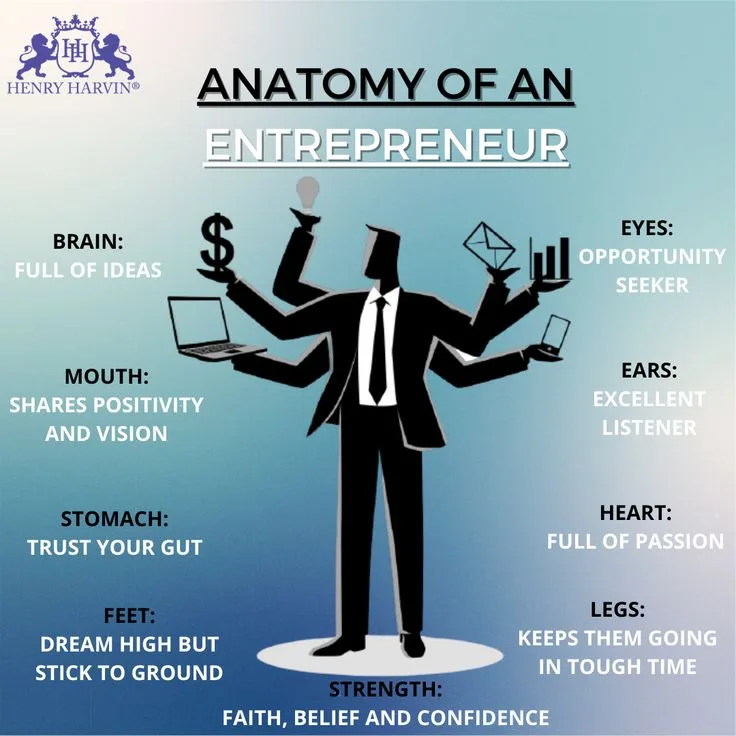
Entrepreneurship is the process of identifying an opportunity, assembling resources under conditions of uncertainty, and creating an organization to pursue that opportunity - bearing meaningful personal, financial, and reputational risk in exchange for potential reward.
It ranges from a freelancer launching a consulting practice to a team of technologists building a venture-backed platform, and understanding this full spectrum is essential for anyone considering whether to start something of their own.
The popular narrative of entrepreneurship features a lone genius, a garage, and a world-changing idea - followed by either triumph or dramatic failure. The actual story is more complicated, more interesting, and far more useful. Research from the Global Entrepreneurship Monitor, the U.S.
Bureau of Labor Statistics, and decades of academic study reveals that most entrepreneurs are not young visionaries disrupting industries. They are experienced professionals, often in their 40s, who see a specific gap in a market they already know well and decide to fill it.
Understanding what entrepreneurship actually is - rather than what the mythology says it is - is the most useful starting point for deciding whether it is right for you.
"The entrepreneur always searches for change, responds to it, and exploits it as an opportunity."
- Peter Drucker, Innovation and Entrepreneurship, 1985
The Intellectual Origins of Entrepreneurship
The word comes from the French entreprendre, meaning "to undertake." The economist Jean-Baptiste Say is often credited with introducing it to economic theory in the early 1800s, describing the entrepreneur as someone who shifts resources from areas of low productivity to areas of higher productivity and greater yield.
Say's entrepreneur was not an inventor but a coordinator - someone who organized labor, capital, and land more effectively than the prevailing arrangement.
Joseph Schumpeter extended this in the 20th century with his concept of "creative destruction" - the entrepreneur as the agent who disrupts existing industries through innovation, rendering old products, processes, and organizations obsolete while building new ones.
Schumpeter's Capitalism, Socialism and Democracy (1942) argued that entrepreneurship was the engine of economic progress, not incremental improvement but radical replacement.
Frank Knight (1921) contributed the crucial distinction between risk and uncertainty. Risk means the odds are unknown but can be estimated; uncertainty means they genuinely cannot be calculated.
Knight argued that entrepreneurial profit is the reward for bearing true uncertainty - situations where no amount of data can tell you whether your venture will succeed.
Israel Kirzner (1973) offered a complementary view: the entrepreneur as someone uniquely alert to opportunities that others miss. In Kirzner's framework, entrepreneurship is fundamentally about perception - seeing a price discrepancy, an unmet need, or an inefficiency that no one else has noticed.
These four perspectives - coordination (Say), disruption (Schumpeter), uncertainty-bearing (Knight), and alertness (Kirzner) - remain the intellectual foundations of how economists and researchers think about entrepreneurship today.
Types of Entrepreneurship: A More Useful Taxonomy
The word "entrepreneur" covers an enormous range of activities. Lumping them together obscures more than it reveals, and applying advice meant for one type to another is one of the most common sources of entrepreneurial failure.
Lifestyle vs. High-Growth Entrepreneurship
A lifestyle business is designed to generate income that supports the founder's desired standard of living, not to scale indefinitely. A local restaurant, a freelance consulting practice, a yoga studio, an e-commerce shop selling handmade goods - these are valid businesses that most small business owners actually run.
They outnumber VC-backed startups by orders of magnitude. The U.S. Small Business Administration reports that there are approximately 33.3 million small businesses in the United States (2023), while the National Venture Capital Association tracks only about 5,000 venture deals per year.
A high-growth startup is explicitly designed to scale fast, typically by leveraging software, network effects, or both. These businesses seek outside investment because their growth ambitions require more capital than their revenue can fund. The playbook - raise, burn, scale, raise again - is specific to this narrow category.
Confusing the two leads to enormous amounts of bad advice. The "move fast and break things" philosophy that may work for a venture-backed SaaS company can be lethal for a local service business with thin margins.
Similarly, the careful, profit-first approach that sustains a lifestyle business would be fatal for a startup trying to capture a winner-take-most platform market.
Opportunity vs. Necessity Entrepreneurship
The Global Entrepreneurship Monitor (GEM), which surveys entrepreneurial activity in over 50 countries annually, distinguishes between two motivational categories:
- Opportunity entrepreneurship: Starting a business because you see a market gap, want to increase your independence, or believe you can build something valuable.
- Necessity entrepreneurship: Starting a business because unemployment or underemployment leaves you no better option.
These categories behave very differently across economic cycles. During the 2008-2009 recession, necessity entrepreneurship rose sharply in many countries. It also correlates with lower survival rates and slower growth: people starting businesses out of desperation typically have fewer resources, weaker networks, and less market fit.
GEM's 2023/2024 Global Report found that opportunity-motivated entrepreneurs were 2.5 times more likely to expect significant job creation than necessity-motivated ones.
Social and Institutional Entrepreneurship
Social entrepreneurship applies entrepreneurial methods to social problems - organizations like Grameen Bank (Muhammad Yunus, 1983) or Khan Academy (Sal Khan, 2008) operate with the discipline and creativity of businesses but measure success in social outcomes, not profit margins.
The Skoll Foundation has tracked the growth of this sector, estimating that social enterprises account for approximately 3% of GDP in the UK and are growing across developed economies.
Institutional entrepreneurship refers to efforts to change the rules themselves - regulations, industry standards, or social norms - rather than just compete within them.
Many platform businesses are institutional entrepreneurs as much as product ones: Uber changed transportation regulation in dozens of cities, not just transportation technology.
| Type | Primary Goal | Typical Funding | Success Metric | Failure Rate Context |
|---|---|---|---|---|
| Lifestyle / SMB | Personal income + stability | Self-funded or small loans | Revenue, profit margin | ~45% close within 5 years |
| High-growth startup | Market capture and exit | Venture capital | Growth rate, valuation | ~75% fail to return investor capital |
| Social enterprise | Social outcome | Grants, impact investors | Beneficiaries served | Varies by model and sector |
| Necessity entrepreneur | Survival income | Self-funded | Staying solvent | Higher than opportunity ventures |
The Real Failure Rate Data
The "90% of startups fail" figure circulates constantly. It is, at best, a dramatic simplification - and at worst, it actively distorts how people think about entrepreneurial risk.
What the BLS Data Actually Shows
The U.S. Bureau of Labor Statistics tracks business survival rates through the Business Employment Dynamics series. The numbers tell a more nuanced story:
- Approximately 20% of new employer businesses fail within the first year.
- About 45% have closed by the end of year five.
- About 65% have closed by year ten.
- About 75% have closed by year fifteen.
These figures represent closure, not always failure in the catastrophic sense. Many businesses are voluntarily wound down when the founder retires, sells, pivots, or decides the opportunity cost is no longer worth it - BLS data cannot distinguish these from bankruptcies.
"The popular statistic that nine out of ten startups fail is more mythology than measurement. The actual numbers suggest that half of new businesses survive five years, and about a third survive ten - which is hard, but not a death march."
- Adapted from analysis of BLS Business Employment Dynamics data, 2023
Why Context Matters Enormously
Failure rates vary sharply by industry, funding model, founder experience, and economic conditions.
A 2014 study by Shikhar Ghosh at Harvard Business School found that 75% of venture-backed startups never return investors' capital - a much higher failure rate than the headline BLS numbers, because VC-backed companies are explicitly selected for high-risk, high-reward strategies.
The median VC-backed startup does not die in a spectacular crash; it simply runs out of runway before finding product-market fit.
Industry matters enormously. According to BLS data, restaurants and retail businesses have five-year failure rates closer to 60%, while professional services firms (consulting, legal, accounting) fail at roughly 35%. The difference reflects margin structure, capital requirements, and the severity of local competition.
Founder experience is one of the strongest predictors. Research by Paul Gompers, Anna Kovner, Josh Lerner, and David Scharfstein (2010) at Harvard found that entrepreneurs who had previously succeeded had a 30% chance of success with their next venture, compared to 22% for first-time entrepreneurs and 20% for those whose previous venture had failed.
The advantage of success breeds success - successful founders attract better talent, better investors, and more favorable terms.
Effectuation vs. Causation: Two Modes of Entrepreneurial Thinking
One of the most important contributions to entrepreneurship research in the past 25 years came from Saras Sarasvathy at the University of Virginia Darden School of Business.
Through a study of expert entrepreneurs - founders with at least 15 years of experience and at least one company that had gone public - she identified two fundamentally different decision-making logics.
Causation
Causation is the logic most MBA programs teach. You start with a goal, analyze the market, build a plan, assemble resources to execute that plan, and optimize for the expected outcome. It assumes a reasonably predictable future and asks: what should I do to achieve this goal?
Causation works well in established markets with known competitors, measurable demand, and existing distribution channels. If you are opening the tenth coffee shop in a neighborhood, causation - market research, financial projections, location analysis - is the appropriate logic.
Effectuation
Effectuation inverts this. It starts not with a goal but with available means - who you are, what you know, whom you know - and asks: what could I build with these?
It embraces contingency (unexpected events are incorporated as inputs, not obstacles), operates by the principle of affordable loss (how much can I lose if this goes wrong?) rather than expected return, and builds through partnerships rather than competition.
Expert entrepreneurs in Sarasvathy's study used effectuation far more than causation. They did not begin with thorough market research; they began with what was already in their hands.
Howard Schultz did not conduct a formal market study before bringing Italian espresso culture to the United States - he had a personal conviction formed by direct experience, and he started by testing the concept in a single store.
This distinction has practical implications. If you are an aspiring entrepreneur waiting for the perfect idea backed by comprehensive market research, effectuation theory suggests you may be using the wrong logic.
The expert approach is to start with your unique combination of skills, knowledge, and relationships, and to ask what ventures those assets uniquely enable.
What Research Says About Founder Traits
The entrepreneurial personality has attracted enormous research attention, and the results are more complicated than the "risk-taker with vision" archetype suggests.
What Predicts Success
Studies consistently find that the following traits correlate with entrepreneurial success:
Tolerance for ambiguity: The ability to act without complete information. This is not the same as recklessness - it is comfort with the fact that certainty is not available.
A meta-analysis by Rauch and Frese (2007), covering 116 studies, found that tolerance for ambiguity was among the strongest personality predictors of entrepreneurial success.
Domain expertise: Research by Scott Shane at Case Western Reserve University found that founders with deep industry knowledge consistently outperform outsiders, despite the romantic appeal of "disruption by outsiders." Shane's work showed that the most common source of entrepreneurial opportunities is not brilliance but knowledge - entrepreneurs start companies in fields where they have worked long enough to see inefficiencies that outsiders cannot perceive.
Prior failure experience: Counterintuitively, prior failed ventures are associated with better outcomes in subsequent ventures. The learning effect - understanding what went wrong and how to avoid it - outweighs the stigma in most empirical studies.
Network quality: Access to information and resources through relationships matters enormously, and networks tend to amplify advantage over time.
Research by Aldrich and Zimmer (1986) established that entrepreneurship is fundamentally embedded in social networks, and subsequent work has consistently confirmed that founders with stronger professional networks raise more capital, hire better, and survive longer.
What Does Not Reliably Predict Success
Risk-seeking personality: The data does not support the idea that successful entrepreneurs are inherently bigger risk-takers. Many are deeply risk-aware and work systematically to manage downside.
A study by Xu and Ruef (2004) found that entrepreneurs' risk preferences are not significantly different from those of the general population - they simply perceive risk differently because of their domain knowledge.
Youth: The average age of a successful startup founder in the U.S. is not 25. A landmark 2018 MIT study (Azoulay, Jones, Kim, and Miranda) analyzing 2.7 million company founders found that the average age of founders of the fastest-growing new companies was 45.
Founders in their 50s were more likely to build a top 0.1% company than founders in their 20s.
Formal education: Education shows a weak and inconsistent relationship with entrepreneurial success. What matters more is what kind of knowledge you have and how you apply it. Bill Gates and Mark Zuckerberg dropped out of Harvard, but they were at Harvard in the first place because of extraordinary prior knowledge and networks.
The Stress and Wellbeing Dimension
Entrepreneurship research increasingly examines the psychological costs of founding a company. A study by Michael Freeman and colleagues (2015), published in Small Business Economics, found that entrepreneurs were significantly more likely to report lifetime histories of depression (30% vs.
15% of comparison participants), ADHD (29% vs. 5%), substance use conditions (12% vs. 4%), and bipolar diagnosis (11% vs. 1%).
This is not an argument against entrepreneurship - but it is an argument for taking mental health seriously as a performance variable, not just a personal concern. The isolation of leadership, the financial risk, and the identity fusion between founder and company all contribute to what researchers call entrepreneurial stress.
Founders who build support systems - mentors, peer groups, professional help - consistently outperform those who try to bear the burden alone.
Why People Become Entrepreneurs
Beyond the opportunity/necessity distinction, motivational research identifies several consistent drivers:
Independence and autonomy: The desire to be your own boss is consistently the most commonly cited reason for starting a business across surveys. The GEM 2023 report found that "independence and self-fulfillment" was the primary motivation for 56% of early-stage entrepreneurs globally.
This suggests that entrepreneurship is partly a response to organizational failure - traditional workplaces do not provide enough autonomy for a significant portion of the workforce.
Financial upside: Particularly in high-growth tech entrepreneurship, the equity upside that is unavailable in employment is a major driver. The ability to capture the full value of your work, rather than a salary, is the financial logic.
However, the expected financial return of entrepreneurship is actually lower than employment for most founders - the median outcome is a pay cut, not a windfall. It is the tail outcomes that make the expected value calculation look attractive.
Identity and meaning: Many founders describe entrepreneurship as an identity, not just a career choice. The company becomes an expression of values, aesthetics, and purpose. This fusion can be a source of extraordinary energy - and extraordinary vulnerability when the company struggles.
Problem obsession: The most durable founders are typically those who are genuinely obsessed with the problem they are solving, not with "being an entrepreneur" as an identity. The problem focus provides direction when the process becomes painful.
Y Combinator's Paul Graham has written extensively about this distinction, arguing that the best founders are those who would work on their problem even if no one would pay them.
How to Think About Whether to Start Something
The cultural celebration of entrepreneurship has created a risk of status-driven decision-making: people start companies because it seems prestigious, not because they have good reason to believe they can create something valuable.
A more useful set of questions before starting:
What is the specific problem you are solving, and for whom? Vague answers here predict vague businesses. "I want to make healthcare better" is not a business opportunity.
"Small dental practices in the southeastern US have no affordable way to manage patient scheduling and insurance billing in a single tool" is a business opportunity.
What is your unfair advantage? This could be domain expertise, a unique network, proprietary insight, or capital access. "I am passionate about it" is not an unfair advantage - passion is necessary but not differentiating.
What is the worst realistic outcome, and can you absorb it? Sarasvathy's affordable-loss principle is useful here: instead of asking "what is the maximum I could make?", ask "what is the maximum I could lose, and would that be survivable?" This reframes the decision from a gamble on upside to a deliberate acceptance of downside.
What does success look like in three years? This forces specificity about whether you are building a lifestyle business, a scalable venture, or something in between - and whether your expectations match your strategy and risk tolerance.
Do you have enough domain knowledge, or a clear plan to acquire it? Starting in an industry you do not understand is a recoverable mistake for some founders with strong learning ability and a fatal one for those without it.
The Bigger Picture: Entrepreneurship in the Economy
Entrepreneurship is both an individual act and a social phenomenon. Economists generally agree that new business formation drives a substantial portion of job creation and innovation in market economies.
The Kauffman Foundation's research consistently shows that startups - defined as companies less than one year old - are the primary net job creators in the U.S.
economy, responsible for an average of about 3 million new jobs per year, even though most of those jobs do not survive five years at the original company.
The conditions that enable entrepreneurship vary enormously across countries and communities.
The World Bank's Doing Business reports (published annually until 2021) documented massive differences in the time, cost, and regulatory complexity of starting a business - from 1 day in New Zealand to over 100 days in some developing economies.
These differences compound over time, creating divergent entrepreneurial ecosystems.
Access to capital remains the most significant structural barrier. Research by the Federal Reserve Banks (2023 Small Business Credit Survey) found that 44% of small businesses that applied for financing received less than they sought, with rejection rates significantly higher for Black-owned (52%) and Hispanic-owned (43%) businesses than white-owned (28%) businesses.
The venture capital landscape is even more concentrated: PitchBook data shows that in 2023, only 2% of VC funding went to all-female founding teams, and only 1% went to Black founders.
The honest assessment is this: entrepreneurship is neither the heroic path to freedom and wealth the culture often portrays, nor the reckless gamble that its critics sometimes describe.
It is a specific form of work with specific demands, specific risks, and specific rewards - more accessible than the mythology suggests, and harder than the cheerleading implies. Understanding what it actually is, rather than what the stories say it is, is the most useful starting point.
Sources & Further Reading
- Schumpeter, J.A. Capitalism, Socialism and Democracy. Harper & Brothers, 1942.
- Knight, F.H. Risk, Uncertainty, and Profit. Houghton Mifflin, 1921.
- Kirzner, I.M. Competition and Entrepreneurship. University of Chicago Press, 1973.
- Drucker, P. Innovation and Entrepreneurship. Harper & Row, 1985.
- Sarasvathy, S.D. Effectuation: Elements of Entrepreneurial Expertise. Edward Elgar Publishing, 2008.
- Azoulay, P., Jones, B.F., Kim, J.D., & Miranda, J. "Age and High-Growth Entrepreneurship." American Economic Review: Insights, 2(1), 65-82, 2020. (Based on 2018 NBER working paper.)
- Ghosh, S. "The Venture Capital Secret: 3 Out of 4 Start-Ups Fail." Wall Street Journal, 2012. Based on Harvard Business School research, 2014.
- Gompers, P., Kovner, A., Lerner, J., & Scharfstein, D. "Performance Persistence in Entrepreneurship." Journal of Financial Economics, 96(1), 18-32, 2010.
- Freeman, M.A. et al. "Are Entrepreneurs Touched with Fire?" University of California, San Francisco. Small Business Economics, 2015.
- Rauch, A. & Frese, M. "Let's Put the Person Back into Entrepreneurship Research: A Meta-Analysis on the Relationship Between Business Owners' Personality Traits, Business Creation, and Success." European Journal of Work and Organizational Psychology, 16(4), 353-385, 2007.
- Global Entrepreneurship Monitor. 2023/2024 Global Report. gemconsortium.org.
- U.S. Bureau of Labor Statistics. Business Employment Dynamics. bls.gov/bdm.
- Kauffman Foundation. The Role of Startups in Job Creation. kauffman.org.
- Federal Reserve Banks. 2023 Small Business Credit Survey. fedsmallbusiness.org.
- Shane, S. The Illusions of Entrepreneurship. Yale University Press, 2008.
- Aldrich, H.E. & Zimmer, C. "Entrepreneurship Through Social Networks." In The Art and Science of Entrepreneurship, pp. 3-23, 1986.