
In 1776, Adam Smith published "An Inquiry into the Nature and Causes of the Wealth of Nations" and inadvertently gave capitalism its intellectual architecture - complete with its own internal critique.
The pin factory passage, which opens the book, described how dividing the production of a pin among ten workers specializing in different operations could produce 48,000 pins a day where one worker doing all operations could produce 20.
Division of labor and market exchange, Smith argued, allowed the accumulated output of society to far exceed what any planning authority could organize.[1]
The invisible hand - the mechanism by which individuals pursuing their own interest serve the public good without intending to - is perhaps the most quoted phrase in the history of economics.
What is less often quoted is what Smith said about the people who run markets. "People of the same trade seldom meet together," he wrote, "even for merriment and diversion, but the conversation ends in a conspiracy against the public, or in some contrivance to raise prices." Smith was not a simple free-market ideologue.
He was deeply suspicious of concentrated private power, particularly of merchants and manufacturers who used political influence to restrict competition and suppress wages.
His invisible hand was always accompanied, in the actual text, by a visible fist - the fist of organized business interests seeking monopoly.
The tension between market coordination and market power, between competition's productive benefits and its tendency toward concentration, runs through capitalism's entire history and its entire intellectual tradition.
Understanding capitalism requires sitting with that tension rather than resolving it prematurely in either direction.
Capitalism's defenders are right that market-coordinated economies have produced material abundance, technological dynamism, and - with caveats - associations with political freedom that no other economic system has matched at scale.
Its critics are right that capitalism systematically tends toward inequality, periodically produces catastrophic crises, and externalizes enormous costs - environmental, social, human - onto parties who had no voice in the transactions that produced them.
Both are describing the same system. The debate is about what follows from this description, and what institutional forms can capture capitalism's productive benefits while limiting its destructive ones.
"The bourgeoisie, wherever it has got the upper hand, has put an end to all feudal, patriarchal, idyllic relations.
It has pitilessly torn asunder the motley feudal ties that bound man to his 'natural superiors,' and has left remaining no other nexus between man and man than naked self-interest, than callous 'cash payment.'" - Karl Marx & Friedrich Engels, The Communist Manifesto (1848)
Key Definitions
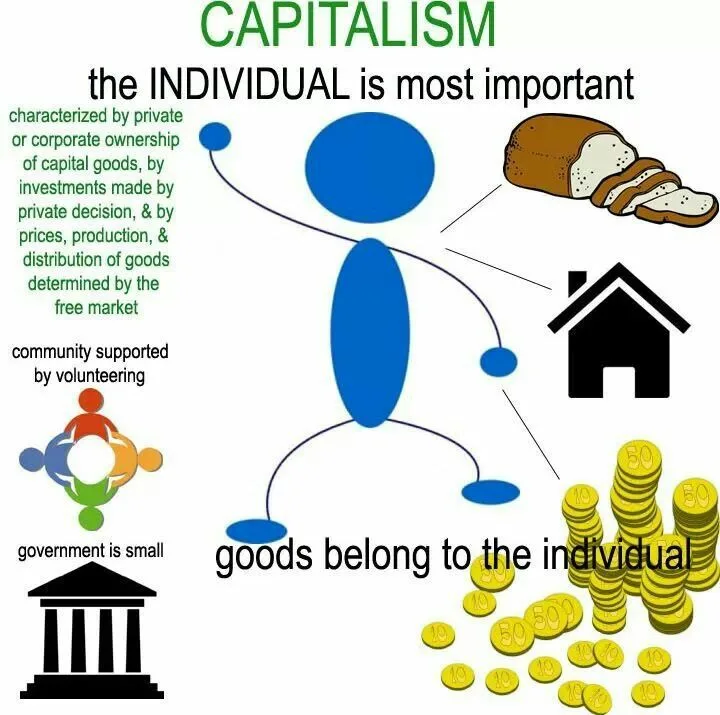
Capitalism: An economic system characterized by private ownership of the means of production, wage labor, commodity production for market exchange, and capital accumulation as the primary organizing logic.
Means of production: The non-labor inputs to production - land, equipment, factories, raw materials - whose private ownership distinguishes capitalism from socialist or commons-based alternatives.
Surplus value: Marx's concept - the value produced by workers above the cost of their own reproduction (subsistence wage), appropriated by capitalists as profit.
Capital accumulation: The process of reinvesting profits to expand productive capacity and wealth, the primary logic driving capitalist dynamics.
Varieties of capitalism: Hall and Soskice's framework distinguishing liberal market economies (US, UK) from coordinated market economies (Germany, Nordic countries) based on how they coordinate economic activity.[4]
Market failure: A condition in which market outcomes are inefficient - when prices fail to reflect full social costs (externalities), when public goods are underprovided, when information asymmetries distort exchange, or when market power allows price-setting above competitive levels.[7]
r > g: Piketty's formula for the long-run tendency of capital concentration - when the return on capital exceeds economic growth, wealth concentrates over time.
Invisible hand: Smith's metaphor for how self-interested market behavior can coordinate to produce socially beneficial outcomes without central direction.
The Historical Emergence of Capitalism
Where and how capitalism arose is a question that has generated almost as much scholarly energy as the question of what it is. The two most influential accounts emphasize different causal factors, and their disagreement illuminates different aspects of capitalism's nature.
Max Weber's "The Protestant Ethic and the Spirit of Capitalism" (1905) is the most famous cultural account.[3]
Weber observed that capitalism was not merely a set of institutional arrangements but a particular spirit - a disposition toward rational acquisition, methodical bookkeeping, and the reinvestment of profit rather than its enjoyment.
He sought to explain where this spirit came from and identified what he took to be a striking correlation: capitalism's early development was concentrated in Protestant, particularly Calvinist, regions of Europe.
Weber argued this was not coincidental. The Calvinist doctrine of predestination held that divine election or damnation was predetermined and unknowable, but that worldly success in one's calling might serve as a sign of grace.
This created a religious motivation toward diligent, successful work - and a religious prohibition on spending that success in luxurious consumption.
The disciplined Protestant, Weber argued, was structurally oriented toward accumulation: earn maximally, spend minimally, reinvest the difference. The monastery's asceticism was transferred to the counting house.
Weber's thesis has been criticized extensively, and rightly so. Capitalism flourished in Catholic northern Italy and in secular Holland before it took hold in Protestant England. The correlation Weber identified was less robust than he believed.
And the causal mechanism - that Calvinist theology changed economic behavior at scale - is difficult to establish empirically against alternative explanations (perhaps Protestant regions were already more commercially developed for other reasons, and the theology followed the commerce rather than preceded it).
But Weber's insight that capitalism requires not merely institutions but dispositions - a particular way of relating to work, money, and time - remains genuinely important even if his specific historical argument is contested.
The Marxist account emphasizes material conditions and class relations.[2] Capitalism required a proletariat - a class of workers who own no productive property and must sell their labor to survive. This class was not natural; it was created through specific historical processes.
In England, the enclosure movement of the 16th through 18th centuries converted common lands, on which peasant communities had subsisted, into private sheep pastures for the wool trade.
The displaced peasants became the landless laborers who would staff the factories of the Industrial Revolution. Meanwhile, the Atlantic slave trade provided both capital - the profits from slavery financed early industrial investment - and the commodity markets, particularly in cotton, that British manufacturing first served.
Capitalism's emergence was not a spontaneous evolution from commercial exchange but a process of primitive accumulation in which non-market coercion created the conditions for market dominance.
These accounts are not mutually exclusive. Capitalism's actual emergence involved institutional innovation (property law, corporate forms, banking), demographic and agricultural change, technological development, colonial extraction, and cultural dispositions - all operating in conjunction.
What both accounts agree on is that capitalism's emergence was a historically specific transformation, not a natural or inevitable development from human commercial instincts.
Adam Smith: The Foundation and Its Internal Complexity
Smith's "Wealth of Nations" remains foundational because it articulated capitalism's productive logic so clearly and because its internal tensions - between market coordination and market power, between commercial society's benefits and its moral costs - anticipated nearly every subsequent debate.
The productive logic is the division of labor and specialization, enabled by market exchange. When each person and each region specializes in what they do best and trades for what they need, total output rises dramatically.
The price mechanism coordinates this specialization without central direction: rising prices signal that more production is needed and attracts producers; falling prices signal the opposite.
No single authority needs to know all the relevant information; the price system aggregates and communicates it.
Smith was also the founder of classical growth theory. He argued that growth depended on the extent of the market - which determined how fine specialization could be - and on the accumulation of "stock" (capital) through saving and reinvestment of profits.
Economic policy should therefore maximize market extent (free trade, not mercantilism) and encourage accumulation (not dissipation of wealth in luxury consumption).
But Smith's second major work, "The Theory of Moral Sentiments" (1759), and his cautions in "The Wealth of Nations" itself, present a more complex picture. Smith was not the simple laissez-faire ideologue that later admirers and later critics both made him.
He was acutely aware that commercial society could erode moral sentiments, that workers subjected to narrow specialization might lose their broader human capacities, that merchants and manufacturers would use political power to restrict competition if allowed to, and that the market produced distributive outcomes that required supplementation.
He supported public provision of infrastructure, education for working-class children, and usury laws. He was a moral philosopher who thought markets were powerful but not self-sufficient.
Marx's Critique: Exploitation, Crisis, and Alienation
Karl Marx's analysis of capitalism is the most systematic and influential critique ever produced, and despite the collapse of the Soviet regimes that claimed his legacy, it retains genuine analytical power in understanding how capitalist economies function.
The core of Marx's economics is the labor theory of value and the derived concept of surplus value. In a capitalist economy, workers sell their labor power - their capacity to work - as a commodity in exchange for wages.
Those wages are set roughly at the cost of reproducing the worker's labor power: enough to feed, house, clothe, and maintain a worker capable of showing up tomorrow. But in a working day, workers produce more value than this subsistence cost.
If a worker's labor power costs the equivalent of four hours of output to reproduce, but the worker works for ten hours, six hours of output accrues to the capitalist without any corresponding payment. This surplus value is the source of profit, rent, and interest - the return to capital in all its forms.
The exploitation involved is systematic, not the product of individual fraud. Each contract is formally voluntary: no worker is forced to work for any particular employer. The coercion is structural: workers who own no productive property must sell their labor power to someone who does, or starve.
The formal equality of the wage contract conceals a substantive inequality of bargaining power that gives capitalists access to surplus labor.
Marx's model predicts several features of capitalism that its later history validated: the tendency of competition to drive wages toward subsistence; the periodic crises of overproduction when workers lack the purchasing power to buy back what they produce; the concentration of capital through competitive weeding-out of smaller firms; and the globalization of capitalist production as firms seek cheaper labor and new markets.
Marx also developed an account of alienation that goes beyond economics to human psychology and sociology. In capitalist production, workers are estranged from the product of their labor - it belongs to the capitalist, not them. They are estranged from the labor process - they perform tasks designed by others, without creative control.
They are estranged from other workers - placed in competition rather than cooperation. And they are estranged from their species-being - the distinctively human capacity for conscious, self-directed, creative activity is reduced to a means of survival rather than an end in itself.
This account of alienation anticipated 20th-century concerns about deskilling, meaningless work, and the psychological costs of labor market organization that remain active in contemporary sociology.
Varieties of Capitalism: Why All Capitalisms Are Not the Same
Peter Hall and David Soskice's "Varieties of Capitalism" framework (2001) made a seemingly obvious but theoretically significant point: not all capitalist economies are organized the same way, and these organizational differences have systematic consequences for inequality, innovation, and social outcomes.
Their central distinction is between Liberal Market Economies (LMEs) and Coordinated Market Economies (CMEs):
| Feature | Liberal Market Economy | Coordinated Market Economy |
|---|---|---|
| Primary examples | United States, United Kingdom, Australia | Germany, Sweden, Japan, Netherlands |
| Labor relations | Individual contracts, flexible hiring/firing | Collective bargaining, employment protection |
| Firm finance | Equity markets, short-term return pressure | Long-term bank relationships, patient capital |
| Innovation style | Radical, disruptive breakthroughs | Incremental improvement of complex products |
| Wage inequality | High - market-set wages diverge widely | Low - collective agreements compress wages |
| Welfare state | Liberal (means-tested, residual) | Social democratic or Christian democratic (universal) |
| Worker training | General skills (portable across firms) | Specific skills (supported by employer-worker-state coordination) |
The key theoretical claim is that these features form coherent institutional complementarities: each element supports the others.
The German system of industry-wide collective bargaining works with long-term bank financing and codetermination (worker board representation) to produce a patient, cooperative model of production suited to high-quality manufacturing.
The American system of at-will employment works with equity-market financing to produce fast-moving, risk-taking innovation suited to software, biotech, and digital platforms. Neither is straightforwardly superior; they are adapted to different competitive niches.
The distributional implications are, however, stark. LMEs consistently produce higher income inequality, weaker labor protections, and more precarious employment than CMEs.
The Nordic countries - which are CMEs with strong social democratic welfare states - achieve higher scores on virtually every human development measure (health, education, life satisfaction, social mobility) than the United States, while maintaining comparable or superior economic productivity.
Piketty and the Arithmetic of Inequality
Thomas Piketty's "Capital in the Twenty-First Century" (2014) made a mathematical argument about capitalism's long-run distributional tendency that drew on the most extensive historical wealth and income data ever assembled.[5] The argument is contained in the formula r > g.
When the rate of return on capital (r) - the annual return that owners of wealth receive from dividends, rents, profits, and interest - exceeds the rate of economic growth (g), capital owners' share of national income increases over time.
Their wealth grows faster than the economy, allowing them to reinvest and compound their advantages. When capital is bequeathed, children of the wealthy begin with structural advantages that are difficult to overcome through earned income. Inequality tends to compound.
Piketty's data showed that r has historically run at approximately 4-5% per year in mature economies, while long-run g has run at approximately 1-2% in fully developed economies. The r > g condition is, therefore, the normal state of capitalist economies.
The compressed inequality of the mid-20th century was an exception explained by exceptional circumstances: the physical destruction of capital in two world wars, the collapse of wealth in the Great Depression, and the political responses to these crises - progressive taxation, capital controls, union power - that were sustained through the postwar decades.
Since the 1980s, as those political constraints were dismantled, r > g has reasserted itself and inequality has risen substantially across most developed economies.
Piketty's projections for the 21st century are contested - they depend on specific assumptions about growth rates and returns that may not hold - and his prescription (a global progressive wealth tax) is politically utopian under current conditions.
But his central empirical contribution - the comprehensive documentation of wealth inequality's rise - has been broadly corroborated by independent research and has permanently altered the terms of the distributional debate.
Market Failures and the State's Role
Capitalism's defenders often present markets as naturally efficient and state intervention as a distortion requiring special justification.
The economic theory of market failure reverses this framing: it specifies the conditions under which markets produce inefficient outcomes and identifies the forms of intervention that can correct them.
Climate change is the most consequential market failure of the current era. Carbon emissions impose enormous costs on future generations and on vulnerable populations, but those costs are not reflected in the price of energy, transportation, or goods produced with fossil fuels.
Without a carbon price - a Pigouvian tax that makes emitters pay the social cost of their emissions - markets produce far more carbon than is socially optimal, because they are not pricing the externality.
The market is working exactly as designed: prices reflect private costs and benefits. The problem is structural, not individual - no one firm can correct it by acting alone, since the firm that voluntarily raises its own costs loses competitive position without reducing the collective harm.
Mariana Mazzucato's "The Entrepreneurial State" (2013) extends the critique further.[6] Not only do markets fail under specific conditions; they depend on prior state investment to function at all.
The foundational technologies of the digital economy - the internet (ARPANET), GPS (US military), touchscreen interfaces (funded by CIA and NSF), and the algorithms behind Google Search (NSF-funded) - were all developed with public funding before private firms could profit from them.
The pharmaceutical industry depends on basic science funded by NIH. mRNA vaccine technology, which enabled the rapid COVID-19 vaccines, was developed over decades of publicly funded basic research.
Mazzucato argues that the appropriate policy conclusion is not just that the state should fix market failures but that the state should be recognized and compensated as a risk-taking investor - and that the current arrangement, in which public investment creates the conditions for private profit without public return, represents a misallocation of the gains from innovation.
Alternatives, Hybrids, and the Limits of the Question
The most useful question about capitalism is not "capitalism or not?" but "which institutional configuration, and for whom?" The empirical record shows that some capitalist configurations perform far better than others on the measures most people care about - health, education, security, opportunity, and environmental sustainability.
The Nordic model demonstrates that robust welfare states, strong labor market institutions, and progressive redistribution are compatible with dynamic market economies.
German codetermination demonstrates that workers can have significant governance voice in capitalist firms without those firms becoming less productive. Mondragon demonstrates that worker cooperatives can compete successfully in international markets.
None of these examples dissolves the fundamental tensions that capitalism generates: the tendency toward inequality, the externalization of costs, the periodic crises of coordination, and the challenge of democratic governance over increasingly concentrated private power.
But they suggest that the institutional space within capitalism is large enough to produce outcomes that differ dramatically from the Anglo-American model that is most often taken as the default.
For detailed analysis of the inequality dynamics Piketty described, see why-inequality-grows.
For the historical context of capitalism's industrial emergence, see what made-the-industrial-revolution-happen.
For the relationship between capitalism and theories of what a just society requires, see what-is-justice.
Sources & Further Reading
- Smith, A. (1776). An Inquiry into the Nature and Causes of the Wealth of Nations. W. Strahan and T. Cadell.
- Marx, K., & Engels, F. (1848). The Communist Manifesto. Burghard.
- Weber, M. (1905/1930). The Protestant Ethic and the Spirit of Capitalism. Allen & Unwin.
- Hall, P. A., & Soskice, D. (Eds.). (2001). Varieties of Capitalism: The Institutional Foundations of Comparative Advantage. Oxford University Press.
- Piketty, T. (2014). Capital in the Twenty-First Century. Harvard University Press.
- Mazzucato, M. (2013). The Entrepreneurial State: Debunking Public vs. Private Sector Myths. Anthem Press.
- Akerlof, G. A. (1970). The market for 'lemons': Quality uncertainty and the market mechanism. Quarterly Journal of Economics, 84(3), 488-500. DOI: 10.2307/1879431
Further Reading
- Ostrom, E. (1990). Governing the Commons: The Evolution of Institutions for Collective Action. Cambridge University Press.