
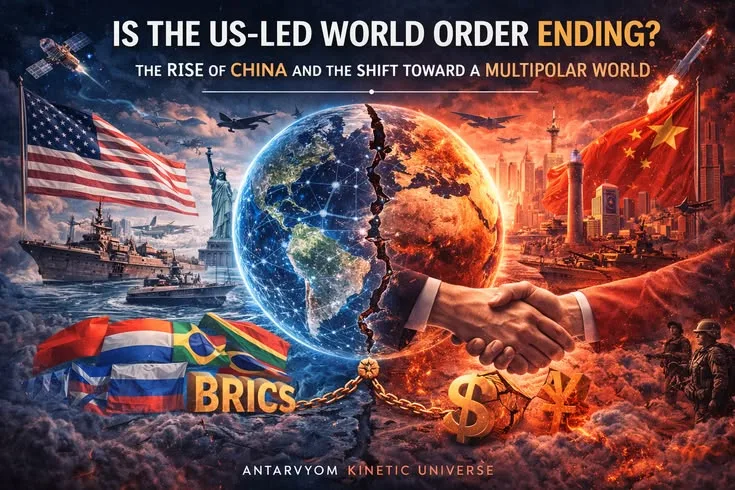
For roughly thirty years after the Cold War ended, American foreign policy operated on a broadly shared assumption: engagement with China would make China more like the United States. As China grew wealthier, its middle class would demand political rights.
As it integrated into the global economy, it would accept the rules-based international order. The combination of prosperity, interdependence, and institutional participation would gradually liberalize the Chinese system.
By the mid-2010s, this assumption had been officially abandoned. China under Xi Jinping was more authoritarian than it had been in decades, more militarily assertive in the South China Sea and around Taiwan, and more explicitly committed to displacing American primacy in Asia and eventually globally.
The United States declared China a "strategic competitor" in its 2017 National Security Strategy.[7] The era of engagement was over.
What replaced it is the defining geopolitical competition of the 21st century: a multidimensional rivalry between the world's largest economy (by purchasing power parity, China), the world's largest economy by nominal GDP and dominant military power (the United States), and a second country with every aspect of national power - economic, military, technological, and ideological - to eventually challenge American global leadership.
Understanding this rivalry means understanding not just what each side wants but what each side fears, and why the structural dynamics of power transition make this competition so difficult to manage peacefully.
"The defining feature of our time is a fundamental competition between open and closed societies, between democracy and autocracy, and the United States must lead the democracies of the world to meet the challenges from China." - President Joe Biden, address to Congress (April 2021)
"Some countries claim to be democratic but in fact they practice a 'my-way-or-the-highway' hegemony that smacks of bullying. This is not democracy, it's the use of democratic values to bully other countries." - Chinese President Xi Jinping, CCP centenary celebration (July 2021)
Key Definitions
Great power competition - A term describing international relations dominated by competition between major powers with global reach and the capacity to shape the international system. The current usage refers specifically to the US-China competition and, secondarily, to US-Russia tensions.
Great power competition is considered more dangerous than ordinary interstate conflict because the stakes are systemic - the outcome determines the rules, institutions, and values governing the international order.
Thucydides Trap - The historical tendency for rising powers challenging established powers to produce war. Political scientist Graham Allison studied 16 cases over 500 years where a rising power challenged a ruling power; 12 ended in war.[1]
The term comes from Thucydides' analysis of the Peloponnesian War: Sparta went to war with Athens because it feared the consequences of Athenian growth.
The US-China dynamic fits this pattern structurally, though both sides have nuclear weapons and enormously interdependent economies, complicating the analogy.
Hegemony - The dominant position of one state in the international system, in which that state sets the rules, maintains global public goods (freedom of navigation, currency stability, conflict prevention), and shapes others' behavior through a combination of hard power (military) and soft power (cultural and ideological appeal).
The United States has been the global hegemon since 1991; China's goal is at minimum to become the regional hegemon in Asia and at maximum to become a coequal global power.[6]
Taiwan - An island democracy of 23 million people that has governed itself independently since 1949, when the defeated Nationalist government retreated there after losing the Chinese Civil War. China's government regards Taiwan as a breakaway province that must be reunified with the mainland - by force if necessary.
The US maintains "strategic ambiguity": it does not formally recognize Taiwan's independence but sells it defensive weapons and has grown more explicit about defending it militarily.
TSMC (Taiwan Semiconductor Manufacturing Company) - The world's most advanced semiconductor manufacturer, producing over 90% of the world's chips below 10 nanometers - the chips that power AI, advanced weapons systems, smartphones, and modern computing.
TSMC's presence in Taiwan makes Taiwan strategically critical beyond its political significance. A Chinese invasion that captured or destroyed TSMC would be economically catastrophic for the global technology sector.
Belt and Road Initiative (BRI) - China's global infrastructure investment program, launched by Xi Jinping in 2013. Over 140 countries have signed BRI agreements covering roads, railways, ports, power plants, telecommunications, and digital infrastructure.
Chinese loans and construction contracts build Chinese influence with recipient countries while absorbing China's excess construction capacity and extending Chinese economic networks globally.
South China Sea dispute - China claims approximately 90% of the South China Sea through the "nine-dash line" - a claim rejected by the 2016 Permanent Court of Arbitration ruling (which China refuses to recognize).
The sea is one of the world's busiest shipping lanes, contains significant energy reserves, and is home to disputed islands whose control matters for military positioning. China has built artificial islands and militarized them with runways and missile batteries.
Technology decoupling - The effort to reduce interdependence in strategically sensitive technology sectors - particularly semiconductors, AI, quantum computing, and telecommunications. The US has restricted exports of advanced semiconductor manufacturing equipment and chips to China, targeting companies like Huawei.
China has responded with massive investment in domestic semiconductor development. Full technology decoupling would be extremely costly for both economies.
CHIPS Act - The US Creating Helpful Incentives to Produce Semiconductors Act (2022), providing $52 billion in subsidies to build semiconductor manufacturing in the United States, reducing dependence on Taiwanese production.
Combined with allied investment in Japan (TSMC plant), the Netherlands (ASML restrictions on China), and South Korea, the act is part of a broader effort to restructure semiconductor supply chains away from Taiwan risk.
Economic interdependence - In 2023, US-China bilateral trade totaled approximately $575 billion, making China the third-largest US trading partner. US companies have approximately $1 trillion in investments in China. Chinese investors hold approximately $800 billion in US Treasury securities.
This interdependence creates mutual vulnerability - aggressive action by either side imposes costs on both - but also creates leverage.
Historical Background: From Partnership to Competition
Engagement (1972-2016)
Nixon's 1972 opening to China began the era of US-China engagement. The initial strategic logic was realpolitik: engaging China against the Soviet Union. After the Cold War, the logic shifted to integration: bring China into the international economic and political order, and its development would stabilize rather than destabilize it.[12]
China's admission to the World Trade Organization in 2001 represented the high-water mark of engagement. The US supported Chinese WTO membership, accepting significant trade concessions in exchange for expectations that WTO rules would discipline Chinese economic behavior.
US corporations invested heavily in Chinese manufacturing, building supply chains that produced the low-cost goods that drove down consumer prices for American households.
The trade-offs were more complex than anticipated. The "China shock" - the economic impact of Chinese manufacturing competition - produced significant job losses in US manufacturing communities, a dynamic documented by economists David Autor, David Dorn, and Gordon Hanson (2013) in their landmark American Economic Review study.[2]
They estimated that Chinese import competition displaced between 2 and 2.4 million US workers between 1999 and 2011.
The communities affected were concentrated in the Midwest and South, contributing to the political conditions that eventually produced the 2016 election and the trade war.[5]
Meanwhile, China's economic growth and technology capabilities advanced more rapidly than US assessments had projected. The Chinese government's industrial policies - subsidies, market access restrictions, and intellectual property requirements - accelerated this growth in ways that WTO rules did not fully constrain.
The Turning Point
Several events and assessments crystallized the shift from engagement to competition:
Xi Jinping's consolidation of power (2012-2018): Xi reversed the collective leadership norms that had governed the Chinese Communist Party since Deng Xiaoping, concentrating power in his own hands, abolishing term limits for the presidency, and increasing party control over economic, social, and media life.
This signaled a more assertive, less reformist China than engagement theory had predicted.
South China Sea militarization (2013-2016): China constructed and militarized artificial islands in disputed waters, defying international legal rulings and signaling willingness to use force to establish facts on the ground in territorial disputes.
Cybertheft and economic espionage: US intelligence assessments documented systematic Chinese state-sponsored theft of US corporate intellectual property on a massive scale - "the greatest transfer of wealth in history," as NSA Director Keith Alexander described it in 2012.
The Office of the National Counterintelligence Executive estimated annual losses to US businesses from Chinese IP theft at hundreds of billions of dollars per year.
Huawei and 5G (2018-present): The US moved to block Huawei from 5G networks, arguing that the company's equipment posed intelligence and security risks.
The case illustrated a broader concern: Chinese technology companies operating in global markets could provide the Chinese government with intelligence access and potential infrastructure control.
China's Domestic Transformation Under Xi
Elizabeth Economy's 2018 analysis The Third Revolution: Xi Jinping and the New Chinese State documented the internal dimensions of this shift.[4] Under Xi, the Chinese Communist Party reversed the tentative market liberalization of the Jiang Zemin and Hu Jintao eras.
State-owned enterprises were strengthened rather than reformed. Internet controls tightened into the "Great Firewall." The social credit system expanded surveillance into new domains.
In Xinjiang, mass detention of Uyghur Muslims - estimated at one million or more people in re-education camps by 2018 - drew condemnation from Western governments and changed the political calculus of engagement.
These developments made the engagement thesis untenable not only strategically but morally. The argument that trade and investment would produce liberalization appeared not merely incorrect but potentially self-serving: it had rationalized profitable commercial relationships while the Chinese state became more repressive.
The Four Dimensions of Rivalry
1. Economic Competition
China overtook Japan as the world's second-largest economy in 2010 and is projected to surpass the United States as the largest nominal GDP economy in the 2030s (it already exceeds the US by purchasing power parity). This economic rise is the material foundation of Chinese power.
The trade war beginning in 2018 imposed tariffs on hundreds of billions of dollars of goods in both directions. The economic effect was modest for both large economies, but the political signal was significant: the US was willing to accept economic costs to push back on Chinese trade practices it considered unfair.
More consequential is the technology competition. Advanced semiconductors, AI systems, quantum computing, and biotechnology are the foundations of both economic productivity and military capability.
The US effort to restrict China's access to advanced semiconductor technology - through export controls and restrictions on equipment sales - aims to maintain a technological lead in these domains.
| Metric | US | China | Note |
|---|---|---|---|
| Nominal GDP (2024) | ~$28 trillion | ~$18 trillion | US leads nominally |
| PPP GDP (2024) | ~$28 trillion | ~$35 trillion | China leads by PPP |
| R&D spending | ~$700 billion | ~$500 billion | US leads but gap closing |
| STEM graduates annually | ~800,000 | ~3.5 million | China far ahead |
| Patent filings | ~660,000 | ~1.6 million | China far ahead |
| Military budget (2023) | ~$858 billion | ~$225 billion | US leads but China growing |
| AI research papers | Significant | World leader since 2017 | China ahead by volume |
China's Made in China 2025 industrial strategy, announced in 2015, targeted ten strategic sectors including aerospace, robotics, AI, and biotechnology for domestic dominance, with explicit goals of reducing import dependence and achieving global market leadership.
The Office of the US Trade Representative's 2018 investigation under Section 301 concluded that China's industrial policies constituted systematic unfair trade practices.[9]
What made Made in China 2025 alarming to Western strategists was not protectionism per se - every major economy engages in some form of industrial policy - but the explicit strategic goal of technology supremacy in sectors that are simultaneously commercial and military.
The decoupling debate among economists has been contentious. Former Treasury Secretary Henry Paulson warned in 2018 that the US and China risked an "economic iron curtain" that would damage both economies.
Researchers at the Peterson Institute for International Economics have estimated that full decoupling could reduce US GDP by between 0.3 and 0.5 percent and Chinese GDP by between 1.5 and 3 percent - modest for the US but significant for China, which remains more dependent on external markets and technology imports.
2. Military Competition
China has undertaken the largest peacetime military buildup in history, transforming from a force designed for local territorial defense into one capable of power projection across the Indo-Pacific region. Key developments:
Navy: China now has the world's largest navy by number of ships. It is building aircraft carriers, advanced destroyers, and submarines at a pace that has alarmed US naval planners.
The Congressional Research Service estimated in 2023 that China's navy had approximately 370 battle-force ships, compared to the US Navy's approximately 296, though the US maintains large advantages in aircraft carriers and nuclear submarines.
Missiles: China's arsenal of precise, long-range anti-ship and anti-access missiles (DF-21D, DF-26) poses serious threats to US aircraft carrier groups in the Western Pacific - the US Navy's traditional instrument of regional dominance.[10]
The DF-21D, dubbed the "carrier killer," has a range of approximately 1,500 kilometers and is specifically designed to target large surface vessels.
Nuclear: China is expanding its nuclear arsenal from approximately 350 warheads toward a potential goal of 1,000-1,500 warheads, building silo fields in the desert, and diversifying delivery vehicles.[8]
The US Department of Defense's 2023 China Military Power Report estimated China could have 1,500 nuclear warheads by 2035, raising concerns about the adequacy of existing bilateral arms control frameworks designed for a US-Russia dyad.
Space and cyber: China has demonstrated anti-satellite capabilities, conducted extensive cyber operations against US government and corporate networks, and is investing heavily in space-based military infrastructure.
The 2015 hack of the US Office of Personnel Management - attributed to Chinese state actors - exposed sensitive personal information of approximately 21.5 million current and former federal employees.
"China is the only country with both the intent to reshape the international order and, increasingly, the economic, diplomatic, military, and technological power to do it." - US Secretary of State Antony Blinken, The Administration's Approach to the People's Republic of China, speech at George Washington University (May 2022)[3]
3. Technological Competition
Semiconductors are the central battlefield. The US maintains a lead in advanced chip design and the manufacturing equipment needed to produce them. Taiwan's TSMC manufactures the most advanced chips.
The Netherlands' ASML makes the extreme ultraviolet lithography machines that advanced fabrication requires - only ASML can make them.
US export controls imposed in 2022-2023 restrict the export of advanced chips and chip-making equipment to China, aiming to prevent China from developing the AI and military systems that advanced semiconductors enable.
China has responded with a massive domestic investment program in semiconductor development - spending estimated at over $100 billion to build indigenous capability.
The competition extends to AI, 5G telecommunications, quantum computing, and biotechnology - each representing both economic value and military application. In artificial intelligence, China has achieved rough parity with the United States in some domains and leads in others.
Chinese AI companies including Baidu, Alibaba, Tencent, and Huawei - along with the Chinese military - have made AI a national priority. The 2017 release of China's New Generation Artificial Intelligence Development Plan set a goal of becoming the world's leading AI innovation center by 2030.
Quantum computing represents perhaps the most consequential technological frontier. A sufficiently powerful quantum computer could break current encryption systems, threatening the security of everything from financial transactions to military communications.
Both the US and China are investing heavily; the US National Security Agency has stated that quantum computing poses a credible long-term threat to current cryptographic standards.
4. Ideological and Institutional Competition
Xi Jinping has articulated Chinese governance as an alternative model to Western liberal democracy, suited to developing countries seeking growth without the instability he associates with democratic pluralism.
China's combination of economic development under one-party rule - presented as "whole-process people's democracy" - has genuine appeal in parts of the developing world that have grown frustrated with Western conditionality on aid and democratic norms requirements.
The competition plays out in international institutions. China has sought to lead UN specialized agencies, shape international standards bodies (for AI, telecommunications, and other emerging technologies), and build its own institutions (Asian Infrastructure Investment Bank, New Development Bank, Shanghai Cooperation Organisation) as alternatives to Western-dominated ones.
The Wolf Warrior diplomacy that emerged under Xi - named for a nationalist Chinese action film series - represents a more assertive ideological posture: rather than avoiding ideological confrontation, Chinese diplomats and state media have engaged directly in arguments about democratic legitimacy, racial injustice in the United States, and what China frames as Western hypocrisy.
This represents a departure from Deng Xiaoping's counsel to "hide your strength and bide your time."[13]
Taiwan: The Most Dangerous Flashpoint
Taiwan is the most acute potential flashpoint for direct US-China military conflict. China's official position is that Taiwan is a province of the People's Republic and that reunification is inevitable.
Xi Jinping has stated that resolving Taiwan is a "historic mission" that cannot be passed to the next generation indefinitely.
The US does not formally recognize Taiwan as an independent country (it recognizes the People's Republic of China) but maintains extensive unofficial relations with Taiwan and sells it defensive weapons under the Taiwan Relations Act (1979).
US policy of "strategic ambiguity" - not explicitly committing to defend Taiwan - was designed to deter both Chinese attack and Taiwanese independence declarations.
The Military Balance Around Taiwan
US Indo-Pacific Command has conducted extensive analysis of potential conflict scenarios.
A 2023 RAND Corporation study, Inflection Point: How to Reverse the Erosion of US and Allied Power in the Indo-Pacific, concluded that the military balance in the region has shifted significantly in China's favor over the past two decades, though the US and its allies - particularly Japan - retain significant capabilities.[11]
The key variable in most conflict simulations is whether the US military can rapidly concentrate force in the Taiwan Strait faster than China can present a fait accompli.
Japan's strategic significance has grown considerably. Japan hosts the largest US military presence in Asia, and Japanese Self-Defense Forces have significantly expanded their capabilities in response to Chinese assertiveness.
In December 2022, Japan announced the largest military buildup since World War II - a commitment to double defense spending to 2 percent of GDP - explicitly citing the China threat.
A Chinese military attempt to take Taiwan would be the most serious international crisis since World War II. It would:
- Trigger US military involvement (though the exact US response remains uncertain)
- Devastate global semiconductor production
- Potentially destroy the rules-based international order governing the western Pacific
- Force every country in the world to choose sides in a fundamental conflict
Both the US and China have strong incentives to avoid this outcome. The catastrophic costs of miscalculation mean that the Taiwan situation is most likely to remain in managed tension - unless a crisis escalates through accident, miscalculation, or deliberate provocation.
"The Taiwan question is a purely internal affair of China that brooks no external interference. The Chinese people have the determination and capability to safeguard national sovereignty and territorial integrity." - Xi Jinping, CCP centenary speech (July 2021)
The Alliance Dimension
America's Alliance Network
One of the United States' most significant structural advantages in the rivalry is its network of formal alliances. The US maintains treaty alliances with Japan, South Korea, Australia, the Philippines, and Thailand in the Indo-Pacific, as well as its NATO commitments in Europe.
China has no comparable formal ally network - its closest strategic partner, Russia, is itself diminished by the economic and military costs of the Ukraine war.
The AUKUS security partnership, announced in September 2021 between the United States, United Kingdom, and Australia, is specifically designed to counter Chinese power in the Indo-Pacific.
Its most consequential element is a commitment to provide Australia with nuclear-powered submarine technology - a capability that would give Australia a dramatically enhanced ability to operate in contested waters.
The AUKUS announcement angered France, which lost a submarine contract with Australia, but the strategic logic - binding the Indo-Pacific's most strategically significant middle power more tightly to US-led security arrangements - was deliberate.
The Quad (Quadrilateral Security Dialogue) grouping of the US, Japan, India, and Australia has been elevated from a diplomatic forum to a leaders-level summit format.
India's participation is significant: India is the world's most populous nation, a rising economic power, and deeply suspicious of Chinese intentions following the 2020 Galwan Valley border clash in which Indian and Chinese soldiers fought with clubs and stones at 14,000 feet, killing at least 20 Indian soldiers.
China's Diplomatic Response
China's primary diplomatic response to US alliance-building has been to deepen ties with Russia, assert leadership in the Global South through the Belt and Road Initiative and multilateral forums, and cultivate regional influence through economic partnerships.
The Regional Comprehensive Economic Partnership (RCEP), a free trade agreement that China leads and which includes most of Asia-Pacific, represents an economic framework that excludes the United States.
Economic Decoupling: Costs, Limits, and Reality
The Semiconductor War
The semiconductor contest is the clearest example of strategic decoupling in action. In October 2022, the Biden administration imposed the most sweeping export controls on advanced semiconductor technology since the Cold War.
The restrictions prevented not only US companies but foreign companies using US technology anywhere in their supply chains from selling advanced chips or chip-making equipment to China without a license.
The practical effects have been significant. Nvidia, whose AI training chips are essential for large language model development, was unable to sell its most advanced products to Chinese customers.
Nvidia developed modified chips (A800, H800) with reduced specifications to comply with the rules; the Biden administration subsequently tightened the rules further.
ASML, which makes the extreme ultraviolet lithography machines essential for the most advanced chips and whose technology incorporates US components, was restricted from selling to China.
China's response has been the Big Fund (National Integrated Circuit Industry Investment Fund), with investments in semiconductor development estimated at over $150 billion.
China's largest chipmaker, SMIC, achieved 7-nanometer production in 2023 - a significant achievement given the restrictions - though it remains approximately two to three generations behind TSMC's most advanced capabilities.
The "Friend-Shoring" Strategy
US Trade Representative Katherine Tai coined the term "friend-shoring" - redirecting supply chains toward allied and trusted partners rather than simply maximizing efficiency - to describe the economic strategy underlying decoupling.
The practical manifestation includes: new semiconductor fabs in Arizona (TSMC) and Ohio (Intel); the Inflation Reduction Act's domestic manufacturing incentives for electric vehicle batteries; and supply chain mapping requirements for critical minerals.
The costs are real. The Wall Street Journal reported in 2023 that US consumers were paying approximately $100 billion per year more for goods due to tariffs and supply chain reorganization. Multinational corporations face significant compliance costs managing dual supply chains - one for China, one for the rest of the world.
Can the Rivalry Be Managed?
The US-China rivalry is not a Cold War repeat. The US and Soviet Union had minimal economic interdependence; US-China economic ties are deeply intertwined. Nuclear deterrence operates on both sides. Both countries have interests in cooperation on climate change, pandemic preparedness, and financial stability.
The Kissinger framework, articulated by Henry Kissinger shortly before his death in 2023 at age 100, was that the US and China needed to establish what he called "co-evolution" - a managed competition in which both sides accept the legitimacy of the other's core interests while competing in areas of divergence.
Kissinger was one of the last major US policymakers who believed diplomatic management of the rivalry remained possible and necessary.
Critics of engagement, including former national security advisor Robert O'Brien and hawks in both parties, argue that accommodation merely gives China time to develop capabilities it will eventually use coercively.
The structural danger is that competitive pressures in one domain - technology, military, Taiwan - could spill over and undermine the cooperation both sides need in others.
The Climate Complication
Climate change represents the clearest domain where US-China interests converge rather than conflict.
China is the world's largest emitter of greenhouse gases - responsible for approximately 30 percent of global CO2 emissions - and is simultaneously the world's largest producer and exporter of solar panels, wind turbines, and electric vehicle batteries.
No climate agreement that excludes China is physically meaningful, yet climate cooperation has proven difficult to insulate from the broader deterioration of the relationship.
The 2021 US-China Glasgow climate commitments, negotiated between Special Presidential Envoy for Climate John Kerry and his Chinese counterpart Xie Zhenhua, represented one of the few areas of active diplomatic cooperation at a time when most channels were frozen.
Whether that precedent can be sustained and expanded is one of the most consequential questions in international relations.
Managing the rivalry requires maintaining communication channels even as competition intensifies, establishing clear red lines to prevent miscalculation, and finding domains where interests align enough for cooperation.
Whether that management is achievable - or whether the structural logic of great power transition makes conflict ultimately difficult to avoid - is the central question of 21st century geopolitics.
For related concepts, see Iran-Israel conflict explained, how oil shapes geopolitics, and how global alliances work.
Sources & Further Reading
- Allison, G. (2017). Destined for War: Can America and China Escape Thucydides's Trap? Houghton Mifflin Harcourt.
- Autor, D., Dorn, D., & Hanson, G. H. (2013). The China Syndrome: Local Labor Market Effects of Import Competition in the United States. American Economic Review, 103(6), 2121-2168. DOI: 10.1257/aer.103.6.2121
- Blinken, A. (2022, May 26). The Administration's Approach to the People's Republic of China. Speech at George Washington University. US Department of State.
- Economy, E. (2018). The Third Revolution: Xi Jinping and the New Chinese State. Oxford University Press.
- Luce, E. (2017). The Retreat of Western Liberalism. Atlantic Monthly Press.
- Mearsheimer, J. J. (2001). The Tragedy of Great Power Politics. W. W. Norton.
- National Security Council. (2017). National Security Strategy of the United States of America. White House.
- Office of the Secretary of Defense. (2023). Military and Security Developments Involving the People's Republic of China: Annual Report to Congress. US Department of Defense.
- Office of the US Trade Representative. (2018, 2022). Reports on China's Acts, Policies, and Practices Related to Technology Transfer, Intellectual Property, and Innovation. USTR.
- Posen, B. R. (2003). Command of the Commons: The Military Foundation of US Hegemony. International Security, 28(1), 5-46.
- RAND Corporation. (2023). Inflection Point: How to Reverse the Erosion of US and Allied Power in the Indo-Pacific. RAND.
- Schell, O., & Delury, J. (2013). Wealth and Power: China's Long March to the Twenty-First Century. Random House.
- Westad, O. A. (2012). Restless Empire: China and the World Since 1750. Basic Books.