
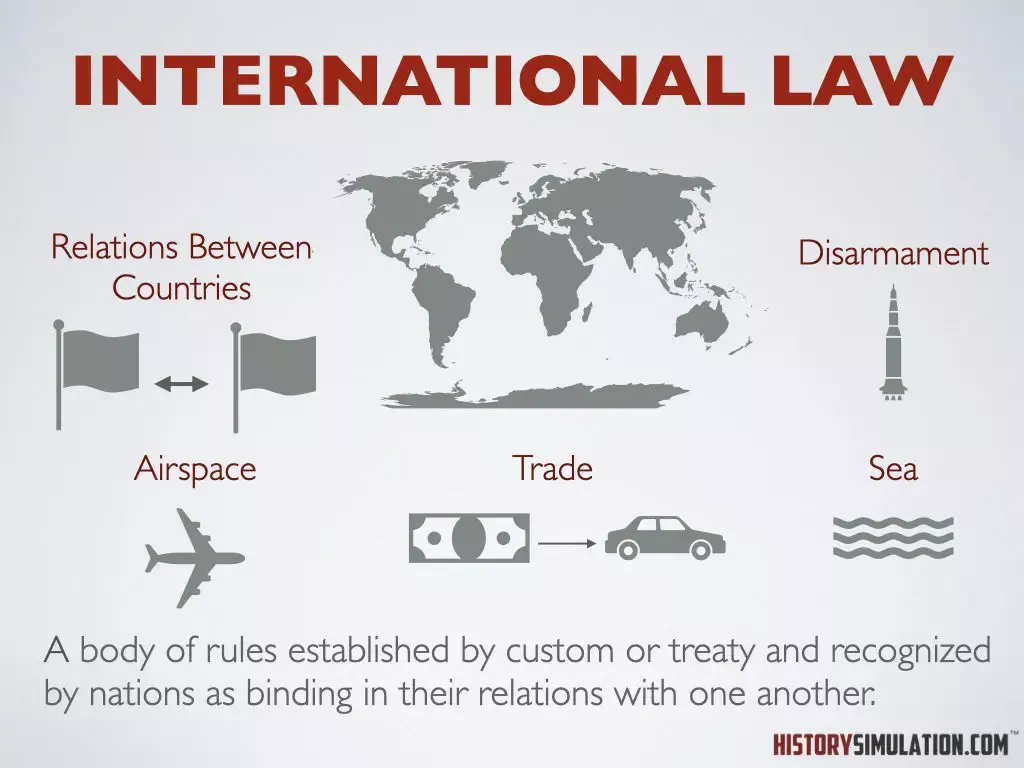
Understanding international law means recognizing a weakly enforced legal order that nevertheless shapes state behavior through treaties, custom, reciprocity, reputation, and institutions.
It governs states, international organizations, and increasingly non-state actors without a global sovereign or automatic enforcement.
Its limitations are clear when powerful states resist judgments, yet legal norms still provide legitimacy, constrain options, and generate substantial compliance in ordinary relations.
In June 1986, the International Court of Justice issued a ruling that the United States had violated international law by mining Nicaragua's harbors and by training, equipping, and directing the Contra forces fighting to overthrow the Sandinista government.[7]
The Reagan administration had already withdrawn from the Court's compulsory jurisdiction before the case concluded, declaring the Court lacked authority over matters it considered national security questions.
The ICJ issued its judgment anyway, finding against the United States by 12 votes to 3 on the non-intervention count and by 14 votes to 1 on the harbor mining.
The United States vetoed the Security Council resolution calling on all states to comply with the ruling. Nicaragua never received compensation. No punishment followed.
The Nicaragua case is the standard illustration of what critics offer when they argue that international law is a fiction: powerful states simply ignore inconvenient rulings, and nothing happens to them. But the case is also more complicated than that summary suggests.
The United States invested considerable diplomatic and legal effort in disputing the Court's jurisdiction, contesting the standing of Nicaragua's claims, and offering alternative characterizations of its own conduct.
The effort to appear compliant with legal norms - even when defying them - is itself evidence that those norms carry force.[3] States care about being seen as law-abiding in ways that pure cynicism about international law cannot explain. A world of pure power politics would not generate this kind of behavior.
International law is neither the global rule of law that its most enthusiastic proponents describe nor the empty pretension that its sharpest critics dismiss.
It is something more interesting and more fragile: a weakly enforced legal order that generates substantial behavioral compliance, shapes the options available to states, provides a legitimacy framework whose costs of violation are real even when they are not automatically punished, and represents humanity's most serious ongoing attempt to govern relations between sovereign states through something other than raw power.
Understanding what it is, where it comes from, and how it actually works requires holding together both its genuine achievements and its persistent structural limitations.
"Almost all nations observe almost all principles of international law and almost all of their treaty obligations almost all of the time." - Louis Henkin, How Nations Behave (1979)[6]
| Source of International Law | Description | Example |
|---|---|---|
| Treaties | Binding agreements between states | UN Charter; Geneva Conventions |
| Customary international law | General state practice accepted as law | Prohibition on torture; diplomatic immunity |
| General principles | Principles common to major legal systems | Good faith; equity; res judicata |
| Judicial decisions | Rulings of international courts | ICJ, ICC, WTO Dispute Settlement |
| Scholarly writing | Highly qualified publicists' opinions | Used to interpret disputed rules |
Key Definitions
International law: The body of rules, principles, and norms governing the conduct of states, international organizations, and increasingly non-state actors in their mutual relations.[2] Lacks centralized enforcement authority but generates substantial compliance through reciprocity, reputation, and institutional mechanisms.[8]
Customary international law: Rules developed from the consistent and general practice of states combined with the belief that such practice is legally obligatory (opinio juris). Binding on all states, including those that did not participate in creating the custom, subject to the narrow "persistent objector" exception.
Treaty law: Binding written agreements between states. Governed by the Vienna Convention on the Law of Treaties (1969). The foundational principle is pacta sunt servanda - treaties must be performed in good faith.
Opinio juris: The belief by states that a given practice is legally required, not merely habitual. Together with consistent state practice, one of the two elements required to establish customary international law.
Jus cogens: Peremptory norms from which no derogation is permitted, even by treaty. Includes the prohibitions on genocide, slavery, torture, and aggression. These bind all states regardless of consent.
Pacta sunt servanda: The principle, codified in Article 26 of the Vienna Convention on the Law of Treaties (1969), that every treaty in force is binding on its parties and must be performed in good faith.[13]
Complementarity: The principle governing International Criminal Court jurisdiction - the Court may act only when national courts are "unable or unwilling" to genuinely investigate and prosecute. Preserves state primacy in criminal jurisdiction while providing a backstop against impunity.
Chapter VII: The section of the UN Charter authorizing the Security Council to take binding measures, including the use of force, in response to threats to international peace and security. The veto power of the five permanent members critically limits its reach.
Is International Law Real Law? The Austin Objection
The foundational theoretical challenge to international law as law comes from John Austin's legal positivism, articulated in The Province of Jurisprudence Determined (1832). For Austin, law is the command of a sovereign backed by a credible threat of sanction.[1]
International law satisfies neither condition: there is no sovereign above states capable of issuing commands to them, and there is no reliable enforcement mechanism comparable to domestic police and courts.
On Austin's account, international law is not law at all but "positive morality" - norms states may follow as a matter of custom, convenience, or moral commitment, but which lack binding legal force in the strict positivist sense.
The Austinian critique identifies a genuine structural feature. Unlike domestic legal systems, international law lacks a centralized legislature, a hierarchical court system with compulsory jurisdiction over all subjects, and an executive enforcement mechanism.
When a state violates international law, there is no international police force to arrest its leaders, no automatic sanction, and no guarantee that any institutional consequence will follow.
And yet the behavioral reality of international law substantially contradicts the Austinian prediction.
Studies of treaty compliance consistently find that states comply with their treaty commitments the overwhelming majority of the time - not because compliance is enforced in each instance, but because states generally find it in their interest to maintain reputations as reliable actors in an interdependent system.
Henkin's observation that almost all nations observe almost all principles of international law almost all of the time overstates the uniformity of compliance but captures something empirically important: the default is compliance, not defection.
The mechanisms sustaining compliance without central enforcement include: reciprocity (states know that violations invite retaliation in kind); reputation (states that systematically violate obligations face increased costs in negotiating future agreements); domestic politics (international commitments create enforceable expectations among domestic constituencies); and international institutions, which raise the visibility and costs of non-compliance.
None of these mechanisms is reliable when powerful states have strong short-term interests in violation.[5] But together they constitute a legal order that generates substantial behavioral constraint even in the absence of any enforcement sovereign.
Sources of International Law: Article 38 and Its Framework
The definitive statement of international law's sources is Article 38(1) of the Statute of the International Court of Justice, which directs the Court to apply:[11]
- International conventions (treaties), whether general or particular, establishing rules expressly recognized by the contesting states;
- International custom, as evidence of a general practice accepted as law;
- The general principles of law recognized by civilized nations;
- Subject to Article 59, judicial decisions and the teachings of the most highly qualified publicists, as subsidiary means for the determination of rules of law.
Treaty law is the most deliberate and documented source. Treaties require affirmative state consent - signature followed by ratification through domestic constitutional processes.
The Vienna Convention on the Law of Treaties (1969), itself a treaty now with 116 parties, codifies the rules governing treaty conclusion, interpretation, and termination.
Article 26 states the foundational principle: "Every treaty in force is binding upon the parties to it and must be performed by them in good faith." Article 31 governs interpretation: treaties are to be interpreted in good faith in accordance with the ordinary meaning of their terms in their context and in light of their object and purpose.
Customary international law arises from the consistent practice of states combined with opinio juris - the belief that the practice is legally required rather than merely conventional. Identifying customary law is inherently uncertain and more an art than a science.
The prohibition on torture as a rule of customary international law binding on all states - not merely the 173 parties to the Convention Against Torture - illustrates both the significance and the complexity of customary law.
State practice is evidenced by domestic legislation, diplomatic communications, military manuals, and court decisions. Opinio juris is demonstrated by states' universal formal characterization of torture as illegal even when they engage in it covertly.
The combination of these elements has led international tribunals and most scholars to classify the torture prohibition as not just customary but jus cogens - a peremptory norm admitting no derogation.
General principles of law, the third source, fills gaps through principles recognized across major legal systems: good faith, res judicata, procedural fairness, prohibition on unjust enrichment, and others.
Judicial decisions and scholarly writings, the subsidiary sources, are influential in establishing what the primary sources provide, particularly in areas where state practice is sparse or contested.
International Humanitarian Law
International humanitarian law - the laws of war, also called the law of armed conflict - is among the oldest and most developed areas of international law, with a codified framework that is effectively universal. Its core instruments are the four Geneva Conventions of 1949 and their Additional Protocols of 1977.[4]
The Geneva Conventions have 196 states parties, more than the United Nations itself - a rare case of genuinely universal treaty ratification.
The four Conventions protect: wounded and sick combatants on land (Convention I), wounded, sick, and shipwrecked naval personnel (Convention II), prisoners of war (Convention III), and civilians in occupied territory and during armed conflict (Convention IV).
Common Article 3, which appears identically in all four Conventions, establishes minimum protections in non-international armed conflicts - meaning civil wars and insurgencies as well as wars between states.
The Additional Protocols of 1977 extended protections further, particularly for non-international conflicts, and codified in treaty form many principles that had developed as customary law.
The three cardinal principles of IHL are:
Distinction: Parties to a conflict must at all times distinguish between the civilian population and combatants, and between civilian objects and military objectives. Attacks may be directed only against combatants and military objectives.
Proportionality: Attacks may not be expected to cause incidental civilian casualties or damage to civilian objects excessive in relation to the concrete and direct military advantage anticipated.
Military necessity: Force is permitted only to the extent required to achieve a legitimate military objective. Acts of violence not required for military purposes are unlawful.
Violations of these principles constitute war crimes.
The International Committee of the Red Cross plays a unique monitoring role under IHL: it has a treaty-based right of access to prisoners of war and detained civilians, which it exercises through confidential visits and private reports to the detaining authority rather than public condemnation.
The ICRC's model of confidential engagement reflects the practical judgment that maintaining access - and thereby improving the actual treatment of detainees - requires avoiding the public confrontations that would lead detaining states to revoke access.
Domestic prosecution of IHL violations remains rare; international criminal tribunals have reached only a small fraction of serious violations.
Enforcement Mechanisms: Reciprocity, Reputation, and Institutions
The enforcement mechanisms of international law are diverse, none fully adequate, and collectively insufficient for reliable compliance by powerful states.
Understanding them requires moving beyond the domestic law analogy and recognizing that enforcement in international law is distributed, indirect, and dependent on the interests of states themselves.
Reciprocity is the most fundamental mechanism. States comply with treaties and customary rules in part because they expect others to reciprocate, and defection licenses counter-defection.
Trade agreements are enforced largely through the expectation that violations will invite countermeasures.
The laws of war are partly observed because both parties to a conflict expect the other to treat their own combatants and civilians according to the same rules. Reciprocity breaks down when power is dramatically asymmetric or when the benefits of violation clearly exceed expected retaliation costs.
Reputation effects supplement reciprocity. States that systematically violate international law face diplomatic costs, find it harder to negotiate future agreements, and may lose access to preferential arrangements or international financing.
These costs are real but not automatically sufficient to deter violations when short-term interests are strong.
UN Security Council Chapter VII authorization is the system's closest approximation to centralized enforcement: the Security Council may determine that a threat to international peace exists and authorize binding measures, including military force.
Chapter VII enforcement has authorized interventions in Korea (1950), Iraq (1990-1991), Somalia, and Libya (2011). The critical limitation is the veto of the five permanent members.
Russia's 2022 invasion of Ukraine in straightforward violation of Article 2(4) of the UN Charter could not receive Chapter VII response because Russia could veto any such resolution.
The veto renders the Security Council structurally incapable of authorizing enforcement against any permanent member or its close allies, regardless of the gravity of their violations.
WTO dispute settlement represents one of the strongest enforcement mechanisms in international law for trade obligations.
The Dispute Settlement Understanding allows any member to bring complaints against any other, requires losing parties to bring measures into conformity, and authorizes the winning party to suspend equivalent concessions if compliance is not achieved.
The system has heard over 600 disputes since 1995. Since 2019, the US has blocked appointments to the Appellate Body, leaving it without a quorum, which has substantially weakened the appellate mechanism.
Human rights treaty bodies - committees of independent experts monitoring compliance with major human rights conventions - have no enforcement power but generate authoritative interpretations and public documentation.[12]
Beth Simmons's Mobilizing for Human Rights (2009), the most comprehensive quantitative study of human rights treaty effects, found that ratification predicts improved outcomes but only under specific domestic conditions: when civil society is active, courts relatively independent, and countries in democratic transition.[10]
In stable autocracies, ratification without domestic political mobilization achieves little. The finding is a careful empirical qualification of both the optimist and skeptic positions.
The International Criminal Court
The Rome Statute, adopted in July 1998 and entering into force in July 2002, created the International Criminal Court - the first permanent international tribunal with jurisdiction over individuals for genocide, crimes against humanity, war crimes, and (from 2018) the crime of aggression.[9]
The Court sits in The Hague. As of 2023, it has 124 states parties.
The United States, China, and Russia are not members. The US signed the Rome Statute under President Clinton in December 2000.
The Bush administration formally withdrew the US signature in May 2002, simultaneously enacting the American Servicemembers' Protection Act - which authorizes the use of military force to release any American detained by the ICC.
The Bush administration also negotiated bilateral immunity agreements (so-called "Article 98 agreements") with numerous states, threatening to cut military assistance to those that refused, substantially limiting the Court's geographic reach.
The Court's complementarity principle - it may only act when national courts are genuinely unable or unwilling to prosecute - means it functions as a backstop for situations where domestic accountability has failed, rather than as a general criminal tribunal.
This design preserves state sovereignty over criminal justice while creating accountability of last resort.
In March 2023, the ICC issued arrest warrants for Russian President Vladimir Putin and Russia's Commissioner for Children's Rights, Maria Lvova-Belova, for the alleged war crime of unlawful deportation of Ukrainian children during Russia's invasion.
Putin became the first sitting head of state of a UN Security Council permanent member to face an ICC arrest warrant. Russia is not a Rome Statute party, will not surrender Putin, and vetoed any Security Council action.
But the warrant has real consequences: Putin cannot travel to any of the 124 member states without risk of arrest, constraining his international movement.
South Africa, as an ICC member, faced acute legal and political pressure when it hosted the 2023 BRICS summit; Putin attended by video rather than in person.
The warrant demonstrates both the reach of the Court's authority and the gap between legal determination and practical enforcement.
Can Powerful Countries Ignore International Law?
The frank answer is: more easily than weaker states, but not without cost.
The structural reality is that enforcement mechanisms in international law operate asymmetrically, and powerful states - particularly permanent Security Council members - have substantially more capacity to avoid formal accountability.
The United States mined Nicaragua's harbors, was found to have violated international law by the ICJ, ignored the ruling, and faced no direct legal consequence.
Russia invaded Ukraine in 2022 in what the UN General Assembly characterized, in a resolution adopted 141 to 5, as a violation of the UN Charter's prohibition on the use of force; Russia's Security Council veto prevented any binding response.
China rejected the 2016 UNCLOS Arbitral Tribunal ruling that found its South China Sea claims inconsistent with the law of the sea, continues to construct and militarize artificial islands, and has faced no binding enforcement mechanism.
These examples demonstrate real impunity. But the analysis should not stop there. The costs of international law violations are not zero even for powerful states.
They include sustained diplomatic effort to manage political fallout, economic costs (the sanctions against Russia after 2022 were massive even if not legally compelled by any court judgment), reputational erosion affecting the state's credibility as a treaty partner, and the precedential costs of having normalized certain norms' violation.
The effort powerful states invest in appearing compliant - offering legal arguments, seeking Security Council authorization where possible, negotiating treaty exemptions rather than simply ignoring treaties - is itself evidence that the system carries normative weight that pure power calculation cannot displace.
The structure of international law generates differential costs for violations by different actors depending on power, relationships with enforcement gatekeepers, and the nature of the violation. It is not impartial. But it is not without effect.
The question is not whether international law stops powerful states from doing what they are determined to do - it often does not - but whether it raises the costs, shapes the options, and provides a legitimacy framework that makes certain behaviors systematically more difficult and diplomatically expensive than they would otherwise be.
On that question, the evidence is that it does.
For related reading, see What Is International Relations, Why Wars Start, and What Is Decolonization.
Sources & Further Reading
- Austin, J. (1832). The Province of Jurisprudence Determined. J. Murray.
- Crawford, J. (2012). Brownlie's Principles of Public International Law (8th ed.). Oxford University Press.
- Franck, T. M. (1990). The Power of Legitimacy Among Nations. Oxford University Press.
- Geneva Conventions of August 12, 1949 and Additional Protocols of 1977. International Committee of the Red Cross.
- Goldsmith, J. L., & Posner, E. A. (2005). The Limits of International Law. Oxford University Press.
- Henkin, L. (1979). How Nations Behave: Law and Foreign Policy (2nd ed.). Columbia University Press.
- International Court of Justice. (1986). Military and Paramilitary Activities in and Against Nicaragua (Nicaragua v. United States of America). ICJ Reports.
- Koh, H. H. (1997). Why do nations obey international law? Yale Law Journal, 106(8), 2599-2659.
- Rome Statute of the International Criminal Court. (1998). UN Doc. A/CONF.183/9.
- Simmons, B. A. (2009). Mobilizing for Human Rights: International Law in Domestic Politics. Cambridge University Press. doi:10.1017/CBO9780511811340
- Statute of the International Court of Justice. (1945). Article 38. Annex to the UN Charter.
- Tomuschat, C. (2014). Human Rights: Between Idealism and Realism (3rd ed.). Oxford University Press.
- Vienna Convention on the Law of Treaties. (1969). UN Doc. A/CONF.39/27.
Further Reading
- Slaughter, A.-M. (2004). A New World Order. Princeton University Press.