
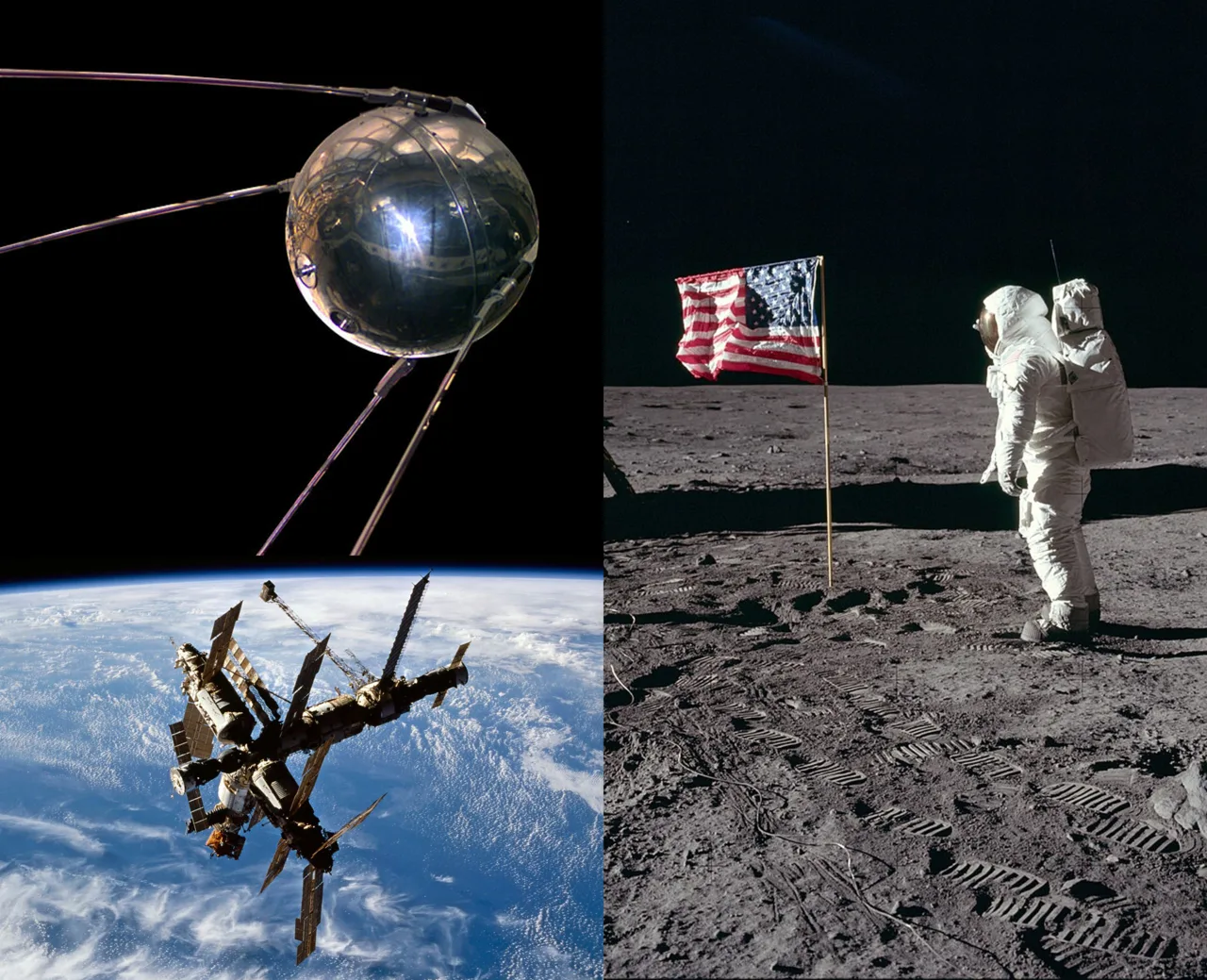
The space race was a Cold War contest in which the United States and Soviet Union pursued orbital, human, lunar, and rocket milestones as demonstrations of technological and ideological power. Built on ballistic-missile technology, it produced satellites, spaceflight techniques, scientific knowledge, and the Apollo Moon landing. Its achievements were inseparable from nuclear deterrence, military research, national prestige, and international competition.
On the evening of October 4, 1957, amateur radio operators around the world tuned to 20.005 MHz and heard something no human being had ever heard before: a steady, mechanical beep from orbit.
The Soviet Union had launched Sputnik 1 - a polished metal sphere about the size of a beach ball, weighing 84 kilograms - and it was circling the Earth every 96 minutes, its radio transmitter announcing to anyone with a receiver that the space age had begun.
In Washington, the announcement produced something close to panic.[7] The same rocket that had put Sputnik in orbit could, with different payload, deliver a nuclear warhead to any city in America. The United States, the world's leading industrial power, had been beaten into space by a communist dictatorship.
Over the next twelve years, the two superpowers spent enormous resources - financial, intellectual, and human - in a competition that redefined both the limits of technology and the meaning of national prestige.
The Space Race produced the first human in orbit, the first spacewalk, the first soft landing on the Moon, and ultimately, on July 20, 1969, the most watched event in the history of television: two American astronauts walking on the surface of another world.
It also produced satellites that now guide our navigation, materials that are in our furniture, computing techniques that underlie our software, and a body of scientific knowledge about our solar system and our planet that continues to expand.
The Space Race was, at its core, a Cold War story: a competition between two ideological systems for the minds of a watching world.[9] But it was also something more - a demonstration of what human beings can achieve when they commit, with genuine seriousness, to a collective goal that seems impossible.
"We choose to go to the Moon in this decade and do the other things, not because they are easy, but because they are hard." - President John F. Kennedy, Rice University, September 1962
| Milestone | Country | Date |
|---|---|---|
| First satellite in orbit (Sputnik 1) | USSR | October 4, 1957 |
| First living creature in orbit (Laika) | USSR | November 3, 1957 |
| First human in space (Yuri Gagarin) | USSR | April 12, 1961 |
| First American in orbit (John Glenn) | USA | February 20, 1962 |
| First spacewalk (Alexei Leonov) | USSR | March 18, 1965 |
| First lunar orbit (Apollo 8) | USA | December 1968 |
| First Moon landing (Apollo 11) | USA | July 20, 1969 |
Key Definitions
ICBM: Intercontinental Ballistic Missile. A guided missile with a range exceeding 5,500 kilometers, capable of delivering nuclear warheads across continents. The development of ICBMs in the 1950s by both superpowers created the rocket technology that was adapted for space launch.
Orbital velocity: The speed required to maintain a stable orbit around the Earth - approximately 7.9 kilometers per second (28,440 kilometers per hour) at low Earth orbit altitude. Achieving orbital velocity requires far more energy than simply reaching high altitude; it is what distinguishes orbital spaceflight from suborbital flight.
Cosmonaut / Astronaut: The Soviet and American terms, respectively, for a trained spaceflight crew member. "Cosmonaut" derives from the Greek for "cosmos" + "sailor"; "astronaut" from "star" + "sailor."
Pax Americana: The period of American geopolitical dominance following World War II. Sputnik's launch challenged American assumptions of technological superiority that underpinned this dominance, precipitating a crisis of confidence about American education, industrial capacity, and strategic capability.
Saturn V: The American launch vehicle developed specifically for the Apollo Moon program. At 110 meters tall and producing 34.5 million newtons of thrust at launch, it remains the most powerful rocket ever successfully flown. All 13 Saturn V missions succeeded; none suffered a launch failure.
Origins: V-2 Rockets, Cold War Tensions, and the Race to Space
From Peenemunde to Cape Canaveral
The technological foundation of the Space Race was built during World War II in a secret research facility on the Baltic coast of Germany.
At Peenemunde, under the direction of the 32-year-old Wernher von Braun, a team of engineers and scientists developed the A-4 ballistic missile, which Hitler renamed the V-2 (Vergeltungswaffe 2, Vengeance Weapon 2).
First launched operationally in September 1944, the V-2 was the world's first operational long-range guided ballistic missile: it flew on a parabolic arc to heights of about 80 kilometers, reached speeds of nearly 5,800 kilometers per hour, and carried a one-ton warhead to targets 320 kilometers away.
Over 3,000 were fired at London and Antwerp. The weapon was too inaccurate and too expensive to be militarily decisive, but its engineering represented a quantum leap in rocket technology.
As Germany collapsed in spring 1945, both the United States and the Soviet Union recognized the military importance of German rocket expertise and equipment.
The American program, Operation Paperclip, brought von Braun and over 1,600 German engineers, scientists, and technicians to the United States, along with over 100 V-2 rockets. Von Braun would go on to lead development of the Redstone missile, the Jupiter rocket, and ultimately the Saturn V.[5]
The Soviets captured the Peenemunde facilities themselves, taking whatever remained of the equipment, design documents, and some German specialists.
But their rocket program was led from within: Sergei Pavlovich Korolev, a brilliant and charismatic engineer who had survived Stalin's gulags in the 1930s and emerged to lead Soviet rocket development with extraordinary organizational energy.
Korolev's identity was a state secret throughout his lifetime - known to the world only as "the Chief Designer" - a precaution motivated partly by fear of assassination and partly by the Soviet desire to deny the West a target for their intelligence operations.
The Nuclear Context
The rockets that launched Sputnik and Explorer 1 were not built for scientific curiosity.
Both superpowers were engaged in an accelerating nuclear arms competition, and the key strategic question of the early 1950s was which side would first develop ICBMs capable of delivering nuclear warheads across continents, rendering the bomber-based deterrence of the early Cold War obsolete.
In 1957, the Soviets successfully tested an ICBM before the United States - the R-7 rocket, designed by Korolev, which also became the launch vehicle for Sputnik.
The same flight that proved the R-7 could deliver a warhead to the United States also demonstrated it could put a satellite in orbit. The military and the scientific programs shared the same rockets.
Sputnik and the American Response
The Shock of October 4
The psychological impact of Sputnik on the American public and political establishment was disproportionate to any direct military threat the satellite posed. Sputnik itself was simply a radio transmitter.
But its existence demonstrated that Soviet rockets had the range and power to reach the United States - something the American government had known but the public had not fully grasped.
President Eisenhower, briefed in advance and privately unconcerned about the satellite itself (he was more interested in whether satellites were considered a violation of national airspace, since U-2 overflights of the Soviet Union were a more pressing intelligence concern), publicly downplayed Sputnik's significance.
Congress and the media were less calm.
Sputnik 2, launched just four weeks later on November 3, 1957, amplified the shock: it carried a living passenger, a dog named Laika, the first animal in orbit.
Laika died within hours of launch from overheating - a fact concealed by Soviet authorities for decades - but the achievement demonstrated that Soviet rocket technology was advancing rapidly.
The American response was multi-dimensional and immediate. The National Defense Education Act of 1958 committed approximately one billion dollars to reforming American science, mathematics, and foreign language education from elementary schools through universities - a federal investment in education that had no precedent and reflected the assessment that the educational system needed to produce more scientists and engineers.
The National Aeronautics and Space Administration was created by law in July 1958, consolidating the existing National Advisory Committee for Aeronautics (NACA) and absorbing the military's disparate space programs into a civilian agency.
The Army's Explorer 1, launched February 1, 1958, on a Redstone rocket derived from von Braun's German V-2 work, became the first successful American orbital satellite.
Its scientific instruments, designed by physicist James Van Allen of the University of Iowa, discovered the radiation belts surrounding Earth - regions of magnetically trapped charged particles that now bear Van Allen's name. It was the first major scientific discovery of the space age.
Gagarin and Kennedy: The Race Accelerates
Yuri Gagarin's 108 Minutes
The Soviet Union won the first major manned milestone decisively. On April 12, 1961, Yuri Alekseyevich Gagarin, a 27-year-old Soviet Air Force pilot and son of a collective farm carpenter, launched from Baikonur Cosmodrome aboard the Vostok 1 spacecraft.[8]
Over the following 108 minutes, he completed one full orbit of the Earth before firing the retrorocket and beginning reentry.
At an altitude of about 7 kilometers, he ejected from the capsule and parachuted separately to a landing in a farm field near the Volga River - a detail concealed from the public because the official aviation records board required pilots to land with their aircraft, and the Soviets wanted Gagarin's flight recognized as an official record.
Gagarin reported seeing "the Earth is blue" and described the experience of weightlessness. He became instantly one of the most famous people on Earth - a walking propaganda achievement for Soviet communism and the personal vision of Sergei Korolev, whose name the world would not know for years.
Korolev watched the launch from the ground, sick with anxiety, then embraced Gagarin at the landing site. He never received public recognition for the achievement during his lifetime.[3]
Kennedy was briefed on Gagarin's flight at 7:30 in the morning and understood the political stakes immediately. His administration was six weeks old, fresh from the Bay of Pigs fiasco, and the United States had just been beaten into space by its ideological adversary.
Alan Shepard's Freedom 7 mission on May 5, 1961 - a 15-minute, 22-second suborbital arc - demonstrated American capability but could not match the propaganda weight of a full orbit.
Kennedy's Pledge
On May 25, 1961, Kennedy addressed a joint session of Congress in a Special Message on Urgent National Needs.[10] "I believe that this nation should commit itself to achieving the goal, before this decade is out, of landing a man on the Moon and returning him safely to the Earth," he declared.
"No single space project in this period will be more impressive to mankind, or more important for the long-range exploration of space; and none will be so difficult or expensive to accomplish."
The scale of commitment Kennedy authorized was extraordinary. NASA's budget rose from $500 million in 1960 to $5.9 billion in 1966 - approximately 4.4% of the entire federal budget.
At the program's peak, roughly 400,000 engineers, scientists, and technicians were working on Apollo, either directly for NASA or through its contractors.
The Saturn V rocket had roughly 700,000 individual components, all of which had to function reliably in sequence for the mission to succeed.[4]
The Apollo Program: From Fire to Tranquility
Mercury and Gemini: Building the Foundations
Project Mercury (1958-1963) proved that Americans could survive in space.[11] Six astronauts flew Mercury missions, culminating in John Glenn's three-orbit flight on February 20, 1962 - the first American to orbit Earth, a year after Gagarin - and Gordon Cooper's 22-orbit, 34-hour mission in May 1963.
Project Gemini (1961-1966) developed the techniques that a Moon mission required: extravehicular activity (spacewalk), rendezvous and docking between spacecraft in orbit, and long-duration missions up to two weeks. Ten crewed Gemini missions flew between 1965 and 1966.
The program suffered its worst disaster before it reached the Moon. On January 27, 1967, during a ground test at Launch Pad 34, a fire swept through the Apollo 1 command module within seconds.
Astronauts Gus Grissom, Ed White, and Roger Chaffee, trapped in a pure-oxygen atmosphere with a locked escape hatch that opened inward, died in less than 30 seconds.
The program was halted for 20 months while the spacecraft was fundamentally redesigned: the hatch was rebuilt to open outward in less than 10 seconds, the atmosphere was changed to a nitrogen-oxygen mixture on the ground, and flammable materials were eliminated from the cabin.
Apollo 8, launched December 21, 1968, carried Frank Borman, Jim Lovell, and William Anders on the first crewed journey to the Moon and back - not landing but completing 10 lunar orbits. On Christmas Eve, Anders photographed the Earth rising above the lunar horizon: a fragile blue sphere suspended against the black of space.
The image, known as "Earthrise," became one of the most reproduced photographs in history and is credited with helping spark the environmental movement by giving humanity its first visceral sense of the Earth's smallness and vulnerability.
July 20, 1969
Apollo 11 launched from Kennedy Space Center on July 16, 1969. Commander Neil Armstrong, Command Module Pilot Michael Collins, and Lunar Module Pilot Edwin "Buzz" Aldrin made the three-day transit to the Moon, then separated: Collins remained in orbit in the Columbia command module while Armstrong and Aldrin descended to the surface in Eagle.
The descent was not smooth. The lunar module's guidance computer, overloaded with data, began throwing alarm codes.[12] Mission controllers in Houston, particularly 26-year-old guidance officer Steve Bales and his team, correctly assessed that the alarms were non-critical and instructed the crew to continue.
Sixty seconds from landing, Armstrong realized the programmed landing site was a boulder-strewn crater; he took manual control and flew the module to a smoother area while Aldrin read out altitude and descent rate. They touched down in the Sea of Tranquility with less than 30 seconds of fuel remaining.[1]
"The Eagle has landed," Armstrong radioed. In Houston, controllers exhaled.
At 10:56 p.m.
EDT on July 20, 1969, Armstrong stepped off the ladder and onto the lunar surface: "That's one small step for man, one giant leap for mankind." (He later said he had intended to say "one small step for a man" but the "a"
was obscured by static.) Aldrin joined him 19 minutes later, describing the view as "magnificent desolation." They planted the American flag, spoke briefly with President Nixon, collected 21.5 kilograms of lunar samples, deployed scientific instruments, and returned to the lunar module after 2 hours and 31 minutes on the surface.
Approximately 600 million people around the world - roughly one in five of the entire human population - watched the moonwalk on television.
Five more successful Apollo Moon landings followed, through Apollo 17 in December 1972.
The exception was Apollo 13 (April 1970), in which an oxygen tank explosion forced the crew to abort the Moon landing and use the lunar module as a lifeboat, returning safely to Earth in what became one of history's most dramatic rescues.
In total, twelve human beings walked on the Moon - all Americans, all men.
The Soviet Program: Triumphs and Failures
The First Years: Soviet Dominance
Through the mid-1960s, the Soviet space program compiled an extraordinary record of firsts. Valentina Tereshkova became the first woman in space on June 16, 1963, aboard Vostok 6 - a milestone that the United States would not match until Sally Ride flew on the Space Shuttle in 1983.
Alexei Leonov performed the first spacewalk on March 18, 1965, exiting the Voskhod 2 spacecraft for 12 minutes - though the spacewalk nearly ended in disaster when his spacesuit inflated in the vacuum and he could not reenter the airlock until he partially deflated it by releasing pressure.
Luna 9 achieved the first soft landing on the Moon on February 3, 1966, transmitting the first photographs from the lunar surface.
The program operated under the same Cold War secrecy that concealed Korolev's identity. Western intelligence and the public could observe results - launches, transmissions, achievements - without understanding the program's structure, competing factions, or failures. The Soviets revealed only successes.
The Death of Korolev and the N1 Failures
Sergei Korolev died on January 14, 1966, from complications of routine colon surgery. He was 59 years old. The Soviet space program was never the same.
Korolev had been the organizational center that held together rival design bureaus, mediated between competing rocket designs, and maintained relationships with Soviet military and political leadership.
His successor, Vasily Mishin, was a competent engineer but lacked Korolev's political authority and organizational genius.
The Soviet Moon rocket, the N1, was a massive vehicle comparable in scale to the American Saturn V - roughly 105 meters tall and generating enormous thrust from 30 first-stage engines. All four of its test flights failed catastrophically.
The second test, on July 3, 1969 - just two weeks before Apollo 11 landed - produced an explosion at launch that was one of the largest non-nuclear detonations in history, destroying the launch pad and setting back the program by years.[2]
The Soviet government denied for two decades that a crewed lunar program had existed.
After Apollo 11, the Soviet program redirected toward Earth-orbital space stations - the Salyut series beginning in 1971, and later the Mir station (1986-2001) - where Soviet cosmonauts accumulated world records for long-duration spaceflight.
The scientific and engineering achievements of this period were genuine, though they received less public attention in the West than the Moon race had.
Legacy: Technology, Politics, and the View from Space
What the Space Race Built
The technologies developed for the Space Race permeate modern life, though popular accounts are riddled with myths that inflate NASA's contribution to everyday products.[6] Tang, the orange drink powder, is the canonical example: it was not invented by NASA.
General Foods developed Tang in 1957, before the Space Race properly began, and NASA simply purchased it for early astronaut use because it was shelf-stable and easy to prepare. Velcro similarly predates the Space Race, having been invented by Swiss engineer George de Mestral in 1948.
The myths persist because they are rhetorically useful - they justify public investment in space exploration by connecting it to household objects - but they misrepresent where the genuine innovations occurred.
The real spinoffs are both more impressive and more specific. Memory foam was developed by NASA aeronautical engineer Charles Yost in 1966 under contract to improve the energy-absorbing capacity of aircraft seats in crashes. Marketed commercially as "Tempur" material from the 1980s onward, it became a global consumer product.
The image sensor technology underlying CT (computed tomography) scanning drew on digital imaging algorithms developed for processing photographs transmitted by lunar orbiters and planetary probes in the 1960s; the direct lineage between NASA's image processing contracts and medical imaging technology has been documented by NASA's Technology Transfer Office.
The miniaturization of electronics driven by the need to fit computing capability into mass-constrained spacecraft accelerated integrated circuit development.
The Global Positioning System (GPS), now essential infrastructure for navigation, logistics, and financial system timing, derives from military satellite navigation programs whose feasibility was demonstrated by the Space Race's orbital achievements.
Weather satellites, beginning with TIROS-1 in April 1960, transformed meteorology; the ability to track hurricanes from orbit has prevented tens of thousands of storm deaths by enabling evacuation warnings.
The Apollo Guidance Computer pushed software engineering as a formal discipline; NASA engineer Margaret Hamilton coined the term "software engineering" and developed key concepts in fault-tolerant system design.
The food safety system HACCP (Hazard Analysis and Critical Control Points), developed by Pillsbury in collaboration with NASA to ensure astronaut food contained no pathogens, became the global standard for food manufacturing safety.
See /culture/global-cross-cultural/why-the-cold-war-shaped-the-modern-world for broader context on Cold War competition and technological competition between the superpowers.
The Apollo-Soyuz Test Project of July 1975 - in which an American Apollo capsule and a Soviet Soyuz spacecraft docked in orbit, and their crews shook hands in the connecting tunnel - symbolized the geopolitical detente of the mid-1970s and foreshadowed the international cooperation that would characterize the post-Cold War space program, culminating in the International Space Station's 25-year continuous occupation beginning in 2000.
The Modern Space Race
The early 21st century has seen a new space race, structurally quite different from the Cold War original. The most significant structural change is the emergence of commercial space launch companies.
SpaceX, founded by Elon Musk in 2002, developed the partially reusable Falcon 9 rocket that dramatically reduced the cost per kilogram to orbit and the Crew Dragon capsule that restored American crewed orbital capability in 2020.
Reusable rockets - landing back at their launch site or on floating drone ships at sea - have cut launch costs from thousands of dollars per kilogram to hundreds, potentially transforming access to space.
NASA's Artemis program, begun in 2017 and accelerated under multiple administrations, aims to return humans to the Moon for the first time since 1972. Artemis I, launched November 16, 2022, flew an uncrewed Orion capsule on the Space Launch System on a successful circumlunar mission.
Artemis III, planned to carry astronauts to the lunar surface using a SpaceX Starship lander, has been targeted for approximately 2026, though schedules have repeatedly slipped.
The geopolitical dimension has returned: China's space agency, CNSA, has landed rovers on the Moon and Mars, returned lunar samples, deployed its own space station, and announced plans for a crewed Moon landing by 2030.
Unlike the Cold War Space Race, however, the current competition coexists with substantial international cooperation - the ISS involves 15 nations - and with commercial ecosystems that are accessible to any nation with sufficient resources.
Twelve human beings walked on the Moon between 1969 and 1972. All were Americans. All were men. Half a century later, Artemis III is planned to carry the first woman to the lunar surface. The story of human beings in space is still early in its telling.
For further context on the international rivalry that drove these achievements, see /culture/global-cross-cultural/why-the-cold-war-shaped-the-modern-world.
Sources & Further Reading
- Chaikin, Andrew. A Man on the Moon: The Voyages of the Apollo Astronauts. Viking, 1994.
- Siddiqi, Asif A. Challenge to Apollo: The Soviet Union and the Space Race, 1945-1974. NASA History Division, 2000.
- Harford, James. Korolev: How One Man Masterminded the Soviet Drive to Beat America to the Moon. Wiley, 1997.
- Murray, Charles, and Catherine Bly Cox. Apollo: The Race to the Moon. Simon and Schuster, 1989.
- Neufeld, Michael J. Von Braun: Dreamer of Space, Engineer of War. Knopf, 2007.
- Dick, Steven J., and Roger D. Launius, eds. Critical Issues in the History of Spaceflight. NASA History Division, 2006.
- Brzezinski, Matthew. Red Moon Rising: Sputnik and the Hidden Rivalries That Ignited the Space Age. Times Books, 2007.
- French, Francis, and Colin Burgess. Into That Silent Sea: Trailblazers of the Space Era, 1961-1965. University of Nebraska Press, 2007.
- Launius, Roger D. Apollo's Legacy: Perspectives on the Moon Landings. Smithsonian Books, 2019.
- Logsdon, John M. John F. Kennedy and the Race to the Moon. Palgrave Macmillan, 2010.
- Wolfe, Tom. The Right Stuff. Farrar, Straus and Giroux, 1979.
- Mindell, David A. Digital Apollo: Human and Machine in Spaceflight. MIT Press, 2008.