
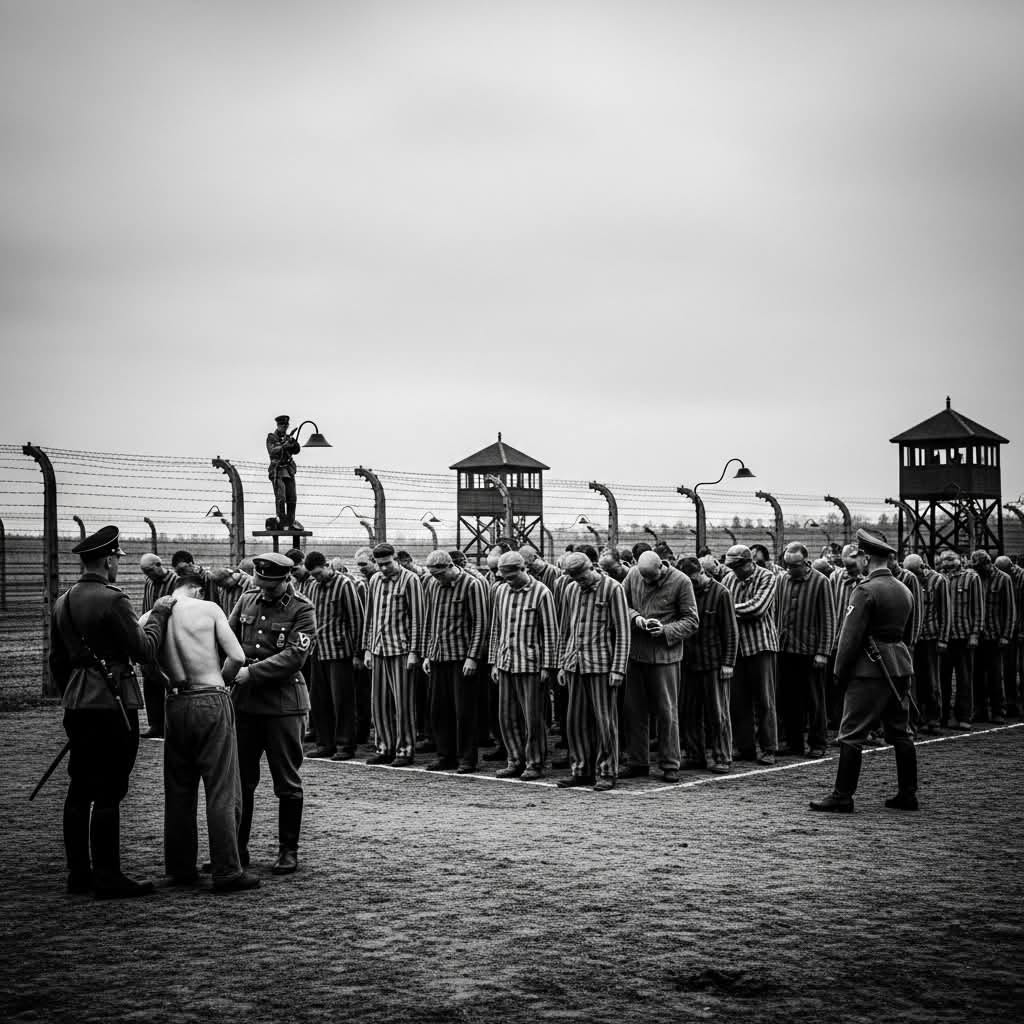
Understanding the holocaust requires confronting the documented, systematic Nazi murder of approximately six million Jews alongside the wider persecution and killing of other targeted groups. The genocide progressed through legal exclusion, violence, ghettos, mass shootings, bureaucratic coordination, and death camps.
Its scale arose from racial antisemitism, state institutions, industrial infrastructure, and the participation or acquiescence of perpetrators, bystanders, and collaborators.
The Holocaust stands as the most extensively documented genocide in human history and one of the most studied events of the twentieth century. Millions of pages of perpetrator records survived the war in German archives.[8] Hundreds of thousands of survivors gave testimony.
Dozens of major perpetrators were tried in court and their conduct examined under cross-examination. Historians have produced an enormous literature from this evidence, examining not only the scale and mechanisms of the killing but the questions it raises about human nature, political evil, modern civilization, and moral responsibility.
The facts are not in dispute among serious historians. Nazi Germany systematically murdered approximately six million Jews between 1941 and 1945 - two-thirds of the Jewish population of Europe.
The genocide of the Jews was embedded within a broader program of racial and political murder that also killed millions of Soviet prisoners of war, hundreds of thousands of Roma and Sinti, at least 200,000 people with disabilities, and tens of thousands of homosexuals, political opponents, and others classified as racially or socially undesirable.
The scale and the deliberateness of the operation - the bureaucratic coordination, the industrial infrastructure, the state resources devoted to hunting and killing people across an entire continent - place it in a category that requires particular explanation.
What has generated the most enduring scholarship and moral urgency is not the documentation of the killing, which is extensive, but the questions the killing poses. Who were the perpetrators? What made them do it? What did the bystanders know, and what did they do with that knowledge?
What does the Holocaust's occurrence reveal about the civilization that produced it? These questions refuse simple answers, and the literature that has engaged them honestly is among the most morally serious body of historical writing produced in the postwar era.
"If this is a man who works in the mud, who does not know peace, who fights for a scrap of bread, who dies because of a yes or a no. Consider if this is a woman, without hair and without name, with no more strength to remember, her eyes empty and her womb cold like a frog in winter.
Meditate that this came about: I commend these words to you. Carve them in your hearts at home, in the street, going to bed, rising; repeat them to your children." - Primo Levi, If This Is a Man, 1947[6]
| Stage | Period | Events |
|---|---|---|
| Legal persecution | 1933-1938 | Nuremberg Laws; civil service exclusions; boycotts |
| Pogrom and violence | 1938 | Kristallnacht; mass arrests |
| Ghettoization | 1939-1941 | Warsaw, Lodz, and other ghettos established |
| Mass shootings | 1941-1942 | Einsatzgruppen kill over 1 million Soviet Jews |
| Wannsee Conference | January 1942 | "Final Solution" coordinated across Nazi agencies |
| Death camp operations | 1942-1944 | Auschwitz-Birkenau, Treblinka, Sobibor at full operation |
| Liberation and aftermath | 1944-1945 | Allied forces liberate camps; Nuremberg trials |
Key Definitions
Holocaust: From the Greek holokauston (a sacrifice wholly consumed by fire); applied to the Nazi genocide of the Jews; increasingly the term Shoah (Hebrew: catastrophe) is preferred by Jewish communities as avoiding the connotation of religious sacrifice.
Genocide: The deliberate killing of a large group of people, especially those of a particular ethnic group or nation. The UN Convention on Genocide (1948) defined it as acts committed "with intent to destroy, in whole or in part, a national, ethnical, racial or religious group."
Antisemitism: Hostility toward, prejudice against, or discrimination against Jewish people. Nazi racial antisemitism held that Jews constituted a biological race that was inherently hostile to non-Jewish civilization.
Einsatzgruppen: Mobile SS killing units that followed the German military into the Soviet Union in 1941, systematically shooting Jewish communities and others.
Final Solution (Endlosung): The Nazi bureaucratic euphemism for the program of systematic extermination of European Jews, coordinated at the Wannsee Conference in January 1942.
Nazi Ideology and the Road to Genocide
The Ideological Framework
Nazi racial antisemitism did not emerge from nowhere, but Hitler's 'Mein Kampf' (My Struggle, 1925-1926) expressed it with unusual explicitness and with a genocidal logic that, in retrospect, was visible to anyone who read it carefully.
Hitler presented Jews not as adherents of a religion but as a biological race engaged in a permanent parasitic assault on host civilizations - specifically on Germany and on the 'Aryan' race that Nazism idealized.
The "Aryan" concept was pseudo-scientific racial mythology, but it was presented with the apparatus of scientific authority: racial hygiene, Social Darwinism, and demographic anxiety about racial "degeneration" provided the intellectual vocabulary.
This fusion of longstanding religious and social anti-Jewish prejudice with biological racism and apocalyptic nationalism produced an ideology uniquely hostile to Jewish existence.
The historian Saul Friedlander, himself a survivor who lost his parents in the Holocaust, developed the concept of "redemptive antisemitism" - the idea that for the Nazi true believers, eliminating the Jews was not merely a political program but a redemptive act that would save Germany and the Aryan race from destruction.[3]
This millenarian quality, more than ordinary political prejudice, helps explain the priority given to the genocide even as Germany was losing the war militarily.
Legal Persecution, 1933-1939
When the Nazi Party came to power in January 1933, initial persecution was legislative and social rather than directly lethal. Jews were expelled from the civil service under the Law for the Restoration of the Professional Civil Service (April 1933), excluded from professions, and subjected to a national boycott of Jewish businesses.
The Nuremberg Laws of September 15, 1935 - the Reich Citizenship Law and the Law for the Protection of German Blood and German Honor - stripped Jews of German citizenship, prohibited marriage and sexual relations between Jews and non-Jews, and set out legal definitions of who was "Jewish" based on descent.
These laws created the legal infrastructure for the exclusion of Jews from German civic life and marked a qualitative deepening of the persecution.
Kristallnacht, the Night of Broken Glass, on November 9-10, 1938, was a nationwide pogrom organized by the SS and SA.
In a single night, approximately 7,500 Jewish-owned businesses were destroyed, 1,400 synagogues were burned, 91 Jews were killed (with many more dying later from injuries), and approximately 30,000 Jewish men were arrested and sent to concentration camps.
The event was publicly visible, internationally reported, and met with international condemnation - and with a striking international passivity in terms of practical response.
The Evian Conference, convened by President Roosevelt in July 1938 to address the Jewish refugee crisis, saw representatives of 32 nations cite domestic political constraints, economic concerns, and immigration pressures as reasons for not substantially increasing refugee quotas.
The United States did not fill its existing quota for German refugees. The conference's failure left the majority of European Jews with nowhere to flee.
From Emigration to Annihilation
In the first years of Nazi rule, the regime's goal was not yet systematic murder but forced emigration - making life in Germany so intolerable that Jews would leave. By 1939, approximately half of Germany's Jews had emigrated.
The conquest of Poland in September 1939 brought millions more Jews under German control, and the conquest of France, the Netherlands, Belgium, and other Western European countries in 1940 brought millions more.
The problem, from the perspective of Nazi racial ideology, had become vastly larger than emigration could address.
Various territorial "solutions" were considered, including a plan to deport European Jews to Madagascar, but none was operationally feasible. By 1941, with the invasion of the Soviet Union, the logic had shifted to systematic extermination.
Operation and Scale
The Einsatzgruppen and Mass Shootings
With the launch of Operation Barbarossa, the German invasion of the Soviet Union, in June 1941, the Holocaust entered its mass murder phase.
Einsatzgruppen - four main mobile SS units, Einsatzgruppen A, B, C, and D - followed the advancing Wehrmacht and began the systematic shooting of Jewish communities, alongside Soviet political commissars and other designated enemies.
The killings were conducted openly and efficiently. Local population centers were informed that Jews were to assemble for "resettlement" or for "work registration"; those who assembled were marched to pits at the edges of towns or to ravines and shot.
Babi Yar, a ravine on the outskirts of Kyiv in Ukraine, became the site of one of the largest mass murders in history. On September 29-30, 1941, members of Einsatzgruppe C, supported by German police units and Ukrainian auxiliaries, shot 33,771 Jews in two days.
The Babi Yar massacre was characteristic in method and scale of the eastern killing operations.
Similar massacres occurred at Ponary outside Vilnius (over 70,000 killed), at Rumbula outside Riga (approximately 25,000 killed in two days in November-December 1941), and at hundreds of smaller locations across Ukraine, Belarus, and the Baltic states.
Total Jewish deaths from shooting operations by the Einsatzgruppen and associated units have been estimated at 1.5 to 2 million.
The Death Camps
In late 1941 and 1942, as the mass shootings were already underway, a parallel infrastructure was constructed in occupied Poland to murder by gassing rather than shooting - partly because the psychological burden on shooters was producing reports of psychological breakdown, partly because the scale of the intended operation exceeded what mobile units could accomplish.
Chelmno, in the Warthegau region of occupied Poland, began killing operations in December 1941, using carbon monoxide from mobile gas vans.
Operation Reinhard - named for Reinhard Heydrich after his assassination in Prague in May 1942 - established three dedicated extermination camps in occupied Poland: Belzec, Sobibor, and Treblinka.
These camps had no function other than murder: deportees arrived by train and were killed within hours, primarily using carbon monoxide generated by diesel engines. Their victims were overwhelmingly Polish Jews. Approximately 1.7 million Jews were killed in Operation Reinhard camps.
Auschwitz-Birkenau, in occupied southern Poland, was the largest and most notorious of the Nazi camps.
Originally opened in 1940 as a concentration camp for Polish political prisoners, Auschwitz expanded to include the Birkenau extermination camp, where industrial-scale killing using Zyklon B (hydrogen cyanide gas released from pellets) was conducted in purpose-built gas chambers adjacent to crematoria.
At its peak operational capacity, Auschwitz-Birkenau could kill and cremate thousands of people per day.
Approximately 1.1 million people were murdered at Auschwitz, 90 percent of them Jewish, drawn from across occupied Europe.
The systematic deception that accompanied deportations - prisoners were told they were being resettled for labor, and arrivals at Auschwitz were directed to "showers" - was central to the operation of the killing process.
Perpetrators and Complicity
Ordinary Men
The question of who the perpetrators were and what motivated them has generated the most sustained scholarly debate in Holocaust historiography.
The perpetrators were not exclusively SS men or committed ideologues; they included regular police officers, soldiers, railway workers, local administrators, and civilian bystanders and informers across occupied Europe.
Christopher Browning's study of Reserve Police Battalion 101, published as 'Ordinary Men' in 1992, remains the most careful examination of a specific unit.[1]
The men of Reserve Police Battalion 101 were middle-aged Germans from Hamburg - civilians, not SS volunteers - who were assigned to killing operations in occupied Poland in 1942. Their commander, Major Wilhelm Trapp, offered his men the choice to opt out of the first mass shooting.
A small number did. The rest participated. Over the following months, the unit directly killed approximately 38,000 Jews and deported 45,000 more to Treblinka.
Browning's explanation emphasized situational factors - conformity to peer expectations, deference to authority, the gradual habituation produced by participating in increasingly extreme acts, and career self-interest - rather than ideological conviction, drawing on Stanley Milgram's experiments on obedience to authority to illuminate the psychological mechanisms.
Daniel Goldhagen's 'Hitler's Willing Executioners' (1996), which analyzed some of the same perpetrators, argued that Browning had underweighted ideology: the perpetrators were motivated by a specifically German eliminationist antisemitism so pervasive that it constituted a cultural consensus.[5]
The debate between situational and dispositional explanations has generated extensive subsequent research and remains unresolved, though most historians find that ideology, situational pressures, institutional structure, and individual psychology all contributed.
Hannah Arendt and the Banality of Evil
Hannah Arendt attended the trial of Adolf Eichmann in Jerusalem in 1961 as a reporter for The New Yorker. Her subsequent book 'Eichmann in Jerusalem: A Report on the Banality of Evil' (1963) introduced one of the most influential and contested concepts in Holocaust discourse.
Arendt's central argument was that Eichmann was not a monster driven by radical antisemitic hatred, but a bureaucrat of remarkable ordinariness - a "desk murderer" who understood himself as performing his organizational duties efficiently and who had, in Arendt's analysis, essentially stopped thinking morally about what those duties entailed.[2]
Evil, she argued, need not be demonic; it can be produced by thoughtlessness, by the substitution of role-performance for moral judgment. Arendt's portrait of Eichmann provoked immediate and fierce criticism from survivors and scholars, some of whom argued that she had minimized his ideological commitment.
Bettina Stangneth's exhaustive study 'Eichmann Before Jerusalem' (2014), drawing on audio recordings of Eichmann in Argentina and other sources, demonstrated that he was far more ideologically committed than Arendt's portrait suggested.[11]
The concept of the "banality of evil" survives the challenge to its specific biographical application: it captures something important about how bureaucratic structures enable and normalize mass violence, regardless of whether Eichmann himself perfectly illustrated it.
Resistance and Rescue
Armed Resistance
The Warsaw Ghetto Uprising of April-May 1943 is the most celebrated instance of armed Jewish resistance. By April 1943, approximately 60,000 Jews remained in the Warsaw Ghetto, the rest having been deported to Treblinka in previous deportation actions.
When German forces entered the ghetto on April 19 to complete the deportation, fighters of the ZOB (Jewish Combat Organization), under the command of Mordecai Anielewicz, and the ZZW (Jewish Military Union) opened fire.
The fighters were armed with smuggled pistols, hand grenades, and Molotov cocktails, and employed the ghetto's buildings and tunnels for ambush and concealment. SS General Jurgen Stroop's units, initially driven back, suppressed the uprising by systematically burning the ghetto building by building.
Fighting continued until mid-May. Anielewicz died on May 8 in the ZOB command bunker. Stroop reported the destruction of the ghetto in a bound report - "The Jewish Quarter of Warsaw is No More!" - decorated with photographs that has become one of the defining documentary records of the Holocaust.
Armed uprisings also occurred at the Sobibor and Treblinka death camps (both October and August 1943 respectively), and Jewish partisan units operated across the forests of Eastern Europe.
Rescue Networks and the Righteous Among the Nations
Yad Vashem has recognized over 27,000 individuals as "Righteous Among the Nations" - non-Jews who risked their lives to rescue Jews. The number, while substantial, represents a small fraction of the European non-Jewish population that was in a position to help.
The village of Le Chambon-sur-Lignon in the Cevennes region of southern France, led by Protestant pastor Andre Trocme and his wife Magda, provided shelter and false documents to an estimated 3,000 to 5,000 Jews over the course of the German occupation.
Denmark's rescue of its Jewish population in October 1943 - when ordinary citizens organized the clandestine ferry of approximately 7,000 Jews to neutral Sweden in fishing boats over several nights - stands as the most remarkable collective rescue in the Holocaust's history.
Jan Karski, a courier for the Polish underground, entered the Warsaw Ghetto and was smuggled into a transit camp at Izbica Lubelska in 1942, witnessing directly the conditions of the killing operations.
He reported to Allied leaders including Roosevelt and Churchill in 1943. He was not believed, or his reports were not acted upon effectively; at a meeting with Supreme Court Justice Felix Frankfurter, Karski later recalled, Frankfurter said he could not believe what Karski was telling him - not that he was lying, but that his mind could not accommodate the reality.
The Allied failure to act on early intelligence about the extermination, including the failure to bomb the railway lines to Auschwitz even as bombers flew regular missions over adjacent industrial facilities, remains a subject of historical and ethical debate.
Why It Happened: Historical Debates
Intentionalism and Functionalism
Two main schools have structured historical debate about the origins of the genocide.
Intentionalists, most forcefully represented by Lucy Dawidowicz in 'The War Against the Jews' (1975) and later Gerald Fleming, argued that Hitler had intended the genocide from the beginning - that 'Mein Kampf' and subsequent speeches were programmatic rather than rhetorical, and that the genocide was the deliberate, planned execution of a long-held intention.[7]
Functionalists, or structuralists, represented by Hans Mommsen and Martin Broszat, argued that there was no single master plan - that the Holocaust emerged from the cumulative radicalization of a polycratic regime, through competition among power structures and through improvised responses to operational problems.
The genocide was, in this view, not programmed from 1933 but evolved through phases in which decisions at multiple levels interacted.
Most historians have moved toward what Christopher Browning called "moderate intentionalism": Hitler's ideological commitment to eliminating the Jews was the necessary motor, but the specific program of systematic extermination developed in phases, shaped by the circumstances of the war, particularly the invasion of the Soviet Union.
Modernity and the Holocaust
Zygmunt Bauman's 'Modernity and the Holocaust' (1989) offered the most provocative structural interpretation.
Bauman argued that the Holocaust was not an eruption of pre-modern barbarism or a regression from civilized norms, but a product of distinctively modern conditions: the bureaucratic state, which enabled the disaggregation of moral responsibility across a chain of specialized functions; industrial technology, which provided the means; scientific racism, which provided the legitimating framework;
and the structures of moral distance that modern institutions create, allowing individuals to participate in terrible outcomes without confronting their moral significance.
Bauman drew on Milgram's research and on Arendt's "banality of evil" to argue that the Holocaust demonstrated the moral insufficiency of modern institutional civilization - that the bureaucratic organization of violence, far from being an aberration, reflected the capacities inherent in modern social organization.[4]
This argument does not exculpate the perpetrators; it challenges the assumption that modernization, rationalization, and institutional development necessarily produce moral progress.
Memory, Denial, and the Future of Remembrance
Nuremberg and Subsequent Trials
The International Military Tribunal at Nuremberg (1945-1946) prosecuted 24 senior Nazi leaders for crimes against peace, war crimes, and crimes against humanity - categories that were substantially developed through the trial process.
Twelve defendants were sentenced to death and executed, including Hans Frank, Hermann Goring (who cheated the gallows by suicide), and Julius Streicher.
The Nuremberg Trials established the principle that heads of state and senior officials could be held criminally accountable for waging aggressive war and for crimes against civilian populations - a significant innovation in international law.
The Eichmann trial in Jerusalem in 1961, in which Eichmann was convicted and executed, was the first major Holocaust trial in Israel and the first to center survivor testimony extensively, exposing a new generation to direct witness accounts of the genocide.
Holocaust Denial and the Irving Trial
Holocaust denial - the false claim that the genocide did not occur or was vastly smaller than documented - is a form of antisemitic propaganda rather than a legitimate historical position. The most significant legal test came in the British case of David Irving versus Deborah Lipstadt and Penguin Books.
Irving, a British author who had written extensively on World War II, sued Lipstadt for libel over her characterization of him as a Holocaust denier in 'Denying the Holocaust' (1993).[9]
Under British defamation law, the burden of proof lay with the defendants to show their characterization was justified.
The 2000 judgment by Justice Charles Gray found that Irving was a deliberate falsifier of historical evidence who manipulated documents and statistics to minimize the Holocaust's scale, and that he did so in service of an ideological commitment to rehabilitating Hitler.
D.D. Guttenplan's 'The Holocaust on Trial' (2001) and Lipstadt's own 'History on Trial' (2005) provided detailed accounts of the proceedings.[10]
Never Again and Its Failures
The phrase "Never Again," adopted as a slogan for Holocaust remembrance, has been haunted by the subsequent genocides it did not prevent. The Khmer Rouge killed approximately 1.5 to 2 million people in Cambodia between 1975 and 1979, targeting intellectuals, ethnic minorities, and perceived class enemies.
The Rwandan genocide of April-July 1994 killed approximately 800,000 to 1,000,000 Tutsi in 100 days, while the international community watched and the United States deliberately avoided using the word "genocide" to avoid the obligation to act.
The massacre at Srebrenica in July 1995, in which Serbian forces commanded by General Ratko Mladic killed approximately 8,000 Bosniak Muslim men and boys - under the nominal protection of a UN "safe area" - was subsequently ruled a genocide by the International Court of Justice.
The Darfur conflict beginning in 2003 produced a coordinated campaign of mass killing and displacement that the US State Department classified as genocide in 2004.
Each recurrence raises the same questions: what does Holocaust remembrance actually demand? What are the obligations of states and individuals when they have knowledge of ongoing mass atrocity?
The gap between the rhetoric of "Never Again" and the repeated failure to act on it is itself a central problem for any honest engagement with the Holocaust's legacy.
Sources & Further Reading
- Browning, C.R. (1992). Ordinary Men: Reserve Police Battalion 101 and the Final Solution in Poland. HarperCollins.
- Arendt, H. (1963). Eichmann in Jerusalem: A Report on the Banality of Evil. Viking Press.
- Friedlander, S. (2007). The Years of Extermination: Nazi Germany and the Jews, 1939-1945. HarperCollins.
- Bauman, Z. (1989). Modernity and the Holocaust. Cornell University Press.
- Goldhagen, D.J. (1996). Hitler's Willing Executioners: Ordinary Germans and the Holocaust. Knopf.
- Levi, P. (1947). Se questo e un uomo [If This Is a Man]. (S. Woolf, Trans., 1959). Orion Press.
- Dawidowicz, L. (1975). The War Against the Jews, 1933-1945. Holt, Rinehart & Winston.
- Hilberg, R. (1961). The Destruction of the European Jews. Quadrangle Books.
- Lipstadt, D.E. (1993). Denying the Holocaust: The Growing Assault on Truth and Memory. Free Press.
- Guttenplan, D.D. (2001). The Holocaust on Trial. W.W. Norton.
- Stangneth, B. (2014). Eichmann Before Jerusalem: The Unexamined Life of a Mass Murderer. Knopf.
Further Reading
- Wiesel, E. (1958). La Nuit [Night]. (M. Wiesel, Trans., 2006). Hill and Wang.