
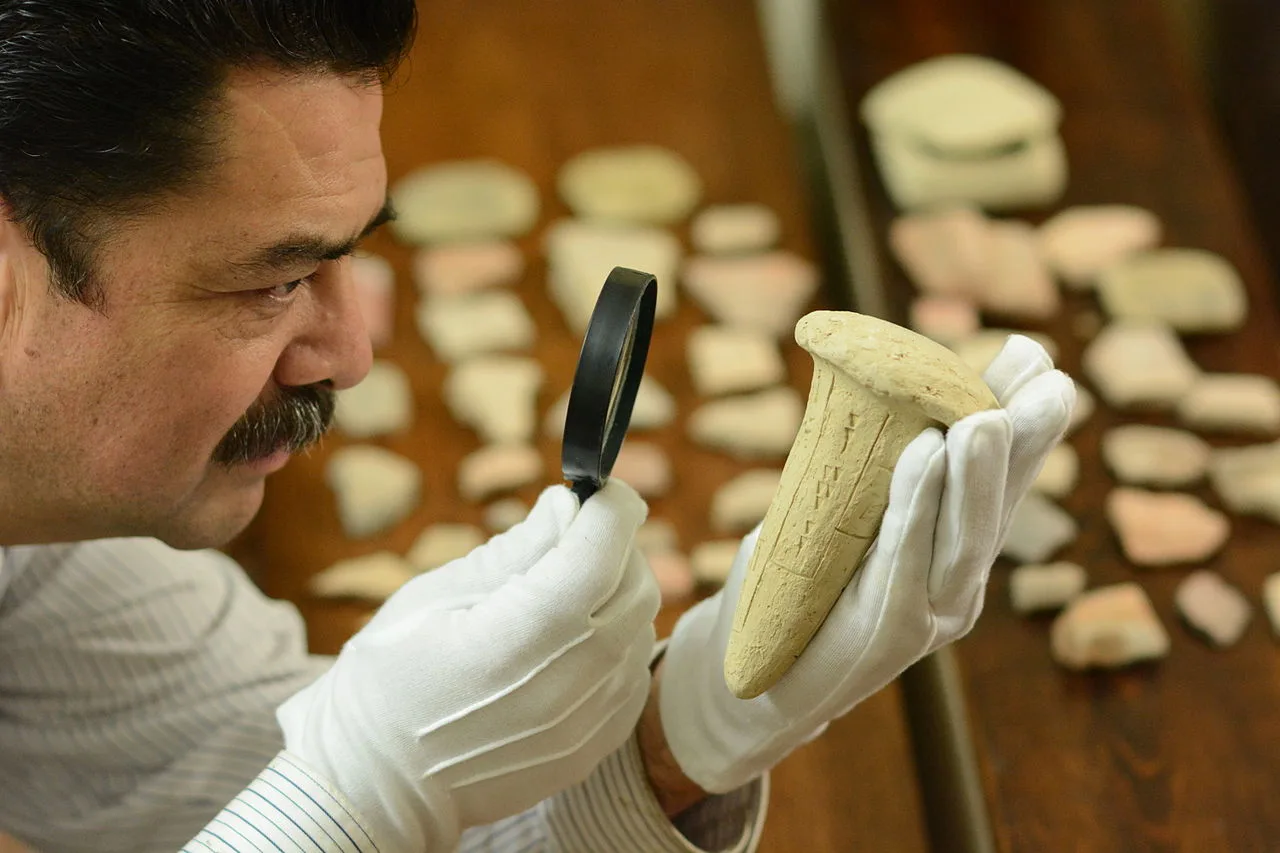
Archaeology is the systematic study of past human societies through the recovery, analysis, and interpretation of material remains.
Where historians read documents, archaeologists read the physical world: the tools people made, the food they ate, the buildings they constructed, the dead they buried, the sediments that accumulated over them across centuries and millennia.
In doing so, archaeology gains access to the vast majority of human history that unfolded before writing was invented, and to the everyday lives of the vast majority of people who lived after writing appeared but rarely produced it.
The discipline is both a science and a humanity. It requires the precision of laboratory analysis, the systematic logic of hypothesis testing, and the imaginative reconstruction of worlds that have left only silent traces.
It spans prehistoric archaeology recovering two-million-year-old stone tools in East African lakebeds, classical archaeology excavating the civic spaces of ancient Rome, historical archaeology examining the enslaved quarters of American plantations, and conflict archaeology documenting twentieth-century battlefields before their evidence disappears.
How Archaeology Differs from History
The relationship between archaeology and written history is complementary but not redundant. Written records exist for only a small fraction of human existence: the earliest writing systems date to roughly 3200 BCE in Mesopotamia and Egypt, but anatomically modern humans have existed for roughly 300,000 years.
The entire Paleolithic period, spanning over 99 percent of the time Homo sapiens has walked the earth, is accessible only through material remains.
Even within the historical period, written records are deeply selective. They overwhelmingly document elites, states, and literate cultures. The daily lives of farmers, craftspeople, enslaved individuals, and ordinary women are rarely written about.
Archaeology recovers what they ate, how they organized their living spaces, what objects they valued, and where they were buried - evidence for which no text exists.
The archaeology of slavery at plantation sites in the United States, for example, has revealed material patterns of resistance, cultural retention, and social organization that written records by slaveholders systematically omitted or distorted.
Archaeologist Paul Mullins's work on African American consumerism and the archaeology of race has demonstrated that excavating the material lives of enslaved and free Black Americans produces evidence of dignity, agency, and cultural creativity that written records largely suppressed.
The recovery of West African ritual practices, cooking techniques, and architectural preferences in archaeological deposits from slave quarters at sites including Monticello and Carter's Grove plantation has transformed understanding of how enslaved people maintained cultural identity under conditions designed to destroy it.
Archaeology is also inherently destructive: excavation removes the very stratigraphy being studied. This irreversibility is why meticulous recording during the process is not optional but constitutive of the method. An excavated site that was not recorded is simply a destroyed site.
The Development of Archaeology as a Discipline
From Antiquarianism to Science
The intellectual ancestors of archaeology were Renaissance antiquarians who collected ancient objects as curiosities. By the eighteenth century, figures like William Stukeley were drawing measured plans of Stonehenge and Avebury, but interpretation remained speculative.
Johann Winckelmann's systematic study of Greek and Roman art in the eighteenth century pointed toward a more analytical approach, but true scientific method was still absent.
Heinrich Schliemann's excavations at Hisarlik in 1868 and subsequent years demonstrated that Troy was not merely legend but a real site with multiple superimposed occupation levels. Schliemann found genuine prehistoric material - but his methods were catastrophic by modern standards.
In his eagerness to reach what he believed was Homeric Troy, he dug through and destroyed later levels of equal archaeological value, including the very period his Troy would have occupied.
He is a cautionary figure: the first to prove that systematic excavation could validate literary tradition, and the first to demonstrate how ambition and impatience could devastate a site.
The same era produced other foundational discoveries with better methodology. John Lloyd Stephens and Frederick Catherwood's exploration of Maya ruins in the 1830s and 1840s, documented in Incidents of Travel in Central America, Chiapas, and Yucatan (1841), brought systematic description and Catherwood's precise architectural drawings to a literate world that had not known these civilizations existed.
Their work established that the Americas had produced complex urban civilizations independent of the Old World - a revelation that fundamentally altered Western understanding of human history.
The Methodological Revolution: Pitt Rivers
The genuine transformation came with Augustus Lane Fox Pitt Rivers, who in the 1880s excavated his estates at Cranborne Chase in Dorset with a fastidiousness that was genuinely unprecedented.
Pitt Rivers insisted on recording everything - not just beautiful objects but potsherds, animal bones, post holes, soil variations - in its precise stratigraphic position.
He published multi-volume reports with detailed plans, sections, and artifact illustrations accessible to other scholars.
His foundational principle - that the commonplace and mundane are as important as the spectacular - remains central to modern archaeology. A single gold object extracted without context tells us less than a carefully recorded assemblage of everyday pottery that maps the daily life of an entire community across generations.
Flinders Petrie extended systematic recording to Egypt and the Near East, developing sequence dating of pottery styles to establish relative chronologies. By the early twentieth century, the stratigraphic principle was established: layers of soil accumulate over time, so deeper generally means older unless disturbance has occurred.
Gertrude Bell, the archaeologist, linguist, and political officer who shaped the borders of modern Iraq, contributed to Near Eastern archaeology through her meticulous documentation of sites, buildings, and inscriptions across what was then Ottoman Mesopotamia.
Her work, and that of contemporaries including Leonard Woolley at Ur, established systematic documentation of Mesopotamian archaeology at the same time that European and American institutions were removing vast quantities of material to their home museums - a practice whose legacy continues to generate repatriation claims.
Processual and Post-Processual Archaeology
The New Archaeology or processual archaeology of the 1960s, led by Lewis Binford, pushed toward explicit hypothesis testing and scientific reasoning.
Binford argued in his influential 1962 paper "Archaeology as Anthropology" that archaeology should seek to explain cultural processes rather than merely describe artifact sequences.[1] Archaeology should aspire to the generalization and theoretical rigor of the social sciences.
Post-processual archaeology, emerging in the 1980s under figures including Ian Hodder, challenged this scientific positivism. Material culture, Hodder argued, is not a direct reflection of social organization but an active medium of meaning-making.[6]
Objects do not just mirror society; they constitute it. The same artifact can carry different meanings in different contexts. Rigorous empiricism is necessary but not sufficient; interpretation requires understanding material culture as a kind of text.
The tension between processual and post-processual approaches has been productive. Contemporary archaeology largely integrates both: systematic data recovery and quantitative analysis alongside reflexive attention to the interpretive frameworks and power relations that shape what questions are asked and whose past is studied.
Methods of Excavation
Modern excavation begins before any earth is moved.
Pre-Excavation Survey
Field walking - systematically traversing a study area and recording surface scatters of artifacts - can locate sites and provide initial information about their extent and date range. Geophysical prospection using ground-penetrating radar, magnetometry, or electrical resistivity detects buried features without disturbing them.
LiDAR (Light Detection and Ranging) scanning from aircraft or drones has revolutionized landscape archaeology: LiDAR pulses can penetrate vegetation to reveal landscape features invisible at ground level.
The 2010 LiDAR survey of the Caracol Maya site in Belize revealed a settlement system three times larger than ground survey had suggested, transforming understanding of Maya urbanism. A 2018 survey over northern Cambodia revealed previously unknown urban landscapes surrounding Angkor Wat, extending the known boundaries of the Khmer city.
A 2018 LiDAR study published in Science by Marcello Canuto and colleagues mapped over 61,000 structures connected by a network of roads in the Maya Lowlands of northern Guatemala - evidence for a level of political integration and urban planning that previous scholarship had not recognized.[2]
The scale of the Maya civilization revealed by LiDAR is significantly larger, denser, and more complex than earlier estimates had suggested.
Satellite remote sensing has added another layer of non-invasive prospection. Multi-spectral imaging from satellites can detect crop marks - variations in plant growth above buried features - and thermal anomalies.
Sarah Parcak's use of satellite imagery to detect looting pits in Egypt and potential archaeological sites across the Mediterranean earned her the TED Prize in 2016.
Parcak estimated that sites in Egypt were being looted at a rate of one new pit per eleven minutes during the politically unstable period following the 2011 revolution.[10]
Excavation Technique
When excavation begins, the site is typically laid out in a grid system of one- or two-meter squares separated by narrow unexcavated sections called balks or baulks that preserve a visible stratigraphic profile.
The fundamental unit is the context: any discrete deposit of sediment, a cut feature, or a constructed surface. Every context receives a unique number; all finds and samples are recorded against that context number before removal.
Excavators remove soil with trowels and sometimes fine brushes rather than spades. Soil is rarely discarded. Dry sieving through meshes of four or ten millimeters recovers small finds and animal bone that would otherwise be missed.
Flotation - stirring soil in water to float charred seeds, wood fragments, and plant macrofossils - recovers environmental evidence for diet and land use that would be invisible in a trowel excavation.
The Harris Matrix, a system invented by Edward Harris in the 1970s, maps the stratigraphic relationship of all contexts in a site in a diagrammatic sequence.[5] It is the essential organizational tool for managing the complexity of a multi-period site with hundreds or thousands of individual contexts.
Every context is plotted showing which contexts it overlies, which overlay it, and which are contemporary with it, producing a complete temporal sequence of the entire site.
Post-Excavation Analysis
Post-excavation work - specialist analysis of ceramics, lithics, faunal remains, human skeletal material, botanical remains, soils, and environmental proxies - often takes years longer than the fieldwork itself.
A six-week excavation season may generate five years of post-excavation analysis before publication. This is not inefficiency but a reflection of the information density of well-recorded archaeological contexts.
Zooarchaeology (analysis of animal bones) reconstructs diet, animal husbandry, hunting patterns, and seasonal activity. Archaeobotany analyzes plant remains to understand agriculture, cuisine, and trade.
Geoarchaeology examines the formation processes of deposits - whether features are undisturbed, what post-depositional factors have affected preservation - to evaluate how much confidence to place in the archaeological record's apparent patterns.
Stable isotope analysis of human skeletal material has transformed bioarchaeology. Carbon and nitrogen isotope ratios in tooth enamel and bone reflect diet; oxygen and strontium isotope ratios reflect the water sources consumed during childhood, which vary geographically and act as signatures of birthplace.
This has allowed archaeologists to determine where individuals spent their childhoods and whether they were local to the site of their burial.
The discovery that the "Amesbury Archer" - an early Bronze Age individual buried near Stonehenge with an exceptional assemblage of metalwork and arrowheads - had grown up in the Alps, not Britain, changed understanding of early Bronze Age long-distance movement and the networks through which metallurgical knowledge spread.
Dating Methods
| Method | Applicable Material | Effective Range | Key Developers |
|---|---|---|---|
| Stratigraphy | All deposits | Relative sequence only | Pitt Rivers (1880s) |
| Typology | Pottery, lithics, coins | Relative sequence | Petrie (1890s) |
| Radiocarbon | Organic material | Up to ~50,000 years | Libby (1949) |
| Dendrochronology | Wood | Up to ~14,000 years (regional) | Douglass (1920s) |
| Thermoluminescence | Fired ceramics, burnt flint | Up to ~500,000 years | Daniels & Finney (1966) |
| Potassium-argon | Volcanic minerals | 100,000+ years to billions | Multiple, 1950s onward |
| Optically stimulated luminescence | Sediment grains | Up to ~300,000 years | Huntley et al. (1985) |
| Archaeomagnetic dating | Burnt clay, hearths | Up to ~10,000 years | Multiple, 1960s onward |
Willard Libby's development of radiocarbon dating in 1949 was the most transformative single methodological advance in the discipline's history.[8] Libby, a chemist at the University of Chicago, received the Nobel Prize in Chemistry in 1960 for the work.
Radiocarbon exploits the known decay rate of carbon-14, a radioactive isotope absorbed by living organisms and no longer replenished after death. By measuring the ratio of carbon-14 to stable carbon-12, laboratories can estimate when an organism died. The method works reliably for organic material up to roughly 50,000 years old.
Crucially, radiocarbon dates are not single-point estimates but probability distributions, and they require calibration against dendrochronological sequences because atmospheric carbon-14 levels have varied over time.
The IntCal calibration curve, maintained and updated by international collaboration, translates raw radiocarbon measurements into calibrated calendar-year probability ranges.
Modern accelerator mass spectrometry (AMS) allows radiocarbon dating from milligram-scale samples - a single barley grain, a fragment of bone, a fiber from a textile. This has transformed the datability of archaeological contexts that previously could not be sampled without significant destruction of fragile material.
Human Origins and Migration
Paleoanthropology - the archaeology of human origins - has repeatedly reshaped understanding of the human family tree.
The African Record
The discovery of Australopithecus afarensis, represented most famously by the partial skeleton known as "Lucy" found in Ethiopia's Afar region in 1974 by Donald Johanson's team, established that bipedalism preceded large brain size by over a million years.[7]
Lucy dates to approximately 3.2 million years ago. The Laetoli footprints in Tanzania, preserving bipedal tracks at 3.6 million years, confirmed habitual upright walking in australopiths.
The oldest confirmed stone tools, from Lomekwi 3 in Kenya and dated to approximately 3.3 million years ago by Sonia Harmand and colleagues (published in Nature, 2015), predate the genus Homo entirely.
The Acheulean handaxe tradition, beginning around 1.76 million years ago, shows a standardization of form that implies learned transmission and some degree of shared mental templates - the earliest evidence for cultural transmission in the archaeological record.
The Middle Stone Age of southern Africa, extending from roughly 280,000 to 25,000 years ago, has become the primary evidence base for the emergence of behavioral modernity: symbolic thought, complex technology, long-distance exchange, and language-dependent cognitive flexibility.
Sites including Blombos Cave, Pinnacle Point, and Sibudu in South Africa have produced evidence of ochre use, engraved geometric patterns, heat treatment of stone for tool production, and shell beads - some of the earliest evidence of symbolic behavior in the archaeological record.
The Complex Hominin World
The 2003 discovery at Liang Bua cave on the Indonesian island of Flores produced Homo floresiensis, a diminutive hominin with a brain roughly the size of a chimpanzee's, apparently surviving until as recently as 50,000 years ago.
Its co-existence alongside modern humans suggested a more complex and crowded hominin world than earlier frameworks had imagined.
Ancient DNA analysis, using genetic material extracted from skeletal material, has added dimensions impossible to recover from bones alone. The Neanderthal genome project, led by Svante Paabo at the Max Planck Institute for Evolutionary Anthropology, confirmed interbreeding between Neanderthals and modern humans outside Africa.[9]
Paabo received the Nobel Prize in Physiology or Medicine in 2022 for discoveries concerning the genomes of extinct hominins and human evolution.
Approximately 1-4 percent of the DNA of all non-African humans derives from Neanderthal ancestors, with populations in Melanesia inheriting an additional 4-6 percent from a third extinct population called Denisovans.
The discovery of the Denisovans from a finger bone in Siberia's Denisova Cave - an entirely new hominin population known almost entirely from genetics - was one of the most remarkable scientific discoveries of the twenty-first century.
Multiple subsequent finds of Denisovan material, including a jawbone from Tibet's Baishiya Karst Cave, suggest that Denisovans ranged across Asia from Siberia to Southeast Asia.
The Peopling of the Americas
The peopling of the Americas was long explained by the Clovis-first hypothesis: the earliest Americans arrived roughly 13,000 years ago via the Bering land bridge. Excavations at Monte Verde in southern Chile, which Tom Dillehay documented as dating to approximately 14,500 years ago, overturned this model.[4]
Subsequent evidence from sites including Buttermilk Creek in Texas pushes the North American presence back further. Current models support multiple migration waves and probable coastal routes along the Pacific kelp highway before the continental interior was accessible.
A 2021 study in Nature by Matthew Bennett and colleagues documented human footprints at White Sands National Park in New Mexico dating to between 21,000 and 23,000 years ago - evidence of human presence in the Americas during the Last Glacial Maximum, when the Bering land bridge corridor would have been glaciated and impassable.
The finding, if confirmed, would require a substantial revision of models of American prehistory and suggests that coastal sea routes were used far earlier than previously recognized.
Maritime Archaeology
Maritime archaeology studies human interaction with water environments through shipwrecks, submerged settlements, harbors, and the material culture of seafaring. Waterlogged anaerobic environments both destroy iron and preserve organic materials - wood, rope, leather, textiles - far better than dry land conditions.
The Bronze Age Uluburun wreck off Turkey, dated to approximately 1300 BCE, carried a cargo representing at least ten different cultures: copper ingots from Cyprus, tin from central Asia, ebony from Africa, glass ingots, Canaanite amphoras, Mycenaean pottery, and personal jewelry of multiple origins.
It is the most powerful single piece of evidence for the breadth of Late Bronze Age Mediterranean trade networks.
Robert Ballard's 1985 discovery of RMS Titanic at approximately 3,800 meters depth brought deep-water archaeology to global attention and raised ethical questions about wrecks that are simultaneously archaeological sites and mass graves.
Ballard's subsequent surveys in the Black Sea, whose deep waters are anoxic below approximately 150 meters, found remarkably well-preserved ancient ships whose wood remains intact - conditions impossible in oxygenated waters.
Doggerland, the now-submerged North Sea plain that connected Britain to continental Europe during the last glacial maximum, was a major area of Mesolithic habitation whose archaeology can only be accessed from the seabed.
As sea levels have risen roughly 120 meters since the last glacial maximum around 20,000 years ago, vast inhabited coastlines were inundated. Recovering their archaeology is one of the field's pressing frontiers.
The Antikythera Mechanism, recovered from a Roman-era shipwreck off the Greek island of Antikythera in 1900, is perhaps the most celebrated object in maritime archaeology.
X-ray and CT scanning of the corroded bronze fragments over the following century revealed an extraordinary device: a geared astronomical calculator capable of predicting planetary positions, lunar cycles, and eclipse patterns.
Dating to approximately 100-150 BCE, it represents a level of mechanical sophistication not known from any other surviving ancient artifact and suggests that ancient Greek technology was considerably more advanced than the surviving written record had implied.
Archaeological Science: The Laboratory Revolution
Ancient DNA and Genetic Archaeology
The application of ancient DNA (aDNA) analysis to archaeological populations has transformed understanding of prehistoric population movements, admixture, and the spread of languages and technologies.
Work by David Reich and colleagues at Harvard Medical School, summarized in Who We Are and How We Got Here (2018), has traced the genetic signatures of major prehistoric migrations: the spread of farming from the Near East into Europe approximately 8,000 years ago, the subsequent expansion of Steppe herders (the Yamnaya culture) across Europe approximately 5,000 years ago who brought Indo-European languages, and the peopling of the Americas.[11]
These genetic findings have resolved long-standing archaeological debates. The spread of farming into Europe was long debated as either cultural diffusion (farming practices adopted by indigenous hunter-gatherers) or population replacement (actual movement of farming populations).
Ancient DNA demonstrated that it was substantially both: early European farmers were genetically distinct from indigenous hunter-gatherers, showing genuine population replacement in many areas, but with significant admixture at various points.
Proteomics and Dental Calculus
Dental calculus - mineralized plaque - has emerged as a remarkable archive of individual diet, health, and even behaviour. Ancient dental calculus preserves DNA, plant microfossils (phytoliths), starch granules, proteins from consumed foods, and the DNA of oral pathogens.
A 2019 study published in Nature by Warinner and colleagues recovered milk proteins from dental calculus of individuals across Eurasia, establishing that dairying was practiced far earlier and more widely than other evidence had suggested, and identifying specific animals (cattle, sheep, goats, horses, yaks) whose milk was consumed by specific individuals.[12]
Proteomics - the analysis of ancient proteins - extends the temporal range of molecular archaeology beyond the limits of DNA preservation, which rarely survives beyond approximately 500,000 years except in frozen environments. Protein sequences can survive for millions of years in dental enamel.
A 2020 Nature paper by Welker and colleagues recovered protein sequences from an approximately 800,000 year old Homo antecessor tooth from Atapuerca, Spain, extending the molecular record of human evolution to a period previously accessible only through morphology.[13]
Repatriation Debates
Repatriation - the return of cultural property, including human remains, sacred objects, and artifacts, to the communities or nations from which they were taken - is among the most contested issues in contemporary archaeology and museum studies.
The Elgin Marbles
The Elgin Marbles, removed from the Parthenon in Athens between 1801 and 1812 by Thomas Bruce, the seventh Earl of Elgin, and now housed in the British Museum, are the most internationally prominent case. Greece has formally requested their return since 1982, when Melina Mercouri launched the first official repatriation campaign.
The British Museum has consistently refused, citing its ability to offer universal access and better conservation, and warning that return would set a precedent that would empty museums worldwide.
Greece argues that the sculptures are inseparable from their original context and that the universalist argument was never applied when the objects were acquired.
In 2023, negotiations between the British Museum and the Greek government came closer to a potential solution than at any previous point, with discussions of a long-term loan arrangement that would bring major sculptures to Athens while nominally maintaining British Museum ownership.
The eventual outcome of these negotiations will set precedents for dozens of similar disputes worldwide.
NAGPRA in the United States
In the United States, the Native American Graves Protection and Repatriation Act (NAGPRA) of 1990 established a legal framework requiring federally funded institutions to inventory and repatriate Native American human remains and culturally affiliated objects.
NAGPRA has resulted in the return of hundreds of thousands of items and has substantially improved relationships between archaeologists and indigenous communities.
The most contentious case was Kennewick Man - a 9,000-year-old skeleton found in Washington State in 1996 whose cultural affiliation was disputed between scientists wanting to study it and Native American tribes claiming it for reburial.
After nearly two decades of legal dispute, a 2015 DNA analysis confirmed Native American ancestry, and the remains were repatriated in 2017.
In 2023, the Biden administration strengthened NAGPRA regulations to require institutions to obtain affirmative consent from tribes before using unaffiliated Native American remains for research - a significant tightening of the previous standard, which had required only consultation rather than consent.
"The old model of archaeology was essentially extraction. The new model has to be collaboration. And not just as ethics, but as epistemology - because descendant communities hold knowledge that changes what we find and what it means." - Chip Colwell, Plundered Skulls and Stolen Spirits (2017)[3]
A growing number of archaeologists argue that collaborative archaeology centered on the knowledge and sovereignty of descendant communities produces better science as well as better ethics.
Indigenous knowledge of land use, oral traditions, and ecological relationships has repeatedly led to discoveries that purely technical approaches missed. The ethical and epistemological arguments, on this view, point in the same direction.
The archaeology of the Dmanisi site in Georgia, where a series of small-brained, small-bodied hominin skulls dating to 1.8 million years ago were found - the earliest hominin fossils outside Africa - illustrates how archaeological discoveries continue to rewrite the human story.
The Georgian government's decision to establish the site as a protected national monument, with Georgian scientists leading the research, reflects a broader shift toward national and community ownership of heritage that repatriation debates have catalyzed globally.
Frequently Asked Questions
What is archaeology and how does it differ from history?
Archaeology is the study of past human societies through material remains - tools, structures, pottery, food debris, skeletal material, and the sediments that contain them.
It differs from history in that it does not depend on written records: it can access periods entirely before writing and everyday lives that written records systematically ignored.
Archaeology is inherently destructive - excavation removes the stratigraphy being studied - which makes meticulous recording essential.
What is radiocarbon dating and how accurate is it?
Radiocarbon dating measures the decay of carbon-14 in organic material to estimate when an organism died. Developed by Willard Libby in 1949 (Nobel Prize in Chemistry, 1960), it works reliably for material up to roughly 50,000 years old. Results are probability distributions requiring calibration, not single-point estimates.
Modern accelerator mass spectrometry allows dating from milligram-scale samples, making it applicable to individual seeds or bone fragments.
What has LiDAR revealed about ancient civilizations?
LiDAR scanning from aircraft can penetrate forest canopy to reveal landscape features invisible at ground level. It has dramatically expanded understanding of Maya, Khmer, and other tropical civilizations.
A 2018 LiDAR survey revealed that Angkor Wat was surrounded by an urban landscape far larger than previously known, with evidence for intensive water management across hundreds of square kilometers.
In 2022, LiDAR mapping of the Maya Lowlands revealed connections between hundreds of sites via a road network, indicating a level of political integration not recognized before.
What are the main ethical debates in archaeology today?
The principal ethical debates concern repatriation of human remains and cultural property, the rights of descendant communities over the study of their ancestors, and the balance between scientific knowledge and cultural sovereignty. NAGPRA in the United States and the Elgin Marbles dispute in Britain are the most prominent cases.
A broader shift toward collaborative and community archaeology reflects both ethical commitments and the recognition that descendant communities hold knowledge that enriches rather than constrains the discipline.
How has ancient DNA changed archaeology?
Ancient DNA analysis, pioneered by researchers including Svante Paabo (Nobel Prize, 2022), has revealed that Neanderthals and modern humans interbred, that the Denisovans were a previously unknown hominin population, and that major prehistoric population movements - including the spread of farming and the expansion of Indo-European-speaking Steppe herders - reshaped the genetic composition of Europe and Asia.
These findings have resolved long-standing archaeological debates about whether cultural change reflected population movement or the adoption of ideas, and they have opened entirely new questions about the relationships between prehistoric human groups.
Sources & Further Reading
- Binford, L. R. (1962). Archaeology as Anthropology. American Antiquity, 28(2), 217-225.
- Canuto, M. A., et al. (2018). Ancient Lowland Maya Complexity as Revealed by Airborne LiDAR of Northern Guatemala. Science, 361(6409). DOI: 10.1126/science.aau0137
- Colwell, C. (2017). Plundered Skulls and Stolen Spirits: Inside the Fight to Reclaim Native America's Culture. University of Chicago Press.
- Dillehay, T. D. (1997). Monte Verde: A Late Pleistocene Settlement in Chile. Smithsonian Institution Press.
- Harris, E. C. (1989). Principles of Archaeological Stratigraphy (2nd ed.). Academic Press.
- Hodder, I. (1986). Reading the Past: Current Approaches to Interpretation in Archaeology. Cambridge University Press.
- Johanson, D. C., & Edey, M. A. (1981). Lucy: The Beginnings of Humankind. Simon and Schuster.
- Libby, W. F. (1955). Radiocarbon Dating (2nd ed.). University of Chicago Press.
- Paabo, S. (2014). Neanderthal Man: In Search of Lost Genomes. Basic Books.
- Parcak, S. (2019). Archaeology from Space: How the Future Shapes Our Past. Henry Holt.
- Reich, D. (2018). Who We Are and How We Got Here: Ancient DNA and the New Science of the Human Past. Pantheon Books.
- Warinner, C., et al. (2014). Pathogens and Host Immunity in the Ancient Human Oral Cavity. Nature Genetics, 46, 336-344.
- Welker, F., et al. (2020). The Dental Proteome of Homo antecessor. Nature, 580, 235-238.
Further Reading
- Allsworth-Jones, P. (2010). West African Archaeology: New Developments, New Perspectives. Archaeopress.