
Factors: On March 21, 1861, about three weeks before the first guns fired at Fort Sumter, the newly inaugurated Vice President of the Confederate States of America stood before a crowd in Savannah, Georgia, and explained precisely what the new nation was about.
Alexander Stephens was an unlikely Confederate firebrand - a frail Georgia lawyer who had opposed secession as recently as November 1860.[1] But standing at the Athenaeum, he spoke with the clarity of a man who had accepted the logic of a position he had once resisted.
The "cornerstone" of the Confederacy, Stephens declared, was the "great truth that the negro is not equal to the white man; that slavery, subordination to the superior race, is his natural and normal condition."
The founders of the United States, he said, had made a fatal error by treating the equality of man as a self-evident truth; the Confederacy's "foundations are laid, its cornerstone rests, upon the great truth that the negro is not equal to the white man."
The Cornerstone Speech is the cleanest possible answer to a question that should not be difficult but has been deliberately made so for over a century and a half. What caused the American Civil War? Slavery. The Confederate Vice President said so.
The Confederate states' own secession declarations said so. Confederate President Jefferson Davis said so, though he later thought better of it. The historical record is not ambiguous.
The controversy about the Civil War's cause is not a historical controversy - it is a political one, manufactured after the war for reasons that were themselves about race and power.
Understanding how that controversy was manufactured, and what the actual record shows, is essential to understanding both the war itself and the long shadow it casts over American life today.
The effort to obscure the Civil War's causes began almost as soon as the war ended.
Former Confederates, stripped of political rights and facing a future in which four million formerly enslaved people were citizens, needed a new story - one that preserved their honor, justified their losses, and quietly restored their social position without requiring them to confront the moral catastrophe of what they had fought for.
The story they chose was elegant and durable: the war had been about constitutional principle, not slavery; about the right of sovereign states to govern themselves without interference from a distant federal government; about a way of life threatened by Northern aggression.
The enslaved people in this narrative were peripheral, even comfortable. This was the Lost Cause, and it has proven one of the most successful propaganda campaigns in American history.
"Our position is thoroughly identified with the institution of slavery - the greatest material interest of the world." - Mississippi Declaration of Secession (January 9, 1861)
| Issue | Northern Position | Southern Position |
|---|---|---|
| Slavery expansion | Restrict slavery in new territories | Allow slavery to expand freely |
| States' rights | Federal authority supreme on core issues | States may nullify federal law |
| Tariffs | High tariffs protect Northern industry | Low tariffs benefit Southern exports |
| Economic model | Wage-labor industrialism | Plantation slave-labor agriculture |
| Representation | Population-based (favored North) | Equal state representation (favored South) |
| Lincoln's election (1860) | Moderate Republican, anti-expansion | Perceived as existential threat to slavery |
Key Definitions
Slavery: The legal institution by which human beings were held as property, bought and sold, denied legal personhood, and forced to labor without compensation. In the antebellum United States, approximately four million people were enslaved, almost entirely in the Southern states.
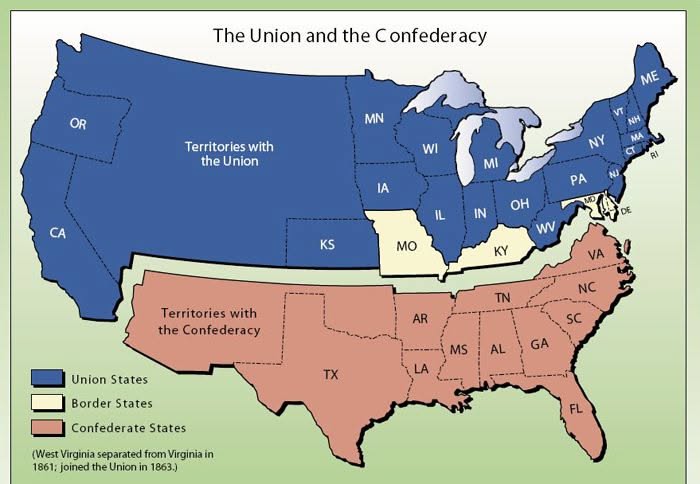
Secession: The act of a state formally withdrawing from the United States, which eleven Southern states did between December 1860 and June 1861, forming the Confederate States of America.
The Lost Cause: A post-war revisionist narrative, systematically promoted by former Confederates and their descendants, which held that the Confederacy fought for constitutional principles rather than slavery, and that enslaved people were generally content with their condition.
Emancipation Proclamation: President Lincoln's executive order, issued January 1, 1863, declaring enslaved people in Confederate-held territory to be "forever free" and authorizing Black men to serve in the Union Army.
Reconstruction: The period from 1865 to 1877 during which the federal government attempted to reintegrate the former Confederate states while securing civil rights for formerly enslaved people. It ended with the withdrawal of federal troops and the subsequent disenfranchisement of Black Southerners.
Fugitive Slave Act: Federal legislation, strengthened in 1850, requiring citizens in free states to assist in the capture and return of escaped enslaved people. The act was profoundly unpopular in the North and was a significant accelerant of sectional tensions.
The Secession Declarations: The Confederacy's Own Case
The Lost Cause narrative has never had to contend seriously with the most obvious piece of evidence against it: the Confederate states' own statements about why they were leaving the Union.
These declarations were written at the moment of maximum sincerity, before the revisionist project had begun, by men who were explaining their actions to their own citizens and to the world.
South Carolina, the first state to secede (December 20, 1860), devoted most of its declaration to the Union's failure to enforce the Fugitive Slave Act.[8] It complained specifically that Northern states had passed "personal liberty laws" designed to obstruct the return of escaped enslaved people.
The irony - that South Carolina invoked states' rights while simultaneously demanding that Northern states be prevented from exercising their own sovereignty over fugitive slave enforcement - was not lost on contemporaries.
Mississippi, which seceded January 9, 1861, was explicit to the point of bluntness: "Our position is thoroughly identified with the institution of slavery - the greatest material interest of the world." The declaration went on to argue that slavery was essential to Southern civilization, that the African was an inferior being suited to enslavement, and that Republican government threatened the institution.
Georgia's declaration of January 19, 1861, argued at length about the economic stakes of slavery, the Republican Party's hostility to the institution, and the impossibility of remaining in a Union governed by a party committed to slavery's restriction.
Texas's declaration, adopted February 2, 1861, went further than any other, stating that Texas had been settled by the "white race" for the benefit of the "white race" and that the African was naturally inferior to the white man.
These were not statements made under duress or in haste. They were formal legal documents explaining to the world why sovereign states were dissolving their bonds with the United States government.[9] There is no credible interpretation of them that does not place slavery at the center of the Confederate project.
The Economic Architecture of Slavery
The Confederate states did not secede over an abstraction. The wealth of the antebellum South rested on a foundation of human bondage so vast and so deeply embedded in the economy that its preservation was treated as existential.
By 1860, the approximately four million enslaved people in the United States represented the largest single category of capital asset in the country, valued at roughly $3.5 billion - a figure that exceeded the combined value of all the nation's railroads and all its manufacturing enterprises.
Historian Edward Baptist, in "The Half Has Never Been Told" (2014), documented the extent to which enslaved people were used as collateral for loans, bought and sold in sophisticated financial markets, and managed as capital assets with the same ruthless efficiency applied to any other productive property.[4]
The domestic slave trade - the buying and selling of enslaved people within the United States, primarily from the Upper South to the expanding cotton frontier of the Deep South - was itself a massive industry.
Between 1820 and 1860, roughly one million enslaved people were sold away from Virginia, Maryland, and the Carolinas to Mississippi, Alabama, Louisiana, and Texas, generating enormous profits for slave traders and financing the expansion of the cotton economy.
Cotton was the engine of that economy. By 1860, cotton accounted for over half of all US export earnings, and the vast majority of it was grown by enslaved labor on Southern plantations.
The Mississippi Delta, the Alabama Black Belt, the South Carolina low country - these were among the wealthiest agricultural regions in the world, and that wealth had a single source.
When Southern planters spoke of protecting "their way of life," they were speaking with precision: a way of life in which the largest fortunes derived from the ownership and exploitation of other human beings.
The 1860 Census makes the distribution visible. In Mississippi, the wealthiest state per capita in the United States in 1860, the top twenty wealthiest individuals were all large slaveholders. The Confederacy's richest men were not manufacturers or financiers - they were planters, and their wealth walked on two legs.
The Political Crisis: A Decade of Accelerating Failure
The Civil War did not begin with Lincoln's election in November 1860; it had been building through a decade of political crises that progressively destroyed every institutional mechanism for containing the slavery question.
The Missouri Compromise of 1820 had established a framework for managing slavery's westward expansion: slavery would be permitted south of latitude 36-30, prohibited north of it. The framework worked for thirty years.
Then the Mexican-American War added approximately 500,000 square miles of new territory - and reopened the question in its most dangerous form.
The Compromise of 1850 attempted another settlement, admitting California as a free state and implementing "popular sovereignty" (local determination) for other territories.
But it included the Fugitive Slave Act - which required citizens in free states to participate in the capture of escaped enslaved people and imposed heavy penalties for non-compliance.
The Act transformed an abstract argument about Western territories into an immediate, personal confrontation for Northerners who suddenly found themselves legally required to assist in human kidnapping.
The Kansas-Nebraska Act of 1854, sponsored by Illinois senator Stephen Douglas, was intended to resolve the territorial question once and for all by applying popular sovereignty to all new territories, explicitly repealing the Missouri Compromise.
Instead, it detonated a political explosion. Pro-slavery and anti-slavery settlers poured into Kansas, formed rival governments, and fought each other in what became known as "Bleeding Kansas." The episode destroyed the Whig Party, which had functioned as a national institution bridging sectional interests, and replaced it with the Republican Party - organized explicitly around opposition to slavery's expansion.
The Democratic Party split along sectional lines, losing its capacity to serve as a national unifying institution.
The Dred Scott decision of 1857 was supposed to settle the matter through judicial authority.[10]
Chief Justice Roger Taney, ruling for a 7-2 majority, held that Scott - an enslaved man who had lived for years in free territory - could not sue for his freedom because Black people were not citizens and had "no rights which the white man was bound to respect."
More consequentially for the sectional crisis, Taney ruled that Congress had never had constitutional authority to prohibit slavery in any territory, thereby invalidating the Missouri Compromise and, by implication, the entire Republican Party platform.
The ruling accomplished the opposite of its intended effect: it convinced many Northerners that there was no constitutional means of constraining slavery's expansion, radicalized Republican opinion, and handed Republicans an enormously effective political argument.
John Brown's raid on Harpers Ferry in October 1859 - an attempt to seize the federal armory and spark a general slave rebellion - ended in failure and Brown's execution.
But it convinced many white Southerners that Northern abolitionists were violent revolutionaries, and Brown's martyrdom in segments of Northern opinion confirmed their fears.
Lincoln's Election and the Decision for Secession
Abraham Lincoln won the presidency in November 1860 without carrying a single Southern state. His platform was not abolitionist - he explicitly promised not to interfere with slavery where it existed. But he was unequivocal that slavery could not be permitted to expand into new territories.
This was, for the planter class, an existential threat. The slave states had maintained influence in national politics partly through the three-fifths compromise, which gave them congressional representation and electoral votes proportional to their enslaved population.
As the country expanded and free states multiplied, this advantage would erode - and a political majority committed to containing slavery would eventually have the power to do something about it.
The Southern fire-eaters had concluded, correctly, that the trend of American demographics and politics ran against them. They chose to leave rather than adapt.
The War Itself: Why the Union Won
The Confederacy's strategic theory was reasonable on its face: the Union could not conquer an area the size of Western Europe with the will and determination to resist. Defeat enough Union armies, maintain enough Confederate territory, and Northern political will would eventually crack.
This strategy came remarkably close to working. By the summer of 1864, after three years of grinding war, Lincoln himself doubted he would win reelection. A Democratic victory in November 1864 would have meant negotiations with the Confederacy - potentially on terms that preserved slavery.
Two developments prevented this outcome. Sherman's capture of Atlanta on September 2, 1864 - the result of a brilliantly unconventional campaign that flanked Confederate General Joseph Johnston out of position - demonstrated that Union military progress was real and generated enormous Northern enthusiasm.
Sheridan's subsequent victories in the Shenandoah Valley completed the political transformation. Lincoln was reelected by a large margin, the war would be fought to conclusion, and the Confederacy's strategic theory was refuted.
The Union's material advantages were decisive in a prolonged war.[2] Northern population stood at roughly 22 million versus approximately 9 million in the Confederacy, of whom 3.5 million were enslaved and could not (at first) serve as Confederate soldiers.
The Union possessed the bulk of US industrial capacity, over 70% of railroad mileage, an established navy capable of blockading Confederate ports, and financial institutions that could sustain war debt.
General Ulysses Grant, promoted to General-in-Chief in March 1864, understood that the Confederacy's only path to victory was time, and he implemented a strategy of relentless simultaneous pressure on all fronts - refusing to allow Confederate forces to concentrate or recover.
The Emancipation Proclamation: Strategy and Morality
The Emancipation Proclamation of January 1, 1863 is sometimes described as merely political - a wartime measure that freed no one immediately. This is partly true and largely misleading.
The Proclamation applied to Confederate-held territory, where Union authority did not yet run; it did not apply to border states or Union-held Confederate territory. But its effects were immediate and profound.
Practically, it authorized the enlistment of Black men into the Union Army. By the end of the war, 180,000 Black men had served in the United States Colored Troops, fighting in over 400 engagements. Their participation was not marginal - it was, in the war's final phases, essential.
Frederick Douglass understood this: once Black men carried rifles for the Union, citizenship could not be permanently denied. The Proclamation also accelerated the flight of enslaved people from Confederate plantations, directly undermining the agricultural production that sustained the Confederate war effort.
Diplomatically, the Proclamation made it politically impossible for Britain or France to recognize the Confederacy. Both powers had significant economic interests in cotton, and there had been genuine momentum in the British government toward Confederate recognition.
But both Britain and France had abolitionist domestic movements, and recognizing a slaveholding republic after Lincoln had framed the war explicitly as a struggle for freedom would have been politically ruinous. The Confederacy's hope of foreign intervention died with the Proclamation.
The Thirteenth Amendment, ratified December 6, 1865, made permanent what the Proclamation had begun, abolishing slavery throughout the United States.
Reconstruction and Its Defeat
The period from 1865 to 1877 was a genuine attempt, however flawed and incomplete, to build an interracial democracy in the former Confederate states.
The Reconstruction Amendments - the Thirteenth (abolishing slavery), Fourteenth (equal citizenship and due process), and Fifteenth (voting rights regardless of race) - remade the constitutional framework.
Black men voted in large numbers, held office at every level of government, and built political organizations of remarkable sophistication.
Hiram Revels and Blanche Bruce served in the US Senate. More than a dozen Black men served in the House of Representatives. Black communities built schools, churches, and businesses.
Reconstruction was destroyed by organized violence and Northern political exhaustion.[3] The Ku Klux Klan and similar paramilitary organizations used systematic terrorism - murder, arson, beatings - to suppress Black voting and drive Republicans from power in the South.
The Compromise of 1877, which resolved the disputed 1876 presidential election by giving the presidency to Rutherford Hayes in exchange for withdrawing federal troops from the South, effectively ended federal protection for Black Southerners.
Within two decades, Black men had been disenfranchised through poll taxes, literacy tests, grandfather clauses, and violence. Segregation was institutionalized through Jim Crow laws. Lynching became a tool of racial terror. The "Redeemers" - white Democratic politicians who overturned Reconstruction governments - had won.
The Long Shadow: Confederate Monuments and Neo-Confederate Revisionism
The Lost Cause narrative was institutionalized through deliberate cultural investment.[5] The United Daughters of the Confederacy, founded in 1894, campaigned successfully to ensure that textbooks across the South taught the Lost Cause version of the war for generations.
The movement produced a distinctive cultural infrastructure: monuments, ceremonies, holidays, and a literature that romanticized the antebellum South and rehabilitated Confederate leaders as heroes.
The timing of Confederate monument construction is revealing. Very few were erected immediately after the war, when grief was fresh.
The largest waves came in two subsequent periods: roughly 1900-1915, coinciding with the peak of Jim Crow legal entrenchment, the nadir of racial violence, and the national reconciliation movement that brought North and South together by setting aside the question of Black rights; and 1950-1965, coinciding directly with the Civil Rights Movement.
A monument to Robert E. Lee erected in 1965 at a courthouse where Black voters were being turned away was not a memorial to the war dead - it was a statement about contemporary racial hierarchy.
Neo-Confederate revisionism persists in popular culture, in some educational contexts, and in political rhetoric. It is not a legitimate historical debate - professional historians reached consensus on the Civil War's causes decades ago, and the primary sources are unambiguous.
But it continues to serve political functions: obscuring the racial stakes of the Civil War, legitimizing Confederate symbols as markers of regional pride rather than white supremacy, and making it harder to have honest conversations about the racial inequalities that Reconstruction's defeat left intact.[7]
Toward Honest History
The Civil War's causes are not obscure. The men who made the Confederacy said exactly what they were doing. Stephens said slavery was the cornerstone. The secession declarations said slavery was the cause. The Confederate Constitution protected slavery from being abolished by any Confederate state.[6]
The political crises of the preceding decade were all about slavery's expansion, slavery's enforcement, and the rights of enslaved people.
The war was fought, at its core, over whether the United States would remain half slave and half free - and the Union's victory, sealed by the Thirteenth Amendment, answered that question.
What followed - the defeat of Reconstruction, the imposition of Jim Crow, the long campaign to rehabilitate the Confederacy - was a second struggle over the same question, fought with different weapons. The Confederate monuments built during the Civil Rights era were not historical commemorations; they were political interventions.
Understanding this is not about relitigating old grievances; it is about seeing American history with sufficient clarity to understand the present.
The Cornerstone Speech was not a secret. Alexander Stephens published it himself. It took over a century of sustained effort to obscure what it contained.
Sources & Further Reading
- Stephens, Alexander H. "Cornerstone Speech." Savannah, Georgia, March 21, 1861. Reprinted in The Rebellion Record, Vol. 1 (1861).
- McPherson, James M. Battle Cry of Freedom: The Civil War Era. Oxford University Press, 1988.
- Foner, Eric. Reconstruction: America's Unfinished Revolution, 1863-1877. Harper & Row, 1988.
- Baptist, Edward E. The Half Has Never Been Told: Slavery and the Making of American Capitalism. Basic Books, 2014.
- Blight, David W. Race and Reunion: The Civil War in American Memory. Harvard University Press, 2001.
- McCurry, Stephanie. Confederate Reckoning: Power and Politics in the Civil War South. Harvard University Press, 2010.
- Rothstein, Richard. The Color of Law: A Forgotten History of How Our Government Segregated America. Liveright, 2017.
- South Carolina Declaration of Secession (December 20, 1860). Available at: View source
- Mississippi Declaration of Secession (January 9, 1861). Available at: View source
- Dred Scott v. Sandford, 60 U.S. 393 (1857). DOI: 10.2307/1811403