
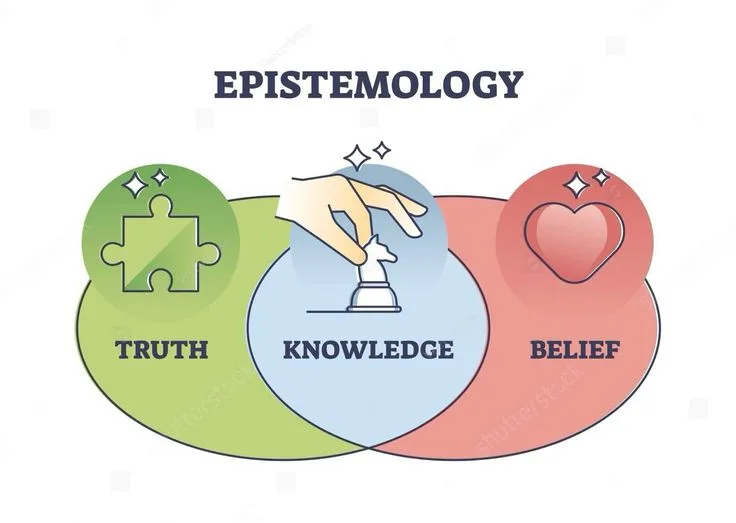
What is epistemology? It is the study of knowledge, its sources, its justification, and its limits. The traditional account treats knowledge as justified true belief, but Gettier cases show that a belief can be true and justified by accident. The field also examines the reliability of perception, memory, testimony, and reasoning when people decide what to believe.
You believe the earth is roughly 4.5 billion years old. You believe water is made of hydrogen and oxygen. You believe your friend is honest. You believe the news article you read this morning.
These beliefs vary enormously in how they were formed, how certain they are, and how much they actually deserve the label of knowledge. The philosophical discipline that examines these distinctions is epistemology, the study of knowledge itself.
Epistemology asks the questions that most people never consciously ask but implicitly rely on every day: What does it actually mean to know something? How do you distinguish knowledge from lucky guessing, from well-founded belief, from mere opinion? Where does knowledge come from? And what are the limits of what any person can know?
These are not abstract puzzles with no practical relevance. Questions about the sources and reliability of knowledge, about what counts as evidence, who counts as an authority, and when confidence is warranted, are at the heart of how we make decisions, evaluate information, and navigate a world full of competing claims.
The Central Question: What Is Knowledge?
Epistemology's foundational question is: what is knowledge?
The most influential answer comes from Plato's dialogue Theaetetus, written around 369 BCE. After exploring and rejecting several definitions of knowledge, Plato converged on a definition that would stand for over two millennia: knowledge is justified true belief.
To know something, on this account, three conditions must all be met:
- Belief: You must actually believe it. You cannot know something you doubt.
- Truth: The belief must be true. You cannot know something false (you can mistakenly believe it, but not know it).
- Justification: Your belief must be based on adequate grounds: evidence, reasoning, or reliable processes. Lucky guessing that happens to land on a truth does not count as knowledge.
This JTB (justified true belief) definition captures much of what we intuitively mean by knowledge.
It explains why we do not credit someone with knowing tomorrow's weather if they guessed correctly, why a false memory, however sincerely held, is not knowledge, and why deeply held but evidence-free beliefs about unverifiable claims occupy an epistemically different category than well-evidenced scientific conclusions.
The Gettier Problem: When JTB Isn't Enough
In 1963, Edmund Gettier, a young philosopher at Wayne State University, published a three-page paper that shook epistemology to its foundations. Titled "Is Justified True Belief Knowledge?", it offered simple, clear counterexamples demonstrating that justified true belief is not sufficient for knowledge.
The structure of a Gettier case: a person has a justified belief that is technically true, but is true for a different reason than the justification implies. The justification and the truth-maker are accidentally disconnected.
A classic version: Suppose you are in the Scottish highlands and you look at what appears to be a sheep standing in a field.
You form the justified belief "there is a sheep in that field." But what you are actually looking at is a rock painted to look like a sheep (from that distance, perfectly convincingly). However, hidden behind a hill where you cannot see it, there is an actual sheep in the field.
Your belief ("there is a sheep in that field") is:
- True: There is indeed a sheep in the field.
- Justified: You have excellent perceptual grounds for the belief.
- Believed: You clearly believe it.
But intuitively, you do not know there is a sheep in the field. You got the right answer by accident, through a coincidence between your misleading evidence and the world's actual state.
Gettier cases can be constructed in any domain: testimony, perception, memory, inference. They reveal that the relationship between justification and truth must be tighter than JTB requires: justification must somehow connect to the truth in the right way, not just accidentally coexist with it.
Philosophers have proposed dozens of solutions in the sixty-plus years since Gettier's paper. The most prominent include:
- No False Lemmas: Adding a condition that knowledge cannot be based on reasoning through false intermediate steps.
- Reliabilism: Knowledge requires that the belief was produced by a reliable process, not just that it happens to be justified and true.
- Proper Functionalism: Knowledge requires that one's belief-forming faculties are functioning properly in an appropriate environment.
- Virtue Epistemology: Knowledge requires beliefs formed through the exercise of intellectual virtues (open-mindedness, thoroughness, appropriate rigor).
None has achieved consensus, which is itself epistemically interesting: after 60 years of serious philosophical work, we still lack a universally agreed definition of one of our most fundamental concepts.
The Sources of Knowledge
Epistemology also asks: where does knowledge come from? The major sources are:
Perception
Sensory experience is the most immediate source of knowledge. Seeing, hearing, touching, tasting, and smelling provide direct information about the world.
But perception is not infallible. Optical illusions demonstrate that perceptual systems can produce systematically false representations. Color perception varies between individuals. Memory of perceived events degrades and distorts.
The reliability of perceptual knowledge, and the conditions under which it is trustworthy, is a major epistemological topic.
Memory
Much of what you know you know through memory rather than current perception. You do not currently see your childhood home, but you know what it looked like. Memory is epistemically both indispensable and fallible.
The psychology of memory is epistemically important here: research by Elizabeth Loftus and colleagues has demonstrated that human memory is reconstructive rather than reproductive: we do not replay recorded events but reconstruct them each time, filling gaps with inferences and expectations.
This makes memory less reliable than it feels from the inside, particularly for stressful or distant events.
Testimony
The vast majority of what any individual knows comes through testimony, what other people tell them. You know the French Revolution happened not through personal observation but because countless sources of testimony (textbooks, historians, museums) say so. You know your date of birth because your parents told you.
Epistemologists debate the status of testimonial knowledge: is it always reducible to the testimonial sources' own perception and reasoning (reductionism), or does testimony provide an independent basic source of justification (anti-reductionism)?
Either way, the reliability of testimony depends on the reliability of the testifier, raising questions about authority, expertise, and trustworthiness that are profoundly practically relevant.
Reason
Reason, the capacity to draw inferences and identify logical relationships, generates knowledge in two ways.
Deductive reasoning produces knowledge through logical entailment: if the premises are true and the argument is valid, the conclusion must be true. Mathematical knowledge is paradigmatically deductive. Once you accept the axioms of Euclidean geometry, all geometric theorems are known with certainty through deduction.
Inductive reasoning draws general conclusions from particular observations: you observe that the sun has risen every morning for your entire life and conclude that it will rise tomorrow. This provides strong reason to believe the conclusion but not logical certainty: the future might not resemble the past.
David Hume famously argued that there is no rational justification for inductive inference, the problem of induction, because the inference from past patterns to future regularities itself depends on assuming the world is uniform, which is exactly what is in question. This remains one of philosophy's deepest unresolved problems.
Rationalism vs Empiricism: The Great Epistemological Debate
The most significant historical debate in epistemology concerns the relative priority of reason and experience as sources of knowledge.
Rationalism holds that some genuine knowledge can be obtained through reason alone, prior to and independent of experience. The paradigm cases are mathematics and logic: we know that 7 + 5 = 12 not by counting seven things and five things repeatedly but by grasping the logical relationships between numbers.
Rationalist philosophers, Descartes, Leibniz, Spinoza, argued that reason could also generate substantive knowledge about reality (God, causation, substance) through pure thought.
Descartes' famous Cogito ergo sum ("I think, therefore I am") is a rationalist foundation: it is knowledge derived from pure rational reflection, not from sensory experience.
Empiricism holds that all meaningful knowledge about the external world must ultimately be grounded in sensory experience. Empiricists, Locke, Hume, Berkeley, argued that the mind begins as a "blank slate" (tabula rasa) and acquires all knowledge through perception.
Abstract concepts like "substance" or "causation" that cannot be traced to sensory impressions are either confused or meaningless.
Hume's analysis of causation is a landmark of empiricism: we do not perceive causation directly, we observe constant conjunction (one thing always following another) and our minds add the concept of necessary connection.
The "necessary connection" we attribute to causal relationships is a projection of our own expectations, not a feature of reality we observe directly.
Kant's synthesis attempted to resolve the debate. In the Critique of Pure Reason (1781), Kant argued that some knowledge is a priori (prior to experience) and yet genuinely informative. The mind imposes categories, space, time, causation, unity, on raw sensory experience.
These categories make experience possible and are known a priori. But they apply only to the realm of possible experience; they cannot be extended to "things in themselves" beyond experience.
The rationalism/empiricism debate has contemporary relevance in cognitive science: debates about whether humans have innate language structures (Chomsky), innate moral intuitions, or innate concepts of number reflect the same underlying question about what knowledge is built in versus learned from experience.
Key Epistemological Concepts for Everyday Reasoning
A Priori vs A Posteriori Knowledge
- A priori knowledge: Known independently of experience, through reason alone. Mathematical truths are the clearest examples: you do not need to count objects to know that 2 + 2 = 4.
- A posteriori knowledge (or empirical knowledge): Known through experience. "Water boils at 100°C at sea level" is a posteriori, we know it through observation and measurement.
Foundationalism vs Coherentism
How is the structure of our knowledge organized?
Foundationalism holds that knowledge rests on basic, foundational beliefs that are self-evident or directly given by experience, and that other beliefs are justified by their inferential connection to these foundations.
Descartes' project was foundationalist: find beliefs so certain they cannot be doubted, and build all other knowledge on that base.
Coherentism holds that beliefs are justified by their coherence with other beliefs in a web or network: there are no foundational beliefs, just mutually supporting sets. A belief is more justified the more it coheres with the rest of what you believe.
Fallibilism
Fallibilism is the view that all our knowledge claims are potentially subject to revision, even our most confident beliefs could turn out to be wrong in light of new evidence. This is the epistemological foundation of scientific method: no theory is beyond revision, however well supported.
Fallibilism does not collapse into skepticism (the view that we know nothing); it simply holds that knowledge and certainty are different things.
Skepticism: The Extreme Challenge
Skepticism is the position that knowledge, or certain kinds of knowledge, is impossible or unattainable. Epistemological skepticism comes in many strengths:
- Global skepticism: We cannot know anything at all.
- External world skepticism: We cannot know anything about the world outside our own minds.
- Local skepticism: We cannot know certain things in a specific domain (e.g., about the past, about other minds, about moral truths).
Descartes raised the most famous skeptical scenario in his Meditations: how do you know you are not dreaming right now? More radically, how do you know an evil demon is not systematically deceiving you about everything you experience?
The modern version is the brain-in-a-vat scenario: how do you know your brain is not in a vat, connected to a computer generating all your experiences?
Most contemporary epistemologists are not skeptics, they think the skeptical scenarios can be addressed or that skeptical conclusions do not follow from the scenarios.
But the skeptical challenge functions as a rigorous stress test for any theory of knowledge: whatever conditions are required for knowledge, they must be conditions we could plausibly meet in the actual world.
Epistemic Humility: The Practical Upshot
Epistemic humility is the disposition to recognize the limits of your own knowledge, the possibility that your beliefs are mistaken, and the importance of remaining open to revision in light of new evidence.
It is distinct from:
- Epistemic cowardice: Refusing to commit to positions to avoid being wrong.
- Relativism: The view that all positions are equally valid.
- Excessive certainty: Treating strong evidence as proof and well-founded beliefs as known facts beyond revision.
Epistemic humility means calibrating confidence to evidence: being highly confident in claims supported by overwhelming, replicated evidence; more tentative about claims supported by limited or contested evidence; and openly uncertain about claims where evidence is sparse.
Philip Tetlock's research on forecasting, synthesized in Superforecasting (2015), found that individuals who achieved the best probabilistic predictions over long time horizons shared a consistent epistemic profile: they updated their beliefs frequently in response to evidence, acknowledged when they were wrong, expressed calibrated uncertainty rather than overconfident predictions, and drew on diverse information sources rather than a single framework.
This profile is, essentially, applied epistemic humility.
The Dunning-Kruger effect, the finding that people with limited competence in a domain systematically overestimate their competence, is the psychological complement to epistemic humility.
The antidote is not humility as a personality trait but the deliberate practice of seeking disconfirming evidence, testing beliefs against reality, and maintaining awareness of the limits of one's expertise.
How Epistemology Applies in Practice
Epistemological concepts provide tools for evaluating the information we encounter daily:
| Epistemological Concept | Practical Application |
|---|---|
| Justified true belief | Distinguish knowing from guessing; check your justifications |
| Reliability of sources | Evaluate testimonial knowledge by source credibility |
| Inductive limits | Recognize that patterns may not hold; base rates matter |
| Fallibilism | Hold beliefs provisionally; update when evidence changes |
| Epistemic humility | Calibrate confidence; express appropriate uncertainty |
| Coherentism | Check new claims for consistency with well-established beliefs |
Understanding epistemology makes you a better consumer of information in an environment of unprecedented information abundance and unprecedented opportunities for misinformation.
Questions like "What is the evidence for this?" "Who is the source and how reliable are they?" "Am I confusing what I believe with what I know?" and "How confident should I actually be?" are epistemological questions translated into everyday practical inquiry.
Summary
"The trouble with the world is that the stupid are cocksure and the intelligent are full of doubt.", Bertrand Russell, one of the founders of analytic epistemology, identifying the practical cost of miscalibrated confidence that epistemology aims to correct
Epistemology is the philosophical investigation of knowledge: what it is, where it comes from, and what its limits are.
The traditional definition of knowledge as justified true belief, disrupted by Gettier's counterexamples, remains the starting point for discussions that have continued to generate serious philosophy for six decades.
The great historical debate between rationalists (who trust reason to generate knowledge a priori) and empiricists (who ground all knowledge in experience) was partially synthesized by Kant and continues to animate debates in cognitive science.
The major sources of knowledge, perception, memory, testimony, and reason, are each fallible in different ways.
The practical value of epistemology is not in resolving its open problems but in developing the intellectual habits its questions cultivate: holding beliefs with evidence-proportionate confidence, remaining open to revision, distinguishing reliable from unreliable sources, and maintaining the epistemic humility that distinguishes careful reasoning from confident noise.