
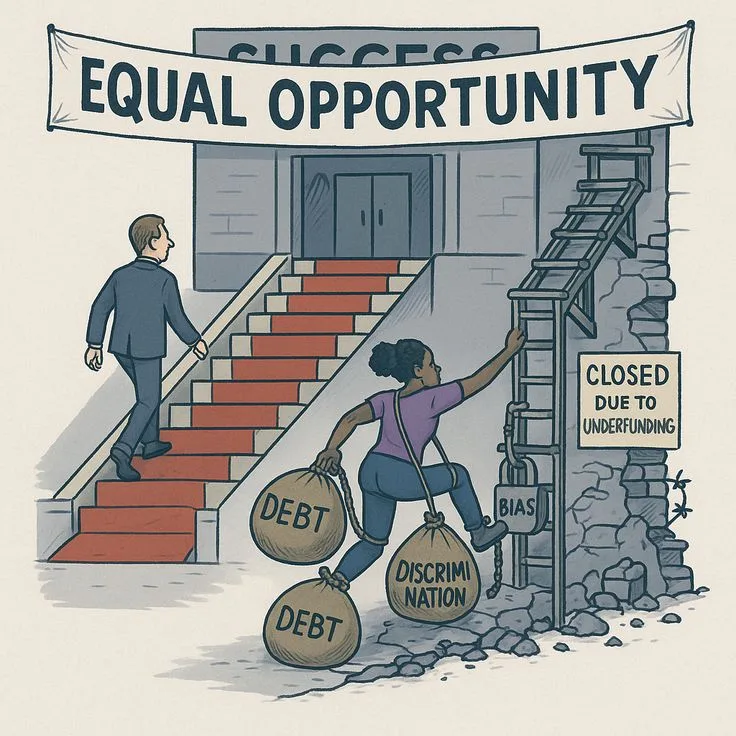
Why inequality is rising involves several overlapping forces: technological change, globalization, winner-take-all markets, capital returns, weakened labor bargaining, and tax policy. Income, wealth, regional opportunity, and intergenerational mobility are related but distinct forms of inequality with different remedies. The central dispute is not simply whether the gap has widened, but which mechanisms matter most and how gains, risks, and power should be distributed.
In 1971, the year Richard Nixon closed the gold window and ushered in the modern floating exchange rate era, a production worker at a General Motors plant in Flint, Michigan earned roughly $17 an hour in 2023 dollars - enough to buy a home, raise a family, and retire with a pension without a college degree.
The Gini coefficient measuring US income inequality that year was around 0.35. By 2022, it had risen to 0.39, a seemingly modest numerical shift that masks a dramatic reorganization of who gets what.
The top 1% of American earners, who took home about 10% of total income in the early 1970s, now capture roughly 19-20%, according to Emmanuel Saez and Gabriel Zucman's long-run income share estimates at UC Berkeley.[3] The share going to the bottom 50% has moved in the opposite direction.
The standard story of rising inequality names a set of familiar culprits: globalization, automation, declining unions, Reagan-era tax cuts. Each explanation contains genuine truth.
But the economics of the widening gap is considerably more complex than any single cause allows, and the politics of addressing it more contested than either left or right typically acknowledges.
Thomas Piketty's landmark "Capital in the Twenty-First Century" (2014), the most discussed economics book in decades, offered a sweeping structural argument: capitalism, left to itself, tends toward ever-greater wealth concentration because the rate of return on capital has historically exceeded the rate of economic growth.[1]
This is Piketty's famous r > g - and its implications, if true, are unsettling for anyone who assumes that growth alone can solve the distribution problem.
What makes inequality particularly hard to address is that it is not one phenomenon but several, operating at different levels of the economy, over different time horizons, through different mechanisms. Income inequality is distinct from wealth inequality (which is more extreme and more persistent).
Inequality between individuals is distinct from inequality between regions. Inequality of outcomes is distinct from inequality of opportunity - a distinction that sits at the heart of political disagreements about what, if anything, to do.
Understanding why the gap is widening, and what history and research suggest about narrowing it, requires working through these distinctions carefully, because the policy responses differ depending on which form of inequality you are trying to address.
"The rate of return on capital has exceeded the rate of growth of output and income for much of human history. The tendency for returns on capital to exceed the rate of growth...
implies that the entrepreneur inevitably tends to become a rentier, more and more dominant over those who own nothing but their labor." - Thomas Piketty, Capital in the Twenty-First Century (2014)
| Driver of Inequality | Mechanism | Evidence |
|---|---|---|
| Skill-biased technological change | Automation raises returns to high-skill work | College premium rising since 1980s |
| Globalization | Low-skill labor competes globally | Manufacturing decline in wealthy countries |
| Winner-take-all markets | Top performers capture disproportionate rewards | CEO pay; superstar economics |
| Capital share growth | Returns to capital outpace wage growth | Piketty's r > g thesis |
| Declining union density | Less bargaining power for workers | Union membership fell; wage share fell in tandem |
| Tax policy changes | Top marginal rates cut in US, UK | Post-1980 tax reforms favored wealthy |
Key Definitions
Gini coefficient: A summary measure of income or wealth distribution, ranging from 0 (perfectly equal distribution) to 1 (one person holds everything). The US Gini for income is approximately 0.39-0.41; Nordic countries typically score 0.26-0.29.
r > g: Thomas Piketty's formulation that when the rate of return on capital (r) exceeds the rate of economic growth (g), wealth concentrates over time among those who own capital, as investment returns outpace the income growth of wage earners.
Income share: The fraction of total national income captured by a given segment of the population - commonly the top 1%, top 10%, or bottom 50%. In the US, the top 1% income share has roughly doubled since the 1970s.
Skill-biased technological change (SBTC): The tendency of modern information technology to increase demand for high-skill cognitive labour while substituting for routine mid-skill tasks, thereby raising earnings inequality between education levels.
Absolute income mobility: The share of people who earn more (in real terms) than their parents did at the same age. Raj Chetty and colleagues found this fell from ~90% for Americans born in 1940 to ~50% for those born in 1980.[7]
Elephant curve: Branko Milanovic's visualization of global income growth from 1988 to 2008, showing large gains for the global middle class (primarily in China and emerging economies), small gains for Western working classes, and very large gains for the global top 1%.[10]
Superstar economics: The economic dynamic, identified by Sherwin Rosen in 1981, in which small differences in talent or position at the top of a market translate into enormous income differences, because technology allows the best performer to serve global markets at near-zero marginal cost.
The Long-Run Trend: What the Data Show
The rise in inequality within wealthy nations is one of the most extensively documented trends in modern social science.
Saez and Zucman's long-run series for the United States, compiled from tax records and national accounts data, shows that the top 1% income share fell from above 20% in the 1920s to roughly 10% by the 1970s - a compression driven by New Deal policies, progressive taxation, unionization, and the destruction of capital in the Depression and Second World War.
Since approximately 1980, the trend reversed sharply. By 2015, the top 1% income share had returned to roughly 20%; the top 0.1% share had risen even faster.
Wealth inequality is substantially more extreme. Federal Reserve data show the top 1% holding approximately 38% of US household wealth, the top 10% holding roughly 70%, and the bottom 50% holding approximately 2-3%.
This concentration reflects the compounding logic at the heart of Piketty's argument: wealth generates returns that, reinvested, generate more wealth.
Those who own substantial financial assets, real estate, and businesses see their net worth grow faster than their earned income, and faster than the economy as a whole.
The primary mechanism for passing these advantages forward is inheritance - what Piketty calls "patrimonial capitalism," the return of wealth concentration levels not seen since the belle epoque.
The international comparisons are instructive. OECD data consistently show the United States at the high end of inequality among wealthy democracies, with a Gini coefficient for disposable income (after taxes and transfers) of around 0.37-0.39, compared with Germany at 0.29, France at 0.30, and the Nordic countries at 0.26-0.29.
This gap is not explained entirely by pre-tax market income differences; it largely reflects the lower degree of redistribution through the US tax and transfer system.
Canada and Australia, with similar labour markets and demographic profiles to the US, achieve meaningfully lower inequality - suggesting that policy choices, not just structural forces, explain a substantial part of the difference.
The Structural Argument: Piketty's r > g
Piketty's central theoretical claim is that when the rate of return on capital (r) exceeds the rate of economic growth (g), wealth concentration is the natural long-run equilibrium of market economies.
Over much of modern history, r has been in the range of 4-5% per year, while g - the growth rate of total output - has averaged 1-2% in mature economies.
At these rates, those who own substantial capital accumulate wealth faster than the economy grows, and faster than wage earners can save and invest. The result, compounded over generations, is a world in which inherited wealth increasingly dominates earned income.
Piketty's analysis drew both admiring responses and sharp criticism. Lawrence Summers (2014) argued that Piketty conflated the net return on capital with the gross return, and that as capital accumulates, its return will decline - an equilibrating mechanism that Piketty's framework understates.
Matthew Rognlie (2015) argued that virtually all the increase in the capital-output ratio in recent decades is attributable to housing appreciation rather than productive capital, and that housing is a policy problem (restrictive zoning, planning failures) amenable to targeted solutions.
Acemoglu and Robinson argued that Piketty's purely economic framework neglects the institutional and political determinants of inequality - that the policies of the 1980s, not the inexorable logic of r > g, explain much of what happened.
These are genuine scholarly disputes, not merely political ones. But the core observation - that those who own productive assets have seen their wealth grow substantially faster than those who depend on wages - is consistent with the data regardless of the theoretical mechanism.
Technology and the Hollowing Out of the Middle
The skill-biased technological change hypothesis is one of the most durable findings in labour economics.
Lawrence Katz and Alan Krueger (1992) and Katz and Kevin Murphy (1992) documented that the college wage premium - the earnings advantage of college graduates over high school graduates - rose sharply in the 1980s even as the supply of college graduates increased, implying that demand for skilled labour grew faster than supply.
This demand increase, they argued, was driven by information technology.
David Autor's subsequent work refined and complicated this picture. In a series of influential papers, Autor, Frank Levy, and Richard Murnane (2003) developed the "task framework" for understanding technological substitution.[4]
The key insight is that computers do not replace workers uniformly; they substitute for routine tasks - precisely defined, rule-following activities that can be codified in software - while complementing non-routine cognitive tasks (problem-solving, creativity, judgment) and leaving non-routine manual tasks (care work, cleaning, construction) largely untouched.
The occupations most affected by computerization are middle-skill, routine jobs: bookkeeping, clerical work, assembly-line production, data entry. The result is labour market "polarization" - job growth at the high-skill and low-skill ends, contraction in the middle.
This polarization is visible in wage data. Real wages for college graduates rose substantially from the 1980s onward. Real wages for workers without college degrees stagnated or fell, particularly for men in manufacturing and mid-skill occupations.
The "hollowing out" of middle-income jobs is a consistent finding across OECD countries with different trade and immigration exposure, suggesting technology is doing most of the work - though the relative contribution of technology versus trade versus institutional change (unions, minimum wages) remains disputed.
Sherwin Rosen's 1981 paper "The Economics of Superstars" anticipated a related dynamic. Rosen showed that in markets where small quality differences matter and the best performer can serve the entire market, returns concentrate dramatically at the top.[11]
A modestly talented pianist in the 1880s could earn a living performing locally; Liszt could fill concert halls across Europe.
In the digital economy, this logic applies across sectors: the best software platform captures global markets, the leading professional services firm wins the largest deals, the most-followed creator earns orders of magnitude more than the merely good.
Winner-take-all or winner-take-most dynamics have spread from entertainment into finance, professional services, and platform businesses in ways that explain a significant share of top-end income growth.
Trade, the "China Shock," and Regional Inequality
Economists long argued that free trade produces aggregate gains even when some workers are displaced - because the economy-wide efficiency gains exceed the losses to import-competing workers, and in principle the winners can compensate the losers.
Whether compensation actually occurs is a political question, not an economic one, and the answer has generally been: no.
Daron Acemoglu, David Autor, David Dorn, Gordon Hanson, and Brendan Price's research on the "China shock" (2016) documented the specific local labour market effects of rising Chinese import competition.[5]
Counties with high exposure to Chinese imports - those where employment was concentrated in manufacturing sectors that China entered - experienced lasting declines in employment, wages, and earnings that were not offset by gains elsewhere.
Workers displaced from these industries did not, in aggregate, find comparable employment in other sectors.
The adjustment mechanisms that trade theory assumed - geographic mobility, industry switching - proved far slower and less complete than models predicted, particularly for older workers and less educated workers in regions where manufacturing was the dominant employer.
Dani Rodrik at Harvard has pushed this analysis further, arguing that advanced economies over-globalised - that the pace and form of trade liberalization from the 1990s onward was politically unsustainable precisely because its costs were concentrated on specific groups while its gains were diffuse.
Rodrik's "political trilemma" argument holds that nations cannot simultaneously maximise economic globalisation, national sovereignty, and democratic politics.
The political backlash against trade - manifest in the Brexit vote, the election of Donald Trump in 2016, and rising economic nationalism across wealthy democracies - is, on this reading, a predictable consequence of a model of globalisation that ignored distribution.
Inheritance, Housing, and Dynastic Wealth
Two specific mechanisms deserve particular attention as drivers of long-run wealth concentration: housing appreciation and inheritance.
Housing has become the primary store of wealth for most middle-class families and the primary vehicle through which prosperity is transmitted across generations in wealthy countries.
Home prices in major metropolitan areas in the US, UK, Canada, and Australia have risen far faster than incomes since the 1980s, driven by a combination of restrictive zoning that constrains supply, low interest rates that inflated asset prices, and the economic geography that concentrates high-productivity activity in a small number of cities.
This has created a structural divide between those who owned property before the appreciation - and their children, who benefit from family wealth, proximity to opportunity, and inheritance - and those who rent, who pay an increasing share of income for housing while building no equity.
Matthew Rognlie's analysis found that nearly all of the increase in the capital share of income in Piketty's data is attributable to housing.
This is both a qualification of Piketty's thesis (it is less about manufacturing capital and financial capital than about land and property) and a diagnosis: rising housing costs and land-value capture by existing owners is a major, policy-amenable driver of the wealth gap.
Land value taxes, zoning reform to allow denser construction, and social housing investment are policy levers with direct theoretical connections to housing-based inequality.
Inheritance transmits advantage across generations in ways that directly challenge meritocratic ideals. Piketty's data show that the share of inherited wealth in total private wealth is rising across OECD countries, reversing a mid-twentieth-century decline.
Raj Chetty's "Great Gatsby Curve" work, and Miles Corak's cross-national analysis (2013), document a robust negative correlation between inequality and intergenerational mobility: more unequal countries show less mobility from one generation to the next.[9]
The mechanism is not mysterious - higher inequality means larger advantages to pass on and larger disadvantages to overcome - but the evidence is now sufficiently robust to challenge the comforting assumption that high inequality is compatible with high mobility.
Social Mobility: What Raj Chetty Found
Raj Chetty's Equality of Opportunity Project, conducted at Harvard and Stanford with co-authors Nathaniel Hendren, Patrick Kline, and Emmanuel Saez, has produced some of the most influential inequality research of the past decade.
Using administrative tax records linked across generations, Chetty's team has documented, mapped, and explained patterns of social mobility with unprecedented precision.
Their 2014 paper found that absolute income mobility - the share of children earning more than their parents at the same age - fell from approximately 90% for the 1940 birth cohort to approximately 50% for the 1980 cohort.
This decline was driven primarily by the increasingly unequal distribution of economic growth, not by slower growth per se: had post-1980 growth been distributed as evenly as 1940-1980 growth, absolute mobility would have remained near 90%.
Subsequent work mapped intergenerational mobility at the county level, revealing enormous geographic variation.[6] Some counties - the San Jose area, certain parts of the Great Plains - showed high mobility comparable to Denmark. Others - parts of the Southeast, industrial Midwest - showed mobility among the lowest of any rich country.
The geographic variation correlates with several local factors: school quality (measured by test-score data), family structure (two-parent families are associated with better child outcomes, though causality is complex), social capital and civic participation, residential segregation, and local income inequality itself.
Charles Murray's "Coming Apart" (2012) and Robert Putnam's "Our Kids" (2015) approached the same divergence from different political and methodological angles. Murray, writing from a libertarian perspective, emphasized the collapse of working-class family structure and community institutions.
Putnam, writing from a communitarian-liberal perspective, emphasized the withdrawal of upper-middle-class families from shared civic institutions and the disinvestment in the common goods - schools, parks, community organisations - that mobility depends on.
Both document, with different emphases, a society increasingly divided into parallel worlds with limited connection.
Policy Responses: What Works
The minimum wage is one of the most extensively studied labour market policies. The Card-Krueger New Jersey study (1994) challenged the consensus that minimum wage increases reduce employment by comparing fast food employment in New Jersey (which raised its minimum wage) with adjacent Pennsylvania (which did not).[8]
Finding no significant employment effect, the study launched an extensive research programme.
Arindrajit Dube at UMass Amherst has conducted a series of studies using county-pair designs (comparing counties on either side of state borders with different minimum wages) and found that moderate minimum wage increases raise incomes at the bottom with minimal disemployment effects.
This remains contested: some economists, including David Neumark and William Wascher, maintain that the employment effects are real but masked by averaging across heterogeneous workers.
Progressive taxation reduces post-tax inequality directly and raises revenue for redistribution.
Saez and Zucman's "The Triumph of Injustice" (2019) argues that the US effective tax system has become roughly flat - that the bottom 50% and the top 400 wealthiest Americans pay similar effective tax rates when all taxes are included - and that restoring progressivity requires taxing capital income and wealth more effectively.[2]
Direct investment in children has among the highest documented social returns. James Heckman's research on early childhood education programmes - particularly the Perry Preschool Project and the Abecedarian Project - shows that high-quality early intervention for disadvantaged children produces returns of 7-13% per year through improved educational outcomes, reduced crime, better health, and higher earnings.
Heckman argues that the earliest investments have the highest returns because skills built early enable further skill accumulation (the "skill begets skill" dynamic).
The Nordic model - particularly Denmark, Sweden, Finland, and Norway - consistently achieves high incomes alongside Gini coefficients in the 0.26-0.29 range.
The institutional package includes: high union coverage (70-80% in Scandinavia, compared with 10-12% in the US); generous universal social insurance; active labour market policies (retraining support rather than simple unemployment benefits); universal high-quality education from early childhood; and compressed wage structures from collective bargaining.
These countries are not without problems - immigration has strained social trust in some cases, and some benefits have been modestly cut - but they demonstrate empirically that market economies can function with substantially less inequality than the US accepts.
Multiple Perspectives on Cause and Remedy
The causes of rising inequality and the appropriate policy responses are genuinely contested, not just politically but empirically. Several serious perspectives deserve acknowledgment.
Market-oriented economists including N. Gregory Mankiw and Tyler Cowen argue that a significant share of top-end income growth reflects genuine productivity differences - that superstar executives, technology entrepreneurs, and leading professionals are paid more because they produce more value.
On this view, the appropriate concern is poverty and the bottom of the distribution, not the gap itself. Rising inequality driven by innovation and productivity is not, in this framework, a problem to be solved - and redistribution aimed at top earners risks reducing the incentives that drive innovation and growth.
Institutionalist economists including Daron Acemoglu and James Robinson argue that inequality is primarily a political phenomenon, not a technological or market inevitability.
In "Why Nations Fail" (2012) and subsequent work, Acemoglu and Robinson argue that who captures economic gains depends heavily on institutional design - property rights, contract enforcement, political representation - and that rising inequality in the US reflects a political failure to maintain broadly inclusive institutions as much as any market force.
Branko Milanovic's global perspective complicates purely national analyses. His "elephant curve" shows that the biggest losers from globalization, measured in relative income growth, are the Western working and lower-middle classes - while the biggest winners, in absolute terms, are the global poor in emerging economies.
A framework focused only on within-country inequality risks treating gains to the global poor as irrelevant because they happen abroad.
Any honest account of global inequality trends must reckon with the genuine tension between national workers' interests and the interests of far poorer people in developing nations.
Practical Implications
Rising inequality has consequences that extend beyond economic distribution. Richard Wilkinson and Kate Pickett's comparative research across 23 wealthy countries found that inequality correlates with worse outcomes on health (including mental health and life expectancy), trust, crime, imprisonment rates, social mobility, and child wellbeing - independent of average income levels.[12]
The causal mechanisms they propose - status anxiety, social comparison, weaker social cohesion - are plausible but debated. The correlation is robust across multiple datasets.
The political consequences are also documented. Arlie Hochschild's ethnographic study "Strangers in Their Own Land" (2016) and J.D.
Vance's "Hillbilly Elegy" (2016) both, from very different perspectives, documented the cultural and political effects of deindustrialization and economic stagnation in specific communities.
The political science literature consistently links rising inequality with declining trust in institutions, rising populist and nationalist movements, and reduced support for cross-party compromise.
Thomas Ferguson's "investment theory" of politics argues that high inequality leads to politics dominated by wealthy donors, which produces policies that maintain high inequality - a self-reinforcing cycle.
The practical policy agenda with the strongest research support includes: raising the minimum wage to levels consistent with the local cost of living; restoring progressive taxation on income and capital gains; and significant investment in early childhood education and K-12 schools in low-income areas.
It also includes housing supply reform to moderate price appreciation, portable benefit systems that reduce the penalty of job change, and robust antitrust enforcement to reduce rent extraction by market-dominant firms.
None of these is sufficient alone, and implementation involves genuine trade-offs that research can inform but not resolve. The case for addressing inequality, however - both for its direct effects and for the health of democratic institutions - is considerably stronger than the political resistance to doing so might suggest.
For related analysis of how technology and automation interact with these economic forces, see What Will AI Do to Society. For the political consequences of inequality, see Is Democracy in Decline.
For the specific health effects of social stratification, see How Inequality Affects Health.
Sources & Further Reading
- Piketty, Thomas. Capital in the Twenty-First Century. Harvard University Press, 2014.
- Saez, Emmanuel and Gabriel Zucman. The Triumph of Injustice: How the Rich Dodge Taxes and How to Make Them Pay. W.W. Norton, 2019.
- Saez, Emmanuel. "Striking It Richer: The Evolution of Top Incomes in the United States." UC Berkeley working paper, updated 2015. View source
- Autor, David H., Frank Levy, and Richard J. Murnane. "The Skill Content of Recent Technological Change: An Empirical Exploration." Quarterly Journal of Economics 118(4): 1279-1333, 2003.
- Acemoglu, Daron, David Autor, David Dorn, Gordon H. Hanson, and Brendan Price. "Import Competition and the Great US Employment Sag of the 2000s." Journal of Labor Economics 34(S1): S141-S198, 2016.
- Chetty, Raj, Nathaniel Hendren, Patrick Kline, and Emmanuel Saez. "Where Is the Land of Opportunity? The Geography of Intergenerational Mobility in the United States." Quarterly Journal of Economics 129(4): 1553-1623, 2014.
- Chetty, Raj, David Grusky, Maximilian Hell, Nathaniel Hendren, Robert Manduca, and Jimmy Narang. "The Fading American Dream: Trends in Absolute Income Mobility Since 1940." Science 356(6336): 398-406, 2017.
- Card, David and Alan B. Krueger. "Minimum Wages and Employment: A Case Study of the Fast-Food Industry in New Jersey and Pennsylvania." American Economic Review 84(4): 772-793, 1994.
- Corak, Miles. "Income Inequality, Equality of Opportunity, and Intergenerational Mobility." Journal of Economic Perspectives 27(3): 79-102, 2013.
- Milanovic, Branko. Global Inequality: A New Approach for the Age of Globalization. Harvard University Press, 2016.
- Rosen, Sherwin. "The Economics of Superstars." American Economic Review 71(5): 845-858, 1981.
- Wilkinson, Richard and Kate Pickett. The Spirit Level: Why More Equal Societies Almost Always Do Better. Allen Lane, 2009.