
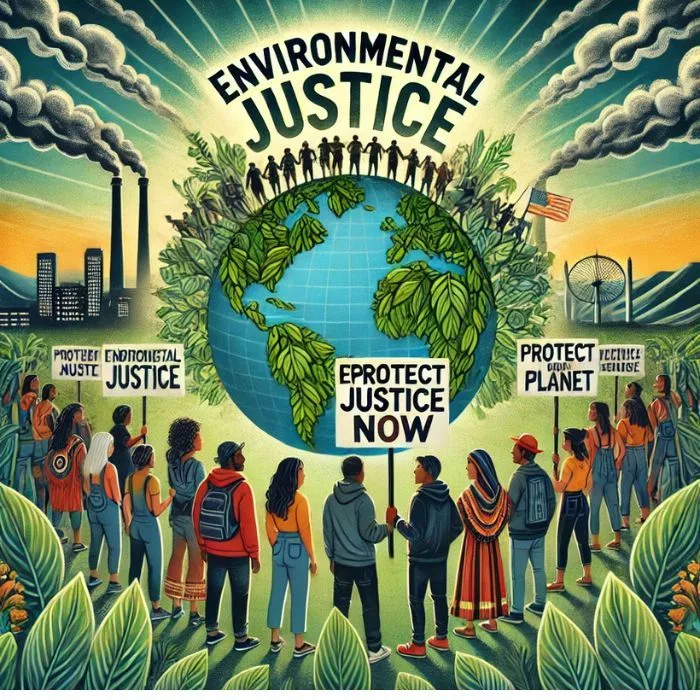
What is climate justice? It is an ethical and political framework for assessing how climate causes, harms, and responses are distributed among nations, generations, classes, and communities. It addresses historical emissions, loss and damage, recognition, meaningful participation, Indigenous rights, and a just transition for fossil-fuel workers. Its central concern is that those facing the gravest climate consequences often contributed least to the problem.
On November 9, 2021, Simon Kofe, the Foreign Minister of Tuvalu, delivered his address to the COP26 climate summit in Glasgow while standing knee-deep in the Pacific Ocean. He wore a suit and tie. Behind him, the flat blue water extended to the horizon with no visible shore.
He was standing where the shore had been. "We are sinking," he told the assembled delegates of 197 nations.
"But so is everyone else." Kofe's government had decided that year to begin the legal process of maintaining Tuvalu's national sovereignty even after its territory disappears beneath the rising sea - a legal fiction made necessary by a physical fact.
The average elevation of Tuvalu above sea level is 1.8 meters. Conservative projections give the country roughly 80 years before the ocean claims the last of its nine coral atolls.
Tuvalu's total greenhouse gas emissions are so small they do not register at the national level in most international databases. The country runs on fishing, remittances from Tuvaluans working abroad, and revenue from the .tv internet domain.
Its contribution to the atmospheric carbon dioxide concentrations that are causing the sea levels threatening its existence is, in any meaningful scientific sense, zero. This is the central fact that climate justice begins with: the people bearing the worst consequences of climate change are not the people who caused it.
One year later, at COP27 in Sharm el-Sheikh in November 2022, three decades of diplomatic blockage broke.
After an all-night negotiating session, the assembled nations agreed to establish a dedicated fund for loss and damage - the first formal acknowledgment in treaty-level climate negotiations that wealthy countries owe financial compensation to vulnerable nations for climate harms that have already occurred and cannot be undone.
Small island delegations wept in the conference hall.
The Alliance of Small Island States had first proposed such a mechanism in 1991. The wait had cost thirty years and, in territories already experiencing inundation, things that cannot be restored.
"It is not enough to say that developed countries should do more. The question is what they owe - and why - and whether obligations grounded in causing harm can be distinguished from obligations grounded in capacity to help." - Henry Shue, Energy Policy (1993)
| Principle | Application to Climate | Example |
|---|---|---|
| Common but differentiated responsibility | Rich nations caused more emissions; bear greater burden | Paris Agreement differentiated targets |
| Intergenerational equity | Today's emissions harm future generations | Youth climate litigation; Greta Thunberg movement |
| Just transition | Fossil fuel workers need economic alternatives | Green New Deal provisions |
| Loss and damage | Vulnerable nations deserve compensation for climate harm | COP27 Loss and Damage Fund established |
| Indigenous rights | Climate policies must respect indigenous lands and sovereignty | UNDRIP integration in climate policy |
Key Definitions
Climate justice: the ethical and political framework that analyzes climate change through the lens of fairness, examining how its causes and consequences are distributed across nations, generations, classes, and communities.
Distributive justice (climate): the question of how the costs and benefits of climate change, and of responding to it, should be fairly distributed across different parties.
Procedural justice (climate): the question of whether affected communities have genuine voice in climate decision-making processes, not merely the outcomes of those processes.
Recognition justice: the acknowledgment of the identities, cultures, and ways of life that are disproportionately threatened by climate change, including the loss of land-based cultures and traditional ecological knowledge.
Loss and damage: the harm from climate change that cannot be prevented through mitigation (reducing emissions to slow warming) or adaptation (adjusting to changed conditions) - the residual costs that occur after these strategies are exhausted or unavailable.
Historical emissions: cumulative greenhouse gas emissions over the industrial period; the measure most relevant to moral attribution of climate responsibility, since CO2 emitted in 1900 remains in the atmosphere warming the planet today.
Carbon budget: the maximum total quantity of greenhouse gases that can be emitted while keeping global temperature rise below a given threshold; determining how this budget is fairly distributed among nations and peoples is a central climate justice question.
Climate debt: the concept that wealthy industrialized nations owe a debt to developing nations for having consumed a disproportionate share of the global atmospheric commons during industrialization.
Environmental justice: the movement and framework focused on the disproportionate exposure of low-income communities and communities of color to pollution and environmental hazards.
Frontline communities: communities - often low-income, indigenous, or communities of color - that face the earliest and most severe consequences of climate impacts and are most exposed to fossil fuel pollution.
Just Transition: the principle that the economic shift away from fossil fuels must not impose disproportionate burdens on workers and communities dependent on those industries, and that the benefits of clean energy should be equitably distributed.
UNFCCC: the United Nations Framework Convention on Climate Change, the international treaty framework under which climate negotiations including the Paris Agreement take place.
Common but differentiated responsibilities (CBDR): the principle enshrined in the UNFCCC that all countries share responsibility for addressing climate change but that their obligations differ based on their historical contributions and current capacities.
The Empirical Inequality: Who Causes It, Who Suffers
The empirical case for climate injustice is among the best-documented in environmental science and development economics. It operates at multiple scales, and each scale reinforces the same pattern.
At the national level, the disparity in per-capita emissions is stark. Qatar emits approximately 34 metric tons of CO2 equivalent per capita annually. The United States emits approximately 14 tons. The global average is around 4.7 tons.
Chad emits approximately 0.06 tons per capita - a ratio against Qatar of more than 500 to one. Niger, the Central African Republic, and Mali register similarly negligible emissions.
When the measure shifts to historical cumulative emissions - the scientifically correct measure, since carbon dioxide emitted in 1900 is still trapping heat today - the inequality becomes more extreme. The United States alone is responsible for approximately 25% of cumulative historical CO2 emissions since industrialization began.
The European Union countries together account for roughly another 22%. The entire African continent accounts for less than 4% of cumulative historical emissions, despite containing 17% of the global population.
Bangladesh provides the starkest single-country illustration. It contributes approximately 0.47% of global greenhouse gas emissions.
Consistent modeling by the World Bank, the International Organization for Migration, and the IPCC places Bangladesh among the most climate-vulnerable countries on earth: sea level rise, more intense cyclones, and riverine flooding from glacial melt in the Himalayas are projected to displace 13 to 17 million Bangladeshis by 2050.
The people who emitted the least will lose the most.
At the individual level, Oxfam International's 2020 report "Confronting Carbon Inequality" quantified what researchers had long suspected.[3] The wealthiest 1% of the global population produced about 16% of global CO2 emissions in 2015. The wealthiest 10% produced about 52%.
The poorest 50% - 3.1 billion people - produced about 7%.
Within countries, the asymmetry between emissions and exposure is equally documented. Christopher Tessum and colleagues, in a 2019 study in the Proceedings of the National Academy of Sciences (doi: 10.1073/pnas.1818859116), systematically analyzed air pollution exposure by race and income across the United States.[5][4]
Latino Americans were exposed to 63% more particulate air pollution than their consumption generated; Black Americans faced 56% excess exposure.
White Americans were exposed to 17% less than their consumption generated - meaning consumption by wealthier, whiter households effectively exported its pollution burden to communities of color through the spatial logic of industrial siting.
W. Neil Adger and colleagues, in work synthesized in the 2006 MIT Press volume "Fairness in Adaptation to Climate Change," argued that adaptive capacity is distributed according to existing inequality: wealthy countries have the sea walls, air conditioning, crop insurance, and disaster recovery infrastructure to protect themselves from impacts that would be catastrophic for poorer ones.[6]
The gap between emissions responsibility and climate harm exposure is not an accident of geography but a product of economic inequality.
Philosophical Frameworks: Who Owes What and Why
The empirical inequality does not automatically determine the philosophical question of obligation, but it sets the parameters for it. Several distinct frameworks have been developed by moral philosophers for thinking about what wealthy countries and individuals owe poorer ones in the context of climate change.[8]
The Polluter Pays Principle
The polluter pays principle holds that those who caused the harm bear primary responsibility for remedying it. Applied to climate, this assigns the greatest obligations to the countries and industries whose historical emissions are responsible for current atmospheric CO2 concentrations.
The standard objection is that most historical emitters did not know they were causing global harm: the scientific consensus on the greenhouse effect and its consequences did not reach public or policy awareness until roughly the 1980s. Can a party bear obligations for harms it could not reasonably have foreseen?
The Beneficiary Pays Principle
The beneficiary pays principle offers an answer that does not depend on culpability. Even if historical emitters did not know they were harming others, they and their successors have materially benefited from the carbon-intensive industrialization that caused the harm.
The wealth of wealthy nations was built substantially through fossil-fuel-powered economic development.
Those benefits generate obligations regardless of whether the original actors were blameworthy - just as an heir who inherits wealth acquired through unjust means may have obligations to those who were harmed, even though the heir personally did nothing wrong.
The Capacity to Pay Principle
The capacity to pay principle focuses not on causation but on ability: those with the greatest resources should bear the greatest burden of addressing climate change, irrespective of who caused it. This is the framework most congenial to wealthy countries seeking to avoid liability while acknowledging some obligation.
It is embodied in the CBDR principle of the UNFCCC, which affirms shared responsibility differentiated by historical contributions and current capacities.
Henry Shue's Subsistence-Luxury Distinction
Henry Shue's 1993 foundational essay in Energy Policy developed a distinction that has become central to climate ethics: the difference between subsistence emissions (those necessary for basic survival - cooking food, heating a home, reaching a clinic) and luxury emissions (those associated with consumption beyond any reasonable standard of need - private aviation, multiple large homes, frequent long-haul flights).
Shue argued that any just allocation of the global carbon budget must prioritize subsistence emissions.[1]
A global framework that treats a billionaire's yacht flight equivalently to a farmer's cooking fire is not morally defensible regardless of which framework one applies.
Stephen Gardiner's Perfect Moral Storm
Stephen Gardiner's 2011 book "A Perfect Moral Storm: The Ethical Tragedy of Climate Change" offers a structural account of why climate justice is so difficult to achieve even when the arguments for it are clear.[2]
The combination of three features - the spatial diffusion of harms (those who emit and those who suffer are largely different people in different places), the temporal diffusion (the worst harms fall on future generations who cannot participate in current decisions), and the institutional vacuum at the international level (no binding enforcement mechanism for climate obligations) - creates conditions uniquely likely to corrupt moral reasoning.
The most powerful parties to the problem, those with the greatest leverage in negotiations, can construct internally consistent but ultimately self-serving justifications for inaction.
Climate justice ethics must therefore attend carefully to motivated reasoning by those with power: the very sophistication of the arguments for delay from wealthy nations is part of what makes them suspect.
Loss and Damage: Thirty Years to an Acknowledgment
Loss and damage has emerged as the central battleground of climate justice politics in international negotiations. It represents what remains when mitigation (reducing emissions to prevent further warming) and adaptation (adjusting to changed conditions) are insufficient: the residual harm that cannot be prevented or managed.[9]
Loss and damage encompasses both economic losses - destroyed infrastructure from cyclones and floods, lost agricultural productivity from heat and drought, displacement and resettlement costs, health system burdens from heat-related illness - and non-economic losses that are harder to monetize but no less real.
These include the loss of cultural heritage embedded in coastal landscapes that will be inundated; the loss of traditional ecological knowledge inseparable from a specific land base; the loss of languages and practices that will not survive the displacement of their communities; and, in the most extreme cases, the loss of sovereign national territory itself.
The Alliance of Small Island States first proposed a formal international mechanism for loss and damage at the Second World Climate Conference in 1991. For thirty years the proposal went essentially nowhere.
Wealthy countries - fearing that any formal acknowledgment of loss and damage would create binding legal liability for historical emissions - systematically blocked substantive proposals at every negotiating session.[10]
The Warsaw International Mechanism for Loss and Damage, established at COP19 in 2013, was a diplomatic milestone in establishing the concept as a formal pillar of the UNFCCC process, but it contained no finance commitments and no liability framework.
COP27 in Sharm el-Sheikh in November 2022 broke the impasse. After an all-night session that extended past the scheduled close of the conference, delegates agreed to establish a dedicated fund for loss and damage.
It was the first formal acknowledgment at treaty level that wealthy countries owe financial support to vulnerable nations for climate harms that have already occurred and cannot be reversed.
At COP28 in Dubai in 2023, the fund was formally operationalized and initial pledges totaling approximately $661 million were announced from a mix of wealthy countries and multilateral institutions.
The gap between this figure and actual need is vast. The IPCC and independent climate economists estimate that loss and damage financing needs from developing countries will reach $400 billion per year by 2030. The initial pledges represent roughly 0.15% of this annual need.
The gap is so large that advocates are careful not to let the symbolic victory of the fund's creation obscure the material inadequacy of its capitalization.
But the principle has been established in international law - and that establishment matters, because once a principle of financial responsibility for climate harm is codified, it becomes significantly more difficult for wealthy countries to deny its application.
Environmental Justice: The Domestic Dimension
The American environmental justice movement developed on a parallel track to international climate justice, emerging from civil rights activism in the 1970s and 1980s.
Its founding document is Robert Bullard's 1990 book "Dumping in Dixie: Race, Class and Environmental Quality," the first systematic empirical survey of the siting of polluting facilities - petrochemical plants, incinerators, hazardous waste sites, landfills - in Black communities in the American South.[7]
Bullard documented that these facilities were concentrated in communities of color not primarily because land values happened to be lower there, but because the political marginalization of these communities made them less able to mount effective opposition.
This framing - environmental harm as an expression of political and economic power, not market neutrality - became the conceptual foundation of the environmental justice movement.
The communities that became emblematic of environmental justice violations are places of concentrated industrial exposure and political vulnerability.
Chester, Pennsylvania - a predominantly Black city southwest of Philadelphia - hosted five waste disposal facilities by the late 1980s, including the nation's largest permitted medical waste incinerator, while neighboring predominantly white suburbs hosted none.
The stretch of the Mississippi River between New Orleans and Baton Rouge, known as Cancer Alley, hosts approximately 150 petrochemical plants in a corridor where predominantly Black communities bear the pollution burden for industrial activity that generates wealth flowing largely to shareholders and executives elsewhere.
Tessum et al.'s 2019 PNAS findings - that Black Americans face 56% excess air pollution exposure and Latino Americans face 63% excess exposure relative to their consumption patterns - placed the environmental justice movement's anecdotal record on a nationally comprehensive quantitative footing.
The federal response has been incremental and contested. President Clinton signed Executive Order 12898 in 1994, requiring federal agencies to consider environmental justice in permitting and policy decisions. Implementation was weak across most subsequent administrations.
The Biden administration's Justice40 initiative, announced in 2021, committed to directing 40% of the benefits from federal climate, clean energy, and infrastructure investments to disadvantaged communities and created an environmental justice advisory council with genuine policy access.
Critics argued that directing benefits - clean energy jobs, weatherization programs, transit investment - falls short of addressing the accumulated pollution burdens that communities of color have absorbed for generations.
The concept of "frontline communities" connects domestic environmental justice and international climate justice in a single framework: in both contexts, the communities facing the earliest and most severe consequences are those that have long been politically marginalized, whose voices have counted least in the decision-making that produced the harms.
The Just Transition: What It Actually Requires
The concept of Just Transition originated in the labor movement's response to environmental regulation in the 1990s.
Unions representing coal miners, oil workers, and industrial laborers argued that if environmental policy eliminated their jobs to benefit the broader public, the broader public owed affected workers compensation - a principle analogous to trade adjustment assistance for workers displaced by trade liberalization.
The phrase is credited to Tony Mazzocchi of the Oil, Chemical and Atomic Workers International Union, who in the early 1990s called for a "Superfund for workers."
The concept has expanded to encompass entire communities. When a coal mine closes in Appalachia or a refinery shuts in a small Texas town, the effects cascade: the tax base collapses, schools deteriorate, healthcare withdraws.
Studies of prior deindustrialization - the closure of Pennsylvania steel mills in the 1970s and 1980s, the collapse of the British coal industry after 1984 - show that workers who complete retraining programs typically earn significantly less than pre-displacement wages and experience persistent long-term earnings penalties.
Retraining is necessary but insufficient.
Genuine just transition requires income support adequate to maintain living standards during the transition; direct public investment in new industries in affected regions; community ownership stakes in new clean energy infrastructure; and genuine democratic participation in planning rather than plans imposed from outside.
Germany's coal phase-out included a 40 billion euro structural adjustment fund for affected regions. In most jurisdictions, the gap between the rhetoric and the resources remains large, and communities that bore the pollution costs of the fossil fuel economy are asked to bear the transition costs as well.
The core tension is temporal: the pace required by climate science is faster than the timeline that makes transitions manageable. Resolving it requires both ambition and adequate compensation - not a choice between them.
Youth Activism and Climate Litigation
Greta Thunberg's school strike outside the Swedish Parliament, beginning in August 2018, initiated a global youth climate movement of unprecedented scale. Fridays for Future spread to over 150 countries within a year.
The September 2019 global climate strike mobilized an estimated four million people in 161 countries - one of the largest coordinated mass demonstrations in recorded history.
Thunberg's address to the UN Climate Action Summit in September 2019 - "You have stolen my dreams and my childhood with your empty words.
How dare you" - crystallized the moral logic of intergenerational equity into a statement of direct accusation that reframed the climate debate from technocratic policy to moral accountability between generations.
The political significance of youth claimants is their distinctive standing: not interest groups lobbying for policy preferences, but people whose entire futures are at stake.
That the claimants cannot vote in most jurisdictions, and that the harms will materialize primarily after current policymakers have died, is itself a structural feature of the intergenerational injustice.
Legal strategies have developed in parallel. The Juliana v. United States case, filed in 2015 by 21 young plaintiffs arguing that the federal government's promotion of fossil fuel development violated their constitutional rights to a stable climate, remained entangled in procedural battles through the early 2020s.
More decisive was Held v. Montana, decided in August 2023: Montana state court ruled in favor of 16 young plaintiffs that the Montana State Environmental Policy Act's prohibition on considering climate impacts in fossil fuel permitting decisions violated the Montana state constitution's guarantee of a clean and healthful environment.
It was the first constitutional environmental ruling of its kind in the United States and was upheld by the Montana Supreme Court in December 2024.
At the European level, the European Court of Human Rights ruled in April 2024 in Verein KlimaSeniorinnen Schweiz v. Switzerland that Switzerland had violated its obligations under the European Convention on Human Rights by failing to take sufficient action on climate change - the first such ECHR ruling.
Six young Portuguese plaintiffs in the companion case Duarte Agostinho v. Portugal won a ruling that 32 European states had contributed to violations of their rights through inadequate climate action.
These rulings are establishing that governments have enforceable legal obligations regarding future generations that go beyond non-binding political commitments, and that individuals have standing to bring those obligations before international human rights bodies.
Policy Implications: What Climate Justice Would Require
Translating climate justice principles into concrete policy is politically contested but analytically tractable. Several policy domains follow directly from the framework.
International climate finance is the most immediate. The pledge made at Copenhagen in 2009 by wealthy countries to mobilize $100 billion per year for developing countries' climate action by 2020 was repeatedly missed.
Even $100 billion annually is a fraction of what developing countries' adaptation needs and loss and damage compensation would require on credible estimates.
Climate justice advocates argue that climate finance should be grant-based rather than loan-based - requiring already debt-burdened developing countries to borrow in order to finance adaptation to a problem they did not cause compounds the original injustice - and must be additional to rather than counted against existing development aid.
Technology transfer - providing clean energy technology to developing countries on terms enabling local manufacturing and deployment - is a second critical dimension.
Intellectual property regimes governing clean technology patents were designed to reward innovation in wealthy markets and systematically disadvantage developing country adoption.
Compulsory licensing of clean energy patents for developing country use, analogous to the TRIPS flexibilities that enabled generic antiretroviral drug production for HIV treatment in the 2000s, has been proposed by climate justice advocates.
Debt relief for climate-vulnerable countries addresses the intersection of climate and debt justice. Many of the most climate-vulnerable countries are simultaneously among the most heavily indebted, spending more of their national income on debt service than on climate adaptation.
Debt swaps for climate investment, debt relief for small island states, and concessional finance for climate-vulnerable countries represent concrete steps that wealthy creditor countries could take with large climate justice impacts.
Connections
For the underlying science of how greenhouse gas concentrations drive warming, see how climate change works. For the philosophical framework of distributive justice that climate justice draws on, see what is justice.
For the structural economic forces that shape climate vulnerability across nations, see why inequality grows.
Sources & Further Reading
- Shue, H. (1993). Subsistence emissions and luxury emissions. Energy Policy, 21(10), 39-48.
- Gardiner, S. M. (2011). A Perfect Moral Storm: The Ethical Tragedy of Climate Change. Oxford University Press.
- Oxfam International. (2020). Confronting Carbon Inequality: Putting Climate Justice at the Heart of the COVID-19 Recovery. Oxfam GB.
- Tessum, C. W., Apte, J. S., Goodkind, A. L., Muller, N. Z., Mullins, K. A., Paolella, D. A., Polasky, S., Schwartz, P. M., WT, S. P., & Hill, J. D. (2019). Inequity in consumption of and health responses to air pollution in the United States.
- Proceedings of the National Academy of Sciences, 116(13), 6001-6006. DOI: 10.1073/pnas.1818859116
- Adger, W. N., Paavola, J., Huq, S., & Mace, M. J. (Eds.). (2006). Fairness in Adaptation to Climate Change. MIT Press.
- Bullard, R. D. (1990). Dumping in Dixie: Race, Class, and Environmental Quality. Westview Press.
- Caney, S. (2010). Climate change and the duties of the advantaged. Critical Review of International Social and Political Philosophy, 13(1), 203-228. DOI: 10.1080/13698230902741033
- Intergovernmental Panel on Climate Change. (2022). Climate Change 2022: Impacts, Adaptation and Vulnerability. Contribution of Working Group II to the Sixth Assessment Report. Cambridge University Press. DOI: 10.1017/9781009325844
- Ciplet, D., Roberts, J. T., & Khan, M. R. (2015). Power in a Warming World: The New Global Politics of Climate Change and the Remaking of Environmental Inequality. MIT Press.