
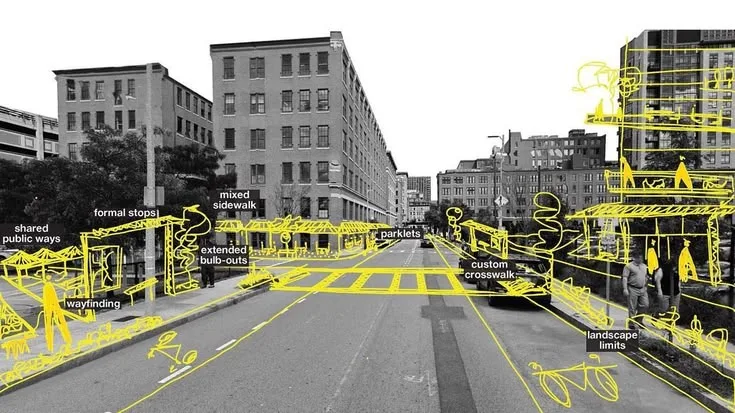
Urban planning shapes land use, housing, transport, public space, and development through tools such as zoning and long-range plans. The answer to what is urban planning includes both building healthier, connected cities and confronting its capacity to displace residents, enforce segregation, or concentrate poverty. Its competing approaches balance density, transit, mixed use, affordability, community life, and the distribution of power over urban change.
In the summer of 1853, the Prefect of the Seine handed surveyors a map of Paris and told them to begin measuring streets that did not yet exist.
Baron Haussmann's renovation of the French capital would demolish roughly twenty thousand buildings, displace an estimated 350,000 residents - nearly all of them poor - and produce the wide, uniform boulevards that tourists photograph today.
What Haussmann built was a city reorganized around movement, commerce, light, and the suppression of the revolutionary barricades that had repeatedly paralyzed Paris.[1]
It was also the first demonstration, at scale, of what modern urban planning could do: reimagine the inherited form of a city from above, treat its existing inhabitants as a problem to be managed, and impose a vision of order that served some interests while destroying the world of others.
That ambivalence - between the genuine problems that professional planning can solve and the coercive potential of expert authority over communities - has animated the discipline's history ever since. Urban planning has produced magnificent public parks, coherent transit systems, and neighborhoods designed for human flourishing.
It has also produced highways driven through Black communities, housing projects that concentrated poverty and demolished social fabric, and zoning codes that locked racial and economic segregation into law long after explicit discrimination was prohibited.
Understanding what urban planning is requires understanding both its achievements and its failures.
"Cities have the capability of providing something for everybody, only because, and only when, they are created by everybody." - Jane Jacobs, The Death and Life of Great American Cities (1961)
Key Definitions
Zoning: A legal mechanism by which local governments divide their territory into districts (zones) and specify, for each district, which land uses are permitted, what building forms are allowed (height, setback, floor area ratio), and what processes govern changes or exceptions.
Comprehensive plan: A long-range policy document, typically with a twenty-year horizon, that articulates a municipality's goals for land use, transportation, housing, parks, economic development, and related areas. It provides the framework within which zoning and other regulatory decisions are made.
Urban renewal: The mid-twentieth-century federal program in the United States through which cities condemned and demolished "blighted" areas, typically lower-income neighborhoods of color, and redeveloped them for other uses. The program displaced an estimated one million Americans between the 1950s and 1970s.
Transit-oriented development (TOD): A planning approach that concentrates higher-density, mixed-use development within walking distance of transit stations to maximize transit ridership and reduce car dependence.
Upzoning: A regulatory change that increases the density of development permitted on a parcel or in an area, typically by allowing taller buildings, smaller lots, or multiple dwelling units on parcels previously restricted to single-family homes.
Major Planning Approaches Compared
| Approach | Era | Core Principle | Key Proponent | Criticism |
|---|---|---|---|---|
| Haussmannization | 1850s-1870s | Top-down redesign for movement and order | Baron Haussmann | Displaced the poor; served power, not people |
| Garden City | 1900s-1920s | Self-contained communities with cooperative land ownership | Ebenezer Howard | Economics were stripped in practice |
| Modernist/CIAM | 1920s-1960s | Towers in the park; separate functions by zone | Le Corbusier | Destroyed street life; concentrated poverty |
| Urban renewal | 1950s-1970s | Clear "blight" and rebuild | Robert Moses | Demolished Black neighborhoods; forced displacement |
| New Urbanism | 1980s-present | Walkable, mixed-use, human-scale design | Andres Duany, Peter Calthorpe | Critics say it produces expensive enclaves |
| Transit-oriented development | 1990s-present | Density near transit to reduce car dependence | Peter Calthorpe | Can accelerate gentrification near stations |
| YIMBY / upzoning | 2010s-present | Deregulate land use to increase supply and reduce costs | Various reformers | Contested effects on displacement |
The Roots of Modern Planning
Haussmann and the Redesigned City
Urban planning as a professional discipline is largely a product of the nineteenth and early twentieth centuries, though every civilization has made decisions about where to locate buildings, streets, and public spaces.
What distinguished modern planning was the combination of state power, large-scale capital, and professional expertise that allowed the wholesale transformation of existing cities rather than merely the incremental addition of new districts.
Haussmann's Paris is the exemplary case. Between 1853 and 1870, he coordinated the expropriation of land, the demolition of existing buildings, and the construction of new boulevards, parks, sewers, and water mains on a scale that had no precedent in a major European city.
The financial mechanism was equally novel: rather than funding construction from existing revenues, Haussmann anticipated future land value increases along new boulevards, using credit to finance current construction in expectation of future receipts.
When the system collapsed in 1869 and Haussmann was dismissed, he left Paris with the bones of its modern form and a tradition of debt-financed speculation on urban redevelopment that has recurred ever since.
The renovation served multiple interests simultaneously. It was aesthetic - Napoleon III wanted a capital that would match London's recent improvements.
It was sanitary - the old dense neighborhoods had harbored the cholera epidemics that struck Paris repeatedly after 1832, and the new infrastructure of sewers and clean water would dramatically reduce disease mortality.
It was economic - the new boulevards opened Paris to commercial activity and allowed the rapid movement of goods.
And it was political - the wide, straight streets were far more difficult to barricade than the narrow medieval alleys that had made Paris ungovernable during the revolutions of 1789, 1830, and 1848.
The Garden City as Alternative Vision
Where Haussmann's renovation imposed order on an existing city by force of state power, the Garden City movement proposed to build new communities from scratch on a cooperative model.
Ebenezer Howard's 1898 pamphlet described the Garden City as a planned community of limited size - he proposed thirty-two thousand residents - that would combine the employment and social amenities of the city with the clean air, open space, and community of the countryside, while avoiding the overcrowding and exploitation that characterized both existing cities and isolated rural villages.[2]
Howard's economics were as radical as his urban form. He proposed that residents of the Garden City would collectively own the land, leasing it to occupants at rates that would capture for the community the rising land values that normally accrue to private landowners.
As the city filled and land values rose, the community land trust would generate sufficient revenue to fund schools, parks, and social services without taxation.
This combination of physical design and cooperative economics made Howard's vision a challenge not just to the design of cities but to the property relations that drove their development.
Letchworth, begun in 1903 as the first Garden City about 35 miles north of London, demonstrated that the physical concept was viable: a low-density residential community with generous green space, town center, industry separated from housing, and pedestrian-friendly design could be attractive, functional, and commercially sustainable.
Welwyn Garden City followed in 1920. But neither fully realized Howard's cooperative economics; both were developed by private companies that retained conventional ownership structures even as they implemented the physical design principles.
The movement's wider influence was vast and contradictory. Garden City ideas inspired post-war British New Towns, American suburban development (stripped of cooperative economics), and the general principle that residential environments should incorporate green space and design for health.
But the key economic insight - that rising land values should benefit communities rather than private landowners - was systematically stripped out in every implementation at scale, because it directly challenged the interests of the development industry that financed actual construction.
The Twentieth Century: Modernism and Its Critics
CIAM and the Radiant City
The International Congresses of Modern Architecture (CIAM), founded in 1928 and dominated by Le Corbusier through the 1930s and 1940s, developed a systematic architectural-planning doctrine that became the theoretical foundation for mid-century urban renewal programs worldwide.
The doctrine called for strict functional separation of land uses (residence, work, recreation, circulation), housing in tall towers set in open green space, and the destruction of existing dense urban fabric in favor of superblocks organized around towers-in-a-park.
Le Corbusier's Plan Voisin (1925) proposed demolishing most of central Paris north of the Seine and replacing it with identical cruciform towers set in parkland, retaining only a few historic monuments.
The proposal was never implemented, but its underlying logic - that the existing city was a slum to be cleared, that professional expertise should determine urban form, that towers in open space were inherently superior to dense mixed-use streets - suffused the urban renewal programs that American cities would pursue from the 1940s through the 1970s.
The Pruitt-Igoe housing project in St. Louis, designed by Minoru Yamasaki and opened in 1956, became the emblem of modernist public housing's failure. Thirty-three high-rise towers housed more than ten thousand residents, mostly Black families displaced from demolished neighborhoods.
Within a decade, the project had become a byword for crime, poverty concentration, and social disintegration; by 1972, the first towers were being demolished.
The demolition was famously described by architectural critic Charles Jencks as the death of modern architecture, though the problems of Pruitt-Igoe and similar projects were as much a product of deliberate underfunding, racial segregation, and concentrated poverty as of architectural form.
Jane Jacobs and the Critique of Urban Renewal
Jane Jacobs' "The Death and Life of Great American Cities" (1961) arrived as a devastating critique of precisely the planning orthodoxy that had produced Pruitt-Igoe and similar disasters.
Jacobs, a Greenwich Village resident and journalist with no formal planning credentials, had spent years observing the street life of mixed-use, dense urban neighborhoods and had developed a systematic account of what made them work.[3]
Her argument turned the planning orthodoxy on its head. The dense, messy, diverse streets that planners called "slums" were not pathologies requiring treatment but self-organizing systems that produced safety, economic vitality, and community through the density and diversity of their activity.
The four conditions she identified for urban vitality - mixed primary uses, short blocks, buildings of varying age, and sufficient population density - created the conditions for "eyes on the street," the natural surveillance that makes neighborhoods safe not through policing but through the continuous presence of residents, shopkeepers, and passersby with stakes in public order.
Jacobs' critique was simultaneously architectural (towers in parks destroy street life), economic (retail districts require a mixture of destinations to generate pedestrian traffic), and political (urban renewal programs served the interests of real estate developers and downtown business associations at the expense of working-class communities).
Her book became the intellectual foundation for community opposition to urban renewal across the United States, and her leadership of the successful campaign against Robert Moses's proposed Lower Manhattan Expressway demonstrated that organized community opposition could stop even powerful highway projects.
Power and Displacement: Robert Moses
Robert Moses held positions of extraordinary power in New York from the 1930s through the late 1960s.
Without ever holding elected office, he directed the construction of highways, bridges, parks, housing projects, and urban renewal sites through a network of overlapping appointments that made him simultaneously unaccountable to any single authority and nearly impossible to remove.
Moses's highway projects physically transformed New York City and its suburbs in ways that still shape metropolitan life. The Cross Bronx Expressway, completed in 1963, cut through established Bronx neighborhoods, displacing approximately sixty thousand residents.
The project was not routed through the Bronx because that route was technically superior but because the neighborhoods in its path had less political power than the more affluent communities that might have been affected by alternative routes.
The displacement and neighborhood disruption that followed contributed to the catastrophic decline of the South Bronx over the following decade, a process that produced iconic images of abandonment and arson that became shorthand for urban crisis throughout the 1970s.
Moses also shaped New York's public housing program. His Slum Clearance Committee used federal urban renewal funds to demolish neighborhoods and relocate their residents - disproportionately Black and Puerto Rican - to large public housing towers in peripheral locations.
The concentration of poor families in isolated, high-rise projects without adequate services, employment, or connection to the city's economic life was predictable; the consequences were severe and long-lasting.
Robert Caro's biography "The Power Broker" (1974) traced how Moses accumulated power through a combination of institutional innovation (creating public authorities that could issue bonds and were insulated from democratic oversight), strategic control of information and expertise, and political acuity about what each of his principals - governors, mayors, presidents, federal agencies - needed from him.[4]
The book became a canonical account of how planning power can be concentrated, abused, and insulated from accountability, and it permanently altered how Americans thought about the relationship between technical expertise and democratic governance.
New Urbanism and Transit-Oriented Development
The New Urbanism movement, associated primarily with architects Andres Duany and Elizabeth Plater-Zyberk and urban designer Peter Calthorpe, emerged in the 1980s as a reaction against both modernist urban renewal and conventional suburban sprawl.[5]
Drawing heavily on Jacobs' critique, New Urbanists argued for walkable, mixed-use, transit-accessible communities designed on a human scale, with front porches, alley-accessed garages, and civic spaces that encourage social interaction and community formation.
The most famous early New Urbanist project is Seaside, Florida, a planned community on the Florida panhandle designed by Duany and Plater-Zyberk beginning in 1981. Seaside became widely recognized and widely photographed for its coherent, traditional urban form.
It also, somewhat awkwardly for its designers' civic aspirations, became one of the most expensive real estate markets in Florida - a community so desirable that it was financially accessible only to the wealthy.
The tension between good urban design and the market dynamics that translate desirability into exclusion was not resolved by New Urbanism's design principles.
Transit-oriented development took the New Urbanist framework and oriented it explicitly around transit infrastructure, arguing that the most effective way to build walkable, reduced-car-dependence communities was to concentrate density within a quarter-mile to half-mile walking radius of transit stations.
TOD principles have informed station-area planning across the United States and internationally, and they provide the planning rationale for upzoning around transit that has become a centerpiece of housing affordability advocacy.
The Housing Affordability Crisis and the Zoning Debate
By the 2010s, the housing affordability crisis in major American cities had become severe enough to generate a political movement - YIMBY, for Yes In My Backyard - that explicitly demanded zoning reform to permit more housing construction.
The movement drew its intellectual foundations from urban economics research showing that restrictive land use regulation - single-family zoning, minimum lot sizes, setback requirements, parking minimums, lengthy permitting processes - constrained housing supply in the locations of highest demand and drove prices far above construction costs.[9]
The economics are straightforward in principle: when housing is undersupplied relative to demand, prices rise. When regulation prevents supply from responding to demand, the price signal is not eliminated but simply leads to higher prices rather than more construction.
The places with the most severe affordability problems - San Francisco, Los Angeles, Boston, Seattle, New York - are also places with highly restrictive zoning, high construction costs, and lengthy permitting processes.
Research on upzoning has generally supported the supply-side argument. Research by economist Evan Mast (around 2019-2021) found evidence that new market-rate apartment construction can ease rents in nearby buildings through a "chain move" or filtering process, as residents move into the new units and free up existing ones.[7] The measured effects are real but modest and localized, and this is one body of evidence rather than the final word in a debated area.
Minneapolis, which eliminated single-family zoning citywide through its Minneapolis 2040 plan (adopted in 2018), and Oregon, which permitted duplexes statewide, have been closely watched as natural experiments in statewide zoning reform.
Critics of supply-side upzoning argue that market-rate construction in low-income neighborhoods can accelerate gentrification by signaling rising land values to investors, that supply additions will not bridge the affordability gap without substantial public subsidy for below-market housing, and that the YIMBY movement has been coopted by real estate interests seeking to deregulate development for profit.
Community land trusts, inclusionary zoning (which requires developers to include below-market units), tenant protections, and social housing programs represent tools that address affordability more directly but require public resources rather than relying on market mechanisms.
Smart Cities and the Surveillance Question
The smart cities agenda promises to use digital technology - sensors, networks, real-time data analytics, and artificial intelligence - to make urban infrastructure more efficient, reduce energy consumption, improve transit, and support better planning decisions.[8]
In its most ambitious versions, it imagines a city instrumented with sensors capable of monitoring everything from traffic flows and energy use to environmental conditions and pedestrian movement in real time.
The most instructive case study is Sidewalk Toronto, the Alphabet subsidiary project that proposed to develop twelve acres on Toronto's waterfront as a model smart city district.
The project generated extensive debate about the governance of urban data, the role of private technology companies in public space, and the surveillance implications of pervasive sensor networks before being cancelled in 2020.
The debate surfaced a fundamental question: who owns the data generated by public space, and who should control the infrastructure that generates it?
The concern is not merely theoretical. Predictive policing systems deployed in Chicago, Los Angeles, and other cities used algorithmic analysis of historical crime data to direct police attention, with the risk that neighborhoods already subject to intensive policing receive still more attention, creating a feedback loop, while crime in wealthier areas that had historically been under-policed went relatively undetected.
The algorithm was not neutral with respect to race and class; it encoded the biases of the historical data it was trained on and amplified them.
Smart city technology, like all urban planning tools, operates within political economies that distribute its benefits and burdens unevenly. The efficiency gains from adaptive traffic management and predictive maintenance are real, but they flow primarily to users of the street network and managers of infrastructure budgets.
The surveillance infrastructure required to generate the data for these applications creates risks that fall primarily on the residents of the neighborhoods where sensors are densest.
Urban Planning and Structural Inequality
The history of American urban planning cannot be understood without understanding its relationship to racial segregation and structural inequality.
From the explicit racial covenants that governed suburban subdivision development in the 1920s and 1930s, to the Federal Housing Administration's redlining of Black neighborhoods (which systematically denied mortgage insurance in minority areas, making private financing unavailable), federal and local planning policy shaped residential segregation directly.
To the urban renewal programs that destroyed Black communities and relocated their residents to isolated housing projects, to the highway construction that bisected and displaced established Black neighborhoods, planning policy has been a major driver of the residential segregation and concentrated poverty that characterize American metropolitan areas today.
Single-family zoning itself was developed partly in response to efforts by Black middle-class families to move into white residential neighborhoods in Berkeley and other cities in the 1910s. The legal mechanism of exclusive residential zoning - later upheld by the Supreme Court in Euclid v.[6]
Ambler Realty (1926) - achieved through land use regulation what explicit racial covenants and racial zoning ordinances achieved more directly, and it has proven far more durable and legally defensible.
The legacy of these policies is visible in current housing and poverty data. Metropolitan areas with the most restrictive residential zoning - those that preserved the most exclusionary single-family zones - also have the most severe residential segregation by race and income.
Remedying this legacy requires not only zoning reform but targeted investment in communities that were systematically divested, and community-controlled planning processes that give affected residents genuine power over decisions about their neighborhoods.
See Also
- What Is Systems Thinking?
- What Is Behavioral Economics?
- What Is Political Economy?
- What Is Complexity Theory?
Sources & Further Reading
- Haussmann, G.-E. (1890-1893). Memoires du Baron Haussmann. Victor-Havard.
- Howard, E. (1902). "Garden Cities of To-Morrow". Swan Sonnenschein.
- Jacobs, J. (1961). "The Death and Life of Great American Cities". Random House.
- Caro, R. (1974). "The Power Broker: Robert Moses and the Fall of New York". Knopf.
- Duany, A., Plater-Zyberk, E., & Speck, J. (2000). Suburban Nation: The Rise of Sprawl and the Decline of the American Dream. North Point Press.
- Rothstein, R. (2017). "The Color of Law: A Forgotten History of How Our Government Segregated America". Liveright.
- Mast, E. (2021). The effect of new market-rate housing construction on the low-income housing market. Journal of Urban Economics, 133.
- Townsend, A. M. (2013). Smart Cities: Big Data, Civic Hackers, and the Quest for a New Utopia. W. W. Norton.
- Fischel, W. A. (2015). Zoning Rules! The Economics of Land Use Regulation. Lincoln Institute of Land Policy.
Further Reading
- Autor, D., Dorn, D., & Hanson, G. (2013). The China syndrome: Local labor market effects of import competition in the United States. American Economic Review, 103(6), 2121-2168.
- Sennett, R. (1970). The Uses of Disorder: Personal Identity and City Life. Yale University Press.