
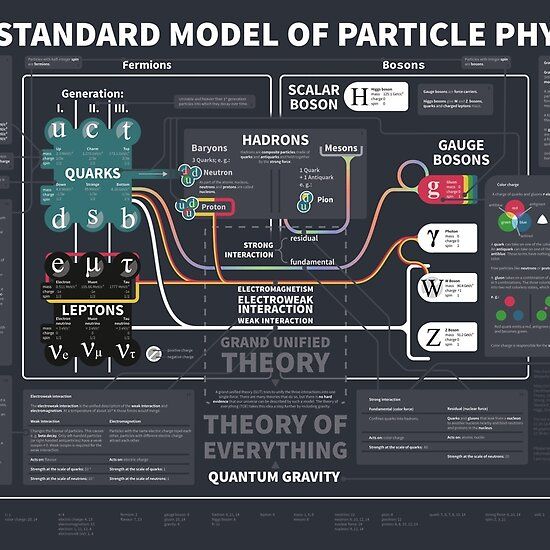
What is particle physics? It studies fundamental constituents of matter and the forces governing their interactions through accelerators, detectors, and quantum field theory. The Standard Model describes known elementary particles and the electromagnetic, weak, and strong forces with exceptional accuracy, yet leaves much unexplained.
Scattering experiments revealed the atomic nucleus and continue to probe substructure, while quantum mechanics replaced classical particle trajectories with probability-based descriptions.
There is something deeply strange about the world when you look closely enough. A gold atom is mostly empty space. The proton at its center, though it feels solid, is itself a seething cluster of quarks bound by a force so powerful it cannot be separated at any energy humans have yet produced.
The electron orbiting that proton is not a tiny ball at all but a probability cloud, a smeared-out possibility of presence, until you choose to measure its position. And underlying all of this is a mathematical structure of extraordinary elegance and almost offensive incompleteness.
Particle physics is the attempt to answer the simplest and hardest question in science: what is matter, and what holds it together?
The answers accumulated over the past century have given us the Standard Model, a theory that predicts experimental results to eleven decimal places and leaves most of the universe unexplained. It is the most successful and the most incomplete theory in physics, possibly in all of science.
"Not only is the universe stranger than we think, it is stranger than we can think."
- Werner Heisenberg
What Is Particle Physics? Key Definitions
Particle physics (also called high-energy physics) is the branch of physics that studies the fundamental constituents of matter and the forces that govern their interactions, using accelerators, detectors, and theoretical quantum field theories.
The Standard Model is the theoretical framework describing all known elementary particles and three of the four fundamental forces (electromagnetic, weak, strong), expressed as a gauge quantum field theory.
Elementary particle is a particle with no known substructure; it is not composed of smaller particles. Quarks and electrons are elementary; protons are not.
Quantum field theory is the framework combining quantum mechanics and special relativity in which particles are excitations of underlying quantum fields that permeate all of space.
The Standard Model: Particles at a Glance
| Category | Particle | Symbol | Charge | Role |
|---|---|---|---|---|
| Quarks | Up, Down | u, d | +2/3, -1/3 | Constituents of protons and neutrons |
| Quarks | Strange, Charm | s, c | -1/3, +2/3 | Found in exotic hadrons |
| Quarks | Bottom, Top | b, t | -1/3, +2/3 | Heaviest quarks; top mass ~173 GeV |
| Leptons | Electron | e | -1 | Carries electric current; defines chemistry |
| Leptons | Muon, Tau | mu, tau | -1 | Heavier electron cousins |
| Leptons | Neutrinos | nu_e, nu_mu, nu_tau | 0 | Weakly interacting; produced in nuclear reactions |
| Gauge bosons | Photon | gamma | 0 | Carrier of electromagnetic force |
| Gauge bosons | W+, W-, Z | W, Z | +1, -1, 0 | Carriers of weak nuclear force |
| Gauge bosons | Gluon | g | 0 | Carrier of strong nuclear force |
| Scalar boson | Higgs | H | 0 | Gives mass to W, Z bosons and fermions |
Rutherford and the Nuclear Atom
The modern story of particle physics begins at the University of Manchester in 1909. Hans Geiger and Ernest Marsden, working under Ernest Rutherford, directed a beam of alpha particles at a sheet of gold foil only a few atoms thick and recorded the scatter pattern using zinc sulfide scintillation screens surrounding the foil.
Under the prevailing Thomson plum pudding model, the positive charge and mass of an atom were thought to be distributed diffusely throughout its volume, like a positive cloud with electrons embedded like raisins. Alpha particles should have passed through with minimal deflection, like bullets through a cloud.
Most did. But approximately one in eight thousand alpha particles deflected at angles greater than 90 degrees, bouncing almost straight back. Rutherford concluded in his 1911 paper that the atom's positive charge and nearly all its mass must be concentrated in an extraordinarily compact nucleus.[1]
His calculations placed the nuclear radius at less than one ten-thousandth of the atomic radius. The atom was almost entirely empty space.
This experiment did more than revise the atomic model. It established the fundamental methodology of particle physics: probe the unknown structure by scattering known particles off it and inferring internal geometry from the deflection pattern.
The logic is unchanged in every modern particle accelerator, from the Stanford Linear Accelerator Center's discovery of quark substructure in the 1960s to the Large Hadron Collider at CERN today.
The Quantum Revolution
Rutherford's nuclear model immediately ran into a problem. Classical electromagnetism required that electrons orbiting a nucleus would radiate energy and spiral inward, destroying atoms in nanoseconds.
Niels Bohr patched this with his 1913 atomic model, postulating that electrons occupied discrete energy levels without radiating, but his model was purely phenomenological, with no physical justification for the quantization.
The solution emerged over the following decade. Louis de Broglie proposed in 1924 that particles have wavelike properties, with wavelength inversely proportional to momentum. Werner Heisenberg developed matrix mechanics in 1925.
Erwin Schrodinger developed wave mechanics in 1926, producing his equation for the time evolution of the quantum wave function.
Max Born provided the probability interpretation: the wave function's squared magnitude gives the probability density for finding the particle at each location.
Heisenberg's uncertainty principle, published in 1927, states that the product of the uncertainties in position and momentum cannot be less than Planck's constant divided by four pi.[12]
This is not a statement about measurement limitations but about the fundamental nature of quantum states: a particle with precisely defined position has maximally uncertain momentum and vice versa.
The electron does not have a definite trajectory; it exists as a probability amplitude until a measurement interaction localizes it.
Antimatter: Dirac's Prediction and Anderson's Discovery
Paul Dirac combined quantum mechanics with special relativity in his 1928 equation describing the relativistic electron.[2] The Dirac equation had solutions corresponding not only to electrons but also to particles with the same mass but opposite charge.
Dirac initially tried to identify these with protons, then reluctantly accepted that they represented a new particle. He predicted the existence of the positron in 1931.
Carl Anderson photographed a positron track in a cloud chamber in 1932, the first confirmed observation of antimatter.[3] The track curved in the wrong direction for an electron in a magnetic field and was far too light to be a proton. Anderson received the Nobel Prize in Physics in 1936.
Every elementary particle has a corresponding antiparticle of equal mass and opposite charge and other quantum numbers. When a particle and its antiparticle meet, they annihilate, converting their combined rest mass into energy in the form of photons or other particle-antiparticle pairs.
The question of why the observable universe consists overwhelmingly of matter rather than antimatter, given that the Big Bang should have produced them in equal quantities, is one of the deepest unsolved problems in physics.
The Standard Model: Particles and Forces
Quarks and the Strong Force
Quarks are the fundamental constituents of hadrons. Murray Gell-Mann proposed quarks in 1964 to make sense of the proliferating zoo of hadrons discovered in cosmic ray and accelerator experiments.[4] There are six quark flavors: up, down, charm, strange, top, and bottom.
Each comes in three color charges (red, green, blue) and has an antimatter counterpart. Deep inelastic scattering experiments at SLAC in 1968-1969, led by Jerome Friedman, Henry Kendall, and Richard Taylor (Nobel 1990), confirmed that protons had pointlike internal scattering centers.
Quarks carry color charge and interact through the strong force, mediated by eight gluons in quantum chromodynamics (QCD). Gluons themselves carry color charge, making QCD non-abelian and qualitatively different from electrodynamics.
Confinement means color-charged objects cannot be isolated: trying to pull a quark out of a proton creates enough energy to produce a new quark-antiquark pair.
Asymptotic freedom, discovered by David Gross, David Politzer, and Frank Wilczek in 1973 (Nobel 2004), means that quarks behave as nearly free particles at very short distances (high energies) but are strongly interacting at larger separations.[5] This is the opposite of the intuitive expectation and was the insight that made QCD tractable.
Leptons and the Weak Force
Leptons do not carry color charge and do not interact through the strong force. The charged leptons are the electron, muon, and tau. Each is paired with a neutrino: the electron neutrino, muon neutrino, and tau neutrino.
Neutrinos are electrically neutral and interact only through the weak force and gravity, making them extraordinarily difficult to detect despite being produced in enormous quantities by nuclear reactions in the Sun and by supernovae.
The weak force mediates radioactive beta decay and is responsible for processes that change quark flavor, such as the conversion of a neutron into a proton. It is mediated by three massive bosons: the W-plus, W-minus, and Z.
Their large mass, roughly 80-91 GeV compared to the massless photon, explains why the weak force has such short range.
Electroweak Unification
Sheldon Glashow, Abdus Salam, and Steven Weinberg developed the electroweak theory in the 1960s and early 1970s, demonstrating that electromagnetism and the weak force are two aspects of a single electroweak interaction whose symmetry is spontaneously broken at the energies of everyday physics.[6]
They received the Nobel Prize in Physics in 1979. The prediction of the W and Z bosons with specific masses was confirmed by Carlo Rubbia and Simon van der Meer's team at CERN in 1983 (Nobel 1984).
Quantum Electrodynamics
QED, developed by Richard Feynman, Julian Schwinger, and Sin-Itiro Tomonaga (Nobel 1965), describes how charged particles interact by exchanging virtual photons.
Its most famous achievement is the prediction of the anomalous magnetic moment of the electron: theory and experiment agree to roughly one part in a trillion, a precision unmatched anywhere in science.
The technique of renormalization, which Feynman's diagrammatic method implements, systematically handles the infinities that arise from self-interactions by absorbing them into measured physical parameters.
The Higgs Boson: The Final Piece
The electroweak theory required the W and Z bosons to be massless by gauge symmetry, yet experiments showed they were not. Peter Higgs, Robert Brout, Francois Englert, and others proposed in 1964 a mechanism of spontaneous symmetry breaking: a scalar field (the Higgs field) permeates all of space with a non-zero vacuum expectation value.
The W and Z bosons acquire mass by coupling to this field. Fermion masses arise through Yukawa couplings to the same field. The quantum of the Higgs field is the Higgs boson.
The Higgs boson was the Standard Model's only unconfirmed prediction for nearly five decades. Finding it required building the Large Hadron Collider, a 27-kilometer ring beneath the Franco-Swiss border that accelerates protons to 6.5 TeV and collides them at 13 TeV center-of-mass energy.
The collision products are tracked by the 25-metre-tall ATLAS and 21-metre-long CMS detectors, each involving thousands of collaborating physicists.
On July 4, 2012, both collaborations announced the discovery of a new particle at approximately 125 GeV with properties consistent with the Higgs boson.[7] Statistical significance exceeded five sigma in both experiments. Peter Higgs and Francois Englert received the Nobel Prize in Physics in 2013.
Since discovery, the LHC has measured the Higgs boson's properties in increasing detail. Its spin is confirmed as zero. Its couplings to other particles are consistent with Standard Model predictions at current precision. Ongoing measurements seek deviations that would indicate new physics contributing to Higgs couplings.
Neutrino Masses: The First Crack in the Standard Model
The minimal Standard Model assumed neutrinos were massless. This assumption was overturned by two experimental findings.
Ray Davis's Homestake chlorine detector, operating in a South Dakota gold mine from the late 1960s, consistently measured only about one-third of the electron neutrino flux predicted from solar models, a discrepancy called the solar neutrino problem.
The Sudbury Neutrino Observatory in Canada resolved this by 2001: the total neutrino flux from the Sun (summing all three flavors) matched predictions, but the electron neutrinos had transformed into muon and tau neutrinos in transit.
The Super-Kamiokande detector in Japan demonstrated in 1998 that atmospheric muon neutrinos, produced when cosmic rays hit the upper atmosphere, disappeared over long baselines in a way dependent on the ratio of travel distance to neutrino energy, the signature of oscillation.[8]
Takaaki Kajita and Arthur McDonald received the 2015 Nobel Prize for these discoveries.
Neutrino oscillation requires that neutrino mass eigenstates differ from flavor eigenstates and that at least two mass eigenstates have different (nonzero) masses. This requires minimal extensions to the Standard Model.
The absolute mass scale of neutrinos remains unknown; current upper limits place all three masses below roughly 0.1 eV, making them at least 500,000 times lighter than the electron but not massless.[11]
Dark Matter and Dark Energy: The Majority of the Universe
Ordinary matter, everything described by the Standard Model, constitutes approximately 5 percent of the universe's total energy content. Dark matter constitutes roughly 27 percent and dark energy roughly 68 percent. Neither has been directly detected as a particle or field in the laboratory.
Evidence for dark matter is compelling and comes from multiple independent probes. Galaxy rotation curves measured by Vera Rubin and Kent Ford from the 1960s onward show that stars orbit at nearly constant speed far from galactic centers, implying that mass continues to increase proportionally with radius even beyond the visible disk.
Gravitational lensing surveys show mass concentrations far exceeding luminous matter.
The Bullet Cluster provides a particularly clean demonstration: two colliding galaxy clusters whose gas (most of the ordinary matter) was slowed by electromagnetic interactions during collision, while gravitational lensing reveals the mass passed through, consistent with collisionless dark matter halos.
The cosmic microwave background power spectrum requires a component of matter that does not interact with photons.
The leading candidates remain WIMPs (weakly interacting massive particles), predicted by supersymmetric extensions of the Standard Model, and axions, motivated by the strong CP problem in QCD.
Direct detection experiments using multi-tonne xenon detectors buried deep underground have set increasingly stringent limits without a confirmed signal, progressively ruling out parameter space but not the existence of dark matter.
Dark energy was inferred from type Ia supernova distance measurements by the Supernova Cosmology Project and the High-Z Supernova Search Team in 1998.[10] Both groups found that distant supernovae were fainter than expected, indicating the universe's expansion is accelerating.[9]
Saul Perlmutter, Brian Schmidt, and Adam Riess received the 2011 Nobel Prize. The simplest description is Einstein's cosmological constant, representing a constant energy density of the vacuum.
But quantum field theory predictions for vacuum energy density exceed the observed cosmological constant by approximately 120 orders of magnitude, the most severe fine-tuning problem in all of physics.
Beyond the Standard Model
The Standard Model has no dark matter candidate, no explanation for the matter-antimatter asymmetry, no mechanism for neutrino mass without modification, and no accommodation of gravity. These gaps motivate theoretical extensions, none of which has experimental confirmation.
Supersymmetry (SUSY) posits that every Standard Model particle has a supersymmetric partner with different spin, providing natural dark matter candidates (the lightest supersymmetric particle) and addressing the hierarchy problem (why the Higgs mass does not receive enormous quantum corrections).
The LHC has searched extensively for supersymmetric particles and found none at masses below roughly a TeV, straining but not eliminating SUSY.
String theory proposes that fundamental particles are not point-like but are different vibrational modes of one-dimensional strings, and requires extra spatial dimensions compactified at extremely small scales. It naturally incorporates gravity but currently makes no testable predictions at accessible energies.
Loop quantum gravity takes a different approach, quantizing spacetime geometry directly. The relationship between gravity and quantum mechanics remains one of the deepest open problems in physics.
Cross-References
- For the molecular machines that exploit quantum tunneling in enzyme catalysis, see Molecular Biology: Genetic Information Flow Explained
- For how cosmology and particle physics converge in understanding the early universe, see Explaining Dark Matter and Dark Energy's Role
- For complexity and emergence at larger scales, see Emergence Explained with Examples
- For probabilistic reasoning and uncertainty in scientific claims, see Common Decision Traps and How to Avoid Them
Sources & Further Reading
- Rutherford, E. (1911). The scattering of alpha and beta particles by matter and the structure of the atom. Philosophical Magazine, 21, 669-688.
- Dirac, P.A.M. (1928). The quantum theory of the electron. Proceedings of the Royal Society A, 117(778), 610-624.
- Anderson, C.D. (1933). The positive electron. Physical Review, 43(6), 491-494.
- Gell-Mann, M. (1964). A schematic model of baryons and mesons. Physics Letters, 8(3), 214-215.
- Gross, D.J. and Wilczek, F. (1973). Ultraviolet behavior of non-abelian gauge theories. Physical Review Letters, 30(26), 1343-1346.
- Weinberg, S. (1967). A model of leptons. Physical Review Letters, 19(21), 1264-1266.
- ATLAS Collaboration and CMS Collaboration (2012). Observation of a new boson at a mass of 125 GeV with the CMS experiment at the LHC. Physics Letters B, 716(1), 1-29.
- Fukuda, Y. et al. (Super-Kamiokande Collaboration) (1998). Evidence for an oscillatory signature in atmospheric neutrino oscillation. Physical Review Letters, 81(8), 1562-1567.
- Riess, A.G. et al. (1998). Observational evidence from supernovae for an accelerating universe and a cosmological constant. Astronomical Journal, 116(3), 1009-1038.
- Perlmutter, S. et al. (1999). Measurements of omega and lambda from 42 high-redshift supernovae. Astrophysical Journal, 517(2), 565-586.
- Particle Data Group (2022). Review of particle physics. Progress of Theoretical and Experimental Physics, 2022(8), 083C01.
- Heisenberg, W. (1927). Uber den anschaulichen Inhalt der quantentheoretischen Kinematik und Mechanik. Zeitschrift fur Physik, 43, 172-198.