
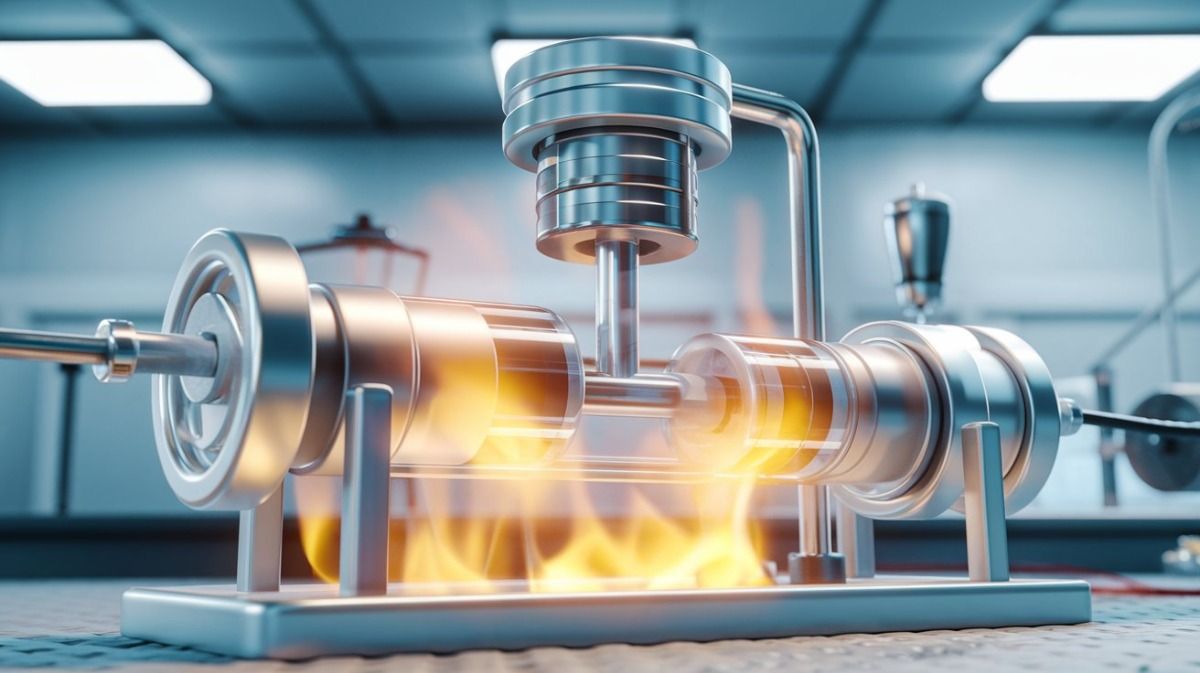
Thermodynamics: There is a question that physicists sometimes ask students to contemplate: why do you know which direction is the future? The laws of classical mechanics, the laws of quantum mechanics, even most of the laws of electromagnetism work identically whether time runs forward or backward.
A film of two billiard balls colliding looks plausible in either direction. A film of an egg falling off a table and shattering does not look plausible in reverse - we know, immediately and without any calculation, that the reversed film is physically impossible.
Something has a direction, and that something is thermodynamics. The second law of thermodynamics - the law that says entropy can only increase or stay the same in an isolated system - is often described as the main law of physics that distinguishes past from future at the macroscopic scale. (Strictly, weak-interaction CP/T violation also breaks time-reversal symmetry at the particle level, but the thermodynamic arrow is what governs everyday irreversibility.)
Understanding thermodynamics means understanding not just how steam engines work, but why time flows.
Thermodynamics emerged as a discipline not from abstract philosophical reflection but from the eminently practical problem of making steam engines more efficient. Its founding questions were economic and engineering questions: how much work can we extract from burning a given amount of coal?
Is there a theoretical limit to how efficient a heat engine can be? The answers to these questions turned out to implicate the deepest structure of reality. The science of boilers and pistons became, in the hands of Clausius, Kelvin, Maxwell, and Boltzmann, a science of the universe itself.
"The second law of thermodynamics holds, I think, the supreme position among the laws of Nature. If someone points out to you that your pet theory of the universe is in disagreement with Maxwell's equations - then so much the worse for Maxwell's equations.
But if your theory is found to be against the second law of thermodynamics I can give you no hope; there is nothing for it but to collapse in deepest humiliation." - Arthur Eddington, The Nature of the Physical World (1928)[8]
Key Definitions
Thermodynamics: The branch of physics that studies the relationships between heat, work, temperature, and energy, and the statistical behavior of large assemblies of particles.
Entropy: A measure of the number of microscopic arrangements consistent with a given macroscopic state; often described informally as a measure of disorder or, more accurately, of how energy and matter are dispersed among available microstates. Defined formally by Clausius (1865) and statistically by Boltzmann (1877).
Heat engine: A device that converts heat into mechanical work by moving heat from a high-temperature reservoir to a low-temperature reservoir; the conceptual basis for Carnot's analysis of thermodynamic limits.
Carnot efficiency: The theoretical maximum efficiency of any heat engine operating between two temperatures, equal to 1 minus the ratio of the cold reservoir temperature to the hot reservoir temperature (in Kelvin).
Boltzmann's constant (k): A fundamental physical constant relating temperature to the average kinetic energy of particles; appears in Boltzmann's entropy formula S = k log W.
Absolute zero: The temperature at which all classical motion ceases (0 Kelvin, or -273.15 degrees Celsius); the Third Law establishes it cannot be reached.
The Steam Engine Problem: Why Thermodynamics Was Needed
By the early nineteenth century, steam engines were economically transforming Britain and beginning to spread across Europe and North America. They pumped water from mines, powered textile mills, and were beginning to propel locomotives. But the men who built and operated them were working largely by intuition and empirical experience.
They had no theory of why one engine was more efficient than another, no way of calculating the maximum possible efficiency, and no understanding of the fundamental relationship between heat and mechanical work.
The decisive theoretical intervention came from an unexpected source: a twenty-eight-year-old French military engineer named Nicolas Leonard Sadi Carnot. In 1824, Carnot published Reflections on the Motive Power of Fire, a slim book of fewer than 120 pages that contained one of the most important insights in the history of physics.
Carnot was motivated in part by a patriotic concern: French steam engines were notably less efficient than British ones, and France was losing the industrial competition.
He wanted to understand whether this was a matter of engineering details or whether there was a theoretical maximum to what any heat engine could achieve.
Carnot's central insight was that a heat engine does not simply consume heat.[1] It moves heat from a hot reservoir (the boiler, heated by burning fuel) to a cold reservoir (the atmosphere, or the condenser).
Mechanical work is extracted from this flow of heat, just as mechanical work can be extracted from water flowing from a high reservoir to a low one.
And just as a waterwheel can never extract more work than corresponds to the full height difference of the water fall, a heat engine can never extract more work than corresponds to the temperature difference between the hot and cold reservoirs.
The maximum efficiency depends only on these temperatures, not on the working substance, not on the clever design of the machinery.
Carnot died of cholera in 1832 at age thirty-six. His book was largely ignored for fifteen years. Then Rudolf Clausius in Germany and William Thomson (Lord Kelvin) in Britain independently recognized its importance and used it as a starting point for the systematic development of thermodynamics in the 1840s and 1850s.
The Four Laws of Thermodynamics
| Law | Statement | Practical Implication |
|---|---|---|
| Zeroth Law | If A is in equilibrium with C and B is in equilibrium with C, then A is in equilibrium with B | Temperature is a meaningful, comparable quantity; thermometers work |
| First Law | Energy is conserved; heat added minus work done equals change in internal energy | You cannot build a perpetual motion machine of the first kind |
| Second Law | Entropy of an isolated system never decreases | No engine can be 100% efficient; heat flows from hot to cold; time has a direction |
| Third Law | As temperature approaches absolute zero, entropy approaches a constant minimum | Absolute zero (0 K) is unreachable in finite steps |
The Zeroth Law: Temperature Is Real
The Zeroth Law was recognized after the other three laws were already established, which is why it has the peculiar name of zeroth rather than being inserted as a new fourth law.[9] It states that if two systems are each in thermal equilibrium with a third system, they are in thermal equilibrium with each other.
This sounds trivially obvious, but it is doing important conceptual work. It establishes that temperature is a well-defined, transitive property that can be compared across different systems.
It is the theoretical justification for the existence of thermometers: a thermometer measures the temperature of an object by coming into thermal equilibrium with it, and the zeroth law guarantees that this equilibrium temperature is a meaningful representation of the object's thermal state.
Without the zeroth law, we could not consistently compare the temperatures of different objects.
The First Law: Energy Is Conserved
The First Law of thermodynamics is a statement of energy conservation, translated into the language of heat and work. The change in the internal energy of a system equals the heat added to the system minus the work done by the system. Energy can be neither created nor destroyed; it can only be converted from one form to another.
The experimental foundation for this law was laid significantly by James Prescott Joule, an English brewer and meticulous amateur physicist who spent decades in the 1840s and 1850s demonstrating the equivalence of mechanical work and heat.
His most famous experiment involved a paddle wheel inside an insulated container of water: measured mechanical work was done to turn the paddle, and the resulting temperature rise of the water was precisely measured.
Joule showed that a fixed amount of mechanical work always produced the same temperature rise in the same amount of water - the mechanical equivalent of heat - regardless of the method used to do the work.
This quantitative equivalence demolished the caloric theory, which had imagined heat as a fluid substance distinct from mechanical energy, and established energy conservation as a universal principle.
The Second Law: Entropy Always Increases
The Second Law is the deepest and most consequential of the four. It has been stated in several equivalent forms by different physicists. Clausius (1850) stated it as: heat does not spontaneously flow from a colder body to a hotter body.[2]
Kelvin's statement is: it is impossible to convert heat entirely into work without some other effect on the surroundings.
Clausius later restated it in terms of entropy - a new state function he invented and named: in any spontaneous process in an isolated system, the total entropy either increases or remains constant. It never decreases.
These statements are equivalent, and each captures a different intuition about irreversibility. Clausius's version captures the directional flow of heat. Kelvin's version captures the fundamental inefficiency of heat engines. The entropy version captures the general tendency toward disorder.
All three say the same thing: natural processes have a preferred direction, and that direction is not reversible without paying an energy cost.
The Second Law is statistical, not absolute, in the sense that it applies to macroscopic systems with large numbers of particles. For very small systems with only a few molecules, spontaneous decreases in entropy do occur with non-negligible probability - and this has been measured experimentally.
But for any macroscopic system, the probability of a spontaneous entropy decrease is so fantastically small that it can be treated as impossible for all practical purposes.
The Third Law: Absolute Zero Is Unreachable
The Third Law, associated with Walther Nernst around 1906 and refined by subsequent work, states that as the temperature of a system approaches absolute zero (0 Kelvin), its entropy approaches a minimum value - typically zero, for a perfect crystal with a single ground state.
A practical consequence is that absolute zero cannot be reached in a finite number of cooling steps. Each step of a refrigeration cycle removes a smaller and smaller fraction of the remaining thermal energy, and the final gap can never be closed.
Modern physics laboratories have cooled atoms to within billionths of a degree of absolute zero, creating exotic quantum states like Bose-Einstein condensates in which atoms behave collectively as a single quantum entity.
These experiments probe the frontier between thermodynamics and quantum mechanics. But the absolute zero of classical thermodynamics - complete cessation of all motion - remains physically unreachable.
Boltzmann and the Statistical Interpretation
Rudolf Clausius invented entropy in 1865 as a mathematical quantity that captured thermodynamic irreversibility. But what is entropy, physically? The question was answered by Ludwig Boltzmann, an Austrian physicist whose statistical mechanics constitutes one of the greatest achievements of nineteenth-century science.
Boltzmann's key insight was to think about the macroscopic states of a thermodynamic system - a gas at a certain temperature and pressure, for instance - in terms of the underlying microscopic arrangements of molecules that could produce that macroscopic state.
He called the number of such microscopic arrangements the thermodynamic probability, denoted W.
A gas expanded to fill a large container has more possible arrangements of molecules than the same gas compressed into a corner; a shuffled deck of cards has more possible arrangements than a sorted deck.[12]
Boltzmann showed that entropy is proportional to the logarithm of the number of microstates: S = k log W.[3]
Why Entropy Increases
Boltzmann's formula makes the second law intuitively clear. High-entropy states have vastly more microstates than low-entropy states.
When a system evolves from a constrained low-entropy state - all molecules on one side of a container, or a sorted deck of cards - to an unconstrained high-entropy state, it is not violating any microscopic law.
Each individual microstate is equally probable. But there are so many more high-entropy microstates than low-entropy ones that the system will almost certainly be in a high-entropy state if observed at random.
Entropy increases not because of any force that drives it upward, but because high-entropy states are overwhelmingly more probable.
Boltzmann's Tragic Life
Boltzmann faced fierce opposition from Ernst Mach and Wilhelm Ostwald, influential philosophers-scientists who rejected the atomic hypothesis and therefore attacked the entire conceptual foundation of statistical mechanics.
The controversy was not purely academic: Ostwald in particular was well connected and could influence appointments and publications. Boltzmann's health deteriorated under the combined stress of scientific controversy and personal setbacks.
He died by suicide in 1906, just as the scientific community was beginning to converge on his position.[11]
Within a few years, Einstein's 1905 explanation of Brownian motion provided direct experimental evidence for atoms, and Boltzmann's statistical mechanics became the foundation of modern physics. His equation S = k log W is inscribed on his tombstone in the Vienna Central Cemetery.
Maxwell's Demon and the Physics of Information
In 1867, James Clerk Maxwell proposed a thought experiment that seemed to violate the second law. Imagine a gas container divided by a partition with a small door. A tiny intelligent being - Maxwell's demon - watches molecules and opens the door for fast molecules moving one way, slow molecules moving the other.
Eventually all fast molecules are on one side and all slow ones on the other, creating a temperature difference without doing any work. Entropy seems to have decreased for free.
The thought experiment troubled physicists for nearly a century. The resolution, when it came, connected thermodynamics to information theory in a profound and unexpected way.
Leo Szilard showed in 1929 that the demon must acquire information about each molecule, linking the demon's operation to information. Later work (Bennett, building on Landauer) clarified that acquiring or measuring information need not carry an unavoidable thermodynamic cost. But the complete resolution came from Rolf Landauer at IBM in 1961. Landauer realized that the costly step is not gathering information but erasing it.
The demon must have a memory, and when that memory is reset to accept new measurements, the erasure is a thermodynamically irreversible process that generates entropy. The minimum entropy cost of erasing one bit of information is k ln 2 - Landauer's principle.[6]
This has been experimentally verified and has deep implications. Every logically irreversible computation - every operation that discards information - must generate at least Landauer's minimum of heat.
Modern computers are far less efficient than this limit, but as miniaturization continues, the Landauer limit becomes practically relevant.
The demon revealed a deep connection between physical entropy and Shannon information entropy that remains one of the most fertile areas of theoretical physics.
Entropy and the Arrow of Time
If the microscopic laws are time-symmetric, why does time have a direction? The second law provides an answer: the direction we call the future is the direction in which entropy increases.[10] This is not a circular definition but an explanation grounded in the statistical properties of macroscopic systems.
The answer, however, raises a deeper question. If entropy increases toward the future, it must decrease toward the past - meaning the past must have had lower entropy than the present. But if microscopic laws are symmetric, why should entropy be lower in one temporal direction?
Boltzmann's answer was that the universe started in an extremely low-entropy initial condition - what we now call the Big Bang - and has been evolving toward higher entropy states ever since. The arrow of time is an echo of the initial conditions of the universe, not a feature of the fundamental laws.[7]
This explains why we remember the past but not the future. Low-entropy past states leave behind structured records: physical traces in the environment, neural patterns in the brain, writing on paper.
High-entropy future states leave no such records because there is no thermodynamic mechanism for them to do so. On this view, the asymmetry of memory and of cause and effect is closely tied to the entropy gradient set up by the universe's low-entropy past. This is a leading account of the arrow of time rather than a fully settled or complete explanation.
Thermodynamics and Living Systems
Life presents an apparent paradox for thermodynamics. A living organism is a highly ordered, low-entropy structure in a universe tending toward disorder. How does the second law permit the evolution of complexity?
The answer is that the second law governs closed systems, while living organisms are open systems. A bacterium, a tree, or a human being maintains its internal order by consuming low-entropy energy - chemical energy in food, electromagnetic energy in sunlight - and expelling high-entropy waste products into the environment.
The organism's local decrease in entropy is more than compensated by the entropy increase it generates in its surroundings. Total entropy still increases; life does not violate the second law but depends on it.
Erwin Schrodinger articulated this framework memorably in his 1944 book What Is Life? He described living organisms as feeding on negative entropy - they extract order from their environment to maintain their own order.[4]
He also made the prescient prediction that genetic information must be stored in an aperiodic crystal, a molecule with a complex, non-repeating structure capable of encoding large amounts of information.
DNA, whose structure Watson and Crick identified in 1953 in part inspired by reading Schrodinger, is precisely this kind of structure.
Ilya Prigogine extended thermodynamic analysis to far-from-equilibrium open systems, showing that when a continuous throughput of energy drives a system far from equilibrium, spontaneous self-organization can emerge.[5] He called these organized states dissipative structures - they dissipate energy while maintaining internal order.
Hurricanes, oscillating chemical reactions, and many biological processes are dissipative structures. Prigogine received the Nobel Prize in Chemistry in 1977. His work suggested that the emergence of complexity is not a violation of thermodynamics but one of its consequences.
Thermodynamics and Climate Change
Climate change is, at its physical foundation, a problem in thermodynamics. The Earth's climate is governed by a thermodynamic energy budget: the rate at which the planet absorbs energy from the Sun must equal the rate at which it radiates energy to space, or the temperature must change until balance is restored.
Greenhouse gases - carbon dioxide, methane, water vapor, nitrous oxide - are largely (though not perfectly) transparent to incoming shortwave solar radiation while strongly absorbing the longer-wavelength infrared radiation that the Earth's surface emits.
When a photon of infrared radiation is absorbed by a CO2 molecule, the molecule re-emits energy partly back toward Earth, reducing the rate at which the planet can shed absorbed solar energy. The planet warms until it is radiating at a higher rate, which requires a higher surface temperature.
This is the greenhouse effect, and it is straightforward thermodynamics: a consequence of energy conservation and the Stefan-Boltzmann law governing thermal radiation.
The atmosphere's circulation, ocean currents, and weather systems are dissipative structures in Prigogine's sense: they are maintained by the throughput of solar energy and organize themselves to transport heat from the equator toward the poles as efficiently as possible.
When the energy balance is altered by increased greenhouse gas concentrations, the entire system must reorganize.
The reorganization involves higher mean temperatures, altered precipitation patterns, more energetic extreme weather events, and changes in ocean circulation - all consequences of thermodynamic principles operating at planetary scale.
Cross-References
- For the broader framework of understanding complex systems, see What Is a System?
- For information theory and its connections to entropy, see Information Theory Unpacked: Shannon and Digital Foundations
- For how emergence relates to self-organization in thermodynamic terms, see Emergence Explained with Examples
- For feedback loops in complex systems, see How Feedback Loops Work
- For why optimization can fail in complex systems, see Why Optimization Fails in Complex Systems
Sources & Further Reading
- Carnot, Sadi. Reflections on the Motive Power of Fire. 1824. Translated by R.H. Thurston, Dover, 1960.
- Clausius, Rudolf. "On the Moving Force of Heat and the Laws of Heat which May Be Deduced Therefrom." Annalen der Physik, 1850.
- Boltzmann, Ludwig. Lectures on Gas Theory. 1896-1898. Translated by Stephen Brush, University of California Press, 1964.
- Schrodinger, Erwin. What Is Life? Cambridge University Press, 1944.
- Prigogine, Ilya and Isabelle Stengers. Order Out of Chaos: Man's New Dialogue with Nature. Bantam Books, 1984.
- Landauer, Rolf. "Irreversibility and Heat Generation in the Computing Process." IBM Journal of Research and Development 5(3), 1961.
- Penrose, Roger. "The Emperor's New Mind". Oxford University Press, 1989.
- Eddington, Arthur. The Nature of the Physical World. Cambridge University Press, 1928.
- Atkins, Peter. The Laws of Thermodynamics: A Very Short Introduction. Oxford University Press, 2010.
- Carroll, Sean. From Eternity to Here: The Quest for the Ultimate Theory of Time. Dutton, 2010.
- Cercignani, Carlo. Ludwig Boltzmann: The Man Who Trusted Atoms. Oxford University Press, 1998.
- Ben-Naim, Arieh. Entropy Demystified: The Second Law Reduced to Plain Common Sense. World Scientific, 2007.