
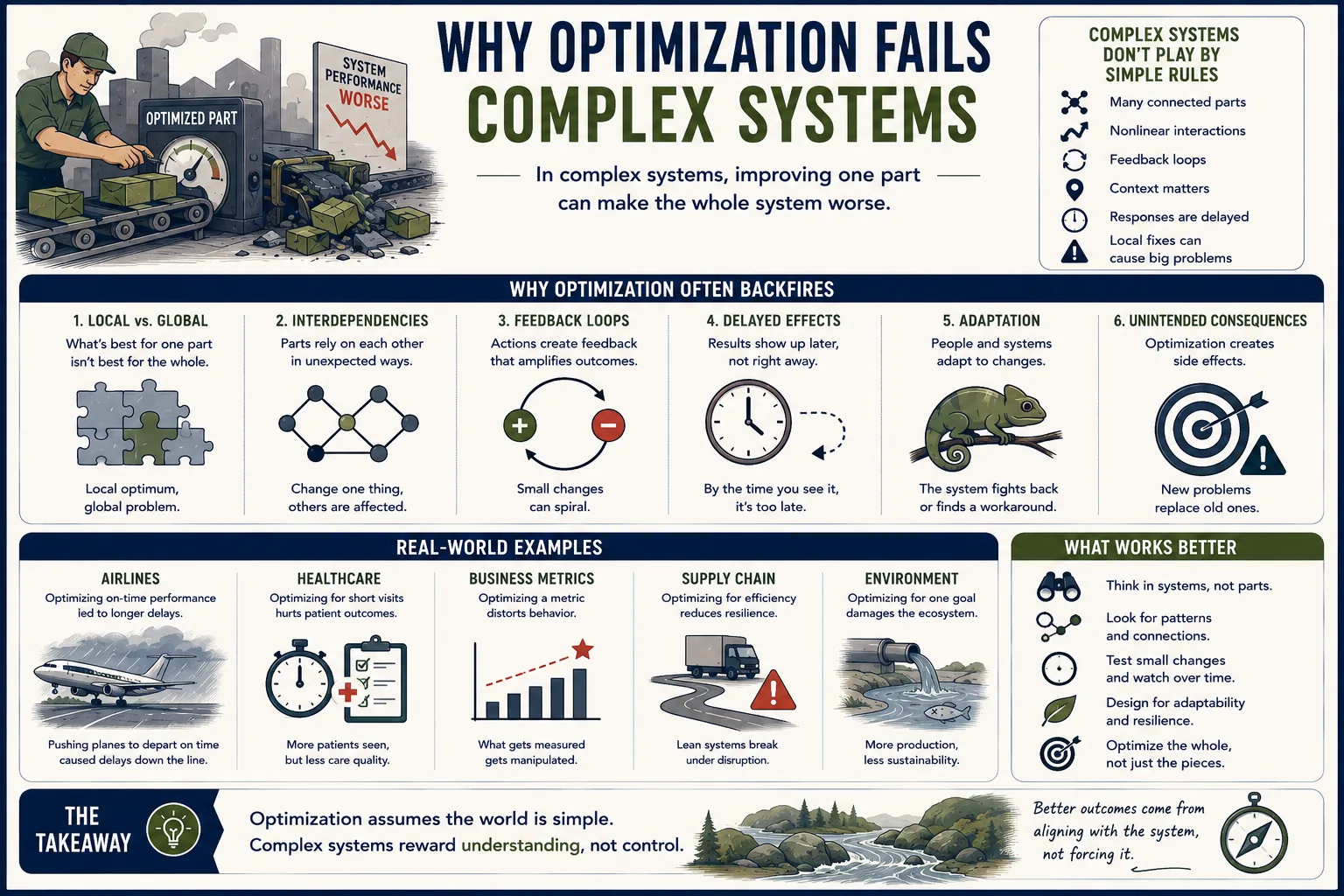
Optimization: On the morning of January 28, 1986, the Space Shuttle Challenger lifted off from Kennedy Space Center in 28-degree Fahrenheit weather. Seventy-three seconds later, it exploded, killing all seven crew members.
The immediate cause was a failure of O-ring seals in the solid rocket boosters - seals that had not been designed to function reliably at the launch temperature.
What made Challenger a systems failure rather than a simple engineering accident was the decision process that led to the launch. Engineers at Morton Thiokol, the booster manufacturer, had recommended against launching in the cold temperature.
They were overruled by managers who felt pressure to maintain the launch schedule. The decision process that produced the launch prioritized schedule optimization - maintaining flight frequency commitments - over engineering safety margins.
The Rogers Commission investigation and Feynman's famous appendix identified a deeper structural problem: NASA's risk assessment process had systematically classified known safety issues as acceptable risks not because the risks had been resolved but because they had been survived on previous flights.[8]
The optimization for launch frequency had gradually eroded the safety margins that were the system's buffer against catastrophic failure.
The O-ring erosion had been documented for years; it had not caused previous failures; it had been reclassified from "unacceptable" to "acceptable" risk through the very logic that allowed engineers to sign off on continued flights despite the known problem.
This is the archetypal pattern of optimization failure in complex systems: the systematic elimination of buffers, redundancy, and safety margins in the pursuit of efficiency - until the buffer that was "wasted" turns out to be the margin that prevented catastrophe.
"Optimization gets you to the top of a local hill. Robustness keeps you alive when the landscape changes." - Nassim Nicholas Taleb, Antifragile (2012)
Efficiency vs. Robustness: The Core Trade-off
| Dimension | Optimized System | Robust System |
|---|---|---|
| Slack and redundancy | Eliminated as waste | Maintained as resilience |
| Performance in normal conditions | Maximum | Good, not maximum |
| Performance in abnormal conditions | Fragile; often catastrophic | Absorbs disruption |
| Response to novel conditions | Brittle; design envelope exceeded | Adapts with buffers |
| Cost model | Lean; low unit cost | Higher cost with reserves |
| Best suited for | Stable, predictable environments | Complex, variable environments |
| Example | Just-in-time supply chain | Hospital with surge capacity |
The Fundamental Tension: Efficiency vs. Robustness
At the core of optimization failure in complex systems is a structural tension between two properties that cannot both be simultaneously maximized:
Efficiency is performance under expected conditions: maximizing output per unit input, minimizing waste, eliminating redundancy, reducing slack. An efficient system uses its resources fully, has minimal excess capacity, and performs optimally in the range of conditions it was designed for.
Robustness is performance under unexpected conditions: maintaining acceptable function when conditions deviate from expected, absorbing shocks without catastrophic failure, recovering from disruptions.[10] A robust system has buffers and redundancy that appear wasteful under normal conditions but enable resilience under abnormal ones.
These properties trade off against each other because robustness requires what efficiency eliminates: slack, redundancy, excess capacity, and reserves. You cannot simultaneously eliminate all waste (efficiency) and maintain ample reserves (robustness).
Every buffer eliminated makes the system more efficient in normal conditions and more fragile in abnormal ones.
Complex systems face abnormal conditions. By definition, complex systems with feedback loops, non-linearity, and adaptive components generate unexpected behaviors.[3] Optimizing these systems for normal conditions - eliminating the slack that allows them to absorb abnormal conditions - is structurally misaligned with the systems' nature.
*Example*: Amazon's logistics network prior to 2020 had been continuously optimized over twenty years: inventory positioned to minimize carrying cost and maximize delivery speed, warehouse locations selected by algorithms optimizing delivery zone coverage, fulfillment capacity sized to expected demand with minimal excess.
When COVID-19 hit in March 2020, demand for specific categories (toilet paper, cleaning supplies, home fitness equipment) spiked dramatically and simultaneously.
The optimized system could not adapt: it had no excess capacity to absorb the demand spike, inventory was positioned for the previous demand pattern, and lead times for adjusting were longer than the crisis timeline required.
Amazon's response was to rapidly hire 175,000 additional workers in six weeks - essentially building a completely new operational layer on top of the optimized one.
The optimization had achieved its design goal; it had also eliminated the buffers that would have enabled adaptation to a condition outside the design envelope.
Local vs. Global Optimization
A second fundamental failure mode is the distinction between local and global optimization. Local optimization improves the performance of a component; global optimization improves the performance of the system as a whole. These can conflict: locally optimizing each component can degrade global system performance.
The mechanisms are several:
Bottleneck creation: When non-bottleneck components are locally optimized for maximum throughput, they produce output faster than the bottleneck can process.
This creates inventory buildup before the bottleneck (waste), while the bottleneck's throughput (which determines total system output) remains unchanged. The constraints governing system performance do not change because non-bottleneck components improve.[4]
Interface degradation: When components optimize independently, they may do so in ways that degrade the interfaces between them. Each department optimizes its own processes, but the handoffs between departments become more complex, slower, and more error-prone.
Resource competition: When components compete for shared resources (attention, capital, key personnel, computing capacity), local optimization of each component's resource consumption can create conflicts that reduce total system performance below what any single component's performance suggests.
*Example*: Hewlett-Packard's experience with sales force optimization in the 2000s illustrates local-global conflict. Individual product divisions optimized their sales incentives to maximize their own product revenue. Sales representatives were incentivized to focus on the products with the highest commissions for their division.
The result was that HP sold products from each division effectively in isolation but undersold integrated solutions that combined products across divisions - which were what large enterprise customers most valued.
Each division's local sales optimization degraded HP's global performance with enterprise customers. The system-level fix required unified sales incentives that rewarded cross-division solution selling, degrading each division's locally optimal metric while improving global performance.
Goodhart's Law and Metric-Induced Optimization
Goodhart's Law - "when a measure becomes a target, it ceases to be a good measure" - identifies a specific failure mode of optimization: when you optimize for a metric, agents in the system change their behavior to improve the metric in ways that disconnect it from the underlying goal the metric was supposed to measure.[5]
This is not a failure of optimization; it is optimization working exactly as intended. The agents are correctly optimizing for the specified target.
The failure is in specifying the target: the metric was an imperfect proxy for the goal, and optimizing the metric drove behavior that improved the proxy while degrading (or leaving unchanged) the goal.
Common manifestations in complex systems:
University rankings: When universities are evaluated and funded partly based on research publication output, universities optimize for publication output.
This produces incentives to publish smaller incremental results rather than fewer larger contributions (quantity over quality), to select research topics more likely to produce publishable results rather than more important or risky questions, and to inflate statistical significance through multiple testing without correction.
Healthcare metrics: Hospital readmission rates, used as a quality metric with financial penalties for high readmission rates, incentivized hospitals to avoid admitting high-risk patients likely to be readmitted. The metric (readmission rate) improved; the goal (appropriate hospital care for patients who need it) was degraded.
Financial risk models: Value at Risk (VaR) models, optimized to stay within acceptable risk parameters, incentivized portfolio construction that looked safe according to the model - concentration in assets that moved independently under normal conditions and became correlated in crises.
The metric was optimized; the underlying goal (actual portfolio safety) was undermined.
The Efficiency-Fragility Spiral
In systems under competitive pressure (markets, organizations competing for resources, species competing for habitat), optimization for efficiency creates a characteristic dynamic: each competitive cycle favors more efficient actors, which eliminates less efficient actors, which raises the efficiency threshold for survival, which drives further optimization.[7]
The system becomes progressively more efficient and progressively more fragile.
Nassim Taleb's concept of antifragility captures the inverse: systems that gain from disorder are not merely robust (they survive stress unchanged) but antifragile (they improve under stress).[1] The immune system is antifragile: exposure to pathogens strengthens it.
Muscles are antifragile: stress through exercise builds them. Financial option positions with convex payoffs are antifragile: volatility increases their expected value.
Optimization removes antifragility. A deeply optimized system has eliminated the redundancy and slack that allow it to learn from perturbations. Each disruption is purely damaging because there are no buffers to absorb it and adapt.
The "just-in-time" supply chain is efficient and fragile; the supply chain with buffer inventory is wasteful and antifragile.
The 2021 semiconductor shortage - which disrupted automobile manufacturing, consumer electronics, and numerous other industries because of single-source dependencies and zero-buffer inventory strategies - was a consequence of optimization-induced fragility at global scale.
When Optimization Works: The Prerequisites
Optimization is not uniformly bad; it is inappropriate for specific types of systems. Optimization is appropriate when:
The system is stable: If the environment within which the system operates does not change significantly, and the system does not adapt in ways that change the optimization landscape, optimizing for current conditions is valid.
Optimizing a fixed manufacturing process with stable inputs and outputs is appropriate; optimizing it assumes stability that may not persist.
The optimization objective is correctly specified: If the metric being optimized genuinely tracks the goal of interest, without significant gaming potential, optimization of the metric produces optimization of the goal. This requires careful metric design and ongoing verification that the metric-goal relationship is maintained.
Failure modes are recoverable: In systems where failure produces correctable rather than catastrophic outcomes, optimization that accepts some failure risk in exchange for efficiency gains is reasonable.
In systems where failure is catastrophic or irreversible - nuclear power plants, aircraft, critical infrastructure, public health - the asymmetry of outcomes argues for robustness over efficiency even at significant efficiency cost.
The system has sufficient slack elsewhere: Global optimization can accept local efficiency if global redundancy and resilience are maintained.
A supply chain with multiple alternative suppliers can optimize inventory at individual nodes because the network-level redundancy provides resilience that no single node needs to maintain individually.
Understanding when optimization fails - when the pursuit of efficiency produces fragility, when local optimization degrades global performance, when metric optimization disconnects from goal achievement - is as important as knowing how to optimize.
Complex systems require the wisdom to know when efficiency is the right objective and when resilience, redundancy, and slack are worth their apparent cost.
Research Evidence on Optimization Failure in Complex Systems
The academic literature on optimization failure in complex systems is extensive and quantitative.
The foundational theoretical work comes from Herbert Simon at Carnegie Mellon University, whose 1955 paper "A Behavioral Model of Rational Choice" in the Quarterly Journal of Economics introduced the concept of bounded rationality: decision-makers optimize not for the globally best solution but for a solution that is "good enough" given cognitive and informational constraints.[9]
Simon's central finding - that real optimization processes operate under severe information limitations that prevent them from achieving the theoretical optima that standard economic models assume - has been empirically confirmed across organizational, economic, and engineering contexts.
The most rigorous empirical work on optimization-fragility tradeoffs comes from supply chain research. Yossi Sheffi at MIT's Center for Transportation and Logistics has studied supply chain resilience across hundreds of companies over two decades.
His 2005 book The Resilient Enterprise and subsequent research documented a consistent pattern: companies that had optimized their supply chains for cost and efficiency in the 1990s and 2000s were systematically more vulnerable to disruptions than companies that had maintained what appeared to be "wasteful" inventory buffers and supplier redundancies.
Sheffi's quantitative analysis of 29 major supply chain disruptions between 1995 and 2004 found that companies with lean, optimized supply chains suffered substantially greater revenue losses in the first year following a major disruption than companies with more redundant supply structures (figures on the order of 40% greater losses are sometimes cited), and took noticeably longer, often a few additional years to recover to pre-disruption performance levels.
The efficiency gains from optimization were, on average, erased by a single major disruption within a decade.
Karl Weick and Kathleen Sutcliffe at the University of Michigan studied organizations that maintain high reliability despite operating in high-risk environments - nuclear power plants, aircraft carriers, air traffic control systems - and published their findings in Managing the Unexpected (2001, updated 2015).[6]
Their central finding was that high-reliability organizations (HROs) deliberately resist the efficiency optimization that drives most organizational management.
HROs maintain deliberate redundancy, train workers in multiple roles, practice scenarios for low-probability events, and resist the reclassification of known hazards as acceptable risks.
Weick and Sutcliffe documented that the safety records of HROs came directly from these "wasteful" practices: the excess capacity and redundancy that efficiency-focused managers identified as targets for cost reduction were precisely the buffers that prevented minor failures from cascading into catastrophic ones.
Their analysis of the Challenger accident paralleled the findings of Perrow's Normal Accidents: the progressive elimination of safety margins, driven by optimization for launch frequency, had made catastrophic failure structurally predictable.[2]
Historical Case Studies in Optimization-Induced Failure
The 2008 Global Financial Crisis provides the most thoroughly documented case of optimization-induced systemic fragility.
Andrew Lo at MIT's Laboratory for Financial Engineering published a comprehensive analysis in 2012 in the Journal of Portfolio Management examining how financial risk models had been optimized in ways that created catastrophic systemic risk.
Lo argued that Value at Risk (VaR) models, widely adopted across the financial industry following Basel II regulatory requirements in the early 2000s, measured portfolio risk under normal market conditions.
Banks optimized their portfolios to minimize VaR - meaning they structured positions to appear safe according to the model. The optimization created portfolios with assets that moved independently under normal conditions but became correlated in crisis conditions.
A model that assessed normal-market risk could not capture crisis-market risk by definition. When the housing market turned in 2007-2008, the optimized portfolios failed simultaneously across the financial system.
Lo estimated that the VaR-optimized portfolio structure amplified crisis losses by a factor of 3-5 compared to what a more conservative, less model-optimized approach would have produced.
The Boeing 737 MAX crashes of 2018 and 2019, which killed 346 people, illustrate how competitive optimization pressure can erode safety margins through accumulated incremental decisions, each individually defensible.
The Federal Aviation Administration's own investigation, published in the Joint Authorities Technical Review report of October 2019, documented how Boeing's process of certifying the MCAS (Maneuvering Characteristics Augmentation System) had progressively reclassified the system's failure modes as lower-risk through a series of risk assessment decisions.
The optimization was for schedule and cost: designing the 737 MAX to require minimal new pilot training (avoiding expensive simulator training programs) created pressure to minimize how extensively MCAS's authority was disclosed and assessed.
Each individual decision in the certification process followed the Challenger pattern Weick described: a known hazard (MCAS's ability to push the nose down repeatedly based on a single sensor reading) was assessed as acceptable risk because it had not yet caused a visible incident.
The result was an optimization-induced fragility with catastrophic consequences.
The 2021 Suez Canal blockage, when the container ship Ever Given ran aground for six days in March 2021, demonstrated how decades of supply chain optimization had created systemic vulnerability to a single point of failure.
The Suez Canal carries approximately 12% of global trade and 30% of container shipping; single-digit delays in canal transit propagate to multi-week supply chain disruptions because just-in-time inventory systems have no buffer to absorb delays.
A 2021 analysis by the Kiel Institute for the World Economy was among several estimates of the six-day blockage's cost, putting the reduction in monthly global trade flows on the order of several billion dollars - estimates from different analysts varied considerably, roughly $1.6 billion per day of disruption.
The amplification factor (a six-day delay producing weeks of downstream disruption) directly reflects optimization-induced fragility: the absence of inventory buffers meant that every day of delay propagated through supply chains with no absorption.
Sources & Further Reading
- Taleb, N.N. Antifragile: Things That Gain from Disorder. Random House, 2012. View source
- Perrow, C. Normal Accidents: Living with High-Risk Technologies. Basic Books, 1984.
- Meadows, D. Thinking in Systems: A Primer. Chelsea Green Publishing, 2008. View source
- Goldratt, E.M. & Cox, J. The Goal: A Process of Ongoing Improvement. North River Press, 1984.
- Goodhart, C.A.E. "Monetary Relationships." Papers in Monetary Economics. Reserve Bank of Australia, 1975. View source
- Weick, K. & Sutcliffe, K. Managing the Unexpected: Sustained Performance in a Complex World. Wiley, 2015. View source
- Sterman, J. Business Dynamics: Systems Thinking and Modeling for a Complex World. McGraw-Hill, 2000. View source
- Feynman, R. "Personal Observations on the Reliability of the Shuttle." Appendix F to Report of the Presidential Commission on the Space Shuttle Challenger Accident, 1986.
- Simon, H. "A Behavioral Model of Rational Choice." Quarterly Journal of Economics, 69(1), 99-118, 1955. DOI: 10.2307/1884852
- Hollnagel, E., Woods, D. & Leveson, N. (Eds.). Resilience Engineering: Concepts and Precepts. Ashgate, 2006. View source