What Are Mental Representations?
State: Mental representations are the internal cognitive structures through which experts perceive, organize, process, and retrieve domain knowledge - and the primary mechanism that distinguishes expert performance from novice performance.
Rather than having more raw memory or processing speed, experts have developed richer, more densely interconnected representational structures that allow them to chunk information into meaningful patterns, recognize situations rapidly, and generate appropriate responses without exhaustive conscious search.
The study of how these representations develop and what makes them powerful has been the central project of expertise science since the foundational chess research of Chase and Simon in the 1970s.
In 1973, William Chase and Herbert Simon published a study that had a deceptively simple design and profoundly disruptive results. They showed chess positions to grandmasters and beginners for five seconds, then asked each group to reconstruct the positions from memory.
Grandmasters reconstructed roughly 23 pieces on average; beginners reconstructed about 6. The result seemed to suggest superior memory - until the researchers added a crucial condition.
When the same experiment was run with randomly arranged pieces (positions that could not occur in an actual game), grandmasters performed no better than beginners. Both groups recalled about 6 pieces.
The grandmasters did not have superior raw memory. They had superior perceptual chunking: they organized the chess positions into meaningful units (typical attack patterns, familiar defensive structures, known pawn formations) that could be stored as single chunks in working memory.
Random positions contained none of these chunks and defeated the advantage entirely. The grandmasters were not seeing more squares; they were seeing differently organized information.
This study launched what became the dominant paradigm in expertise research: the investigation of mental representations - the internal cognitive structures through which experts perceive, organize, process, and retrieve domain knowledge.
Understanding how these representations differ from novice representations, how they develop, and why they produce the behavioral differences we call expertise has been the central project of expertise science for fifty years.
"The difference between an expert and a novice is not just how much they know. It is how their knowledge is organized - the richness of the relational structures that connect what they know." - K. Anders Ericsson, The Cambridge Handbook of Expertise and Expert Performance (2006)
Types of Mental Representations
| Representation Type | What It Encodes | Expert Advantage | Example |
|---|---|---|---|
| Perceptual representations | Meaningful patterns in sensory input | See relevant features immediately; ignore irrelevant ones | Radiologist recognizing pneumonia pattern in X-ray |
| Conceptual representations | Abstract categories with associated knowledge | Rapid categorization; class-level knowledge immediately applicable | Attorney's "contract dispute" schema |
| Procedural representations | Action sequences and conditional decision trees | Fluent execution with automatic exception handling | Surgeon's appendectomy including complication protocols |
| Situational representations | Real-time integration of all knowledge in current context | Direct generation of plausible actions without exhaustive search | Incident commander reading a fire scene |
| Long-term working memory | Retrieval structures extending effective working memory capacity | Work with far more domain information than capacity limit suggests | Chess grandmaster playing simultaneous blindfold games |
What Mental Representations Are
A mental representation is an internal cognitive structure that represents information about the world in a form that can be manipulated, stored, and retrieved for use in perception, reasoning, and action. The term is agnostic about the precise neural mechanisms; it refers to the functional structures that enable cognition.
Mental representations exist at multiple scales:
Perceptual representations organize sensory information into meaningful patterns.
A skilled radiologist reading a chest X-ray does not process raw pixel data; they perceive organized patterns - tissue densities, structural features, shadow distributions - that correspond to anatomical and pathological categories built from thousands of prior X-rays.
Conceptual representations organize knowledge into categories and schemas - abstract structures that capture the essential features of a class without preserving all instance details.
An experienced attorney's representation of "contract dispute" includes the relevant legal doctrines, the procedural framework, the strategic considerations, and the typical evidentiary questions - all organized into a coherent structure that can be rapidly populated with case-specific details.
Procedural representations encode sequences of actions and the conditions under which they apply.
An experienced surgeon's representation of an appendectomy includes not just the steps but the decision points, the complications that can arise at each step, and the alternative procedures for each complication - all organized as a conditional flow that guides action under varying conditions.
Situational representations (the most complex) integrate perceptual, conceptual, and procedural knowledge into a real-time model of a specific situation as it develops.
Gary Klein's research on firefighter decision-making found that experienced incident commanders did not generate multiple options and compare them; they maintained a rich situational representation that generated plausible courses of action directly, which they then mentally simulated and either executed or modified.
The Development of Expert Representations: Chunking
The Chase-Simon paradigm established chunking as the primary mechanism by which expert representations differ from novice representations. But the process of chunking is more complex than the classic studies suggest.
Chunking involves grouping lower-level units (individual pieces, individual notes, individual words) into higher-level units (tactical patterns, melodic phrases, semantic structures) that can be stored and retrieved as single items.
As expertise develops, the chunks become larger, more densely populated, more richly connected to each other, and more automatically deployed.
The development of chunks is driven by experience with meaningful patterns. A chess player who has seen the King's Gambit opening hundreds of times does not store each piece's position separately; they store the whole opening structure as a single chunk with attendant knowledge about its implications, typical continuations, and strategic goals.
A jazz musician who has played bebop for decades stores characteristic harmonic movements as chunks that can be deployed in real time without conscious construction.
The key requirement is meaningful pattern exposure: chunks cannot be built from random patterns (as the chess experiment showed) because random patterns do not repeat in ways that reward learning.
Deliberate practice in expert domains is partly the systematic exposure to the meaningful patterns that experienced practitioners store as chunks, and the feedback that calibrates chunk recognition to actual outcomes.
*Example*: Alfred Binet, studying chess masters in the 1890s, noted that strong players could play simultaneous blindfold chess against dozens of opponents, maintaining detailed representations of all boards without visual access.
This capacity - which appears miraculous to observers - reflects the chunked nature of their board representations: they are not storing the positions of 32 individual pieces across 20 boards (640 items, far beyond any memory system).
They are storing perhaps 5-10 meaningful patterns per board, each of which encodes the positions and relationships of multiple pieces as a single structured unit.
Skilled Perception: Seeing Differently
The most externally striking feature of expert performance is often skilled perception: experts literally see things that novices do not. This is not metaphorical; the perceptual processing of experts produces different phenomenal experiences and different behavioral affordances than novice processing.
Research using eye-tracking technology has documented this directly. Expert radiologists move their eyes over X-rays in distinctly different patterns than novice radiologists: they fixate on diagnostically relevant areas first, spend less time on irrelevant areas, and process the overall organizational structure of the image before examining details.
Novices process more globally and uniformly, then gradually identify regions of interest. The expert's prior knowledge shapes what they see, not just how they interpret what they see.
In chess, experts perceive the board in terms of piece relationships and positional patterns rather than individual pieces. Ask a grandmaster what piece is on e4 and they will need a moment to translate from their relational representation into position-based terms.
Ask them whether the position on e4 is tactically dangerous and they will respond immediately, because the tactical properties of the position are what they stored - not the piece identity and location.
This skilled perception has a practical implication for skill acquisition: novices cannot simply be given the same problems as experts and expected to develop similar representations. The problems look different to novices (they see individual elements rather than patterns) and provide different learning material.
Effective skill acquisition requires deliberate practice in conditions that guide perceptual attention toward the patterns that experts store - which is why expert coaching and structured practice are so superior to unguided experience for developing expert representations.
The Role of Long-Term Working Memory
Anders Ericsson and Walter Kintsch proposed the concept of long-term working memory (LTWM) to explain how experts can work with much larger amounts of information than the standard 4-7 item working memory limit would suggest.
Standard working memory stores items in an immediately accessible but capacity-limited buffer that decays within seconds without active rehearsal.
LTWM extends this by using long-term memory as an organized retrieval structure: experts encode information in ways that create retrieval cues in long-term memory, enabling rapid access to large amounts of domain-specific information as if it were in working memory.
The mechanism depends on the richness of existing long-term memory structure. A physician who has treated hundreds of patients with similar presentations can encode a new patient's presentation rapidly into an existing schema, making the whole schema immediately accessible for reasoning without loading each element into working memory individually.
The richness of the long-term structure effectively extends the working memory capacity available for domain-specific reasoning.
This is why expert representations take years to develop even with deliberate practice: LTWM depends on the existence of rich long-term memory structures that serve as the retrieval scaffolding. Those structures are built incrementally through extended meaningful experience and cannot be shortcut by intensive training over short periods.
The 10,000-hour figure associated with Anders Ericsson's work reflects this requirement: not 10,000 hours of any experience, but 10,000 hours of deliberate practice that systematically builds and refines the long-term memory structures on which LTWM depends.
Pattern Libraries and Template Theory
Adriaan de Groot's 1965 research on chess masters (the original source for the Chase-Simon paradigm) suggested that grandmasters have access to a library of approximately 50,000 to 100,000 chess patterns.
This estimate has since been refined, but the underlying concept has proven durable: expert performance depends on an extensive pattern library - a structured collection of recognized patterns with associated information about their implications and responses.
Gobet and Simon's 1996 extension of this work proposed template theory: that experts' representations are organized not just as chunks but as templates - complex structures with a stable core (the prototype of a common pattern) and slots (variable elements that distinguish instances).
A chess template for a typical kingside attack might have a stable core (pawn structure, piece placement, open files) with slots for the specific piece identities and exact positions that vary across instances.
Templates are more powerful than simple chunks because:
- They generalize: A template can represent a class of positions rather than a single position, enabling recognition of novel positions that share the core structure
- They generate predictions: A template's slots generate expectations about what variations are likely, guiding perceptual attention to confirm or disconfirm those expectations
- They encode implications: Templates link pattern recognition to strategic implications, typical continuations, and appropriate responses
The template theory has influenced instructional design in complex domains: effective teaching exposes learners to the core patterns that anchor templates and provides systematic variation across the slots to develop the generalization capacity that distinguishes flexible expert recognition from rigid pattern matching.
Domain Specificity and Transfer Limits
One of the most consistent and practically important findings in expertise research is the domain specificity of expert representations. Chess expertise does not transfer to checkers; medical expertise in cardiology does not transfer to dermatology; mathematics expertise does not transfer automatically to physics problem-solving.
The cognitive basis for this specificity is clear from the chunking and template accounts: expert representations encode knowledge in forms specific to the patterns, relationships, and concepts of a particular domain. The chunks are domain-specific; the templates are domain-specific; the retrieval cues are domain-specific.
When an expert moves to a new domain, their general cognitive capacities (working memory capacity, reasoning ability, metacognitive awareness) transfer, but the specific representations that drive expert performance do not.
This has significant practical implications:
For skill development: The primary resource for developing expert representations is deliberate practice in the specific domain, with expert feedback on specific domain-relevant patterns. There is no shortcut through general cognitive enhancement.
For assessing expertise: Domain experts' opinions about matters outside their domain of expertise carry no more epistemic authority than non-experts' opinions about those matters. Expertise is domain-specific; its authority is limited to the domain.
For transfer learning: When knowledge is genuinely abstract (mathematical structures, logical relationships, general methodological principles), it can transfer across domains. But the concrete representations that encode expert pattern recognition are domain-specific and do not transfer.
*Example*: Richard Feynman is often cited as an example of the "genius" who was expert in many domains simultaneously. More careful examination reveals domain-specific expertise with high general cognitive capacity: Feynman's profound expertise was in physics, specifically quantum electrodynamics.
His apparent facility in other domains (art, bongos, safe-cracking) reflected general cognitive capacities (rapid learning, systematic thinking, playfulness with problems) rather than expert representations in those domains.
His physics representations were incomparably rich; his representations in other domains were talented amateur level. High general cognitive capacity can enable faster development of expert representations in new domains, but it does not substitute for that development.
The Components of Deliberate Practice That Build Expert Representations
Anders Ericsson's research on deliberate practice identified the specific conditions under which expert representations develop. Not all practice produces expert representations; the conditions matter.
Appropriate challenge level: Tasks must be at or slightly above current capability - demanding enough to require concentrated effort and extension of existing representations, but not so demanding that processing breaks down entirely.
Immediate, accurate feedback: The learner must receive rapid feedback about the accuracy of their representations and pattern recognition. Without feedback, representations cannot be calibrated against reality; errors persist and may be reinforced. The feedback loop is what makes practice deliberate rather than merely repetitive.
Focused repetition: Effective practice targets specific aspects of performance for improvement, rather than running through complete performances from beginning to end.
A musician who practices a difficult passage dozens of times improves their representation of that passage; a musician who plays through complete pieces repeatedly does not improve the difficult passage in the same way.
Expert coaching: Coaches who have the expert representations the learner is developing can direct attention to the patterns the learner is failing to recognize, provide feedback at the appropriate level, and structure practice to systematically build the representations that expert performance requires.
This is why mentorship and coaching are so much more effective than self-directed practice for developing expert representations in complex domains.
The development of expert representations through deliberate practice typically requires years of sustained effort (the 10,000-hour estimate refers to cumulative deliberate practice hours in high-performers across multiple domains).
This reflects the time required to build the pattern libraries, templates, and long-term working memory structures that characterize expert performance - not time to acquire declarative knowledge, which can be acquired much faster.
Implications for Knowledge Transfer and Learning
Understanding expert mental representations has direct implications for how learning actually works and for designing effective instruction.
Worked examples outperform discovery: Because novices cannot perceive the meaningful patterns in problem domains, unguided discovery learning produces incomplete and often incorrect representations.
Worked examples - where the expert's reasoning process is made visible - allow novices to observe the patterns and relationships that the expert representation encodes.
Research by Sweller, Kalyuga, and colleagues has repeatedly demonstrated that worked examples produce better initial learning than equivalent discovery practice.
Deliberate exposure to varied cases: Expert representations are flexible because they have been calibrated against many instances of patterns, including variations.
Effective instruction exposes learners to a range of cases that share the core pattern (building the template's core) and vary across the slots (developing the ability to recognize pattern instances despite variation).
Progressive challenge: Because expert representations are built incrementally, instruction that jumps immediately to complex problems forces novices to manage problem complexity and develop representations simultaneously, producing cognitive overload and poor learning.
Progressive challenge - beginning with simpler versions of the core patterns and increasing complexity as representations develop - produces better representation development.
Diagnostic testing: Testing that requires pattern application and prediction (not just recall) reveals the structure of the learner's current representations, enabling targeted instruction at the specific points where representations are incorrect or incomplete.
Neuroimaging Evidence for Expert Mental Representations
The theoretical framework of mental representations developed from behavioral research in the 1970s and 1980s, but modern neuroimaging has provided direct physiological evidence for how expert representations differ from novice representations at the neural level.
Katsuki Nakamura and colleagues at the National Institute for Physiological Sciences in Japan used functional MRI to study professional shogi (Japanese chess) players and novices as they evaluated board positions.
Expert players showed strong activation in the precuneus - a region associated with retrieving visuospatial information from long-term memory - when viewing meaningful positions. Novices showed higher activation in the prefrontal cortex, associated with effortful reasoning.
The finding suggests that experts are retrieving stored patterns (precuneus activity) while novices are performing explicit logical analysis (prefrontal activity). The same information in the same position produces fundamentally different neural processing depending on the depth of stored representations.
Marcel Just and colleagues at Carnegie Mellon University applied machine learning techniques to fMRI data to decode what category of object a participant was thinking about from their neural activity patterns alone.
Expert mathematicians asked to think about mathematical concepts showed neural patterns for those concepts that differed systematically from novice mathematicians - the experts had more structured, differentiated representations.
When participants thought about concepts in which they lacked expertise, the neural differentiation disappeared.
The study provided direct evidence that expertise changes not just behavior but the neural organization of knowledge itself.
Research by Eleanor Maguire at University College London on London taxi drivers remains the most widely known demonstration of experience-driven neural change. London cabbies must pass the "Knowledge" - a multi-year test requiring memorization of approximately 25,000 streets and 20,000 landmarks in central London.
Maguire's 2000 study found that experienced taxi drivers had significantly larger posterior hippocampi than non-drivers, and that the enlargement correlated positively with years of experience.
A 2011 follow-up study tracked trainee cabbies through the Knowledge process: those who passed the final examination showed measurable hippocampal growth; those who failed or dropped out did not. The knowledge acquisition literally reshaped brain structure - but only when driven to the point of genuine expert representation.
Case Studies in Expert Representation Failure and Recovery
Understanding how expert mental representations can degrade, and how they recover, illuminates both their nature and the conditions required for their maintenance.
Astronaut cognitive performance has been studied by Rachael Seidler at the University of Florida using neuroimaging before and after extended spaceflight.
Astronauts returning from six-month missions to the International Space Station showed significant changes in white matter structure in regions involved in sensorimotor coordination - the same regions that support expertise-level bodily control.
Performance on fine motor tasks declined after return, even for highly experienced astronauts.
Full recovery required several weeks of Earth-surface experience. The finding demonstrates that expert representations are not permanent once established; they require ongoing maintenance through interaction with the environments they encode.
Instrument currency in aviation provides a well-documented domain where expert representation degradation has been systematically measured.
The Federal Aviation Administration requires instrument-rated pilots to log six instrument approaches every six months to remain current, based on research showing that instrument flight skills degrade measurably after periods of non-use.
A 2014 study by Taylor, Kennedy, Noda, and Yesavage at Stanford found that pilots who had not flown instrument procedures in 60 or more days showed error rates two to three times higher than those who had flown within 30 days, even when general flight experience was equivalent.
The instrument representations had not disappeared - the pilots still knew what instrument flight required - but the representations had degraded in the automatic, rapid-access form that actual instrument flight demands.
Stroke rehabilitation research has demonstrated both the domain specificity of expert representations and their partial recoverability.
Ginsberg and colleagues documented cases of professional musicians who suffered strokes affecting motor regions, losing specific instrumental technique while retaining general musical knowledge, emotional response to music, and the ability to teach - abilities that depend on different representation systems.
Intensive rehabilitation focused specifically on the affected technique, rather than general motor rehabilitation, proved substantially more effective for recovering the targeted expert representations.
The finding supports the chunking account: the musician's representations are domain-specific structures, not applications of general motor ability, so domain-specific rehabilitation targets the right structures.
Sources & Further Reading
- Chase, W.G. & Simon, H.A. "Perception in Chess." Cognitive Psychology, 4(1), 55-81, 1973. DOI: 10.1016/0010-0285(73)90004-2
- de Groot, A. Thought and Choice in Chess. Mouton, 1965. View source
- Ericsson, K.A. & Kintsch, W. "Long-Term Working Memory." Psychological Review, 102(2), 211-245, 1995. DOI: 10.1037/0033-295x.102.2.211
- Gobet, F. & Simon, H.A. "Templates in Chess Memory: A Mechanism for Recalling Several Boards." Cognitive Psychology, 31(1), 1-40, 1996. DOI: 10.1006/cogp.1996.0011
- Klein, G. Sources of Power: How People Make Decisions. MIT Press, 1998. View source
- Ericsson, K.A., Krampe, R.T. & Tesch-Romer, C. "The Role of Deliberate Practice in the Acquisition of Expert Performance." Psychological Review, 100(3), 363-406, 1993. DOI: 10.1037/0033-295x.100.3.363
- Sweller, J. "Cognitive Load Theory, Learning Difficulty, and Instructional Design." Learning and Instruction, 4(4), 295-312, 1994. DOI: 10.1016/0959-4752(94)90003-5
- Kalyuga, S., Ayres, P., Chandler, P. & Sweller, J. "The Expertise Reversal Effect." Educational Psychologist, 38(1), 23-31, 2003. DOI: 10.1207/s15326985ep3801_4
- Charness, N. "Search in Chess: Age and Skill Differences." Journal of Experimental Psychology, 10(4), 467-483, 1981. DOI: 10.1037/0278-7393.10.4.467
- Brown, P., Roediger, H. & McDaniel, M. Make It Stick: The Science of Successful Learning. Harvard University Press, 2014. View source
Frequently Asked Questions
What is flow state exactly?
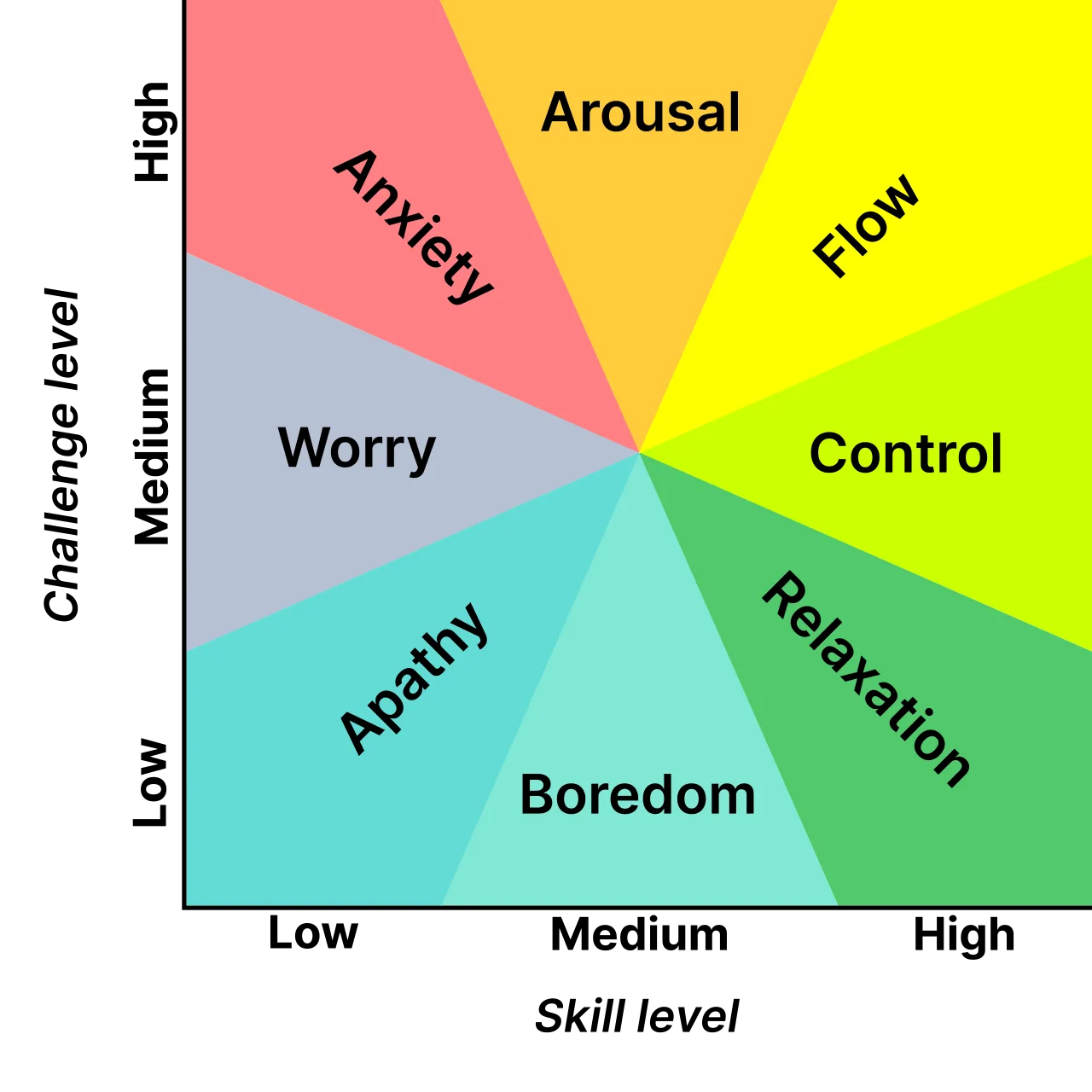
Flow is a subjective state of effortless absorption in an activity where challenge and skill are well-matched. Mihaly Csikszentmihalyi, the Hungarian-American psychologist who named it in the 1970s, identified nine components: clear goals, immediate feedback, challenge-skill balance, merger of action and awareness, concentration, sense of control, loss of self-consciousness, altered time perception, and autotelic experience (activity rewarding in itself). Not all nine must be present, but the cluster reliably appears together in activities that produce flow. The state is associated with peak performance in many domains but cannot be directly commanded. It emerges when conditions are met.
What is the challenge-skill balance requirement?
Flow requires an activity whose difficulty is calibrated to slightly exceed current skill. Too easy produces boredom. Too hard produces anxiety. The sweet spot, often called the flow channel, is difficulty that demands full engagement but falls within the range of achievable performance. As skill grows, the challenge must grow to maintain flow, which is why flow-producing activities tend to involve continuous skill development. This also means flow is harder to enter in routine work that does not push against current capability.
Can you really enter flow on demand?
Not exactly on demand, but reliably through preparation. The conditions that produce flow can be engineered. Select a task with challenge-skill balance. Establish clear goals and a feedback mechanism. Remove interruptions. Start the work and continue past initial resistance, which typically subsides within 20 to 30 minutes. The transition from deliberate effort to flow usually takes this long and cannot be rushed. What you can control is the probability, not the timing. Regular practitioners report hitting flow in roughly 60 to 80 percent of well-prepared sessions.
What is the neuroscience of flow?
Arne Dietrich’s 2003 transient hypofrontality hypothesis proposes that flow involves reduced activity in parts of the prefrontal cortex responsible for self-monitoring and conscious deliberation, while other regions associated with the task remain highly active. This explains the subjective experiences of effortless action and loss of self-consciousness. EEG and fMRI studies have partially supported this model, though the exact neural signatures remain debated. What is robust is that flow involves a different cognitive mode than deliberate problem-solving, and the shift between modes takes time and cannot be forced.
Does flow require the activity to be enjoyable?
Not during the activity itself. Csikszentmihalyi documented flow in activities that participants found stressful or exhausting while performing them, including surgeons in operations, climbers on difficult routes, and factory workers on demanding tasks. The autotelic quality, the sense that the activity is worth doing for its own sake, often emerges after the activity rather than during it. In retrospect, the session was rewarding. In the moment, the experience was total absorption, not pleasure. This distinguishes flow from relaxation or recreational pleasure.
What are the main flow triggers?
Steven Kotler and the Flow Research Collective have identified around 22 flow triggers across psychological, environmental, social, and creative categories. The most robust include clear goals, immediate feedback, intensely focused attention, challenge-skill balance, risk (physical, emotional, or social), deep embodiment in the activity, and shared goals in team contexts. Environmental triggers include rich sensory input in novel environments, which partly explains why travel and new settings often produce flow-rich experiences. The trigger approach treats flow as a state that can be engineered by stacking conditions rather than waiting for it to arrive.
Why do some activities produce flow more easily than others?
Activities with built-in challenge-skill matching, clear goals, and immediate feedback produce flow more reliably than activities without these features. Sports, music performance, skilled crafts, and games are flow-engineered by design. Most knowledge work lacks these features by default: goals are vague, feedback is delayed, and difficulty does not scale with skill automatically. The intervention for knowledge workers is to artificially create the flow conditions: define specific session goals, create feedback loops through measurable outputs, and select tasks that genuinely stretch current capability rather than grinding through routine work.