
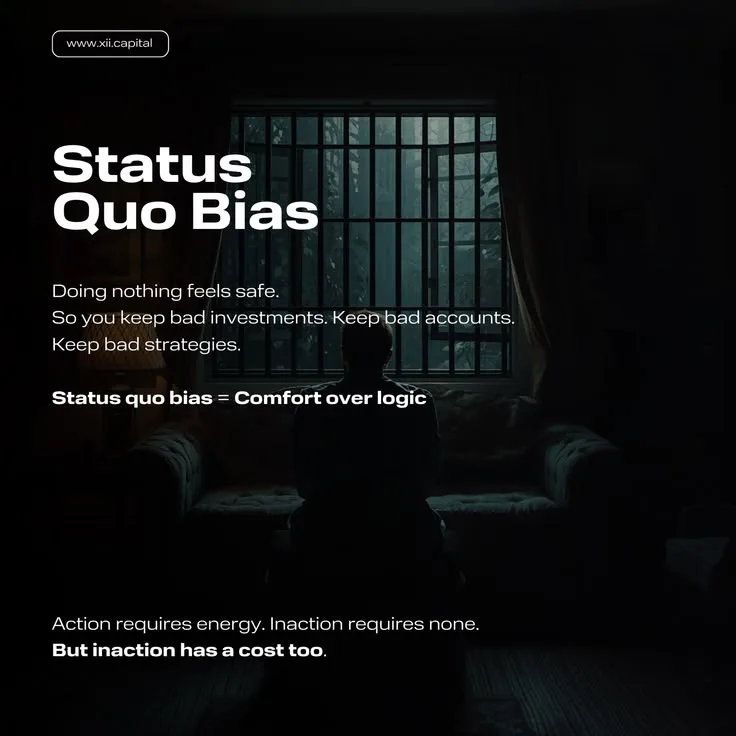
Status: Most decisions involve alternatives. A new job versus the current one. An updated software platform versus the familiar one. A different healthcare plan during open enrollment. A change in a long-held habit.
In each case, there is a well-documented pattern: people tend to stay with what they already have, even when objective analysis suggests the alternative is better.
This pattern is the status quo bias, one of the most pervasive and consequential cognitive biases identified by behavioral economists and psychologists. It shapes individual decisions in ways people rarely notice, and it has profound effects on policy design, product development, and organizational change.
The Research Foundation
Samuelson and Zeckhauser (1988)
The status quo bias was formally named and characterized by economists William Samuelson and Richard Zeckhauser in their 1988 paper "Status Quo Bias in Decision Making," published in the Journal of Risk and Uncertainty.
Their goal was to explain a systematic pattern in economic decision-making that standard rational choice theory could not account for: people's persistent preference for existing arrangements over equivalent or superior alternatives.
Their experimental approach presented participants with decision scenarios in two forms. In one version, participants were told they inherited a portfolio and asked which investment mix they would choose going forward.
In the other version, participants were told they inherited the same portfolio already invested in one of the mixes and asked whether they wanted to change it.
The result was clear and replicable: participants who were told they already held a particular investment mix were significantly more likely to stick with it than participants who were making the choice fresh.
The current state was preferred simply because it was the current state, not because of any new information or rational reanalysis.
Samuelson and Zeckhauser also examined real-world data, including the choices of Harvard University faculty among health insurance plans.
When a new, lower-cost plan was introduced, faculty members who were previously enrolled in a more expensive plan showed a strong tendency to stay with it even when the new plan was objectively advantageous. The longer they had held the existing plan, the less likely they were to switch.
What the bias is not
The status quo bias is sometimes confused with rational inertia: the reasonable decision to stay with a current option because switching costs are high, because information is insufficient, or because the difference is genuinely small. These are legitimate reasons to maintain the status quo and do not represent bias.
The status quo bias, technically defined, is the preference for the existing state that exceeds what is warranted by rational analysis of switching costs and option quality. It is the component of status quo preference that cannot be explained by sensible decision-making and can only be explained by psychological mechanisms.
The Psychological Mechanisms
Loss aversion
The primary mechanism driving the status quo bias is loss aversion, identified by Daniel Kahneman and Amos Tversky as a central feature of human decision-making in their 1979 prospect theory paper.
Loss aversion describes the asymmetry in how people weigh gains and losses: a loss of a given magnitude feels roughly twice as bad as an equivalent gain feels good. In experimental tasks, people typically require approximately two dollars of potential gain to accept a 50/50 gamble involving a one-dollar loss.
The status quo creates a natural reference point: the current state. Any change involves relinquishing some features of the current state (experienced as losses) in exchange for new features (experienced as gains).
Because losses weigh more heavily than gains in psychological accounting, changes that are objectively advantageous may still feel net-negative when evaluated against the status quo reference point.
This is why a health insurance plan that provides similar coverage at lower cost may still feel risky to switch to: you are giving up the specific coverage details you are familiar with and accustomed to (losses), in exchange for savings and new features (gains).
Even when the savings are substantial, the prospect of giving up known coverage feels more salient.
Omission bias
Omission bias is the tendency to judge harmful actions as worse than equally harmful inactions. Related to the status quo bias, it means that changing the status quo, an active choice, feels riskier than maintaining it, even when the risks of maintenance and change are identical.
Experiments on omission bias by Ritov and Baron (1990) showed that participants consistently judged harmful outcomes that resulted from actions (switching vaccines) as worse than identical harmful outcomes from inaction (not switching), even when the probabilities and magnitudes of harm were matched.
In the status quo bias context, omission bias means that if changing produces a bad outcome, you will hold yourself more responsible for having changed than you would if staying had produced the same bad outcome. This asymmetric blame aversion makes inaction the psychologically safer default.
Regret aversion
Regret aversion, the motivation to avoid the specific emotional experience of regret, amplifies both loss aversion and omission bias. Regret is anticipated more intensely for bad outcomes following active choices than for equally bad outcomes following inaction.
Research by Zeelenberg et al. (1996) confirmed that anticipated regret over a bad outcome from changing is stronger than anticipated regret over the same outcome from not changing.
The combined effect: when you consider changing the status quo, you are implicitly weighing not just potential outcomes but the different emotional experiences you would have following those outcomes. Staying and having a bad result feels different, less regrettable, than changing and having the same bad result.
Uncertainty aversion and the familiarity premium
Uncertainty aversion refers to the preference for known risks over unknown risks of equal expected value, a concept captured in Daniel Ellsberg's experiments on ambiguity aversion (1961). The status quo is familiar; its risks and properties are known.
An alternative carries uncertainty about what it will actually be like, separate from whatever information is available about it.
This uncertainty premium on the status quo is compounded by the mere exposure effect (Zajonc, 1968): simple familiarity with something, independent of any evaluation of it, increases positive affect toward it. The thing you already have is the thing you have most experience with, and familiarity itself generates preference.
Transition costs (rational and perceived)
Legitimate switching costs, the time, money, and effort required to change, provide a rational basis for status quo preference. The status quo bias extends beyond this to perceived switching costs that are inflated beyond their actual magnitude.
Studies of utility switching, cable provider changes, and health plan changes consistently find that stated switching costs far exceed actual measured costs, with the gap attributable to the psychological inflation of transition effort.
The Endowment Effect Connection
The endowment effect, demonstrated most famously by Kahneman, Knetsch, and Thaler in their 1990 mugs experiment, is the tendency to value objects more highly once you own them.
Participants who received a mug valued it at approximately twice the price that non-owners were willing to pay for the same mug, with no additional information about quality.
The endowment effect and the status quo bias are closely related but distinct:
| Feature | Status Quo Bias | Endowment Effect |
|---|---|---|
| Applies to | Any current state of affairs | Specifically owned objects |
| Core mechanism | Aversion to change from reference point | Higher valuation of possessed items |
| Domain | Decisions about change vs. staying | Buy/sell price asymmetry |
| Key research | Samuelson and Zeckhauser (1988) | Kahneman, Knetsch, Thaler (1990) |
Both share loss aversion as an underlying mechanism: the owned object or current situation is the reference point, and departing from it involves losses that feel larger than the gains of the alternative.
Applications in Policy and Product Design
Organ donation and the default effect
The most dramatic real-world demonstration of the status quo bias in policy comes from organ donation consent rates. A study by Eric Johnson and Daniel Goldstein published in Science in 2003 analyzed organ donation rates across European countries.
Countries with opt-out systems (where donation is the default and individuals must actively register not to donate) showed consent rates of 85-100 percent. Countries with opt-in systems (where individuals must actively register as donors) showed rates of 4-28 percent.
The difference persisted even when survey data showed similar levels of support for donation across the countries, ruling out cultural differences as the primary explanation.
The default is the status quo. In opt-out systems, being a donor is the current state; not donating requires overcoming the status quo bias to take action. In opt-in systems, not being a donor is the current state.
"The power of the default is such that most citizens of opt-out countries will die as organ donors, and most citizens of opt-in countries will die as non-donors, simply because each country made a different choice about what action was required to express a preference." Paraphrase of Johnson and Goldstein's central argument
Retirement savings enrollment
Brigitte Madrian and Dennis Shea studied the effects of automatic enrollment in 401(k) retirement savings plans in a landmark 2001 paper in the Quarterly Journal of Economics.
They compared enrollment rates before and after a company switched from opt-in (employees must choose to participate) to automatic enrollment (employees are enrolled by default but can opt out).
Enrollment rates among new employees jumped from approximately 49 percent to 86 percent within the first year.
The contribution rate and fund allocation set as the default by the employer became the most common choice among enrolled workers, not because they had evaluated these as optimal, but because changing the default required action that most employees deferred indefinitely.
This finding became a cornerstone of the behavioral economics approach to retirement policy. The U.S. Pension Protection Act of 2006 encouraged automatic enrollment based in part on this research, contributing to substantially higher retirement savings rates.
Software design and default settings
Product designers exploit the status quo bias systematically through default settings. Users, confronted with unfamiliar choices in an interface, overwhelmingly accept defaults rather than investing the cognitive effort to evaluate and change them.
Privacy settings in software consistently show high persistence of defaults regardless of whether those defaults favor user privacy or company data collection.
A well-documented pattern in the digital advertising industry shows that opt-out rates for behavioral tracking remain below 10 percent even when users express discomfort with tracking in surveys, because the opt-out process requires active steps against the default.
This represents both the status quo bias's policy-beneficial applications (automatic savings enrollment, opt-out organ donation) and its exploitative ones (pre-checked consent boxes, dark patterns that benefit companies at users' expense).
Electricity market deregulation
Studies of consumer behavior following electricity market deregulation in several U.S. states and European countries found that a large majority of consumers remained with their incumbent utility provider despite the availability of cheaper alternatives.
In Ohio, Pennsylvania, and New Jersey, years after deregulation, participation rates for competitive suppliers remained below 25 percent in many areas despite price differentials of 10-20 percent.
The explanation is not lack of information: awareness of competitive options was high. The explanation is status quo bias: switching required active steps, and the existing provider was the status quo. The potential savings (gains) were insufficient to overcome the cognitive and psychological cost of departing from the default.
Overcoming the Status Quo Bias
Recognizing the bias does not automatically eliminate it, cognitive biases are remarkably persistent even when identified, but several strategies reduce its distorting influence.
Reverse the framing. Instead of asking "Should I change?", ask "Would I choose the current option if starting fresh today?" This reframe removes the status quo premium by treating all options symmetrally, without any option being privileged as the default.
Separate switching costs from the option quality evaluation. Make a deliberate two-step assessment: first evaluate the quality of all options on their merits, then separately evaluate whether switching costs make the better option not worth pursuing. Conflating these steps allows the status quo bias to contaminate the quality evaluation.
Set decision deadlines. The status quo bias is amplified by indefinite deferral: a decision that can be made at any time is perpetually defeatable. A specific deadline forces the active evaluation that the bias avoids.
Seek external perspective. A person without attachment to your current situation will evaluate alternatives more symmetrically. The advisory function of a financial planner, a mentor, or a trusted friend is partly to apply an outsider's less biased framing to decisions where you have a psychological stake in the status quo.
Audit your portfolio of unmade decisions. Many people maintain a list of decisions they know they should make but keep deferring, changing insurance plans, updating investment allocations, leaving a job they know isn't right, ending a relationship that has run its course.
The common thread is that each involves departing from the status quo. A deliberate review of these deferred decisions, with a commitment to make at least one, can interrupt the default-deferral pattern.
The Status Quo Bias in Organizations
Organizations are particularly vulnerable to the status quo bias because established processes and structures create powerful institutional status quos. The people within organizations develop vested interests in existing arrangements, and change requires coordinated action against loss aversion among multiple people simultaneously.
Researchers studying organizational inertia (the tendency of organizations to maintain existing strategies, structures, and processes even when environmental conditions have changed) find status quo bias operating at every level: individual decision-makers, teams, and the institutional rules and norms that structure decisions.
The implication for organizational change: successful change management must address the psychological mechanisms of the status quo bias directly.
Simply presenting evidence that a new approach is better addresses the rational component of resistance but not the loss aversion, regret aversion, and uncertainty aversion that drive most of the resistance.
Effective change strategies typically involve making the cost of the status quo vivid, the losses from not changing, rather than only making the gains from changing salient.
Because people are loss-averse, framing the decision in terms of what is lost by staying rather than what is gained by changing exploits the same mechanism in service of better decisions.
The status quo bias is not irrational in any simple sense, there are often good reasons to prefer the known and established. The problem is that the psychological weight given to the current state far exceeds any rational calculation of switching costs and risks.
Recognizing this excess is the first step toward decisions that reflect what you actually want rather than what you happen to already have.
The Status Quo Bias and Health Decisions
Medical contexts reveal the status quo bias with particular clarity because the stakes of inaction can be life-threatening.
Patients who receive diagnoses requiring behavior change (dietary reform, exercise, medication adherence, smoking cessation) show the status quo bias in their adherence rates: the existing behavior pattern (the status quo) persists even when the rational case for change is overwhelming.
Research on inertia in chronic disease management shows that patients who have been managing a condition the same way for years resist changes to their treatment regimen even when clinical evidence clearly supports the change.
Physicians who understand the status quo bias frame recommended changes differently: rather than emphasizing the gains from the new treatment, they emphasize what will be lost, in quality of life, in function, in years, by remaining with the current approach.
The same dynamic affects health screening: people avoid diagnostic tests partly because a negative test result maintains the current belief state (no known disease) while a positive result would force the current state to change.
The status quo being maintained here is not a behavior but a belief, and the bias is toward avoiding information that would disturb it.
Temporal Patterns: When the Status Quo Bias Is Strongest
Research on the conditions that intensify versus weaken the status quo bias reveals consistent patterns.
The bias is strongest when choices are complex. More alternatives, more dimensions to compare, more uncertainty about outcomes, all increase the cognitive cost of evaluation and make the current option more attractive by default.
This explains the classic car insurance finding by Samuelson and Zeckhauser: faced with complex multi-dimensional insurance choices, consumers disproportionately choose their existing plan regardless of its relative merits.
The bias is strongest under time pressure. When decisions must be made quickly, the least effortful option, the status quo, benefits disproportionately. Slow, deliberative decision processes are more likely to produce genuine preference expression than forced rapid choices.
The bias is weakest when the status quo is recently established. The longer a person has held a current arrangement, the more entrenched their attachment to it. Newly made decisions have not yet accumulated the familiarity and identity investment that amplify the bias.
This is why it is strategically important to make good initial choices (e.g., in retirement fund allocation) rather than relying on the ability to correct them later.