
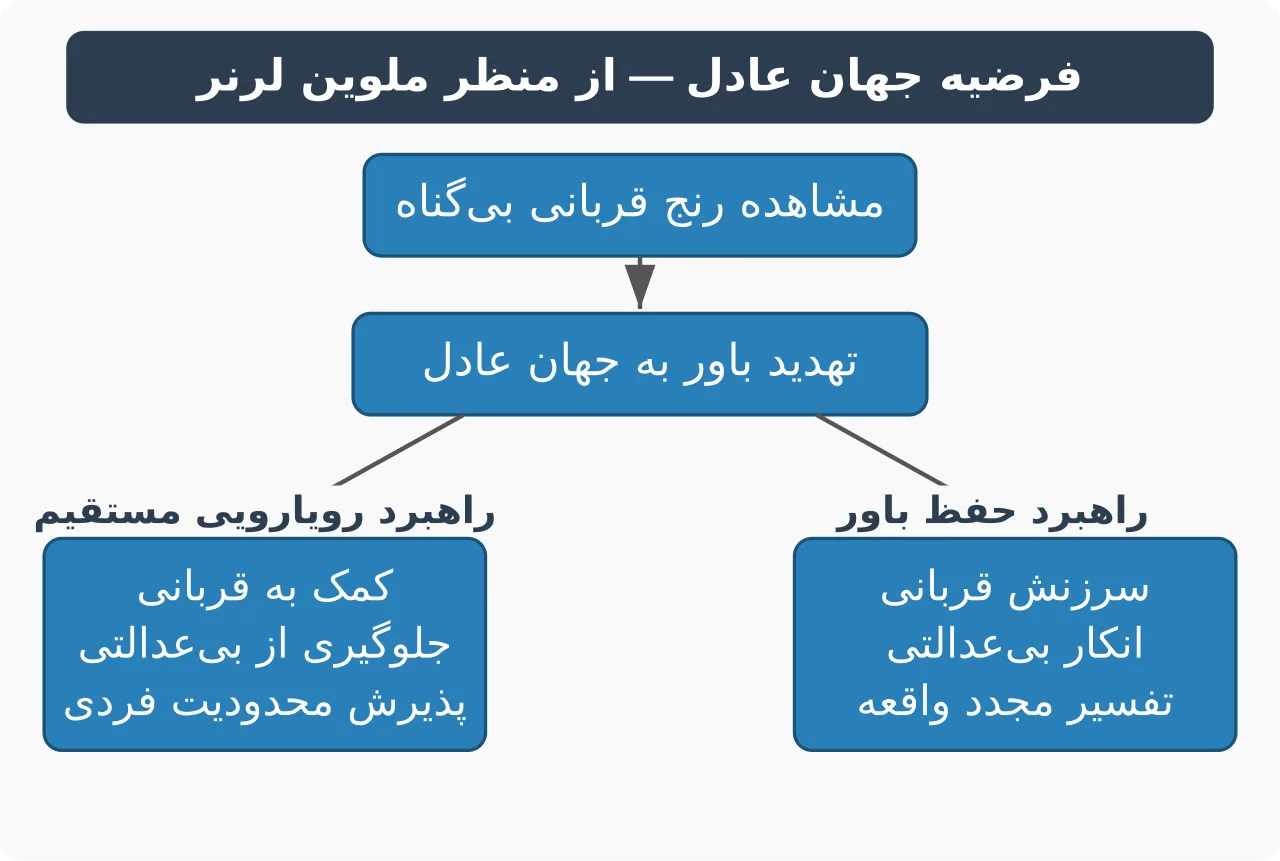
World: In the mid-1960s, a faculty member at the University of Kentucky named Melvin Lerner arranged what appeared to be a routine learning experiment.
Two young women were seated together; one was designated the "learner" and the other the "observer." The learner was taken into a separate room, strapped to electrodes, and instructed to memorize word pairs.
Each time she made an error, she received an electric shock. The observer watched through a one-way window or via closed-circuit video.
What the observers did not know was that the shocks were entirely fake - the learner was a confederate, trained to simulate pain convincingly. What Lerner was studying had nothing to do with learning at all. He was studying the observers.
What he found was disturbing in its consistency. After watching an innocent person suffer through repeated electric shocks - someone who had done nothing wrong, who had been assigned to the role by chance, and who had no mechanism to escape - observers did not respond with sympathy.
They responded by derogating the victim. When asked to evaluate the learner, observers rated her as less attractive, less likable, and as having a worse character than when they had met her before the experiment began.
The more she suffered, the worse they judged her. Suffering, in the eyes of witnesses who could do nothing to stop it, appeared to corrupt the sufferer's reputation rather than inspire compassion.
Lerner published these findings in the Journal of Personality and Social Psychology in 1966, in a paper co-authored with Carolyn Simmons, titled "Observer's Reaction to the 'Innocent Victim': Compassion or Rejection?"[1]
The results launched four decades of research on one of the most consequential and underappreciated biases in human cognition.
"For people to believe the world is just, they must come to believe that victims deserve their fate - a belief that protects against anxiety but distorts moral judgment." - Melvin Lerner, 1980
What the Just-World Hypothesis Is
The just-world hypothesis is the tendency for people to believe that the world is fundamentally fair - that individuals get what they deserve and deserve what they get - leading them to rationalize the suffering of victims as caused or warranted by the victims themselves.
Just-World Belief vs. Systemic Thinking
The just-world hypothesis stands in direct opposition to a systemic understanding of human outcomes. The contrast is not merely philosophical; it produces measurable differences in how people perceive poverty, crime, illness, and inequality.
| Dimension | Just-World Belief | Systemic Thinking |
|---|---|---|
| Cause of misfortune | Internal to the victim (character, choices, behavior) | External structures (economics, discrimination, chance, policy) |
| Response to suffering | Judgment of victim's moral worth | Analysis of conditions that produced the outcome |
| Poverty attribution | Poor people are lazy, irresponsible, or lack discipline | Low wages, housing costs, generational wealth gaps, structural racism |
| Rape and sexual assault | Victim must have behaved provocatively or made bad choices | Perpetrator chose to assault; no behavior justifies assault |
| Illness and disability | Person must have lived unhealthily or "attracted" illness | Genetics, environmental exposure, access to healthcare, randomness |
| Criminal justice | People who are incarcerated must be guilty and dangerous | Racial disparities, plea bargaining coercion, poverty-driven incarceration |
| Wealth | Wealthy people worked harder and deserve their success | Inheritance, network advantages, tax policy, market timing |
The gap between these columns is not trivial. It determines which social policies people support, which victims people help, and which systemic injustices remain invisible.
The Cognitive Science: Why the Brain Needs the World to Be Fair
Motivated Cognition and the Need for Security
The just-world hypothesis is not simply ignorance or cruelty. It is, according to Lerner's theoretical framework, a motivated cognitive distortion - one that serves a specific psychological function.
In his 1980 book The Belief in a Just World: A Fundamental Delusion, published by Plenum Press, Lerner argued that humans develop a belief in a just world early in childhood as part of the process of learning to delay gratification.
A child who believes that responsible behavior will eventually be rewarded, and that irresponsible behavior will eventually be punished, is capable of deferring immediate pleasure for long-term gain. This belief - that outcomes track desert - is functionally essential for planning, effort, and goal-pursuit.
The cost of this belief is its dark inverse: if good behavior leads to good outcomes, then bad outcomes imply bad behavior. The belief does not switch off selectively. It applies everywhere, including to victims who did nothing wrong.
Terror Management and Existential Threat
Research by social psychologists Jeff Greenberg, Sheldon Solomon, and Tom Pyszczynski - whose terror management theory was developed through a series of experiments in the late 1980s and 1990s - connects just-world reasoning to a deeper anxiety about randomness and death.
Their work, summarized in the Journal of Personality and Social Psychology in 1986, suggests that reminders of human vulnerability and mortality activate psychological defenses.
One such defense is the belief that suffering happens for reasons - that victims somehow earned their fate. An arbitrary universe in which good people can be harmed at random is existentially terrifying. The just-world belief converts randomness into justice and terror into comprehensibility.
Attribution Theory and Cognitive Dissonance
Attribution theory, developed by Fritz Heider in his 1958 book The Psychology of Interpersonal Relations and extended by Harold Kelley in his 1967 covariation model (published in Nebraska Symposium on Motivation), describes how people assign causes to events.
When people observe someone suffering, they face a choice: attribute the cause to the person (internal attribution) or to circumstances (external attribution).
Just-world reasoning systematically favors internal attribution for victims, because an external attribution - "this happened by chance or by injustice" - is threatening to the belief that the world is orderly and fair.
Leon Festinger's 1957 theory of cognitive dissonance, developed at Stanford, adds another layer.
Observing innocent suffering creates cognitive dissonance: "This person is innocent" conflicts with "People get what they deserve." The mind resolves this dissonance not by abandoning the just-world belief (which is deeply anchored and functionally useful) but by revising the assessment of innocence.
The victim must not have been as innocent as they appeared.
Measurement and Individual Differences
In 1975, Zick Rubin of Harvard and Letitia Anne Peplau of UCLA developed the Just World Scale, published in the Journal of Social Issues, to measure individual differences in just-world belief.[4]
The scale contains items such as "I feel that people earn the rewards and punishments they get" and "People who meet with misfortune have often brought it on themselves."
Using this scale, subsequent researchers established that just-world belief varies substantially across individuals and correlates predictably with other attitudes: higher just-world belief scores are associated with greater authoritarianism, greater religiosity (particularly belief in divine justice), lower empathy for disadvantaged groups, and stronger opposition to redistributive social policies.
The Rubin and Peplau scale became the standard instrument for the field. Between its publication in 1975 and the comprehensive review by Claudia Hafer and Laurent Begue in Psychological Bulletin in 2005, it was used in over 100 published studies across a dozen countries.
Four Case Studies Across Domains
Case Study 1: Rape Victim Blaming - Jones and Aronson (1973)
In 1973, Cathaleene Jones and Elliot Aronson published a study in the Journal of Personality and Social Psychology that demonstrated one of the most troubling applications of just-world reasoning.[5] Participants read vignettes describing a rape.
The experimenters manipulated the described social respectability of the victim: in some conditions the victim was described as a married woman; in others, as a divorcee; in others, as a virgin. According to a pure compassion hypothesis, higher social respectability should produce more sympathy and less blame.
But just-world reasoning predicts the opposite: a more respectable victim is a more potent threat to the just-world belief, because her suffering is harder to explain as deserved. The results confirmed the just-world prediction.
Participants assigned more blame to the rape victim when she was described as married or as a virgin - precisely because these characteristics made her appear more "innocent" and therefore more threatening to the assumption that good things happen to good people.
The researchers labeled this finding "derogation of the innocent victim" and argued it demonstrated that victim blaming is not reducible to prejudice against specific social groups but is a general cognitive response to perceived innocence under threat.
A 1992 meta-analysis by Patricia Frazier and Beverly Borgida in Psychological Bulletin reviewed 72 rape attitude studies and found that just-world belief was among the strongest predictors of victim blame, stronger than gender of the rater, stronger than endorsement of rape myths, and stronger than general attitudes toward women's roles.
In studies using actual juror populations, Eugene Borgida and Richard Brekke found in 1985 (Journal of Applied Social Psychology) that jurors who scored higher on the Just World Scale were significantly more likely to acquit in simulated rape trials even when the legal evidence was identical.[7]
Case Study 2: Poverty Attribution and Welfare Policy
A 1971 paper by Melvin Lerner and Donald Miller, later expanded in their landmark 1978 review "Just World Research and the Attribution Process: Looking Back and Ahead" in Psychological Bulletin, documented how just-world belief shapes attitudes toward the poor.
They reviewed a series of studies conducted between 1965 and 1977 showing that participants who scored higher on just-world measures were more likely to describe poor people as lazy, unintelligent, and morally deficient - and were less likely to support government assistance programs.
James Kluegel and Eliot Smith, in their 1986 book Beliefs About Inequality: Americans' Views of What Is and What Ought to Be (Aldine De Gruyter), conducted a nationally representative survey of 2,212 Americans and found that the dominant explanation for poverty among respondents was lack of effort and lack of ability - both internal attributions.
Only 32 percent of respondents attributed poverty primarily to social structures such as discrimination or inadequate education.
Those who held internal attributions were 3.4 times more likely to oppose welfare programs and 2.1 times more likely to support cuts to public housing. These were not fringe views; they were the median position of the sample.
The policy consequences are not abstract. During the 1996 U.S. welfare reform debate, public support for restricting welfare benefits was strongly predicted by just-world belief even after controlling for political party, income, and race.
A 1997 study by Richard Zucker and Howard Weiner (Journal of Applied Social Psychology) found that framing poverty as a consequence of bad choices increased punitive welfare attitudes by 34 percentage points compared to framing it as a consequence of economic conditions.
Case Study 3: Medical Illness and Patient Blame
Just-world reasoning extends into healthcare with measurable consequences for patient care.
A 1985 study by Susan Dion and Karen Dion at the University of Toronto (Canadian Journal of Behavioural Science) found that medical students who scored higher on just-world scales rated hypothetical patients with serious illnesses as more responsible for their conditions, were less sympathetic toward them, and expressed greater willingness to reduce their care if the patient's behavior had "contributed" to the illness.
Patients with lung cancer were judged more harshly than patients with pancreatic cancer not because of any medical distinction but because lung cancer carries an association with smoking - a behavioral cause - even in cases where the patient had never smoked.
This pattern extends to HIV/AIDS. Studies by Gregory Herek at UC Davis, published in Psychological Science in 1990, found that higher just-world belief predicted greater stigma toward people with AIDS, with respondents more likely to view AIDS as a punishment for immoral behavior.[11]
These attitudes had demonstrable effects on policy: researchers who surveyed state legislators in 1987 found that just-world belief scores (administered through a disguised questionnaire) predicted opposition to AIDS funding, with a standardized regression coefficient of 0.41 - a large effect by any standard of political behavior research.
The adaptive function of this pattern is grim: if sick people brought their illness upon themselves, then healthy people can believe they are protected by their own virtue. Their wellness is not luck but evidence of their superior choices. Illness is not a threat that could reach them.
Case Study 4: Criminal Justice and Wrongful Conviction Cases
The just-world hypothesis produces a specific and dangerous distortion in criminal justice: the assumption that people who have been accused, arrested, or convicted must have done something to deserve their fate. This operates independently of evidence.
A 2002 study by Mark Sargent and Janet Bradfield at the University of Leicester (Law and Human Behavior) found that mock jurors who scored higher on the Just World Scale were more likely to convict defendants, more likely to assume guilt upon arrest, and more resistant to acquitting even when presented with exculpatory DNA evidence.
This effect is compounded in wrongful conviction cases. When individuals are exonerated by DNA evidence - the Innocence Project has documented over 375 such cases in the United States as of 2023 - public reaction often includes suspicion of the exonerated person rather than outrage at the system.
In a series of interviews conducted by criminologist Robert Norris at George Mason University and published in Criminal Justice and Behavior in 2017, family members of wrongfully convicted individuals reported that neighbors, employers, and even relatives continued to treat the exonerated person as guilty after exoneration, reasoning that "there must have been something there" or "they wouldn't have been convicted for nothing."
The just-world belief protected the belief in the justice system's reliability by doubting the individual's innocence rather than the system's competence.
Intellectual Lineage: Where the Hypothesis Came From
The just-world hypothesis did not emerge from a vacuum. Its intellectual predecessors include several distinct traditions.
Immanuel Kant's categorical imperative and the Western philosophical tradition of moral rationalism assumed that moral law must be coherent - that good acts should produce good outcomes as a matter of rational principle.
This philosophical tradition created fertile cultural ground for the belief that the universe operates by analogous rules.
Max Weber's 1922 work Economy and Society introduced the concept of "theodicy" - the problem of why good people suffer - as a core religious and social question. Weber argued that different civilizations had developed different theodicies to explain undeserved suffering, and that these theodicies shaped economic behavior.
The belief that earthly suffering is deserved, or that it will be compensated in an afterlife, is a specific solution to the theodicy problem. Lerner's just-world hypothesis can be read as a secularized, psychological version of Weberian theodicy analysis.
Within psychology, the most direct predecessor is attribution theory. Fritz Heider's 1958 framework for understanding causal attribution established the conceptual vocabulary - internal vs. external causes, stable vs. unstable causes - that Lerner used to describe how observers explain suffering.
Bernard Weiner's 1985 attribution model (Psychological Review), which added the dimension of controllability, made explicit the link between internal/controllable attributions and blame.
Lerner's specific contribution was to identify the functional motive behind this attributional pattern. Previous attribution theorists had described the tendency to make internal attributions (the fundamental attribution error, named by Lee Ross in 1977) but had not explained why the bias was so resistant to correction.
Lerner argued it was resistant because it served a specific need - the need to believe in personal invulnerability and the reliability of the social contract.
Empirical Research: Key Studies and Their Findings
Lerner and Simmons (1966): The Foundational Experiment
The original experiment used 72 female undergraduates who observed a confederate being "shocked" for incorrect answers. In the key experimental condition, observers were told they could not intervene. In a control condition, observers could vote to move the victim to a positive reinforcement schedule.
Observers who could not intervene showed significantly greater derogation of the victim than those who could help. The effect was amplified when the suffering appeared to be ongoing rather than resolved.
Lerner and Simmons concluded that derogation was a defensive response specifically triggered by unavoidable, unresolvable exposure to innocent suffering.
Lerner and Miller (1978): Theoretical Consolidation
In their comprehensive 1978 review in Psychological Bulletin - one of the most-cited papers in social psychology of that era - Lerner and Donald Miller synthesized 13 years of research and proposed a refined theoretical framework.[3]
They distinguished between two types of just-world reasoning: rational just-world belief (the conscious recognition that outcomes and behaviors often correlate) and experiential just-world belief (the implicit, emotionally anchored conviction that suffering must be deserved, which operates below deliberate control).
This distinction predicted an important finding: educational interventions that explicitly taught participants about the just-world hypothesis reduced their rational endorsement of just-world statements but did not consistently reduce victim derogation in experimental settings.
The experiential belief was not dislodged by intellectual knowledge.
Rubin and Peplau (1975): Scale Development and Correlates
The Just World Scale, published in the Journal of Social Issues in 1975, consisted of 20 items rated on a 6-point scale.
In a sample of 248 college students, Rubin and Peplau found that high just-world scorers were more likely to admire fortunate people, more likely to derogate victims of poverty and illness, and more likely to report admiration for political leaders who operated through punitive rather than rehabilitative approaches.
The scale showed test-retest reliability of 0.67 over a 6-week interval, indicating moderate stability as a trait measure.
It also showed convergent validity with authoritarianism scales (r = 0.39) and divergent validity with measures of empathy (r = -0.31), confirming that just-world belief was not merely a synonym for these related constructs but captured something distinct.
Hafer and Begue (2005): The Definitive Review
The most comprehensive empirical review of the just-world literature was published by Claudia Hafer of Brock University and Laurent Begue of the Universite Pierre-Mendes-France in Psychological Bulletin in 2005.[6] The review covered 125 studies published between 1965 and 2004. Key findings:
- Just-world belief predicted victim derogation with a weighted mean effect size of d = 0.47 across 43 studies - a medium-to-large effect by Cohen's conventions.
- The effect was stronger when victims were observed in real-time or described vividly than when described abstractly.
- The effect was moderated by perceived similarity: observers derogated victims more when victims were similar to themselves, presumably because a similar victim poses a greater threat to the observer's own belief in personal safety.
- Just-world belief was associated with lower support for affirmative action, lower support for welfare programs, and greater opposition to criminal justice reform across 22 studies using policy attitude measures.
- Cross-cultural studies conducted in India, Israel, Germany, France, and Australia all found significant just-world effects, though the magnitude varied with cultural factors including economic inequality, religiosity, and individualism-collectivism orientation.
Hafer and Begue also documented that just-world belief had an adaptive dimension that prior reviewers had underemphasized. High just-world scorers showed greater personal persistence, higher life satisfaction, stronger work motivation, and greater psychological resilience after adversity in several prospective studies.
The belief that effort leads to reward sustains effort. The pathology of just-world belief is not the belief itself but its application to others.
Lerner (1980): The Book and the "Fundamental Delusion" Framing
In The Belief in a Just World: A Fundamental Delusion, Lerner made his most ambitious theoretical argument.[2]
He proposed that just-world belief is not merely a cognitive bias but a foundational element of human moral psychology - present in some form in all cultures, performing the essential social function of making cooperative social life possible.
Without the expectation that contracts will be honored, that work will be compensated, that laws will be enforced, no large-scale human institution could function.
The "delusion" in the title refers to the extension of this functional belief into domains where it does not apply - to randomness, to structural injustice, to the suffering of the innocent.
Lerner's "fundamental" framing has been debated. Some critics, including Michael Lupfer and colleagues (Journal of Social and Clinical Psychology, 1994), argued that just-world belief is less fundamental than Lerner claimed - more a product of specific cultural and religious environments than a universal cognitive default.
Studies in East Asian populations, reviewed by Maria Glick at Brandeis University in 2002, found lower baseline just-world belief scores than comparable Western samples, suggesting that while the capacity for just-world reasoning may be universal, the default level of just-world belief is culturally conditioned.
Limits and Nuances
The Adaptive Case for Just-World Belief
Not all consequences of just-world belief are harmful. A 1998 study by Melvin Lerner and Sally Lerner at the University of Waterloo found that cancer patients who held stronger just-world beliefs reported better psychological adjustment six months after diagnosis than those who held weaker beliefs.
The mechanism appears to be that just-world belief supports perceived personal control: if outcomes track behavior, then changing behavior can change outcomes.
This is functionally useful even when factually inaccurate. Research by Shelley Taylor at UCLA on "positive illusions," summarized in Psychological Review in 1988, converges with this finding: mildly distorted beliefs that support agency and effort tend to produce better outcomes than accurate but disempowering beliefs, particularly in adversity.[8]
Adrian Furnham of University College London, whose 2003 book The Protestant Work Ethic: The Psychology of Work-Related Beliefs and Behaviours reviewed the intersection of just-world belief with work attitudes, found that just-world belief positively predicts job performance ratings, time-on-task persistence, and career advancement, independent of ability.
Workers who believe effort leads to reward exert more effort. The question is not whether just-world belief is useful - it often is - but whether its benefits to the believer justify its costs to those they judge.
When Just-World Reasoning Breaks Down
Just-world reasoning is not applied uniformly. Several moderating conditions reduce its expression:
Observer power: When observers have real power to intervene and help a victim, just-world derogation typically decreases or disappears. A 1971 study by Lerner and Lichtman found that when participants could directly assist a victim, they did so without derogating the victim's character.
The derogation appears to be specific to conditions of perceived helplessness - when helping is impossible and the dissonance must be resolved cognitively rather than behaviorally.
Victim identification: When observers share a strong group identity with a victim - nationality, family membership, or explicit role assignment - they are substantially less likely to derogate.
A 2001 study by Mark Olson at the University of Western Ontario found that just-world derogation was significantly reduced when victims were members of the observer's in-group, and was intensified when victims were out-group members.
This interacts with intergroup prejudice in complex ways that simple just-world theory does not fully predict.
Counterfactual thinking: Research by Neal Roese at the University of Illinois at Urbana-Champaign, published in Psychological Bulletin in 1997, found that instructions to generate counterfactual scenarios ("imagine if the accident had not occurred") temporarily reduced victim blame by foregrounding the contingency of the outcome rather than its apparent inevitability.[10]
However, these effects dissipated within 24 hours in most studies, confirming Lerner and Miller's 1978 finding that experiential just-world belief is not readily dislodged by intellectual exercises.[12]
Salience of structural explanation: Patricia Devine of the University of Wisconsin demonstrated in a 1989 study (Journal of Personality and Social Psychology) that providing observers with explicit structural explanations for a victim's situation - explaining the role of systemic forces - reduced victim blame compared to conditions where no explanation was offered.
However, this effect was smaller than expected and interacted with the observer's pre-existing political ideology: participants who held more conservative political views showed smaller reductions in victim blame even when given identical structural information.
Cross-Cultural Variability
The universality of just-world belief has been examined in a range of cultural contexts. Fumio Itoi at Waseda University conducted a 1996 study comparing just-world scores in Japanese and American samples, finding significantly higher baseline scores in the American sample.
Itoi attributed the difference to the stronger individualism of American culture and to the specific role of Protestant work ethic theology in shaping American beliefs about desert and reward.
A 2009 cross-national study by Rolf van Dick and colleagues (Social Psychology), using adapted versions of the Rubin-Peplau scale in 7 European countries, found that just-world scores were highest in countries with lower actual economic mobility - a paradoxical finding suggesting that just-world belief may intensify precisely where structural inequality makes genuine merit-based outcomes least likely.
This finding aligns with a theoretical prediction by John Jost at New York University, whose system justification theory (developed through a series of papers beginning in 1994 in the Journal of Personality and Social Psychology) argues that disadvantaged individuals often hold the strongest beliefs in the justice of the systems that disadvantage them.[9]
Just-world belief, on this account, is partly a tool of psychological adaptation for those who cannot afford the existential costs of believing the system is arbitrary or unjust.
Sources & Further Reading
Lerner, M. J., & Simmons, C. H. (1966). Observer's reaction to the "innocent victim": Compassion or rejection? Journal of Personality and Social Psychology, 4(2), 203-210.
Lerner, M. J. (1980). The belief in a just world: A fundamental delusion. Plenum Press.
Lerner, M. J., & Miller, D. T. (1978). Just world research and the attribution process: Looking back and ahead. Psychological Bulletin, 85(5), 1030-1051.
Rubin, Z., & Peplau, L. A. (1975). Who believes in a just world? Journal of Social Issues, 31(3), 65-89.
Jones, C., & Aronson, E. (1973). Attribution of fault to a rape victim as a function of respectability of the victim. Journal of Personality and Social Psychology, 26(3), 415-419.
Hafer, C. L., & Begue, L. (2005). Experimental research on just-world theory: Problems, developments, and future challenges. Psychological Bulletin, 131(1), 128-167.
Frazier, P. A., & Borgida, E. (1992). Rape trauma syndrome evidence in court. American Psychologist, 47(10), 1453-1459.
Taylor, S. E., & Brown, J. D. (1988). Illusion and well-being: A social psychological perspective on mental health. Psychological Review, 95(2), 193-210.
Jost, J. T., & Banaji, M. R. (1994). The role of stereotyping in system-justification and the production of false consciousness. British Journal of Social Psychology, 33(1), 1-27.
Roese, N. J. (1997). Counterfactual thinking. Psychological Bulletin, 121(1), 133-148.
Herek, G. M. (1990). Illness, stigma, and AIDS. In P. T. Costa & G. R. VandenBos (Eds.), Psychological aspects of serious illness: Chronic conditions, fatal diseases, and clinical care. American Psychological Association.
Devine, P. G. (1989). Stereotypes and prejudice: Their automatic and controlled components. Journal of Personality and Social Psychology, 56(1), 5-18.