
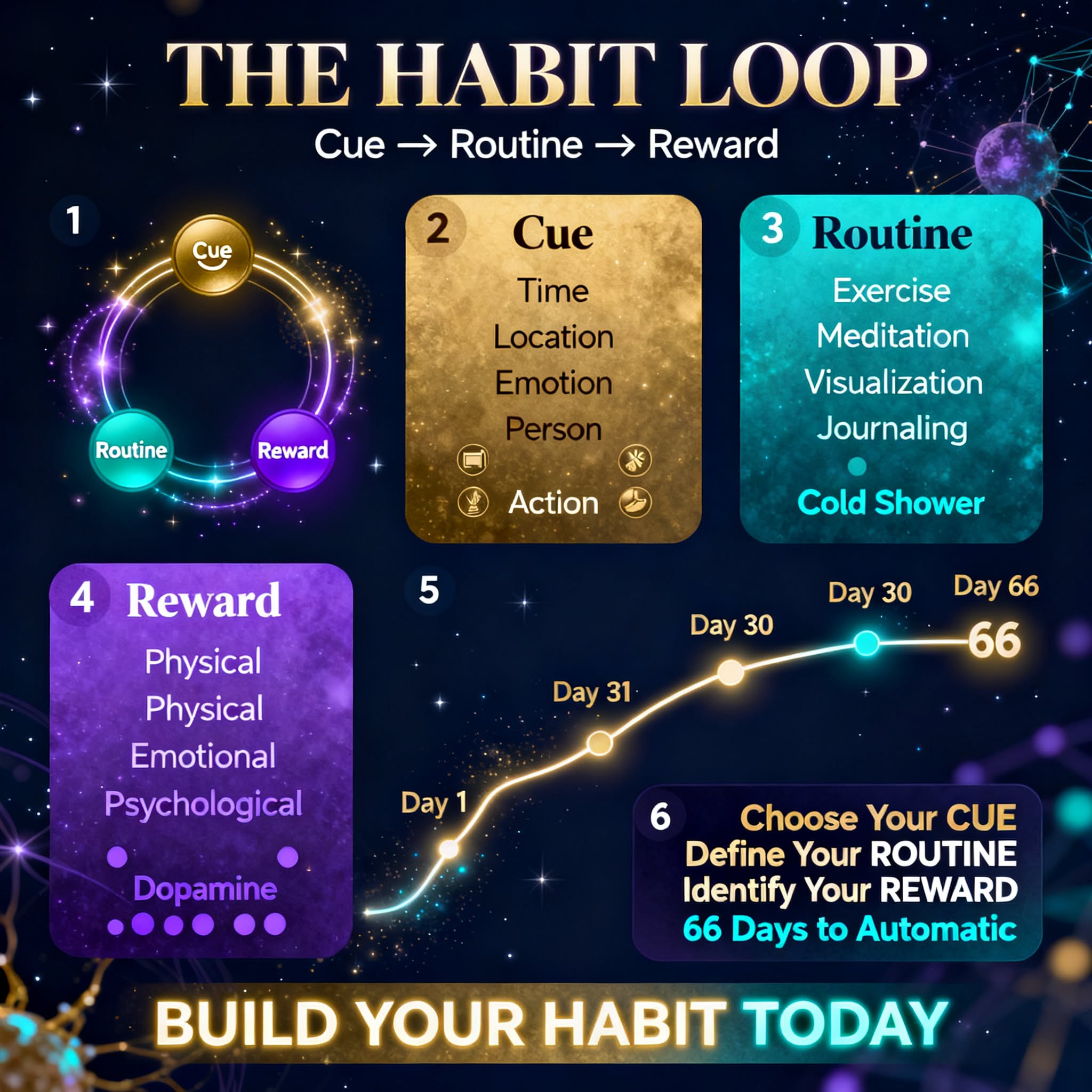
A habit loop links a cue to an automatic routine and an expected reward, with the basal ganglia helping package repeated behavior into efficient sequences. Dopamine progressively shifts from the reward to its predicting cue, which helps create craving. Stress, fatigue, and cognitive load weaken prefrontal control, making well-practiced habits more likely to take over.
Roughly 40 to 45 percent of the actions people perform every day are habits rather than conscious decisions. What you eat for breakfast, how you respond to your phone, which route you take to work, how you react under stress: a large fraction of daily behavior runs on autopilot, shaped by patterns formed through repetition and reward.
Understanding how habits work, not at the motivational level but at the neurological level, is the foundation for changing them deliberately rather than being changed by them unconsciously.
What Is a Habit, Neurologically?
A habit is a chunked behavior sequence encoded in the brain through repetition, such that a specific trigger (cue) automatically initiates the sequence without requiring conscious deliberation.
The neurological mechanism was clarified through a landmark series of experiments by Ann Graybiel's lab at MIT in the late 1990s. Using electrode implants in rats' brains, Graybiel's team tracked neural activity as rats learned to navigate a T-shaped maze to find chocolate.
Initially, the rats' cortex was highly active throughout the run, processing each choice point, each turn, each new stimulus. As the rats practiced the same maze hundreds of times, something remarkable happened: cortical activity diminished.
The behavior was transferred from the cortex (which handles conscious, effortful processing) to the basal ganglia, a collection of subcortical structures deep in the brain.
More specifically, neural activity in the basal ganglia reorganized: instead of firing continuously throughout the behavior, activity concentrated at the two endpoints, the moment the maze gate opened (the cue) and the moment chocolate was received (the reward). The middle of the sequence was chunked into a single automatic unit.
"The basal ganglia turns a sequence of actions into an automatic routine." Ann Graybiel, MIT
This chunking process is the neurological definition of a habit. It is why habits are:
- Energy-efficient: Automatic behaviors consume far less glucose and cognitive resource than deliberate ones
- Fast: Chunked sequences execute faster than consciously controlled sequences
- Persistent: The basal ganglia encoding is extremely resistant to extinction, even when the reward is removed, the cue-routine association remains latent in the basal ganglia, ready to be reactivated
The persistence of basal ganglia encoding is why habits are so difficult to truly eliminate. They are not erased; they are suppressed, and with the right cue, they can resurface after years of dormancy.
Dopamine and the Prediction Signal
The role of dopamine in habit formation is more nuanced than the popular account, "dopamine = pleasure", suggests. Wolfram Schultz's research at Cambridge, extending through the 1990s and 2000s, revealed that dopamine neurons in the basal ganglia do not simply fire when rewards are received.
They fire when rewards are better than predicted, fall silent when rewards are worse than predicted, and gradually shift their firing to the cue that predicts the reward, rather than to the reward itself.
This is the reward prediction error signal: the dopaminergic system is constantly updating its model of what cues reliably predict reward, and this updating process is the neural substrate of learning. As a habit forms, the dopamine signal migrates from reward delivery to cue onset.
The cue itself becomes rewarding, which explains the peculiar experience of craving an activity before you have even started it. The anticipation, not the act, is where most of the dopaminergic energy lies.
This has a critical practical implication: when a well-established habit cue fires and the expected routine is blocked or replaced, the dopamine signal that fired in anticipation goes unresolved. This produces the agitation, craving, and discomfort familiar to anyone who has tried to change a deeply embedded habit.
You are not simply failing to do a new behavior; you are actively blocking a dopaminergic prediction signal that expected a specific outcome.
The Role of the Prefrontal Cortex
While the basal ganglia store and execute habitual sequences, the prefrontal cortex (PFC) retains a supervisory role. The PFC can override habitual behavior: this is what happens when you drive a familiar route but need to take a detour. The habit pulls you toward the familiar turn; the PFC overrides it toward the intended destination.
What determines whether the habit or the PFC wins? Research by Judson Brewer and colleagues suggests that the PFC's ability to override habitual responses is strongly resource-dependent. Under cognitive load, fatigue, stress, or negative mood, prefrontal oversight of automatic behavior diminishes.
This is why bad habits resurge under stress, not because stress causes you to make worse decisions, but because the neural resource needed to override automatic behavior is depleted. The habit takes over not because the PFC concedes but because it runs out of fuel.
The Habit Loop
The habit loop is the behavioral-level description of the neurological pattern identified in Graybiel's research. It was popularized for general audiences by Charles Duhigg in his 2012 book The Power of Habit.
The loop has three components:
1. Cue (Trigger)
The cue is the stimulus that initiates the habitual behavior. It can be:
- A location (entering the break room triggers reaching for snacks)
- A time of day (7:00 PM triggers sitting on the couch with a phone)
- An emotional state (feeling anxious triggers checking email)
- Other people (a specific colleague's presence triggers complaining)
- A preceding action (pouring coffee triggers reaching for sugar)
Identifying the cue is often the hardest part of habit analysis, because habits run below conscious awareness. Most people can describe the behavior; fewer can accurately identify what reliably triggers it.
Duhigg's diagnostic method: For one week, every time you notice a habitual behavior, write down: where you are, what time it is, your emotional state, who else is present, and what action preceded the behavior. Patterns in this data typically reveal the cue.
2. Routine (Behavior)
The routine is the behavior itself, the action that is triggered by the cue. It can be physical (reaching for cigarettes, opening the fridge), mental (ruminating, catastrophizing), or emotional (feeling irritable, withdrawing).
The routine is the most visible part of the habit and is the component most people try to change directly, often unsuccessfully, because the cue and craving that drive it have not been addressed.
3. Reward
The reward is what reinforces the habit: what satisfies the craving that the cue triggered and signals to the brain that the habit loop is worth remembering.
Rewards can be:
- Sensory: Food tastes, physical sensations, alcohol's relaxation effect
- Emotional: Relief from anxiety, pleasurable distraction, sense of accomplishment
- Social: Approval, connection, belonging
- Cognitive: Resolution of uncertainty, intellectual stimulation
The reward is what the habit is really about, which is often not what it appears to be on the surface. Duhigg's example: a habit of walking to the office cafeteria and buying a cookie every afternoon at 3:30. Possible rewards: the cookie's taste, a break from work, the social interaction in the cafeteria, or the physical walk.
Identifying the actual reward (not the assumed one) is essential to modifying the habit, because it reveals what craving needs to be satisfied by a substituted routine.
The Craving: What Drives the Loop
James Clear, in Atomic Habits (2018), refined Duhigg's three-part loop by adding a fourth component: the craving. Clear's version of the loop is:
Cue → Craving → Response → Reward
The craving is the motivational state that the cue triggers: the wanting that drives the behavior. It is distinct from the cue itself (which provides information) and from the reward (which provides satisfaction). The craving is the experiential bridge between them.
This distinction matters because you cannot change a habit without addressing the craving. Two people might have the same cue (stress) and seek the same reward (relief) but have different habitual responses (one smokes, another exercises). The underlying craving is the same; the response is the lever available for change.
"Every behavior that humans exhibit is driven, at its core, by the anticipation of reward, not the reward itself." James Clear, Atomic Habits
The Neurochemistry of Craving
Kent Berridge at the University of Michigan has produced some of the most illuminating neuroscience research on the distinction between wanting and liking, a distinction with direct relevance to understanding cravings and habits.
Berridge's research found that the brain systems underlying wanting (the mesolimbic dopamine system) and liking (opioid-mediated hedonic hotspots in the nucleus accumbens and ventral pallidum) are anatomically and functionally separable.
You can want something intensely without liking it very much; you can like something without strongly wanting it. Addiction, Berridge argues, is largely a disorder of wanting: dopaminergic systems are sensitized to drug cues, producing intense craving, even as hedonic liking of the substance often diminishes with tolerance.
For everyday habits, this distinction explains why people often feel compelled to perform habitual behaviors they do not particularly enjoy. The wanting system, driven by dopaminergic prediction signals, generates the craving; the liking system evaluates the actual hedonic experience.
When these are decoupled, the craving can pull behavior despite diminished pleasure from the outcome. This is part of why simply reminding yourself that a habit is not that enjoyable does not automatically reduce its pull.
The Golden Rule of Habit Change
Duhigg's central practical insight: you cannot eliminate a habit, but you can replace it.
Habits are encoded in the basal ganglia and never fully erase. Attempts to simply stop a habitual behavior leave the cue-craving association intact and require continuous willpower to suppress, an unsustainable strategy.
The more effective approach: keep the cue and reward, change only the routine.
Example: A person who smokes cigarettes when stressed (cue: stress → routine: smoking → reward: relaxation, physical sensation).
Instead of trying to simply stop, they keep the stress cue and identify an alternative routine that delivers a similar reward: physical activity, deep breathing, a walk outside, or social interaction. The habit is redirected rather than blocked.
This approach has stronger evidence behind it than pure cessation strategies, because it works with the existing neurological architecture rather than against it.
Evidence from smoking cessation research supports this approach. A 2014 review by Judson Brewer and colleagues in the journal Drug and Alcohol Dependence found that mindfulness-based interventions, which help people identify the specific craving underlying smoking behavior and substitute conscious awareness as a "reward," produced quit rates approximately twice those of the American Lung Association's gold-standard cessation program.
The mindfulness approach essentially disrupts the habit loop by decoupling the craving from the automatic routine.
James Clear's Four Laws of Behavior Change
Atomic Habits organizes habit formation around four properties that make a behavior more or less likely to become habitual:
| Law | For Building Habits | For Breaking Habits |
|---|---|---|
| 1st Law (Cue) | Make it obvious | Make it invisible |
| 2nd Law (Craving) | Make it attractive | Make it unattractive |
| 3rd Law (Response) | Make it easy | Make it difficult |
| 4th Law (Reward) | Make it satisfying | Make it unsatisfying |
Make It Obvious
Implementation intentions, specifying exactly when, where, and how you will perform a behavior, dramatically increase follow-through. Research by Peter Gollwitzer found that people who state "I will [behavior] at [time] in [location]" are 2 to 3 times more likely to actually do it than those who only state the goal.
Gollwitzer and Sheeeran's (2006) meta-analysis of 94 independent studies found an average effect size of d = 0.65 for implementation intentions on goal attainment, a substantial effect by social science standards.
The mechanism is that the specific plan pre-empts deliberation at the moment of action: when the cue occurs, the response is already decided, so there is no opportunity for competing impulses to win the internal debate.
Habit stacking (Clear's term), attaching a new habit to an existing one, uses the existing habit as a cue: "After I [current habit], I will [new habit]." The established routine creates a reliable trigger for the new behavior.
Make It Attractive
Temptation bundling, pairing a desired behavior with a behavior you are already motivated to do, increases the attractiveness of the desired behavior. Example: only watching a favorite TV show while exercising.
Katherine Milkman at the University of Pennsylvania tested temptation bundling in a randomized controlled trial. Participants who could only access audio entertainment (novels, podcasts) at the gym visited significantly more frequently than controls.
At 9 weeks, the gym-bundling group visited 51% more than controls. The effect, published in Management Science (2014), provided experimental confirmation that reward timing matters as much as reward magnitude.
Social environments shape what feels attractive. Habits that are normal behavior in your social group have a lower activation threshold: the social reward of fitting in amplifies the behavioral reward.
Wendy Wood's research at the University of Southern California consistently finds that social norms are among the strongest predictors of habitual behavior, operating largely outside conscious awareness.
Make It Easy
Friction reduction is among the most effective habit-formation strategies. The less effort required to perform a behavior, the more likely it is to occur. This is why choice architecture (where physical or digital environments are designed to make desired behaviors the path of least resistance) is so powerful.
- Want to exercise more? Sleep in your workout clothes, put the gym bag by the door.
- Want to eat healthier? Keep fruit at eye level, move unhealthy snacks to a less accessible shelf.
- Want to practice guitar more? Leave the guitar on a stand in the main room, not in a case in the closet.
Brian Wansink's research on food environments (though some specific findings have been disputed, the general friction principle has been replicated independently) demonstrated that small environmental changes, bowl size, plate color, distance to the snack bowl, reliably alter consumption behavior without any conscious awareness on the part of the consumer.
The two-minute rule: Clear recommends making new habits so simple that they take two minutes to start, the goal being to establish the routine before adding complexity.
Running becomes "put on running shoes and step outside." Journaling becomes "write one sentence." The starting ritual becomes habitual first; the full behavior builds naturally.
Make It Satisfying
Immediate rewards are disproportionately motivating compared to delayed rewards, the behavioral phenomenon of present bias.
Since many beneficial habits (exercise, saving money, meditation) have delayed rewards and many harmful habits (junk food, procrastination, substance use) have immediate rewards, the asymmetry works against habit formation in domains with long reward lag times.
Solutions:
- Create an immediate reward for newly established habits: a small, non-undermining celebration, a visual progress tracker, or a habit-tracking system that makes streaks satisfying to maintain
- Habit tracking itself becomes intrinsically motivating through the "don't break the chain" phenomenon: the visual streak of consecutive days creates a reason to maintain behavior even when motivation is low
Research by John Norcross and colleagues, published in the Journal of Clinical Psychology (2002), tracked 200 participants over two years on resolutions and self-change efforts. Those who used self-monitoring strategies, tracking their behavior in some form, had significantly higher success rates.
By the end of one year, self-monitoring was one of only two strategies that significantly predicted maintained behavior change.
How Long Does It Actually Take to Form a Habit?
The popular claim that habits form in 21 days is folklore, not science. It derives from a 1960 self-help book by plastic surgeon Maxwell Maltz (Psycho-Cybernetics), who noted that patients took "a minimum of about 21 days" to adjust to changes in physical appearance, a clinical observation about psychological adjustment, not habit formation research.
The most rigorous study on habit formation timing was published in the European Journal of Social Psychology in 2010 by Phillippa Lally and colleagues at University College London. They tracked 96 participants over 12 weeks as they tried to establish a new dietary, exercise, or drinking habit.
Key findings:
| Finding | Detail |
|---|---|
| Range to automaticity | 18 to 254 days |
| Average (median) | 66 days |
| Simple habits | Faster (drinking a glass of water before a meal: ~20 days) |
| Complex habits | Slower (50 daily sit-ups: 84+ days) |
| Missed days | One missed day had minimal effect on long-term habit formation |
| Individual variation | Substantial, same behavior took very different times for different people |
The 66-day median is dramatically longer than the 21-day myth. And the range (18 to 254 days) is more informative than any average: habit formation time is highly variable and depends on behavior complexity, individual factors, and the consistency of the cue-routine-reward cycle.
The practical implication: do not expect a new habit to feel automatic in three weeks. Expect it to take two to three months for simple behaviors, and potentially much longer for complex ones. Missing a day is not catastrophic: consistency over time matters far more than perfection.
Why Habit Formation Timelines Vary So Widely
Several factors drive individual differences in habit formation speed, as identified in Lally et al. and subsequent research:
Behavior complexity is the strongest determinant. A habit involving a single simple action (drinking a glass of water before breakfast) approaches automaticity far faster than one requiring multiple steps, equipment, scheduling, or significant physical exertion.
Intrinsic motivation predicts faster habit formation. When a behavior aligns with existing values and is experienced as personally meaningful rather than externally obligated, repetition produces stronger encoding, likely because intrinsic motivation produces more consistent execution, which produces more consistent cue-routine pairings.
Contextual stability matters greatly. Habits form fastest when performed in consistent contexts: same time, same place, same preceding actions. Variable context creates variable cue associations, slowing the process. This is one reason that travel, illness, and life transitions disrupt established habits and make new ones harder to form.
Stress and emotional state modulate habit formation through PFC availability. Chronic stress, as David DeSteno's research suggests, depletes the cognitive resources available for consistent behavioral execution, slowing habit encoding while simultaneously strengthening the existing habits triggered by stress cues.
Keystone Habits: High-Leverage Behavior Change
Keystone habits are habits that have positive ripple effects: they create conditions that make other positive behaviors more likely, even without direct effort.
Duhigg's research identifies exercise as the most robust keystone habit. Studies show that when people establish a regular exercise habit, they spontaneously:
- Eat better (without being instructed to)
- Smoke less
- Show more patience with colleagues and family
- Use credit cards less impulsively
- Report feeling more productive at work
The mechanism is not straightforward causality. Exercise does not directly cause better eating. Rather, the process of successfully establishing and maintaining a habit:
- Creates positive self-perception ("I am the kind of person who follows through")
- Establishes the mental structures (scheduling, environmental design) that facilitate other habits
- Generates small wins that build confidence in the possibility of change
A 2012 study in the British Journal of Health Psychology by Marques and colleagues found that participants who began a new exercise program showed improvements in emotional regulation, study habits, household maintenance, and healthy eating, none of which were targeted by the exercise intervention.
The researchers attributed this to the generalization of self-regulatory capacity: successfully exercising self-control in one domain appears to enhance its availability in others.
Other frequently identified keystone habits include:
- Regular meal planning
- Making the bed each morning (associated with higher reported productivity and wellbeing in surveys, though causation is disputed)
- Keeping a daily schedule or journal
- Regular meditation (associated with improved self-regulation across domains)
The practical value of the keystone habit concept is in prioritization: if you are trying to make multiple behavioral changes simultaneously, identifying and establishing one high-leverage keystone habit first may generate more total change than working on all targets in parallel.
Identity-Based Habits: Clear's Core Insight
The deepest insight in Atomic Habits is not about tactics, it is about the level at which lasting habit change occurs.
Clear distinguishes three levels of behavior change:
- Outcomes: Changing results (lose 20 pounds, write a book, run a marathon)
- Processes: Changing systems (diet, exercise routine, writing schedule)
- Identity: Changing beliefs about who you are ("I am a healthy person," "I am a writer," "I am a runner")
Most habit advice focuses on outcomes and processes. Clear argues that the most durable behavior change happens at the identity level, and works backwards from there.
"The most practical way to change who you are is to change what you do. Each time you write a page, you are a writer. Each time you practice the violin, you are a musician. Each time you start a workout, you are an athlete." James Clear, Atomic Habits
The practical implication: when building a new habit, ask not "What do I want to achieve?" but "Who do I want to become?", and then cast votes for that identity through the behavior, regardless of immediate outcome.
This reframe changes the motivation structure from external (achieve X) to internal (be the kind of person who does X), which research on self-determination theory shows produces more persistent motivation.
The Psychology of Identity and Behavioral Consistency
Research on self-concept consistency supports Clear's framework from a different direction. Elliot Aronson's work on cognitive dissonance shows that people are strongly motivated to act in ways consistent with how they see themselves.
Behaviors that are inconsistent with self-concept produce cognitive dissonance, psychological discomfort that motivates either changing the behavior or changing the self-concept to accommodate it.
When a person adopts the identity "I am someone who exercises," failing to exercise creates dissonance with that identity, generating motivational pressure to exercise in order to restore consistency.
The identity functions as an internal standard against which behavior is measured, a far more persistent motivator than any external goal.
David Miller and Cathy Effron's research on moral licensing provides a cautionary nuance: identity claims can cut in the other direction too. People who feel they have "established" a positive identity sometimes relax standards in the same domain, using past virtue to justify current indulgence.
The risk is that a strong sense of "being a healthy person" based on yesterday's workout can license skipping today's. Clear's emphasis on the ongoing act of "casting votes", rather than claiming a settled identity, addresses this trap by keeping the focus on current behavior rather than past achievement.
The Social Architecture of Habits
One of the most consistently underappreciated forces in habit formation and change is the social environment.
Research by Wendy Wood and colleagues at the University of Southern California demonstrates that social norms function as powerful habit cues: what the people around you do habitually becomes what seems normal and feels automatic.
A 2015 study published in the Journal of Personality and Social Psychology found that people who moved to new environments showed significantly more habit change than those who remained in stable environments, not because of intention, but because new social contexts disrupted old habit cues and created opportunities for new patterns to establish themselves.
Major life transitions (moving cities, changing jobs, entering or leaving relationships) are statistically the highest-probability windows for lasting habit change, precisely because the cue structure supporting old habits is temporarily dismantled.
The practical implication is what Clear calls "joining a tribe": surrounding yourself with people for whom the desired behavior is the norm lowers the activation energy of the habit because social belonging reinforces it.
Running clubs, study groups, sober communities, and professional peer groups all function partly as social habit architecture: environments in which the desired behavior is cued, rewarded, and normalized by others.
Habit Change in Practice
The neuroscience and psychology of habits converges on a small set of practical principles:
- Identify the actual cue, not what you assume triggers the behavior, but what observation reveals actually does
- Identify the actual reward, often different from what the behavior appears to be about
- Design the environment to make desired behaviors obvious and easy, undesired ones invisible and difficult
- Use habit stacking, attach new behaviors to existing routines rather than trying to create them from scratch
- Start smaller than seems productive, the starting ritual needs to become automatic before complexity is added
- Track consistency, visual habit tracking increases follow-through by making streaks motivating
- Expect 2 to 3 months, not 21 days, for a meaningful new behavior to approach automaticity
- Plan for relapses, missing a day does not break a habit; missing two days in a row is the pattern to avoid
Common Failure Modes in Habit Change
Several patterns consistently undermine habit change efforts, independent of motivation or intention:
Beginning too ambitious. The neurological encoding of a habit requires consistent repetition of the cue-routine-reward sequence. Habits that are too demanding to perform consistently (especially when motivation is low) never achieve the repetition rate needed for automaticity.
The person who commits to one hour of daily exercise from a base of zero quickly runs out of high-motivation days; the person who commits to ten minutes builds the cue-routine association steadily.
Neglecting friction. Most habit change attempts focus on increasing motivation while leaving the environment unchanged. Motivation fluctuates; environment is relatively stable.
Environmental redesign, placing the gym bag by the door, removing cigarettes from the house, turning off social media notifications, is less emotionally satisfying than motivational commitment but more reliably effective.
Willpower as strategy. Baumeister and Tierney's research on ego depletion, the finding that self-control is a depletable resource, suggests that habit change based primarily on willpower will succeed only when willpower supplies are adequate, which is not reliably predictable.
Effective habit change designs the situation so that the desired behavior requires less willpower, not more of it.
Missing the reward. Behaviors that do not reliably produce some form of reward do not become habitual, regardless of intention. For some habits (exercise, meditation, healthy eating), the intrinsic reward is real but delayed.
Creating a reliable immediate reward, however small, during the early phase of habit formation provides the reinforcement signal the basal ganglia needs to encode the behavior.
Habits are not destiny. The brain's plasticity means that behavioral patterns established through one set of experiences can be modified by new ones.
But the modification requires working with the underlying mechanism: the cue-craving-routine-reward loop, the basal ganglia's resistance to extinction, the identity that is expressed or undermined by each behavioral choice, rather than relying on willpower alone.
Further Reading
- Duhigg, C. (2012). The Power of Habit: Why We Do What We Do in Life and Business. Random House.
- Clear, J. (2018). Atomic Habits: An Easy and Proven Way to Build Good Habits and Break Bad Ones. Avery.
- Wood, W., & Neal, D. T. (2007). A new look at habits and the habit-goal interface. Psychological Review, 114(4), 843-863.
- Graybiel, A. M. (2008). Habits, rituals, and the evaluative brain. Annual Review of Neuroscience, 31, 359-387.
- Lally, P., van Jaarsveld, C. H. M., Potts, H. W. W., & Wardle, J. (2010). How are habits formed: Modelling habit formation in the real world. European Journal of Social Psychology, 40(6), 998-1009.
- Gollwitzer, P. M., & Sheeran, P. (2006). Implementation intentions and goal achievement: A meta-analytic review of effects and processes. Advances in Experimental Social Psychology, 38, 69-119.
- Berridge, K. C., & Robinson, T. E. (1998). What is the role of dopamine in reward: Hedonic impact, reward learning, or incentive salience? Brain Research Reviews, 28(3), 309-369.