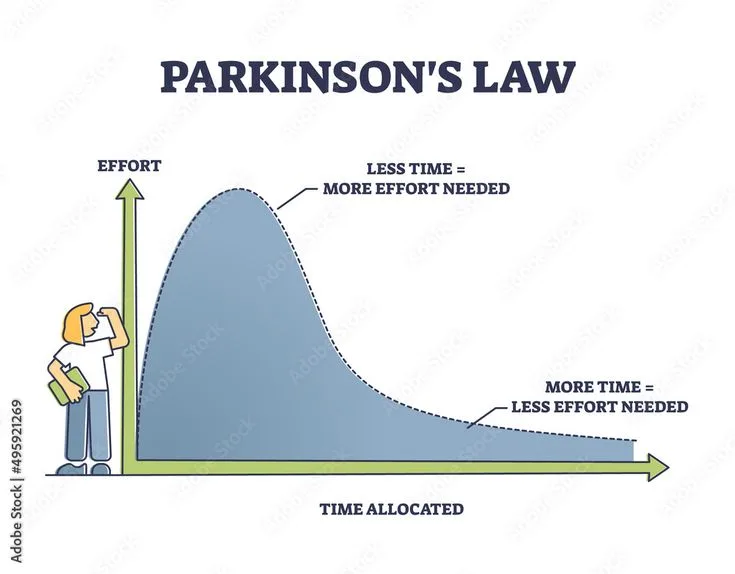

Parkinson: Give someone a week to write a report that needs only an afternoon, and the report will somehow take a week. The afternoon’s worth of writing gets surrounded by a halo of rumination, reorganization, second-guessing, and elaborate formatting until it neatly consumes the time on offer. This is not laziness, and it is not always procrastination in the usual sense.
It is a structural feature of how tasks, organizations, and human attention behave when there is slack to absorb. It is Parkinson’s Law, and once you see it, you begin to notice it everywhere: in the meeting that fills its hour regardless of agenda, in the bureaucracy that grows whether or not its workload does, and in your own to-do list, which never seems to get shorter no matter how much faster you work.
The phrase is often repeated as folk wisdom, but it began as a sharp piece of social satire backed by real arithmetic. Understanding where it came from, why it is true more often than it should be, and how to work against it turns a clever aphorism into a genuinely useful tool for thinking about time, effort, and the strange tendency of work to inflate.
“Work expands so as to fill the time available for its completion. Granted that work (and especially paperwork) is thus elastic in its demands on time, it is manifest that there need be little or no relationship between the work to be done and the size of the staff to which it may be assigned.” - C. Northcote Parkinson, Parkinson’s Law, and Other Studies in Administration (1957)
Where the Law Came From
Parkinson’s Law is named for Cyril Northcote Parkinson, a British naval historian who published the idea as an essay in The Economist in November 1955 before expanding it into a book in 1957. He was not writing a self-help manual. He was writing satire about the British Civil Service and the Royal Navy, institutions he had observed from the inside.
His central claim, delivered with deadpan precision, was that the number of officials in a bureaucracy rises at a rate unconnected to the amount of work actually produced.
To support this he offered data rather than mere wit. He noted that between 1914 and 1928 the number of capital ships in commission in the Royal Navy fell by roughly two-thirds, and the number of officers and men fell by about a third, yet the number of Admiralty officials administering this shrinking fleet rose by nearly 80 percent. The administrators multiplied while the thing being administered shrank.
Parkinson called the resulting body, with characteristic dryness, “a magnificent Navy on land.” The figures are not perfectly comparable, and later analysts have argued about how much of the growth reflected genuinely new responsibilities, but the rhetorical point survives the quibbles: staff numbers tracked something other than the size of the fleet.
The Two Engines of Bureaucratic Growth
Parkinson did not stop at observing that bureaucracies grow. He proposed a mechanism, and it is the mechanism that makes the law more than a joke. He identified two near-axiomatic motives operating inside any official.
“An official wants to multiply subordinates, not rivals” and “officials make work for each other.” - C. Northcote Parkinson, Parkinson’s Law, and Other Studies in Administration (1957)
The first motive means that an overworked official, given the choice, prefers to hire two juniors who report to them rather than one peer who might compete. This converts one busy person into a small hierarchy. The second motive means that those new subordinates then generate work for one another, checking, reviewing, and forwarding documents among themselves, so that the original official ends up busier than before supervising the very structure created to lighten the load.
The two forces compound. Growth produces the appearance of more work, which justifies further growth.
| Parkinson’s Mechanism | What the Official Does | Net Effect on Work |
|---|---|---|
| Multiply subordinates | Hires juniors instead of a rival | Creates a hierarchy to supervise |
| Make work for each other | Subordinates review and route each other’s output | Internal work rises independent of output |
| Supervision overhead | Original official manages the new structure | Busier than before, justifying yet more staff |
The cruelty of the table is that every step feels locally rational. Nobody is shirking. Each person is genuinely occupied. The work is real to the people doing it. And yet the total useful output may not have moved at all. This is precisely what makes the pattern so resistant to correction: there is no villain to remove and no obvious waste to point at, only a structure that quietly grows because each individual decision within it is defensible on its own terms.
The Psychology of the Single Task
The bureaucratic version is the law’s birthplace, but most people meet Parkinson’s Law in a smaller, more personal form: the single task that swells to fill whatever deadline contains it. Here the mechanism is psychological rather than organizational, and it draws on several well-documented features of how people estimate and manage effort.
The first is the absence of a natural stopping point. Most knowledge work has no objective definition of “done.” A report can always be polished further, a slide deck restructured, an analysis extended. Without an external constraint, the only signal to stop is the deadline, so effort continues until the deadline arrives.
The second is that a distant deadline removes urgency, and tasks without urgency are easily displaced by lower-value but more immediate demands, a pattern researchers have called the “mere urgency effect,” in which people choose urgent tasks over more important ones simply because they feel time-pressured.
The third is the well-studied tendency to misjudge how long things take, which interacts viciously with generous deadlines. When we have a lot of time, we plan loosely, assume the work is small, and leave it until later, only to discover the familiar truth that the task absorbed every hour we gave it. These three forces do not operate in isolation; they hand off to one another.
Loose initial planning leaves the task feeling small, the comfortable deadline keeps it from feeling urgent, and the lack of a completion criterion means that when work finally begins, there is nothing to stop it short of the clock.
The Planning Fallacy Connection
Parkinson’s Law is frequently confused with the planning fallacy, and the two are worth separating because they pull in opposite directions while reinforcing the same dysfunction. The planning fallacy, identified by Daniel Kahneman and Amos Tversky, is the tendency to underestimate how long a task will take, even when we have direct experience of similar tasks running long.
“The planning fallacy is only one of the manifestations of a pervasive optimistic bias… we focus on our goals, anchor on our plans, and neglect relevant base rates, thereby setting ourselves up for time-overruns.” - Daniel Kahneman, Thinking, Fast and Slow (2011)
Notice the apparent contradiction. The planning fallacy says we expect tasks to take less time than they do; Parkinson’s Law says tasks take as long as the time we allot. The resolution is that these describe different stages. When estimating, optimism makes us promise quick delivery.
When executing, the absence of a binding constraint lets the work sprawl. A person can simultaneously believe a task will take two days (planning fallacy) and then take the full two weeks they were given (Parkinson’s Law), because the estimate governs the promise while the available time governs the behavior.
| Phenomenon | Stage | Direction of Error |
|---|---|---|
| Planning fallacy | Estimating before starting | Underestimate duration |
| Parkinson’s Law | Executing with slack | Work inflates to the deadline |
| Mere urgency effect | Choosing among tasks | Favor urgent over important |
Evidence That Time Pressure Changes Output
Is there real evidence that constraints sharpen work, or is Parkinson’s Law just a memorable anecdote? Some of the most suggestive support comes from research on how deadlines shape the pacing of work. In her influential study of project teams, Connie Gersick found that groups characteristically did little substantive work in the first half of their allotted time and then underwent a sharp “midpoint transition,” reorganizing and accelerating once they sensed the deadline approaching, regardless of how much total time they had.
The progress of the teams was triggered more by their awareness of time and deadlines than by the completion of any fixed amount of work. The deadline, not the workload, governed the pacing.
Laboratory work on time constraints tells a complementary story. Studies of decision-making under time pressure find that moderate constraints often improve efficiency by forcing people to focus on the most diagnostic information and abandon low-value elaboration, though severe pressure degrades accuracy. The practical reading is not that less time is always better, but that some constraint concentrates effort, while unlimited time invites the diffuse expansion Parkinson described.
The challenge of self-management is to manufacture a useful constraint where none exists naturally. It is worth being honest that controlled experiments isolating Parkinson’s Law itself are scarcer than the law’s popularity suggests; the strongest evidence is convergent rather than from a single decisive trial, which is reason to hold the principle as a robust regularity rather than a law in the strict scientific sense.
The Corollary Laws
Parkinson’s central insight has spawned a small family of related observations, some from Parkinson himself and some from later writers, that together describe the broader pattern of resource expansion.
The most famous extension is sometimes called Parkinson’s Law of Triviality, also from his 1957 book and now known as the “bike-shed effect.” Parkinson observed that a committee asked to approve a multimillion-pound nuclear reactor will pass it quickly, because almost no one understands it well enough to argue, while the same committee will spend an enormous amount of time debating the cost of a bicycle shed for the staff, because everyone has an opinion about bicycle sheds. Trivial, comprehensible items expand to consume disproportionate attention precisely because they are accessible.
A second, broader generalization holds that consumption of any resource expands to match its supply. The clearest non-time example is data storage: files multiply to fill whatever disk capacity is available, just as belongings expand to fill a larger house. The common thread is that abundance removes the discipline that scarcity imposes, and in the absence of an external limit, expansion is the default.
| Variant | Resource That Expands | Trigger |
|---|---|---|
| Parkinson’s Law (original) | Time / staff | Available deadline or budget |
| Law of Triviality | Attention / meeting time | Items everyone feels able to judge |
| Storage corollary | Disk space, possessions | Available capacity |
Why the Law Is Not Universal
It would be a mistake to treat Parkinson’s Law as an iron rule. Plenty of work does not expand: an emergency surgery, a live performance, a flight that must depart on schedule. The law applies most strongly to work that has three features at once.
It must be elastic, meaning there is no objective definition of completion. It must be unconstrained, meaning the only limit on effort is a chosen deadline rather than a hard external one. And it must be self-paced, meaning the person or group controls how the time is used.
Strip away any of these and the law weakens. A task with a clear “done” condition, such as solving a specific equation, cannot expand indefinitely because there is a definite endpoint. A task with a hard external constraint, such as a broadcast that airs at eight o’clock, forces completion. Recognizing which of your tasks have all three elastic features tells you exactly where the law will bite, and therefore where you most need to impose artificial structure.
The Animal Dimension
The deeper principle beneath Parkinson’s Law, that consumption rises to meet available supply, is not a quirk of bureaucracy but a pattern visible across the living world. Ecologists describe a closely analogous dynamic in animal populations: given abundant resources, a population tends to grow until it presses against the limits of its environment, a ceiling known as the carrying capacity.
Reproduction expands to fill the resources available, exactly as paperwork expands to fill the time available, and in both cases the expansion is driven not by need but by the simple absence of a binding constraint. Behavioral studies of foraging show a subtler version of the same logic.
The marginal value theorem, formalized by Eric Charnov in 1976, predicts that an animal feeding in a patch should leave when its rate of gain drops to the average for the environment, yet animals that are not pressured by competition or predation often linger in a patch longer than that strict optimum would dictate, lavishing effort on diminishing returns. Slack, whether of food or of time, reliably produces expansion and inefficiency unless something external imposes a limit.
The bureaucrat lingering over the bicycle shed and the well-fed bird overstaying a depleted patch are, in a loose but instructive sense, running the same algorithm. Scarcity, uncomfortable as it is, turns out to be the great enforcer of efficiency, and abundance its great dissolver. The analogy is not a claim that the two systems share a literal mechanism, but a reminder that the absence of a binding constraint produces expansion wherever it appears, from a clutch of eggs to a quarterly budget.
Putting the Law to Work
The practical value of Parkinson’s Law lies in inverting it. If work expands to fill the time available, then shrinking the available time can compress the work, provided the deadline remains believable rather than fantastical. This is the logic behind setting deliberately tight deadlines, time-boxing tasks to fixed blocks regardless of how much remains undone, and breaking large open-ended projects into small units each with its own short clock.
“If you wait until the last minute, it only takes a minute to do.” - the Stock-Sanford corollary to Parkinson’s Law, a popular maxim capturing the law’s everyday form
The most effective single technique is the artificial hard deadline. Because the law thrives where the only constraint is a soft, self-chosen one, replacing it with a constraint that feels real, by booking a meeting to present the work, promising it to someone, or scheduling it against a fixed event, removes the slack the work would otherwise expand into. Time-boxing works on the same principle at smaller scale: deciding in advance that a task gets ninety minutes and then stopping forces the brain to prioritize the essential and abandon the ornamental. A complementary move is to define “done” explicitly before starting, since an elastic task with no completion criterion has no natural stopping point and will run until the clock does.
There is a limit to this, and it is worth stating plainly so the advice is not abused. Compression has a floor set by the genuine difficulty of the work, and pushing deadlines below that floor does not sharpen focus; it produces panic, errors, and burnout. The point of using Parkinson’s Law is to remove the wasteful slack between the real time a task needs and the generous time it was given, not to deny the task the time it genuinely requires.
Used wisely, the law is a diagnostic for over-allocated time. Used foolishly, it becomes an excuse for impossible schedules.
Implications for Organizations
At the organizational scale, Parkinson’s original target, the law carries a warning that remains pointed nearly seventy years later. Headcount and budget, once granted, are extraordinarily difficult to reclaim, because the people occupying them are genuinely busy and can demonstrate it. The work they generate for one another is real work, performed in good faith, and therefore nearly impossible to distinguish from necessary work by anyone inside the system.
This is why staff and spending tend to ratchet upward and rarely down, and why periodic forcing functions, hard budget caps, zero-based reviews that justify every role from scratch, and explicit limits on meeting time, are the only reliable counterweights.
The healthiest organizations treat slack as something to be designed deliberately rather than allowed to accumulate by default. A little slack is valuable; it absorbs shocks, allows for creativity, and prevents the brittleness of a system run at maximum capacity. Uncontrolled slack, by contrast, quietly converts into the self-justifying internal busywork Parkinson skewered.
The discipline is to choose how much slack you want and to defend that boundary, rather than letting work, staff, and spending expand into every vacuum the way they always will if left alone. Parkinson wrote it as satire, but the joke endures because the arithmetic was never really a joke.
Related Resources
- The Planning Fallacy: Why Everything Takes Longer Than You Think
- Time Boxing: How Fixed Time Blocks Beat Endless To-Do Lists
- The Pomodoro Technique and the Psychology of Focus
- What Is Procrastination and Why We Do It
References
- Parkinson, C. N. (1955, November 19). Parkinson’s Law. The Economist.
- Parkinson, C. N. (1957). Parkinson’s Law, and Other Studies in Administration. Houghton Mifflin.
- Kahneman, D., & Tversky, A. (1979). Intuitive prediction: Biases and corrective procedures. TIMS Studies in Management Science, 12, 313-327.
- Kahneman, D. (2011). Thinking, Fast and Slow. Farrar, Straus and Giroux.
- Gersick, C. J. G. (1988). Time and transition in work teams: Toward a new model of group development. Academy of Management Journal, 31(1), 9-41. https://doi.org/10.2307⁄256496
- Zhu, M., Yang, Y., & Hsee, C. K. (2018). The mere urgency effect. Journal of Consumer Research, 45(3), 673-690. https://doi.org/10.1093/jcr/ucy008
- Charnov, E. L. (1976). Optimal foraging, the marginal value theorem. Theoretical Population Biology, 9(2), 129-136. https://doi.org/10.1016⁄0040-5809(76)90040-X