
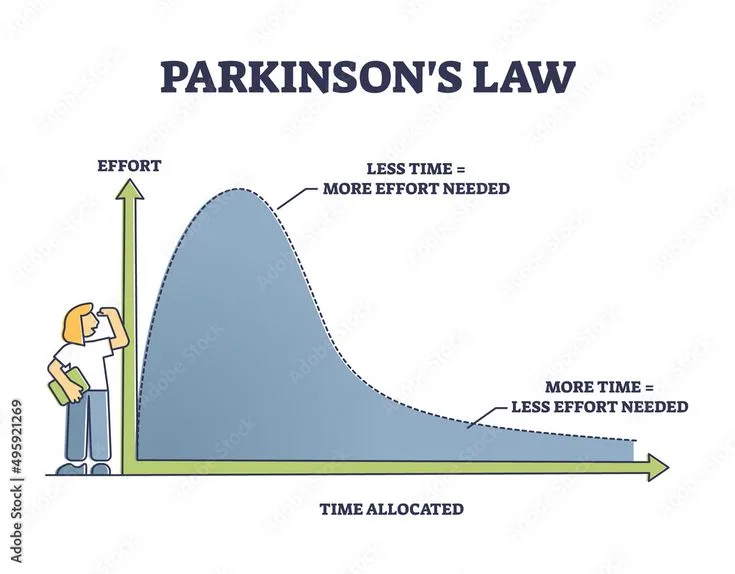
On November 19, 1955, a historian named Cyril Northcote Parkinson published an essay in The Economist. It began with a sentence that has been quoted millions of times since: "It is a commonplace observation that work expands so as to fill the time available for its completion."
Parkinson was not writing a formal academic study. The essay was satirical, a gently devastating critique of British bureaucracy, written by a man who had spent decades observing colonial administration and military organization. He had noticed something that struck him as deeply funny: the number of people employed to do administrative work bore almost no relationship to the amount of administrative work that actually needed to be done.
The essay was a hit. The Economist reader response was so enthusiastic that Parkinson expanded it into a book, published in 1958 as "Parkinson's Law: The Pursuit of Progress," which became an unlikely bestseller.
The eponymous law entered the language, and two specific phenomena Parkinson identified (the expansion of work to fill available time, and the tendency of bureaucracies to grow regardless of their workload) have been discussed, researched, and applied ever since.
What makes Parkinson's Law interesting is not that it is merely amusing. It has genuine predictive power about how individuals manage time, how organizations staff themselves, and how deadline structures shape output quality. Understanding it offers practical leverage over both personal productivity and organizational design.
"It is a commonplace observation that work expands so as to fill the time available for its completion." (Cyril Northcote Parkinson, The Economist, 1955)
Parkinson's Original Argument
The 1955 essay made two distinct claims, which are often conflated.
Claim One: Work Expands to Fill Time
The first claim is the one most people know: when you have more time to do something, that thing somehow takes more time to do. Parkinson illustrated this with a vivid hypothetical:
An elderly woman of leisure has nothing to do but send a postcard to her niece. She spends an entire day on this task. An hour finding the card. An hour finding her glasses. Thirty minutes deciding whether to carry an umbrella. Twenty minutes looking for the niece's address.
An hour and a half writing the card. Twenty minutes deciding whether to take the card to the post office or wait for the afternoon collection.
The task itself, writing a postcard, takes perhaps five minutes for a busy person who must do it between other commitments. But for the woman with a full day, it expands magnificently. The work, in Parkinson's formulation, is never done; it is merely scheduled to stop.
Claim Two: Bureaucracies Grow Independent of Workload
The second claim is more specific to large organizations: the number of staff required to manage work has a tendency to expand regardless of whether the underlying workload is increasing.
Parkinson supported this with actual data from the British Civil Service. He noted that the British Admiralty administration grew at a rate of approximately 5.6% per year between 1914 and 1928, a period during which the British Navy shrank considerably.
At the start of this period, Britain had 62 capital ships, crewed by 146,000 officers and ratings, administered by 2,000 Admiralty officials. By 1928, Britain had 20 capital ships, crewed by 100,000 officers and ratings, but was now administered by 3,569 officials, an increase of 78%.
The Colonial Office provided a similar data point: its staff increased from 372 to 1,661 between 1935 and 1954, a period during which the British Empire was systematically shrinking and the amount of actual colonial administration being done was declining.
Parkinson identified the mechanism as two "laws" of bureaucratic behavior:
- An official wants to multiply subordinates, not rivals
- Officials make work for each other
When a bureaucrat feels overworked, they request two or three assistants rather than splitting their role between two colleagues (which would create rivals). Those assistants generate work for each other and for their superior through the need to coordinate and communicate, which validates the original expansion.
The Psychological Mechanisms
Why does work expand to fill available time? The explanation involves several interacting psychological tendencies.
Engrossment and Scope Expansion
When people are given substantial time for a task, they unconsciously expand the scope of what they consider the task to include.
Given two hours to write a memo, a person considers whether to add additional background, whether to revise the structure, whether to include supporting data, whether the tone is optimal, whether the formatting could be improved. Given 20 minutes, they write the essential content.
This is not irrationality: the person with two hours genuinely does produce a more complete and refined document. The question is whether the improvement justifies the additional time relative to other uses of it.
Parkinson's point is that this calculation is rarely made explicitly: the available time determines the scope, rather than the required scope determining the time.
Parkinson's Law and Perfectionism
The expansion of work over time is closely related to perfectionism: the tendency to continue improving work past the point where improvement is marginal. Given infinite time, a perfectionist will never consider anything finished. Given a deadline, they produce a finished product.
Research by psychologist Robert Boice on academic writing found that professors who wrote for fixed daily periods produced more publishable work than those who waited for large blocks of "open time," because the fixed period forced completion rather than indefinite refinement.
The Effort-Time Confusion
There is also a cultural confusion between time spent and effort applied. In many work environments, time at a desk is treated as a proxy for effort and commitment. This creates incentives to appear busy for the duration of available time, even when the core work has been completed.
The incentive structure rewards filling time rather than completing work efficiently.
Evidence for Time Pressure and Output Quality
The claim that less time produces better output sounds counterintuitive. Does the evidence support it?
The relationship between time pressure and quality follows a U-shaped curve. Too little time produces errors and shallow work. Too much time produces over-elaboration and avoidance. Moderate time pressure produces focused, prioritized, efficient work.
Teresa Amabile's Research
Teresa Amabile and colleagues at Harvard Business School conducted a study of creative workers tracked over days and weeks, collecting diary entries on work activities and output quality. Published in 2002, the research found that moderate time pressure (a sense of urgency about meaningful work) supported creative output.
Extreme time pressure (crisis mode, unreasonable deadlines) substantially reduced creativity and produced effects that persisted for days after the high-pressure period ended.
But low time pressure was not associated with high creative output either; it was associated with distraction, tangential exploration, and low productivity.
The sweet spot was what Amabile called "focus and urgency": a sense that the work mattered and needed to be done within a meaningful timeframe, without the panic of impossible demands.
Chris Bailey's Time Experiment
Productivity writer Chris Bailey conducted a personal experiment in which he varied his weekly work hours dramatically, from 90 hours per week to 20 hours per week, while tracking his output.
He found that output varied far less than hours did: the 20-hour weeks produced comparable results to the 90-hour weeks, because constraints forced prioritization of the most important work.
The additional 70 hours of the long week were largely absorbed by tasks that expanded to fill the available time.
This experience, while anecdotal, is consistent with the broader literature on attention and constraint: people make sharper decisions about what to include in their work when they have less capacity for everything.
Practical Applications: Using Parkinson's Law to Your Advantage
Understanding Parkinson's Law opens several practical levers for improving productivity at both individual and organizational levels.
Timeboxing
Timeboxing is the practice of allocating a fixed, defined period to a task and committing to stopping (or at least reviewing) when the time expires. Rather than working on a task "until it is done," you work on it for 90 minutes and produce the best version achievable in that time.
Timeboxing exploits Parkinson's Law directly: by artificially constraining available time, you compress the scope of the work to what genuinely matters. Research on decision quality and creative output consistently finds that constraint produces focus that unconstrained time does not.
Timeboxing also has a secondary benefit: it makes procrastination more difficult. The prospect of working for 25 minutes is less aversive than the prospect of "finishing the report," a task whose endpoint is indefinite and therefore easily avoided.
The Pomodoro Technique
The Pomodoro Technique (25 minutes of focused work followed by a 5-minute break, repeated in cycles) is a structured application of timeboxing. Its creator, Francesco Cirillo, developed it as a student struggling with procrastination.
The technique works, in part, through Parkinson's Law: a 25-minute constraint forces commitment to a specific, achievable chunk of work rather than diffuse, open-ended "working on the project."
Research by Ariga and Lleras (2011), published in "Cognition," found that brief mental breaks from a task prevented performance decline over extended work periods, providing additional support for the Pomodoro structure.
Artificial Deadlines and Commitment Devices
In behavioral economics, a commitment device is a mechanism by which you bind your future self to a behavior or constraint that you know your future self will be tempted to avoid.
Artificial deadlines (publicly stating a completion date, booking a plane ticket that requires departure before a project must be submitted, scheduling a review meeting with a colleague) function as commitment devices that exploit Parkinson's Law.
The public commitment matters. Research by Peter Gollwitzer and colleagues on implementation intentions found that specific plans ("I will do X on day Y at time Z") dramatically improved follow-through compared to vague intentions ("I will do X eventually"). External commitments strengthen this effect further.
Meeting Length Design
Parkinson's Law applies directly to meeting design. A meeting scheduled for 60 minutes tends to use 60 minutes regardless of how much material needs to be covered. The same meeting scheduled for 25 minutes often covers the same material in 25 minutes, with more focus and less digression.
Cal Newport, in "A World Without Email," recommends 22- and 47-minute meetings (rather than 30 and 60 minutes) as a practical implementation: the slightly compressed timings force participants to take the time limit seriously in a way that round numbers do not.
Some organizations have adopted stand-up meetings (meetings conducted with participants standing rather than seated), partly because standing produces discomfort that motivates brevity.
Parkinson's Law for Organizations: Bureaucratic Expansion
The second aspect of Parkinson's argument, that administrative staff grows independent of workload, has been extensively studied in organizational behavior.
Evidence for Bureaucratic Expansion
Peter Drucker, the management thinker, spent decades documenting the tendency of large organizations to generate administrative overhead disconnected from productive work. His concept of "management work" (work done to coordinate other work) grows as organizations grow, eventually consuming disproportionate resources.
Economist Jonathan Gruber and Simon Johnson's research has found that healthcare administrative costs in the United States (driven partly by the complexity of insurance billing and regulatory compliance) consume approximately 25-30% of total healthcare spending, far more than comparable systems in other countries.
The administrative layer has grown through exactly the Parkinson mechanism: staff create coordination requirements for each other, each coordination requirement justifies more staff, and the total grows regardless of whether patient outcomes are improving.
A 2016 survey by McKinsey found that executives in large companies spent an average of 20% of their time on organizational administration that could in principle be eliminated without affecting output.
The time was absorbed by internal reporting, attending meetings where their presence was requested rather than necessary, and managing coordination processes that were artifacts of organizational structure rather than genuine work requirements.
The Parkinson Mechanism in Remote Work
Research on remote work during and after the COVID-19 pandemic produced evidence for Parkinson's Law at organizational scale.
Several studies found that as synchronous meeting requirements increased (a natural consequence of managers feeling less visible control over remote workers), productive output time declined. The coordination overhead expanded to fill the available schedule.
Microsoft's research on its own workforce using Teams activity data, published in 2021, found that remote work had increased meeting time while decreasing the time available for focused, uninterrupted work.
The insight consistent with Parkinson's Law: coordination work expanded to fill the schedule, crowding out the work the coordination was supposed to support.
The Reverse Application
If work expands to fill time, then shrinking available time compresses work to fit. This is the "reverse Parkinson" insight, and it has several practical applications.
Fixed-schedule productivity: Cal Newport advocates committing to a fixed end time for your workday and making all necessary work fit within it. The constraint forces prioritization. Work that previously seemed necessary becomes optional when time is genuinely finite.
Parkinson's Law for projects: when planning a project, start by estimating how long it would take under ideal conditions (no interruptions, everything working, best-case effort), then set the deadline significantly closer to that estimate rather than to the worst-case estimate.
The closer deadline forces teams to make design decisions that optimize for completion rather than completeness.
The "half the time" heuristic: for tasks that recur regularly, occasionally attempt them in half the time you would normally allocate. The experiment reveals which parts of your usual process are genuinely necessary versus which have expanded to fill available time.
Parkinson's Law Tools in Practice
| Technique | How It Works | Best Used For |
|---|---|---|
| Timeboxing | Fixed period allocated; work stops at end | Tasks that tend to expand: writing, research, email |
| Pomodoro Technique | 25-minute focused intervals with 5-minute breaks | Procrastinated tasks; focus-intensive work |
| Artificial deadlines | Public commitments or scheduled reviews | Projects without external deadlines |
| Meeting compression | Schedule 22- or 47-minute slots instead of 30 or 60 | Recurring meetings that routinely run over |
| Half-time experiment | Attempt recurring tasks in half their normal time | Identifying which process steps are genuine vs. padding |
| Fixed schedule | Hard stop at end of workday | Creative and knowledge work across whole days |
What Parkinson Got Right and What He Missed
Parkinson's Law has proved remarkably durable as a practical insight, but its satirical origins mean it was not formulated with the precision of a scientific theory.
What it gets right: The core observation, that time availability influences how long tasks take, and that organizations generate administrative overhead disconnected from productive work, is robustly supported by experience and research.
What it oversimplifies: Not all expansion of work over time is wasteful. Some of what looks like scope expansion is genuine quality improvement: a document that receives careful revision over two days rather than 20 minutes is often genuinely better. The law provides no way to distinguish productive effort from mere time-filling.
What it misses: Time pressure can harm output quality, particularly for complex, creative, or collaborative work. Extreme deadlines produce errors, shortcuts, and the kind of burnout that reduces long-term productivity.
The relationship is curvilinear, not linear: there is an optimal level of time pressure, and it varies by task type and individual.
The practical wisdom drawn from Parkinson's Law is not "give yourself as little time as possible." It is to make time constraints explicit and deliberate rather than letting available time passively determine scope: choose your deadlines rather than accepting whatever the calendar provides.
Parkinson himself, writing with characteristic wit, noted that there was no solution to bureaucratic expansion: "Action will be taken in the course of the next century or so, but we need not detain ourselves with that." The law, he implied, was a feature of organizational life, not a bug that clever management could design away.
What we can do, at the level of the individual and the team, is work with the grain of the law rather than against it, using the constraint of limited time as a resource rather than treating unlimited time as a luxury.