
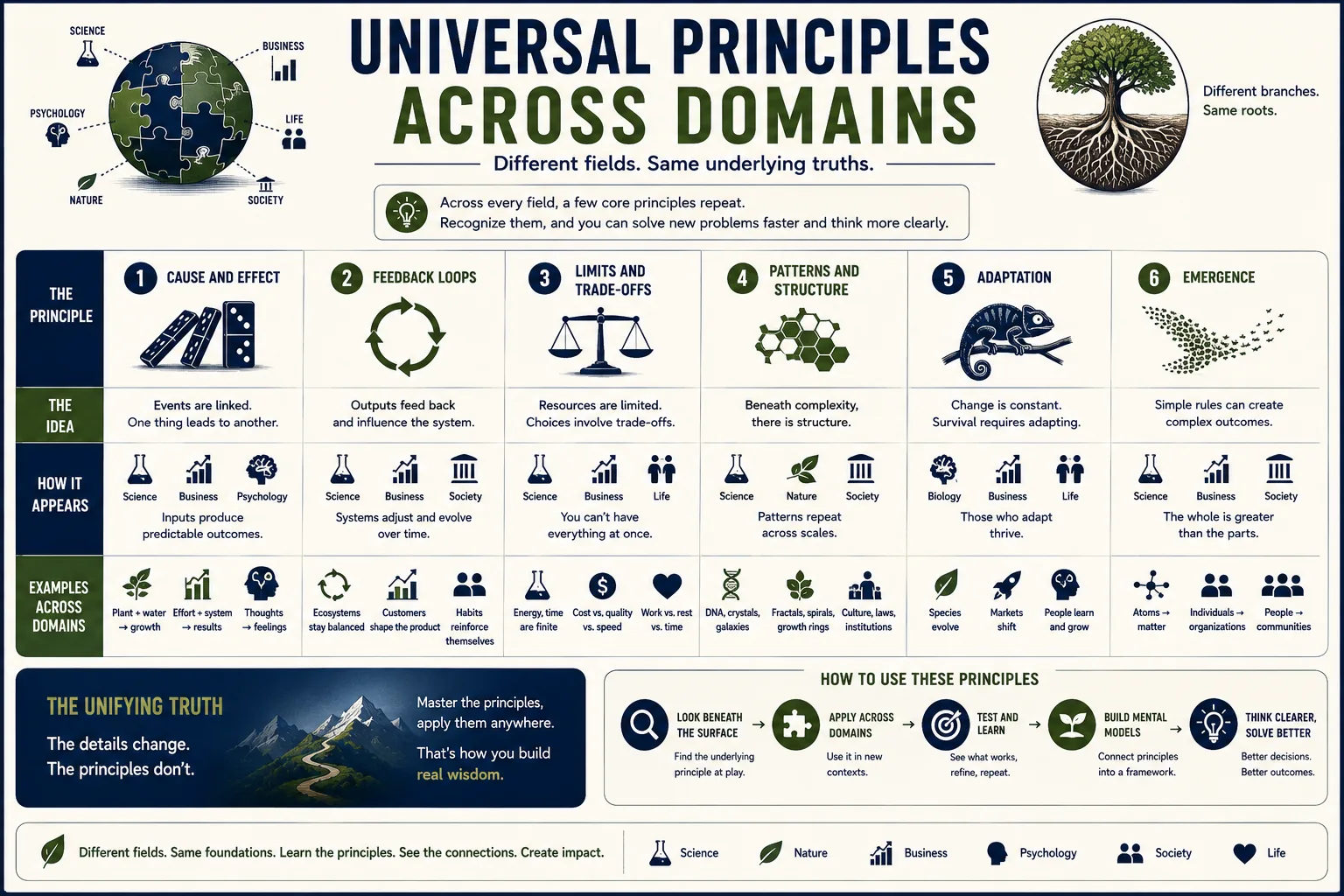
Universal: You're learning chess tactics. Memorize: "Knight forks win material." Then you start learning programming. Unrelated field-except you notice the same pattern: Create situations where one action accomplishes multiple goals.
Then negotiation: Position yourself so every option benefits you. Then business strategy: Build capabilities that serve multiple purposes simultaneously.
Different domains, same principle: Multiplicity-arrange things so single actions achieve multiple objectives.
This recognition-that fundamental patterns recur across seemingly unrelated domains-is one of the most powerful intellectual tools available. Universal principles are truths that transcend specific fields, explaining patterns in physics, biology, psychology, business, and human behavior using the same underlying logic.
Before exploring specific universal principles, it helps to understand what a principle is and why it matters - specifically, how principles differ from rules and why that difference changes how you apply them.
"You've got to have models in your head. And you've got to array your experience - both vicarious and direct - on this latticework of models." - Charlie Munger[1]
Understanding universal principles transforms how you think. Instead of learning thousands of disconnected domain-specific lessons, you recognize the same 10-20 fundamental patterns appearing everywhere.
This recognition accelerates learning, enables transfer between fields, and provides reliable guides for decision-making in novel situations where domain-specific knowledge doesn't exist yet.
"To understand is to find simpler things that something is built out of. When you discover the underlying mechanism, you can apply it everywhere you see the same structure." - Richard Feynman
What Makes a Principle Universal
A principle is universal when it is cross-domain applicable (working in physics, biology, psychology, and business alike), robust to context (holding across varied conditions), and irreducible (not derivable from a simpler principle). It must also explain observable patterns and predict outcomes in new situations, not just describe one field's specific rules.
Principles that fail these tests are usually domain-specific patterns, vague platitudes, or context-dependent rules mistaken for universal truths.
Definition
Universal principle: A fundamental truth that applies across multiple unrelated domains.
Key characteristics:
| Characteristic | Explanation |
|---|---|
| Cross-domain applicability | Works in physics, biology, psychology, business, etc. |
| Robust to context | Maintains validity across varied conditions |
| Explains patterns | Provides underlying logic for observable phenomena |
| Predictive | Can anticipate outcomes in new situations |
| Irreducible | Not derivable from simpler principles |
True vs. Pseudo-Universal Principles
Many claimed "universal principles" are actually:
- Domain-specific patterns misapplied elsewhere
- Vague platitudes that explain nothing
- Context-dependent rules dressed up as fundamentals
Test for universality:
1. Apply to genuinely different domains
- Not just "business marketing" and "political marketing" (too similar)
- Test in physics, biology, psychology, economics, etc.
2. Provide explanatory power
- Does it explain why patterns occur?
- Can you derive predictions from it?
3. Withstand scrutiny
- Do experts in each field recognize its validity?
- Does it hold under examination?
Core Universal Principles
Principle 1: Compound Effects
Statement: Small changes compound over time through multiplication rather than addition.
Mathematical form:
- Linear growth: +10 per period → 10, 20, 30, 40...
- Compound growth: +10% per period → 10, 11, 12.1, 13.3...
Over time: Compound growth dominates.
Applications across domains:
| Domain | Manifestation |
|---|---|
| Finance | Compound interest: $1,000 at 10% annual = $2,594 after 10 years (not $2,000) |
| Biology | Population growth: bacteria double every 20 minutes → 1 becomes 16,777,216 in 8 hours |
| Learning | Knowledge compounds: today's learning builds on yesterday's, accelerating over time |
| Business | Network effects: each user makes product more valuable for all users (Facebook, phones) |
| Physics | Exponential decay: radioactive half-life, drug metabolism |
| Personal | Habits compound: 1% daily improvement = 37x better in one year |
Why universal: Multiplicative processes appear everywhere. When rate of change depends on current state, compound effects emerge.
Key insight: Consistency matters enormously over time. Small consistent improvements or degradations produce dramatic long-term differences.
Principle 2: Leverage
Statement: Small inputs at high-leverage points create disproportionately large outputs.
Archimedes: "Give me a lever long enough and a fulcrum on which to place it, and I shall move the world."
"Do more and more with less and less until eventually you can do everything with nothing." - Buckminster Fuller
Applications across domains:
| Domain | High-Leverage Point |
|---|---|
| Physics | Mechanical advantage: small force, long lever arm ? large force, short distance |
| Business | Automation: build once, benefit infinitely; capital leverages labor |
| Learning | First principles: master core principles, understand thousands of applications |
| Biology | Keystone species: wolves in Yellowstone regulate entire ecosystem |
| Software | Code reuse: write library once, used millions of times |
| Strategy | Bottlenecks: improve constraint, entire system improves |
| Finance | Debt: borrow $100, control $1,000 of assets (10x leverage) |
Why universal: Systems have structure. Some points have outsized influence on system behavior.
Key insight: Don't distribute effort equally. Find high-leverage points and focus there.
Risks: Leverage amplifies downside too (debt can destroy, keystone removal collapses ecosystem).
Principle 3: Feedback Loops
Statement:Systems outputs feed back as inputs, creating self-reinforcing or self-correcting dynamics.
Two types:
Reinforcing (positive) feedback: Output amplifies itself
- Growth or collapse
- Unstable equilibria
- Exponential dynamics
Balancing (negative) feedback: Output corrects itself
- Stability
- Homeostasis
- Returns to equilibrium
Applications across domains:
| Domain | Reinforcing Loop | Balancing Loop |
|---|---|---|
| Biology | Predator-prey cycles (population booms) | Body temperature regulation (homeostasis) |
| Economics | Bank runs (panic ? withdrawals ? more panic) | Supply-demand (high price ? more supply ? lower price) |
| Psychology | Anxiety spiral (worry ? physical symptoms ? more worry) | Adaptation (stimulus ? response ? desensitization) |
| Social | Fame (attention ? more attention) | Social norms (deviance ? correction) |
| Technology | Network effects (users ? value ? more users) | Thermostats (cold ? heat ? warm ? off) |
| Climate | Ice-albedo feedback (warming ? ice melts ? less reflection ? more warming) | Carbon cycle (CO2 ? plants grow ? absorb CO2) |
Why universal: Feedback is fundamental to system dynamics. When outputs become inputs, loops emerge.
Key insight: Identify whether you're in reinforcing or balancing loop. Reinforcing loops demand early intervention (compound); balancing loops resist change (stable).
Principle 4: Diminishing Returns
Statement: Marginal benefit of each additional unit declines as quantity increases.
First unit high value, subsequent units progressively less.
Applications across domains:
| Domain | Manifestation |
|---|---|
| Economics | Marginal utility: 1st pizza slice delicious, 8th makes you sick |
| Agriculture | Fertilizer: adding N increases yield until soil saturated, then no effect |
| Learning | Study hours: hour 1 very productive, hour 14 counterproductive |
| Medicine | Drug dosage: some effective, more isn't always better, can be harmful |
| Marketing | Ad spend: first $10K high ROI, $500K reaches marginal audience |
| Exercise | Training: optimal load builds strength, excessive load causes injury |
Why universal: Resources interact with constraints. Early applications address most pressing needs; later applications face limitations.
Key insight: Stop when marginal benefit < marginal cost. More isn't always better.
Principle 5: Opportunity Cost
Statement: Choosing option A means not choosing option B. True cost includes foregone alternatives.
Nothing is free. Every choice has cost: the value of next-best alternative.
Applications across domains:
| Domain | Opportunity Cost |
|---|---|
| Economics | Money: spending $100 means not investing it (could have earned returns) |
| Time | Watching TV: 3 hours costs potential reading, exercise, relationships |
| Business | Focus: pursuing strategy A means not pursuing B (resources are finite) |
| Biology | Energy allocation: growing large muscles costs brain development (trade-off) |
| Career | Job choice: taking role A means not taking role B (experience, connections) |
| Attention | What you focus on costs what you ignore |
Why universal: Resources are finite (time, money, energy, attention). Allocating to one use means not allocating elsewhere.
Key insight: Evaluate decisions not just by benefits, but by what you're giving up.
Principle 6: Inertia
Statement: Objects in motion stay in motion; objects at rest stay at rest. Change requires force.
Original: Newton's First Law (physics)
Generalized: Systems resist change. Current state persists unless external force intervenes.
Applications across domains:
| Domain | Manifestation |
|---|---|
| Physics | Momentum: moving object continues unless force applied |
| Psychology | Habit: behavior persists due to automaticity, requires effort to change |
| Social | Status quo bias: people prefer current state, resist change |
| Organizations | Bureaucratic inertia: processes persist even when obsolete |
| Markets | Price stickiness: prices slow to adjust despite changed conditions |
| Biology | Evolutionary conservation: structures persist unless selection pressure changes them |
Why universal: Change requires energy. Maintaining current state is lower energy than initiating change.
Key insight: Default outcomes are powerful. To change systems, you must overcome inertia. Once changed, new state persists (inertia now works for you).
Principle 7: Path Dependence
Statement: History matters. Current state depends not just on current conditions, but on the path taken to get here.
Different histories ? different outcomes, even with same present conditions.
Applications across domains:
| Domain | Manifestation |
|---|---|
| Technology | QWERTY keyboard: designed to prevent typewriter jams, persists despite obsolescence |
| Biology | Evolutionary path: whales evolved from land mammals ? still have vestigial leg bones |
| Economics | Development: countries with historical institutions have different growth trajectories |
| Psychology | Trauma: past experiences shape current responses even when context changed |
| Business | Lock-in: initial technology choice constrains future options (Windows vs Mac ecosystem) |
| Social | Culture: historical events create persistent norms and institutions |
Why universal: Decisions create constraints. Early choices influence what's possible later. Reversing history is often impossible or extremely costly.
Key insight: Early decisions matter enormously. Path dependence means initial conditions have lasting effects.
Principle 8: Scale Effects
Statement: What works at one scale often fails at another. Properties change with size.
Small ? big. Scaling introduces qualitatively different challenges.
Applications across domains:
| Domain | Scale Effect |
|---|---|
| Biology | Surface-area-to-volume: insects don't need lungs (surface suffices), elephants do |
| Business | Startup at 10 people operates completely differently than 10,000 people |
| Physics | Quantum mechanics governs atomic scale, general relativity governs cosmic scale |
| Social | 5-person group discussion → 500-person assembly (different dynamics) |
| Manufacturing | Prototype in lab ? factory production at scale (different challenges) |
| Software | App with 100 users → 100 million users (different infrastructure) |
Why universal: Relationships between factors change with magnitude. Ratios shift. Some effects dominate at one scale, become negligible at another.
"Almost everything scales with size in a systematic, predictable way across the whole of biology, from cells to ecosystems - the same mathematics that governs the elephant governs the city." - Geoffrey West
Key insight: Don't assume solutions scale linearly. Test at new scales. Beware assuming "just do more of same."
Principle 9: Conservation Laws
Statement: Some quantities remain constant. Total amount is preserved, only redistributed.
Original: Physics (energy, momentum, mass-energy)
Generalized: Closed systems have conserved quantities. Can't create from nothing.
Applications across domains:
| Domain | Conservation |
|---|---|
| Physics | Energy: cannot be created or destroyed, only transformed |
| Time | 24 hours/day: spending time on X means not spending on Y |
| Attention | Focus is zero-sum in the moment: attending to X means not attending to Y |
| Economics | Trade: value created or destroyed, but in transaction, gain on one side often offset by other |
| Thermodynamics | Entropy: disorder in closed system always increases (can't reverse without external energy) |
Why universal: Some properties are truly limited. Total fixed, only allocation varies.
Key insight: When dealing with conserved quantity, optimization means better allocation, not increasing total.
Principle 10: Threshold Effects (Phase Transitions)
Statement: Small incremental changes accumulate until critical threshold reached, then sudden qualitative shift.
Gradual → Sudden discontinuous change.
Applications across domains:
| Domain | Threshold Effect |
|---|---|
| Physics | Water: 99C liquid, 100C gas (phase transition) |
| Psychology | Stress: manageable load ? one more stressor ? breakdown |
| Business | Market tipping point: slow adoption ? critical mass ? rapid adoption cascade |
| Social | Revolutions: discontent builds slowly ? spark ? sudden regime change |
| Ecosystems | Collapse: gradual degradation ? threshold crossed ? sudden ecosystem collapse |
| Networks | Connectivity: add links ? percolation threshold ? giant connected component emerges |
Why universal: Many systems have tipping points. Accumulation creates tension; release is sudden. This behavior is a signature feature of complexity.
Key insight: Watch for approaching thresholds. Small changes near threshold have outsized effects. After threshold, system behaves qualitatively differently.
How to Use Universal Principles
You use universal principles by matching a new situation to a familiar pattern, then applying the insight that pattern predicts. The core method has four strategies: pattern recognition (spotting feedback loops, compound effects, or leverage points in unfamiliar problems), transfer between domains (abstracting a principle from one field and testing it in another), building mental models (combining several principles into a working framework), and prediction (using a matched principle to anticipate what happens next before you have domain-specific data).
Strategy 1: Pattern Recognition
When encountering new problem:
1. Identify underlying structure
- What are components?
- How do they interact?
- What are constraints?
2. Match to universal principle
- Does this look like feedback loop?
- Is this compound effect?
- Are we seeing diminishing returns?
3. Apply principle-derived insights
- What does this principle predict will happen?
- Where are high-leverage points?
- What interventions does principle suggest?
Example: Understanding viral content spread
Structure: Each person shares with multiple others, who share with others...
Principle: Compound effects + network effects (feedback loop)
Prediction: Exponential growth initially, then saturation as network exhausts
Leverage points: Initial seeding (reach high-connectors), early momentum (reinforcing loop needs kickstart), message sharability (each share produces more shares)
Result: Understanding viral mechanics without "social media expertise" by recognizing universal compound + feedback pattern.
Strategy 2: Transfer Between Domains
Learn in one field, apply in another.
Process:
1. Abstract the principle from specific domain
- What's the underlying logic?
- Strip away domain-specific details
2. Test applicability in new domain
- Do similar structures exist?
- Does principle explain patterns?
3. Adapt to context
- How does principle manifest here?
- What are domain-specific constraints?
Example: Applying biological evolution to business
Principle (biology): Variation, selection, retention ? evolution of adapted organisms
Transfer to business:
- Variation: Try different strategies
- Selection: Market rewards some, punishes others
- Retention: Successful strategies persist and spread
Insight: Businesses "evolve" through market selection. Don't need perfect strategy upfront; need variation + selection process.
Application: Create portfolio of experiments, let market select, scale winners, kill losers.
Strategy 3: Building Mental Models
Universal principles become building blocks of mental models.
Mental model: Representation of how something works, built into frameworks from principles.
Example: Understanding cryptocurrency boom
Combine principles:
1. Network effects (more users ? more value ? more users)2. Compound growth (exponential price rise initially)3. Feedback loops (reinforcing: price rise ? media attention ? more buyers ? higher price)4. Diminishing returns (early adopters huge gains, late adopters diminishing gains)5.
Threshold effects (sudden collapse when sentiment shifts)
Result: Comprehensive understanding of boom-bust cycle without needing deep crypto expertise, by combining universal principles.
Strategy 4: Prediction and Anticipation
Universal principles enable prediction in novel situations.
When entering new domain:
1. Identify which principles likely apply
- Structure suggests compound effects?
- Evidence of feedback loops?
- Constraints suggest diminishing returns?
2. Derive predictions
- If compound effect, expect exponential growth/decay
- If feedback loop, expect amplification or stability
- If threshold nearby, expect sudden shift
3. Test predictions
- Do observations match?
- If not, which principles are missing/misapplied?
Limits and Cautions
Caution 1: Principles Aren't Sufficient
Universal principles provide structure, not details.
You need:
- Principles: Why things work (universal)
- Domain expertise: How things work in this specific context
Danger: Thinking principles replace expertise.
Reality: Principles + expertise is powerful. Principles alone are incomplete.
Example: Medical diagnosis
Universal principles help:
- Systems thinking (interconnections)
- Feedback loops (symptoms and causes)
- Threshold effects (sudden deterioration)
But insufficient:
- Need anatomy, physiology, pharmacology
- Need clinical experience
- Need diagnostic tools
Principles provide framework; expertise provides content.
Caution 2: Oversimplification
Universal principles necessarily abstract away details.
Risk: Missing important context-specific factors.
Example: "Apply compound interest to learning"
Principle is true: Knowledge compounds.
But ignores:
- Forgetting curves (decay)
- Retrieval practice (method matters)
- Spacing effects (timing matters)
Use principle as starting point, not complete answer.
Caution 3: Misapplication
Not every superficial similarity means principle applies.
Test carefully:
- Does structure genuinely match?
- Are underlying mechanisms similar?
- Do predictions hold?
Example: "Evolution in business"
Where it works: Variation + selection + retention genuinely occurs
Where it fails: Business strategy involves intentional design (not random variation), rational planning (not blind process)
Don't force analogies. Verify applicability.
Building Your Principle Library
Start with 10-20 Core Principles
Focus on fundamentals that appear most frequently:
- Compound effects (exponential growth/decay)
- Leverage (disproportionate input-output)
- Feedback loops (reinforcing and balancing)
- Diminishing returns (declining marginal benefit)
- Opportunity cost (alternatives forgone)
- Inertia (systems resist change)
- Path dependence (history matters)
- Scale effects (properties change with size)
- Conservation laws (fixed total, varied allocation)
- Threshold effects (phase transitions)
- Incentives (people respond to rewards/punishments)
- Comparative advantage (specialize in relative strengths)
- Signaling (actions communicate information)
- Survivorship bias (visible survivors ? all cases)
- Regression to mean (extremes tend toward average)
Deep understanding of these beats superficial knowledge of 100.
Study Principle Across Multiple Domains
For each principle:
1. Learn origin domain (where was it formalized?)2. Study applications in 3-5 different unrelated domains3. Identify common patterns (what's same across all?)4. Note domain-specific variations (how does manifestation differ?)5. Practice applying to new situations
Test Principles Against Reality
Principles must earn their place through predictive power.
For each principle:
- What does it predict in this situation?
- Do observations match predictions?
- When predictions fail, why? (wrong principle, or context factors?)
Discard or refine principles that consistently fail.
Conclusion: The Power of Fundamental Truths
Universal principles are intellectual leverage.
Instead of learning:
- 1,000 disconnected domain-specific lessons
- New rules for every new situation
- Starting from scratch in each field
You learn:
- 10-20 fundamental patterns
- Recognition of structures
- Transfer mechanisms
The advantage:
1. Accelerated learning
- New domains become understandable faster
- Recognize familiar patterns in unfamiliar contexts
2. Better predictions
- Understand likely dynamics in novel situations
- Anticipate problems before they arise
3. Higher leverage
- Identify high-impact intervention points
- Avoid low-impact busywork
4. Transfer ability
- Insights from one field inform another
- Cross-pollination of ideas
Key insights:
- Same patterns recur across domains (compound effects, leverage, feedback loops, etc.)
- Principles explain why (not just what)
- Principles transfer (learn once, apply everywhere)
- Principles + expertise is powerful (neither sufficient alone)
- Focus on fundamentals (10-20 core principles beats superficial knowledge of many)
The path forward:
Build your principle library:
- Study 10-20 core universal principles deeply
- Learn each across multiple domains
- Practice recognition and application
Use principles as thinking tools:
- Pattern recognition (what structure is this?)
- Prediction (what will likely happen?)
- Leverage identification (where to intervene?)
Combine with domain expertise:
- Principles provide framework
- Expertise provides content
- Together, powerful understanding
"We are drowning in information, while starving for wisdom. The world henceforth will be run by synthesizers, people able to put together the right information at the right time, think critically about it, and make important choices wisely." - E.O. Wilson
Universal principles are foundations of clear thinking.
Master them, and you see patterns others miss.
Apply them, and you solve problems others struggle with.
Transfer them, and you learn faster than others believe possible.
Sources & Further Reading
Munger, C. (1994). A Lesson on Elementary Worldly Wisdom. USC Business School speech.
Meadows, D. H. (2008). "Thinking in Systems: A Primer." Chelsea Green Publishing.
Kahneman, D. (2011). Thinking, Fast and Slow. Farrar, Straus and Giroux.
Taleb, N. N. (2012). Antifragile: Things That Gain from Disorder. Random House.
Thaler, R. H., & Sunstein, C. R. (2008). Nudge: Improving Decisions About Health, Wealth, and Happiness. Yale University Press.
Senge, P. M. (1990). "The Fifth Discipline: The Art and Practice of the Learning Organization." Doubleday.
Simon, H. A. (1996). "The Sciences of the Artificial" (3rd ed.). MIT Press.
Sowell, T. (2014). Basic Economics: A Common Sense Guide to the Economy (5th ed.). Basic Books.
Gladwell, M. (2000). "The Tipping Point: How Little Things Can Make a Big Difference." Little, Brown and Company.
Christensen, C. M. (1997). "The Innovator's Dilemma: When New Technologies Cause Great Firms to Fail." Harvard Business Review Press.
Dawkins, R. (1976). "The Selfish Gene." Oxford University Press.
Harford, T. (2011). Adapt: Why Success Always Starts with Failure. Farrar, Straus and Giroux.
Tetlock, P. E., & Gardner, D. (2015). "Superforecasting: The Art and Science of Prediction." Crown Publishers.
Arthur, W. B. (1994). Increasing Returns and Path Dependence in the Economy. University of Michigan Press.
Axelrod, R. (1984). "The Evolution of Cooperation." Basic Books.
About This Series: This article is part of a larger exploration of principles and laws. For related concepts, see [What Is a Principle and Why It Matters], [Why Principles Outlast Tactics], [First-Order vs Second-Order Effects], and [Cognitive Principles That Shape Decisions].
Researchers Who Documented Cross-Domain Universality
The claim that identical principles govern seemingly unrelated phenomena has been rigorously tested rather than merely asserted by several researchers whose work spans disciplinary boundaries.
Geoffrey West, former president of the Santa Fe Institute and a theoretical physicist, spent decades quantifying scaling laws across biology, cities, and corporations.
His findings, published in Science (1997) and summarized in Scale (2017), demonstrated that metabolic rate in mammals scales as body mass to the 3/4 power, that heart rate scales as body mass to the minus 1/4 power, and that both derive from the same underlying principle: fractal branching networks optimized to minimize energy costs subject to terminal unit size constraints.
The same mathematical structure governs trees, circulatory systems, and river basins.
West then applied the framework to cities and found that economic productivity, innovation rates, and crime rates all scale superlinearly with city population (approximately to the 1.15 power), suggesting that social network density obeys similar structural rules to biological networks - the same principle manifesting in human social organization.
Lada Adamic (formerly at Hewlett-Packard Labs, later at Facebook) and Bernardo Huberman documented power law distributions in web link structures in 2000, finding that the distribution of incoming links to websites followed a Pareto-like pattern identical to those described by Vilfredo Pareto for income distribution in 19th-century Italy, by George Zipf for word frequency in natural languages (1935), and by Robert Gibrat for firm size distributions in industrial economies (1931).
The same mathematical form - a small number of nodes capturing a disproportionate share of connections, income, frequency, or size - appeared independently across natural language, urban geography, income economics, and network topology.
This is not coincidence: the mechanism that generates power law distributions (preferential attachment, where new elements are more likely to connect to elements that already have many connections) is a universal property of growth processes in which success breeds success.
Per Bak (then at Brookhaven National Laboratory, later at the Niels Bohr Institute), Chao Tang, and Kurt Wiesenfeld published the concept of "self-organized criticality" in Physical Review Letters in 1987, showing that many complex systems spontaneously organize to a critical state at which threshold effects and power law dynamics emerge without external tuning.
Their sandpile model - in which grains of sand added one at a time produce avalanches of all sizes following a power law distribution - became a theoretical framework for explaining similar patterns in earthquakes, forest fires, stock market fluctuations, and extinction events.
Bak argued that biological evolution, neural dynamics, and economic systems all self-organize to criticality through the same mechanism. The universality of the power law is thus explained by the universality of the underlying dynamical process, not by coincidence.
Feedback Loops and Threshold Effects: Empirical Validation Across Fields
The universality of feedback loop and threshold dynamics has been documented with particular precision in ecology, economics, and social dynamics, where the consequences of crossing tipping points are dramatic enough to demand careful measurement.
Marten Scheffer (Wageningen University) spent two decades studying lake ecosystems to document threshold transitions.
His research, published in Nature (2001) and synthesized in Critical Transitions in Nature and Society (2009), showed that shallow lakes exist in two stable states: clear water dominated by aquatic plants, and turbid water dominated by algae.
The transition between states is not gradual - lakes can absorb substantial nutrient loading without apparent change, then shift abruptly to the turbid state when a critical threshold is crossed.
Critically, the transition back to clear water requires nutrient levels substantially lower than those that caused the original transition - a phenomenon Scheffer called "hysteresis." The same threshold-and-hysteresis pattern appeared in fisheries (fish populations that collapsed under harvesting pressure did not recover when harvesting was reduced to pre-collapse levels), desertification transitions in semi-arid landscapes, and coral reef state shifts following bleaching events.
The principle - systems resist change until a threshold is crossed, then shift to a new stable state that is difficult to reverse - proved empirically universal across ecological contexts.
Robert Axelrod (University of Michigan) tested feedback loop dynamics in social systems through his famous computer tournament of iterated prisoner's dilemma strategies (1980-1984).
By inviting game theorists worldwide to submit strategies and competing them against each other, Axelrod documented that cooperative strategies based on reciprocity (particularly Anatol Rapoport's "Tit for Tat") outperformed defection-based strategies across diverse competitive environments.
The reinforcing feedback loop - cooperation breeds cooperation, defection breeds defection - proved robust across strategy variations.
Axelrod's findings, published in The Evolution of Cooperation (1984), were subsequently confirmed in biological studies of mutualism, in economic experiments on trust and reciprocity, and in field studies of human social norms.
The feedback dynamic that governs arms races also governs the spread of cooperative norms: the principle is universal, the domain is variable.
Didier Sornette (ETH Zurich) applied log-periodic power law analysis to financial market crashes, documenting in Why Stock Markets Crash (2003) that speculative bubbles exhibit characteristic oscillating patterns in the months before collapse - a signature of the reinforcing feedback loop between rising prices and new entrants attracted by rising prices, combined with the increasing fragility of the system as it approaches a critical threshold.
Sornette and his collaborators published papers claiming advance warning signs ahead of the 2000 dot-com peak and the mid-2000s US housing peak, among other episodes. The approach remains genuinely contested within economics and econophysics: critics argue that the apparent successes rely on cherry-picked cases, lack rigorous out-of-sample testing, and that the model's parameters have sometimes been adjusted after the fact rather than fixed in advance.
The same mathematical model - developed originally for materials fracture mechanics - applied to financial systems because both involve reinforcing feedback loops accumulating strain until a threshold triggers sudden state transition. The universality was mathematical rather than metaphorical.