
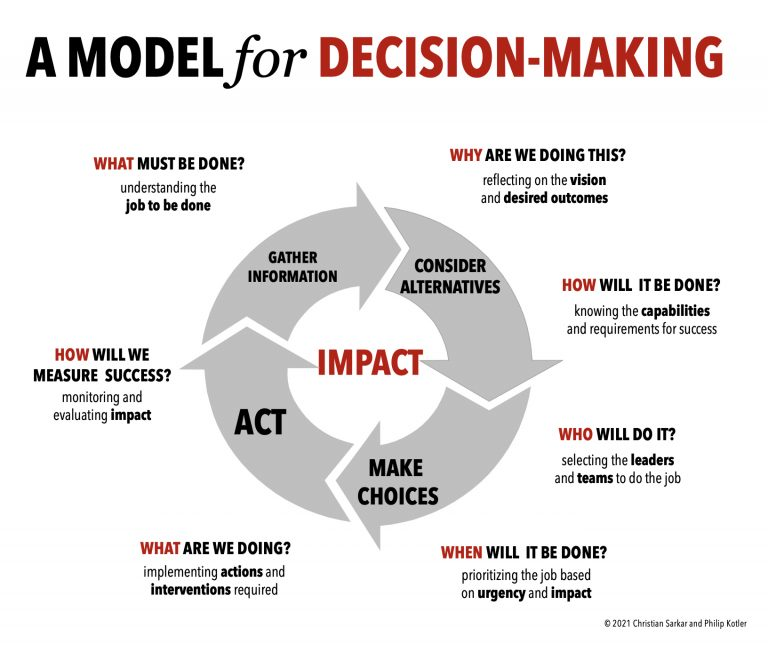
Good decisions involve more than selecting an option: they require framing the problem, gathering useful information, generating alternatives, weighing trade-offs, acting, and learning from results. Clarifying what is the decision being made helps match the approach to its reversibility, stakes, uncertainty, participants, and timing. Cognitive limits and competing values make perfect certainty impossible, so decision quality matters more than perfect outcomes.
You're staring at two job offers. One pays $20,000 more. The other offers better work-life balance, more interesting projects, and colleagues you'd enjoy. Your spreadsheet shows the higher salary wins, but your gut says take the other.
You've been thinking about this for days and still can't decide. Why is something that looks straightforward (compare options, pick best) so paralyzing in practice?
Or consider this: You spend 45 minutes researching which $15 phone case to buy, reading reviews, comparing features, analyzing photos. Later that day, you spend 5 minutes deciding whether to accept a new project that will consume 200 hours over the next three months.
Why do we struggle with small decisions while rushing through important ones?
These moments reveal something fundamental: decision making is hard, not because we lack intelligence, but because it involves navigating uncertainty, conflicting values, emotional factors, and cognitive limitations.
Understanding how decisions actually get made, not how they should be made in theory, but how humans actually process choices, helps you make better ones.
This guide introduces decision making fundamentals for people new to the topic. We'll explore what decisions actually involve, why they're difficult, how humans typically make them, common pitfalls, practical frameworks, and how to improve your decision quality over time.
The goal isn't to become perfectly rational, it's to make better decisions more consistently.
What Decision Making Actually Is
Decision making is the process of selecting between alternatives based on available information, your goals, and relevant constraints. It sounds simple: gather information, compare options, pick best. But each step involves substantial complexity.
"A decision is a judgment. It is a choice between alternatives. It is rarely a choice between right and wrong. It is at best a choice between 'almost right' and 'probably wrong.'" - Peter Drucker
The Core Components
Every decision involves these elements:
1. Problem Framing
- What decision are you actually making?
- Why does this decision need to be made?
- What constraints exist?
- What are you trying to optimize for?
2. Information Gathering
- What do you need to know?
- What information is available?
- What's missing?
- How reliable is your information?
3. Option Generation
- What are your choices?
- Are there alternatives you haven't considered?
- Can you combine or modify options?
4. Evaluation
- What are the likely outcomes of each option?
- What are the trade-offs?
- How certain or uncertain are these predictions?
- What are second-order effects?
5. Selection
- Which option best serves your goals given uncertainty and trade-offs?
- Can you commit despite not having perfect information?
6. Implementation
- How will you act on this decision?
- What resources are needed?
- What could go wrong during execution?
7. Learning
- What actually happened?
- Was your prediction accurate?
- What would you do differently next time?
Most people focus only on Step 5 (selection), but the other steps determine decision quality.
Types of Decisions
Not all decisions are equal. Different types require different approaches:
Reversible vs. Irreversible
- Reversible: Can be undone or changed (which restaurant for dinner, trying a new process at work)
- Irreversible: Cannot be undone (marriage, having children, selling your company)
- Why it matters: Reversible decisions deserve less agonizing, you can experiment. Irreversible decisions deserve careful analysis.
High-Stakes vs. Low-Stakes
- High-stakes: Significant consequences (career change, major purchase, health treatment)
- Low-stakes: Minimal consequences (which socks to wear, which route to take)
- Why it matters: High-stakes decisions justify time investment in analysis. Low-stakes don't: decide quickly and move on.
Decisions Under Certainty vs. Uncertainty
- Certainty: Outcomes are known or highly predictable
- Risk: Outcomes are probabilistic but probabilities are known
- Uncertainty: Outcomes and probabilities are unknown
- Why it matters: Approach changes dramatically. Under certainty, calculate optimal. Under uncertainty, build robustness and optionality.
Individual vs. Group Decisions
- Individual: You alone decide
- Group: Multiple stakeholders with different preferences
- Why it matters: Group decisions require coordination, compromise, and political navigation that individual decisions don't.
Immediate vs. Delayed Consequences
- Immediate: Outcomes apparent quickly (which movie to watch tonight)
- Delayed: Outcomes apparent much later (investing for retirement, choosing a college major)
- Why it matters: Delayed consequences are harder to predict and require different decision strategies.
Understanding which type of decision you're facing shapes how you should approach it. For a deeper look at navigating choices with incomplete information, see decision making under uncertainty.
Why Decision Making Is Hard
If decision making were simply "gather information and pick best option," it would be trivial. It's not. Here's why:
1. Uncertainty About Outcomes
Most decisions involve predicting the future, and predictions are often wrong. You can't know:
- How will this career change actually feel in two years?
- Will this investment appreciate or decline?
- Will this relationship work long-term?
- How will technology/markets/politics change?
You're making choices with incomplete, unreliable information about outcomes that won't be apparent until after you've committed.
Why it's hard: You have to decide without knowing what will actually happen. The "right" choice often only becomes clear in hindsight.
2. Competing Values and Trade-Offs
Most significant decisions don't have a clearly "best" option, they involve trade-offs between things you value:
- Money vs. time (higher-paying job with longer hours)
- Security vs. growth (stable job vs. risky startup)
- Short-term vs. long-term (enjoy now vs. invest for future)
- Individual vs. collective (what's best for you vs. what's best for your family/team)
Why it's hard: There's no objective way to weigh these values against each other. You have to make judgment calls about what matters more, and live with the trade-offs.
3. Information Overload
Modern life provides too much information, not too little:
- Dozens of reviews for every product
- Conflicting advice from different experts
- Endless research papers and articles
- Social media opinions from thousands of people
Why it's hard: More information doesn't automatically improve decisions, it creates paralysis, confusion, and cherry-picking bias. You have to filter signal from noise.
4. Emotional Factors
Emotions powerfully influence decisions, sometimes helpfully, sometimes harmfully:
- Fear prevents necessary risks
- Excitement causes impulsive choices
- Social pressure drives conformity over reason
- Sunk cost attachment makes you continue failing paths
- Loss aversion makes you irrationally cling to status quo
Why it's hard: You can't simply "be rational": emotions are part of decision making. The challenge is recognizing when they're providing useful signals vs. clouding judgment.
5. Cognitive Biases
Systematic thinking errors distort how you process information and evaluate options:
Confirmation bias: Seeking information that supports your preferred option while ignoring contradictions
Availability bias: Overweighting recent or vivid information
Anchoring: Over-relying on the first number or option you encounter
Status quo bias: Preferring current state even when alternatives are objectively better
Overconfidence: Overestimating the accuracy of your predictions
Hindsight bias: After outcomes, believing you "knew it all along"
Why it's hard: These biases are automatic, unconscious, and affect everyone (including highly intelligent people). You can't eliminate them, only recognize and compensate.
"The confidence people have in their beliefs is not a measure of the quality of evidence but of the coherence of the story that the mind has managed to construct." - Daniel Kahneman
6. Time Pressure
Many decisions must be made quickly:
- Market opportunities don't wait
- Crisis situations demand immediate response
- Other people's schedules create deadlines
Why it's hard: Time pressure forces decisions before you've gathered adequate information or fully evaluated options. You must decide with whatever understanding you have.
7. Complexity and Interdependence
Decisions rarely exist in isolation:
- One choice affects other choices
- Decisions have second-order and third-order consequences
- Systems are complex with feedback loops and emergent behavior
Why it's hard: You can't analyze decisions in isolation, you need to consider ripple effects, compounding consequences, and how different pieces interact. What is systems thinking explains the structural reasons why complex systems produce non-obvious consequences and provides tools for tracing them.
8. Accountability and Social Judgment
Decisions aren't just personal, others will judge them:
- Stakeholders affected by your choice
- Social pressure toward conformity
- Fear of criticism if you're wrong
- Status and reputation implications
Why it's hard: This creates defensiveness, choosing what's easy to justify rather than what you believe is best. It also causes risk aversion: avoiding decisions that might be criticized.
How Humans Actually Make Decisions
Ideally, decision making would be systematic: gather all information, analyze objectively, calculate optimal choice. Reality is messier. Humans use various strategies:
System 1 vs. System 2 Thinking
Psychologist Daniel Kahneman distinguishes (explored fully in his book Thinking, Fast and Slow):
System 1 (Fast Thinking):
- Automatic, effortless, unconscious
- Pattern recognition and intuition
- Quick judgments based on experience
- Emotionally driven
- Most daily decisions
System 2 (Slow Thinking):
- Deliberate, effortful, conscious
- Analytical and logical
- Systematic evaluation
- Emotionally regulated
- Important or complex decisions
The problem: System 1 runs by default because it's easier. System 2 requires deliberate activation, and we often don't bother, even for important decisions.
The pattern: Small decisions get System 2 (researching phone cases). Big decisions get System 1 (choosing job based on gut feeling). This is backwards.
Common Decision Strategies
1. Satisficing
- Don't find optimal, find "good enough"
- Set minimum criteria, pick first option meeting them
- Efficient but may miss better alternatives
2. Recognition Heuristic
- Choose familiar over unfamiliar
- "I've heard of brand A, not brand B, so choose A"
- Often works but vulnerable to marketing manipulation
3. Affect Heuristic
- How does this option make me feel?
- Positive feeling = good choice, negative feeling = bad choice
- Quick but emotionally driven
4. Social Proof
- Do what others do
- "This restaurant is crowded, so it must be good"
- Works when others have good information, fails when they don't
5. Authority Deference
- Trust expert recommendations
- Efficient when authority is legitimate and unbiased
- Problematic when authority is false or conflicted
6. Elimination by Aspects
- Set criteria, eliminate options failing each criterion
- Efficient for many options
- Can eliminate good options based on arbitrary order of criteria
7. Maximizing
- Exhaustively search for optimal
- Analyze every option thoroughly
- Produces good outcomes but causes analysis paralysis and dissatisfaction
None of these is always right or always wrong. Skilled decision makers match strategy to decision type.
The Role of Intuition
Intuition (rapid pattern recognition based on experience) gets a bad reputation as "irrational." But intuition is compressed expertise.
When intuition works:
- Experienced domains (doctor diagnosing conditions they've seen hundreds of times)
- Pattern-rich environments (chess master recognizing positions)
- Repetitive feedback (skills where you've learned what works)
When intuition fails:
- Novel situations (no relevant experience to draw from)
- Environments with misleading patterns (financial markets appearing predictable but actually random)
- Emotionally charged situations (fear/excitement overwhelming pattern recognition)
Good decision makers use intuition and analysis:
- Intuition to generate options and red flags
- Analysis to verify and refine
- Not intuition or analysis, both
Common Decision Making Mistakes
Even when trying to decide carefully, people make predictable errors. These are sometimes called common decision traps:
Mistake 1: Solving the Wrong Problem
The error: Answering a different question than the one you should be asking.
Example:
- Wrong question: "Should I take this job offer?"
- Right question: "What career trajectory do I want, and how does this role advance that?"
You can make a perfect decision about the wrong problem, and end up worse off.
How to avoid it: Before deciding, clearly articulate:
- What problem are you actually solving?
- Why does this decision need to be made?
- What would success look like?
Mistake 2: Limiting Your Options Prematurely
The error: Treating decisions as binary (yes/no, A or B) when more options exist.
Example:
- Binary framing: "Should I accept this job offer or stay in my current role?"
- Expanded options: Negotiate different terms, explore other opportunities, consider part-time consulting while looking, start your own thing, take a sabbatical, etc.
Most decisions aren't binary, you just haven't generated alternatives.
How to avoid it: Before evaluating options, explicitly brainstorm: "What else could I do? What options am I not seeing?"
Mistake 3: Overvaluing Sunk Costs
The error: Continuing paths because you've already invested time/money/effort, even when future prospects are poor.
Example:
- Staying in a failing relationship because "we've been together for five years"
- Continuing a doomed project because "we've already spent $500k"
Past investments are gone, they shouldn't influence future choices. Only future costs and benefits matter.
"The sunk cost fallacy is the general tendency for people to continue an endeavor once an investment has been made in money, effort, or time, even when abandoning it would lead to better outcomes." - Hal Arkes & Catherine Blumer
How to avoid it: Ask "If I were starting fresh today with no prior investment, would I choose this path?" If no, the sunk costs are clouding judgment.
Mistake 4: Analysis Paralysis
The error: Endlessly researching and analyzing without ever deciding.
Example:
- Spending weeks researching graduate programs without applying
- Reading reviews indefinitely without buying
- Discussing strategies without acting
Perfect information rarely exists. At some point, further research has diminishing returns.
How to avoid it: Set decision deadlines. Ask "What would I need to know to decide? Can I get that information? If not, what's my best judgment with available information?"
Mistake 5: Ignoring Base Rates
The error: Focusing on specific information about this case while ignoring general statistical patterns.
Example:
- Specific: "My startup idea is great, I'm passionate, and I'll work hard."
- Base rate: "90% of startups fail within 5 years."
- Error: Believing your case is special without evidence you're in the successful 10%
Starting with base rates (what usually happens) then adjusting based on specific information produces better predictions than ignoring statistical patterns.
How to avoid it: Ask "What typically happens in situations like this? What makes my case different from the typical pattern?"
Mistake 6: Not Considering Second-Order Effects
The error: Only thinking about immediate consequences without considering what happens next.
Example:
- First-order: "I'll work 80-hour weeks to get promoted faster."
- Second-order: "Burnout, health problems, relationship strain, reduced long-term productivity."
Many decisions look good at first-order but problematic at second-order and beyond. Second-order thinking is a full discipline for developing this skill, with concrete techniques for tracing consequences through complex systems.
How to avoid it: For important decisions, explicitly ask "And then what? What happens after that? What does this enable or prevent later?"
Mistake 7: Deciding Based on Justifiability Rather Than Quality
The error: Choosing what's easy to defend to others rather than what you believe is best.
Example:
- Hiring from a prestigious company because it's defensible ("They worked at Google!") rather than the candidate you think is actually best
- Choosing conventional strategy because if it fails you won't be blamed, rather than unconventional strategy you think has better odds
This is CYA decision making: optimizing for not being criticized rather than for outcomes.
How to avoid it: Distinguish "What can I justify?" from "What do I actually think is best?" If they diverge, ask whether justifiability concerns are legitimate or defensive.
Mistake 8: Not Deciding Is a Decision
The error: Treating inaction as avoiding a decision, when not choosing is itself a choice.
Example:
- Not deciding about investment is choosing to keep money in current allocation (which may be bad)
- Not deciding about career change is choosing to stay in current role
- Not deciding about relationship is choosing to continue current dynamic
Every day you don't decide, you're implicitly choosing the status quo.
How to avoid it: Recognize that inaction has consequences. Evaluate status quo as actively as you evaluate alternatives.
Practical Decision Making Frameworks
Frameworks don't replace judgment, but they provide systematic approaches to improve decision quality. For a broader toolkit, see decision frameworks used by high performers:
Framework 1: The 10/10/10 Rule
How it works: For any decision, ask:
- How will I feel about this 10 minutes from now?
- How will I feel about this 10 months from now?
- How will I feel about this 10 years from now?
Why it helps: Separates immediate emotional reactions from longer-term consequences. Often reveals that short-term discomfort leads to long-term benefit (or vice versa).
Example:
- Quitting job to start business:
- 10 minutes: Terrified
- 10 months: Either excited about progress or dealing with failure
- 10 years: Either grateful I tried or regretful I didn't
The 10-year lens clarifies what matters.
Framework 2: Pre-Mortem Analysis
How it works:
- Assume your decision fails spectacularly
- Work backward: Why did it fail?
- List all plausible failure modes
- Design to avoid or mitigate those failures
Why it helps: Easier to identify risks when assuming failure than when hoping for success. Overcomes optimism bias.
Example:
- Decision: Launch new product
- Pre-mortem: "It's now one year later and the product failed. Why?"
- No one wanted it (insufficient market research)
- Couldn't deliver on time (underestimated complexity)
- Competitors responded faster (didn't anticipate competitive response)
- Too expensive to build (poor cost estimation)
- Response: Address each failure mode before launching
Framework 3: Regret Minimization
How it works: Imagine yourself at age 80 looking back. Which choice would you regret less?
Why it helps: Long time horizon clarifies what truly matters. Temporary embarrassment, lost money, or effort often fade in importance compared to never trying.
Example (Jeff Bezos on starting Amazon):
"When I'm 80, I want to have minimized the number of regrets I have. I knew that when I was 80 I would never regret having tried this thing and failed. I would only regret not having tried." - Jeff Bezos
Best for: Big life decisions (career, relationships, major opportunities)
Framework 4: Expected Value Analysis
How it works:
- Identify possible outcomes
- Estimate probability of each
- Estimate value (benefit - cost) of each
- Calculate: Σ(Probability × Value)
- Compare expected values
Why it helps: Forces explicit consideration of probabilities and outcomes rather than gut feeling.
Example:
- Option A: Safe job, $100k salary, 100% probability = expected value $100k
- Option B: Risky startup, 10% chance $500k, 90% chance $50k = expected value (0.1 × $500k + 0.9 × $50k) = $95k
Expected value alone shouldn't decide, but it clarifies the trade-off between risk and reward.
Framework 5: Reversibility Filter
How it works:
- Is this decision reversible or irreversible?
- If reversible: Decide quickly, experiment, iterate
- If irreversible: Slow down, gather more information, analyze carefully
Why it helps: Prevents over-analyzing low-stakes decisions while ensuring sufficient analysis of high-stakes ones.
Example:
- Reversible: Trying new project management tool (can switch back)
- Decision strategy: Quick decision, try it, evaluate, adjust
- Irreversible: Selling your company (can't undo)
- Decision strategy: Thorough analysis, seeking multiple perspectives, considering long-term implications
Framework 6: Devil's Advocate
How it works:
- Identify your preferred option
- Deliberately argue against it
- Generate strongest possible case for alternatives
- Evaluate whether your preference survives scrutiny
Why it helps: Counteracts confirmation bias, forcing consideration of contradicting evidence and alternative views.
Example:
- You want to expand into new market
- Devil's advocate: "This is a mistake because: market is saturated, we lack expertise, it'll distract from core business, success cases aren't analogous to our situation, cost will exceed projections..."
- If your decision survives strong counter-arguments, confidence increases. If it doesn't, you've avoided a mistake.
Framework 7: Decision Journal
How it works:
- Before deciding, write:
- The decision
- Options considered
- Your reasoning
- What you predict will happen
- Your confidence level
- Months/years later, review:
- What actually happened
- Was prediction accurate?
- What did you learn?
Why it helps: Creates feedback loops. Most people never systematically learn from decisions because they don't track predictions vs. outcomes.
Example tracking:
- Decision: Hired candidate A over candidate B
- Reasoning: A had better technical skills, B had better cultural fit
- Prediction: A will perform well technically but may struggle with team dynamics
- 6 months later: A performing well technically but team friction emerging, prediction accurate. Lesson: Weight cultural fit higher next time.
How to Improve Your Decision Making
Decision making is a skill, it improves with deliberate practice. Building strong mental models is one of the highest-leverage investments you can make - for a beginner-friendly introduction to the most useful thinking frameworks, see mental models explained for beginners:
1. Match Decision Strategy to Decision Type
Stop treating all decisions the same:
- Low-stakes, reversible: Decide quickly, rely on intuition, experiment
- High-stakes, irreversible: Slow down, gather information, use systematic analysis
- Certain outcomes: Calculate optimal
- Uncertain outcomes: Build robustness and optionality
Practice: For each decision, explicitly categorize it before choosing how much time to invest.
2. Improve Problem Framing
Most decision quality comes from framing the right problem.
Techniques:
- Write down the decision you're making ("I am deciding whether to...")
- Ask "Why am I making this decision? What problem am I solving?"
- Reframe multiple ways, examine which framing reveals most insight
- Ask "What would need to be true for each option to be best?"
Example:
- Initial framing: "Should I accept this job offer?"
- Reframing: "What kind of work environment do I thrive in, and how well does this match?"
- Better framing enables better decisions
3. Generate More Options
Most people consider too few alternatives.
Techniques:
- Force yourself to generate 5 options minimum (even if some seem unrealistic)
- Ask "What else could I do?"
- Combine elements from different options
- Ask "If my preferred option were impossible, what would I do?"
- Seek outside perspectives (others see options you don't)
Practice: Before evaluating any options, spend 10 minutes brainstorming alternatives without judgment.
4. Separate Information Gathering from Decision
Information gathering should precede evaluation, not be biased by it.
Why this matters: If you gather information after forming a preference, confirmation bias leads you to seek supporting evidence and ignore contradictions.
Practice:
- Gather information about all options without deciding
- Only after information gathering, begin evaluation
- If new information emerges, suspend judgment again until gathered
5. Use Structured Evaluation
Instead of vague "this feels better," use systematic comparison:
Techniques:
- List criteria that matter (what would make an option good?)
- Weight criteria by importance
- Score each option on each criterion
- Calculate weighted scores
Example (job decision):
| Criterion (weight) | Job A | Job B |
|---|---|---|
| Learning (3x) | 7 | 9 |
| Compensation (2x) | 9 | 6 |
| Culture (3x) | 6 | 8 |
| Location (1x) | 8 | 7 |
| Weighted Total | 65 | 70 |
This doesn't make the decision for you, but it clarifies trade-offs and forces explicit consideration of what matters.
6. Consider Multiple Perspectives
Your perspective is limited, deliberately seek others:
Techniques:
- Ask people who've faced similar decisions
- Consult someone with relevant expertise
- Use "devil's advocate": argue against your preference
- Ask "What would [person you respect] do?"
- Seek perspectives from people with different backgrounds/values
Why it helps: Reveals blind spots, considerations you missed, and alternative framings.
7. Set Decision Deadlines
Without deadlines, decisions drift indefinitely.
Practice:
- Set explicit deadline for decision
- If deadline arrives and you're still uncertain, that's information, make your best judgment with available data
- Distinguish "I need more information" from "I'm avoiding discomfort of deciding"
Guideline: Time invested should match decision stakes. Don't spend weeks on trivial choices or minutes on life-altering ones.
8. Build Decision Review Habits
The only way to improve is learning from outcomes:
Practice:
- Keep a decision journal (predictions vs. outcomes)
- Quarterly review: What decisions did I make? What happened? What did I learn?
- Identify patterns: Which types of decisions do I handle well? Which do I struggle with?
- Update mental models based on what actually happens
Why it works: Most people never systematically learn from decisions because they don't track them. Deliberate review creates feedback loops.
9. Accept Good Process Over Perfect Outcomes
You can make good decisions that have bad outcomes due to luck/uncertainty.
Key insight: Evaluate decision quality based on process (given information available, was the reasoning sound?) not just outcome (did it work out?).
Why this matters: If you only judge by outcomes, bad luck teaches wrong lessons and good luck reinforces bad habits.
Example:
- You take calculated risk that has 70% success probability
- It fails (unlucky 30%)
- Wrong lesson: "I shouldn't have taken that risk" (outcome-based)
- Right lesson: "Was my probability estimate accurate? Would I make the same choice again with same information?" (process-based)
10. Reduce Decision Fatigue
Every decision depletes mental energy, conserve it for important choices.Decision fatigue is a real phenomenon with measurable effects on choice quality:
Strategies:
- Automate routine decisions (same breakfast, same work clothes, standard processes)
- Decide once for categories (always choose Option A for this type of situation)
- Make important decisions when fresh (morning, not after exhausting day)
- Eliminate trivial decisions (who cares which socks?)
Why it matters: Decision fatigue leads to worse choices or avoidance. Conserving mental energy for decisions that matter improves overall quality.
"The best decision makers are not the ones who make the most decisions, they are the ones who recognize which decisions deserve careful thought and which deserve little." - Annie Duke
Key Takeaways
What decision making involves:
- Problem framing (what are you actually deciding?)
- Information gathering (what do you need to know?)
- Option generation (what are your choices?)
- Evaluation (what are likely outcomes and trade-offs?)
- Selection (which option best serves your goals?)
- Implementation (how will you act on this?)
- Learning (what actually happened?)
Why it's difficult:
- Uncertainty about outcomes
- Competing values and trade-offs
- Information overload
- Emotional factors clouding judgment
- Cognitive biases distorting evaluation
- Time pressure forcing premature decisions
- Complexity and interdependence of consequences
- Social judgment and accountability pressures
How humans actually decide:
- System 1 (fast, intuitive, automatic) vs. System 2 (slow, analytical, deliberate)
- Common strategies: satisficing, recognition heuristics, social proof, authority deference
- Intuition works in experienced domains with clear feedback; fails in novel or misleading environments
- Most decisions use mixed approaches combining intuition and analysis
Common mistakes:
- Solving wrong problem (answering different question than you should)
- Limiting options prematurely (treating as binary when more exist)
- Overvaluing sunk costs (continuing because of past investment)
- Analysis paralysis (endlessly researching without deciding)
- Ignoring base rates (focusing on specific case, missing statistical patterns)
- Not considering second-order effects (only seeing immediate consequences)
- Deciding based on justifiability rather than quality (CYA decision making)
- Treating inaction as avoiding decision (not deciding is itself a choice)
Practical frameworks:
- 10/10/10 Rule - How will I feel in 10 minutes/months/years?
- Pre-Mortem - Assume failure, work backward to identify risks
- Regret Minimization - At age 80, which would I regret less?
- Expected Value - Probability × outcome for each option
- Reversibility Filter - Reversible? Decide fast. Irreversible? Analyze carefully.
- Devil's Advocate - Argue against your preference
- Decision Journal - Track predictions vs. outcomes to learn
How to improve:
- Match strategy to decision type
- Improve problem framing before evaluating options
- Generate more alternatives (force minimum 5)
- Separate information gathering from evaluation
- Use structured comparison (weighted criteria)
- Consider multiple perspectives
- Set decision deadlines
- Review outcomes to learn from experience
- Judge process quality, not just outcomes
- Reduce decision fatigue for important choices
Final Thoughts
Decision making isn't a talent you're born with or without, it's a skill that improves with understanding and practice. Nobody makes perfect decisions. Everyone faces uncertainty, makes mistakes, and experiences regret.
The goal isn't perfection, it's better decisions on average. This comes from:
- Understanding how decisions actually work (not idealized versions)
- Recognizing your own biases and limitations
- Using systematic approaches for important choices
- Learning from outcomes over time
Start simple:
For the next week, notice your decision process. Which decisions do you agonize over? Which do you rush through? Does the time investment match decision importance?
For one important upcoming decision, pick a framework from this guide and apply it deliberately. Notice what it reveals that you wouldn't have seen otherwise.
Start a decision journal, even for just one month. Write predictions, check outcomes, identify patterns.
Over time, these practices become habits. You'll still make mistakes, but fewer of them, and you'll learn from them faster.
The best decision makers aren't the smartest or most analytical, they're the ones who recognize decision quality comes from process, who match their approach to the decision type, and who systematically learn from both successes and failures.
That's what this guide is about: not becoming a perfect decision maker, but becoming a better one.
How Group and Organizational Decision Making Differs
Individual decision making is already difficult. When decisions move into organizations and groups, the complexity multiplies in ways that most frameworks for individual choice do not capture.
Why Groups Make Worse Decisions Than Their Best Members
Research by Irving Janis on groupthink documented how cohesive groups suppress dissent, overvalue consensus, and systematically ignore warning signals.
His analysis of the Bay of Pigs invasion planning showed that a group of highly intelligent Kennedy administration officials collectively made decisions that each member individually recognized as flawed, but social pressure toward unanimity overwhelmed individual judgment.
The symptoms Janis identified remain recognizable in organizations today: pressure on dissenters, self-censorship of doubts, illusions of unanimity, and collective rationalization.
A related phenomenon is diffusion of responsibility: in groups, each individual feels less personally accountable for outcomes, reducing the care and rigor with which they evaluate options. The person who would have scrutinized a decision carefully alone may defer when ten colleagues seem comfortable with it.
Organizational Incentives Distort Decisions
Individual decisions are distorted by cognitive biases. Organizational decisions are additionally distorted by incentive misalignment. Managers often make decisions that protect their careers, budgets, or department, rather than decisions optimal for the organization. This produces predictable patterns:
- Empire building: Decisions favor options that expand a manager's headcount or budget
- Risk aversion for careers, risk taking with other people's money: Managers avoid decisions that could be personally blamed if they fail; they're more willing to take risks when accountability is diffuse
- Short-termism: Annual performance reviews reward quarterly results, making managers discount long-term consequences
Charlie Munger's observation applies here directly: "Show me the incentive and I'll show you the outcome." Understanding the incentives facing decision-makers explains organizational choices that seem irrational when viewed purely through the lens of what's best for the organization.
The Role of Decision Rights
Organizational decision quality also depends on decision rights: who has authority to make what decisions. Organizations that push decision authority down to people with the most relevant information tend to make better tactical decisions.
Organizations that centralize authority at the top gain consistency but lose speed and local knowledge. The RACI model (Responsible, Accountable, Consulted, Informed) is one framework for clarifying who makes which decisions.
Amazon's well-known single-threaded ownership model assigns one person clear accountability for each major decision domain, eliminating the diffusion of responsibility that kills decisions in committee.
For individual decisions, the frameworks in this guide apply directly. For organizational decisions, the additional layer of incentives, social dynamics, and authority structures requires explicitly addressing who should decide and what motivates the people deciding.
The Science of Decision Quality: What Research Actually Shows
The study of decision making has produced a body of research substantial enough to separate folklore from evidence. Several findings are robust enough to anchor any practical approach.
Kahneman and Tversky's Foundational Work
Psychologists Daniel Kahneman and Amos Tversky spent decades documenting systematic deviations from rational choice.
Their 1974 paper "Judgment under Uncertainty: Heuristics and Biases" in Science established that humans use mental shortcuts (heuristics) that introduce predictable, systematic errors. This was not a claim about occasional mistakes but about structural features of human cognition.
Their prospect theory (1979) showed that people evaluate outcomes relative to a reference point, not in absolute terms, and that losses feel approximately twice as painful as equivalent gains feel pleasurable.
This loss aversion explains why people hold losing investments too long, why organizations cling to failing strategies, and why individuals resist necessary change: the pain of what will be lost outweighs the pleasure of what will be gained, even when the objective trade-off favors changing.
Philip Tetlock on Forecasting Accuracy
Philip Tetlock's 20-year study of expert political predictions, summarized in Superforecasting (2015), found that most experts performed barely better than random chance when forecasting complex events.
The study distinguished between "foxes" (people who draw on many ideas from many traditions) and "hedgehogs" (people with one big idea that explains everything). Foxes substantially outperformed hedgehogs at prediction.
The implication for decision making: calibrated uncertainty (knowing what you don't know and correctly assessing confidence levels) is more valuable than confident expertise. Decisions made with overconfident assumptions about outcomes are structurally weaker than decisions that explicitly account for the range of plausible futures.
Gary Klein on Naturalistic Decision Making
While Kahneman and Tversky studied error, Gary Klein studied expertise. His research on firefighters, military commanders, and intensive care nurses showed that experienced professionals in high-stakes domains rarely made decisions by comparing options analytically.
Instead, they used recognition-primed decision making: pattern recognition from experience generated a single candidate action, which they mentally simulated before acting. If the simulation revealed a problem, they generated a different action, but they rarely compared multiple options head to head.
Klein's finding challenges the assumption that better decisions always require more options and more analysis. For experienced practitioners in domains with good feedback, intuitive recognition often outperforms analytical comparison.
The skill is knowing which mode applies: recognition-based intuition for familiar problems in experienced domains; systematic analysis for novel situations or high-stakes irreversible choices.
How Real-World Decision Research Differs from Laboratory Findings
The dominant tradition in decision research emerged from laboratory experiments using hypothetical choices with small monetary amounts. These studies established fundamental findings-loss aversion, anchoring, the availability heuristic-that have replicated broadly.
But a growing body of research examines decision making in high-stakes real-world contexts, and some of its findings complicate the laboratory picture significantly.
The Sycophancy Problem in Organizational Decisions
In 2011, Olivier Sibony, Daniel Kahneman, and Dan Lovallo published research in the Harvard Business Review examining cognitive bias in strategic decisions at large corporations. Kahneman and Sibony (joined by legal scholar Cass Sunstein) later developed a related but distinct idea in their 2021 book Noise: A Flaw in Human Judgment: that a large source of decision error in organizations is not systematic bias in individual decision-makers but "noise"-random, unwanted variability in judgments across people, times, and frames.
The finding challenged the standard bias-reduction prescription. If you know that individuals are systematically biased toward overconfidence, the prescription is to correct for overconfidence.
But if different people in the same organization make radically different judgments about identical cases-one underwriter pricing a risk at $10,000 and another pricing the same risk at $25,000, for example-you cannot simply correct for a single bias. The variability itself is the problem.
Sibony, Kahneman, and Lovallo distinguished two types of error: bias (systematic directional distortion) and noise (unsystematic random variability).
Their subsequent book Noise: A Flaw in Human Judgment (2021) documented that noise is pervasive, underappreciated, and often larger in magnitude than bias in high-stakes professional decisions.
Forensic specialists disagreeing on whether fingerprints match. Doctors producing inconsistent diagnoses for the same symptoms. Judges imposing wildly different sentences for identical crimes.
Implication for decision improvement: Decision journals and structured evaluation frameworks-both discussed in this guide-address noise as much as bias. They do not just correct for systematic errors; they create consistency and reduce unsystematic variation.
The value of a structured decision process is not only that it helps you think more accurately but that it helps you think more consistently.
The Evidence on Decision Fatigue
The concept of decision fatigue appears frequently in popular discussions of decision making, typically citing a 2011 study by Jonathan Levav and Shai Danziger showing that Israeli parole board judges were more likely to grant parole in the morning and just after breaks, with approval rates dropping close to zero before each break.
The standard interpretation: mental depletion reduces willingness to make effortful decisions, causing judges to default to the easier "deny" option.
This study generated considerable attention and was widely cited as evidence for ego depletion-the idea that self-control and decision-making capacity draw on a limited resource that depletes with use.
However, a critical review of the evidence by Malte Friese and colleagues (2019), along with an earlier meta-analysis by Evan Carter and colleagues published in the Journal of Experimental Psychology: General, along with a large preregistered multi-lab replication effort, cast substantial doubt on the ego depletion effect more broadly.
Many replication attempts failed to reproduce the original finding, and the Danziger parole study has been reanalyzed with alternative explanations-including that hungry judges may simply be in worse moods rather than experiencing cognitive depletion.
Where does this leave the decision fatigue concept? The practical reality is more nuanced than early research suggested. Decision quality does not simply deplete like battery charge with each choice.
But there is real evidence that difficult decisions requiring conflict resolution are harder to make under time pressure, negative mood, or competing cognitive demands.
The actionable recommendation-make important decisions when rested, fed, and not under acute stress-remains valid even if the underlying mechanism is different from what early ego depletion research proposed.
Gerd Gigerenzer and the Case for Heuristics
While much decision research has focused on documenting the failures of heuristics, German psychologist Gerd Gigerenzer at the Max Planck Institute has led a sustained research program examining when heuristics outperform analytical methods.
His Adaptive Toolbox framework, developed across multiple books including Simple Heuristics That Make Us Smart (1999) and Gut Feelings (2007), argues that heuristics are not second-best approximations of rational calculation but ecologically adapted tools that fit the structure of specific environments.
His most striking demonstration involved portfolio selection. Gigerenzer and colleagues compared the out-of-sample performance of the simple heuristic "divide money equally across all available funds" (the 1/N rule) against fourteen sophisticated portfolio optimization models from modern finance theory.
Across seven different stock markets over periods ranging from 10 to 50 years, the naive equal-weighting heuristic matched or outperformed the sophisticated optimization models in out-of-sample tests.
The reason: complex optimization models require accurate estimates of means, variances, and covariances across assets. These parameters must be estimated from historical data, which introduces substantial estimation error. The simple heuristic avoids this estimation problem by ignoring the parameters entirely and just dividing equally.
In environments with high uncertainty about the future, ignoring irrelevant information is often smarter than trying to use it.
Gigerenzer's framework does not contradict the core finding that heuristics produce errors in certain contexts-that finding is robust.
His contribution is identifying the conditions under which each approach excels: analytical methods when parameters are known and stable; heuristics when parameters are uncertain and environments are changing.
This directly supports the "match strategy to decision type" principle in this guide, with empirical content about which types favor which approaches.
Case Studies in Consequential Decision Making
Abstract principles become concrete through examining real decisions with traceable outcomes. The following cases document how decision-making errors manifested in high-stakes organizational contexts.
NASA's Challenger Disaster and the Normalization of Deviance (1986)
On January 28, 1986, the Space Shuttle Challenger broke apart 73 seconds after launch, killing all seven crew members. The cause was failure of an O-ring seal in one of the solid rocket boosters in cold weather.
Engineers at Morton Thiokol, the booster manufacturer, had raised concerns about O-ring performance in cold temperatures the night before the launch. Those concerns were overruled.
The decision to launch has been analyzed extensively by sociologist Diane Vaughan in The Challenger Launch Decision (1996).
Vaughan introduced the concept of the normalization of deviance to describe what she found: over multiple flights, engineers and managers had observed small O-ring anomalies that should have been treated as warning signs but were instead categorized as acceptable within existing safety rules.
Each anomaly that did not cause disaster was reinterpreted as evidence that the risk was manageable.
The boundary between "acceptable risk" and "unacceptable risk" drifted incrementally over years, without anyone making a single conscious decision to accept greater danger.
By the night before the Challenger launch, the engineers arguing for delay faced the burden of proof: they had to prove beyond doubt that O-ring failure would occur, rather than managers having to prove that it was safe to launch. This framing reversed the appropriate default.
When you face genuine uncertainty about catastrophic risk, the precautionary principle-require evidence of safety before proceeding, not evidence of danger before stopping-is the appropriate standard.
Decision lesson: The Challenger case is the canonical example of sunk cost pressure, groupthink, and what this guide calls "deciding based on justifiability rather than quality" combining in a high-stakes organizational context.
Managers were under schedule pressure; the launch had already been delayed; political and financial pressures argued for proceeding.
The engineers' concerns were technically sound but organizationally difficult to act on. The structural conditions made the bad decision easier than the good one.
NASA implemented significant changes to decision culture and safety review processes following both Challenger (1986) and Columbia (2003). The post-Challenger changes were documented as substantially improving safety culture through the early 2000s.
Their gradual erosion contributed to the Columbia disaster seventeen years later-demonstrating that decision culture requires continuous maintenance rather than one-time reform.
Amazon's "Two-Pizza Teams" and Reversibility Architecture (2000s)
Jeff Bezos at Amazon developed several organizational practices explicitly designed to improve decision quality at scale. The most analytically significant for decision-making research is his distinction between "two-way door" and "one-way door" decisions, articulated in his 2015 shareholder letter.
Two-way door decisions (which Amazon calls Type 2) are reversible: if you make the wrong choice, you can go back through the door and try something else. These decisions should be made quickly, by the smallest competent group, with minimal analysis.
Spending significant time on reversible decisions is waste; the cost of being wrong is low, and speed enables learning.
One-way door decisions (Type 1) are irreversible or highly consequential: major capital commitments, acquisition decisions, fundamental changes to product direction. These decisions warrant deliberate analysis, multiple perspectives, and extended deliberation.
Bezos observed that large organizations tend to apply the heavy process appropriate for Type 1 decisions to most decisions, including Type 2 decisions where it is not needed. The result is organizational slowness without the quality benefits: companies move slowly on everything and still make poor decisions on the things that matter.
This framework directly operationalizes this guide's reversibility filter, and Amazon's documented growth suggests it functions effectively at organizational scale.
McKinsey & Company's research on organizational decision-making has repeatedly found that faster decision-making correlates with better financial outcomes: a later McKinsey survey found that executives at organizations reporting the fastest decision-making were roughly twice as likely to report high-performing financial returns as those at the slowest-deciding organizations.
Speed gains were most pronounced when companies applied selective rigor-moving faster on reversible decisions while maintaining deliberation on consequential ones-rather than applying uniform process regardless of decision type.
Sources & Further Reading
Kahneman, D. (2011). Thinking, Fast and Slow. Farrar, Straus and Giroux.
Kahneman, D., Lovallo, D., & Sibony, O. (2011). "Before You Make That Big Decision..." Harvard Business Review, 89(6), 50-60.
Klein, G. (2003). The Power of Intuition: How to Use Your Gut Feelings to Make Better Decisions at Work. Crown Business.
Russo, J. E., & Schoemaker, P. J. H. (2002). Winning Decisions: Getting It Right the First Time. Currency.
Hammond, J. S., Keeney, R. L., & Raiffa, H. (1999). Smart Choices: A Practical Guide to Making Better Decisions. Harvard Business School Press.
Suzy Welch (2009). 10-10-10: A Life-Transforming Idea. Scribner.
Heath, C., & Heath, D. (2013). Decisive: How to Make Better Choices in Life and Work. Crown Business.
Tetlock, P. E., & Gardner, D. (2015). "Superforecasting: The Art and Science of Prediction". Crown Publishers.
Gigerenzer, G. (2007). Gut Feelings: The Intelligence of the Unconscious. Viking.
Schwartz, B. (2004). "The Paradox of Choice: Why More Is Less". Ecco.
Simon, H. A. (1956). "Rational Choice and the Structure of the Environment." Psychological Review 63(2): 129-138.
Tversky, A., & Kahneman, D. (1974). "Judgment under Uncertainty: Heuristics and Biases." Science, 185(4157), 1124-1131.