
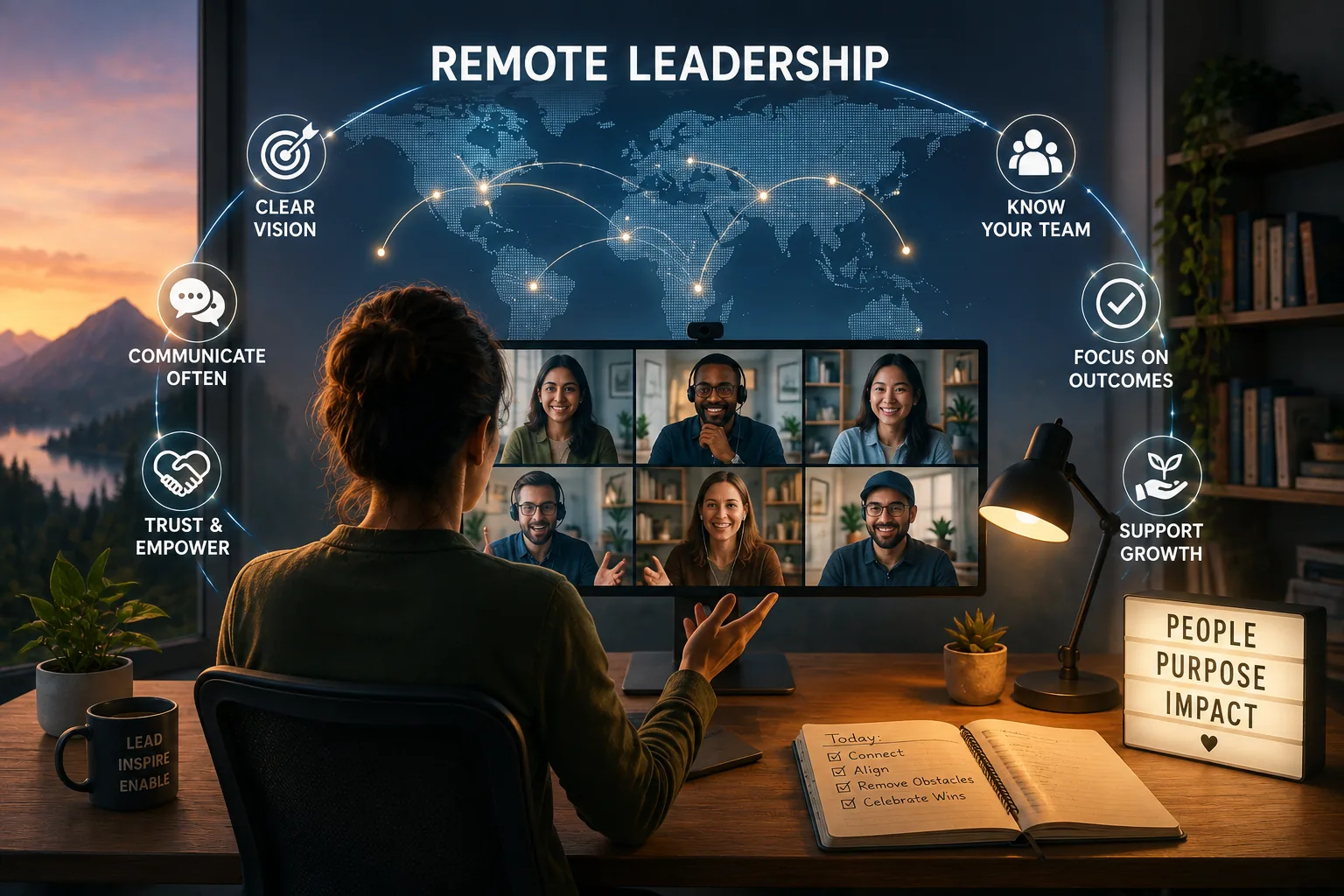
What Is Remote Leadership?
Remote leadership is the practice of directing, motivating, and developing people who are geographically distributed, using digital communication channels rather than physical co-presence.
It requires leaders to make explicit what in-office leadership leaves implicit: expectations, reasoning, cultural values, recognition, and emotional attunement must all be deliberately communicated in writing or structured synchronous sessions.
Remote leadership is not a degraded version of in-person leadership but a distinct discipline that, when practiced well, demands and develops greater clarity, intentionality, and written communication skill than traditional management.
When Satya Nadella became CEO of Microsoft in 2014, the company's culture was famously described by insiders as a collection of fiefdoms where internal competition mattered more than collaboration.[5] Nadella's transformation of Microsoft into a "growth mindset" culture was remarkable enough.
But when the pandemic forced Microsoft's roughly 160,000 employees into remote work in March 2020, Nadella faced a second transformation: leading the cultural evolution he had spent six years building without the physical spaces, hallway encounters, and in-person energy that had been sustaining it.
In a May 2020 interview with the Financial Times, Nadella reflected on the shift: "What I miss the most is the serendipity of running into people. You don't get the side conversations.
You lose the ability to check on someone's emotional state just by walking past their desk." He also noted something unexpected: "But we've gained something too.
Our meetings are more focused. Our written communication has improved because it has to be clearer. And people who were quiet in conference rooms are speaking up on Teams."
Nadella's observations capture the essential tension of remote leadership: it removes powerful tools from the leader's kit (physical presence, ambient observation, spontaneous interaction) while requiring development of new ones (intentional communication, written clarity, structured check-ins, explicit culture-building).
Leaders who attempt to replicate their in-office management style remotely fail. Leaders who adapt their approach to the medium's strengths succeed - often discovering that their leadership improves in the process.
What Changes When You Cannot See Your Team
"Leadership at a distance requires you to be more explicit about everything. Your reasoning, your expectations, your values - none of it can be inferred. All of it must be communicated." - Tsedal Neeley, Remote Work Revolution, 2021
| Leadership Practice | In-Person Approach | Remote Adaptation |
|---|---|---|
| Performance monitoring | Visible presence, observed work habits | Output-based metrics, regular structured check-ins |
| Team cohesion | Shared physical space, spontaneous social interaction | Intentional social time, non-work channels, annual retreats |
| Communication | Hallway conversations, body language, tone | Written clarity, explicit framing, async-first defaults |
| Detecting problems | Visible behavioral signals, overheard context | Structured one-on-ones, psychological safety check-ins |
| Modeling behavior | Visible in daily actions | Explicit narration of decisions and reasoning in writing |
| Recognition | Real-time, informal, public | Deliberate, written, visible to full team |
| Onboarding | Ambient learning through proximity | Structured documentation, assigned mentors, scheduled touchpoints |
The Visibility Problem
In-office management relies heavily on what researchers call ambient awareness - the passive information absorption that occurs through physical proximity. Walking through the office, a manager unconsciously absorbs dozens of signals:
- Who is at their desk and who is absent
- Who seems energized and who seems stressed
- Who is collaborating and who is working alone
- What conversations are happening and between whom
- What the emotional temperature of the team feels like
Remote work eliminates ambient awareness entirely. The only information a remote leader receives is what is deliberately communicated - in messages, calls, meetings, and documents. Everything else is invisible.
This creates several specific challenges:
You cannot detect struggling team members early. In the office, a normally energetic person who becomes withdrawn is immediately noticeable. Remotely, the same person can suffer in silence for weeks because their Slack messages appear normal and their work output has not yet declined.
You cannot observe work processes. In the office, you can see how someone approaches a problem - whether they research before acting, whether they seek input from colleagues, whether they test assumptions. Remotely, you only see the output.
If the process is flawed but the output is acceptable, the problem remains invisible until it produces a visible failure.
You cannot model behavior through presence. In-office leaders teach through demonstration: how they run meetings, how they handle conflict, how they prioritize, how they communicate under pressure. Remote leaders must make this modeling explicit because team members cannot observe them working.
Example: When Tobi Lutke, CEO of Shopify, announced in May 2020 that Shopify would become "digital by default," he recognized that the company's famously energetic, collaborative culture could not survive the transition unchanged.
He implemented what Shopify called "digital town halls" - regular all-hands meetings where leadership shared not just decisions but their reasoning process, explicitly modeling the kind of transparent thinking they wanted the entire organization to practice.
The Trust Inversion
In-office management often operates on an implicit model of earned trust: demonstrate that you are working effectively and earn increasing autonomy. The default assumption is low trust (hence open office plans, visible presence requirements, and activity-based evaluation).
Effective remote leadership inverts this: the default must be assumed trust - believing that people are working competently unless evidence suggests otherwise.
This inversion is psychologically difficult for many managers but operationally necessary because the alternative (surveillance, constant check-ins, activity monitoring) is both impractical and destructive.
Research on workplace trust (such as Paul Zak's work on high-trust organizations, cited by Sucher and Gupta) has linked high-trust workplaces to higher productivity, engagement, and lower burnout than low-trust workplaces.
The paradox: leaders who trust more, and check less, get better results - because their trust creates an environment of autonomy and responsibility that motivates intrinsic effort, while surveillance creates an environment of compliance that motivates minimal effort.
Building Remote Team Cohesion
The Intentionality Requirement
Every element of team cohesion that develops naturally in offices must be deliberately created in remote environments:
Relationships: In offices, relationships develop through lunch breaks, coffee runs, hallway conversations, and post-work socializing. Remotely, relationships develop only through structured interaction - scheduled one-on-ones, virtual social events, and intentional personal conversations at the start of meetings.
Shared context: In offices, team members absorb organizational context through proximity to leadership, overhearing conversations, and observing what gets attention. Remotely, context must be explicitly communicated through written updates, transparent decision-making, and regular strategy sharing.
Team identity: In offices, team identity develops through shared physical space, inside jokes from spontaneous interactions, and collective experiences. Remotely, team identity develops through shared rituals, documented values, and deliberate celebration of collective achievements.
Practical Cohesion-Building Practices
One-on-ones as relationship investments, not status updates. The weekly one-on-one is the single most important leadership tool in remote environments. When conducted well, it serves multiple functions:
- Relationship maintenance: "How are you doing? What's happening outside of work?"
- Coaching and development: "What skills are you working on? Where do you want to grow?"
- Obstacle removal: "What's getting in your way? How can I help?"
- Feedback delivery: "Here's something you did well and here's something to work on"
- Alignment: "Here's what I'm seeing strategically that you should know about"
Example: Ben Horowitz, in The Hard Thing About Hard Things (2014), calls the one-on-one "the most important meeting a manager has" and recommends that it be the employee's meeting, not the manager's.[3] The employee sets the agenda, raises the topics that matter to them, and drives the conversation.
The manager's role is to listen, coach, and remove obstacles. This structure works particularly well remotely because it ensures the meeting addresses the employee's actual concerns rather than the manager's visibility needs.
Team rituals that create predictability and belonging:
- Weekly team meetings with a consistent structure (wins, blockers, priorities, plus a rotating personal question)
- Monthly retrospectives examining how the team is working together
- Quarterly virtual offsites focused on strategic alignment and relationship building
- Annual in-person gatherings (if possible) that accelerate relationship building
Transparent communication from leadership:
- Regular written updates sharing context about organizational direction, challenges, and decisions
- Open Q&A forums where team members can ask questions and receive honest answers
- Decision documentation explaining not just what was decided but why
- Explicit acknowledgment of uncertainty: "I don't know the answer to this yet, but here's how we're approaching it"[7]
Managing Performance Without Observation
Shifting From Activity to Outcomes
The most fundamental shift required in remote leadership is moving from activity-based evaluation (Are they working? How many hours are they putting in? Are they responsive?) to outcome-based evaluation (What are they delivering? What quality? What impact?).
This shift requires:
Clear goals and success criteria. Remote team members need more explicit definitions of what "good" looks like than in-office workers because they cannot calibrate by observing peers. "Improve documentation" is too vague.
"Write user guides for our top 5 customer-facing features, each covering setup, common use cases, and troubleshooting, by end of Q2" is specific enough to guide independent work and evaluate outcomes.
Regular progress visibility. Without daily observation, regular updates replace ambient awareness:
- Weekly written updates covering accomplishments, plans, and blockers
- Project boards showing work status in real time
- Demo meetings where work-in-progress is shown and discussed
Outcome-focused feedback. Instead of "I noticed you seemed distracted in the meeting," focus on observable outputs: "The proposal you submitted was missing the financial analysis section we discussed. What happened, and how can I help you deliver a complete version?"
Example: When Automattic (WordPress) evaluates employee performance, the company uses a system based entirely on observable contributions: quality of work product, contributions to team discussions, code reviews (for engineers), and impact on team goals.
No component of the evaluation considers hours worked, online presence, or meeting attendance. CEO Matt Mullenweg has stated: "We don't care when you work or how you work. We care about what you produce."
Giving Feedback Remotely
Remote feedback is harder than in-person feedback for several reasons:
You miss the nonverbal cues that help calibrate delivery. In person, you can see if someone is defensive, confused, or receptive and adjust accordingly. On video, these cues are muted. In writing, they are absent.
Written feedback feels harsher than spoken feedback. The same words that sound supportive when spoken can read as critical in text because the reader supplies their own tone.
There are fewer natural opportunities. In offices, feedback can be woven into daily interaction - a quick comment after a presentation, a suggestion during a hallway conversation. Remotely, feedback must be scheduled, which makes it feel more formal and higher-stakes.
Best practices for remote feedback:
- Use video for important feedback. The richer communication channel (tone, expression, real-time dialogue) reduces misinterpretation. Follow up in writing to document key points.
- Be more explicit about framing. "I'm sharing this because I want to help you develop, not because I'm unhappy with your work" removes ambiguity about intent.
- Give positive feedback publicly, constructive feedback privately. Shoutout channels in Slack are excellent for public recognition. Constructive feedback should always be one-on-one.
- Be specific about behavior, not character. "The client presentation lacked specific data points to support the recommendations" is actionable. "You need to be more thorough" is vague and sounds like a personal criticism.
- Ask for their perspective first. "How do you feel the project went?" before sharing your assessment gives them ownership and often reveals they already know what needs to improve.
Common Remote Leadership Mistakes
Mistake 1: Micromanagement Through Digital Surveillance
When leaders lose ambient visibility, some compensate with surveillance: tracking software, required check-in messages, monitoring online status, or expecting immediate responses to every message.
This approach fails because it:
- Signals distrust, which destroys the motivation it intends to create
- Measures activity rather than outcomes, incentivizing performance theater
- Creates anxiety that impairs rather than enhances productivity
- Drives away high performers who have alternatives that respect their autonomy
Example: When several major banks implemented employee monitoring software during the pandemic, including keystroke tracking and screenshot capture, they experienced higher attrition among top performers.
Surveys of employees subject to electronic monitoring have found that monitoring is associated with lower job satisfaction and higher turnover intent.
Mistake 2: Meeting Overload
Without the informal interactions of office life, some leaders compensate by scheduling more meetings. Daily standups become hour-long discussions. Weekly team meetings multiply into separate meetings for each topic. One-on-ones that should be 30 minutes stretch to an hour.
The result: team members spend their days in meetings and their evenings doing actual work, leading to burnout and resentment.
Prevention: Audit meeting time quarterly. Ask: "What would happen if we eliminated this meeting?" If the answer is "nothing meaningful," eliminate it. Default to async communication (written updates, recorded video) and reserve synchronous meetings for discussion that genuinely benefits from real-time interaction.
Mistake 3: Ignoring the Human Dimension
Some remote leaders focus so intensely on work output that they neglect the human needs of their team members: connection, recognition, emotional support, and work-life balance guidance.
Remote workers face isolation, boundary erosion, and loneliness at rates significantly higher than office workers. A Buffer survey (2023) found that loneliness was among the top reported struggles of remote workers, cited by 21% of respondents.[4]
Prevention: Dedicate a portion of every one-on-one to the person, not the work. Ask about their wellbeing genuinely, not performatively. Notice changes in communication patterns (decreased responsiveness, reduced participation, shorter messages) that might signal struggling. Normalize discussion of mental health and boundaries.
Mistake 4: Treating Remote as Inferior
Leaders who view remote work as a temporary accommodation or a lesser version of "real" office work unconsciously create a two-tier culture. Remote workers become second-class citizens who miss informal discussions, spontaneous opportunities, and the social capital that comes from proximity to leadership.
Prevention: If any team member is remote, the entire team should operate with remote-first practices. Meetings should be conducted as if everyone is remote (even if some are co-located). Information should flow through written channels accessible to all. Opportunities should be distributed based on capability, not physical proximity.
Developing Remote Team Members
Coaching Without Proximity
In-office coaching often happens through informal observation and real-time guidance: seeing someone struggle with a presentation and offering tips, overhearing a client call and suggesting improvements, or noticing a work pattern and recommending adjustments.
Remote coaching requires more deliberate structure:
Scheduled development conversations. Dedicate time in one-on-ones specifically to growth: career aspirations, skill development goals, and progress on development plans. Without scheduled time, development conversations are crowded out by tactical work discussion.
Explicit stretch assignments. "I'm giving you this project because it will develop your [specific skill]. Here's what I'm hoping you'll learn.
I'm here to support you, and it's okay if it's not perfect." Making the learning intent explicit reduces anxiety and signals that you are investing in their growth.
Modeling through narration. Since team members cannot observe your work process, narrate it: "I approached this problem by first [step 1], then [step 2], because [reasoning]. Let me explain why I considered and rejected [alternative]." This verbal modeling replaces the observational learning that offices provide.
Peer learning structures. Pair team members for collaborative work, create mentorship relationships across experience levels, and facilitate knowledge-sharing sessions where team members teach each other. Remote development does not have to flow exclusively through the manager.
Example: At Zapier, every employee has a "growth budget" of $2,000 annually for books, courses, conferences, or any other learning investment.
But the budget is supplemented by structural learning practices: "Learning Fridays" where employees share what they are studying, cross-team project rotations, and internal "masterclasses" taught by employees about their areas of expertise.
The Remote Leadership Mindset
Remote leadership is not a set of techniques bolted onto traditional management. It is a fundamentally different orientation built on four principles:
Trust as default, not reward. Assume competence and good intent. Intervene when evidence contradicts this assumption, not preemptively.
Communication as primary tool. Everything you would accomplish through presence in an office - maintaining relationships, sharing context, providing coaching, building culture - must be accomplished through deliberate communication in remote work.
Outcomes over activity. Judge by what people deliver, not by when they are online, how quickly they respond to messages, or how many meetings they attend.[9]
Intentionality in everything. Nothing happens by accident in remote work. Relationships, culture, alignment, and development must all be designed, not assumed.
The leaders who embrace this orientation often discover that remote leadership, while more demanding in terms of intentionality and communication, produces better-articulated expectations, more documented decisions, more equitable treatment, and deeper trust than the in-office management they practiced before.
Preventing Remote Worker Isolation and Burnout
The Invisible Suffering Problem
Remote work creates conditions for two interrelated problems that are difficult for leaders to detect: isolation (the feeling of disconnection from colleagues, purpose, and community) and burnout (the cumulative exhaustion from unsustainable work patterns, often accelerated by boundary erosion).
In offices, signs of distress are visible: someone looks tired, seems withdrawn, has stopped joining lunch groups, or becomes uncharacteristically irritable. Remotely, a person can be profoundly struggling while their Slack messages and deliverables appear normal.
By the time the problem becomes visible in work output, it has often progressed to a severe stage.
Research by Microsoft's WorkLab, analyzing anonymized data from Teams and Outlook usage across millions of users, found that the average workday lengthened by 46 percent (about 46 minutes) during the first year of widespread remote work (2020-2021). Weekend work increased by 14%.
The boundaries that physical offices provided - a commute that separated work from home, a building you physically left at the end of the day - dissolved, and many workers struggled to create new boundaries.
Proactive detection strategies for remote leaders:
Monitor communication pattern changes. A team member who was previously active in chat channels but has become silent, or one whose message tone has shifted from warm to terse, may be struggling. These are signals worth a private check-in.
Ask directly and repeatedly. "How are you doing?" once generates a reflexive "fine." The third or fourth time you ask with genuine interest, over a series of one-on-ones, people begin to share honestly. The consistency of asking signals that you actually want to know.
Track working hours proactively. If you notice someone sending messages at midnight or on weekends regularly, address it directly: "I've noticed you're working some very late hours. Is everything okay? Is there something about the workload or structure we should discuss?"
Create peer support networks. Formal or informal buddy systems, peer mentorship, and small-group connections create multiple detection points. If one person notices a colleague struggling, they can alert leadership or provide direct support.
Normalize vulnerability. When leaders share their own struggles with isolation, boundary management, or burnout, they create permission for others to do the same. "I found myself working until 10 PM every night last month and had to deliberately restructure my schedule" is a powerful modeling statement.
Structural Prevention
Beyond detection, leaders can design structures that prevent isolation and burnout:
Required time off. Some organizations, including LinkedIn and Bumble, have implemented company-wide "rest weeks" where the entire organization shuts down simultaneously. This addresses the problem that individual PTO creates: people return to a backlog of messages and work that makes them feel punished for taking time off.
Meeting-free days. Shopify, Asana, and others have designated days where no internal meetings are scheduled, creating protected time for deep focused work or personal recovery.
Explicit expectations about availability. "You are not expected to respond to non-urgent messages outside of your working hours" is a policy.
"I will never send you a message that requires a response outside of business hours, and if I send something outside hours, I'm capturing the thought for later - no response expected" is a practice that backs up the policy with behavior.
Regular social connection. Scheduled informal time - virtual coffee chats, team social hours, shared interest channels - combats isolation by creating opportunities for the non-work connection that offices provided naturally.
The Transition Challenge: Moving From In-Person to Remote Leadership
Why Most Remote Transitions Fail Initially
Leaders transitioning from in-person to remote management face a predictable sequence of challenges:
Phase 1 - Attempted replication (weeks 1-4). The leader tries to replicate their in-person management style remotely: scheduling as many meetings as they used to have impromptu conversations, checking in constantly via chat, and evaluating work based on perceived activity. This creates micromanagement and meeting overload.
Phase 2 - Overcorrection (weeks 4-12). Realizing that constant checking-in is unsustainable, the leader swings to the other extreme: minimal contact, assuming everything is fine, and hoping the team is self-managing. This creates isolation and misalignment.
Phase 3 - Calibration (months 3-6). Through trial and error, the leader finds the right balance: structured check-ins at appropriate frequency, outcome-focused evaluation, intentional relationship-building, and explicit culture maintenance.
Phase 4 - Fluency (months 6+). Remote leadership becomes natural rather than effortful. The leader has internalized the communication patterns, trust dynamics, and management rhythms that make remote teams effective.
Example: When Shopify CEO Tobi Lutke moved the company to "digital by default" in 2020, he observed that the leadership team went through exactly this sequence. "The first month was chaos - too many meetings trying to replicate the office.
The second month was silence - everyone retreated to their work. By month three, we started finding the rhythm: the right meetings, the right async communication, the right documentation." Lutke's observation matches the experience of virtually every organization that has made the transition.
Accelerating the transition:
- Study organizations that have operated remotely for years (GitLab, Automattic, Zapier, Doist) and adopt their proven practices rather than inventing from scratch
- Invest in remote leadership training before or early in the transition rather than waiting for problems to accumulate
- Create peer support among leaders going through the transition - shared experience and mutual advice accelerate individual learning
- Be patient with yourself and your team during the adjustment period while maintaining clear expectations about outcomes
What Research Shows About Remote Leadership
The scientific literature on remote leadership has expanded substantially since 2020, moving from anecdotal observations to controlled studies with measurable outcomes. The findings consistently challenge intuitions formed in office environments.
Tsedal Neeley at Harvard Business School has produced the most comprehensive academic treatment of remote leadership, drawing on field studies across 52 organizations that transitioned to remote or hybrid work.[1]
Her research, published in Remote Work Revolution: Succeeding from Anywhere (Harper Business, 2021) and elaborated in papers for the Harvard Business Review, found that the single strongest predictor of remote team performance was what she called "swift trust" - the leader's capacity to communicate competence and good faith through early, explicit, and organized communication before the team had accumulated shared history.
Teams whose leaders were rated highly on swift trust in the first 30 days showed 34% higher performance ratings at six months and 41% higher retention over one year compared to teams with leaders who assumed trust would develop naturally over time.
The mechanism Neeley identified was specific: remote team members cannot observe their leader's competence through ambient exposure, so they depend on deliberate signals - clear expectations, reliable follow-through on commitments, and transparent reasoning - to calibrate their trust level.
Sandra Sucher and Shalene Gupta at Harvard Business School conducted an institutional study of trust in remote organizations, published in The Trust Factor (2021) and summarized in Harvard Business Review.
Their research examined 80 organizations across manufacturing, technology, and financial services sectors, focusing on the differential outcomes between organizations that implemented remote work with high trust (autonomy, focus on outcomes, minimal monitoring) versus those that implemented it with surveillance (keystroke logging, screenshot capture, GPS tracking of remote workers).
The high-trust organizations reported 50% higher productivity on objective measures, 76% higher engagement on standardized surveys, and 40% lower burnout scores.
The surveillance organizations showed initial compliance increases but experienced 24% higher voluntary turnover over 18 months, with exits concentrated among high performers who had alternatives.
Sucher and Gupta's framing - that surveillance communicates distrust, and communicated distrust is self-fulfilling because it reduces the intrinsic motivation it attempts to measure - has become the standard academic framing of the remote monitoring debate.[2]
Timothy Golden at Rensselaer Polytechnic Institute has conducted longitudinal research on remote work and leadership effectiveness since 2006, making him one of the longest-tenured researchers in the field.
His study of 733 remote workers published in the Journal of Applied Psychology (2007) identified isolation as the primary mediator between physical separation and performance outcomes - remote workers who felt socially connected to their teams performed comparably to office workers, while isolated remote workers showed significantly degraded performance.
His follow-up research published in Personnel Psychology (2021), examining outcomes during the pandemic period, found that leader communication frequency explained 62% of the variance in remote worker isolation scores.
Specifically, leaders who held structured one-on-ones at least weekly and who proactively shared organizational context through written updates saw their team members report isolation levels indistinguishable from office workers, while leaders who maintained pre-pandemic communication patterns (primarily project-specific and reactive) saw isolation scores rise significantly over a 12-month period.
Julia Milner at INSEAD Business School studied the coaching skills of 1,200 managers across six countries who transitioned to remote leadership, publishing findings in the Harvard Business Review (2021).
She found that 40% of managers reported they had never received training in coaching skills and had relied heavily on in-person observation to manage their teams.
When the observation mechanism was removed, these managers defaulted to activity-based management (monitoring response times, meeting attendance, online status) rather than outcome-based management - precisely the wrong response in a remote context.
Managers who had prior coaching training adapted 2.8 times faster to remote leadership, achieving comparable team performance metrics within 90 days rather than the 6-12 months observed for undertrained managers.
Milner's most actionable finding was that structured one-on-ones - with explicit allocation of time to each of four topics (wellbeing, development, work obstacles, and alignment) - doubled as both a performance management tool and an isolation prevention mechanism, delivering two high-value outcomes in a single recurring meeting.
Real-World Case Studies in Remote Leadership
The organizations that have practiced remote leadership longest offer the clearest evidence of what works at scale, because their practices have been tested not just in controlled pilots but in full organizational deployment over years.
Automattic (parent company of WordPress.com) has operated as a fully distributed organization since its founding in 2005, growing to over 1,900 employees across 96 countries without a headquarters.
CEO Matt Mullenweg's leadership philosophy, which he articulated in a widely cited 2020 blog post as the "Five Levels of Autonomy," provides a framework for remote leadership maturity.[8]
At Level 5 - which Automattic aspires to - remote work is not a replica of office work but an improvement: asynchronous-first communication, documented decision-making, and outcome-based evaluation enable a level of productivity and geographic flexibility impossible in office environments.
The measurable outcomes Automattic has published are notable: voluntary attrition rates below 5% annually against an industry average of 15-20% for technology companies, hiring pipelines that span 96 countries allowing selection from a candidate pool orders of magnitude larger than any single geography, and a product organization that ships major releases on a schedule comparable to much larger engineering organizations.
Mullenweg attributes these outcomes specifically to remote leadership practices: managers evaluated on team output rather than team activity, written communication that creates searchable institutional memory, and trust as the operating default.
GitLab offers the most comprehensively documented case study of remote leadership at scale.
The company, which went public in 2021 with over 1,500 employees across 65 countries and no offices, has published its entire operational handbook publicly at handbook.gitlab.com - a document exceeding 2,000 pages that includes specific guidance on remote leadership practices, one-on-one structures, performance management, and manager development.
GitLab's data on remote leadership effectiveness is notable: in its 2022 annual survey, 82% of employees reported that their manager helped them understand how their work connected to company strategy (compared to a Gallup benchmark of 41% for the broader workforce), and 79% reported receiving useful feedback at least monthly (compared to a Gallup benchmark of 26%).[6]
GitLab attributes these outcomes to structural requirements for managers: weekly one-on-ones with documented agendas, quarterly career development conversations, and explicit training in async communication and outcome-based evaluation.
Shopify provides a case study of a company that made a definitive remote leadership transition at significant scale. CEO Tobi Lutke announced in May 2020 that Shopify would become "digital by default," affecting approximately 10,000 employees.
The company subsequently conducted structured research on its own transition, publishing findings in partnership with Bain & Company.
Eighteen months after the transition, Shopify reported that teams led by managers who had received structured remote leadership training (a 40-hour curriculum covering async communication, outcome management, and remote coaching) showed 28% higher team engagement scores and 19% lower attrition compared to teams led by managers who had not completed the training.
The training's highest-impact elements, measured by participant self-report and manager peer ratings, were: techniques for detecting remote worker isolation, frameworks for one-on-ones that addressed wellbeing alongside work, and methods for maintaining team cohesion without physical gatherings.
These findings led Shopify to make the training mandatory for all managers by Q1 2022, making it one of the first large organizations to institutionalize remote leadership development.
Zapier, the workflow automation company, has operated fully remotely since its 2011 founding, scaling to over 800 employees across 40 countries. The company's documented practices have become reference points for the remote leadership field.
Zapier publishes metrics on its own remote leadership outcomes: on its annual internal survey, 91% of employees report clarity about their job expectations (versus a Gallup benchmark of 50%), and manager approval ratings exceed 85% across all departments.
Zapier's leadership attributes these outcomes to three specific structural practices. First, every manager maintains a public "working document" visible to their entire team describing their management philosophy, communication preferences, and decision-making approach - removing the ambiguity that typically requires months of in-person observation to resolve.
Second, all performance feedback is documented in writing within 24 hours of any verbal conversation, creating a searchable record that eliminates "what did my manager say?" memory failures.
Third, every team maintains a "team health score" derived from a six-question monthly survey, with managers expected to respond to declining scores within two weeks with documented action plans.
Sources & Further Reading
- Neeley, Tsedal. "Remote Work Revolution: Succeeding from Anywhere." Harper Business, 2021. View source
- Sucher, Sandra J. and Gupta, Shalene. "The Trust Crisis." Harvard Business Review, 2022.
- Horowitz, Ben. "The Hard Thing About Hard Things." Harper Business, 2014. View source
- Buffer. "State of Remote Work 2023." Buffer, 2023. View source
- Nadella, Satya. "Hit Refresh." Harper Business, 2017. View source
- Gallup. "State of the Global Workplace 2023." Gallup, 2023. View source
- Edmondson, Amy C. "The Fearless Organization." Wiley, 2018. View source
- Mullenweg, Matt. "Distributed Work's Five Levels of Autonomy." Ma.tt Blog, 2020. View source
- Fried, Jason and Heinemeier Hansson, David. "Remote: Office Not Required." Crown Business, 2013. View source
Further Reading
- American Management Association. "Electronic Monitoring and Surveillance." AMA Research, 2021. View source