
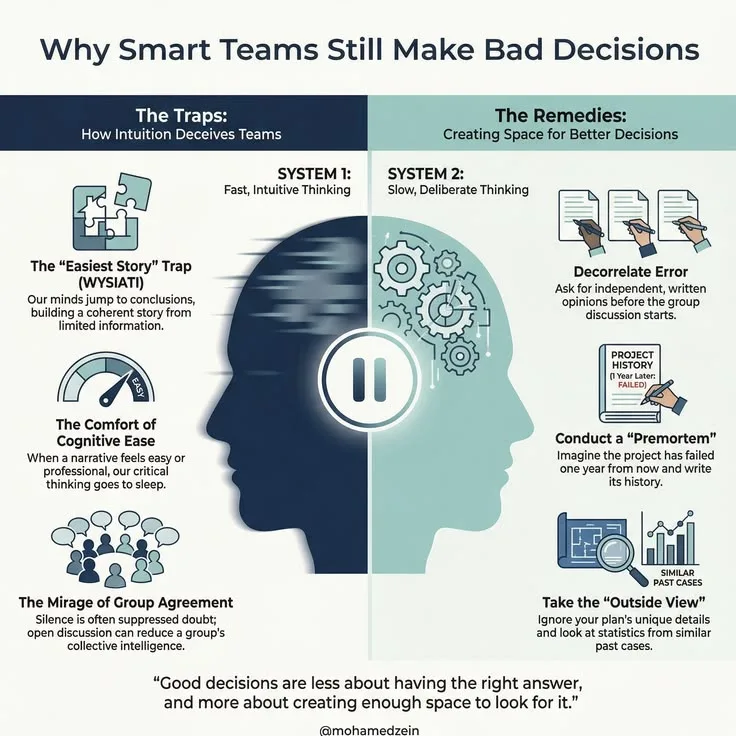
More people can mean more expertise, but a team decision can still be distorted by shared assumptions, hidden information, competing priorities, and status differences. Groups often discuss what everyone already knows while failing to surface unique evidence or dissent. Choosing an appropriate method, clarifying authority, and creating conditions where disagreement is safe can make collective judgment more reliable.
In 2000, Blockbuster's leadership was offered the chance to acquire a scrappy DVD-by-mail startup called Netflix for $50 million. The board declined. At the time, the decision seemed reasonable - Blockbuster had 9,000 stores, $6 billion in annual revenue, and dominated the video rental industry.
Netflix was a small, unprofitable startup with only a few hundred thousand subscribers. By 2010, Blockbuster filed for bankruptcy. By 2023, Netflix was worth over $150 billion.
The Blockbuster board was not populated by incompetent people. The directors included experienced executives from major corporations. They had access to market data, competitive analysis, and strategic advisors. The failure was not individual - it was collective.
The group's decision-making process filtered out dissenting perspectives, overweighted current market position, underweighted disruptive trends, and produced a consensus that felt reasonable in the moment but proved catastrophically wrong.
This is the fundamental paradox of team decision-making: groups have access to more information, more perspectives, and more analytical capacity than individuals. Yet group decisions are frequently worse than what the best individual in the group would have decided alone.
The science of team decision-making explains why this paradox exists and how to resolve it.
Why Group Decisions Are Harder Than Individual Ones
"Groups make better decisions than individuals when they share unique information. They make worse decisions than individuals when they share only common knowledge and suppress dissent." - Garold Stasser, 1985
| Decision Method | Best For | Risk | Required Conditions |
|---|---|---|---|
| Consensus | High-stakes decisions requiring full buy-in | Slowness, pressure toward false agreement, groupthink | Psychologically safe environment, time available |
| Majority vote | Choosing among well-defined options when speed matters | Minority dissent, reduced commitment from losing side | Clear options, roughly equal information distribution |
| Consultative decision | Most operational decisions - leader decides after input | Appearance of consultation without genuine influence | Leader willing to revise, clear communication of process |
| Delegated decision | Decisions within an individual expertise and accountability | Lack of visibility, inconsistency with team direction | Clear authority assignment, transparent criteria |
| Expert decision | Decisions requiring specialized knowledge others lack | Expertise bias, neglect of non-expert perspectives | Identified expert, defined domain boundary |
The Coordination Problem
Individual decisions involve one person evaluating options against their own preferences and priorities.
Group decisions involve multiple people who must first coordinate on what the problem is, then share information about the options, then reconcile different priorities, and finally commit to a course of action that not everyone fully agrees with.
Each of these coordination steps introduces friction:
Problem definition varies: Different team members may understand the problem differently based on their role, experience, and perspective.
The marketing director sees a "positioning problem" while the engineering director sees a "product quality problem" and the finance director sees a "cost structure problem." They may all be looking at the same situation but framing it through different lenses.
Information is distributed unevenly: Each person knows things others do not. Research by Garold Stasser and William Titus (1985) demonstrated that groups spend most of their discussion time on information that everyone already knows (shared information) rather than surfacing information that only one member possesses (unique information).
This means the primary advantage of group decisions - aggregating diverse knowledge - is systematically underutilized.
Example: In Stasser and Titus's experiment, three-person groups were given information about political candidates.[2] Some information was shared by all members; some was unique to individual members. When all information was considered, Candidate A was clearly superior.
But because groups overwhelmingly discussed shared information, they chose the superior Candidate A only about 18% of the time. When all members had all information (no unique knowledge), they chose the superior Candidate A about 83% of the time. The group decision process actually destroyed information rather than aggregating it.
Priorities conflict: Different stakeholders optimize for different outcomes. Sales wants to close the deal; Legal wants to minimize risk; Engineering wants technical elegance; Finance wants cost efficiency.
These are not wrong priorities - they are legitimately different perspectives that must be reconciled, and reconciliation requires time, negotiation, and compromise.
Commitment mechanisms differ: Some people commit easily and change their minds later. Others commit slowly but once committed are immovable. Groups with mixed commitment styles generate friction as fast committers grow frustrated with slow ones, and slow committers feel pressured by fast ones.
The Power Dynamics Problem
Group decisions are not made in a power vacuum. Organizational hierarchy, social status, expertise reputation, and interpersonal dynamics all influence whose voice carries weight and whose is marginalized.
HiPPO effect (Highest-Paid Person's Opinion): When the most senior person in the room speaks first, their perspective anchors the discussion and discourages dissent.
Research by Elizabeth Morrison at New York University found that employees who disagreed with their manager's stated position were 61% less likely to voice their disagreement than when disagreeing with a peer.[8]
Confidence bias: People who express opinions with greater confidence are more persuasive regardless of the accuracy of their views. Research by Don Moore at UC Berkeley found that overconfident speakers were perceived as more competent and more credible, even when their actual accuracy was no better than that of less confident speakers.
Gender and racial dynamics: Extensive research documents that women's contributions to group discussions are interrupted more frequently, attributed to them less often, and weighted less heavily than men's contributions with equivalent content.
Similar patterns exist along racial lines, particularly in majority-group-dominated contexts.
Example: When the Columbia shuttle investigation board examined NASA's decision to launch despite concerns about foam strikes, they found that junior engineers who had identified the risk were effectively silenced by senior managers who expressed confidence that the foam strike was not a safety concern.
The engineers had the expertise and the data. The managers had the authority and the confidence. Authority and confidence won, and seven astronauts died.
Decision-Making Frameworks That Work
Matching Framework to Situation
Not every decision requires the same process. The appropriate framework depends on the stakes, urgency, expertise distribution, and need for buy-in:
Autocratic (leader decides): Appropriate when speed is critical, the leader has the necessary expertise, and buy-in is not essential for implementation. Emergency responses, time-sensitive operational decisions, and technical choices within a leader's domain.
When it fails: When the leader lacks relevant expertise, when implementation requires willing participation, or when the decision has broad organizational impact.
Consultative (leader decides after gathering input): The most common and often most effective framework. The decision-maker solicits perspectives from relevant stakeholders, considers their input genuinely, then decides and explains the rationale.
Example: When Spotify CEO Daniel Ek decided to launch Spotify in the U.S. market in 2011, he consulted extensively with the music industry, technology advisors, legal counsel, and regional market experts. He gathered diverse perspectives, weighed them against Spotify's strategic objectives, and made the decision.
Stakeholders who disagreed with the decision understood that their input was genuinely considered, which maintained trust even when they did not get their preferred outcome.
When it fails: When the decision-maker seeks input performatively without genuine consideration, when stakeholders discover their input was ignored, or when the consultation process becomes so extensive that it delays action indefinitely.
Consensus (everyone agrees): Appropriate for foundational decisions that require universal buy-in - team values, working norms, or major strategic shifts that everyone must implement wholeheartedly.
When it fails: When the group is large (consensus becomes impractical beyond 6-8 people), when the decision is time-sensitive, or when seeking consensus produces watered-down compromise rather than bold action.
Consent (no one objects): A faster variant of consensus. Someone proposes a decision; team members can ask clarifying questions and raise objections; if no principled objection exists ("I believe this will cause harm" or "I have evidence this will fail"), the decision proceeds.
Example: Sociocracy and Holacracy governance models use consent-based decision-making extensively. At Zappos, which adopted Holacracy in 2013, decisions were made through consent: proposals were adopted unless a team member could articulate a specific, principled objection.
This enabled faster decisions than consensus while still protecting against clearly problematic choices.
Democratic (majority vote): Simple and clear but appropriate mainly for low-stakes decisions where all opinions have roughly equal validity. Choosing a team lunch venue, selecting a meeting time, or picking between comparable options.
When it fails: When the minority has critical information or expertise that the majority lacks, when the decision creates clear winners and losers, or when implementation requires more than 50% of the team's commitment.
Delegated (expert decides): Appropriate when one person has significantly more relevant expertise or context than others. The team delegates authority to the expert, who decides within defined boundaries.
When it fails: When the "expert" lacks perspective on dimensions outside their expertise, when the decision has implications beyond the delegated domain, or when the team does not trust the delegate's judgment.
The RAPID Framework
Bain & Company's RAPID framework clarifies decision roles to prevent the ambiguity that derails group decisions:[4]
- R - Recommend: Who proposes the decision? This person does the analysis, considers options, and presents a recommendation.
- A - Agree: Who must agree before the decision can proceed? These are people with formal approval authority or veto power. Keep this group small.
- P - Perform: Who implements the decision? These people need to be consulted so they understand the decision and can implement it effectively.
- I - Input: Who provides relevant information and perspective? These people are consulted for expertise but do not have decision authority.
- D - Decide: Who makes the final call? One person, not a committee. Clear single ownership prevents the "everyone and no one decides" problem.
Example: When Google reorganized under the Alphabet holding company in 2015, the RAPID framework would describe the roles as: Sundar Pichai (Recommend - proposed the restructuring), Larry Page and Sergey Brin (Decide - final authority), the board of directors (Agree - formal approval), CFO Ruth Porat (Input - financial implications), and the executive team (Perform - implementing the reorganization across business units).
Avoiding Groupthink: The Primary Threat to Group Decision Quality
How Groupthink Develops
Irving Janis coined the term "groupthink" in 1972, defining it as a mode of thinking where the desire for unanimity overrides realistic appraisal of alternatives.[1] Groupthink occurs when:
- The group is highly cohesive (strong bonds, shared identity)
- The group is insulated from outside opinions
- A directive leader expresses a preference early
- No systematic procedure for evaluating alternatives exists
- The group faces external pressure (time constraints, competitive threat)
Under these conditions, the group develops shared illusions:
- Illusion of invulnerability: Excessive optimism that discounts risk
- Collective rationalization: Dismissing information that contradicts the emerging consensus
- Belief in inherent morality: Assuming the group's decisions are ethical without examination
- Stereotyping outsiders: Dismissing critics as uninformed or hostile
- Self-censorship: Members withhold doubts to maintain group harmony
- Illusion of unanimity: Silence is interpreted as agreement
- Mind guards: Members protect the group from information that might challenge consensus
Example: The 2003 decision to invade Iraq illustrates nearly every groupthink mechanism.
The administration's inner circle was highly cohesive, insulated from dissenting intelligence analysis, led by a president who had expressed clear preference for action, operating without systematic evaluation of alternatives (the State Department's dissenting analysis was marginalized), and facing external pressure from post-9/11 political dynamics.
Dissenting voices (Army Chief of Staff Eric Shinseki, who warned that troop levels were insufficient) were publicly rebuffed rather than seriously engaged.
Structural Countermeasures
Pre-mortem analysis: Gary Klein's technique, described in a 2007 Harvard Business Review article, asks the team to imagine that the decision has been implemented and has failed spectacularly.[3] Each member independently writes down reasons for the failure.
This surfaces concerns that might not emerge through direct dissent because the framing normalizes criticism.
Example: When Amazon's product teams conduct pre-mortems before major launches, they have surfaced issues ranging from customer adoption barriers to infrastructure scaling concerns that standard planning processes missed.
The technique works because it transforms criticism from "I don't think this will work" (which feels adversarial) to "Here's a way it could fail" (which feels collaborative and constructive).
Designated dissent: Assign a rotating "red team" role where one or two members are explicitly tasked with arguing against the proposed decision. Because the role is assigned and rotated, it is not associated with any individual's personality or agenda.
Outside perspectives: Invite someone outside the group - a different team, an external advisor, a customer - to challenge the group's assumptions. Outsiders lack the social pressure to conform and bring different information.
Anonymous input: When power dynamics or social pressure might suppress dissent, collect input anonymously before discussion. Written submissions, anonymous surveys, or blind voting surface concerns that face-to-face dynamics might suppress.
Sequential rather than simultaneous input: Have each member share their perspective before discussion begins, preventing anchoring on the first speaker's view. This can be done in writing (each person writes their position before the meeting) or verbally (round-robin format with the most junior members speaking first).
Decision-Making in Remote and Async Environments
The Async Decision Advantage
Remote teams often make better decisions than co-located teams for a counterintuitive reason: the constraints of asynchronous communication force practices that in-person groups should adopt but rarely do.
Written proposals require clarity: When you must write a proposal rather than pitch it verbally, you are forced to think more carefully about your logic, consider objections, and present information completely. The proposal document becomes a shared reference that everyone evaluates from the same information base.
Async feedback enables thoughtful input: Unlike live meetings where fast talkers dominate and introverts defer, async feedback processes give everyone equal time to read, think, and respond.
Research on brainstorming consistently shows that individual idea generation followed by group discussion produces more and better ideas than traditional group brainstorming.
Documentation is built into the process: In async decision-making, the proposal, the feedback, and the decision are all written - creating a permanent record that eliminates "What did we decide?" confusion later.
Async Decision Process
Written proposal: One person writes a comprehensive document describing the problem, proposed solution, alternatives considered, expected outcomes, and rationale.
Structured feedback period: The proposal is shared with a clear deadline for feedback (e.g., "Feedback requested by Friday"). Feedback is structured: specific questions to answer, format for objections, mechanism for suggesting alternatives.
Discussion (sync or async): If feedback reveals significant disagreement or complexity, a synchronous meeting resolves the remaining issues. If feedback is aligned, proceed directly to decision.
Clear decision communication: Document the decision, who made it, the rationale, what alternatives were considered, and what implications follow. Share across relevant channels.
Implementation assignment: Specify who is responsible for what, with clear timelines and accountability.
Example: Basecamp's product development process uses what they call "pitches" - written proposals of 2-8 pages that describe a problem and proposed solution.[10] The pitch is reviewed asynchronously by a small leadership team. Feedback is provided in writing.
Decisions about which pitches to pursue for the next 6-week cycle are made in a single meeting, with all relevant context already digested in advance.
This process produces higher-quality decisions with less meeting time than traditional planning processes because the writing forces clarity and the async review enables thoughtful evaluation.
Timezone-Fair Decision Practices
When teams span time zones, decision-making must accommodate:
Sufficient async windows: Allow enough time for people in all time zones to review proposals and provide input before decisions are finalized. A proposal shared Monday at 9 AM Pacific with a Friday decision deadline gives everyone at least 3 business days in their local time.
Rotating meeting times: When synchronous decision meetings are necessary, rotate times so no single time zone always bears the burden of inconvenient hours.
Explicit decision timelines: "We'll decide X on Y date. Input is requested by Z date. If you have concerns you need to raise, here's the channel and format." Clear timelines prevent both premature decisions (people still processing) and indefinite delays (waiting for input that never comes).
Implementation: From Decision to Action
Why Good Decisions Fail in Execution
A study by McKinsey & Company found that only 28% of executives rate their organization's decision-making quality as "good" - but when asked about decision implementation, the number drops to 12%.[6] The bottleneck is not making decisions but executing them.
Common implementation failures:
Unclear ownership: "The team decided" means no individual feels personally responsible. Clear ownership - "Sarah is responsible for implementing X by Y date" - creates accountability.
Insufficient communication: People affected by the decision do not know about it, do not understand it, or do not know what it means for their work. A decision without communication is not a decision - it is a thought.
Incentive misalignment: The decision requires behavior change, but incentives still reward the old behavior. Deciding to "focus on quality" while measuring teams exclusively on speed creates contradiction.
No follow-up: Decisions are made and immediately forgotten as the next urgent issue demands attention. Without scheduled follow-up, decisions drift into "good intentions."
Ensuring Implementation
Assign a single owner for each decision's implementation. Not a committee - one person who is accountable for making it happen.
Communicate the decision to everyone affected: what was decided, why, what it means for their work, and what they should do differently.
Break the decision into concrete actions with deadlines. "Improve documentation" is an aspiration. "Complete API reference guide by March 15; update onboarding guide by March 30; establish documentation review cadence by April 15" is a plan.
Schedule follow-up checkpoints to verify that the decision is being implemented and producing expected results. "We'll review progress in two weeks" creates accountability and enables course correction.
Measure results against expected outcomes. If the decision was supposed to reduce customer complaints by 20%, track whether it does. If results do not materialize, the decision may need revision - but only data-informed revision, not relitigating based on opinion.
Building a Decision-Making Culture
The quality of any single decision matters less than the quality of the organization's decision-making system - the repeated patterns, habits, and norms that produce decisions day after day.
Decide who decides: Before any discussion, clarify: Is this person's decision, the team's decision, or the leader's decision? Is this consensus, consultative, or delegated? Answering this question upfront prevents the frustration of discovering mid-discussion that people have different assumptions about the process.
Normalize dissent: Create explicit cultural permission for disagreement. "I see this differently" should be as natural and welcomed as "I agree." Reward people who surface uncomfortable truths, not just those who support prevailing opinions.
Learn from decisions: Conduct post-decision reviews for significant choices. What went well? What would we do differently? What did we learn about our decision-making process? These reviews build organizational decision-making capability over time.
Accept imperfect decisions: Perfect information and perfect analysis are impossible. The goal is not optimal decisions but good-enough decisions made with appropriate speed and information.
As Jeff Bezos wrote in his 2015 Amazon shareholder letter: "Most decisions should probably be made with somewhere around 70% of the information you wish you had.[9] If you wait for 90%, in most cases, you're probably being slow."
Treat decisions as experiments: When possible, frame decisions as hypotheses to be tested rather than permanent commitments.
"We'll try this approach for 90 days and reassess based on these metrics" creates space for learning and reduces the stakes of any individual decision, making better decisions more likely because the pressure to be right is reduced.
The organizations that make consistently good decisions are not those with the smartest individuals. They are those with decision-making systems that effectively aggregate diverse perspectives, protect against groupthink, ensure clear ownership, and learn from outcomes.
Building that system is itself one of the most important decisions any team or organization can make.
What Research Shows About Team Decision Making
The academic literature on group decision-making consistently reveals a troubling pattern: groups have greater information aggregation capacity than individuals but systematically fail to use it, and the failure modes are predictable and structurally addressable.
Garold Stasser and William Titus at Miami University conducted the foundational research on information sharing in groups, published in Journal of Personality and Social Psychology (1985).
Their "hidden profile" experimental paradigm demonstrated that groups spend disproportionate time discussing information that all members already share and insufficient time surfacing information that only one or two members possess - even when the unique information is necessary for making the correct decision.
In their experiments, groups given "hidden profiles" (distributed information that, when combined, clearly identifies the correct choice) chose the correct option only 18% of the time when members discussed freely, compared to 83% of the time when all members had all information.
This finding - that group discussion systematically degrades information aggregation rather than improving it - has been replicated across dozens of studies and domains.
Irving Janis at Yale University developed the groupthink concept through analysis of major U.S. foreign policy failures, published in Victims of Groupthink (1972) and revised in Groupthink (1982).
Janis examined the Bay of Pigs invasion, the Korean War escalation, the failure to prepare for Pearl Harbor, and the escalation in Vietnam, finding consistent structural patterns across all cases.
His most important methodological contribution was the contrast cases: he also analyzed the Cuban Missile Crisis (1962) and the Marshall Plan (1947) as cases where high-cohesion groups made successful decisions.
The contrast revealed that the critical difference was not group cohesion per se but whether the group had structural mechanisms that legitimized dissent - deliberate procedures for seeking outside expertise, explicit assignment of devil's advocate roles, and leaders who withheld their own preferences until late in deliberations.
Daniel Kahneman, Dan Lovallo, and Olivier Sibony (Harvard Business Review, 2011) analyzed 1,048 major business investment decisions in their survey-based study.[5]
They found that the quality of the decision-making process was six times more important than the quality of the analytical content in predicting decision outcomes.
Specifically, they found that process elements - explicitly considering alternatives, gathering outside perspectives, and formally accounting for bias - predicted decision quality far better than analytical sophistication or executive experience.
This finding is particularly striking given that analytical quality is the focus of most management education and that process quality is rarely taught or evaluated.
Philip Tetlock and Barbara Mellers at the University of Pennsylvania, leading the Good Judgment Project (2011-2015), found that team forecasting accuracy significantly outperformed individual forecasting when teams used specific structured approaches: sharing unique information before discussing shared information, rotating devil's advocate assignments, and explicitly aggregating probability estimates rather than seeking verbal consensus.
Teams using these structured approaches outperformed unstructured teams by 23% in prediction accuracy - a substantial effect in a domain where expert individuals barely outperform random baselines.
The research provides some of the strongest evidence available that the failure of group decision-making is structural and correctable, not inevitable.
Real-World Case Studies in Team Decision Making
Blockbuster vs. Netflix (2000): The Blockbuster board's decision not to acquire Netflix is documented in multiple sources including Gina Keating'sNetflixed (2012) and former Netflix CEO Marc Randolph'sThat Will Never Work (2019).
The board's decision-making process exhibited several documented failures of group decision-making.
First, the shared information problem: board members discussed Blockbuster's current market position (shared information, known to all) at length while inadequately surfacing the unique information held by technology-oriented board members about broadband adoption trajectories and the economics of digital distribution.
Second, the anchoring effect: the discussion was anchored to the comparison of Netflix's current size (a small, unprofitable startup with a few hundred thousand subscribers) to Blockbuster's ($6 billion in annual revenue and 9,000 stores), rather than to the trajectory of each business model.
Third, the HiPPO effect: CEO John Antioco's skepticism about digital threats had been expressed publicly, creating social pressure that made dissenting views harder to voice.
The result was a consensus that felt analytically sound but was missing the unique information and alternative scenarios that would have revealed the correct decision.
NASA's Columbia Launch Decision (2003): The Columbia investigation produced the most detailed documentation of groupthink in a technical organization.
The Columbia Accident Investigation Board, chaired by Admiral Harold Gehman Jr., documented that NASA's decision-making culture had developed several classic groupthink characteristics: an illusion of invulnerability (86 successful missions had normalized risk-taking), collective rationalization (each anomaly was reclassified as acceptable rather than investigated).
Self-censorship (the foam strike was seen as a maintenance issue rather than a safety issue by mid-level managers), and an illusion of unanimity (dissenting engineers' concerns were filtered before reaching senior decision-makers).
The CAIB report recommended structural changes specifically designed to counter groupthink: independent safety oversight with direct access to mission leadership, required devil's advocate review for launch decisions, and explicit dissent documentation requirements.
The Cuban Missile Crisis Decision-Making (1962): Robert F. Kennedy's memoir Thirteen Days (1969) and historical research by James Blight and David Welch (On the Brink, 1989) document the decision-making process that Janis identified as a successful high-stakes group decision.
President Kennedy's Executive Committee (ExComm) implemented several structural anti-groupthink measures: Kennedy frequently absented himself from discussions to prevent his presence from anchoring the group, the group split into subgroups to independently develop options before reconvening.
Outside perspectives were solicited from Dean Acheson (former Secretary of State) and other non-participants, and multiple specific alternatives (air strike, naval blockade, diplomatic solution, invasion) were developed in parallel rather than a single option being advocated and defended.
Historians credit the structural decision-making process - not just the participants' intelligence or Kennedy's leadership - with producing the outcome that avoided nuclear conflict.
Amazon's "Working Backwards" Decision Process: Amazon's product development decision-making, documented by former executives Colin Bryar and Bill Carr in Working Backwards (2021), implements several research-validated structural countermeasures to group decision-making failures.
The "six-page narrative" requirement forces the recommending team to surface unique information in writing before discussion, preventing the Stasser-Titus hidden information problem.
The requirement that meeting participants read the memo in silence before discussion prevents anchoring on the presenter's verbal framing.
The practice of listing the top three "tenets" (non-negotiable principles) for a decision forces explicit statement of what the group is not willing to trade away, creating principled grounds for objection that go beyond opinion.
Amazon's documented product launch success rate - approximately 30% of new products achieving their stated business goals in the first 18 months - while lower than internal optimism would predict, substantially exceeds the industry norm of 5-10% for comparable innovation initiatives.
Evidence-Based Approaches: What Improves Group Decision Quality
Research on group decision-making interventions offers some of the most precisely validated evidence in organizational psychology, because the dependent variable (decision quality) can be measured objectively.
What works: Eliciting unique information before group discussion. The Stasser-Titus research program's most actionable finding is that structured pre-discussion information elicitation dramatically improves group decisions.
Specifically, requiring each participant to write down their unique information (information they believe the group may not know) before discussion begins, and having this information read aloud in round-robin format before open discussion, increases the probability that the group will surface and use unique information.
Research by Winquist and Larson (Organizational Behavior and Human Decision Processes, 1998) examined whether prompting groups to share information improves hidden-profile decisions, with mixed results.
The mechanism is straightforward: once information is on the table, it influences discussion; the challenge is getting it on the table before anchoring suppresses it.
What works: Separating option generation from option evaluation. Research on decision quality by Paul Nutt at Ohio State University (Why Decisions Fail, 2002), examining 400 strategic decisions made by major corporations, found that decisions where multiple alternatives were developed and evaluated in parallel had significantly better outcomes than decisions where a single option was proposed and accepted or rejected.
Specifically, single-option decisions failed (produced outcomes rated as failures by participants 5 years later) at a rate of 52%, while multiple-option decisions failed at a rate of 29%.
Nutt found that most organizations considered only a single option 71% of the time, making this failure mode extremely common despite its clear corrective.
What fails: Consensus seeking for complex decisions. Research by Cass Sunstein and Reid Hastie (Wiser, 2015) analyzed group decision-making across multiple experimental and field studies.[7]
They found that consensus processes are consistently dominated by shared information (already known to all members), by the most vocal participants, and by the desire to maintain group cohesion - all of which reduce the value added by having a group rather than an individual decide.
Consensus works well for simple value trade-offs where all perspectives deserve equal weight (choosing a team meeting time) but poorly for complex analytical decisions where some perspectives have more relevant information than others.
The alternative - structured aggregation of individual judgments with explicit weighting of expertise - consistently outperforms consensus for analytical decisions.
What fails: Post-hoc rationalization reviews. Research by Gerald Whyte at the University of Toronto (Organizational Behavior and Human Decision Processes, 1991) examined "decision reviews" conducted after major organizational choices.
The research found that reviews conducted without structured procedure consistently produced escalation of commitment rather than objective evaluation, participants marshaled evidence supporting the decision that had been made rather than genuinely evaluating whether it should be reversed.
The mechanism is motivated reasoning: once a decision is made, all subsequent "review" is filtered through the motivation to be consistent with the prior commitment.
The practical implication is that decision reviews must be explicitly structured to overcome this motivation: requiring participants to begin by listing evidence against the decision, not evidence for it.
Sources & Further Reading
- Janis, Irving. "Groupthink: Psychological Studies of Policy Decisions and Fiascoes." Houghton Mifflin, 1982. View source
- Stasser, Garold and Titus, William. "Pooling of Unshared Information in Group Decision Making." Journal of Personality and Social Psychology, 1985. View source
- Klein, Gary. "Performing a Project Premortem." Harvard Business Review, 2007. View source
- Bain & Company. "RAPID: Bain's Tool to Clarify Decision Accountability." Bain Insights, 2011. View source
- Kahneman, Daniel, Lovallo, Dan, and Sibony, Olivier. "Before You Make That Big Decision." Harvard Business Review, 2011.
- McKinsey & Company. "Decision Making in the Age of Urgency." McKinsey Global Survey, 2019.
- Sunstein, Cass R. and Hastie, Reid. "Wiser: Getting Beyond Groupthink to Make Groups Smarter." Harvard Business Review Press, 2015. View source
- Morrison, Elizabeth W. "Employee Voice and Silence." Annual Review of Organizational Psychology, 2014. View source
- Bezos, Jeff. "2015 Amazon Shareholder Letter." Amazon, 2016.
- Fried, Jason. "Shape Up: Stop Running in Circles and Ship Work that Matters." Basecamp, 2019. View source