
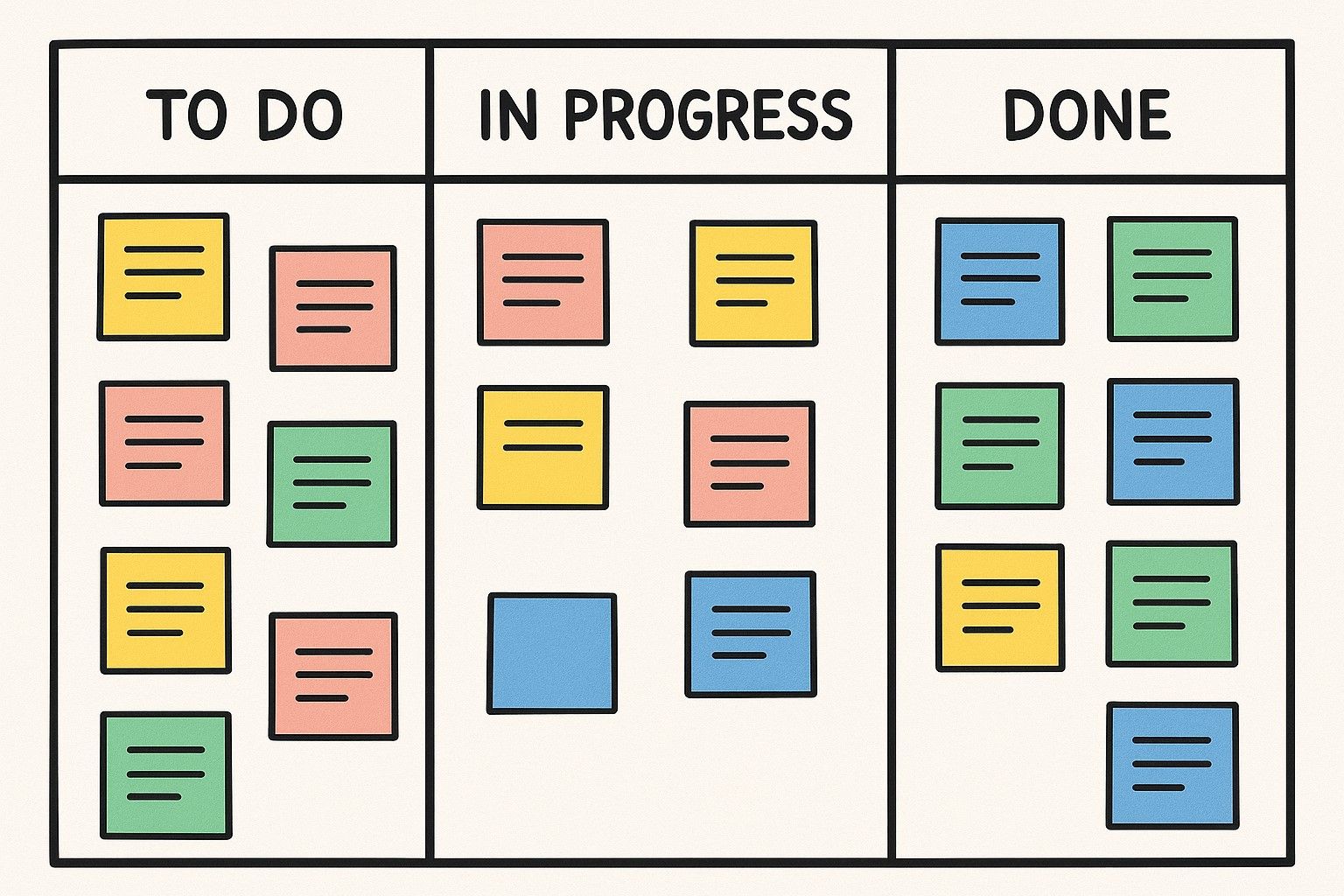
What is kanban? It is a visual workflow method adapted from Toyota's pull-based production system for manufacturing and later knowledge work. Cards move through stages on a board, but the defining practice is limiting work in progress. By responding to actual demand rather than pushing large batches forward, Kanban exposes bottlenecks, reduces queues and inventory, surfaces defects sooner, and improves flow.
Walk into almost any software company's engineering floor and you will likely find a wall, physical or digital, covered in columns and cards.
Chances are high that what you are looking at is a Kanban board: a simple, visual representation of work in progress that has become one of the most widely adopted workflow management tools in the world.
Kanban is not a project management framework invented by a consulting firm in the 2000s. It is a method with industrial manufacturing roots dating to postwar Japan, adapted and refined over decades for knowledge work.
Understanding where it came from, how it works mechanically, and why its core principle of limiting work in progress is counterintuitively effective can fundamentally change how you manage both team and personal workflow.
Origins: Toyota's Production System
The word kanban (看板) is Japanese and translates roughly to "signboard" or "visual card." The method was developed by industrial engineer Taiichi Ohno at Toyota in the late 1940s as part of the broader Toyota Production System (TPS), which would later become the foundation of Lean manufacturing.
Ohno was studying American supermarkets, which restocked shelves based on actual customer demand rather than production forecasts. When a shelf space emptied, that visual signal triggered a replenishment order. The system was self-regulating: restocking was pulled by real consumption rather than pushed by predictions.
Toyota applied this logic to manufacturing. When a production stage needed more parts from the upstream stage, a physical kanban card was passed back to trigger supply. Nothing was produced until the downstream signal arrived.
This pull system was the opposite of the prevailing push approach, in which production ran at maximum throughput and sent inventory downstream regardless of whether it was needed.
The result was dramatically lower inventory, fewer quality defects (because problems surfaced quickly rather than being buried in large batches), and faster overall throughput. Ohno himself later wrote:
"The two pillars of the Toyota production system are just-in-time and automation with a human touch, or autonomation. The tool used to operate the system is kanban."
- Taiichi Ohno, Toyota Production System: Beyond Large-Scale Production (1978)
Toyota's success with the method was so striking that it became a foundational case study in operations management worldwide.
By the 1970s and 1980s, Western manufacturers were traveling to Japan to observe and adapt the techniques, a pilgrimage that produced the broader Lean movement that now shapes manufacturing, healthcare, software, and services industries globally.
David Anderson adapted these principles for software development around 2007, publishing the foundational text Kanban: Successful Evolutionary Change for Your Technology Business in 2010. The modern knowledge-work Kanban method is his adaptation, though it draws heavily on Ohno's original principles and W.
Edwards Deming's systems thinking. Anderson's insight was that software development, despite its apparent differences from automobile manufacturing, shared the same fundamental challenge: work items queue up, wait, and move through stages, and the queuing behavior could be managed using the same principles Toyota had proven in steel and rubber.
The Scale of Kanban Adoption
The reach of Kanban in modern organizations is substantial. The State of Agile Report (2023), published annually by Digital.ai and one of the most comprehensive surveys of agile practice, found that 56 percent of respondents used Kanban in some form, making it the second-most-common agile method behind Scrum.
More significantly, Kanban was the dominant method for teams doing continuous delivery, operational support, and maintenance work, categories that represent a large portion of all knowledge work globally.
A 2022 survey by the Project Management Institute (PMI) found that organizations using hybrid approaches (combining elements of Kanban with structured project methods) reported higher rates of meeting original goals (72 percent) than those using purely predictive (traditional) approaches (54 percent).
The implication is that Kanban's core ideas, visual management, flow optimization, and explicit capacity limits, deliver measurable value when applied thoughtfully.
The Kanban Board: Core Structure
A Kanban board is divided into columns that represent stages in a workflow. Work items, typically represented as cards with a brief description, owner, and any relevant details, move from left to right through the columns as work progresses.
A minimal board for a software team might have five columns:
| Column | Meaning |
|---|---|
| Backlog | Work identified but not yet started |
| Ready | Prioritized and ready to be picked up |
| In Progress | Actively being worked on |
| Review | Awaiting code review, testing, or approval |
| Done | Complete |
More mature boards add columns that reflect the team's actual workflow in finer detail: for example, splitting "In Progress" into "Development" and "Testing," or adding a "Blocked" swimlane for items waiting on external dependencies.
The columns themselves are not the differentiating feature of Kanban. Many teams use column-based boards without practicing Kanban. What makes a board a Kanban board is the WIP limit.
Physical vs. Digital Boards
The choice between a physical wall board and a digital tool involves genuine trade-offs that teams should consider deliberately rather than defaulting to one or the other.
Physical boards (actual cards on an actual wall) have significant advantages: they are always visible to anyone walking by, they require no login or screen, and the tactile act of moving a card can create a more meaningful moment of commitment.
Research by Mueller and Oppenheimer (2014) on handwriting versus typing found that physical engagement with information produces deeper encoding. The same effect appears to apply to physical task boards: teams with wall boards report more organic discussion around their boards than teams using digital equivalents.
Digital boards, such as Jira, Trello, Azure DevOps, Linear, and dozens of others, offer different advantages: they scale across distributed teams, they capture historical data automatically for metrics analysis, they integrate with code repositories and communication tools, and they do not require anyone to be physically present at a specific wall.
For remote or hybrid teams, digital boards are essentially mandatory.
The pragmatic answer for most teams is to use digital boards for operational tracking and to create physical representations of key metrics for team area visibility.
A printed or hand-drawn Cumulative Flow Diagram posted near a team's workspace serves as a constant reminder of system health even when individuals are working from their screens.
Work-in-Progress Limits: The Core Mechanism
A WIP limit is an explicit cap on the number of cards that can be in a column at any time. If the "In Progress" column has a WIP limit of 3 and there are already 3 cards there, no new card can enter the column until one is completed and moved forward.
This feels counterproductive. Shouldn't people always be busy? The answer, supported by both queuing theory and practical experience, is no.
Why WIP Limits Improve Flow
Little's Law, a mathematical theorem from operations research, states:
Average cycle time = Average WIP / Average throughput
If your team completes 5 items per week (throughput) and has 20 items in progress simultaneously, the average cycle time is 4 weeks per item. Halve the WIP to 10 items and, assuming the same throughput, average cycle time drops to 2 weeks.
More practically, every time a person switches from one task to another, they incur a context-switching cost: time spent re-loading the mental model of the new task, re-reading prior notes, and rebuilding momentum.
Studies by Gerald Weinberg (Quality Software Management, 1991) estimated that each additional simultaneous project reduces effective time for any single project by roughly 20 percent. Five simultaneous projects leave only 5 percent of your time effectively available for any one of them.
This finding has been reinforced by neuroscience research. Meyer, Evans, and Rubinstein (2001), publishing in the Journal of Experimental Psychology, demonstrated that task-switching produces measurable cognitive costs that are not eliminated even with practice, and that these costs increase with the complexity of the tasks being switched between.
For knowledge work, which is inherently complex, the overhead of switching is proportionally severe.
WIP limits force completion before new starts. The discomfort of not starting new things, sitting at a limit and having to help clear a blocked item rather than picking up fresh work, is the mechanism by which Kanban surfaces problems and accelerates actual delivery.
When a team member cannot start a new card because the WIP limit is full, they have two choices: help resolve a blocked item or identify the blockage that is preventing completion. Both of these activities are more valuable to flow than starting yet another item.
The Paradox of Busyness
One of the deepest insights from Kanban practice is the distinction between being busy and delivering value. In most organizations, these feel synonymous: a busy person is a productive person; idle time is waste. Kanban challenges this assumption directly.
Consider a production line analogy. If every station in a five-stage production process runs at maximum capacity simultaneously, but the third stage processes more slowly than the others, the slow stage becomes a bottleneck.
Work piles up before it, and all the busy activity at the other stations is building inventory that cannot move through the constraint.
The total throughput of the system is determined by the slowest stage, and all the busyness at the other stages is, in the relevant sense, waste.
Eliyahu Goldratt'sTheory of Constraints (1984) formalized this insight: every system has one constraint, and optimizing anything other than the constraint does not improve the system's output.
Kanban operationalizes this principle by making constraints visible through WIP accumulation and requiring teams to direct attention to clearing constraints rather than continuing to push work into them.
Setting WIP Limits
A common starting point is to set WIP limits at twice the number of people working that stage. For a three-person development team, a WIP limit of 6 for the "In Progress" column allows some parallelism while preventing unlimited accumulation.
These numbers should then be adjusted based on actual flow data: if items frequently stack at a stage, the limit and the underlying reason for the stacking both need examination.
Anderson (2010) recommends starting with whatever the current WIP is, observing rather than immediately constraining, and then progressively tightening limits as the team develops the habit of pulling work rather than having it pushed to them.
A dramatic overnight WIP reduction can create panic and resistance; a gradual tightening allows the team to develop the behaviors that make WIP limits work.
Pull vs Push Systems
Kanban implements a pull system: work is pulled into a stage only when capacity opens up. This contrasts with a push system, where work is assigned or scheduled regardless of current capacity.
In a push system, a project manager assigns five tasks to a developer who already has three open items. All five are now "in progress" by the plan, though realistically they will each take five times longer due to context switching.
Deadlines slip, estimates prove wrong, and the cause, overloading, is obscured by the busyness of apparent activity.
In a pull system, the developer picks up a new task only when a previous task is complete. The manager's role shifts from assignment to prioritization of the backlog, ensuring the right things are at the top of the ready column so that when capacity opens, it flows to the highest-priority work.
This shift in how work enters the system, from manager-pushed to worker-pulled, is one of the most significant cultural changes teams encounter when adopting Kanban.
It requires a degree of managerial trust in team members to pull the right work in the right order, and it requires team members to resist the temptation to cherry-pick easy items from the ready queue rather than pulling from the top.
Research by Hackman and Oldham (1976) on job design found that autonomy, the degree to which people control how their work is done, is a primary predictor of intrinsic motivation and work quality.
Pull systems, by giving workers agency over when and how they pick up work, align with these findings: they tend to produce higher engagement alongside better flow outcomes.
Kanban vs Scrum: Choosing the Right Method
Kanban and Scrum are both agile methods, but they take fundamentally different approaches. Understanding the differences helps teams choose appropriately rather than adopting one by default.
| Dimension | Kanban | Scrum |
|---|---|---|
| Cadence | Continuous flow, no fixed iterations | Fixed sprints (typically 2 weeks) |
| Roles | No prescribed roles | Product Owner, Scrum Master, Developers |
| Ceremonies | No mandatory meetings | Sprint planning, daily standup, review, retrospective |
| Change during work | Allowed anytime | Discouraged during active sprint |
| Primary metric | Cycle time and flow efficiency | Sprint velocity (story points per sprint) |
| Best suited for | Continuous, unpredictable incoming work | Product development in planned increments |
Neither is universally superior. Scrum's regular cadences and ceremonies provide structure that benefits teams building complex products iteratively.
Kanban's lack of prescribed structure suits teams handling continuous operations, support tickets, or maintenance work where the volume and nature of incoming items cannot be predicted two weeks in advance.
Many teams use Scrumban, a hybrid that takes Scrum's planning and retrospective practices and combines them with Kanban's WIP limits and flow metrics, without the strict sprint commitment model.
A 2021 survey of 240 agile teams by Comparative Agility found that 34 percent of teams reported using some form of hybrid approach, with Kanban elements being the most common addition to Scrum-based processes.
When Scrum Is the Better Choice
Scrum's structured cadence is particularly valuable for teams building new products or significant features where the shared commitment of a sprint creates useful forcing functions.
The sprint review, a formal demonstration to stakeholders at the end of each iteration, creates an accountability rhythm that Kanban's continuous flow does not replicate.
For organizations where stakeholders need regular, predictable visibility into what has been built, Scrum's ceremony structure provides this more naturally.
When Kanban Is the Better Choice
Kanban outperforms Scrum in several specific contexts. IT operations and DevOps teams handling a mix of planned infrastructure work and reactive incident response cannot realistically plan two-week sprints because their work arrives unpredictably.
Forcing this work into sprints creates artificial urgency and constant sprint replanning. Kanban's continuous flow accommodates the unpredictability naturally.
Support and customer success teams face similar dynamics: ticket volume, ticket complexity, and priority all shift daily in ways that make sprint commitments unrealistic. Kanban allows these teams to manage their boards with service level agreements rather than sprint commitments, a fundamentally more appropriate fit.
Kanban Metrics: Measuring Flow
Kanban provides a rich set of metrics for understanding and improving process performance.
Cycle Time
Cycle time is the elapsed time from when work on an item actively begins to when it is completed. It is measured for individual items and analyzed as a distribution, not just an average.
A cycle time distribution that is wide and skewed right (most items finish quickly but some take extremely long) indicates process instability: blocking events, unclear requirements, or dependency problems that affect some items unpredictably.
Narrowing the distribution is often more valuable than reducing the average, because predictability allows better planning.
Kanban practitioners commonly use percentile analysis of cycle time for forecasting. If 85 percent of items complete within 10 days, a team can confidently tell stakeholders that a new item will be done within 10 days.
This is more honest and more accurate than a point estimate derived from story points, which carries the hidden assumption that the estimate is precise when it is not.
Lead Time
Lead time is the elapsed time from when an item is requested or added to the backlog to when it is delivered. It includes waiting time in the backlog as well as active cycle time.
From a customer perspective, lead time is what matters. A team that processes items quickly but accumulates a huge backlog still delivers slowly. Kanban teams monitor both metrics to understand whether flow problems are in the active work stages or in backlog prioritization.
The relationship between lead time and cycle time reveals the size of the input queue problem. A team with a two-day average cycle time but a 30-day average lead time has a massive backlog problem: items sit for 28 days before anyone begins working on them.
No process improvement to the active workflow will help here; the problem is backlog management.
Throughput
Throughput is the number of items completed per unit of time (typically per week). It is a measure of sustainable team output.
Throughput is more useful for forecasting than estimates. If a team consistently completes 12-15 items per week and has 60 items in the backlog, a Monte Carlo simulation using historical throughput distributions can forecast completion with statistical confidence, far more reliably than summing point estimates for each item.
Troy Magennis, a Kanban practitioner and researcher, has published extensive analysis demonstrating that Monte Carlo forecasting based on historical throughput consistently outperforms story-point estimation for delivery date prediction.
His research, available through the Focused Objective repository, shows that throughput-based simulations achieve 85th-percentile accuracy within roughly 20 percent of actual delivery dates, compared to point estimates that regularly miss by 50 percent or more on projects with moderate complexity.
Flow Efficiency
Flow efficiency is the ratio of active work time to total elapsed time for an item. In most organizations, this number is startlingly low: industry studies suggest an average of 5-15 percent for knowledge work, meaning items spend 85-95 percent of their lead time waiting rather than being actively worked on.
This finding often surprises managers who believe their teams are highly productive. The reality is that productivity, measured as time spent actively working, is high.
But efficiency, measured as the proportion of total elapsed time that an item spends in active work versus waiting, is very low. Items wait for reviews, approvals, dependency resolution, handoffs between people, and clarification of requirements.
Improving flow efficiency means identifying and reducing these wait states. Common interventions include: faster review cycles through pair review practices, explicit service level agreements for approvals (e.g., any change request must receive a response within 24 hours), and dependency mapping to identify which upstream teams consistently create bottlenecks.
The Cumulative Flow Diagram
The Cumulative Flow Diagram (CFD) is Kanban's signature visualization tool. It plots the number of items in each workflow stage over time, with each stage stacked in a band.
A healthy CFD shows bands of roughly consistent width progressing upward at a steady pace. Widening bands indicate growing WIP (items accumulating in a stage). Flat lines indicate stages that are not completing work. Sudden drops indicate batched completions, which often reflect invisible queuing upstream.
The CFD gives teams a continuous picture of system health without requiring per-item status meetings.
An experienced Kanban practitioner can read a CFD in seconds and identify the primary flow problem: a widening "In Review" band suggests a review bottleneck, while a flat "In Progress" band suggests work is entering but not completing, often due to unclear definitions of done or external blocking.
Anderson (2010) describes using the CFD as a team conversation tool rather than a management reporting tool: "The CFD is most valuable when the team is looking at it together and asking why the shapes are what they are. The diagram does not give you answers: it gives you questions worth asking."
Kanban Board Design Principles
Effective Kanban boards are not just aesthetic tools: they are carefully designed representations of reality.
Represent your actual workflow. Boards that show only three generic columns when the actual process has seven stages hide the bottlenecks Kanban is designed to expose. Map what actually happens, including reviews, approvals, and waiting states.
Make blockers visible. Items blocked by external dependencies, decisions, or resource constraints should be visually distinct: many teams use a red sticker or a separate "Blocked" label. Invisible blockers are the most common reason WIP accumulates.
Include classes of service. Not all work is equal. A production outage and a low-priority enhancement both move through the same board but require different response speeds.
Classes of service define different policies (including different WIP limits and service level expectations) for different types of work, for example, expedite, fixed-date, standard, and intangible.
Limit the backlog too. An unlimited backlog is a form of hidden WIP. Teams that admit 300 items into the backlog inevitably spend time managing, re-prioritizing, and re-estimating work that will never actually be done.
A ready queue limited to a manageable number (often one to two weeks' worth of work) forces harder priority decisions and reduces waste.
Include explicit policies. Mature Kanban teams document the entry and exit criteria for each column: the definition of what it means for an item to enter "In Review" or to be considered "Done." Without explicit policies, different team members apply different standards, and the apparent smooth flow of cards masks inconsistent actual quality.
Common Board Design Mistakes
Several mistakes in board design consistently undermine Kanban effectiveness:
Combining dissimilar work types in a single swimlane. Mixing feature development with bug fixes and infrastructure work in the same lanes makes the board harder to read and the metrics less meaningful. Swimlanes that separate work by type allow different WIP limits and policies to apply to each.
Making columns too coarse. A board with three columns ("To Do," "Doing," "Done") cannot reveal bottlenecks within the process. If the actual workflow has seven steps, a three-column board hides six of them. The bottleneck will still exist: it will just be invisible on the board.
Treating "Done" as the only completion state. Many teams define done as "development complete" rather than "delivered to customers." Work that has been built but not deployed or released is still generating cost and risk, and it should be visible on the board until it is genuinely delivered.
Personal Kanban
The Kanban principles that work for teams translate directly to individual productivity. Jim Benson and Tonianne DeMaria Barry formalized this in Personal Kanban: Mapping Work, Navigating Life (2011), which adapted the method for individual use.
The personal Kanban rules are even simpler than the team version:
- Visualize your work. Create a board, physical or digital, that shows everything you are working on or planning to work on.
- Limit work in progress. Choose a personal WIP limit and enforce it. Two to three active items is a common recommendation.
The research basis for personal WIP limits overlaps with the broader literature on attention and focus. Newport (2016) in Deep Work argues that cognitive fragmentation, dividing attention across many simultaneous tasks, is among the primary causes of productivity loss for knowledge workers.
Personal Kanban provides a structural mechanism for enforcing the focus that Newport recommends.
A 2019 survey of 1,200 knowledge workers by Rescue Time (a productivity tracking service) found that the average knowledge worker switches tasks an average of every three minutes and twenty seconds, and that it takes an average of 23 minutes to return to a task after a significant interruption.
These numbers suggest that reducing WIP, by refusing to start new things until current things are complete, could recover hours of effective work per day.
When to Use Kanban
Kanban is particularly well-suited to:
- Continuous service and support work where items arrive unpredictably and must be processed ongoing
- Maintenance and operations teams handling a mix of planned and reactive work
- Teams transitioning from chaos to structure: Kanban's evolutionary, non-prescriptive approach makes it easier to adopt incrementally than Scrum
- Individuals managing personal workloads: personal Kanban applies the same principles to individual task management
- Multi-team coordination where Kanban boards can be aggregated across teams to visualize end-to-end flow through a value stream
It is less suited to teams with strong dependencies on external stakeholders who require predictable committed delivery dates, where Scrum's sprint cadence may provide more useful coordination.
Implementing Kanban: A Starting Framework
Organizations new to Kanban often struggle with where to begin. Anderson's original guidance emphasized starting with what you currently do: do not reorganize the team, do not change roles or titles, do not immediately impose WIP limits.
Instead, make current work visible by creating a board that reflects the actual workflow. Observe for two or four weeks. Then, having seen where work accumulates, introduce WIP limits at the stages where accumulation is most obvious.
This gradual approach reduces resistance by making the problems visible before proposing solutions. When a team can see for themselves that six items are routinely waiting in the review stage, the case for a review WIP limit becomes self-evident.
Summary
Kanban is a visual workflow management method built on two core ideas: make work visible, and limit how much work is in progress at any given time. Its roots are in Toyota's manufacturing revolution; its modern form is a powerful approach to managing knowledge work.
The principle of WIP limits, limiting starts to improve finishes, is counterintuitive but mathematically sound. Little's Law provides the theoretical foundation; decades of practice in manufacturing, software, healthcare, and services demonstrate it practically.
Combining WIP limits with visible boards, pull-based flow, and metrics like cycle time and throughput gives teams a feedback-rich system for continuous improvement without the ceremony overhead of heavier frameworks.
The data on Kanban adoption supports its value. More than half of agile teams report using Kanban in some form. Teams using flow-based methods show measurably better delivery predictability than those relying on point estimates alone.
And the individual research on context-switching and attention confirms what Toyota discovered in a very different context six decades ago: doing fewer things simultaneously, and finishing them before starting new ones, produces better outcomes than the alternative.
Whether you adopt full Kanban, use its principles to improve a Scrum process, or simply apply WIP limits to your personal task list, the fundamental insight applies universally: finishing existing work before starting new work is almost always faster than running everything simultaneously.