
Understanding: In 2014, Satya Nadella became CEO of Microsoft, succeeding Steve Ballmer. One of his first public observations about the company was blunt: Microsoft's culture had become dominated by internal competition.
Teams competed against each other for resources, credit, and executive attention rather than collaborating against external competitors.
A famous cartoon circulated depicting Microsoft's organizational chart as a collection of armed factions pointing guns at each other-a darkly comic representation of what Nadella described as a "know-it-all" culture that rewarded political maneuvering over collaborative problem-solving.
Nadella's diagnosis was a description of office politics at their most destructive. But his response was not to eliminate politics-an impossibility in any organization involving humans-but to change the political dynamics. He restructured incentives to reward collaboration rather than internal competition.
He replaced the stack-ranking performance system that had pitted employees against each other. He promoted a "growth mindset" culture that valued learning and collaboration over individual dominance.
Microsoft's market capitalization subsequently grew from approximately $300 billion to over $2 trillion, a transformation widely attributed in part to the cultural shift that Nadella engineered.
The Microsoft story illustrates a central truth about office politics: politics are inevitable in any organization, but the form they take-constructive or destructive, collaborative or zero-sum, transparent or secretive-is a function of organizational design, incentive structures, and leadership behavior. Understanding office politics is not optional for anyone who works in an organization.
The choice is not between engaging in politics and avoiding them; it is between engaging skillfully and ethically or being affected by politics you do not understand.
What Are Office Politics?
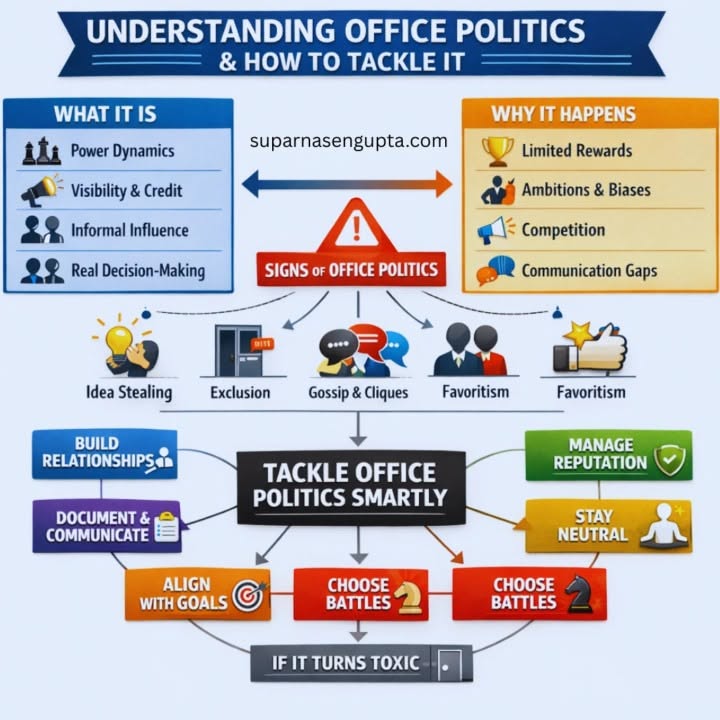
Office politics are the informal power dynamics, influence networks, coalition-building, and interpersonal maneuvering that exist in every organization alongside its formal structure. Every organization has a formal structure of org charts, job descriptions, and official policies, and an informal structure of relationships, alliances, and influence patterns that actually determine how decisions get made and who succeeds. That informal structure is office politics.
Beyond the Org Chart
Office politics refers to the informal power dynamics, influence networks, coalition-building activities, and interpersonal maneuvering that exist in every organization alongside its formal structure.
Every organization has two structures:
The formal structure is documented in organizational charts, job descriptions, reporting relationships, and official policies. It specifies who reports to whom, who has authority over what decisions, and how processes are supposed to work.
The informal structure consists of the relationships, alliances, rivalries, information networks, and influence patterns that actually determine how decisions are made, how resources are allocated, and who succeeds or fails. This informal structure is office politics.
The gap between formal and informal structure varies across organizations. In some organizations, the formal structure closely mirrors reality: decisions are made by the people officially authorized to make them, through the processes officially designated for that purpose.
In others, the gap is enormous: real decisions are made in hallway conversations, at informal dinners, through back-channel communications, and by people whose formal titles bear no relationship to their actual influence.
"It's not what you know, it's who you know-and more importantly, who knows you." - Jeffrey Pfeffer
Why the Gap Exists
The gap between formal and informal structure exists because formal structures are incomplete representations of organizational reality:
- Formal structures cannot capture the expertise asymmetries that develop as people accumulate knowledge. A junior employee who has been at the company for ten years may know more about how things actually work than a recently hired VP.
- Formal structures cannot capture the trust relationships that develop through years of collaboration. A manager may trust one direct report's judgment implicitly and another's not at all, regardless of their formal position.
- Formal structures cannot capture the information flows that develop through social networks. Some people know what is happening across the organization because they have broad, informal networks; others, despite senior titles, operate in information vacuums.
- Formal structures cannot capture the coalition dynamics that form around competing visions, priorities, and interests. Departments ally with each other against competing departments; executives build coalitions to advance their agendas; teams negotiate resources through relationships rather than formal budgeting processes.
Why Do Office Politics Exist?
Office politics emerge from structural conditions present in nearly every organization: scarce resources that people must compete for, ambiguous authority that turns decisions into negotiations, competing priorities between teams, information asymmetry, and subjective performance evaluation. They also emerge from human nature itself, including status seeking, coalition formation, reciprocity, and impression management, all of which shape behavior inside organizations.
Structural Causes
Office politics emerge from structural conditions that are present in virtually every organization:
Scarce resources: Organizations have finite budgets, headcount, executive attention, and strategic priority. When resources are scarce, individuals and teams must compete for them. This competition is politics.
Ambiguous authority: When it is unclear who has the authority to make a specific decision, the decision becomes a political negotiation. The more ambiguous the authority structure, the more political the decision-making process.
This ambiguity is closely tied to how organizations handle responsibility versus accountability-when those two concepts are blurred, political maneuvering fills the vacuum.
Competing priorities: Different teams, departments, and individuals have different priorities that are often genuinely incompatible. The engineering team wants time to refactor; the product team wants new features; the sales team wants custom solutions for clients.
Resolving these competing priorities involves negotiation, coalition-building, and influence-all forms of politics.
Information asymmetry: People have different information about organizational plans, problems, and opportunities. Those with better information have political advantage-and they may use that advantage to advance their interests.
Subjective evaluation: When performance is difficult to measure objectively (as it is for most knowledge work), evaluations become subjective.
Subjective evaluation opens the door to political influence: the people who are best at managing their image and relationships may be evaluated more favorably than those who are best at their actual work.
Human Nature
Office politics also emerge from fundamental aspects of human social behavior:
- Status seeking: Humans are social animals with a deep drive for status and recognition within their groups. In organizational contexts, this drive manifests as competition for promotion, visibility, and influence.
- Coalition formation: Humans naturally form alliances and coalitions to advance shared interests and protect against threats. In organizations, these coalitions form along lines of shared interest (department, function, project) and shared identity (generation, background, education).
- Reciprocity: Humans maintain networks of reciprocal relationships-favors given and owed-that influence behavior. "I supported your project last quarter; I expect your support for mine this quarter" is a political exchange that operates through the human reciprocity instinct.
- Impression management: Humans actively manage how they are perceived by others, emphasizing positive qualities and concealing weaknesses. In organizational contexts, this natural tendency becomes strategic self-presentation.
"The most important thing in communication is hearing what isn't said." - Peter Drucker
Are Office Politics Always Bad?
No, office politics are not inherently destructive. Many forms of political behavior, including building consensus, advocacy, relationship building, and conflict resolution, are essential for organizational functioning. Politics become destructive specifically when they turn zero-sum and secretive and prioritize individual advantage over organizational benefit, as with credit stealing, information hoarding, backstabbing, and self-serving gatekeeping.
Constructive Politics
Office politics are not inherently destructive. In fact, many forms of political behavior are essential for organizational functioning:
Building consensus: When a decision affects multiple stakeholders, building consensus among those stakeholders-through conversations, negotiations, and compromise-is both political and constructive. A leader who persuades skeptical colleagues to support a new initiative through genuine dialogue is engaging in constructive politics.
The way information is presented during these conversations what framing effects are used-can determine whether consensus is reached or fragmented.
Advocacy: Championing a project, a team, or an idea that deserves more resources or attention is political advocacy. The product manager who persuades leadership to invest in an undervalued product is engaging in constructive politics.
Relationship building: Developing trust-based relationships across the organization creates informal channels for collaboration, information sharing, and problem-solving that formal structures cannot provide.
The engineer who has strong relationships with the design team, the legal team, and the customer support team can navigate cross-functional challenges more effectively than one who relies solely on formal processes.
Conflict resolution: Mediating disagreements between individuals or teams, finding compromises that satisfy competing interests, and managing the interpersonal dynamics that formal processes ignore are all constructive political functions.
| Political Behavior | Constructive Form | Destructive Form |
|---|---|---|
| Influence | Persuading with evidence and logic | Manipulating with false information |
| Coalition building | Aligning around shared goals | Forming cliques to exclude others |
| Information sharing | Keeping stakeholders informed | Hoarding information for advantage |
| Advocacy | Championing deserving ideas | Self-promotion at others' expense |
| Networking | Building genuine relationships | Transactional relationship exploitation |
| Impression management | Presenting work accurately | Taking credit for others' work |
Destructive Politics
Office politics become destructive when they are zero-sum, secretive, and prioritize individual advantage over organizational benefit:
Credit stealing: Taking credit for others' work is one of the most universally condemned-and most commonly practiced-forms of destructive office politics.
A manager who presents a subordinate's idea as their own, an executive who takes credit for a team's achievement, or a colleague who claims ownership of a collaborative project is engaging in credit theft.
Information hoarding: Withholding information that others need to do their jobs in order to maintain a personal advantage is destructive politics. The manager who is the only person who knows how a critical system works has job security-but the organization has a single point of failure.
Backstabbing: Undermining colleagues through gossip, false reports, or strategic sabotage is the most overtly destructive form of office politics. It destroys trust, creates a culture of fear, and diverts energy from productive work to self-protection.
Gatekeeping: Using one's position to control access to information, resources, or decision-makers for personal benefit rather than organizational necessity.
The executive assistant who determines who gets time on the CEO's calendar is a gatekeeper whose behavior can be constructive (protecting the CEO's time) or destructive (using access as a power tool).
What Are Signs of Toxic Office Politics?
Toxic political cultures typically show several identifiable patterns: decisions that cannot be explained by merit or evidence, real decisions made in private meetings before the official ones, employees afraid to speak up for fear of retaliation, credit going to people who did not do the work, information flowing through political networks rather than organizational channels, and the most politically skilled people rising rather than the most job-skilled.
Diagnostic Indicators
Organizations with toxic political cultures typically exhibit several identifiable patterns:
Decisions are unexplainable: When decisions about hiring, promotions, resource allocation, and strategy cannot be explained by merit, evidence, or organizational need, political influence is likely the explanation. "Why did Sarah get promoted?" "Because she has a good relationship with the VP" is a political answer.
Meetings after meetings: When the real decisions are made in private conversations before or after the official meetings, the formal decision-making process is a facade for political deal-making.
Fear of speaking up: When employees are afraid to express dissent, report problems, or challenge decisions, political consequences (retaliation, marginalization, career damage) have replaced legitimate decision-making processes.
"What we fear doing most is usually what we most need to do." - Timothy Ferriss
Credit misattribution: When the people who do the work are not the people who receive recognition for it, credit distribution has become a political rather than merit-based process.
Information asymmetry: When some people always seem to know what is happening before others, information flows through political networks rather than organizational channels.
Survival of the political: When the people who rise in the organization are those with the strongest political skills rather than the strongest job skills, the organization has optimized for politics rather than performance.
Can You Avoid Office Politics?
Not really. Trying to stay out of office politics by focusing purely on good work is understandable but usually counterproductive, because staying out of politics is itself a political choice that cedes influence to those who engage. Good work does not speak for itself: evaluators rely on reports, presentations, and conversations to form impressions, so ignoring politics leaves you unable to communicate your value or anticipate threats to it.
The Myth of Staying Out of It
One of the most common responses to office politics is the desire to stay out of it: to focus on doing good work and let the quality of that work speak for itself. This approach is understandable but usually counterproductive.
"Staying out of politics" is itself a political choice-one that cedes influence to those who actively engage. The engineer who ignores organizational dynamics while a politically savvy colleague advocates for their project's resources is not above politics; they are losing the political game by default.
Good work does not speak for itself. In organizations of any significant size, the people who evaluate your work do not have direct visibility into what you do. They rely on reports, presentations, meetings, and conversations to form impressions.
If you do not communicate the value of your work-through relationships, visibility, and strategic self-presentation-others will define your contribution for you. A key component of professional identity is understanding that your reputation is, in part, a political artifact.
Ignoring politics leaves you vulnerable. If you do not understand the political dynamics of your organization, you cannot anticipate threats, identify opportunities, or understand the real reasons behind decisions that affect your work and career.
The Ethical Middle Ground
The alternative to both political manipulation and political disengagement is ethical political engagement:
- Understand the landscape: Know who has influence, how decisions are actually made, what alliances exist, and what competing interests are at play. This knowledge does not require participation in destructive behavior; it requires observation and awareness.
- Build genuine relationships: Invest in relationships based on mutual respect, shared interests, and genuine helpfulness rather than transactional exchange. Genuine relationships are more durable and more ethically sustainable than strategic alliances.
- Communicate your work: Make the value of your work visible to the people who evaluate and reward it. This is not self-promotion; it is professional communication.
- Advocate for your team: Use your influence to advance your team's interests, your colleagues' careers, and your organization's goals. Advocacy for others builds trust and creates reciprocity without the ethical costs of self-serving manipulation.
- Maintain integrity: Refuse to participate in credit theft, backstabbing, information hoarding, and other destructive behaviors, even when others engage in them. Integrity limits short-term political options but builds long-term credibility and trust.
How Does Culture Affect Office Politics?
Office politics operate differently across cultures depending on hierarchy, directness, and individualism. High-power-distance cultures favor deference to superiors and formal protocols, while low-power-distance cultures favor broader coalitions and more direct challenges to authority. Individualist cultures center political behavior on personal credit and advancement, while collectivist cultures center it on group loyalty and harmony.
Remote work has also reshaped visibility, information flow, and relationship building within office politics.
Cultural Dimensions of Politics
Office politics operate differently across cultures, reflecting broader cultural values around hierarchy, directness, relationships, and authority:
Hierarchy and power distance: In high-power-distance cultures (many Asian, Latin American, and Middle Eastern countries), hierarchy is explicit and respected. Political behavior may involve carefully managing relationships with superiors, showing appropriate deference, and navigating formal protocols.
In low-power-distance cultures (Scandinavian countries, Australia, parts of North America), hierarchy is less rigid, and political behavior may involve building broad coalitions and challenging authority more directly.
Directness and indirectness: In direct communication cultures (Germany, Netherlands, Israel), political disagreements may be expressed openly. In indirect communication cultures (Japan, much of Southeast Asia, parts of the UK), political disagreements are expressed through subtle signals, intermediaries, and non-confrontational language.
Individual vs. collective: In individualist cultures (US, UK, Australia), political behavior centers on individual advancement-personal credit, individual visibility, career progression. In collectivist cultures (Japan, China, Korea), political behavior may center on group loyalty, team reputation, and maintaining group harmony.
Relationship vs. task orientation: In relationship-oriented cultures (much of Latin America, Southern Europe, Middle East), political success depends heavily on personal relationships built over time. Business decisions are inseparable from personal relationships.
In task-oriented cultures (Northern Europe, North America), political behavior may be more transactional and less dependent on personal connection.
Remote Work and Political Change
The shift to remote and hybrid work has altered political dynamics in significant ways:
- Visibility has changed: In-office workers had opportunities for spontaneous interactions with leadership-hallway conversations, lunch encounters, informal meetings-that remote workers lack. This creates a political disadvantage for remote workers who are less visible to decision-makers.
- Information flows have changed: In-office informal information networks (watercooler conversations, overheard discussions, social gatherings) are reduced in remote environments. Information flows more through formal channels and selected informal channels (chat messages, one-on-one video calls), potentially concentrating information access.
- Relationship building has changed: Building trust in remote teams is harder than through in-person interaction. Remote workers must be more deliberate about relationship building to maintain political standing.
- Documentation has increased: Remote communication is more likely to be written (chat messages, emails, documents), creating a more extensive record of interactions and potentially reducing some forms of political behavior that depend on deniability.
"In the absence of information, people fill the void with politics." - Patrick Lencioni
How Do You Navigate Office Politics Ethically?
Navigate office politics ethically by mapping the political landscape, identifying who holds real influence versus formal authority, and building a broad network across the organization rather than just your own team. Find sponsors and mentors, deliver results visibly so credibility is grounded in outcomes rather than maneuvering, and maintain integrity by refusing to participate in credit theft, backstabbing, or information hoarding even when others do.
Practical Strategies
Map the political landscape: Identify the key power holders, decision-makers, gatekeepers, and influencers in your organization. Understand who has formal authority versus informal influence. Know the alliances, rivalries, and competing interests that shape organizational dynamics.
Decision frameworks used by high performers are directly applicable here: clear frameworks reduce the ambiguity that toxic politics thrive on.
Build a broad network: Develop relationships across the organization-not just within your team or department. Cross-functional relationships provide information, perspective, and influence that a narrow network cannot.
Find sponsors and mentors: Identify senior leaders who can advocate for your career and provide guidance on navigating political dynamics. Sponsors (who advocate for you publicly) are distinct from mentors (who advise you privately), and both are valuable.
Deliver results visibly: The strongest political position is one built on a foundation of consistent, visible results. When you deliver value that others recognize, you build credibility that political maneuvering alone cannot create.
Choose your battles: Not every political conflict is worth engaging. Focus your political energy on issues that matter most to your goals and to your organization's success.
Document your contributions: Keep records of your work, achievements, and contributions. In performance review conversations, promotion discussions, and credit disputes, documentation provides evidence that impressions alone cannot.
Maintain ethical boundaries: Decide in advance what political behaviors you will and will not engage in. Refusing to participate in gossip, credit theft, and backstabbing may cost you some short-term political advantage, but it builds a reputation for integrity that compounds over time.
Delegate strategically: Effective delegation is both a productivity tool and a political one-it builds trust with your team, creates allies, and demonstrates leadership maturity to decision-makers watching from above.
How Power Actually Moves: Lessons from Research on Organizational Influence
The Science of Informal Power
Sociologist David Krackhardt's influential 1990 study of a manufacturing company found that employees who held central positions in the informal "advice network" were far more influential on actual decisions than their formal titles suggested.
Krackhardt identified three overlapping networks in every organization: the advice network (who people go to for work guidance), the trust network (who people share sensitive information with), and the communication network (who talks to whom regularly).
Power in an organization tracks position in all three of these informal networks simultaneously - not position in the formal hierarchy.
This research has been replicated and extended by Rob Cross and Andrew Parker at IBM's Institute for Knowledge-Based Organizations, who mapped informal networks across dozens of companies in the early 2000s.
Their data showed a consistent finding: organizations routinely overestimate the productivity of highly visible employees (those with many connections) and underestimate the bottleneck costs created by highly central employees (those through whom information must flow).
The most politically powerful person in many organizations is not the one with the most formal authority but the one who sits at the intersection of the most information flows.
Jeffrey Pfeffer at Stanford's Graduate School of Business has documented the downstream consequences in studies of healthcare executives: the managers who advanced were not systematically the highest performers by measurable output metrics.
They were the managers who were most effective at building coalitions, managing upward relationships, and controlling the narrative around their work. In one study of hospital administrators, political skill predicted career advancement three times more strongly than technical competence.
The implication is not that technical competence is irrelevant - it is necessary - but that it is insufficient as a standalone career strategy.
The Moral Licensing Effect in Politics
A subtler finding from organizational research is the "moral licensing" effect documented by psychologists Benoit Monin and Dale Miller: people who have established a reputation for ethical behavior feel implicitly licensed to engage in more questionable behavior afterward.
In political contexts, this means a manager who has built a reputation for fairness may unconsciously feel entitled to make a politically motivated decision - taking credit for a subordinate's idea, for instance - that they would have avoided earlier.
The moral capital built through genuinely ethical behavior can, paradoxically, create a license for lapses. Awareness of this dynamic - particularly in leaders who think of themselves as above office politics - is important for maintaining consistent ethical standards.
When Office Politics Destroy Organizations: The Enron and Kodak Cases
Enron's Political Architecture
Enron's collapse in 2001 was driven by financial fraud, but the fraud was enabled and protected by a particular political culture.
The company's performance review system - the "rank and yank" system implemented by consultant McKinsey and championed internally - required managers to identify and fire the bottom 15 percent of performers annually.
This created intense competition among colleagues, rewarded self-promotion over collaboration, and made information-hoarding a survival strategy rather than a political choice.
Employees who identified problems with off-balance-sheet partnerships were marginalized or fired. The political incentive to conform to the company's official optimism was overwhelming.
Bethany McLean and Peter Elkind's reporting in The Smartest Guys in the Room identified the political dynamics specifically: senior executives used their control of information to maintain the narrative that the company was healthy.
The political culture - not the financial complexity - was the mechanism that prevented the organization from self-correcting.
When vice president Sherron Watkins wrote her famous memo to CEO Ken Lay warning about accounting irregularities in 2001, the political dynamics were such that raising the alarm was more personally dangerous than staying silent.
This is the terminal state of destructive office politics: organizational intelligence is weaponized against organizational survival.
Kodak's Innovation Failure as a Political Problem
Kodak's failure to capitalize on digital photography despite inventing the first digital camera (by engineer Steven Sasson in 1975) is often told as a story of technological blindness. But Sasson himself described a political story: when he showed the invention to management, the response was cautious silence.
The film business was enormously profitable, and the political incentives for managers in that division pointed entirely toward protecting existing revenue rather than cannibalizing it with an unproven technology.
Advocates for digital investment were proposing to destroy the careers and empires of powerful film-business executives. The technical merit of digital photography was clear to many people at Kodak; what was lacking was a political structure that could overcome the defensive interests of the film division.
By the time Kodak made serious digital investments in the 1990s, it had lost the window. Political structures that reward protecting existing business lines - rather than cannibalizing them - are a documented predictor of innovative failure in technology companies.
Office politics are not a problem to be solved. They are a permanent feature of organizational life that can be navigated with skill and integrity.
The organizations that produce the best outcomes are not those that eliminate politics (an impossibility) but those that channel political energy toward constructive purposes: building coalitions around shared goals, advocating for good ideas, resolving conflicts productively, and creating cultures where influence is based on contribution rather than manipulation.
The individuals who thrive in organizations are not those who are above politics but those who engage in politics ethically, skillfully, and with a clear-eyed understanding of the systems they operate within.
Sources & Further Reading
Pfeffer, J. (2010). Power: Why Some People Have It and Others Don't. HarperBusiness. View source
Mintzberg, H. (1983). Power In and Around Organizations. Prentice Hall. View source
Ferris, G.R. & Treadway, D.C. (2012). Politics in Organizations: Theory and Research Considerations. Routledge. View source
Nadella, S. (2017). Hit Refresh: The Quest to Rediscover Microsoft's Soul and Imagine a Better Future for Everyone. Harper Business. View source
Cialdini, R.B. (2006). Influence: The Psychology of Persuasion. Harper Business. View source
Edmondson, A.C. (2018). The Fearless Organization. Wiley. View source
Bolman, L.G. & Deal, T.E. (2017). Reframing Organizations. 6th ed. Jossey-Bass.
Hofstede, G. (2001). Culture's Consequences. 2nd ed. Sage Publications. View source
Scott, K. (2017). Radical Candor. St. Martin's Press. View source
Lencioni, P. (2002). The Five Dysfunctions of a Team. Jossey-Bass.
Buchanan, D. & Badham, R. (2020). Power, Politics, and Organizational Change. 3rd ed. Sage Publications.
Keltner, D. (2016). The Power Paradox: How We Gain and Lose Influence. Penguin Press. View source