
Encryption: When you send a message through a modern messaging app, it travels across a complex chain of systems: your device, a cellular or Wi-Fi network, your carrier's infrastructure, the messaging provider's servers, another network, and finally the recipient's device.
At each point in that chain, someone or something could theoretically intercept and read your message. End-to-end encryption is the mechanism that makes that interception useless - your message arrives at the other end as an incomprehensible string of characters to anyone without the specific key to decrypt it.
The concept sounds simple, but its implications are profound and contested. End-to-end encryption means that not only can attackers not read your messages - neither can the company providing the service, neither can your government with a lawful warrant served to that company, and neither can any third party who subpoenas server logs.
This is simultaneously its greatest privacy strength and the source of intense political controversy. Law enforcement agencies in the United States, United Kingdom, European Union, and Australia have repeatedly argued that encryption without backdoors obstructs legitimate investigation.
The cryptographic community responds that backdoors cannot be limited to authorized parties - they are, by definition, vulnerabilities.
Understanding how end-to-end encryption works technically illuminates why the backdoor debate is not a policy question with a technical solution waiting to be found, but a fundamental mathematical reality.
This article covers the cryptographic foundations, the Signal Protocol that underpins most major encrypted messaging today, the meaningful differences between Signal, WhatsApp, Telegram, and iMessage, and the often-overlooked metadata problem that limits what encryption alone can protect.
"Encryption is the most important privacy-preserving technology we have, and it is under serious threat - not from technical failure, but from political pressure to weaken it." - Bruce Schneier, security technologist and author
Key Definitions
End-to-end encryption (E2EE): A communication method in which only the communicating parties can read the messages. The encryption happens on the sender's device, and decryption happens only on the recipient's device.
Public key cryptography: An asymmetric cryptographic system using a pair of mathematically related keys: a public key (shared openly) and a private key (kept secret). A message encrypted with someone's public key can only be decrypted with their corresponding private key.
Forward secrecy: The property that compromising current or future encryption keys does not compromise past messages. Achieved by generating fresh encryption keys for each session or message.
Metadata: Information about communications - who communicated with whom, when, for how long, from where - rather than the content of the communication itself. Often collected even when message content is encrypted.
The Signal Protocol: An open-source cryptographic protocol developed by Moxie Marlinspike and Trevor Perrin that provides end-to-end encryption with forward secrecy. Used as the basis for Signal, WhatsApp, and other messaging platforms.
Double Ratchet Algorithm: The core mechanism inside the Signal Protocol that generates a new encryption key for every individual message, ensuring that compromising one key does not expose any others.
X3DH (Extended Triple Diffie-Hellman): The key agreement protocol used by Signal to establish a shared encryption key between two parties before any messages are exchanged, even when one party is offline.
Messaging Apps Encryption Comparison
| App | Encryption Protocol | E2EE by Default | Open Source Client | Open Source Server | Metadata Collected |
|---|---|---|---|---|---|
| Signal | Signal Protocol | Yes (all messages) | Yes | Yes | Phone number + last connection date only |
| Signal Protocol | Yes (all messages) | No | No | Extensive - contacts, frequency, device, location | |
| Telegram | MTProto (proprietary) | No (opt-in Secret Chats only) | Partial | No | Moderate - message metadata available to Telegram |
| iMessage | Apple proprietary | Yes (Apple to Apple) | No | No | Moderate - iCloud backup caveat |
How End-to-End Encryption Works
Symmetric vs. Asymmetric Encryption
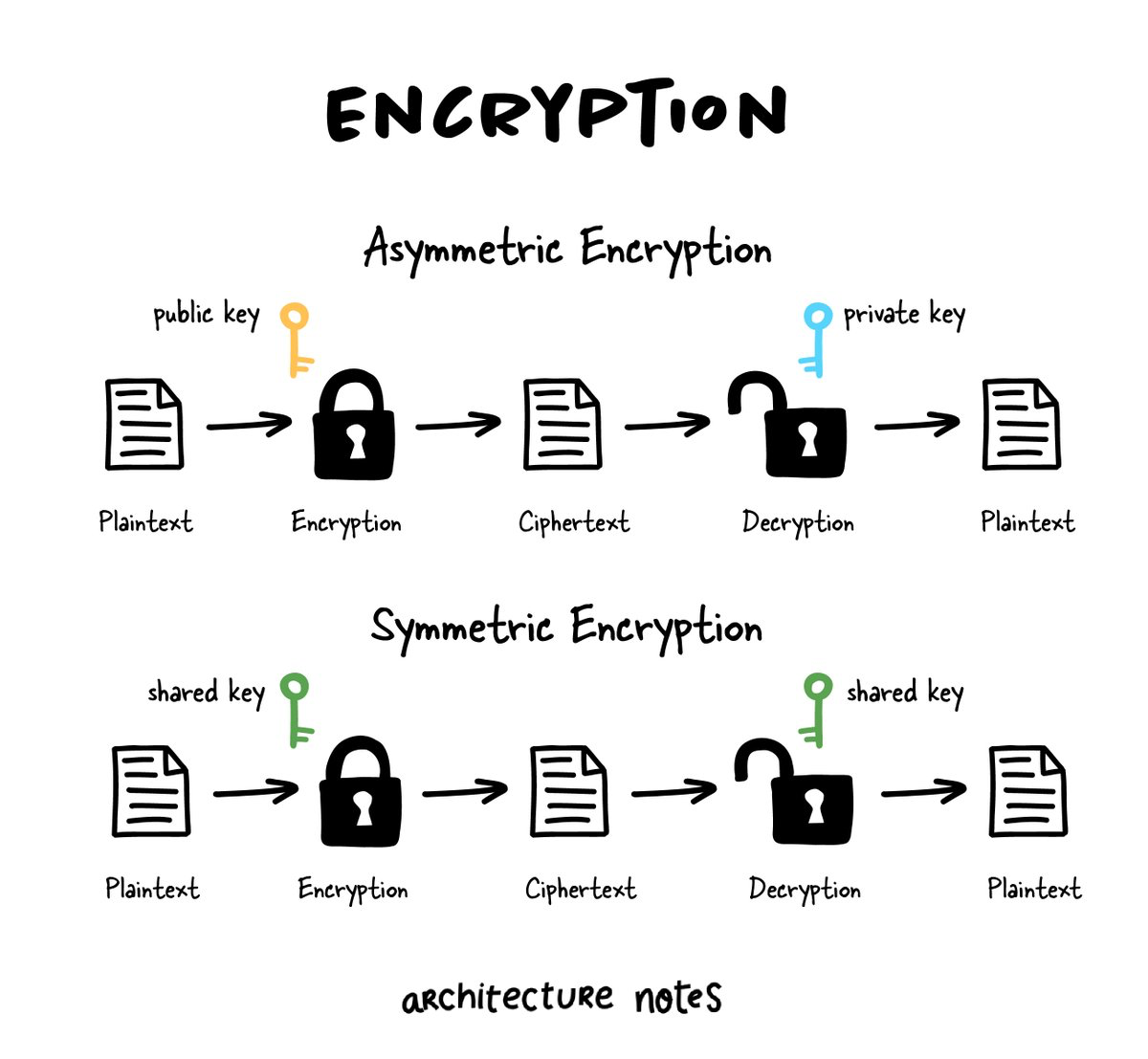
The simplest form of encryption uses a single key that both locks (encrypts) and unlocks (decrypts) a message. This symmetric encryption is fast and efficient but creates a fundamental problem: how do two parties who have never met securely agree on a shared key over an insecure channel?
If you send the key over the same channel as the message, anyone intercepting the channel gets both.
Asymmetric encryption solves this using a mathematically paired key system. Each party generates a key pair: a public key that can be shared with anyone, and a private key that is kept secret and never transmitted. A message encrypted with Alice's public key can only be decrypted with Alice's private key.
When Bob wants to send Alice a message, he encrypts it with her public key. Even if an attacker intercepts the encrypted message - and even if they have Alice's public key - they cannot decrypt it without her private key, which Alice has never shared with anyone.
This enables secure key exchange over insecure channels using a technique called Diffie-Hellman key exchange, independently published in 1976 by Whitfield Diffie and Martin Hellman.[2]
The mathematical elegance of Diffie-Hellman is that two parties can derive a shared secret through exchanges of public information, without ever transmitting the shared secret itself.
An eavesdropper sees the public exchange but cannot derive the secret without solving a mathematical problem - the discrete logarithm problem - that is computationally infeasible with current technology.
To put it concretely: Alice and Bob each pick a private number, exchange derived public values over an open channel, and each independently compute the same shared secret.
An attacker watching the exchange cannot compute the shared secret from the public values alone, because the mathematical relationship requires the private numbers neither party ever shared.
The Signal Protocol
The Signal Protocol, developed by Moxie Marlinspike (founder of Signal) and Trevor Perrin at Open Whisper Systems in 2013, builds on these foundations to create a system with properties beyond simple encryption.
The protocol's most important innovation is the Double Ratchet Algorithm, which advances the encryption key continuously during a conversation.[1] Rather than using a single session key for an entire conversation, the Double Ratchet generates a new key for every message sent.
This means that if an attacker somehow obtained the key for message 47, they could decrypt only message 47 - not messages 1 through 46 (forward secrecy) and not messages 48 onward (break-in recovery, also called future secrecy).
For initial key exchange - establishing a shared secret before any messages have been exchanged - the protocol uses the X3DH (Extended Triple Diffie-Hellman) mechanism.
X3DH allows two parties to establish a shared key even when one party is offline, using preloaded "one-time prekeys" deposited on the server in advance. The server holds only public key material and never has access to the derived shared secret.
The Signal Protocol's full technical specification has been publicly available since its development, and it has been analyzed extensively by cryptographers worldwide.
A formal security analysis by Cohn-Gordon et al. (first published 2016/2017; Journal of Cryptology, 2020) found no significant vulnerabilities in the protocol's design - a remarkable testament to its cryptographic engineering.[3]
What "End-to-End" Actually Means
The phrase "end to end" is precise: encryption happens at one endpoint (your device) and decryption happens at the other (your recipient's device). The messaging provider's servers in the middle see only encrypted ciphertext they cannot read. This is distinct from:
- Encryption in transit only (also called TLS/HTTPS): the message is encrypted between your device and the server, but the server holds it in readable form. The service provider can read your messages.
- Encryption at rest: messages are stored encrypted on servers, but the service holds the encryption keys and can decrypt them for legal or operational purposes.
True E2EE means the service provider is architecturally excluded from reading your messages - not merely promised not to, but technically unable to.
Major Messaging Apps
Signal
Signal is the application built by the Signal Foundation (formerly Open Whisper Systems), a nonprofit organization. It uses the Signal Protocol for all messages and calls. Its source code is fully open source for both the application and the server, meaning the security claims can be independently verified.
Signal collects the absolute minimum possible metadata: just a phone number (required to use the service) and the date a user last connected. It does not collect who you message, when, or for how long.
Signal's privacy model is designed for high-stakes use. Journalists, activists, lawyers, medical professionals, and whistleblowers routinely use it for sensitive communications. The Electronic Frontier Foundation rates it the highest of any mainstream messaging application for privacy.[7]
The practical limitation of Signal is network effects: it requires that your contacts also use Signal. This limits its utility for everyday communication relative to WhatsApp or iMessage, and is the primary reason Signal's user base, while large, remains far smaller than WhatsApp's.
WhatsApp implemented the Signal Protocol in 2016, making it the largest encrypted messaging service in the world by user count - over 2 billion active users.[11]
The encryption of message content on WhatsApp is genuine: WhatsApp cannot read your messages, and this has been confirmed through legal proceedings where WhatsApp could not produce message content in response to subpoenas.
However, WhatsApp is owned by Meta (formerly Facebook), and it collects extensive metadata under its privacy policy. This includes: who you communicate with and how frequently, your location data (if enabled), your device identifiers, your contacts list, usage patterns, and information about the groups you are in.
In jurisdictions where WhatsApp does produce data for law enforcement, this metadata can be highly revealing - even without a single word of message content.
WhatsApp is also closed-source, which means the encryption implementation cannot be independently audited. The Signal Protocol is open and verified; WhatsApp's application of it cannot be externally confirmed to match the published specification.
Telegram
Telegram is frequently mischaracterized as an end-to-end encrypted messaging app. In reality, regular Telegram chats are not end-to-end encrypted by default.
Standard Telegram messages are encrypted in transit between your device and Telegram's servers - meaning Telegram can read your messages, and has done so to enforce its terms of service and respond to law enforcement in certain jurisdictions.
Only "Secret Chats," which must be explicitly enabled through a separate UI option, use end-to-end encryption. Group chats have no E2EE option at all.
Telegram uses its own proprietary MTProto encryption protocol, not the Signal Protocol. MTProto has received sustained criticism from cryptographers over multiple versions, though it has improved. The lack of open-source server code means independent verification of the protocol's implementation is not possible.
For users seeking genuine end-to-end encryption, the default Telegram experience does not provide it. Telegram's popularity and feature richness have made it a widely used platform, but its encryption defaults are fundamentally weaker than Signal or WhatsApp.
iMessage
Apple's iMessage provides end-to-end encryption between Apple devices using Apple's own cryptographic protocol. iMessage does not use the Signal Protocol but implements comparable cryptographic primitives. Its privacy properties are meaningful for Apple-to-Apple communication.
The significant caveat is iCloud backup: if iCloud backup is enabled (the default for most users), a copy of your messages is stored in a form that Apple can access under legal process. Apple has received and complied with legal orders for iMessage data stored in iCloud.
In late 2022, Apple introduced iCloud Advanced Data Protection, which extends E2EE to iCloud backups - but users must opt in, and it is not widely adopted. When iMessages leave Apple devices (sent to Android, for instance), they fall back to unencrypted SMS.
The Metadata Problem
What Metadata Reveals
Encryption protects the contents of communication. It does not protect information about that communication.
Messaging services - even strongly encrypted ones - typically log: who communicated with whom (contact graphs), the timing and frequency of communication, message lengths, the groups users belong to, IP addresses (revealing geographic location), and device identifiers.
In 2014, Jonathan Mayer and Patrick Mutchler at Stanford demonstrated through the MetaPhone study that phone metadata - without content - could reveal that a person had spoken with a neurologist, a cancer support group, and a hospice service in sequence (strongly suggesting a terminal diagnosis).[5]
Or calls to Alcoholics Anonymous, a drug treatment clinic, and a pharmacy. The research illustrated what communications scholars had long argued: metadata about who you talk to, when, and in what pattern is often more revealing than what you say.[6]
Former NSA and CIA director Michael Hayden made a much-cited public statement in 2014: "We kill people based on metadata." He was referring to targeting decisions in counterterrorism operations, but the statement encapsulates how actionable contact graph information can be even without message content.
Signal's Metadata Minimization
Signal has explicitly designed its service to minimize metadata collection as a privacy goal, not merely a technical property.
The 2021 legal case in which Signal was served a subpoena by a US grand jury is instructive: Signal was able to produce only two data points - the Unix timestamp of when a user account was created and the date of the account's last connection to Signal.[9]
No message content, no contact graph, no location data. The design of the system made providing more data impossible, not just prohibited.
This "privacy by architecture" approach - building systems so that sensitive data is never collected rather than promising to protect collected data - is a core principle in privacy-by-design frameworks and represents the highest standard in private communication systems.
The distinction matters: a service that promises not to share your data can be compelled, hacked, or acquired. A service that architecturally cannot produce the data provides a guarantee no policy or promise can match.
The Government Backdoor Debate
The Law Enforcement Argument
Law enforcement agencies, led in the United States by the FBI and Department of Justice, have argued for years that end-to-end encryption without exceptional access (a "backdoor" for lawful surveillance) prevents investigation of serious crimes including terrorism, child exploitation, and organized crime.
This position is known as the "Going Dark" problem - the argument that encryption is diminishing law enforcement's historical ability to intercept communications with appropriate legal authority.
The 2016 FBI vs. Apple case brought this debate to public attention. Following the San Bernardino mass shooting, the FBI sought a court order compelling Apple to create a version of iOS that could be used to unlock the shooter's iPhone by bypassing its encryption.
Apple's CEO Tim Cook publicly refused, arguing that creating such a tool - even once, even for a specific case - would create a vulnerability that could not be guaranteed to remain in only authorized hands.[8] The FBI ultimately withdrew the court order after obtaining access through a third-party vendor.
Why Backdoors Cannot Be Made Safe
Cryptographers have addressed the "backdoor for good actors only" request repeatedly.
The 2015 paper "Keys Under Doormats", authored by Harold Abelson, Ross Anderson, Steven Bellovin, and other leading security researchers, explains the technical impossibility in detail: any mechanism that allows a third party (government) to access encrypted data is a vulnerability - a mathematical key that either exists or does not.[4]
A key held by a government agency can be stolen, leaked, or compelled to be provided to other governments.
There is no cryptographic mechanism that distinguishes a "legitimate" request from an "illegitimate" one - the math does not know.
The paper concluded that the risks to digital security and privacy from mandated exceptional access mechanisms are greater than the potential benefits to law enforcement - a position endorsed by the overwhelming majority of working cryptographers.
The same mathematical reality applies to more recent proposals: client-side scanning (scanning messages before encryption), key escrow systems, and "lawful intercept" architectures all introduce the same fundamental vulnerability from a different angle.
Either a third party can access communications, in which case the system is exploitable - or they cannot, in which case the backdoor does not exist.
Quantum Computing and Future Cryptographic Risk
Current E2EE systems rely on mathematical problems that classical computers cannot practically solve - discrete logarithm for Diffie-Hellman, integer factorization for RSA. Quantum computers, using Shor's algorithm, could in principle break these in polynomial time once sufficiently powerful quantum computers exist.
The National Institute of Standards and Technology (NIST) finalized its first set of post-quantum cryptography standards in 2024, selecting algorithms resistant to quantum attack.[10] Signal has already begun integrating post-quantum key agreement (specifically CRYSTALS-Kyber, now called ML-KEM) into its protocol.
This is not a present threat - current quantum computers cannot break deployed cryptography - but it is a live area of development, and "harvest now, decrypt later" attacks (storing encrypted traffic for future decryption) are a concern for communications that need long-term confidentiality.
Practical Takeaways
For everyday private communication, WhatsApp provides meaningful encryption of message content for most users' threat models.
For high-stakes privacy - journalism, legal communication, political activism, medical information - Signal is the well-supported choice, and understanding why metadata matters is as important as the encryption itself.
Understanding the metadata problem means recognizing that encryption of content and metadata minimization are separate concerns. Even with excellent content encryption, patterns of communication can be revealing.
Using Signal, understanding what iCloud backup does to iMessage privacy, and considering whether the service you use logs contact graphs are the relevant questions for serious privacy practice.
The government backdoor debate will continue, particularly as legislative attempts to mandate exceptional access recur. The technical reality does not change: weakening encryption for one party weakens it for all parties. Any backdoor is a vulnerability - and vulnerabilities do not stay in authorized hands.
Sources & Further Reading
- Marlinspike, M., & Perrin, T. (2016). The Double Ratchet Algorithm. Signal Messenger.
- Diffie, W., & Hellman, M. (1976). "New directions in cryptography." IEEE Transactions on Information Theory, 22(6), 644-654.
- Cohn-Gordon, K., et al. (2020). "A formal security analysis of the Signal messaging protocol." Journal of Cryptology, 33(4), 1914-1983.
- Abelson, H., et al. (2015). Keys Under Doormats: Mandating Insecurity by Requiring Government Access to All Data and Communications. MIT CSAIL.
- Mayer, J., & Mutchler, P. (2014). MetaPhone: The NSA Three-Hop. Web Policy, Stanford University.
- Schneier, B. (2015). Data and Goliath: The Hidden Battles to Collect Your Data and Control Your World. W. W. Norton.
- Electronic Frontier Foundation. (2023). Secure Messaging Scorecard. EFF.
- Apple Inc. (2016). A Message to Our Customers. apple.com, February 16.
- Signal Foundation. (2021). Grand Jury Subpoena for Signal User Data, Eastern District of Virginia. Signal Blog.
- NIST. (2024). Post-Quantum Cryptography Standards. National Institute of Standards and Technology.
- Marlinspike, M. (2016). "WhatsApp's Signal Protocol integration is now complete." Open Whisper Systems Blog, April 5.
Further Reading
- Hypponen, M. (2013). "Governments as malware authors." Proceedings of ACM CCS, Berlin.