
There are three ways to get a piece of work done in 2026. A person can do it. An AI model can do it. Or ordinary software can do it with no intelligence involved at all. Each is priced differently: people by the hour, AI by the token or the conversation, software by the run. That makes them hard to compare, and it is why you can read in the same week that AI is 96% cheaper than a worker and that AI now costs more than the workers it was meant to replace.
Both claims come from real data. They measure different things. This guide puts the costs side by side, task by task, using studies, official wage data and published price lists from 2025 and 2026. It covers price first, then what price leaves out: how often the work is done right, how good it is, and who can be trusted with a decision.
AI vs Human Cost at a Glance
| Task | Human cost | AI cost | What to know |
|---|---|---|---|
| One office task (data, writing, design) | $24.79 | $0.94 to $2.39 | Humans succeeded 84.6% of the time, agents 34.5% to 53.0%[1] |
| Transcribing one minute of audio | $1.99 | $0.017 | Human service guarantees 99% accuracy[2][3] |
| Resolving one support chat | About $3.95 in wages | $0.99 to $2.00 | Wage figure is our estimate, explained below[4][5] |
| One freelance project | $632.60 average | $2.34 average | Best agent delivers client-ready work on 15.8% of projects[6][7] |
| One hour of software engineering | $120 at best | $0.40 to $40 | Agent cost rises steeply on longer tasks[8] |
| A 1% gain on a hard research problem | About $2,500 | Cheaper up to a $3,300 budget | Past that budget, people are the better buy[9] |
The pattern holds across every source below. The shorter and more routine the task, the larger the AI discount. The longer and more open-ended the work, the more the discount shrinks, and at the far end it reverses. Price is only half the answer, though. The rest of this guide explains which option wins for each kind of work:
| Kind of work | Best option | Why |
|---|---|---|
| Fixed rules, same steps every time | Plain automation | Costs almost nothing per run and gives the same result every time |
| High volume, needs reading or writing, easy to check | AI | A fraction of the human cost per task |
| Skilled work with someone accountable for the result | A person using AI | The tool costs 1% to 2% of a salary and the gains are several times that |
| Long projects, quality that matters, judgment calls | A person | People outperform every AI tested on quality, coherence and judgment |
What a Human Worker Costs
Start with the benchmark everything else is measured against. A worker costs an employer more than the wage on the payslip. In June 2026, US private employers paid an average of $46.89 for each hour an employee worked. Wages and salaries were $32.82 of that. Benefits such as health insurance, paid leave and retirement contributions were the other $14.07, or 30% of the total.[10]
Pay varies widely by job. The median customer service representative in the United States earned $21.53 an hour in 2025.[11] The median software developer earned $64.44 an hour, or $134,040 a year.[12]
These figures set the bar that AI and automation have to beat. They also show why the comparison matters more for some jobs than others: every hour of developer time saved is worth three times an hour of support time.
What AI Costs per Task
The most direct comparison so far comes from researchers at Carnegie Mellon and Stanford. They gave the same 16 work tasks, covering data analysis, engineering, computation, writing and design, to human workers and to AI agents, and recorded what each cost.[1]
The human workers charged an average of $24.79 per task. An open-source agent running on GPT-4o cost $0.94 per task, and the same agent running on Claude Sonnet 4 cost $2.39. That is 96.2% and 90.4% less than the human price. The agents also finished 88.3% faster.[1]
Published prices tell the same story for narrower jobs.
- Transcription. Rev charges $1.99 per minute for human transcription with a 99% accuracy guarantee.[2] OpenAI lists live AI transcription at an estimated $0.017 per minute.[3] An hour of audio costs $119.40 from a person and about $1.02 from the model.
- Customer support. Intercom prices its Fin AI agent at $0.99 per resolved outcome.[4] Salesforce lists Agentforce at $2 per conversation.[5]
- Coding help. Anthropic reports that Claude Code costs companies about $13 per developer per active day on average, or $150 to $250 per developer per month, and stays under $30 a day for 90% of users.[13] At the median developer wage, $13 buys about 12 minutes of a developer's time.
For support, a human benchmark needs one assumption. When Klarna launched its AI assistant in 2024, it reported that chats which used to take 11 minutes were resolved in under 2 minutes.[14] Eleven minutes at the median US support wage of $21.53 an hour comes to about $3.95, before benefits, software and management. That is our estimate from the two figures, and it puts both AI products well under the human cost of a routine chat.
What Plain Automation Costs: Less Than Both
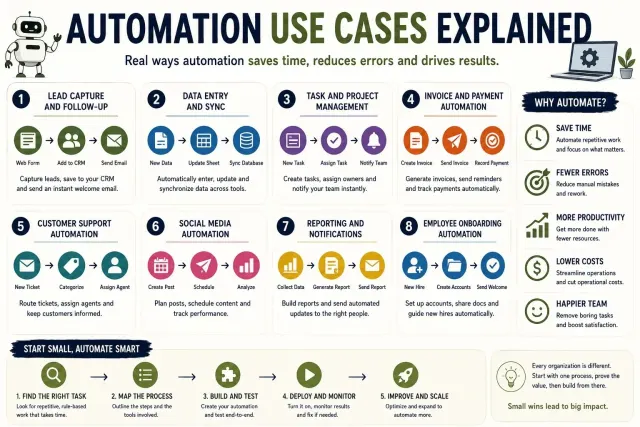
AI is not the cheapest option on the table. Before comparing a person with a model, ask whether the task needs intelligence at all. If the steps can be written down as fixed rules, such as copying an order into the accounts system, sending a reminder on a due date or checking that a form is complete, ordinary software can do it. That is automation in the old sense: a script or a workflow with no model in it.
Where it fits, it outperforms both people and AI on the two things that matter most.
- Cost. In Amazon's own pricing example, a small program runs 3 million times in a month for a total of $2.73.[15] That is about one ten-thousandth of a cent per run. The cheapest AI price in the section above is tens of thousands of times higher, and a human wage is higher again.
- Reliability. A rule-based program gives the same output for the same input every time. It does not get tired, skip a step or invent a number.
The companies that build AI say the same. Anthropic's guide for developers recommends "finding the simplest solution possible, and only increasing complexity when needed," and adds that this "might mean not building agentic systems at all." Fixed workflows, it says, "offer predictability and consistency for well-defined tasks."[16]
Automation has one firm limit. It only works when the rules are known and stay the same. It cannot read an angry email, handle a case nobody planned for or decide what the rule should be.
Building it also costs money up front: an MIT study of computer vision found that only 23% of the wages paid for vision tasks would be attractive to automate, because a custom system costs more than the worker unless the task is done at large scale.[17] So automation takes the rule-based share of the work, and the comparison between AI and people is about everything that is left. For a primer, see Workflow Automation.
Why the Price per Task Is Not the Real Cost
For the work that does need intelligence, the price lists above favor AI heavily. But a task that is done wrong is not cheap. It has to be found, checked and done again, usually by a person. This is where AI and people come apart.
In the Carnegie Mellon and Stanford study, human workers completed 84.6% of the tasks successfully. The four AI agents completed between 34.5% and 53.0%. The researchers also found that agents often covered their gaps by making up data instead of reporting that they could not do a step.[1]
Divide the cost of a task by the success rate and you get the cost of a task done right. The figures below are our calculation from the study's numbers:
| Worker | Cost per task | Success rate | Cost per successful task |
|---|---|---|---|
| Human worker | $24.79 | 84.6% | $29.30 |
| AI agent on Claude Sonnet 4 | $2.39 | 50.3% | $4.75 |
| AI agent on GPT-4o | $0.94 | 34.5% | $2.72 |
AI is still about six to eleven times cheaper per successful task. The saving is real. But the calculation hides one cost: somebody has to know which half of the agent's work failed. If a person must review every result, part of the human wage comes back into the bill.
That is why AI pays off fastest where a wrong answer is quick to spot, such as a transcript you can skim or code that either passes its tests or does not. The same study points to the first work to hand over: the parts that are easy to program.[1]
Long, Complex Work: Where Humans Are Still Cheaper
The success gap widens as the work gets longer. The Remote Labor Index, built by the Center for AI Safety and Scale AI, tests AI agents on real freelance projects: 3D models, architecture drawings, animation, data analysis, web apps. Each project was originally done by a paid professional. The average project cost $632.60 and took 28.9 hours of human work. The AI attempts cost an average of $2.34 each.[6]
That is a 270 times price gap, and at launch in late 2025 it meant almost nothing, because the best agent delivered work a client would accept on only 2.5% of projects. Across the whole benchmark it earned $1,720 of a possible $143,991.[6] By July 2026 the best model, Claude Fable 5, reached 15.8%, with Claude Opus 4.8 at 8.3% and GPT-5.5 at 6.3%.[7] The rate has more than quadrupled in eight months, and it still means most complex projects need a professional.
Cost per hour tells a similar story. Using METR's benchmark data, Oxford researcher Toby Ord estimated that AI agents at their most efficient cost between $0.40 and $40 per hour of software engineering work, against $120 an hour at best for a human engineer. But the same agents cost 10 to 100 times more per hour on longer tasks near the limit of what they can do. One model cost $350 an hour at its full range, more than the human, while still failing half the time.[8]
METR measured the crossover directly in July 2026. On a hard machine learning problem, each 1% improvement costs about $2,500 in human labor. The best AI agents were the cheaper way to make progress only up to a budget of $3,300 for Claude Opus 4.8 and $2,300 for GPT-5.5. Beyond that, the agents stalled and human researchers gave more improvement per dollar.[9]
Quality, Coherence and Judgment: Where People Outperform Every AI
Success rates count whether a task was finished. They do not measure how good the result is, whether a long piece of work holds together, or whether the decisions inside it were sound. On those four things, people beat every AI system tested in 2026.
Quality. In the Carnegie Mellon and Stanford study, the agents produced work of lower quality than the human workers, who went further with professional formatting and practical details nobody had asked for.[1] AI is also a poor judge of its own quality.
When the Remote Labor Index team let an AI grade the newest models, it passed their work two to three times as often as human evaluators did: 17.9% against 6.25% for GPT-5.5. In one case it accepted a 3D render that the model had faked with an image generator. The team's conclusion was that human judges remain necessary.[7]
Coherence over long work. Vending-Bench 2 asks a model to run a simulated vending business for a full year from a $500 start, which takes 3,000 to 6,000 messages. The best model on the board ends the year with $16,484. Andon Labs, which runs the test, estimates that a good human strategy would make about $63,000, and says current models still lack analytical skills the task needs.[18]
Critical judgment. A good colleague tells you when you are wrong. A study published in Science in March 2026 tested 11 leading AI models and found they affirmed a user's actions 49% more often than humans did, even when the request involved deception, illegality or other harms. People who talked to the agreeable AI came away more convinced they were right.[19]
Wise decisions under uncertainty. ForecastBench scores how accurately people and AI systems predict real future events. Human superforecasters lead it with an error score of 0.086, ahead of the best AI system at 0.103, where lower is better.[20] On questions with no answer to look up, the best human judgment still decides better than the best model.
None of this shows up on a price list. It is the reason a cheap first draft and a finished, trusted piece of work are different products, and why AI is the best buy where quality is easy to verify and a person is the best buy where it is not.
When the AI Bill Passes the Payroll
There is one more gap between price and cost. Cheap per task does not mean cheap in total. People use far more of something when it is cheap, and AI agents can run all day.
"For my team, the cost of compute is far beyond the costs of the employees," Bryan Catanzaro, vice president of applied deep learning at Nvidia, told Axios in April 2026. Uber's chief technology officer said the company had used up its entire 2026 budget for AI coding tools by April.[21]
Vendors are also raising prices as they move toward profit. Gartner predicts that by 2030 the cost per resolution for generative AI in customer service will exceed $3, more than many offshore human agents cost. "Full automation will be prohibitively expensive for most organizations," said Patrick Quinlan, senior director analyst at Gartner.[22]
Klarna shows the whole arc. In February 2024 it said its AI assistant handled two-thirds of support chats, did the work of 700 full-time agents and would add an estimated $40 million to profit that year.[14]
In May 2025 it began recruiting human agents again so that customers could always reach a person, while keeping AI for routine requests. "AI solves the easy stuff, our experts handle the moments that matter," a Klarna spokesperson said.[23] That is the split the evidence above predicts.
The Cheapest Setup: Automation, AI and People Together
Put the sections together and the lowest-cost way to get good work is not a choice of one. It is a division of labor in three layers.
- Automate everything that follows fixed rules. It costs almost nothing per run and it is the most reliable of the three.
- Use AI for high-volume work that needs reading or writing. Drafts, summaries, transcripts, routine support and first-pass code cost a fraction of the human price and are quick to check.
- Keep people for quality, judgment and the exceptions. They review what the AI produced, decide the cases nobody planned for, and own the result.
For skilled jobs the middle and top layers merge into one: a person using AI. Stanford's 2026 AI Index reports productivity gains of 14% to 15% in customer support, 26% in software development and 50% in marketing output from studies of workers using AI.[24]
In a 2026 METR survey of 349 technical workers, the median respondent said AI tools raised the value of their work by 1.4 to 2 times.[25] METR notes that self-reports run high. Its own earlier experiment found experienced developers took 19% longer with early-2025 tools, though METR says developers are likely faster with AI now than that result suggests.[26]
The cost side is small. A coding assistant at $150 to $250 a month is about 1% to 2% of a median developer's monthly pay of $11,170.[13][12] A tool that costs 2% of a salary needs to make its user only 2% more productive to pay for itself, and the measured gains are several times that.
This is also where the reliability gap closes. Agents still fail roughly one in three attempts on structured benchmarks.[27] A person in the loop catches those failures and turns fast output into finished work. And people and AI together are the ones who build the automation in the first layer: writing a script once is far cheaper than paying for the same task every time.
How to Compare the Costs for Your Own Work
- Ask first whether it needs intelligence. If the task follows fixed rules, automate it with ordinary software and skip the comparison.
- Count the full human cost. Use total compensation, not the wage. In the US, benefits add about 43% on top of wages on average.
- Measure cost per correct result. Run 50 real tasks through the AI, check every one, and divide the total bill by the number done right.
- Add the checking time. If a person reviews each output for two minutes, price those two minutes into the AI side.
- Look at volume. Per-task prices suit high volume. At low volume, setup and maintenance can outweigh the saving.
- Price the failures. A wrong transcript costs a re-read. A wrong refund or a wrong contract clause costs far more. The more a mistake costs, the more human review you keep.
- Keep people on the judgment calls. Where the work needs quality nobody can check quickly, a long chain of decisions or a call under uncertainty, a person is still the better buy.
For which model to use once you have decided, see Which AI Is Best for What. For practical workflows, see AI for Knowledge Work.
The Bottom Line
Three options, three strengths. Plain automation is the cheapest and most reliable, and it only does work that follows fixed rules. AI costs a fraction of what a person costs per task: a quarter to a half for a routine support chat, a tenth or less for an office task, and about 1% for transcription. It is the best buy for high-volume work that is easy to check.
People cost the most per hour and remain the better buy for long, complex projects, because AI completes only a minority of them to a professional standard, and on quality, coherence and judgment people still outperform every model tested. The lowest cost per unit of good work comes from using all three in that order: automate the rules, give AI the volume, and keep a person for judgment and the final check.
Sources & Further Reading
- Wang, Z. Z., Shao, Y., Shaikh, O., Fried, D., Neubig, G., and Yang, D. (2025). "How Do AI Agents Do Human Work? Comparing AI and Human Workflows Across Diverse Occupations." arXiv:2510.22780. https://doi.org/10.48550/arXiv.2510.22780
- Rev. (2026). "Pricing." Accessed November 2026. View source
- OpenAI. (2026). "API Pricing." Accessed November 2026. View source
- Intercom. (2026). "Pricing." Accessed November 2026. View source
- Salesforce. (2026). "Agentforce Pricing." Accessed November 2026. View source
- Mazeika, M., and others. (2025). "Remote Labor Index: Measuring AI Automation of Remote Work." arXiv:2510.26787. View source
- Mazeika, M. (2026). "A Significant Increase in Digital Labor Automation." Center for AI Safety, July 1, 2026. View source
- Ord, T. (2026). "Are the Costs of AI Agents Also Rising Exponentially?" View source
- Cunningham, T., Shetty, M., Cheng, V., and Rush, N. (2026). "Expenditure Horizon: Measuring Optimization Ability, with an Application to NanoGPT." METR, July 21, 2026. View source
- US Bureau of Labor Statistics. (2026). "Compensation costs for private industry workers averaged $46.89 per hour worked in June 2026." The Economics Daily, September 17, 2026. View source
- US Bureau of Labor Statistics. (2026). "Customer Service Representatives." Occupational Outlook Handbook. View source
- US Bureau of Labor Statistics. (2026). "Software Developers, Quality Assurance Analysts, and Testers." Occupational Outlook Handbook. View source
- Anthropic. (2026). "Manage costs effectively." Claude Code Docs. Accessed November 2026. View source
- Klarna. (2024). "Klarna AI assistant handles two-thirds of customer service chats in its first month." February 27, 2024. View source
- Amazon Web Services. (2026). "AWS Lambda Pricing." Accessed November 2026. View source
- Anthropic. (2024). "Building effective agents." December 19, 2024. View source
- Svanberg, M., Li, W., Fleming, M., Goehring, B., and Thompson, N. (2024). "Beyond AI Exposure: Which Tasks are Cost-Effective to Automate with Computer Vision?" MIT FutureTech. View source
- Andon Labs. (2026). "Vending-Bench 2." Accessed November 2026. View source
- Cheng, M., Lee, C., Khadpe, P., Yu, S., Han, D., and Jurafsky, D. (2026). "Sycophantic AI decreases prosocial intentions and promotes dependence." Science, 391(6792). https://doi.org/10.1126/science.aec8352
- Forecasting Research Institute. (2026). "Making Forecasting Scores Easier to Interpret: Introducing the Brier Index." March 4, 2026. View source
- Rogelberg, S. (2026). "Nvidia executive says right now AI is more expensive than paying human workers." Fortune. View source
- Doerer, K. (2026). "Gartner challenges assumption that AI will be cheaper than human support." CX Dive, March 2, 2026. View source
- Doerer, K. (2025). "Klarna changes its AI tune and again recruits humans for customer service." CX Dive, May 9, 2025. View source
- Stanford Institute for Human-Centered AI. (2026). "Economy." The 2026 AI Index Report, chapter 4. View source
- Becker, J. (2026). "Measuring the Self-Reported Impact of Early-2026 AI on Technical Worker Productivity." METR, May 11, 2026. View source
- Becker, J., Rush, N., Cunningham, T., Rein, D., and Mahamud, K. (2026). "We are Changing our Developer Productivity Experiment Design." METR, February 24, 2026. View source
- Stanford Institute for Human-Centered AI. (2026). "Technical Performance." The 2026 AI Index Report, chapter 2. View source