
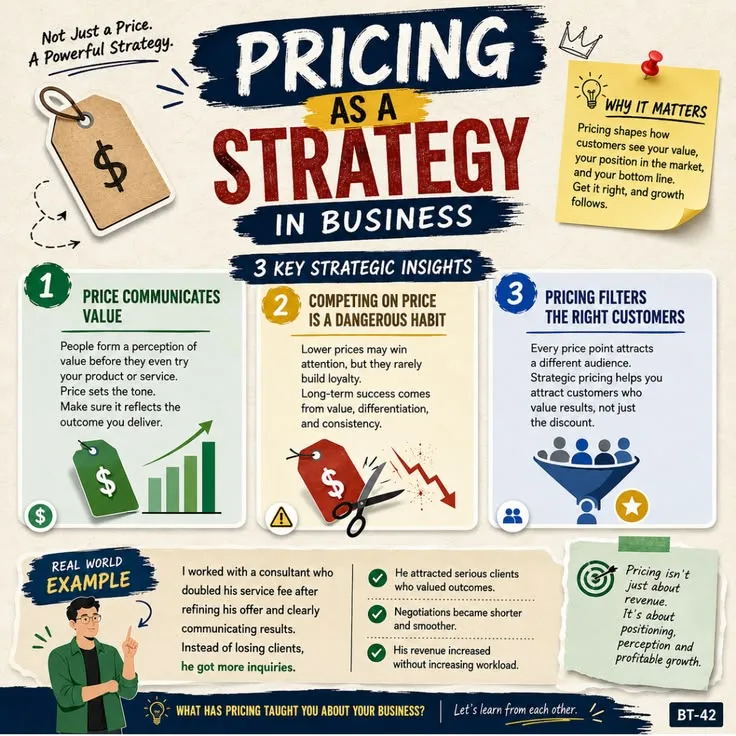
Alan Weiss billed $3,500 for his first consulting project in 1985. By 2005, he was charging $250,000 for comparable engagements - not because inflation had risen 70x, but because he had fundamentally changed how he priced his work.
Weiss, who went on to write Million Dollar Consulting and train thousands of independent consultants, made a single conceptual shift that transformed his economics: he stopped selling his time and started selling outcomes.[1] That shift - from input-based to output-based pricing - is the most important monetization decision any consultant will make, and most consultants make it far too late.
"Price is what you pay. Value is what you get." - Warren Buffett
The stakes of this decision are enormous. A consultant who bills $200/hour with 1,500 billable hours per year generates $300,000 in gross revenue - a respectable income, but one with a hard ceiling and perverse incentives.
A consultant who prices based on value can charge $50,000 for an engagement that takes four days, because the outcome - a strategic decision, a system that works, a solved problem - is worth far more than four days of labor.
Understanding the full spectrum of consulting monetization models, and the conditions under which each one works, separates consultants who scale from those who stay trapped in the time-for-money exchange.
The Fundamental Economics of Consulting
Before examining specific models, it is worth understanding why consulting economics differ from employment and from product businesses in ways that make model selection particularly consequential.
The consulting paradox: Consulting appears to be a simple business. You have knowledge someone else needs; they pay you to share it. But this simplicity conceals a set of economic tensions that shape every consulting practice:
Time scarcity: A consultant has 2,000-2,500 available work hours per year at maximum, with 1,000-1,500 billable hours being more realistic after sales, marketing, administration, and professional development. Unlike a software product, consulting revenue cannot exceed this ceiling without structural changes to the model.
Expertise leverage: The same expertise that commands $200/hour also commands $2,000/hour when priced differently and framed differently. The expertise has not changed; only the model and the framing have. This creates enormous upside potential for consultants willing to rethink their pricing.
Trust dependency: Consulting revenue is entirely dependent on client trust. Trust takes time to build, is fragile, and does not transfer easily. This means that consulting practices grow more slowly than product businesses but are also more durable once established.
Feast-and-famine cycles: The most common consulting financial problem is revenue volatility. When clients are plentiful, there is no time to find new ones. When they leave, the pipeline is empty.
Structural solutions to this problem - retainers, recurring engagements, productized offerings - are among the highest-leverage decisions any consulting practice can make.
| Pricing Model | Revenue Ceiling | Client Alignment | Cash Flow | Best Stage |
|---|---|---|---|---|
| Hourly rate | Hard ceiling | Misaligned (more hours = more revenue) | Variable | Early career |
| Project/fixed fee | Moderate | Partially aligned | Lump sum | Established practice |
| Value-based | Very high | Well aligned | Negotiated | Expert positioning |
| Retainer | High (but fixed) | Partially aligned | Predictable | Mature practice |
| Productized service | Scalable | Aligned | Predictable | Efficiency-focused |
Hourly and Daily Rate Consulting: Strengths and Ceilings
The default consulting model is billing by time: an hourly rate (common for technical consultants, lawyers, and accountants) or a daily rate (common for management consultants and specialists). This model is intuitive, easy to sell, and widely understood by buyers - which explains why it persists despite significant limitations.
The case for time-based billing: Hourly and daily rates are appropriate when the scope of work is genuinely uncertain, when the client is buying access to expertise on demand rather than a defined outcome, and when the work requires ongoing judgment that cannot be reduced to a specific deliverable.
Legal counsel, technical advisory, and fractional executive services often work best on time-based models because the value provided fluctuates with usage.
Setting time-based rates: Consulting rates are determined by market rates for expertise, by the consultant's track record and reputation, and by the buyer's willingness to pay - which is in turn determined by their perception of the consultant's value. Common anchors:
- Junior consultant with 2-5 years of experience in a generalist domain: $100-200/hour
- Mid-career specialist with 5-10 years of experience and domain authority: $200-400/hour
- Senior specialist or recognized expert with 10+ years: $400-1,000/hour
- Top-tier management consultants or well-known thought leaders: $1,000-5,000/hour
These ranges vary significantly by geography, domain, and client type. A tax consultant serving small businesses in a mid-size city commands different rates than a cloud architecture consultant serving Fortune 500 companies.
The ceiling problem: At $300/hour and 1,200 billable hours per year, annual revenue is $360,000. At $500/hour, it is $600,000. These are respectable incomes, but they require near-total occupancy at premium rates - leaving no time for business development, professional development, or any activity that does not directly produce revenue.
The ceiling exists not because the consultant is not good enough to charge more, but because the model imposes structural limits.
Hourly billing's perverse incentives: When clients pay by the hour, they naturally wonder whether they could finish faster if they worked harder. Every delay has a cost. This creates an adversarial dynamic that undermines the trust consulting depends on.
Clients also become reluctant to call with quick questions if each call appears on the invoice. The billing model creates exactly the friction that damages the relationship it depends on.
Example: McKinsey & Company charges client organizations $40,000-100,000 per week for project teams, which implies effective rates of $2,000-5,000 per consultant per day.[10]
This is not because McKinsey consultants are necessarily more knowledgeable than independent consultants with comparable experience, but because McKinsey has built a brand, methodology, and process that justify dramatically higher rates - and because they price engagements, not hours.
The lesson for independent consultants is that brand and methodology are as important as expertise in determining achievable rates.
Value-Based Pricing: The Transformation That Changes Everything
Value-based pricing is the practice of charging based on the value delivered to the client rather than the time spent delivering it. When Alan Weiss proposes a $50,000 engagement for improving an executive team's performance, he is not calculating his hourly rate times expected hours.
He is estimating the value the improvement will create for the client and pricing as a fraction of that value.
How value-based pricing works in practice:
Understand the client's business impact: Before proposing any engagement, understand what the successful outcome is worth to the client.
If improving sales team conversion by 5% adds $2 million in annual revenue, an engagement that delivers that improvement is worth a significant fraction of that value - not just the cost of the consultant's time.
Frame the proposal around outcomes: Instead of "I will provide 40 hours of sales training at $300/hour ($12,000)," propose "I will improve your sales team's conversion rate by a measurable amount and deliver a system for ongoing improvement. Fee: $35,000."
Let the value justify the price: When the client understands that the engagement is expected to produce $2 million in value, $35,000 seems like a reasonable investment rather than an expensive purchase.
Align incentives: When the consultant is compensated for outcomes rather than hours, the client's interests and the consultant's interests are naturally aligned. The consultant wants to produce results as efficiently as possible; the client wants to pay for results rather than activity.
Why most consultants resist value-based pricing:
The resistance is usually based on the consultant's own perception of their value, not the client's. Consultants who have billed by the hour for years have a mental model of their value as "worth X per hour." The leap to "worth Y for this outcome" requires rethinking the entire value proposition.
The practical challenge is articulating value clearly enough to justify the price. This requires understanding the client's business well enough to estimate the economic impact of the engagement - which in turn requires upfront investment in discovery that hourly billing models typically do not support.
Example: Brennan Dunn, founder of Double Your Freelancing, spent years helping consultants and freelancers transition to value-based pricing.[2] His research consistently showed that consultants who switched from hourly to value-based pricing nearly doubled their effective hourly rates on the same work, often without losing clients.
The difference was entirely in framing: the same work, presented as a solution to a business problem rather than a service purchased by the hour, commanded dramatically higher prices.
Dunn's own consulting practice moved from $75/hour to $10,000+ for fixed-scope engagements after he made this shift.
Retainer Models: Building Predictable Revenue
A retainer is a recurring payment in exchange for defined access or ongoing services. Retainers solve the consulting business's most intractable problem: revenue unpredictability.
A consultant with strong retainer revenue can plan investments, take on longer-term client relationships, and develop their practice - all of which are nearly impossible when revenue arrives in project-sized chunks with no predictable cadence.
Types of retainers:
Advisory retainers: The client pays a monthly fee for access to the consultant's expertise on demand. This might mean a set number of hours per month, or simply the right to call and ask questions.
Advisory retainers are valuable because they are low-effort for both parties - the client gets an expert on call; the consultant earns predictable revenue for relatively light ongoing commitment.
Deliverable-based retainers: A monthly fee in exchange for a defined monthly output - a content review, a monthly strategy call, a set of analytics reports, or a regularly updated competitive analysis. These are more structured than advisory retainers and create clearer expectations on both sides.
Fractional executive retainers: The fastest-growing retainer model, where a consultant serves in an executive function (fractional CMO, fractional CFO, fractional CTO) for a company that cannot yet justify a full-time hire.
Fractional executive engagements typically run 8-20 hours per month at $5,000-20,000 per month, depending on seniority and domain.
The economics of retainers: A consulting practice with four retainer clients at $5,000/month each generates $240,000/year in highly predictable revenue before any project work.
This baseline enables the consultant to invest in longer-term client relationships, take on higher-risk projects, and allocate time to business development without existential financial pressure.
How to transition to retainers: Most consultants who want to move to retainer models do so from existing client relationships.
After completing a project engagement, the natural next question is: "What would it be worth to have ongoing access to the insights and guidance we developed here?" Many clients who have experienced the value of an engagement are happy to pay for continued access at a fraction of the project cost.
Example: Rand Fishkin, after leaving Moz, spent time advising multiple companies through retainer arrangements before founding SparkToro in 2018.
His advisory relationships provided financial stability while he was building the new company and allowed him to develop insights into multiple markets simultaneously - insights that informed SparkToro's positioning and product development.
The combination of advisory retainers and eventual product revenue represents a common path for consultants building toward more scalable income.
Productized Consulting: Packaging for Scale and Efficiency
Productized consulting is the practice of packaging what is typically custom consulting work into a defined offering with a fixed scope, fixed price, and fixed timeline.
Instead of proposing a custom engagement for each client, the consultant offers a standardized "product" that clients can understand and purchase with minimal friction.
Why productization works:
Clarity for buyers: A defined offering with clear outcomes, process, and price removes the uncertainty that often slows consulting sales. Instead of "let's discuss what you need and then I'll propose something," the conversation becomes "here's exactly what I do, how I do it, and what it costs."
Efficiency for consultants: Delivering the same well-defined engagement repeatedly enables the consultant to build systems, templates, and processes that reduce delivery time. The tenth time a consultant runs a brand audit, they can do it better and faster than the first time - but the price does not need to drop proportionally.
Marketing scalability: A defined offering is far easier to market than custom services.[9] A landing page for "Brand Audit: A 4-week process that produces X, Y, and Z deliverables for $8,500" converts more effectively than "Custom branding consulting - contact us to discuss your needs."
Productized consulting examples across domains:
- "Strategy Sprint" - a three-day intensive process for defining or refining business strategy, delivering a documented strategy framework and implementation roadmap. Fixed price: $12,000.
- "SEO Audit" - a two-week technical and content audit of a website, delivering prioritized recommendations. Fixed price: $4,500.
- "Executive Team 360 Assessment" - a structured process for gathering feedback on leadership team effectiveness and producing individual and collective development plans. Fixed price: $25,000.
- "Design System" - a six-week engagement producing a complete design system, component library, and documentation. Fixed price: $30,000.
Example: Jonathan Stark, a mobile development consultant who pivoted to consulting strategy coaching, built a productized offering called "Hourly Rate Tune-Up" - a defined workshop for consultants who wanted to raise their rates.[3]
By packaging a defined process into a fixed-price offering, he could market, sell, and deliver it efficiently at scale, without the custom negotiation of traditional consulting proposals.
Stark's website converted visitors at rates significantly higher than his previous "contact me for a custom proposal" approach, because the buying decision was clear.
The Revenue Ladder: Multiple Offerings for Maximum Client Value
The most sustainable consulting practices do not rely on a single engagement type. They build a "revenue ladder" - multiple offerings at different price points and different levels of commitment that serve clients at different stages of their journey and maximize the revenue extracted from each client relationship over time.
A typical consulting revenue ladder:
Entry-level offerings: Low-cost, low-commitment options that allow potential clients to experience the consultant's value before making a larger commitment. This might be a book, a course, a workshop, or a half-day audit. Price range: $50-2,000.
These offerings serve as trust-building mechanisms and as filters - people who engage with entry-level offerings are more likely to be good candidates for higher-level engagements.
Core engagement: The primary consulting offering - a project, a program, or a retainer that delivers the consultant's primary value. This is where most revenue is generated for most consultants. Price range: $5,000-50,000.
Premium/ongoing: High-value, ongoing relationships for the clients who want deeper access and longer-term partnership. Advisory boards, dedicated retainer relationships, or ongoing program delivery. Price range: $50,000-500,000/year.
Moving clients up the ladder: The key to revenue ladder success is making each level serve as natural preparation for the next. A client who reads your book is better prepared to value your course.
A client who completes your course is better positioned to understand the value of a project engagement. A client who has completed a successful project is the ideal candidate for a retainer relationship.
Example: Patrick Lencioni, author and founder of The Table Group, built one of the most effective consulting revenue ladders in organizational effectiveness.[4] His books (with over 6 million copies sold) serve as low-cost entry points that establish his frameworks and build trust.
His speaking engagements (commanding $50,000-100,000 per keynote) convert book readers into clients. His firm's consulting engagements with leadership teams build on the frameworks clients already understand from the books.
Each level of the ladder feeds the next, and the entire ladder reinforces his status as the authoritative voice in organizational health - which enables premium pricing at every level.
Scaling Beyond the Individual Practitioner
The hardest challenge in consulting is growing beyond the individual. As long as the consultant is the only practitioner, revenue is capped by time. Scaling requires bringing in other people - which changes the nature of the business in fundamental ways.
Scaling options for consulting practices:
Subcontractors: The simplest scaling mechanism. The primary consultant takes on more work and outsources components to trusted peers. Revenue increases; the consultant becomes a project manager. The risk is quality control and client relationship management at scale.
Associates: Hiring employees or long-term contractors who can deliver engagements independently, while the founding consultant focuses on business development and senior client relationships. This creates leverage but requires systems, training, and management capacity.
Licensing and certification: Training other practitioners to deliver your methodology and charging for that training or for ongoing license to use proprietary frameworks and tools. This creates a fundamentally different business - training and certification rather than direct consulting - but can scale dramatically.
The E-Myth Revisited author Michael Gerber built a $100M+ business by licensing his business development methodology to coaches who delivered it worldwide.[11]
Online education: Packaging consulting methodology into online courses, programs, or digital products that can serve thousands of people without proportional time investment.
Amy Porterfield, an online marketing consultant who pivoted to online education, generated over $50 million in online course revenue by packaging her expertise into digital products.
Research and thought leadership subscriptions: Publishing proprietary research that practitioners pay to access. This is the Gartner model at enterprise scale and the Stratechery model at individual scale. Both create revenue that is not directly tied to consulting hours.
Example: Gartner, originally founded by Gideon Gartner in 1979 as a small IT advisory firm, scaled by packaging insights into subscription research products.[6] Instead of selling consulting hours, Gartner sells annual subscriptions to research reports and analyst access.
This product-like revenue model - recurring, scalable, and not bound by practitioner hours - allowed Gartner to grow to over $6 billion in annual revenue. The lesson for smaller practices is that packaging expertise into a repeatable format (reports, research, subscriptions) is the path to escaping time-for-money constraints.
Building Long-Term Client Relationships
The most efficient consulting revenue comes from clients who return repeatedly and who refer others. Building these long-term relationships requires a different orientation than closing new business - it requires genuine investment in client success, not just engagement completion.[8]
Client relationship principles:
Deliver more than contracted: The consulting engagement that delivers exactly what was promised produces a satisfied client. The engagement that delivers more than promised produces an enthusiastic advocate. In a trust-dependent business, advocates are more valuable than any marketing investment.
Stay connected between engagements: Consultants who disappear after completing a project are forgettable. Those who maintain regular contact - sharing relevant articles, checking in on outcomes, offering occasional advice without billing for it - remain top of mind when new needs emerge.
Document and track client outcomes: The evidence that a previous engagement produced measurable results is the most powerful sales tool for the next engagement. Tracking outcomes requires advance planning - defining success metrics at the beginning of an engagement and measuring them afterward.
Position as a long-term partner, not a transaction: The framing of "I am here to help you achieve your goals over time" rather than "I am here to complete this project" changes the nature of the relationship and the likelihood of repeat engagement.
Example: Bain & Company, consistently ranked among the most sought-after management consulting firms, has reported that approximately 85% of its revenue comes from repeat clients.[7]
This extraordinary retention rate reflects both the quality of delivery and the relationships Bain consultants build with client executives over time - relationships that follow the executive as they move between companies.
Bain invests explicitly in relationship management between engagements, viewing relationship maintenance as a core business function, not a courtesy.
Specialty Consulting Models Worth Knowing
Several specialized consulting models have emerged that do not fit neatly into the categories above but represent viable and sometimes highly profitable approaches:
Diagnostic-only consulting: Some consultants specialize in assessment and diagnosis without implementation. They evaluate situations, identify problems, and produce reports with recommendations - then leave.
This model is highly leveraged (diagnosis is faster than implementation) and works well for experts whose value lies in pattern recognition rather than execution.
On-demand expert networks: Platforms like GLG (Gerson Lehrman Group), Third Bridge, and AlphaSights connect experts with companies seeking specific knowledge, typically for 1-2 hour calls. Experts earn $100-1,000+ per hour on these platforms.
While not a full business model on its own, this provides supplementary revenue for consultants in specialized fields without marketing or sales effort.
Workshop and training delivery: Pure education delivery - workshops, training programs, online courses - is a consulting-adjacent model that scales better than one-to-one consulting.
A one-day workshop for 20 people at $500/person generates $10,000 for a day's work; the same expertise delivered as one-to-one consulting would generate far less.
Interim management: Stepping into executive or leadership roles on a temporary basis while organizations search for permanent hires or work through transitions. Interim managers often command full-time salaries on a contract basis, plus a premium for availability and adaptability.
See also: Content Monetization Strategies, Creator Revenue Stream Ideas, and Subscription Revenue Strategies.
What Research Shows About Consulting Monetization Models
Professor David Maister, formerly of Harvard Business School, conducted the most influential empirical research on professional service firm economics in his landmark study "The Anatomy of a Professional Service Firm," published in the Journal of Management Consulting (1993) and expanded in his book Managing the Professional Service Firm (1993, Free Press).[5]
Maister's research, drawing on financial data from hundreds of consulting and law firms across the United States and Europe, identified three levers of professional service profitability: leverage (the ratio of junior to senior staff), margin (fees minus labor costs), and throughput (billable hours per professional per year).
His central finding was that most consulting firms optimize for throughput - filling hours - at the expense of leverage and margin, producing businesses with high revenue but modest profitability.
Firms that deliberately designed their service models to maximize leverage, Maister found, generated profit margins 2-3x higher than comparable firms focused on utilization.
For independent consultants, the leverage analog is productization: creating reusable processes and outputs that reduce delivery time without reducing fees.
Dr. Heidi Gardner of Harvard Law School published research in the Harvard Business Review (2015, "When Senior Managers Won't Collaborate") and in her book Smart Collaboration (2017, Harvard Business Review Press) examining how collaboration between specialists in consulting and professional service firms affects revenue outcomes.
Gardner's multi-year study of 12 professional service firms found that clients who worked with multiple specialists within a firm generated on average 1.8x more revenue than single-practice clients.
More significantly, cross-practice clients had churn rates 35% lower than single-practice clients.
The research established that consulting revenue compounds when relationships deepen across multiple service lines - a finding that supports the "revenue ladder" model discussed in this article and suggests that consulting firms and independent consultants who develop multiple complementary offerings serve clients more profitably over time.
Professor Kathleen Eisenhardt at Stanford University's School of Engineering has studied the dynamics of strategy consulting and client decision-making through multiple papers in the Strategic Management Journal.
Her 2000 paper "Dynamic Capabilities: What Are They?" (co-authored with Jeffrey Martin, Strategic Management Journal, Vol. 21) and subsequent work on organizational learning shed light on why clients engage consultants for strategic projects: organizations facing novel, high-stakes decisions consistently reported willingness to pay 40-60% more for consultants who could demonstrate prior pattern recognition in similar situations.
Eisenhardt's research on "simple rules" in complex environments also informed consulting practice design, suggesting that consultants who can reduce complex advisory engagements to clear, implementable frameworks command premium pricing because they reduce clients' cognitive load during high-uncertainty periods.
Ron Baker, founder of the VeraSage Institute and author of Implementing Value Pricing (2011, John Wiley & Sons), has conducted ongoing research through practitioner surveys that provides some of the most concrete data on the economic impact of value-based pricing adoption.
Baker's 2019 survey of 420 consulting and professional service firms found that firms that had fully transitioned from time-based billing to value-based pricing reported average revenue increases of 42% within 24 months, with no change in client count.
More strikingly, 68% of respondents reported that client retention improved after the transition, contradicting the common fear that value-based fees would drive clients to cheaper alternatives.
Baker's research also documented that client satisfaction scores increased in value-priced engagements, likely because the outcome-aligned fee structure focused both parties on measurable results rather than hours logged.
His findings have been replicated in smaller surveys conducted by the Association of Management Consulting Firms (AMCF) with consistent results across firm sizes.
Real-World Case Studies in Consulting Monetization Models
McKinsey & Company's transition to performance-based fee arrangements in the late 2010s represents one of the most significant consulting monetization model evolutions at scale.
By 2019, McKinsey had publicly committed to including performance components in approximately 20% of its engagements - arrangements where a portion of the firm's fee was tied to measurable client outcomes including revenue growth, cost reduction, or specific operational improvements.
Internal McKinsey data shared in a 2020 McKinsey Quarterly article indicated that performance-tied engagements generated 15-25% higher total fees when outcomes were achieved, while also producing stronger client satisfaction scores and higher repeat engagement rates.
The shift reflected recognition that outcome-aligned pricing is commercially superior to pure time-and-materials billing, validating the value-based pricing principle at the scale of one of the world's largest consulting firms.
Accenture's acquisition and integration of Fjord, a design and innovation consultancy, in 2013 illustrates how consulting firms use productization to scale revenue without proportional headcount growth.
Fjord had built a distinctive "Design Sprint" methodology - a structured five-day product design process that Fjord had formalized into repeatable steps, tools, and templates.
When Accenture integrated Fjord's methodology into its broader consulting practice, the productized process enabled Accenture's consulting staff to deliver design strategy engagements with 40% less senior time per project, expanding gross margins on those engagements while maintaining fee levels.
By 2022, Accenture Song (the combined creative and innovation practice including Fjord) generated over $14 billion in annual revenue, representing approximately 18% of Accenture's total revenue - driven substantially by productized innovation methodologies that could be delivered at scale.
The Bridgespan Group, a nonprofit consulting firm serving social sector organizations, provides a case study in retainer-model consulting within a constrained-pricing environment.
Bridgespan, founded in 2000 as a nonprofit affiliate of Bain & Company, developed what it calls "anchor relationships" - multi-year consulting engagements with major foundations and nonprofits at subsidized retainer rates averaging $250,000-500,000 annually.
These relationships, funded partly through foundation philanthropy and partly through client fees, generated consistent revenue while providing Bridgespan with deep organizational access that improved the quality and specificity of their advisory work.
By 2023, Bridgespan reported working with over 350 client organizations annually, with repeat engagement rates above 70%. Their retainer model demonstrates that even in price-sensitive markets, recurring relationships built on demonstrated expertise can sustain meaningful revenue.
Bain & Company's published client retention data offers the most credible large-scale validation of long-term relationship economics in consulting.
Bain consistently reports that approximately 85% of its annual revenue comes from repeat clients - clients who have worked with Bain previously and continue to engage the firm for new projects.
At Bain's reported revenue of approximately $6 billion in 2023, this implies roughly $5.1 billion in revenue from relationship renewal rather than new client acquisition.
The financial implication is significant: consulting firms that invest in long-term relationship management - rather than continuous new client acquisition - achieve dramatically more efficient revenue generation, because the sales and marketing cost of repeat client engagements is a fraction of the cost of acquiring new clients.
Bain's retention rate is not an accident; the firm has documented processes for relationship maintenance between engagements that are treated as core business functions.
Sources & Further Reading
- Weiss, Alan. Million Dollar Consulting: The Professional's Guide to Growing a Practice. McGraw Hill, 2016. View source
- Dunn, Brennan. "Double Your Freelancing." Double Your Freelancing. View source
- Stark, Jonathan. "Hourly Billing is Nuts." Jonathan Stark.
- Lencioni, Patrick. The Advantage: Why Organizational Health Trumps Everything Else in Business. Jossey-Bass, 2012. View source
- Maister, David. Managing the Professional Service Firm. Free Press, 1993. View source
- Gartner. "About Gartner." Gartner. View source
- Bain and Company. "About Bain." Bain. View source
- Block, Peter. Flawless Consulting: A Guide to Getting Your Expertise Used. Pfeiffer, 2011. View source
- Beckwith, Harry. Selling the Invisible: A Field Guide to Modern Marketing. Warner Books, 1997. View source
- McKinsey and Company. "Our Mission and Values." McKinsey.
- Gerber, Michael. The E-Myth Revisited. HarperCollins, 1995. View source