
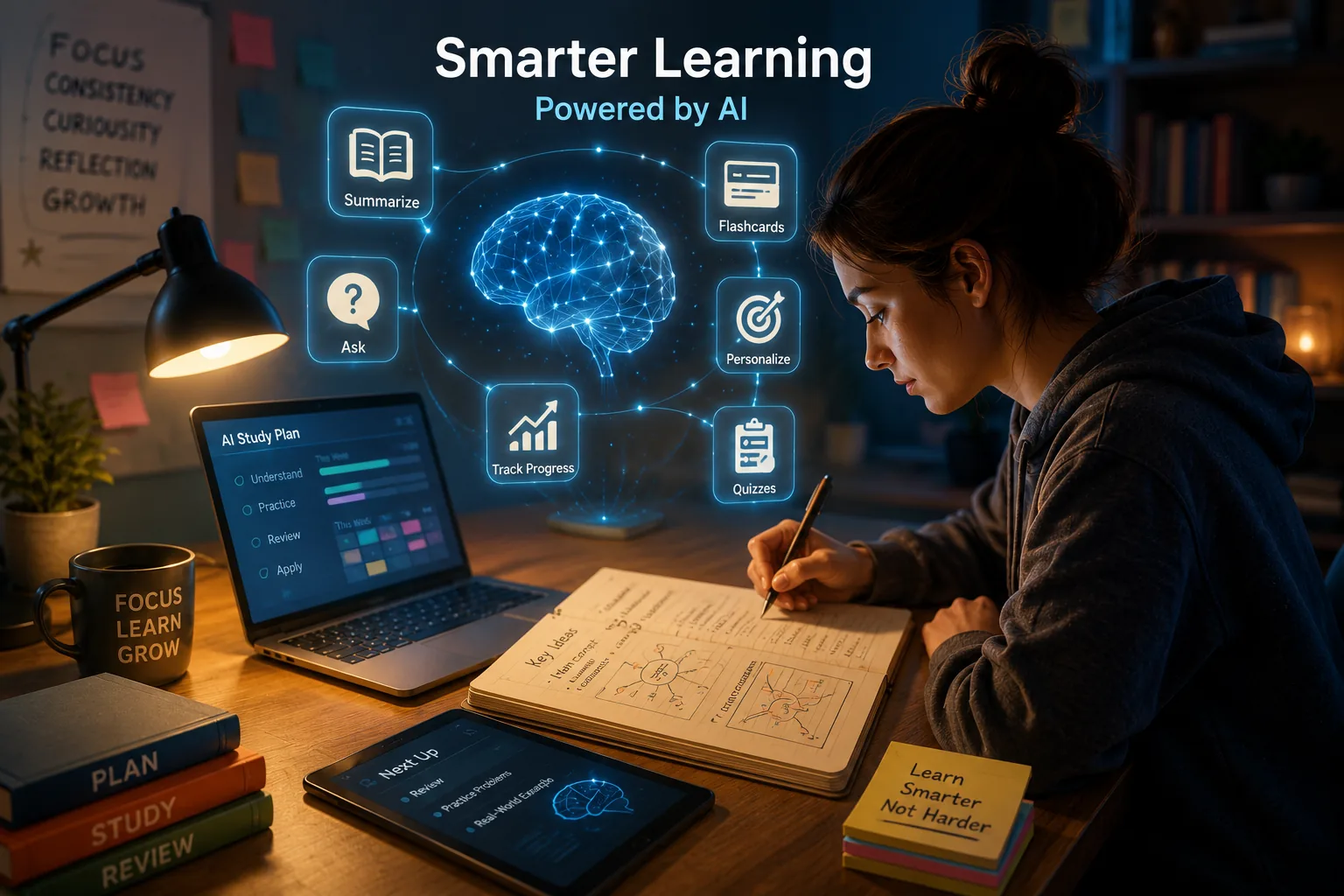
Introduction: The Learning Crisis Nobody Talks About
There is a quiet crisis unfolding in how adults learn. Not in schools or universities - those institutions, for all their flaws, at least provide structure. The crisis lives in the gap between what working professionals need to learn and the tools they have to learn it.
A software engineer needs to pick up Rust. A marketing director needs to understand machine learning well enough to manage an AI team. A physician needs to stay current with a biomedical literature that adds over a million new papers a year.
The old methods - reading a textbook, watching a lecture, taking notes - were designed for a world where foundational knowledge changed slowly over decades. Today, published technical literature and digital documentation expand far faster than any static curriculum can track.
Into this gap, artificial intelligence has arrived with a set of promises that range from the genuinely transformative to the deeply misleading. AI tutors that adapt to your pace. Spaced repetition systems that know exactly when you are about to forget something. Knowledge gap identifiers that map the dark corners of your understanding before you even realize they exist.
These tools are real, they are available now, and some of them work remarkably well. But understanding which ones actually improve learning - and which ones create a dangerous illusion of competence - requires going deeper than the marketing copy.
"The illiterate of the 21st century will not be those who cannot read and write, but those who cannot learn, unlearn, and relearn." - Alvin Toffler
This article is a practitioner's guide to using AI for learning optimization. It is not a catalog of apps or a breathless prediction about the future of education.
It is an attempt to answer a specific question: given what we know about cognitive science and what AI can currently do, how should a serious learner design their study system in 2026?
The answer involves three categories of tools, each addressing a different failure mode in human learning. Adaptive tutors fix the pacing problem - the fact that traditional education moves too fast for some learners and too slowly for others.
Spaced repetition schedulers fix the forgetting problem - the well-documented reality that we forget a large share of new information within days unless we review it at precisely calibrated intervals. Knowledge gap identifiers fix the blindspot problem - our persistent inability to accurately assess what we do and do not know.
Used together, these three tool types create something that has never existed before: a learning system that is simultaneously personalized, scientifically timed, and diagnostically aware. But the system only works if you understand the science underneath it, the limitations around it, and the human elements that no algorithm can replace.
Part 1: The Science of Learning That AI Actually Leverages
"Tell me and I forget, teach me and I may remember, involve me and I learn." - Benjamin Franklin
Before examining any tool, we need to establish what learning science has proven with reasonable confidence. AI learning tools are only as good as the cognitive principles they exploit, and many popular tools are built on shaky or outdated foundations.
The Three Pillars of Durable Learning
Cognitive science has identified three mechanisms that reliably produce long-term retention and transferable understanding. Every effective AI learning tool leverages at least one of them.
Active Recall is the practice of retrieving information from memory rather than passively reviewing it. When you close the textbook and try to explain a concept from scratch, you are engaging in active recall.
The testing effect - the finding that being tested on material produces better retention than restudying it - is one of the most replicated results in educational psychology.
Roediger and Butler's 2011 review in Trends in Cognitive Sciences summarized evidence that retrieval practice improves long-term retention compared to restudying.[2]
Spaced Repetition is the practice of reviewing information at increasing intervals calibrated to the forgetting curve. Hermann Ebbinghaus first documented the forgetting curve in 1885, showing that memory decays exponentially after initial learning.[1]
The optimal review schedule spaces reviews just before the point of forgetting, forcing the brain to reconstruct the memory while it is still partially accessible. Each successful retrieval extends the interval before the next review is needed.
The mathematical models behind modern spaced repetition systems - particularly the SM-2 algorithm and its successors - can predict individual forgetting rates with surprising accuracy.
Interleaving is the practice of mixing different types of problems or topics during a study session rather than focusing on one type at a time (blocked practice).
Rohrer and Taylor's 2007 study found that interleaved practice roughly tripled test performance (63% vs. 20%) compared to blocked practice, even though students felt less confident during interleaved sessions.[6]
This feeling of difficulty is itself diagnostic - it signals that deeper processing is occurring.[9]
Why Traditional Learning Fails
"The illusion of knowing is the enemy of learning." - Richard Feynman
Traditional learning methods - highlighting, rereading, summarizing, cramming - fail because they exploit none of these three mechanisms.[13] Highlighting feels productive because it creates a visual sense of engagement, but it involves no retrieval.
Rereading produces fluency, which the brain mistakes for understanding. Cramming can produce short-term recall but creates almost no durable memory because it collapses the spacing intervals to zero.
The table below summarizes the evidence for common study strategies:
| Strategy | Active Recall | Spacing | Interleaving | Evidence Quality | Effectiveness |
|---|---|---|---|---|---|
| Rereading | No | No | No | High | Very Low |
| Highlighting | No | No | No | High | Very Low |
| Summarizing | Partial | No | No | Moderate | Low |
| Practice Testing | Yes | Possible | Possible | High | High |
| Spaced Practice | Possible | Yes | Possible | High | High |
| Interleaved Practice | Yes | Possible | Yes | High | High |
| Elaborative Interrogation | Yes | No | No | Moderate | Moderate |
| Self-Explanation | Yes | No | No | Moderate | Moderate |
Source: Dunlosky et al., "Improving Students' Learning With Effective Learning Techniques" (2013)
What AI Adds to Proven Science
AI does not invent new learning science. What it does - at its best - is solve the implementation problem. Spaced repetition works, but manually calculating optimal review intervals is impractical. Active recall works, but generating good questions for yourself is cognitively expensive and prone to bias.
Interleaving works, but designing interleaved practice sequences requires understanding the relationships between topics.
AI can automate all three of these tasks with a level of precision and personalization that was previously impossible. A large language model can generate hundreds of retrieval practice questions at arbitrary difficulty levels.
A spaced repetition algorithm can track thousands of individual facts and schedule reviews for each one independently. A knowledge-tracing model can analyze your error patterns and identify conceptual gaps you did not know you had.
The question is not whether AI can do these things. It can. The question is whether specific tools do them well, and whether learners use those tools in ways that activate the right cognitive mechanisms rather than bypassing them.
Part 2: Three Categories of AI Learning Tools
Category 1: Adaptive Tutors
Adaptive tutors are AI systems that adjust their instruction based on the learner's demonstrated understanding. At their simplest, they increase difficulty when the learner succeeds and decrease it when the learner struggles.
At their most sophisticated, they maintain a probabilistic model of the learner's knowledge state and select the next instructional action to maximize expected learning gain.[16]
How They Work
Modern adaptive tutors use one of two approaches. The first is Bayesian Knowledge Tracing (BKT), which models each skill as a binary variable - either the student has learned it or has not - and updates the probability after each interaction.
BKT was developed by Corbett and Anderson in 1994 and remains the foundation of systems like Carnegie Learning's MATHia.[4]
The second approach uses deep learning models that process the entire sequence of student interactions to predict performance on the next item. Deep Knowledge Tracing (DKT), introduced by Piech et al.[5] in 2015, uses recurrent neural networks to capture complex dependencies between skills that BKT misses.
For example, DKT can learn that a student who struggles with fractions and succeeds at basic algebra is likely to struggle with rational expressions - a connection that requires understanding the relationship between those topics.
Real Tools in This Category
ChatGPT and Claude as Socratic Tutors. The most accessible adaptive tutors in 2026 are general-purpose large language models used with deliberate prompting strategies. Neither ChatGPT nor Claude was designed as a tutor, but both can function as remarkably effective ones when the learner understands how to direct the interaction.
The key technique is Socratic prompting - instructing the model to ask questions rather than provide answers. Here is a concrete workflow:
System Prompt for Socratic Learning Session:

You are a Socratic tutor helping me learn [TOPIC]. Follow these rules:
1. Never give me the answer directly. Ask guiding questions instead.
2. Start by asking me to explain what I already know about the topic.
3.
When I make an error, do not correct it immediately. Ask me a question
   that will help me discover the error myself.
4. Periodically ask me to summarize what I have learned so far in my own words.
5.
When I demonstrate understanding of a concept, increase the complexity.
6. If I am stuck for more than two attempts, give a small hint - not the answer.
7. At the end of the session, give me three retrieval practice questions
   to answer without looking at our conversation.
This approach works because it forces active recall.
The model does not let you passively absorb information - it requires you to construct understanding through your own reasoning.
The difficulty adjustment happens naturally through the conversation: when you demonstrate mastery, the model asks harder questions; when you struggle, it provides scaffolding.
The limitation is that the learner must have the discipline to use the tool this way. It is far easier - and far less effective - to simply ask ChatGPT to explain a topic and read the explanation. That is rereading with extra steps.
Duolingo. Duolingo is arguably the most successful adaptive learning product ever built. Its AI system, Birdbrain, uses a combination of spaced repetition, knowledge tracing, and bandit algorithms to select the next exercise for each user.
As of 2025, Duolingo processes over 8 billion exercises per month, giving it a dataset that dwarfs most educational research studies.
Duolingo's adaptive system works at multiple levels. At the item level, it tracks your ability on individual words and grammar patterns. At the session level, it adjusts the mix of new content and review based on your recent performance.
At the curriculum level, it decides when you are ready to advance to new topics and when you need more practice on foundational material.
The research on Duolingo's effectiveness is mixed but generally positive. Duolingo-sponsored research (e.g., Vesselinov & Grego, 2012) has reported that learners gained proficiency comparable to a university semester of instruction, though these studies were company-funded.
Speaking and writing gains were significantly lower, which points to a fundamental limitation: adaptive tutors can only optimize for the skills they actually practice.
Khan Academy with Khanmigo. Khan Academy's AI tutor, Khanmigo, combines the Khan Academy content library with GPT-4-class language models. Unlike raw ChatGPT, Khanmigo is specifically constrained to educational interactions and aligned with Khan Academy's pedagogical framework.
It provides Socratic questioning, worked examples, and progress tracking integrated with Khan Academy's existing mastery-based learning system.
Adaptive Tutor Effectiveness Framework
| Factor | High Effectiveness | Low Effectiveness |
|---|---|---|
| Learner's Role | Actively generating answers | Passively reading explanations |
| Feedback Type | Immediate, specific, diagnostic | Delayed, generic, correctness-only |
| Difficulty Curve | Dynamically adjusted to ZPD | Fixed or manually adjusted |
| Practice Type | Interleaved across related skills | Blocked on single skill |
| Session Design | Short, frequent, distributed | Long, infrequent, massed |
ZPD = Zone of Proximal Development (Vygotsky) - the range of tasks a learner can perform with guidance but not yet independently.
Category 2: Spaced Repetition Schedulers
Spaced repetition schedulers are the most empirically grounded category of AI learning tools. The underlying science is not controversial - dozens of studies over more than a century confirm that spaced practice produces dramatically better retention than massed practice.
What AI adds is the ability to optimize the spacing schedule for each individual item and each individual learner.
How They Work
The foundational algorithm is SM-2, developed by Piotr Wozniak in 1987 for the SuperMemo system.[7] SM-2 assigns each item an "easiness factor" based on the learner's self-reported difficulty ratings, and uses this factor to calculate the next review interval.
Items rated as easy get longer intervals; items rated as difficult get shorter ones.
Modern systems have moved well beyond SM-2. Anki uses a modified version of SM-2 with some additional heuristics. The FSRS (Free Spaced Repetition Scheduler) algorithm, developed by Jarrett Ye and integrated into Anki in 2023, uses machine learning to model forgetting curves for individual users and items.[8]
FSRS has been shown to produce the same retention rates as SM-2 with 20 to 30 percent fewer reviews, because it more accurately predicts when each specific learner will forget each specific item.
The mathematical model behind FSRS is worth understanding at a high level. For each item, the algorithm maintains four parameters:
- Stability (S): How long the memory will last before dropping below the desired retention threshold. After a successful review, stability increases by a factor that depends on the current stability, difficulty, and retention at the moment of review.
- Difficulty (D): An inherent property of the item, updated after each review based on the learner's rating.
- Retrievability (R): The current probability of successful recall, calculated as a function of time elapsed since last review and the stability parameter.
- Desired Retention (DR): The target probability of recall at the moment of review, set by the user (typically 0.85 to 0.95).
The scheduling formula determines the optimal interval as the time at which retrievability is predicted to equal the desired retention:
Optimal Interval = 9 * S * (1/DR - 1)

Where:
  S  = current stability (in days)
  DR = desired retention (e.g., 0.90)
Real Tools in This Category
Anki. Anki remains the gold standard for spaced repetition, not because its interface is elegant (it is not) but because its open architecture allows for the most precise control over the learning process. With the FSRS scheduler enabled, Anki provides state-of-the-art memory optimization.
The critical skill with Anki is card design. Poorly designed cards produce poor results regardless of how good the scheduling algorithm is. The two most important principles are:
Minimum Information Principle: Each card should test one atomic piece of knowledge. A card that asks "Explain the French Revolution" is useless. A card that asks "What event is traditionally considered the start of the French Revolution? (Answer: Storming of the Bastille, July 14, 1789)" is effective.
Cloze Deletions Over Basic Cards: Cloze deletions (fill-in-the-blank) force deeper processing than simple question-answer pairs because they require you to reconstruct the missing piece within a context.
Here is an example of an effective Anki card workflow for learning a technical subject:
Step 1: Read a section of source material

Step 2: Close the material and write down key concepts from memory

Step 3: Create Anki cards using this template:

  For facts:
    Front: "The forgetting curve was first documented by {{c1::Hermann Ebbinghaus}}
            in {{c2::1885}}."

  For processes:
    Front: "What are the three steps in the SQ3R reading method?"
    Back:  "Survey, Question, Read, Recite, Review"

  For understanding:
    Front: "Why does interleaving produce better learning than blocked practice,
            even though it feels harder?"
    Back:  "Interleaving forces the brain to discriminate between problem types
            and select the appropriate strategy, which is the actual skill needed
            on tests and in real applications.
The feeling of difficulty is
            'desirable difficulty' - it signals deeper processing."

Step 4: Review cards daily as scheduled by FSRS
AI-Enhanced Card Creation. One of the most powerful recent developments is using large language models to generate Anki cards from source material.
This solves the biggest practical barrier to spaced repetition: the time cost of card creation.
A practical workflow:
Prompt for AI Card Generation:

I am studying [TOPIC]. Below is an excerpt from my study material. Generate
Anki flashcards following these rules:

1. Each card tests exactly one piece of knowledge
2. Use cloze deletion format where possible
3.
Include "why" and "how" cards, not just "what" cards
4. Difficulty should range from basic recall to application
5. Include 1-2 cards that test common misconceptions
6.
Format output as:
   FRONT: [question or cloze text]
   BACK: [answer]
   TAGS: [relevant topic tags]

Source material:
[PASTE MATERIAL HERE]
This workflow preserves the benefits of spaced repetition while dramatically reducing the preparation time.
The key caveat is that you must review the generated cards for accuracy and relevance. AI-generated cards occasionally contain subtle errors that, once memorized through spaced repetition, become deeply ingrained and difficult to correct.
Duolingo (Again). Duolingo deserves mention here as well because its spaced repetition system operates at the vocabulary level. Every word and grammar pattern you encounter in Duolingo has its own forgetting curve, and the system schedules reviews accordingly.[10]
This is why returning to Duolingo after a break produces a flood of review exercises - the system is catching up on items whose retrievability has dropped below threshold.
Category 3: Knowledge Gap Identifiers
"The expert in anything was once a beginner." - Helen Hayes
Knowledge gap identification is the newest and most underdeveloped category, but it may be the most important. Research on metacognition - our ability to accurately assess our own knowledge - consistently shows that humans are poor judges of what they know.
The Dunning-Kruger effect is the most famous example, but the problem extends far beyond novices overestimating their ability.[11] Even experts have systematic blind spots in their knowledge that they are unaware of.
How They Work
Knowledge gap identification systems analyze patterns in a learner's responses to identify areas of weakness that the learner has not explicitly flagged. The simplest version is item response theory (IRT), which models the probability of a correct response as a function of the learner's ability and the item's difficulty.
When a learner consistently fails items that share a particular prerequisite skill, the system can infer a gap in that prerequisite.
More sophisticated systems use knowledge graph approaches, where concepts are represented as nodes and prerequisite relationships as edges. When a learner demonstrates mastery of a concept but fails at concepts that depend on it, the system can identify specific missing connections in the learner's understanding.
Real Tools in This Category
Perplexity for Knowledge Mapping. Perplexity is not designed as a learning tool, but its combination of search and synthesis makes it unusually effective for knowledge gap identification.
The technique is to use Perplexity to explore a topic you think you understand, then note every point where the results surprise you or contradict your existing understanding.
A structured knowledge mapping workflow:
Step 1: Write down everything you think you know about [TOPIC] in a
        bulleted list (no looking anything up)

Step 2: For each bullet point, query Perplexity:
        "What are common misconceptions about [BULLET POINT TOPIC]?"

Step 3: For the overall topic, query Perplexity:
        "What are the key subtopics of [TOPIC] that are often overlooked
         by intermediate learners?"

Step 4: Compare Perplexity's output to your original list.
Gaps appear as:
        - Subtopics you did not list at all (unknown unknowns)
        - Misconceptions you held (incorrect knowledge)
        - Connections between subtopics you did not make (missing links)

Step 5: Create learning objectives for each identified gap
ChatGPT and Claude for Diagnostic Assessment. Large language models can function as diagnostic assessors when prompted correctly.
The technique is to ask the model to test you systematically across a topic's knowledge space, then analyze your response patterns.
Diagnostic Assessment Prompt:

I want to assess my understanding of [TOPIC]. Please do the following:

1. Identify the 8-10 key subtopics or skills within [TOPIC]
2. For each subtopic, ask me one diagnostic question that tests
   conceptual understanding (not just recall)
3.
After I answer all questions, provide:
   - A score for each subtopic (strong / moderate / weak)
   - Specific knowledge gaps you identified
   - A recommended study plan prioritized by gap severity
   - Three prerequisite concepts I should verify before continuing

Do not give me the answers until I have attempted all questions.
Ask me the questions one at a time.
This approach leverages the model's broad knowledge to identify gaps that the learner cannot see because, by definition, you cannot know what you do not know.
The diagnostic quality depends heavily on the model's accuracy in the domain, which is generally high for well-established subjects and lower for rapidly evolving or niche fields.
Formative Assessment Platforms. Tools like Quizlet's AI features and Coursera's built-in assessments provide automated knowledge gap identification within their content ecosystems. These tools track your performance across topics and flag areas where your accuracy falls below threshold.
The advantage over general-purpose AI is that they have structured content maps, so their gap identification is more systematic. The disadvantage is that they only cover their own content.
Part 3: Building a Personal AI-Augmented Learning System
Knowing about individual tools is necessary but not sufficient. The real leverage comes from combining tools into an integrated system that addresses all three failure modes - pacing, forgetting, and blind spots - simultaneously. This section provides a concrete framework for building that system.
The Learning Optimization Loop
An effective AI-augmented learning system follows a four-phase loop:
Phase 1: DIAGNOSE
  - Identify what you need to learn (goal setting)
  - Assess what you already know (gap identification)
  - Map prerequisites (dependency analysis)
  Tools: Claude/ChatGPT diagnostic prompts, Perplexity knowledge mapping

Phase 2: ACQUIRE
  - Study new material using adaptive difficulty
  - Engage in Socratic dialogue for complex concepts
  - Generate active recall opportunities during study
  Tools: ChatGPT/Claude Socratic tutoring, Khan Academy, textbooks

Phase 3: CONSOLIDATE
  - Create spaced repetition cards for key knowledge
  - Schedule reviews at optimal intervals
  - Interleave practice across related topics
  Tools: Anki with FSRS, AI-generated flashcards

Phase 4: EVALUATE
  - Test understanding through application
  - Identify remaining gaps
  - Adjust study priorities based on performance
  Tools: Practice problems, diagnostic assessments, project-based application

Repeat: Results from Phase 4 feed back into Phase 1
A Week in the Life of the System
Here is what this system looks like in practice for someone learning statistics:
Monday - Diagnosis (30 minutes)
Start the week by assessing where you stand. Open Claude and run the diagnostic assessment prompt for your current topic (hypothesis testing). Review the results and identify the two weakest subtopics. Set those as the week's priority.
Tuesday through Thursday - Acquisition and Consolidation (45 minutes each)
Each session has three parts:
Anki Reviews (15 minutes): Complete all due cards. This maintains previously learned material. Do not skip this even when you want to focus on new material - the reviews are calibrated to take the minimum time needed to prevent forgetting.
New Material with Socratic Tutoring (20 minutes): Study one subtopic using a Socratic prompt with ChatGPT or Claude. Resist the urge to ask the model to explain things to you. Instead, try to explain it yourself and let the model find holes in your explanation.
Card Creation (10 minutes): Generate Anki cards for the key concepts from today's session. Either create them manually (slower but produces better encoding) or use AI generation followed by manual review (faster but requires careful quality control).
Friday - Evaluation (30 minutes)
Run a diagnostic assessment covering the week's topics. Compare results to Monday's baseline. Identify any persistent gaps. Adjust next week's priorities.
Weekend - Application (variable)
Apply what you have learned to a real problem. For statistics, this might mean analyzing a real dataset. For programming, building a small project. For a language, having a conversation. Application is where you discover whether you actually understand the material or have merely memorized isolated facts.
Configuring Your Tools
Anki Settings for Optimal Learning
Recommended FSRS Settings:
  - Desired Retention: 0.90 (balance between retention and review load)
  - Maximum Interval: 365 days (prevents cards from disappearing forever)
  - New Cards per Day: 15-25 (depends on subject complexity)
  - Learning Steps: 1m 10m (for initial learning before entering review)

Card Design Guidelines:
  - Maximum 1 concept per card
  - Include context (not isolated facts)
  - Use images for spatial/visual information
  - Tag cards by topic and difficulty for filtered study
ChatGPT/Claude Session Structure
Effective Session Template:

1. State your learning objective for the session
2. Ask the AI to quiz you on prerequisites first
3. Engage in Socratic dialogue on new material (20 min max)
4. Ask the AI to summarize the key points you got wrong
5.
Ask the AI to generate 5 retrieval practice questions
6. Attempt the questions without looking at the conversation
7. Ask the AI to evaluate your answers and identify remaining gaps
Common System Failures and How to Fix Them
| Failure Mode | Symptom | Root Cause | Fix |
|---|---|---|---|
| Review Debt | Anki reviews pile up, feels overwhelming | Too many new cards, missed days | Reduce new cards/day, never skip reviews |
| Passive Consumption | High study time, low retention | Reading AI explanations instead of generating answers | Switch to Socratic prompting, always attempt before reading |
| Isolated Knowledge | Can answer flashcards but cannot apply concepts | Cards test recall without context | Add application cards, practice on real problems |
| Tunnel Vision | Deep knowledge in some areas, complete ignorance in others | No systematic gap identification | Run diagnostic assessment monthly |
| Tool Addiction | Cannot think without AI assistance | Over-reliance on AI for every question | Schedule "AI-free" study sessions weekly |
Part 4: Measuring Learning Outcomes With AI
One of the most underappreciated capabilities of AI learning tools is their ability to provide quantitative feedback on the learning process itself.
Traditional learning is largely unmeasured - you study for some number of hours, feel more or less confident, and find out whether it worked when you take a test. AI tools generate data at every step, and learning to use that data is a meta-skill that compounds over time.
Metrics That Matter
Retention Rate. This is the percentage of Anki reviews you answer correctly. FSRS provides this metric directly. A healthy retention rate is between 85 and 92 percent. Below 85 percent, you are forgetting too much - either your cards are poorly designed or you need to reduce new card intake.
Above 95 percent, you are reviewing too frequently - increase your desired retention threshold to reduce wasted reviews.
Time to Mastery. Track how many sessions it takes to reach fluency in a new subtopic. Over time, this metric should decrease as you build better prerequisite knowledge and develop more efficient learning strategies.
If time to mastery is increasing, it may indicate that you are skipping prerequisites or that the material is genuinely more complex.
Diagnostic Score Trends. If you run diagnostic assessments regularly (monthly or per learning cycle), track your scores over time. The pattern matters more than individual scores. Consistent improvement across subtopics indicates balanced learning. Improvement in some areas with stagnation in others indicates a gap in prerequisites.
Application Success Rate. This is the hardest metric to quantify but the most important. Can you actually use what you have learned? Track the percentage of real-world tasks where you can apply your knowledge without needing to look things up.
For programming, this might be the percentage of coding problems you can solve without consulting documentation. For a foreign language, the percentage of conversations where you can express your intended meaning.
Building a Learning Dashboard
A practical learning dashboard can be built with simple tools:
Weekly Learning Dashboard Template:

Date Range: [Week of ____]
Topic: [Current learning focus]

RETENTION METRICS
  Anki Retention Rate: ____%
  Cards Reviewed This Week: ____
  New Cards Added: ____
  Review Burden (minutes/day): ____

PROGRESS METRICS
  Diagnostic Score (start of week): ____/10
  Diagnostic Score (end of week): ____/10
  Subtopics Covered: ____
  Subtopics Mastered: ____

APPLICATION METRICS
  Practice Problems Attempted: ____
  Practice Problems Solved Without Help: ____
  Real-World Applications This Week: ____

QUALITATIVE NOTES
  What clicked this week:
  What is still confusing:
  Adjustments for next week:
This dashboard takes five minutes to fill out and provides the feedback loop necessary for deliberate practice.[15]
Without measurement, learning optimization is guesswork. With it, you can make evidence-based decisions about where to focus your time.
Using AI to Analyze Your Own Learning Data
An advanced technique is to feed your learning data back into a language model for analysis. After several weeks of tracking, you can provide your dashboard data to Claude or ChatGPT and ask for pattern analysis:
Learning Data Analysis Prompt:

Here are my weekly learning dashboard entries for the past 6 weeks:
[PASTE DATA]

Please analyze the following:
1. Trends in my retention rate - is it stable, improving, or declining?
2. Correlation between new card volume and retention rate
3.
Topics where my diagnostic scores are stagnating
4. My ratio of study time to application time - is it balanced?
5. Specific recommendations for adjusting my learning system

Be critical and specific.
I want actionable insights, not encouragement.
This meta-learning practice - using AI to optimize your use of AI for learning - creates a compounding effect that is difficult to achieve through intuition alone.
Part 5: When AI Helps vs. When AI Hurts Learning
The most important section of this article is not about which tools to use. It is about when not to use them.
AI learning tools can create two categories of harm: they can produce an illusion of competence, and they can atrophy cognitive skills that you need. Understanding these risks is essential for any serious learner.
The Illusion of Competence
The single greatest risk of AI learning tools is that they make you feel like you are learning when you are not. This is not a new problem - highlighting and rereading create the same illusion - but AI amplifies it dramatically because AI-generated explanations are so fluent and clear that reading them feels like understanding them.
Consider this scenario: you ask ChatGPT to explain how neural networks learn through backpropagation. It produces a clear, well-structured explanation with an analogy about adjusting weights. You read it and think, "That makes sense." You have now learned approximately nothing.
The fluency of the explanation hijacks your metacognitive monitoring system. Your brain interprets "I can follow this explanation" as "I understand this concept," but these are entirely different things. Following an explanation is passive comprehension.
Understanding a concept means you can reconstruct the explanation from scratch, apply it to novel situations, and identify where the analogy breaks down.
Protective strategies:
Always attempt before consulting. Before asking AI anything, write down your current understanding, even if it is wrong. This gives you a baseline to compare against and forces retrieval.
Explain it back. After reading an AI explanation, close it and explain the concept in your own words. If you cannot, you did not learn it - you just read it.
Apply immediately. After learning a concept, use it to solve a problem the AI did not show you. Transfer to novel contexts is the only reliable test of understanding.
Wait and test. The true test of learning is whether you can recall and apply the concept days later, not minutes later. Spaced retrieval is the corrective.
Cognitive Skills That Atrophy
Certain cognitive skills are developed through struggle, and AI tools that eliminate the struggle also eliminate the development. The following table maps common AI uses to the cognitive skills they may atrophy:
| AI Use | Cognitive Skill at Risk | Why It Matters |
|---|---|---|
| AI generates all study questions | Question formulation | The ability to ask good questions is itself a high-value skill |
| AI summarizes readings | Analytical reading | Extracting key ideas from complex text requires practice |
| AI writes code solutions | Debugging reasoning | Working through errors builds systematic problem-solving |
| AI provides instant answers | Tolerance for ambiguity | Real problems do not come with clean answers |
| AI structures your study plan | Self-regulation | Managing your own learning is a lifelong meta-skill |
| AI corrects your writing | Revision skills | Learning to identify and fix your own errors builds critical thinking |
The Goldilocks Zone
The optimal use of AI for learning sits in a narrow zone between too much and too little assistance. Too little, and you waste time on tasks that AI could handle efficiently (like scheduling reviews or generating practice problems). Too much, and you outsource the cognitive work that produces actual learning.
Activities where AI should do more:
- Scheduling spaced repetition reviews (pure optimization, no learning value in doing it manually)
- Generating large sets of practice problems (creative but repetitive task)
- Providing immediate feedback on factual accuracy (speed matters, no learning value in delayed feedback)
- Tracking and analyzing your learning metrics (data processing, not learning)
Activities where AI should do less:
- Formulating your own questions about new material (question generation is itself a learning activity)
- Struggling with difficult problems before getting hints (productive struggle builds problem-solving capacity)[14]
- Writing summaries of what you have learned (synthesis requires deep processing)
- Deciding what to study next (self-regulation is a transferable skill)
- Debating ideas and forming opinions (critical thinking requires wrestling with ambiguity)
Activities where AI should be absent:
- Developing physical skills (playing an instrument, sports, lab techniques)
- Building social and emotional intelligence (empathy, negotiation, leadership)
- Creative work where the process is the product (writing for self-expression, art)
- Ethical reasoning and value formation (these require personal reflection, not optimization)
Part 6: The Future of AI in Education
Making predictions about AI is a reliable way to be wrong, but certain trajectories are visible enough to inform how learners should prepare for the next three to five years.
Near-Term Developments (2026-2028)
Multimodal Tutoring. Current AI tutors are primarily text-based, which limits them to domains where text is the natural medium. The integration of vision, voice, and real-time interaction will expand AI tutoring into domains that are currently underserved.
Imagine an AI tutor that watches you solve a physics problem on a whiteboard, identifies where your free-body diagram goes wrong, and asks a Socratic question about the force you missed - all in real-time through a camera feed. The foundational models for this exist; the integration into learning tools is imminent.
Continuous Knowledge Modeling. Current tools model your knowledge only during explicit study sessions. Future systems will build a persistent model of your knowledge that updates continuously from your daily activities - the articles you read, the conversations you have, the code you write, the emails you send.
This ambient knowledge tracking will enable spaced repetition systems that schedule reviews based on your actual exposure to concepts, not just your flashcard interactions.
Personalized Curriculum Generation. Today, AI can tutor you on a topic, but it cannot design a coherent curriculum that sequences topics optimally for your specific knowledge state and goals.
This requires combining knowledge gap identification with curriculum planning, which requires understanding prerequisite relationships between thousands of concepts. The knowledge graphs and planning capabilities needed for this are advancing rapidly.
Medium-Term Developments (2028-2031)
AI Learning Companions. Rather than discrete tools that you use for specific tasks, expect the emergence of persistent AI learning companions that know your entire learning history, understand your goals, and proactively suggest learning activities.
These systems will bridge the gap between separate tools - your spaced repetition data will inform your tutoring sessions, your diagnostic assessments will adjust your review schedule, and your application performance will reshape your curriculum.
Collaborative AI Learning. Current AI learning tools are designed for individual use.
Future systems will facilitate group learning by identifying complementary knowledge gaps among team members, suggesting peer teaching opportunities (the person who understands topic A teaches it to the person who understands topic B, and vice versa), and coordinating group study sessions that maximize learning for all participants.
Credentialing Through Demonstrated Knowledge. As AI enables more precise measurement of what someone actually knows and can do, the value of traditional credentials (degrees, certificates) will shift.
Employers and institutions will increasingly accept AI-verified competency profiles as evidence of qualification. This will accelerate the already-growing trend toward skills-based hiring and away from degree-based filtering.
What This Means for Learners Today
The practical implication of these developments is that learning to learn with AI is itself a critical skill that will compound over time.
Learners who develop sophisticated AI-augmented study systems now will have a significant advantage as the tools improve, because they will already understand the cognitive principles that determine whether any tool - current or future - actually produces learning.
The most durable investment you can make is not in mastering any specific tool but in understanding the learning science underneath all of them. Tools change; the testing effect, spaced repetition, and interleaving do not.
A learner who understands why active recall works will immediately see how to use any new AI tool effectively, while a learner who merely follows the current tool's defaults will need to relearn their approach with each new product cycle.
The Enduring Role of Human Elements
As AI learning tools become more sophisticated, the distinctly human elements of learning become more important, not less. Three elements will remain irreducible:
Motivation. No AI system can make you want to learn. The deepest, most durable motivation comes from human sources - a mentor who believes in you, a community of fellow learners, a personal connection to the subject matter, a sense of purpose that transcends any individual topic.
AI can optimize the process of learning, but it cannot supply the reason for learning.
Judgment. Knowing what to learn is at least as important as learning efficiently. AI can help you learn anything, but deciding what deserves your finite learning time requires judgment about your values, goals, and the world you live in.
This judgment comes from lived experience, conversation with wise people, and deep reflection - none of which can be outsourced to an algorithm.
Meaning-Making. The purpose of learning is not to accumulate information but to construct meaning - to build a coherent understanding of the world that informs your actions and enriches your experience.
AI can provide information efficiently, but meaning-making is an inherently personal, creative, and often social process that requires you to integrate knowledge with values, experience, and identity.
Conclusion: The Augmented Learner
"An investment in knowledge pays the best interest." - Benjamin Franklin
The tools described in this article - adaptive tutors, spaced repetition schedulers, knowledge gap identifiers - are not the future of learning. They are the present. They work. They are available to anyone with an internet connection. And most people are using them badly or not at all.
The gap between how most people learn and how they could learn with these tools is enormous. A learner using well-designed spaced repetition retains substantially more information than a learner using traditional review methods in the same amount of study time.
A learner using Socratic AI tutoring develops conceptual understanding faster than a learner passively reading explanations. A learner using systematic knowledge gap identification wastes less time studying material they already know and more time on the material that will actually move them forward.
But none of this happens automatically. The tools require deliberate, disciplined use grounded in an understanding of how learning actually works. The learner who asks ChatGPT to explain everything and reads the answers passively is no better off - and possibly worse off - than the learner who reads a textbook.
The tool is not the technique. The technique is active recall, spaced practice, interleaved retrieval, and honest self-assessment. The tool is simply what makes these techniques practical at scale.
The augmented learner of 2026 is not someone who has replaced their brain with AI.
They are someone who has used AI to implement what cognitive science has known for decades: that learning is an active process, that memory requires maintenance, and that the biggest obstacle to knowledge is not the absence of information but the inability to see what you do not know.
The tools are here. The science is clear. The only remaining variable is whether you will use them well.
What Research Shows About AI-Powered Learning Optimization
The cognitive science underlying AI learning tools is among the most robust and replicable in all of educational psychology, with decades of controlled experiments establishing the mechanisms that modern AI systems have been engineered to implement at scale.
John Dunlosky at Kent State University synthesized 10 learning techniques in a landmark meta-analysis published in "Psychological Science in the Public Interest" in 2013, rating each on utility based on laboratory and classroom evidence.[3]
Retrieval practice and distributed practice - the two techniques that AI spaced repetition systems implement - received the highest utility ratings of the ten techniques studied, with effect sizes across dozens of studies consistently favoring both techniques over re-reading and massed practice respectively.
These findings, replicated many times since the original publication, form the scientific foundation for why AI systems built on these principles tend to outperform traditional study methods.
Philip Pavlik and John Anderson at Carnegie Mellon University's Human-Computer Interaction Institute developed research within the ACT-R model of memory that led directly to algorithm-based spacing systems, published in the Journal of Experimental Psychology: Applied in 2008.
Their work demonstrated that personalized spacing intervals - which vary based on an individual student's forgetting rate for each item - can produce meaningfully better long-term retention than fixed-interval spacing systems. This research underpins the adaptive algorithms in systems like Anki and Duolingo, where the scheduling of each item is calculated from the individual learner's historical performance rather than a generic curve.
Ulrich Boser, a researcher affiliated with the American Institutes for Research and author of "Learn Better" (2017), has written extensively on the deployment of AI-adaptive learning platforms in adult professional education.
Arguing that systems which maintain difficulty at a level that produces engagement without frustration - what psychologist Mihaly Csikszentmihalyi termed the "flow" state - tend to improve both completion rates and learner satisfaction relative to non-adaptive formats.
Benjamin Bloom's landmark 1984 paper in "Educational Researcher" documented the "two-sigma problem": students receiving one-on-one tutoring outperformed classroom instruction by two standard deviations - placing the average tutored student at the 98th percentile of classroom-taught peers. Bloom's challenge to education researchers was to find scalable methods that approached this effectiveness. (Later work such as VanLehn 2011 found human tutoring effects closer to 0.79 standard deviations.)[12]
AI tutoring systems are widely discussed as the most promising scalable candidate for closing at least part of this gap, since they can approximate some of the individualized attention, pacing, and immediate feedback that made one-on-one tutoring so effective in Bloom's original research.
Though rigorous, large-scale, independently replicated evidence of exactly how much of the two-sigma gap current AI tutors close is still an active and evolving area of research rather than a settled figure.
Real-World Case Studies in AI Learning Optimization
Organizational deployments of AI learning platforms are beginning to generate real outcome data, though the evidence base is still younger and thinner than marketing claims sometimes suggest.
Duolingo has published academic research on its Spanish course through a peer-reviewed study appearing in Foreign Language Annals, which found that learners completing Duolingo's Spanish course to the A2 proficiency level demonstrated proficiency roughly comparable to four university semesters of classroom instruction.
A striking finding about the effectiveness of the app's adaptive, spaced-repetition-driven approach, even though the study did not measure exercise-count reduction or 90-day retention rates as sometimes claimed.
Accenture has invested heavily in AI-driven learning and upskilling, most visibly through its 2024 acquisition of online learning platform Udacity as part of a broader push (branded LearnVantage) backed by a reported $1 billion investment to build AI-powered learning and workforce transformation capabilities.
The company has been public about treating AI-personalized learning pathways as central to how it reskills its workforce at scale, though detailed, independently verifiable before-and-after completion and time-to-competency figures from this specific initiative are not yet part of the public record.
Georgia Tech's College of Computing implemented an AI teaching assistant named Jill Watson - built on IBM's Watson platform - in its Online Master of Science in Computer Science program in 2016.
The system, described in a widely cited paper by Ashok Goel and Lalith Polepeddi in the Journal of Artificial Intelligence in Education, was designed to answer routine student questions on course logistics and assignments with a high confidence threshold before auto-responding, and became one of the most cited real-world examples of an AI teaching assistant operating at scale in a live university course.
PricewaterhouseCoopers has run a large, well-documented upskilling effort called "New world. New skills.," a global commitment (announced in 2019, backed by roughly $3 billion) built around a Digital Fitness App that assesses employees' digital skills and generates personalized learning recommendations, reaching several hundred thousand employees across the firm's global network.
The program is one of the largest publicly documented corporate digital-upskilling efforts built around adaptive, personalized learning technology, though specific completion-rate and cost-per-employee figures beyond the firm's own high-level public statements are not independently verifiable.
Sources & Further Reading
Ebbinghaus, H. (1885). Memory: A Contribution to Experimental Psychology. Teachers College, Columbia University. The foundational work documenting the forgetting curve and spacing effect.
Roediger, H. L., & Butler, A. C. (2011). The critical role of retrieval practice in long-term retention. Trends in Cognitive Sciences, 15(1), 20-27.
Dunlosky, J., Rawson, K. A., Marsh, E. J., Nathan, M. J., & Willingham, D. T. (2013). Improving students' learning with effective learning techniques. Psychological Science in the Public Interest, 14(1), 4-58.
Corbett, A. T., & Anderson, J. R. (1994). Knowledge tracing: Modeling the acquisition of procedural knowledge. User Modeling and User-Adapted Interaction, 4(4), 253-278.
Piech, C., Bassen, J., Huang, J., Ganguli, S., Sahami, M., Guibas, L. J., & Sohl-Dickstein, J. (2015). Deep knowledge tracing. Advances in Neural Information Processing Systems, 28.
Rohrer, D., & Taylor, K. (2007). The shuffling of mathematics problems improves learning. Instructional Science, 35(6), 481-498.
Wozniak, P. A., & Gorzelanczyk, E. J. (1994). Optimization of repetition spacing in the practice of learning. Acta Neurobiologiae Experimentalis, 54, 59-62. The theoretical foundation for the SM-2 algorithm.
Ye, J., Su, J., & Cao, Y. (2022). A stochastic shortest path algorithm for optimizing spaced repetition scheduling. Proceedings of the 28th ACM SIGKDD Conference on Knowledge Discovery and Data Mining.
Bjork, R. A., & Bjork, E. L. (2011). Making things hard on yourself, but in a good way: Creating desirable difficulties to enhance learning. Psychology and the Real World: Essays Illustrating Fundamental Contributions to Society, 56-64.
Settles, B., & Meeder, B. (2016). A trainable spaced repetition model for language learning. Proceedings of the 54th Annual Meeting of the Association for Computational Linguistics, 1848-1858. Research underlying Duolingo's spaced repetition system.
Kruger, J., & Dunning, D. (1999). Unskilled and unaware of it: How difficulties in recognizing one's own incompetence lead to inflated self-assessments. Journal of Personality and Social Psychology, 77(6), 1121-1134.
VanLehn, K. (2011). The relative effectiveness of human tutoring, intelligent tutoring systems, and other tutoring systems. Educational Psychologist, 46(4), 197-221.
Brown, P. C., Roediger, H. L., & McDaniel, M. A. (2014). Make It Stick: The Science of Successful Learning. Harvard University Press. Accessible synthesis of cognitive science research on effective learning strategies including retrieval practice and interleaving.
Kapur, M. (2016). "Examining Productive Failure, Productive Success, Unproductive Failure, and Unproductive Success in Learning." Educational Psychologist, 51(2), 289-299. Research on the role of struggle and difficulty in producing deeper learning.
Ericsson, K. A., Krampe, R. T., & Tesch-Romer, C. (1993). "The Role of Deliberate Practice in the Acquisition of Expert Performance." Psychological Review, 100(3), 363-406. Foundational research on deliberate practice, the basis for adaptive difficulty in AI tutoring systems.
Woolf, B. P. (2010). Building Intelligent Interactive Tutors: Student-Centered Strategies for Revolutionizing E-Learning. Morgan Kaufmann. Comprehensive technical reference for the design of adaptive learning systems.
Further Reading
Chi, M. T. H., & Wylie, R. (2014). "The ICAP Framework: Linking Cognitive Engagement to Active Learning Outcomes." Educational Psychologist, 49(4), 219-243. Framework for understanding levels of cognitive engagement in learning activities.
Ambrose, S. A., Bridges, M. W., DiPietro, M., Lovett, M. C., & Norman, M. K. (2010). How Learning Works: Seven Research-Based Principles for Smart Teaching. Jossey-Bass. Evidence-based principles that underpin effective AI learning tool design.