
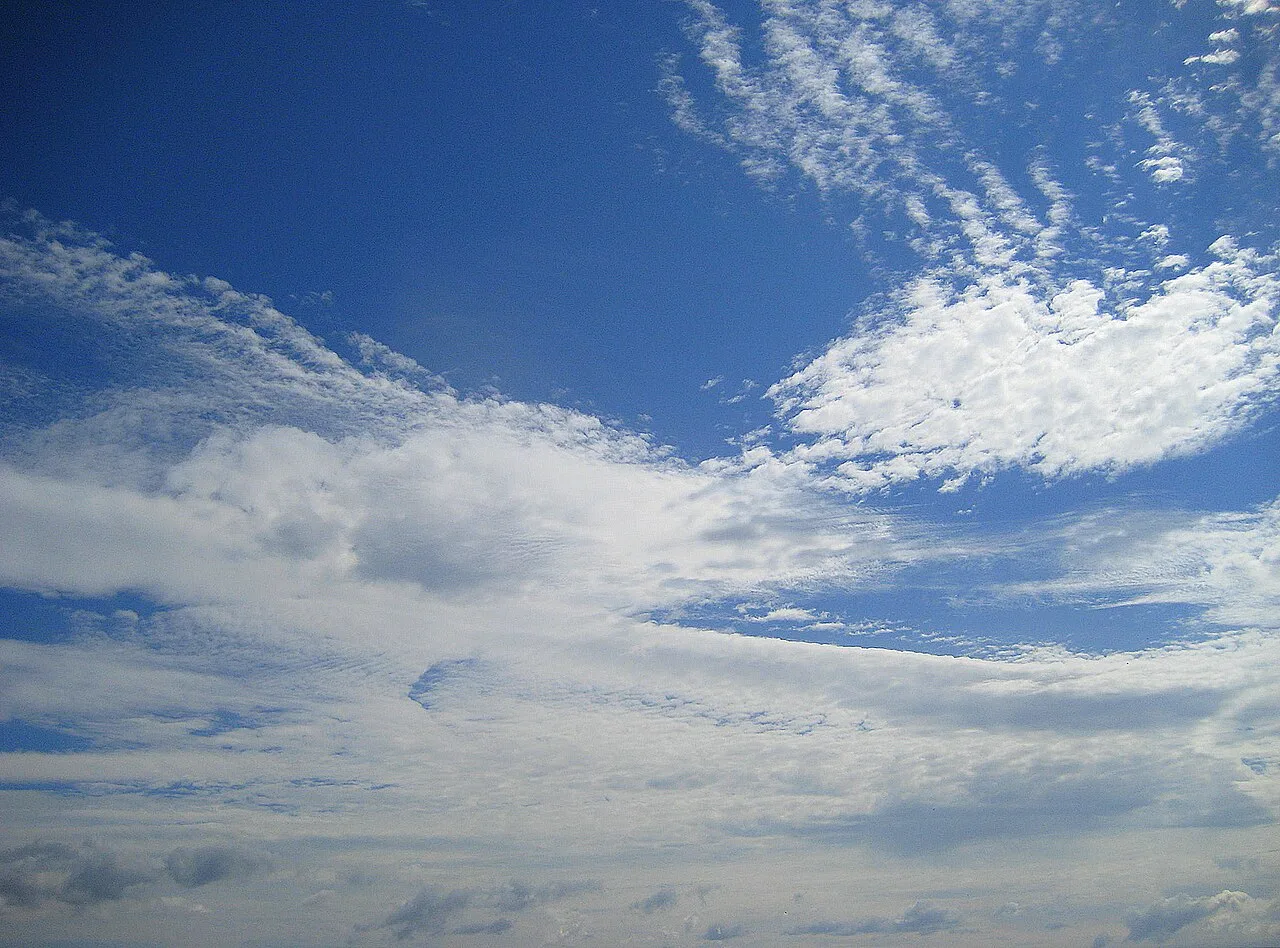
Rayleigh: Look up on a clear day and the answer seems obvious - the sky is just blue. But ask why and the question opens into one of the more elegant pieces of physics: a single mathematical relationship between the size of a particle and the way it deflects light explains not just why the sky is blue, but why sunsets are red, why clouds are white, why the deep ocean looks blue, why the moon has no blue sky, and why the sky on Mars is butterscotch pink.
The answer was worked out in 1871 by John William Strutt, the third Baron Rayleigh - better known as Lord Rayleigh - who derived the relationship between particle size and light scattering that now bears his name.
Rayleigh scattering is the preferential deflection of shorter wavelengths of light by particles much smaller than those wavelengths. It is the reason you are reading this under a blue sky.
The underlying principle is counterintuitive: sunlight is white - a mix of all visible wavelengths - but the sky appears blue not because blue light is present in sunlight in greater quantities, but because blue light is scattered far more effectively than other colors.
Blue light bounces off gas molecules in all directions. Red light passes through nearly unimpeded. Your eye, looking up at the sky, receives scattered blue light from every direction.
"The blue colour of the sky is due to the scattering of sunlight by the molecules of the atmosphere. The shorter the wavelength, the more intense the scattering." - Lord Rayleigh, Philosophical Magazine (1871)
Key Definitions
Visible light spectrum - The range of electromagnetic wavelengths visible to the human eye, approximately 380 nm (violet) to 700 nm (red). White light (like sunlight) contains all visible wavelengths.
Passing white light through a prism splits it into its component wavelengths, producing the familiar rainbow of colors from violet through blue, green, yellow, orange, to red.
Wavelength - For light, the distance between successive wave crests. Shorter wavelengths correspond to higher energy (bluer colors); longer wavelengths correspond to lower energy (redder colors). Violet: ~380-420 nm. Blue: ~420-490 nm. Green: ~490-570 nm. Yellow: ~570-590 nm. Orange: ~590-620 nm. Red: ~620-700 nm.
Rayleigh scattering - The elastic scattering of light by particles much smaller than the wavelength of the light - primarily gas molecules (nitrogen N2 and oxygen O2) in the atmosphere. Rayleigh scattering intensity is inversely proportional to the fourth power of wavelength: I proportional to 1/lambda^4.
This means blue light (~450 nm) scatters approximately 5.5 times more than red light (~700 nm). Named after Lord Rayleigh, who derived the relationship in 1871.[1]
Mie scattering - Scattering of light by particles whose size is comparable to or larger than the wavelength of light - water droplets, ice crystals, dust, pollen. Unlike Rayleigh scattering, Mie scattering does not strongly favor shorter wavelengths; it scatters all wavelengths roughly equally.
Clouds scatter light by Mie scattering, which is why they appear white rather than blue.
Elastic scattering - Scattering in which the photon's energy (and therefore its wavelength and color) is unchanged. The photon's direction changes, but its color does not. Both Rayleigh and Mie scattering are elastic.
Inelastic scattering (Raman scattering) changes the photon's energy, but this is a much weaker effect in the atmosphere.
Atmospheric optical depth - A measure of how transparent the atmosphere is to light of a given wavelength. Higher optical depth means more scattering and absorption. Blue light has significantly higher optical depth than red light in Earth's atmosphere.
When sunlight travels through a long atmospheric path (sunrise and sunset), blue light is scattered out so completely that almost none reaches the observer in the direct beam.
Polarization - Rayleigh-scattered light is partially polarized - the electric field oscillates preferentially in one direction. This is why polarized sunglasses reduce sky glare: they block the polarized component of scattered light. Bees and many other insects exploit sky polarization as a navigation aid.
Scattering coefficient - A measure of how strongly a medium scatters light of a given wavelength. For Rayleigh scattering by air at standard conditions, the scattering coefficient varies as 1/lambda^4.
At 450 nm (blue), the scattering coefficient is approximately 2.2 times greater than at 550 nm (green) and approximately 5.9 times greater than at 700 nm (red).
A Brief History of the Question
Before Lord Rayleigh published his 1871 derivation, several natural philosophers had attempted to explain the sky's color, with varying degrees of success.
John Tyndall (1820-1893) came tantalizingly close. In 1869, he published experiments in the Philosophical Magazine in which he passed light through fine suspensions of particles in solution and observed that scattered light appeared bluish at right angles to the beam, while the transmitted light appeared reddish - precisely the geometry of daytime sky versus sunset.
The Tyndall effect (as it is now called) was a crucial empirical step.[2] However, Tyndall incorrectly attributed the sky's blue to small particles of dust and salt suspended in the atmosphere, rather than to the gas molecules themselves.
Lord Rayleigh corrected this in 1871. Recognizing that Tyndall's particle hypothesis was unnecessary, Rayleigh showed that pure air molecules - nitrogen and oxygen - were sufficient scatterers to produce the observed blue color at the observed intensity.
He derived his scattering formula from first principles in electromagnetic theory, and the quantitative predictions matched observation.
A further refinement came in 1899, when Rayleigh himself revisited the calculation and showed that the formula also predicted the correct polarization of scattered skylight - an independent confirmation of the theory's accuracy.
The story of how Tyndall's incomplete theory was refined into Rayleigh's correct one is a good illustration of how science progresses: through careful empirical observation, mathematical analysis, and the willingness to identify what the data actually require (pure gas molecules, not particles).
The Physics: Why Short Wavelengths Scatter More
The Electromagnetic Mechanism
When an electromagnetic wave (light) passes through a gas molecule, the oscillating electric field of the wave causes the electrons in the molecule to oscillate at the same frequency. These oscillating electrons then radiate electromagnetic energy of the same frequency in all directions - this is scattering.
The key is how the size of the scatterer relates to the wavelength. When the scatterer is much smaller than the wavelength (as gas molecules are relative to visible light), the scattering efficiency increases dramatically with frequency - specifically, as the fourth power of frequency, or equivalently, the inverse fourth power of wavelength:
I proportional to 1/lambda^4
This relationship is Rayleigh's great result. The inverse fourth power is a steep function. Double the frequency (halve the wavelength) and the scattering increases by 2^4 = 16 times. Compare blue light (450 nm) to red light (700 nm):
(700/450)^4 approximately (1.56)^4 approximately 5.9
Blue light scatters roughly 6 times more than red light. Compare violet light (400 nm) to red:
(700/400)^4 approximately (1.75)^4 approximately 9.4
Violet scatters nearly 10 times more than red.
Why Blue and Not Violet?
If violet light scatters even more than blue, why doesn't the sky appear violet? Three compounding factors:
Solar spectrum composition: The sun emits more blue photons than violet photons. The sun's emission spectrum peaks in the green-yellow range; at violet wavelengths, output is significantly lower than at blue.
Human eye sensitivity: The three types of cone cells in the human eye (sensitive to red, green, and blue wavelengths) have different sensitivities. Our eyes are substantially less sensitive to violet than to blue. Even if violet were more prevalent in sky light, we would perceive it as weaker.
Atmospheric absorption: The upper atmosphere absorbs some ultraviolet and violet wavelengths through ozone absorption and other mechanisms, further reducing the violet component that reaches the lower atmosphere.
The combination of these three factors means that despite violet having higher scattering efficiency, the net color we perceive from the sky is blue.
The Angular Distribution of Scattered Light
Rayleigh scattering is not uniform in angle. The scattered intensity follows a characteristic angular distribution:
I(theta) proportional to (1 + cos^2 theta)
where theta is the angle between the incoming and outgoing light directions. This means scattering is strongest in the forward direction (theta = 0) and in the backward direction (theta = 180 degrees), and weakest at right angles (theta = 90 degrees).
This angular distribution also influences the polarization of sky light. At 90 degrees to the sun, scattered light is strongly polarized. Directly toward or away from the sun, it is unpolarized.
This polarization pattern was noticed by Rayleigh and has practical applications: bees and other insects with ultraviolet-sensitive vision use the polarization pattern of skylight to navigate even when the sun itself is obscured by clouds (Wehner, 2001).[11]
Photographers use polarizing filters oriented perpendicular to the sun to deepen the blue of skies in their images, blocking the polarized component of scattered light.
Red and Orange Sunsets: The Long Path Effect
The same physics explains the fiery colors of sunrise and sunset - it is just Rayleigh scattering operating at a different atmospheric path length.
When the sun is directly overhead, sunlight passes through approximately 100 km of atmosphere vertically. At this short path length, blue light is scattered significantly but enough survives the path to make the sky above appear strongly blue.
At sunrise or sunset, the sun is near the horizon. Its light travels through the atmosphere at a shallow angle, traversing a path approximately 40 times longer than the overhead path - roughly 4,000 km of atmospheric air mass.
Over this extended path, virtually all the blue light is scattered out of the direct solar beam. Blue photons deflect into the sky around the sun; they do not reach the observer in the direct beam.
What remains in the direct beam is predominantly the longer wavelengths - orange and red - which scatter less efficiently and survive the long atmospheric journey.
The direct sunlight reaching the observer at sunset is therefore orange-red. The sky near the horizon also glows in these warm colors, because even the scattered light from those directions has traveled through a long atmospheric path before reaching the observer.
"The redness of the setting sun, the blueness of the sky, the whiteness of clouds - these are all aspects of a single principle: the selective scattering of light by the atmosphere, and the dependence of that scattering on wavelength." - Richard Feynman, QED: The Strange Theory of Light and Matter (1985)[3]
Exceptional sunsets occur when the atmosphere contains elevated aerosol particles - following volcanic eruptions (sulfate aerosols), dust storms, or wildfire smoke. These larger particles shift scattering from the Rayleigh to the Mie regime, producing vivid reds and purples as they scatter the few surviving long wavelengths.
The Volcanic Sunset Effect
The most spectacular sunsets in recorded history have followed major volcanic eruptions. The 1815 eruption of Mount Tambora in Indonesia - the largest eruption in recorded history - injected roughly 150 cubic kilometers of material into the stratosphere, including an estimated 60 million tonnes of sulfur dioxide (Oppenheimer, 2003).[8]
The sulfate aerosols circled the globe and produced lurid orange and crimson sunsets across Europe and North America for over a year. 1816 became known as the "Year Without a Summer," with crop failures across the Northern Hemisphere.
Similar effects followed the 1991 eruption of Mount Pinatubo in the Philippines.
That eruption deposited approximately 20 million tonnes of sulfur dioxide into the stratosphere, causing a measurable reduction in global average temperatures of about 0.5 degrees Celsius over the following two years and producing vivid, prolonged sunsets worldwide (McCormick et al., 1995).[9]
The physics is the same in each case: sulfate aerosol droplets, roughly 0.1-1 micrometer in size, are in the transition zone between Rayleigh and Mie scattering. They scatter red wavelengths more effectively than pure gas molecules do, enriching the colors of sunsets far beyond normal.
Why Clouds Are White: Mie Scattering
Water droplets in clouds are enormous compared to gas molecules - roughly 10-100 micrometers in diameter, compared to the 0.3-nanometer size of an N2 molecule. At this scale, the particles are comparable to or larger than visible light wavelengths.
In this regime, Rayleigh's inverse-fourth-power relationship no longer applies. Instead, Mie scattering dominates - a more complex set of solutions to Maxwell's equations for scattering by spherical particles, derived by German physicist Gustav Mie in 1908.[7]
Mie scattering for visible light by water droplets is roughly equal across all wavelengths. Red, green, and blue scatter with similar efficiency.
Scatter all visible wavelengths equally and the combination appears white - which is why clouds are white, why fog is white, and why milk (fat droplets suspended in water) is white.[6]
Dark storm clouds follow from the same physics. When a cloud is thick enough, so much scattering occurs that most light is absorbed or redirected before reaching the bottom of the cloud. The cloud appears grey or dark from below because insufficient light passes through it.
The cloud is not absorbing preferentially - it is simply so optically thick that total transmission is low.
Rainbow Formation
Raindrops also produce color through a completely different mechanism: refraction and internal reflection. When light enters a raindrop, it refracts (bends) at the water-air interface, reflects off the inside of the back of the drop, and refracts again on exit.
Because different wavelengths refract by slightly different amounts (dispersion), they exit the raindrop at slightly different angles - red at about 42 degrees from the incident light, violet at about 40 degrees.
A rainbow, therefore, is not a product of scattering at all, but of the dispersive refraction of sunlight by spherical water droplets.
The observer sees red at the outer arc (from droplets at 42 degrees) and violet at the inner arc (from droplets at 40 degrees), with a dark band above (Alexander's dark band) where neither direct reflection nor refracted light reaches the eye (Minnaert, 1954).[5]
Sky Colors Across the Solar System
Different atmospheric compositions produce different sky colors, testing our understanding of the physics:
| World | Atmosphere | Sky Color | Dominant Mechanism |
|---|---|---|---|
| Earth (daytime) | N2/O2 | Blue | Rayleigh scattering by gas molecules |
| Earth (sunset) | N2/O2 | Red/orange | Long path removes blue; red survives |
| Mars | CO2 + dust | Pink/butterscotch | Iron oxide dust; Mie scattering |
| Moon | None | Black | No atmosphere; no scattering |
| Venus (surface) | Dense CO2 | Orange | Dense atmosphere + sulfuric acid clouds |
| Neptune | H2/He + methane | Deep blue | Methane absorbs red; blue dominates |
| Titan (Saturn's moon) | N2 + haze | Orange | Photochemical haze; complex scattering |
Mars is particularly instructive. Its atmosphere is only 1% as dense as Earth's, greatly reducing Rayleigh scattering. But Martian dust - fine particles of iron oxide - is suspended throughout the atmosphere in concentrations far higher than terrestrial dust.
These particles scatter via Mie scattering, which affects longer wavelengths more than gas-molecule Rayleigh scattering, producing the characteristic pinkish-butterscotch Martian sky color photographed by the Viking landers in 1976 and all subsequent Mars missions.
An interesting wrinkle: at Martian sunset, the sky near the sun turns blue, while Earth's sky turns red.
The iron oxide dust particles are most effective at scattering blue light at the geometry of shallow angles (near the horizon), producing the reverse of Earth's sunset pattern - a rare case where Mars and Earth swap colors (Ehlers et al., 2014).[12]
Neptune's vivid blue color is not Rayleigh scattering but selective absorption: methane in Neptune's upper atmosphere strongly absorbs red and near-infrared wavelengths, leaving the reflected light strongly enriched in blue.
The planet appears blue because its atmosphere removes red, not because it scatters blue. This is a useful distinction - the sky can appear blue for multiple reasons depending on atmospheric composition.
The Ocean's Blue and Other Applications
Why is the ocean blue? Two mechanisms: sunlight reflected from a blue sky, and the water itself. Pure water absorbs red wavelengths more strongly than blue, so in sufficient depth, water preferentially transmits blue wavelengths - a form of selective absorption rather than scattering.
Very clear, deep ocean water would appear blue even on a completely overcast day. This was confirmed by underwater measurements of the absorption spectrum of pure water, which shows strong absorption of red wavelengths beginning around 600 nm and increasing sharply toward the infrared (Pope & Fry, 1997).[10]
Coastal ocean water often appears green or brown due to suspended phytoplankton, sediment, and dissolved organic matter - additional absorbers and scatterers that modify the pure-water blue toward yellows and greens. Open ocean water, free of these additions, displays the clearest blue.
Why does smoke appear bluish and haze appear whitish? Fresh smoke particles are very small (Rayleigh scattering regime) - they scatter blue light selectively, appearing bluish when seen against a dark background, just as the sky does.
Older smoke particles grow by aggregation into larger particles (Mie scattering regime) and scatter all wavelengths roughly equally, appearing whitish.
Cigarette smoke exhaled from a smoker appears whitish because the particles have aggregated; sidestream smoke from the burning cigarette appears bluish because those particles are freshly formed and still in the Rayleigh regime.
Photography and the polarizing filter: Landscape photographers commonly use circular polarizing filters to deepen blue sky colors. The filter works by blocking the polarized component of Rayleigh-scattered light from the sky.
Since Rayleigh-scattered light is strongly polarized at 90 degrees to the sun, the filter, when oriented to block this component, removes some of the haze (non-polarized) but retains the maximally scattered blue (which is polarized), increasing apparent contrast and color saturation.
The Limits of Rayleigh's Equation
Rayleigh's 1/lambda^4 law applies strictly only when the scattering particles are much smaller than the wavelength of light (specifically when the particle radius is less than about 1/10 of the wavelength).
Real atmospheric molecules satisfy this criterion: a nitrogen molecule is about 0.3 nm across, while visible light wavelengths are 400-700 nm - a factor of more than 1,000. The approximation is excellent.
As particles grow larger, corrections are necessary. The full Mie theory (1908) solves exactly for spherical particles of any size relative to the wavelength, recovering Rayleigh scattering as the small-particle limit.[4]
For very large particles (much larger than the wavelength), scattering becomes geometric - governed by simple reflection and refraction rather than wave optics - and all wavelengths scatter equally.
This progression from Rayleigh to Mie to geometric scattering as particle size increases explains the full color range from blue sky (gas molecules, Rayleigh) to white fog (water droplets, Mie) to colorless large rain droplets (geometric scattering, size >> wavelength).
Light Scattering and Human Vision
There is a remarkable biological dimension to why the sky appears blue specifically to humans.
Trichromacy - the use of three types of cone photoreceptors (roughly red-sensitive, green-sensitive, and blue-sensitive) - evolved in primates and is thought to have been selected partly for identifying ripe fruit against a background of foliage.
Interestingly, the sky serves as an almost ideal background against which our color vision is calibrated.
The blue cone cells (S-cones) in the human eye peak in sensitivity at about 420-440 nm, right in the region most effectively scattered by the atmosphere.
This is likely not coincidental: organisms evolving visual systems under an open sky would face selection pressure to be sensitive to the ambient light spectrum. The sensitivity peaks of human color vision broadly align with the solar spectrum filtered by the atmosphere.
This also explains why the sky appears a slightly different shade of blue to different individuals. Color perception is subjective - it depends on the specific sensitivities of each person's cone cells, which vary somewhat genetically.
Some individuals with specific cone cell configurations may perceive the sky as slightly more greenish-blue or more violet-blue than average, all from the same physical stimulus.
Quantitative Summary: Scattering Across the Visible Spectrum
The following table summarizes Rayleigh scattering efficiency across the visible spectrum, taking green (550 nm) as the reference. These values derive from the 1/lambda^4 law and represent relative scattering intensities, not absolute values.
| Color | Wavelength (nm) | Relative Scattering Intensity | Qualitative Role |
|---|---|---|---|
| Violet | 400 | 3.51 | Heavily scattered; partially absorbed/limited by eye sensitivity |
| Blue | 450 | 2.34 | Dominant perceived scattered color; sky color |
| Cyan | 490 | 1.60 | Scattered; contributes to sky blue-green at horizon |
| Green | 550 | 1.00 | Reference; scattered less; sky appears less green |
| Yellow | 580 | 0.84 | Passes through; enriches twilight |
| Orange | 620 | 0.69 | Largely passes; dominant at sunset |
| Red | 700 | 0.42 | Minimally scattered; dominant in sunset direct beam |
The steep drop from violet/blue to red makes clear why even modest amounts of Rayleigh scattering produce such a pronounced blue color.
Red photons pass through the atmosphere with far less deflection, while blue photons are redirected so frequently that the sky appears uniformly blue from any direction the observer looks away from the sun.
Conclusion: One Equation, Many Phenomena
Lord Rayleigh's 1/lambda^4 scattering law is one of the most productive single equations in physics. Derived from first principles of electromagnetism in 1871, it explains:
- Why the sky is blue on Earth (and not violet)
- Why sunsets are red and orange
- Why clouds are white
- Why the sky on Mars is butterscotch pink
- Why the Moon has a black sky
- Why smoke appears bluish
- Why haze appears whitish
- Why polarized sunglasses reduce sky glare
All of these phenomena - the blue above you, the red at the horizon, the white of a cloud - are consequences of the same inverse-fourth-power relationship between wavelength and scattering efficiency. The equation is simple; its consequences are the entire visual appearance of the sky.
For related concepts, see how the universe began, how light and color work, and why does glass transmit light.
Sources & Further Reading
- Rayleigh, Lord (J. W. Strutt). (1871). On the Light from the Sky, Its Polarization and Colour. Philosophical Magazine, 41(271), 107-120, 274-279.
- Tyndall, J. (1869). On the Blue Colour of the Sky, the Polarization of Skylight, and on the Polarization of Light by Cloudy Matter Generally. Philosophical Magazine, 37(251), 384-394.
- Feynman, R. P., Leighton, R. B., & Sands, M. (1963). The Feynman Lectures on Physics, Vol. 1, Chapter 32: Radiation Damping, Light Scattering. Addison-Wesley.
- Bohren, C. F., & Huffman, D. R. (1998). Absorption and Scattering of Light by Small Particles. Wiley-VCH.
- Minnaert, M. G. J. (1954). The Nature of Light and Colour in the Open Air. Dover Publications.
- Lynch, D. K., & Livingston, W. (2001). Color and Light in Nature. Cambridge University Press.
- Mie, G. (1908). Beitrage zur Optik truber Medien, speziell kolloidaler Metallosungen. Annalen der Physik, 330(3), 377-445.
- Oppenheimer, C. (2003). Climatic, Environmental and Human Consequences of the Largest Known Historic Eruption: Tambora Volcano (Indonesia) 1815. Progress in Physical Geography, 27(2), 230-259.
- McCormick, M. P., Thomason, L. W., & Trepte, C. R. (1995). Atmospheric Effects of the Mt. Pinatubo Eruption. Nature, 373(6513), 399-404.
- Pope, R. M., & Fry, E. S. (1997). Absorption Spectrum (380-700 nm) of Pure Water. Applied Optics, 36(33), 8710-8723.
- Wehner, R. (2001). Polarization Vision: A Uniform Sensory Capacity? Journal of Experimental Biology, 204(14), 2589-2596.
- Ehlers, T., et al. (2014). Sky Colors on Mars at Twilight. Icarus, 243, 314-325.