
What is gerrymandering? It is the manipulation of district boundaries to give a party or group an electoral advantage. Mapmakers can pack opponents into a few lopsided districts or crack them across many districts they cannot win. Modern data makes the practice more precise, while independent commissions and voting-rights protections offer different remedies with contested limits.
On February 11, 1812, Elbridge Gerry - governor of Massachusetts, former delegate to the Constitutional Convention, and future vice president of the United States - signed a redistricting bill passed by the Democratic-Republican majority in the Massachusetts legislature.
The bill redrew the state senate districts in ways that conspicuously favored the party. One district in particular, covering parts of Essex County, had been drawn into a contorted shape stretching from the coast inland through a series of sharp bends and elongations.
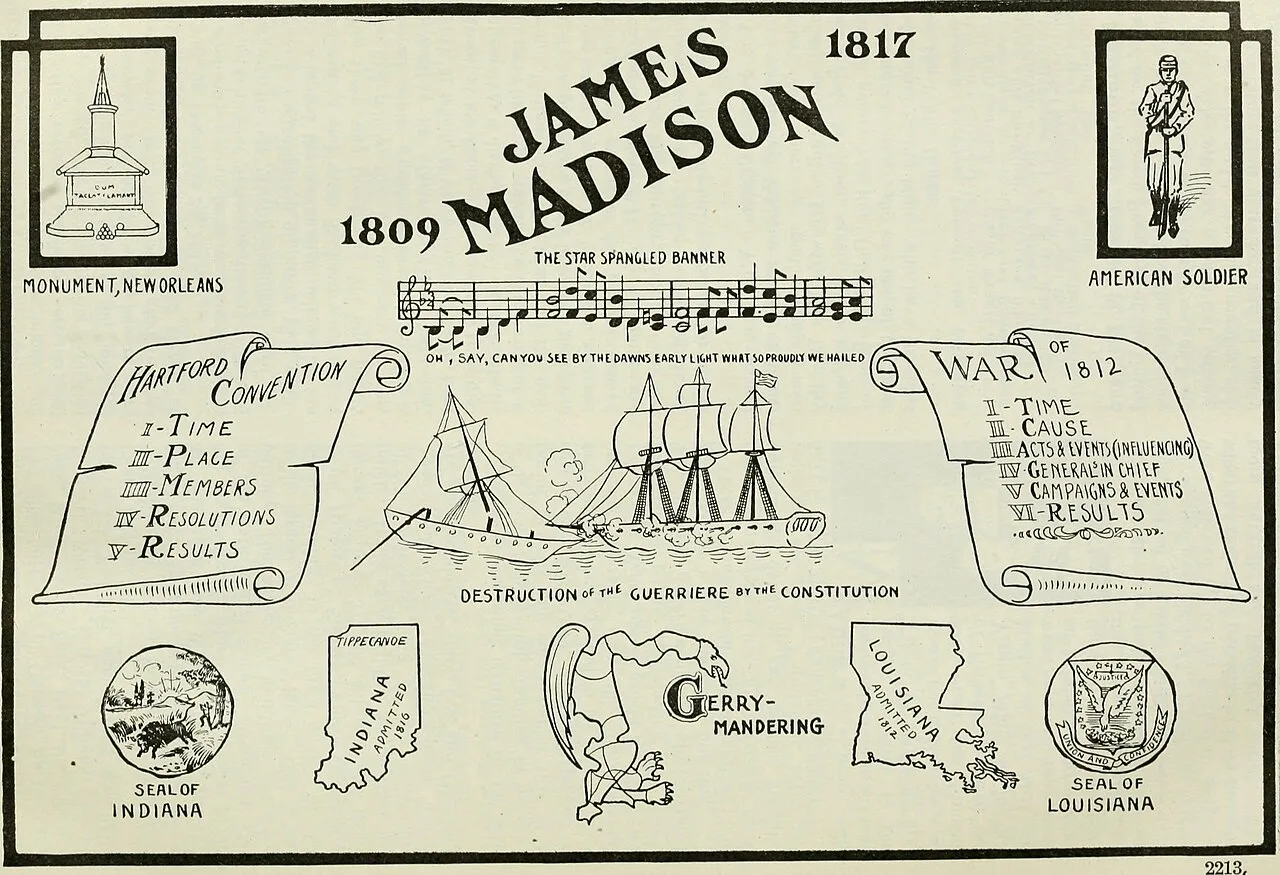
The Boston Gazette ran a cartoon depicting the district with a dragon's head, claws, and wings, and labeled it the "Gerrymander" - combining Gerry's name with the salamander the shape resembled.
Gerry had not drawn the map himself and reportedly found the whole affair embarrassing. His name became synonymous with the practice anyway.
Two hundred and twelve years later, the practice Gerry reluctantly signed into law has been transformed by computational technology into something almost unrecognizable to its 19th-century practitioners.
Software that can model the voting behavior of every census block, optimize district boundaries to fractions of a street, and run millions of simulated electoral outcomes has turned a crude art into a precise science.
The REDMAP project - a Republican State Leadership Committee initiative that targeted state legislative races in 2010 to control post-Census redistricting - demonstrated what was possible: by flipping control of key state legislatures in a single election, a party could lock in structural advantages in congressional representation for an entire decade.
Democrats received roughly 1.4 million more votes than Republicans in 2012 House elections nationally; Republicans won 33 more seats.
The Supreme Court acknowledged in 2019 that partisan gerrymandering is "unjust" and "incompatible with democratic principles." In the same opinion, the Court concluded it was powerless to do anything about it.
Justice Elena Kagan's dissent called the majority's reasoning a betrayal of voters trapped in a "rigged election" system.
The tension between those two positions - that something is both unjust and beyond remedy - defines where the issue stands today.
"Voters are not meant to choose their representatives. With modern gerrymandering, representatives choose their voters - and they make that choice once a decade, with effects that compound over elections, careers, and legislative majorities." - Nate Persily, Solutions to Political Polarization in America (2015)
Key Definitions
Gerrymandering - The manipulation of electoral district boundaries to produce a partisan, racial, or other advantage for one group over another. Named for Governor Elbridge Gerry of Massachusetts.
Redistricting - The process of redrawing electoral district boundaries, required after each decennial US Census to account for population shifts and maintain the constitutional requirement of roughly equal population per district.
Single-member plurality (SMP) - An electoral system in which each district elects one representative, and the candidate with the most votes wins, regardless of whether they received a majority. The United States House of Representatives uses this system.
SMP systems are particularly susceptible to gerrymandering because the winner-take-all structure means that the arrangement of voters across districts directly determines the translation of votes into seats.
Packing - Drawing districts that concentrate the opposing party's voters into as few districts as possible, causing them to win those districts by enormous margins but reducing the number of districts they can win.
Cracking - Dividing the opposing party's voters across multiple districts in numbers insufficient to win any of them, wasting their votes as consistent minorities.
Efficiency gap - A mathematical measure of partisan gerrymandering developed by Nicholas Stephanopoulos and Eric McGhee, calculated as the difference in wasted votes between two parties divided by total votes cast.[5] Wasted votes are all votes cast for the losing candidate plus all votes above the winning threshold cast for the winner.
REDMAP - The Republican State Leadership Committee's "Redistricting Majority Project," a multi-cycle initiative targeting state legislative elections in 2010 to control post-Census redistricting in key states including Pennsylvania, Ohio, Michigan, North Carolina, and Wisconsin.
Independent redistricting commission (IRC) - A body established outside the state legislature to draw electoral maps, typically with requirements for partisan balance among members and criteria prioritizing neutral principles over partisan outcomes.
Voting Rights Act (VRA) - Federal legislation originally passed in 1965 that prohibits voting practices that discriminate on the basis of race. Section 2 of the VRA prohibits drawing district maps that dilute the voting power of racial minority groups.
Political question doctrine - A constitutional principle under which federal courts decline to adjudicate certain disputes because they involve questions the Constitution commits to the political branches to resolve. The Supreme Court applied this doctrine to partisan gerrymandering claims in Rucho v. Common Cause (2019).
Redistricting Systems: International Comparison
| Country | Who draws the maps | Partisan input allowed | Electoral system | Gerrymandering risk |
|---|---|---|---|---|
| United States | State legislatures (most states) | Yes - majority party controls process | Single-member plurality (winner-take-all) | High; computational tools make precise manipulation routine |
| United Kingdom | Independent Boundary Commissions | No | Single-member plurality | Low for partisan manipulation; commission operates on neutral criteria |
| Canada | Federal Electoral Boundaries Commissions | No | Single-member plurality | Low; independent commission process; rare litigation |
| Australia | Australian Electoral Commission | No | Preferential (instant-runoff) voting | Low; independent commission + preferential voting reduces winner-take-all distortion |
| Germany | Mixed-member proportional (MMP) | Constituency boundaries exist but are less consequential | Proportional correction via party lists | Very low; proportional component compensates for any constituency-level distortion |
| New Zealand | Independent Electoral Commission | No | Mixed-member proportional | Very low; proportional system reduces stakes of constituency boundaries |
| France | Legislature (historically); prefect | Historically yes | Two-round system | Moderate historical risk; two-round system reduces but does not eliminate |
How Redistricting Works
The US Constitution requires that seats in the House of Representatives be apportioned among states based on population, counted by the decennial Census.
After each Census, states must redraw their congressional district boundaries to reflect population changes and maintain roughly equal district populations. States also redraw their own state legislative districts, which affect state elections but follow similar principles.
In most states, the state legislature draws both congressional and state legislative maps, subject to the governor's signature. This means the party controlling both chambers of the legislature - and ideally the governor's office - after a Census year controls the maps for the next decade.
The asymmetric importance of "Census year" elections - those ending in zero - is well understood by both parties. REDMAP explicitly targeted 2010 state legislative races for this reason.
Some states have reformed this process. Several use independent or bipartisan commissions for congressional redistricting (California, Arizona, Colorado, Michigan, Virginia) or advisory commissions whose recommendations the legislature must explicitly override.
A smaller number of states use commissions for state legislative redistricting. Iowa uses a nonpartisan legislative staff agency that draws maps using population data without partisan information.
Any redistricting plan must comply with several legal requirements. Districts must be roughly equal in population (the principle of "one person, one vote," derived from Reynolds v. Sims (1964)).
Districts must comply with the Voting Rights Act - they cannot be drawn to dilute minority voting power, and in some circumstances they must be drawn to give minority communities an opportunity to elect representatives of their choice.
Districts must not unconstitutionally use race as the predominant factor in drawing boundaries, even with remedial intent (Shaw v.[4] Reno, 1993).
Within these constraints, state law may require contiguity (districts must be geographically connected), compactness, and preservation of political subdivisions such as counties and municipalities. These requirements create real constraints but leave substantial room for manipulation, particularly in large, populous states.
Partisan Gerrymandering: Packing, Cracking, and the Math of Wasted Votes
The geometry of partisan gerrymandering has a simple logic, though its execution involves considerable complexity.
Suppose a state has ten congressional districts and that 45 percent of its voters reliably vote Democratic, 55 percent reliably Republican. Under a neutral proportional system, the state might elect roughly five Democrats and five Republicans.
Under a gerrymandered map, the same vote distribution can be arranged to produce eight Republican seats and two Democratic seats - or more.
The mechanism: Republican mapmakers pack Democratic voters into two districts where Democrats win 80-15 percent. The remaining eight districts have Democratic voters cracked and dispersed so they constitute roughly 35 percent of each district's voters - enough to be competitive, but not enough to win.
Republicans win each of those eight districts by comfortable margins. Two districts worth of Democratic voters, concentrated by packing, produce two Democratic seats. Eight districts worth of dispersed Democratic voters produce zero Democratic seats.
The Wisconsin Case
The 2011 redistricting in Wisconsin, conducted by a Republican legislature under Republican Governor Scott Walker, produced one of the most studied partisan gerrymanders in American history.
Republican operatives worked with consultants and lawyers in a rented private office - to maintain attorney-client privilege - to draw maps using detailed voter data.
Internal documents, obtained through litigation, showed drafts labeled "Aggressive" and communications discussing how to maximize Republican advantage across a range of electoral conditions.
The resulting maps were remarkably durable: in 2012, Democrats won 53 percent of the statewide assembly vote but only 39 of 99 assembly seats. In 2018, Democrats won 54 percent of the statewide assembly vote and 36 seats. The structural advantage held regardless of how voters actually voted.
The Wisconsin case produced the major federal partisan gerrymandering challenge of the era: Gill v.[2] Whitford (2018).
The Supreme Court unanimously rejected the plaintiffs' claims on standing grounds - the plaintiffs had only shown harm at the statewide level, not at the district level - without reaching the merits. Two years later, Rucho v.
Common Cause ended federal court jurisdiction over partisan gerrymandering entirely.
Racial Gerrymandering and the Voting Rights Act
Racial gerrymandering - drawing district lines to dilute the voting power of racial minorities - has a long history in the United States and remains subject to federal court challenge, unlike partisan gerrymandering.
The Voting Rights Act of 1965 prohibited practices that discriminated on the basis of race in voting. Section 2 of the VRA prohibits any voting practice that results in the denial or abridgment of the right to vote on account of race. Under Thornburg v.
Gingles (1986), courts apply a three-part test: the minority group must be large enough and geographically compact enough to form a majority in a single-member district; it must be politically cohesive; and the white majority must vote sufficiently as a bloc to usually defeat the minority's preferred candidates.[6]
If all three conditions are met, the failure to draw a majority-minority district may violate the VRA.
The court's jurisprudence on racial gerrymandering has been complex and sometimes contradictory. In Shaw v.
Reno (1993), the Supreme Court held that districts drawn predominantly by race to be "bizarre" in shape could be challenged under the Equal Protection Clause - meaning that drawing majority-minority districts too aggressively could also be unconstitutional.
The result is a narrow corridor within which mapmakers must operate: they may not dilute minority voting power (VRA Section 2), but they also may not make race the predominant factor in drawing district lines without satisfying strict scrutiny (Shaw v. Reno and its progeny).
In practice, racial and partisan gerrymandering are often intertwined. In the American South, Black voters vote overwhelmingly Democratic, so packing Black voters into a few districts (racial gerrymandering) and cracking them across others serves partisan purposes simultaneously.
Courts have sometimes struggled to determine which motivation dominated in a given map.
The Supreme Court's 2013 decision in Shelby County v. Holder struck down the coverage formula for the VRA's preclearance provision - which had required states with histories of racial discrimination in voting to obtain federal approval before changing voting laws - significantly weakening the tool that had been most effective in blocking discriminatory redistricting in the South.
Measuring the Harm: Mathematical Tools
The core challenge of gerrymandering litigation is demonstrating that a map's partisan effects exceed what geography and neutral criteria would produce. Several mathematical tools have been developed for this purpose.
The Efficiency Gap
Developed by Nicholas Stephanopoulos of Harvard Law School and political scientist Eric McGhee, the efficiency gap measures the difference in wasted votes between parties divided by total votes cast.
A wasted vote is any vote that did not contribute to electing a representative: all votes for losing candidates, and all votes above 50 percent plus one for winning candidates.
If one party wastes far more votes than the other across all districts, the map has been arranged to be systematically inefficient for that party.
Stephanopoulos and McGhee argued that an efficiency gap above 7 percent in congressional maps was historically associated with durable partisan advantages.[8]
Critics noted that geographic clustering of Democratic voters in cities produces some efficiency gap even without intentional gerrymandering, and that the efficiency gap can be influenced by factors outside mapmakers' control.[1]
Simulation-Based Analysis
The most robust approach to detecting gerrymandering uses Markov chain Monte Carlo (MCMC) methods to generate large numbers of alternative district maps that satisfy neutral legal criteria - equal population, compactness, Voting Rights Act compliance, preservation of municipal boundaries - without using partisan data.
The enacted map is then compared to this distribution of simulated neutral alternatives.
If the enacted map produces partisan results that are more extreme than 99.9 percent of neutrally drawn alternatives, this provides strong statistical evidence that the map was deliberately designed to achieve partisan advantage beyond what neutral criteria would produce.
This approach was used effectively in Pennsylvania litigation. Expert analysis showed that the Republican-drawn 2011 congressional map produced Republican outcomes more extreme than any of 1,000 neutrally drawn simulated maps. The Pennsylvania Supreme Court struck down the map under the state constitution in 2018.
The Supreme Court's Retreat: Rucho v. Common Cause
In June 2019, the Supreme Court issued its 5-4 decision in Rucho v.[3] Common Cause, consolidating challenges to congressional maps in North Carolina (drawn by Republicans) and Maryland (drawn by Democrats).
Chief Justice Roberts, writing for the majority, acknowledged that "excessive partisanship in districting leads to results that reasonably seem unjust." He concluded nonetheless that "federal courts are not equipped to apportion political power as a matter of fairness."
The majority held that partisan gerrymandering claims present a "political question" - a category of disputes the Constitution commits to the political branches rather than the courts.
Because there is no "judicially manageable standard" for determining how much partisan advantage is too much, federal courts cannot resolve such claims.
Justice Kagan's dissent was pointed. She argued that the majority was leaving "millions of Americans with no legal recourse" and that the mathematical tools developed by plaintiffs - efficiency gaps, simulation analyses, mean-median differences - did provide manageable standards.[7]
She analogized the majority's position to "a judge abdicating the judicial role" and suggested that the Court would not apply the same reasoning to other constitutional violations merely because measuring them required quantitative analysis.
After Rucho, partisan gerrymandering challenges must proceed through state courts applying state constitutional provisions. Several state constitutions have provisions about free and fair elections, equality of voting rights, or the separation of powers that state courts have interpreted to prohibit partisan gerrymandering.
This avenue is available but inconsistent: its success depends on state court composition, which is itself affected by elections conducted under gerrymandered maps.
Reform: Commissions, Algorithms, and Electoral Systems
Independent Redistricting Commissions
The most widely adopted reform approach is the independent redistricting commission. Arizona's commission, established by Proposition 106 in 2000, consists of two Democrats, two Republicans, and one independent chosen by the other four members from a list screened by the state's Appellate Court Commission on Appointments.
Members cannot be elected officials, political appointees, or lobbyists, and must not have held partisan office within three years of appointment.
California's Citizens Redistricting Commission, created by Proposition 11 in 2008 and extended to congressional districts by Proposition 20 in 2010, has 14 members - five Democrats, five Republicans, and four others.
Michigan's Voters Not Politicians commission, established by Proposal 2 in 2018 after a campaign led by political novice Katie Fahey, uses a random selection process from a pool of screened applicants.
The evidence on commission-drawn maps is generally positive. Studies comparing commission-drawn and legislature-drawn maps find that commissions produce more competitive districts, less extreme partisan bias, and maps that better reflect statewide vote shares in seat outcomes.
Commissions are not immune to partisan dynamics - their members are not robots, and criteria can be interpreted in partisan ways - but they represent a substantial improvement over direct legislative control.
International Comparisons
The American approach to redistricting is unusual among democracies. The United Kingdom, Canada, and Australia all use independent boundary commissions that draw maps based on neutral criteria without partisan input from legislators.
These systems substantially eliminate strategic mapmaking, though they still produce winner-take-all district systems that can translate votes into seats non-proportionally.
Germany's mixed-member proportional system provides an alternative framework: voters cast two votes, one for a local constituency representative and one for a party list. The party list votes are used to make total seat allocation proportional to overall vote share, with constituency winners counted toward each party's total.
This system makes gerrymandering much less consequential, because the proportional component corrects for any distortions in constituency outcomes.
Algorithmic Redistricting
Some reformers have proposed using computer algorithms to draw district maps automatically based on neutral criteria - population equality, compactness, contiguity, and Voting Rights Act compliance - without human judgment. In principle this approach would eliminate conscious manipulation.
In practice, the choice of criteria and their weights involves normative judgments that algorithmic automation does not eliminate. What "compactness" means, how to weight municipal boundary preservation against compactness, and how aggressively to draw majority-minority districts all involve choices that embed values.
Algorithmic redistricting is a useful tool for generating alternative maps and establishing benchmarks, but it does not remove human judgment from the process - it relocates it to the design of the algorithm.
For a broader treatment of how democratic institutions function and fail, see how democracy works and why democracies fail. For historical context on the racial dimensions of voting rights, see what caused the civil rights movement.
Consequences for Representation and Policy
The effects of gerrymandering extend beyond the immediate question of which party controls the legislature.
Polarization: Safe seats insulate incumbents from general election competition. A representative whose district has been packed with co-partisans faces no meaningful threat from the other party. Their only competitive election is the primary, which tends to be decided by smaller, more ideologically motivated electorates.
This creates incentives to appeal to the party base rather than the center, contributing to the ideological sorting and polarization that political scientists have documented in congressional voting behavior since the 1990s.
Research by political scientists including Thomas Mann and Norman Ornstein documents the relationship between partisan mapmaking and extreme voting records among members of Congress.
Responsiveness: Representatives in gerrymandered safe seats are less dependent on the full range of their constituents' views. If 65 percent of a district's voters will vote for the incumbent regardless of what they do, the representative's behavior is less constrained by electoral accountability.
Studies have found that representatives in more competitive districts are more responsive to district-level opinion shifts than those in heavily gerrymandered seats.
Entrenchment: A party controlling a legislative majority has power over the next redistricting, which shapes the electoral map for the next decade, which influences which party controls the legislature after the next election, which shapes the redistricting after that.
This self-reinforcing cycle means that breaking a gerrymander often requires winning elections under maps drawn to make winning very difficult - an asymmetric challenge that can perpetuate minority-party control of a majority of seats across multiple election cycles.
Sources & Further Reading
- Chen, J., & Rodden, J. (2013). Unintentional gerrymandering: Political geography and electoral bias in legislatures. Quarterly Journal of Political Science, 8(3), 239-269. DOI: 10.1561/100.00012033
- Gill v. Whitford, 585 U.S. ___ (2018).
- Rucho v. Common Cause, 588 U.S. ___ (2019).
- Shaw v. Reno, 509 U.S. 630 (1993).
- Stephanopoulos, N. O., & McGhee, E. M. (2015). Partisan gerrymandering and the efficiency gap. University of Chicago Law Review, 82(2), 831-900.
- Thornburg v. Gingles, 478 U.S. 30 (1986).
- Wang, S. S.-H. (2016). Three tests for practical evaluation of partisan gerrymandering. Stanford Law Review, 68(6), 1263-1321.
- McGhee, E. (2020). Partisan gerrymandering and political science. Annual Review of Political Science, 23, 171-185. DOI: 10.1146/annurev-polisci-060118-045346