
Here is a puzzle that seems to have an obvious answer: Should a country that can produce everything more efficiently than its neighbors bother to trade with them?
Intuition says no. If you are better at making wine, better at making cloth, better at everything, why would you trade with people who are worse at everything? You would just be giving up goods you could have made yourself.
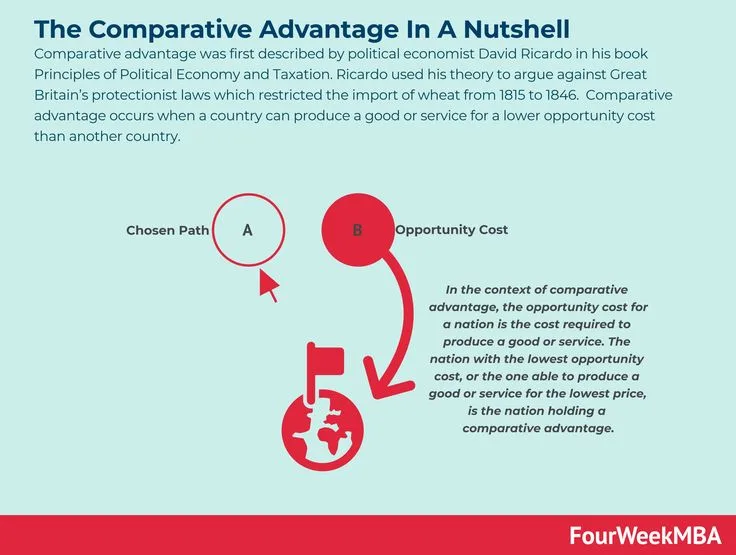
The theory of comparative advantage, developed by David Ricardo in 1817, shows that this intuition is wrong - and that the error is not minor. It fundamentally misunderstands what makes trade valuable.
Understanding why is one of the most important intellectual achievements in the history of economics, and one that remains directly relevant to how we think about trade, globalization, and economic development today.
"To say that comparative advantage is the most counterintuitive but important concept in economics is not an overstatement." - Paul Samuelson, responding to the challenge to name a proposition in economics that is both true and non-trivial, as recounted by Krugman (1996)[13]
Ricardo's Original Example: Wine and Cloth
David Ricardo presented his argument in On the Principles of Political Economy and Taxation (1817), using a simple example involving England and Portugal producing two goods: cloth and wine.[1]
Suppose Portugal can produce both cloth and wine more efficiently than England. In the language of economics, Portugal has an absolute advantage in both goods. Here is a simplified version of Ricardo's setup:
| Country | Hours to produce 1 unit of cloth | Hours to produce 1 unit of wine |
|---|---|---|
| England | 100 hours | 120 hours |
| Portugal | 90 hours | 80 hours |
Portugal is more efficient at producing both goods. If efficiency were all that mattered, Portugal should produce both and England should produce nothing - or at least, England should not export anything to Portugal, since Portugal can produce everything better.
But look at the opportunity cost - what each country gives up to produce one good rather than the other:
- England: To produce 1 unit of cloth, England gives up 100/120 = 0.83 units of wine. To produce 1 unit of wine, it gives up 120/100 = 1.2 units of cloth.
- Portugal: To produce 1 unit of cloth, Portugal gives up 90/80 = 1.125 units of wine. To produce 1 unit of wine, it gives up 80/90 = 0.89 units of cloth.
England's opportunity cost for cloth is lower (0.83 units of wine given up versus Portugal's 1.125). Portugal's opportunity cost for wine is lower (0.89 units of cloth given up versus England's 1.2).
This means:
- England has a comparative advantage in cloth - it gives up less wine to produce cloth than Portugal does.
- Portugal has a comparative advantage in wine - it gives up less cloth to produce wine than England does.
If England specializes in cloth and Portugal specializes in wine, and they trade, both countries can consume more of both goods than they could if each produced everything for itself.
Why This Works: The Mathematics of Opportunity Cost
The key to understanding comparative advantage is the concept of opportunity cost - the value of what you give up to get something.
Absolute advantage compares quantities produced with the same inputs. Comparative advantage compares opportunity costs - what one activity requires you to sacrifice in terms of the other activity.
It is mathematically impossible for one party to have a higher opportunity cost in both goods simultaneously. If England's opportunity cost for cloth is higher than Portugal's, then by definition England's opportunity cost for wine must be lower.
The logic is airtight: every country, no matter how economically disadvantaged, has a comparative advantage in something.
This is the genuinely counterintuitive and important implication: trade is mutually beneficial even when one party is absolutely worse at producing everything. The gains from trade come not from one party being better than another in absolute terms, but from the parties having different relative costs.
A simple non-trade analogy: Suppose a brilliant surgeon can also type faster than her administrative assistant. She has an absolute advantage in both surgery and typing.
But her opportunity cost for typing is enormous - every hour she spends typing is an hour not spent performing surgery, which might generate thousands of dollars of value.
It makes sense for the surgeon to specialize in surgery and have someone else type, even someone much slower than her at typing, because the comparative advantage calculation justifies it.
How Specialization and Trade Increase Total Output
When countries specialize according to comparative advantage and trade, the total output of both goods increases. Here is why:
Before trade, suppose each country allocates half its labor to each good. With 200 hours of labor each:
- England produces 1 unit of cloth and 0.83 units of wine (per 100 hours each)
- Portugal produces 1.11 units of cloth and 1.25 units of wine
Total output: 2.11 units of cloth and 2.08 units of wine.
After specialization (England produces only cloth, Portugal splits more heavily toward wine):
- England (200 hours all on cloth): 2 units of cloth
- Portugal (100 hours on cloth, 100 on wine): 1.11 units of cloth and 1.25 units of wine
With trade, the combined output can exceed what was possible without specialization. More goods are produced with the same total labor. Both parties can consume more.
This is the core claim of comparative advantage: specialization based on opportunity cost and trade generates a surplus that makes both trading parties better off.
The size of the gains depends on what the terms of trade settle at. The actual trade ratio will fall somewhere between England's domestic opportunity cost (0.83 wine per cloth) and Portugal's (1.125 wine per cloth). Both parties benefit as long as the international price ratio falls within this range.
Absolute vs. Comparative Advantage: Why the Distinction Matters
The distinction between absolute and comparative advantage is not merely academic. It changes what trade policy conclusions you should draw.
If absolute advantage determined trade flows, only the most efficient country at each good would produce it, and less efficient countries would either not produce it or would need protection. This would justify blanket protectionism for industrially underdeveloped countries.
Comparative advantage says something more nuanced: every country has productive activities at which it has a relatively lower opportunity cost, and those are what it should specialize in.
The composition of what a country produces may change over time as its labor costs, capital endowments, technology, and skills change - but there is always something it can competitively trade.
This has historically been true even for very poor countries. Low-wage countries have comparative advantage in labor-intensive manufacturing. Highly educated countries have comparative advantage in knowledge-intensive services.
Countries with abundant natural resources have comparative advantage in resource extraction. The comparative advantages are real, even if the sectors they correspond to are not equally desirable.
From Ricardo to Heckscher-Ohlin: Factor Endowments
Ricardo's model explains trade through labor productivity differences. A richer framework, developed by Swedish economists Eli Heckscher (1919) and Bertil Ohlin (1933), explains comparative advantage through differences in factor endowments - the relative abundance of capital, labor, and land.[2]
The Heckscher-Ohlin theorem predicts that countries will export goods whose production makes intensive use of the factors they have in abundance, and import goods whose production is intensive in factors they are relatively scarce in.[3]
The United States, abundant in capital and skilled labor, should export capital-intensive and skill-intensive goods. Bangladesh, abundant in unskilled labor, should export labor-intensive goods.
The model has strong empirical support in broad terms: Bangladesh has become the world's second-largest garment exporter precisely because garment production is labor-intensive and Bangladesh has an enormous supply of low-wage workers.
Germany exports machinery and chemicals - goods requiring engineering expertise and capital. Saudi Arabia exports petroleum - an endowment-based advantage.
In 1953, economist Wassily Leontief tested the Heckscher-Ohlin model against U.S.[5] trade data and found a puzzling result: the United States, the most capital-abundant country in the world, was exporting relatively labor-intensive goods and importing relatively capital-intensive goods.
This Leontief paradox prompted decades of refinements to the model. One resolution: U.S. workers are skilled workers, and skill is itself a form of human capital. When human capital is included alongside physical capital, the paradox largely dissolves.
Empirical Evidence: Does Comparative Advantage Predict Trade?
The modern empirical literature on comparative advantage has moved beyond simple two-country, two-good examples to test whether the theory predicts real-world trade patterns.
Daron Acemoglu and Jaume Ventura (2002) demonstrated that comparative advantage at the country level - in terms of factor endowments - successfully predicts the direction and intensity of bilateral trade flows across a sample of 90+ countries.[10]
Countries with high capital-labor ratios systematically export capital-intensive goods, as the theory predicts.
Eaton and Kortum (2002) developed a Ricardian model that accounts for technology differences across countries and showed it fit bilateral trade flows among 19 OECD countries remarkably well.[7] The key insight: technology-driven productivity differences, not just factor endowments, are a major source of comparative advantage.
A 2021 review by Costinot and Rodriguez-Clare published in the Handbook of International Economics confirmed that gains from trade in calibrated models are substantial - typically in the range of 1-3% of GDP for moderate reductions in trade barriers, and significantly higher for developing countries with smaller domestic markets and more concentrated production structures.[12]
What Comparative Advantage Ignores: The Limits of the Theory
The power of comparative advantage is also its weakness: it is derived from a highly simplified model that abstracts away from features of real economies that matter enormously.
The Adjustment Problem
Ricardo's model assumes that labor and capital can move freely between industries. When comparative advantage changes (or trade policy changes), workers in losing industries can shift to expanding industries. In practice, this adjustment is slow, painful, and incomplete.
The most influential empirical work on this is by David Autor, David Dorn, and Gordon Hanson, whose "China Shock" papers (beginning with Autor et al., 2013) documented the effects of rapidly expanding Chinese imports on U.S.[8] manufacturing workers.
They found that workers displaced from manufacturing by import competition experienced long-lasting earnings losses, reduced employment rates, increased disability claims, and in some communities, higher opioid mortality rates.
"The China trade shock led to substantial falls in employment and earnings in affected regions - effects much larger and more persistent than standard models predicted." - Autor, Dorn, and Hanson, Journal of Economic Perspectives (2016)
These adjustment costs are not captured by standard comparative advantage models. The aggregate gains from trade are real, but they are distributed unevenly, and the costs fall on specific communities and workers who may not benefit from the aggregate gain for many years, if ever.
Autor et al. (2013) estimated that Chinese import competition was responsible for 2.0 to 2.4 million job losses in the United States between 1999 and 2011 - a striking number that contradicted economists' prior assumptions that labor markets would adjust smoothly.
The finding contributed to a major reassessment of trade policy consensus among economists.[9]
Dynamic Comparative Advantage
Ricardo's model treats comparative advantage as fixed by a country's current endowments. In reality, comparative advantage can be built.
South Korea in 1960 had no particular natural comparative advantage in electronics manufacturing or semiconductors. Through deliberate government policy - protected domestic markets, subsidized education and R&D, directed credit to targeted industries - it developed the capabilities that made Samsung and Hynix globally dominant.
Per capita income in South Korea rose from approximately $100 in 1960 to over $30,000 by 2020, one of the most rapid development trajectories in history (World Bank, 2023).[14]
Taiwan followed a similar path, with targeted industrial policy in semiconductors ultimately making TSMC the world's most advanced chipmaker - a strategic position with enormous national security implications that no simple comparative advantage model had foreseen.
The argument that protecting infant industries allows them to develop capabilities they could not develop under immediate free-trade competition is one of the few arguments for industrial policy that most economists accept in principle, though they debate its practical application vigorously.
If comparative advantage can be created, then trade policy that simply follows current comparative advantage may foreclose the possibility of building future comparative advantage in higher-value industries. This is the core of the industrial policy argument and the debate between free-trade orthodoxy and developmental economics.
Distribution: Who Gains and Who Loses
The Stolper-Samuelson theorem (Stolper & Samuelson, 1941), a formal extension of Ricardo's model, makes a sharp distributional prediction: in countries with abundant capital trading with countries with abundant labor, trade will benefit capital owners and harm workers, even if aggregate output increases.[4]
This prediction is broadly consistent with the pattern observed in rich countries since the 1980s: rising corporate profits and capital returns alongside stagnating wages for workers without college degrees.
Whether globalization or technology is the dominant cause is debated, but the distributional consequences of trade are real and were systematically underweighted in the policy consensus of the 1990s and 2000s.
The share of national income going to labor in the United States fell from approximately 64% in 1970 to about 57% by 2015 (Federal Reserve Bank of St. Louis, 2023). A similar trend appeared across most developed economies.
Trade is not the only cause - automation and the decline of union bargaining power play roles - but the Stolper-Samuelson mechanism is part of the story.
National Security and Strategic Industries
Comparative advantage is silent on the question of whether dependence on foreign supply chains for strategic goods - semiconductors, pharmaceuticals, military equipment - creates unacceptable security vulnerabilities.
Even economists who strongly support free trade generally accept that national security considerations can justify maintaining domestic production of certain goods even when it is economically inefficient.
The COVID-19 pandemic, which exposed fragile global supply chains for medical equipment and pharmaceuticals, intensified this debate sharply.
The U.S. CHIPS and Science Act (2022), which committed $52 billion to subsidize domestic semiconductor manufacturing, was explicitly justified on national security grounds despite violating standard comparative advantage logic.
| Aspect | What Comparative Advantage Shows | What It Ignores |
|---|---|---|
| Aggregate welfare | Trade increases total output | Distribution of gains |
| Employment | Net jobs broadly stable | Transitional adjustment costs |
| Industrial structure | Specialize in current comparative advantage | Dynamic comparative advantage, infant industries |
| Security | Irrelevant to model | Strategic vulnerability of import dependence |
| Social stability | Not modeled | Community disruption from industrial decline |
| Time horizon | Static snapshot | Path-dependent capability building |
New Trade Theory: What Ricardo Missed
By the 1980s, economists recognized that much real-world trade could not be explained by comparative advantage at all. The United States and Germany both export automobiles to each other. France and Italy both export wines to each other.
This intra-industry trade - the simultaneous import and export of similar goods - was invisible to Ricardo's model.
Paul Krugman's new trade theory (1979, 1980), for which he won the Nobel Prize in 2008, explained intra-industry trade through two mechanisms Ricardo's model ignored: economies of scale and consumer preference for variety.[6]
When production has economies of scale - meaning the average cost falls as output rises - it is efficient to concentrate production of each variety in a single location and trade rather than each country producing a small amount of every variety.
Germany concentrates production of German-style cars; the United States concentrates production of American-style cars; they trade because both German and American consumers want both types.
Krugman's insight had a policy implication that comparative advantage theory could not produce: which country wins a particular industry can depend on which gets there first. Historical accident, not comparative advantage, may determine whether semiconductors are made in Korea or in Malaysia.
This legitimizes a role for strategic industrial policy that comparative advantage theory largely rules out.
Comparative Advantage Today: Practical Applications
Despite its limitations, comparative advantage remains the essential framework for thinking about why trade occurs and why, in general, it generates value.
For businesses: Understanding where your organization has genuinely lower opportunity costs than competitors - not just absolute efficiency but relative efficiency - guides strategic specialization and outsourcing decisions.
A company that outsources everything it does not have genuine comparative advantage in retains more resources for what it does best.
Apple does not manufacture its own chips, screens, or cases; it designs products and manages an ecosystem - the activities at which it has the greatest comparative advantage.
For individuals: The same logic applies to career development. What activities can you produce at lower opportunity cost relative to others on your team? Those are the activities where your specialization creates the most value.
The surgeon-typist example is directly applicable: your highest-value contribution may not be the thing you are most skilled at in absolute terms.
For trade policy: Comparative advantage provides the theoretical foundation for free trade agreements and explains why most economists are skeptical of blanket protectionism.
But the adjustment costs, distributional consequences, and dynamic considerations are important enough that blind adherence to static comparative advantage is not sufficient as a complete policy guide.
For development economics: Countries seeking to move up the value chain face a genuine tension between static comparative advantage (specialize in labor-intensive manufacturing) and dynamic comparative advantage (invest in building higher-value capabilities).
The historical record of successful developers - Japan, South Korea, Taiwan, China - suggests active industrial policy has a role, though replicating these successes is harder than their architects' retrospective accounts suggest.
The economist Dani Rodrik (2007) argues that the key development question is not whether to have industrial policy, but which industrial policy - since all governments subsidize some sectors, regulate others, and invest in some infrastructure over others.[11]
The question is whether those interventions can be directed intelligently toward building dynamic comparative advantage rather than simply protecting incumbents.
Conclusion
"If a foreign country can supply us with a commodity cheaper than we ourselves can make it, better buy it of them with some part of the produce of our own industry, employed in a way in which we have some advantage." - Adam Smith, The Wealth of Nations (1776)
Comparative advantage is one of the few economic concepts that is genuinely counterintuitive yet rigorously derivable from first principles. It demonstrates that mutual gains from trade arise not from absolute superiority but from differences in relative costs - and that this logic guarantees every country a role in global exchange.
Ricardo's 1817 insight remains valid. Its implications for policy are more contested than its mathematical derivation. The gains from trade specialization are real. The costs fall unevenly and the adjustment from losing industries to gaining ones is slower and more painful than the textbook model suggests.
Dynamic comparative advantages can be built through deliberate investment. Some industries warrant protection for security reasons that comparative advantage cannot address.
The theory is not a complete guide to trade policy. It is an indispensable foundation for thinking about it - a starting point that clarifies what trade does, why it generates value, and what questions need to be answered before concluding that any specific trade pattern or policy is beneficial.
Understanding it deeply means knowing both its power and its limits.
Sources & Further Reading
- Ricardo, D. (1817). On the Principles of Political Economy and Taxation. John Murray.
- Heckscher, E. (1919). The Effect of Foreign Trade on the Distribution of Income. Ekonomisk Tidskrift, 21(2), 497-512.
- Ohlin, B. (1933). Interregional and International Trade. Harvard University Press.
- Stolper, W. F., & Samuelson, P. A. (1941). Protection and Real Wages. Review of Economic Studies, 9(1), 58-73.
- Leontief, W. (1953). Domestic Production and Foreign Trade: The American Capital Position Re-examined. Proceedings of the American Philosophical Society, 97(4), 332-349.
- Krugman, P. (1979). Increasing Returns, Monopolistic Competition, and International Trade. Journal of International Economics, 9(4), 469-479.
- Eaton, J., & Kortum, S. (2002). Technology, Geography, and Trade. Econometrica, 70(5), 1741-1779.
- Autor, D. H., Dorn, D., & Hanson, G. H. (2013). The China Syndrome: Local Labor Market Effects of Import Competition in the United States. American Economic Review, 103(6), 2121-2168.
- Autor, D. H., Dorn, D., & Hanson, G. H. (2016). The China Shock: Learning from Labor-Market Adjustment to Large Changes in Trade. Journal of Economic Perspectives, 30(2), 3-28.
- Acemoglu, D., & Ventura, J. (2002). The World Income Distribution. Quarterly Journal of Economics, 117(2), 659-694.
- Rodrik, D. (2007). One Economics, Many Recipes: Globalization, Institutions, and Economic Growth. Princeton University Press.
- Costinot, A., & Rodriguez-Clare, A. (2014). Trade Theory with Numbers: Quantifying the Consequences of Globalization. In Handbook of International Economics, Vol. 4. Elsevier.
- Krugman, P. (1996). Ricardo's Difficult Idea. Unpublished essay. Available at web.mit.edu.
- World Bank. (2023). World Development Indicators. Washington, DC.