
Dark matter is a hypothetical form of matter that does not interact with the electromagnetic force - meaning it neither emits, absorbs, nor reflects light - but exerts gravitational effects on ordinary matter, shaping the structure of galaxies and the large-scale universe.
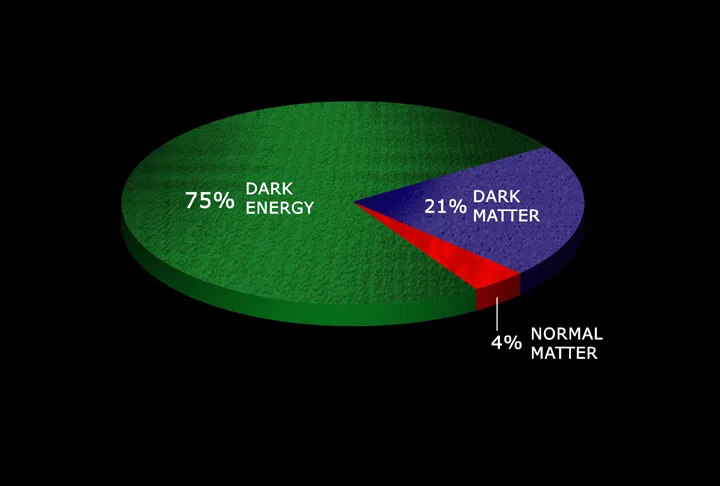
Dark energy is the name given to the unknown cause of the universe's accelerating expansion. Together, dark matter (roughly 27% of the universe's total mass-energy content) and dark energy (roughly 68%) constitute approximately 95% of the cosmos.
Everything you have ever seen - every star, galaxy, planet, and atom of ordinary matter - makes up less than 5% of what exists.
Neither has been directly detected. Neither is understood at a fundamental level. Both are among the most significant open problems in all of science. This is not a statement about the limits of measurement technology or the patience of scientists.
Both dark matter and dark energy have been studied intensively for decades with the most sophisticated instruments ever built. The evidence for their existence is overwhelming. What they actually are remains unknown.
That situation - overwhelming evidence for the existence of something combined with complete ignorance of its fundamental nature - is almost unique in the history of science.
It is as if nineteenth-century chemists had proven conclusively that some invisible substance made up most of the Earth's mass but had no idea what it was made of.
The stakes are correspondingly high: understanding dark matter and dark energy would represent one of the greatest scientific achievements in human history and would almost certainly require physics beyond our current theories.
"We are like a bunch of detectives who have found overwhelming evidence that a crime was committed, but have no idea who did it." - Lisa Randall, theoretical physicist at Harvard University, Dark Matter and the Dinosaurs (2015)
The Evidence for Dark Matter
Galaxy Rotation Curves: The First Clue
The first strong evidence that something was missing from our picture of the universe came from the rotation of galaxies.
In the 1970s, astronomer Vera Rubin and instrument maker Kent Ford at the Carnegie Institution meticulously measured how stars in spiral galaxies orbit the galactic center.
According to Newtonian gravity and the visible distribution of stars and gas, the orbital velocity of stars should decrease with distance from the center - just as planets in the outer solar system orbit the Sun more slowly than inner planets.
This is called a Keplerian decline, after Johannes Kepler's laws of planetary motion.
What Rubin and Ford found was startlingly different. The rotation curves were flat: outer stars orbited at roughly the same speed as inner stars, or even slightly faster. This pattern persisted across every galaxy they measured.
Rubin published definitive results with Ford in 1980, analyzing 21 spiral galaxies and finding flat rotation curves in all of them (Rubin and Ford, 1980).
This is only possible if there is far more mass in the outer regions of galaxies than the visible stars and gas account for. The excess mass forms a roughly spherical "dark matter halo" extending far beyond the visible galaxy - in some cases, ten times farther than the visible disk.
Because this halo does not emit light at any wavelength (radio, infrared, visible, ultraviolet, X-ray, or gamma-ray), it is dark.
Rubin's measurements were replicated across thousands of galaxies by subsequent observers. The rotation curve discrepancy is one of the most robust observations in modern astrophysics.
Earlier work by Fritz Zwicky in 1933 had actually identified the same problem at a larger scale - galaxies in the Coma Cluster were moving too fast to be held together by their visible mass - but Zwicky's results were largely ignored for decades.
Gravitational Lensing
Einstein's general relativity predicted that mass curves spacetime, and therefore massive objects bend the path of light traveling near them.
This gravitational lensing effect was first confirmed during the 1919 solar eclipse (by Arthur Eddington's expedition, which made Einstein a worldwide celebrity) and has since become a precision astronomical tool.
The problem: galaxy clusters produce more lensing than their visible mass should allow. Light from distant galaxies is bent by foreground clusters at angles that require significantly more mass than is observable in stars and hot gas.
The excess follows the same distribution implied by rotation curves - a diffuse halo of invisible matter surrounding the visible galaxies.
Weak gravitational lensing surveys - statistical analyses of the slight distortion of millions of background galaxies - have mapped dark matter distributions across vast regions of the sky.
The Dark Energy Survey (DES), using the Blanco 4-meter telescope in Chile, has produced some of the most detailed dark matter maps to date, analyzing the shapes of over 100 million galaxies to infer the foreground dark matter distribution (DES Collaboration, 2022).
The Bullet Cluster: Dark Matter's Smoking Gun
The most direct and visually compelling evidence for dark matter came from the observation of the Bullet Cluster (officially designated 1E 0657-558), a pair of galaxy clusters that collided roughly 100 million years ago.
When galaxy clusters collide, different components behave differently:
- The hot gas (which makes up most of the normal matter in clusters - roughly 85% of ordinary matter is in the form of intergalactic plasma) slows down due to electromagnetic interactions, piling up between the two clusters. This hot gas is visible in X-ray observations from the Chandra Space Telescope.
- The individual galaxies, which are so sparsely distributed that they rarely physically collide with each other, mostly pass through freely.
- The dark matter halos, which interact only gravitationally, also pass through each other freely.
By mapping both the visible matter (hot gas, via X-ray emission) and the total gravitational mass (via gravitational lensing), astronomer Douglas Clowe and colleagues published a landmark 2006 paper showing something remarkable: the gravitational mass was not located where the hot gas was.
It was located where the galaxies were - ahead of the gas, on the other side of the collision. The mass that was passing through without slowing down was the dark matter halo associated with each cluster.
"A direct empirical proof of the existence of dark matter." - Title of Clowe et al., 2006, The Astrophysical Journal Letters
This observation dealt a serious blow to alternative explanations like modified gravity theories that attempt to explain the rotation curve anomalies without invoking new matter.
In the Bullet Cluster, the gravitational mass is physically separated from the visible mass - something that modified gravity cannot easily explain, because gravity should follow matter, and the visible matter is in a different place than the gravitational center.
The Cosmic Microwave Background
The cosmic microwave background (CMB) - the residual radiation from the Big Bang, first detected by Arno Penzias and Robert Wilson in 1965 (for which they received the 1978 Nobel Prize) - provides another independent line of evidence.
The CMB contains tiny temperature fluctuations (on the order of one part in 100,000) that encode the density distribution of the early universe approximately 380,000 years after the Big Bang. The pattern of these fluctuations - their size, spacing, and relative amplitudes - is exquisitely sensitive to the composition of the universe.
The Planck space telescope (European Space Agency, 2009-2013) measured these fluctuations with unprecedented precision and determined that the data are best fit by a universe containing approximately 5% ordinary matter, 27% dark matter, and 68% dark energy (Planck Collaboration, 2018).
This is a completely independent measurement from galaxy rotation curves and gravitational lensing, and it agrees remarkably well - a powerful confirmation.
Large-Scale Structure
When cosmologists run simulations of how the universe evolved from the smooth near-uniformity of the Big Bang to the current cosmic web of filaments, walls, and voids, ordinary matter alone does not produce the right structure on the right timeline.
Dark matter, because it does not interact electromagnetically, was able to begin clumping gravitationally much earlier than ordinary matter (which was coupled to radiation and could not collapse until the universe cooled sufficiently).
These early dark matter clumps formed the gravitational scaffolding into which ordinary matter subsequently fell, forming galaxies and clusters.
The Millennium Simulation (Springel et al., 2005) and subsequent cosmological simulations adding dark matter in the quantities implied by other observations produce a cosmic web that matches observations remarkably well - reproducing the correct distribution of galaxy clusters, filaments, voids, and the statistical properties of galaxy clustering at multiple scales.
The Cosmic Inventory
| Component | Fraction of Universe | Nature | How We Know |
|---|---|---|---|
| Dark energy | ~68% | Unknown; possibly vacuum energy | Accelerating expansion (supernovae, CMB, baryon acoustic oscillations) |
| Dark matter | ~27% | Unknown particles; gravitationally active | Rotation curves, lensing, Bullet Cluster, CMB, large-scale structure |
| Ordinary matter (total) | ~5% | Protons, neutrons, electrons | Direct observation and CMB analysis |
| Of ordinary matter: stars | ~0.5% | Everything you have ever seen in the night sky | Stellar surveys |
| Of ordinary matter: intergalactic gas | ~4% | Hot plasma in filaments and clusters | X-ray observations |
| Of ordinary matter: planets, dust, etc. | ~0.5% | Solid matter, including Earth and everything on it | Direct observation |
The smallness of the "ordinary matter" fraction - and the even smaller fraction that constitutes stars and planets - is worth sitting with. The atoms that make up every living thing, every planet, every star in every galaxy are a rounding error in the cosmic inventory.
What Dark Matter Might Be
Despite the strong evidence for dark matter's existence, its particle nature remains unknown. The leading candidates each have different properties and different experimental signatures.
WIMPs: The Long-Favored Candidate
Weakly Interacting Massive Particles (WIMPs) were for decades the most popular dark matter candidate. They are hypothetical particles with masses in the range of 1 to 1,000 times the proton mass that interact only through gravity and the weak nuclear force - not electromagnetism, which is why they are invisible.
WIMPs are appealing for two reasons. First, they arise naturally in several theoretical extensions to the Standard Model of particle physics, particularly supersymmetry (SUSY), which predicts a partner particle for every known particle.
The lightest supersymmetric particle (the neutralino) would be stable and would have exactly the right properties to be a WIMP.
Second, if WIMPs were produced thermally in the early universe, the predicted abundance matches the observed dark matter density to within an order of magnitude - a coincidence known as the "WIMP miracle" (Jungman, Kamionkowski, and Griest, 1996).
The problem: decades of increasingly sensitive direct detection experiments have failed to find WIMPs.
Underground detectors like LUX, XENON1T, PandaX, and most recently the LZ experiment at the Sanford Underground Research Facility (which published its first results in 2023) have searched for the rare collisions between WIMPs and ordinary atomic nuclei with extraordinary sensitivity.
LZ can detect interactions as rare as a few events per year in a 7-tonne liquid xenon target.
The results have been consistently null - no confirmed detections. This has ruled out large portions of the WIMP parameter space that theoretical models favored, and the supersymmetry models that predicted WIMPs have also found no support at the Large Hadron Collider despite extensive searches.
While WIMPs are not ruled out entirely (lighter or more weakly interacting WIMPs remain possible), the community's confidence has shifted significantly.
Axions: The Rising Contender
Axions are extremely light hypothetical particles (roughly 10 billion to 1 trillion times lighter than electrons) originally proposed in 1977 by Roberto Peccei and Helen Quinn to solve an unrelated problem in quantum chromodynamics (QCD) called the "strong CP problem" - the puzzle of why the strong nuclear force preserves a symmetry (CP symmetry) that it has no apparent reason to preserve.
If they exist, axions would be produced abundantly in the early universe and would behave gravitationally like cold dark matter. Their extremely low mass means they would form a quantum mechanical condensate - a coherent wave-like state rather than a collection of classical point particles.
This gives axion dark matter qualitatively different behavior from WIMP dark matter at small scales, potentially explaining observed discrepancies between WIMP-based simulations and the actual distribution of dark matter in dwarf galaxies.
The Axion Dark Matter eXperiment (ADMX) at the University of Washington is the most sensitive axion search. It uses a tunable microwave cavity placed in a powerful 8 Tesla magnetic field.
If axions exist, they should occasionally convert into detectable microwave photons in the presence of this field - a process predicted by Pierre Sikivie in 1983.
ADMX has reached sensitivity levels that probe the theoretically favored axion mass range and is systematically scanning through it. As of 2024, no detection has been confirmed, but the experiment is entering the most promising parameter space.
Sterile Neutrinos
Sterile neutrinos are hypothetical heavier relatives of the known neutrinos that interact only through gravity (unlike ordinary neutrinos, which also interact through the weak force). They could be produced in the early universe through mixing with ordinary neutrinos and contribute to dark matter.
Several X-ray observations have reported an anomalous emission line at 3.5 keV from galaxy clusters and the Milky Way center, which could be the signature of sterile neutrinos decaying into ordinary neutrinos and photons. The initial detection was reported by Bulbul et al.
(2014) and independently by Boyarsky et al. (2014). However, subsequent observations have been inconsistent - some confirm the line, others do not detect it - and the signal remains contested. The KATRIN neutrino mass experiment in Germany and future X-ray telescopes may help resolve this question.
Primordial Black Holes
Before particle candidates dominated the discussion, some physicists proposed that dark matter is composed of primordial black holes (PBHs) - black holes formed from density fluctuations in the very early universe, before any stars existed. Stephen Hawking was among the first to study this possibility seriously in the 1970s.
Gravitational microlensing surveys (particularly the EROS and MACHO collaborations in the 1990s and 2000s) have constrained the mass range where PBHs could constitute all of dark matter, ruling out most possibilities from roughly 10^-7 to 30 solar masses.
However, there are windows - particularly around the asteroid-mass range (10^-16 to 10^-10 solar masses) - that remain open.
Interest in PBHs was partially revived by LIGO's detection of gravitational waves from merging black holes in 2015, some of which had masses that were unexpectedly large and potentially consistent with primordial origins.
Modified Gravity Alternatives
Some physicists propose that dark matter does not exist as a substance and instead our theory of gravity needs modification. The most developed alternative is MOND (Modified Newtonian Dynamics), proposed by Mordehai Milgrom in 1983, which modifies Newton's second law at very low accelerations (below approximately 1.2 x 10^-10 m/s^2).
MOND successfully explains galaxy rotation curves without dark matter - in fact, it predicted the rotation curves of subsequently discovered galaxies with impressive accuracy, a genuine success for the theory.
However, it fails to explain the Bullet Cluster (where gravitational mass is separated from visible mass), struggles with the large-scale structure of the universe, and cannot reproduce the CMB power spectrum without adding additional dark matter-like components.
Most physicists regard MOND as a partial empirical regularity that may point to deeper physics rather than a complete alternative to dark matter.
A more sophisticated version, TeVeS (Tensor-Vector-Scalar gravity), developed by Jacob Bekenstein in 2004, attempts to make MOND consistent with general relativity but introduces additional complexity and has its own observational challenges.
Dark Energy: The Accelerating Universe
Dark energy is conceptually distinct from dark matter. Dark matter has gravitational effects similar to ordinary matter - it clumps, it attracts, it slows cosmic expansion. Dark energy has the opposite effect: it accelerates expansion.
The Discovery That Changed Cosmology
In 1998, two independent teams studying Type Ia supernovae - stellar explosions that occur when white dwarf stars exceed a critical mass threshold, producing explosions of remarkably consistent peak brightness that serve as "standard candles" for measuring cosmic distances - published results that shocked the physics community.
The Supernova Cosmology Project led by Saul Perlmutter (Lawrence Berkeley National Laboratory) and the High-z Supernova Search Team led by Brian Schmidt (Australian National University) and Adam Riess (Johns Hopkins University) independently found that distant supernovae were dimmer than expected.
They were farther away than they should be if the universe's expansion were slowing down under the influence of gravity, as everyone had assumed.
The universe was not just expanding. It was expanding faster over time.
For this discovery, Perlmutter, Schmidt, and Riess shared the 2011 Nobel Prize in Physics. The Nobel committee called it "a discovery that changed our understanding of the universe."
The finding required a repulsive force operating at cosmological scales - something that counteracts gravity and accelerates the expansion of space itself. This mysterious force was named dark energy.
The Cosmological Constant
The leading explanation for dark energy is Einstein's cosmological constant (denoted by the Greek letter lambda, $\Lambda$), a term he originally introduced in his general relativity equations in 1917 to produce a static universe (then the prevailing scientific view) and famously retracted when Edwin Hubble discovered that the universe was expanding.
Einstein reportedly called the cosmological constant his "greatest blunder."
The cosmological constant represents the energy density of empty space itself - called vacuum energy.
In this interpretation, space is not truly empty but has an intrinsic energy that produces a repulsive gravitational effect that increases as the universe expands (because there is more space, and each unit of space has the same energy density).
Quantum field theory independently predicts that empty space should have a non-zero energy density due to quantum fluctuations - virtual particles constantly popping into and out of existence.
The problem is breathtaking in its magnitude: the theoretical prediction for vacuum energy is off from the observed dark energy density by a factor of approximately 10^120 - one followed by 120 zeros.
This is the cosmological constant problem and is widely considered the worst prediction discrepancy in all of physics.
Either the vacuum energy exists but is nearly perfectly cancelled by some unknown mechanism, leaving only a tiny residual (which is what we observe), or dark energy is something else entirely. No one knows which is correct, and resolving this discrepancy is one of the deepest unsolved problems in theoretical physics.
Alternative Dark Energy Models
Quintessence models propose that dark energy is not a constant but a dynamic scalar field (analogous to the Higgs field) whose energy density changes over time. If dark energy's strength varies, this could potentially be detected by precise measurements of how the expansion rate has changed through cosmic history.
Current data from supernovae, the CMB, and baryon acoustic oscillations (BAO - a characteristic clustering scale in the distribution of galaxies that serves as a "standard ruler" for measuring cosmic expansion) are consistent with a constant dark energy density, but measurement precision is not yet sufficient to rule out slowly varying models.
The Euclid space telescope, launched by the European Space Agency in July 2023, is designed to map the geometry of the universe with sufficient precision to distinguish between dark energy models by surveying 1.5 billion galaxies over roughly one-third of the sky during its six-year mission.
The Vera C. Rubin Observatory (formerly LSST), expected to begin full operations in Chile by 2025, will conduct a complementary survey from the ground. Together, these instruments represent the most ambitious observational campaign ever directed at the dark energy problem.
The Dark Energy Spectroscopic Instrument (DESI), operating on the Mayall 4-meter telescope in Arizona, released its first-year results in 2024, providing the most precise measurements of baryon acoustic oscillations to date.
Intriguingly, DESI data showed mild hints that dark energy might be evolving over time - not at a statistically definitive level, but enough to generate significant excitement and motivate further observation.
Why Dark Matter and Dark Energy Matter Beyond Physics
It is easy to treat dark matter and dark energy as exotic concerns relevant only to cosmologists. The implications are broader and more profound.
Dark matter made life possible. Without dark matter acting as gravitational scaffolding in the early universe, ordinary matter would not have clumped fast enough to form the first galaxies and stars within the universe's 13.8-billion-year history.
The first stars - which forged the carbon, oxygen, nitrogen, and iron that make up living organisms through nuclear fusion in their cores and supernova explosions - required dense environments created by dark matter halos.
In a literal physical sense, dark matter is a precondition for the existence of anything complex enough to ask questions about it.
They point to physics beyond the Standard Model. The Standard Model of particle physics is extraordinarily successful - it has predicted the outcomes of thousands of experiments with remarkable precision, including the 2012 discovery of the Higgs boson at the LHC.
But it has no candidate for dark matter and offers no mechanism for dark energy. The existence of both tells us that our current description of fundamental reality is incomplete in a profound way. The solution, whatever it is, will require new physics.
The detection problem is a scientific challenge of unusual difficulty. Decades of increasingly sophisticated experiments have failed to identify dark matter's particle nature.
This either means we have been searching in the wrong places (wrong mass range, wrong interaction strength) or that dark matter interacts with ordinary matter so weakly that it may take much longer to detect directly.
The latter possibility has prompted serious discussion among physicists about how to maintain scientific progress on a problem where the answer may be decades away - a challenge of patience and strategy as much as technology.
The Current State of Research (2024-2025)
Progress is being made across several fronts, with some of the most powerful instruments ever built now coming online:
Direct detection: The LZ experiment at the Sanford Underground Research Facility published its first major results in 2023, placing the most stringent limits yet on WIMP interactions in the 10-1,000 GeV mass range.
The next-generation DARWIN/XLZD experiment, planned for the late 2020s, will push sensitivity to the "neutrino fog" - the point where neutrino interactions become an irreducible background.
Axion searches: ADMX continues scanning through the theoretically favored axion mass range with increasing sensitivity. The CAPP experiment in South Korea and several European initiatives are exploring complementary mass ranges.
Indirect detection: The Fermi Gamma-ray Space Telescope continues searching for the gamma-ray signature of dark matter particles annihilating in dense regions (the galactic center, dwarf galaxies).
An intriguing excess of gamma rays from the galactic center has been debated for over a decade - it could be dark matter annihilation or it could be a population of unresolved millisecond pulsars.
Collider searches: The Large Hadron Collider has searched for dark matter production in proton collisions. No evidence has been found, but the LHC's high-luminosity upgrade (HL-LHC, expected 2029) will significantly expand the search reach.
Cosmic surveys: DESI, Euclid, and the Vera C. Rubin Observatory are mapping the universe's structure with unprecedented precision to constrain both dark matter and dark energy models. The Simons Observatory in Chile will provide the next major leap in CMB measurements.
Gravitational wave astronomy: LIGO, Virgo, and KAGRA continue detecting black hole and neutron star mergers. Future space-based detectors like LISA (launch expected ~2035) will open entirely new frequency ranges, potentially constraining primordial black hole abundance and probing the early universe.
The honest scientific consensus is that we do not know what dark matter is. The search is narrowing the possibilities but has not yet found the answer. Given that dark matter makes up 27% of the universe, this is a remarkable state of affairs.
Summary
Dark matter and dark energy together constitute 95% of the universe, yet neither has been identified at a fundamental level.
Dark matter's existence is supported by multiple independent lines of evidence - galaxy rotation curves, gravitational lensing, the Bullet Cluster, the cosmic microwave background, and large-scale structure simulations - but its particle identity remains unknown despite decades of searching with increasingly powerful instruments.
Dark energy is even more mysterious: a force accelerating cosmic expansion whose theoretical description requires accepting either an extraordinary fine-tuning coincidence in the cancellation of vacuum energy or entirely new physics not yet conceived.
These are not peripheral curiosities. They are central to the structure of the cosmos, the conditions for complex chemistry and life, and the completeness of our deepest theories of nature.
Understanding them is among the most significant open problems in science - and the answers, when they come, will reshape our picture of how the physical universe works at the most fundamental level.
Sources & Further Reading
- Rubin, V. C. and Ford, W. K. Jr. (1980). Rotation of the Andromeda Nebula from a Spectroscopic Survey of Emission Regions. The Astrophysical Journal, 159, 379.
- Zwicky, F. (1933). Die Rotverschiebung von extragalaktischen Nebeln. Helvetica Physica Acta, 6, 110-127.
- Clowe, D. et al. (2006). A Direct Empirical Proof of the Existence of Dark Matter. The Astrophysical Journal Letters, 648, L109-L113.
- Planck Collaboration. (2018). Planck 2018 Results. VI. Cosmological Parameters. Astronomy & Astrophysics, 641, A6.
- Perlmutter, S. et al. (1999). Measurements of Omega and Lambda from 42 High-Redshift Supernovae. The Astrophysical Journal, 517, 565-586.
- Riess, A. G. et al. (1998). Observational Evidence from Supernovae for an Accelerating Universe and a Cosmological Constant. The Astronomical Journal, 116, 1009-1038.
- Jungman, G., Kamionkowski, M., and Griest, K. (1996). Supersymmetric Dark Matter. Physics Reports, 267, 195-373.
- Milgrom, M. (1983). A Modification of the Newtonian Dynamics as a Possible Alternative to the Hidden Mass Hypothesis. The Astrophysical Journal, 270, 365-370.
- Peccei, R. D. and Quinn, H. R. (1977). CP Conservation in the Presence of Pseudoparticles. Physical Review Letters, 38, 1440-1443.
- Bulbul, E. et al. (2014). Detection of an Unidentified Emission Line in the Stacked X-ray Spectrum of Galaxy Clusters. The Astrophysical Journal, 789, 13.
- Springel, V. et al. (2005). Simulations of the Formation, Evolution and Clustering of Galaxies and Quasars. Nature, 435, 629-636.
- Randall, L. (2015). Dark Matter and the Dinosaurs. Ecco/HarperCollins.
- DESI Collaboration. (2024). DESI 2024 First Year Results: Baryon Acoustic Oscillations. arXiv preprint.
- LZ Collaboration. (2023). First Dark Matter Search Results from the LUX-ZEPLIN Experiment. Physical Review Letters, 131, 041002.
- Carroll, S. (2012). The Particle at the End of the Universe. Dutton/Penguin.
- Bertone, G. and Hooper, D. (2018). History of Dark Matter. Reviews of Modern Physics, 90, 045002.
- Weinberg, S. (1989). The Cosmological Constant Problem. Reviews of Modern Physics, 61, 1-23.
- European Space Agency. (2023). Euclid Mission Overview. View source